Understanding Criminal Laws in India: Types, Punishments & Procedures
Criminal Laws in India | New Criminal Laws in India

Anuj Anand Malik
Reviewed by AMA Legal Solutions
.webp?alt=media&token=118608fc-f1be-40e6-b962-64953d258424)
Criminal laws in India form the backbone of justice and public safety. These laws define what constitutes a crime, outline the procedures for investigating crimes, and determine the punishments for offenders. With over 1.6k monthly searches in India, the topic "criminal laws in India" reflects the widespread public interest and the need for accessible legal awareness.
In 2023, significant reforms reshaped the Indian criminal law landscape, introducing new statutes and replacing colonial-era laws. This transition marks a major milestone in India’s legal system and calls for an in-depth understanding. In this blog, we will explain the types of criminal laws, new criminal laws in India, their importance, key stages of a criminal case, and more.
Whether you’re a law student, a legal professional, or a curious citizen, this guide will help you navigate the criminal legal framework effectively.
What Are Criminal Laws in India?
Criminal laws in India refer to a set of legal rules established to maintain public order, protect individual rights, and punish wrongdoers. These laws determine what actions are considered criminal and outline the procedures for dealing with them.
Primary Components of Criminal Law:
Substantive Law: Defines crimes and prescribes punishments (e.g., IPC – now replaced).
Procedural Law: Outlines the process of criminal investigation and trial (e.g., CrPC – now replaced).
Criminal laws in India are governed by statutes passed by the Parliament and interpreted by Indian courts. They ensure accountability and justice in society.
As per reports, India sees over 29,000 cases of crimes against women every year, indicating the urgent need for effective criminal laws.
Why Is Criminal Law Important in India?
Criminal law ensures justice, safety, and order. Its importance includes:
Deterrence: Prevents individuals from committing crimes.
Retribution: Ensures punishment for wrongdoing.
Rehabilitation: Aims to reform offenders.
Protection of Society: Shields citizens from criminal acts.
In a diverse country like India, criminal laws play a crucial role in managing civil harmony and upholding constitutional values.
Types of Criminal Laws in India
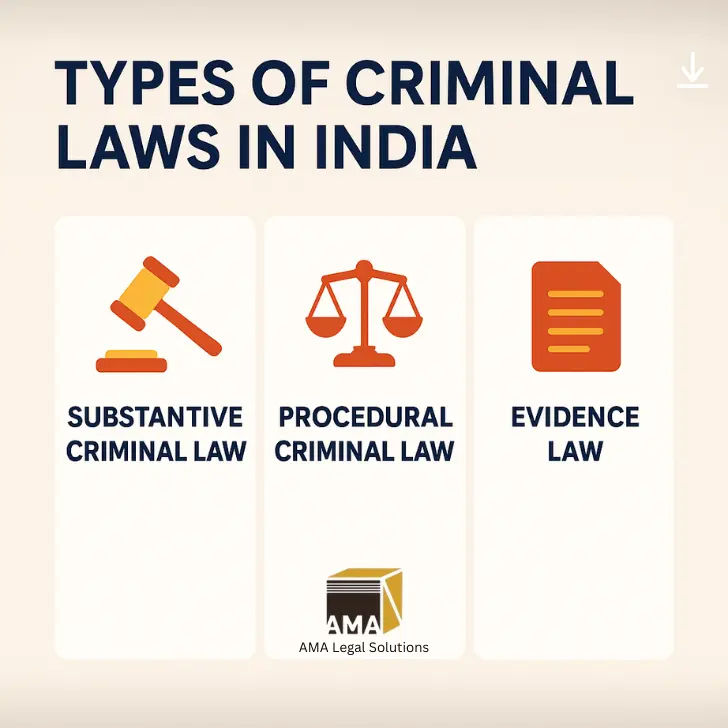
There are three major types of criminal laws in India:
1. Substantive Criminal Law:
This law defines offenses and prescribes punishments.
Example: Bharatiya Nyaya Sanhita (BNS), 2023
2. Procedural Criminal Law:
Provides the process for arrest, trial, evidence, and appeal.
Example: Bharatiya Nagarik Suraksha Sanhita (BNSS), 2023
3. Evidence Law:
Governs the admissibility of evidence in court.
Example: Bharatiya Sakshya Adhiniyam (BSA), 2023
What Are the New Criminal Laws in India?
In 2023, India introduced three new criminal laws replacing the British-era IPC, CrPC, and Indian Evidence Act:
Bharatiya Nyaya Sanhita (BNS), 2023 – Replaces IPC
Focus on victim rights and community service.
New crimes like mob lynching added.
Bharatiya Nagarik Suraksha Sanhita (BNSS), 2023 – Replaces CrPC
Digital filing of FIRs, forensic investigation mandatory for serious crimes.
Bharatiya Sakshya Adhiniyam (BSA), 2023 – Replaces Indian Evidence Act
Digital evidence recognition.
Over 55% of criminal cases are delayed due to outdated procedures—this reform aims to reduce pendency.

Halt Recovery Agent Harassment Legally
Key Stages of a Criminal Case in India
Understanding the process of a criminal case is essential:
Filing of FIR
Investigation by police
Filing of chargesheet
Framing of charges by court
Trial begins
Examination of witnesses and evidence
Judgment
Appeal (if applicable)
Major Criminal Laws in India
Here is a list of criminal acts in India (some now replaced):
Indian Penal Code (IPC), 1860 – Replaced by BNS, 2023
Code of Criminal Procedure (CrPC), 1973 – Replaced by BNSS, 2023
Indian Evidence Act, 1872 – Replaced by BSA, 2023
NDPS Act, 1985 – Drug-related offenses
Prevention of Corruption Act, 1988
POSCO Act, 2012 – Protection of Children
IT Act, 2000 – Cybercrimes
These laws cover a broad spectrum of criminal behavior in India.
The new criminal laws in India reflect a modern, victim-focused, and digital approach to justice.
What Are the Punishments Under Criminal Law?
Punishments under criminal laws in India vary based on the severity of the crime:
Capital Punishment: For rarest of rare cases (e.g., terrorism, brutal rape)
Life Imprisonment: For murder, rape, etc.
Rigorous/Simple Imprisonment: For theft, assault, etc.
Fines/Penalties: For minor offenses
Community Service: Introduced under BNS, 2023
These punishments aim to balance justice, deterrence, and reform.
Conclusion
Understanding criminal laws in India is crucial for every citizen. With the advent of the new criminal laws in India—BNS, BNSS, and BSA—the justice system is undergoing a transformative shift aimed at efficiency and victim empowerment. From digital FIRs to community service and fast-tracked trials, the reform addresses longstanding gaps in the system.
At AMA Legal Solutions, we are committed to simplifying legal knowledge for everyone. Whether you’re facing a legal challenge or just want to learn more, our expert team is here to help.
Relevant Stat: According to NCRB, India has a conviction rate of only 57% in criminal cases—the new reforms aim to improve this drastically.
📽️ Watch Our Explainer Video: Intro to Indian Criminal Laws - AMA Legal Solutions
📞 Schedule a Free Consultation: Book Now with AMA Legal Solutions
Need Strategic Legal Defense for Your Situation?
Our banking & litigation advocates review your notices, debt liability, and recovery issues under complete advocate-client secrecy.

AMA Legal Solutions
Trusted with a 4.7 Google Rating, over 10,000+ Clients Served, 25,000+ Cases Handled, and more than 40+ Years of Experience in providing strategic legal defense and debt resolution across India.
Our media coverages





Frequently Asked Questions
Related Articles

RuPay Credit Card on UPI Default & Credit Line on UPI Settlement (2026)
Micro-transactions on RuPay UPI Credit Cards and pre-approved 'Credit Lines on UPI' have triggered a massive wave of 42%+ APR revolving debt traps. Find out if defaulting blocks your personal savings UPI and how to settle RuPay UPI credit dues for 30%–50%.
Read Article
Paytm, PhonePe & BharatPe Daily EDI Merchant Loan Settlement (2026)
Drowning in Equated Daily Installment (EDI) merchant loans where 100% of your daily QR Soundbox collections are auto-swept before you can pay suppliers or rent? Learn how retail shopkeepers and MSMEs legally halt QR sweeps and negotiate a 50%+ OTS.
Read Article
Can Bank or Loan App Remotely Lock Phone for EMI Default? RBI Rules (2026)
An investigative breakdown of RBI's Remote Device Locking Directions—explaining why lenders cannot lock your phone for personal loans, the mandatory 30/60 DPD safeguards on financed devices, the Rs. 250/hour delay penalty, and how to settle device & app loans.
Read ArticleAbout Author
Anuj Anand Malik
View ProfileAnuj Anand Malik, Founder of AMA Legal Solutions, is a trusted advocate, loan settlement expert, legal advisor, and banking lawyer. With over a decade of experience in loan settlement, corporate law, financial disputes, and compliance, he leads a result-driven law firm based in India that helps individuals, startups, and businesses achieve legal and financial stability.
Connect on LinkedInNeed Legal Representation?
Evaluate your defense against recovery agents, notices, or structure your loan settlement directly with Senior Advocates.
Call +91-8700343611