Can I Register My Trademark By Myself? The Honest DIY Guide
DIY trademark registration | trademark filing guide 2026 | self-file trademark risks | TEAS Plus vs Standard | trademark cost breakdown

Anuj Anand Malik
Reviewed by AMA Legal Solutions
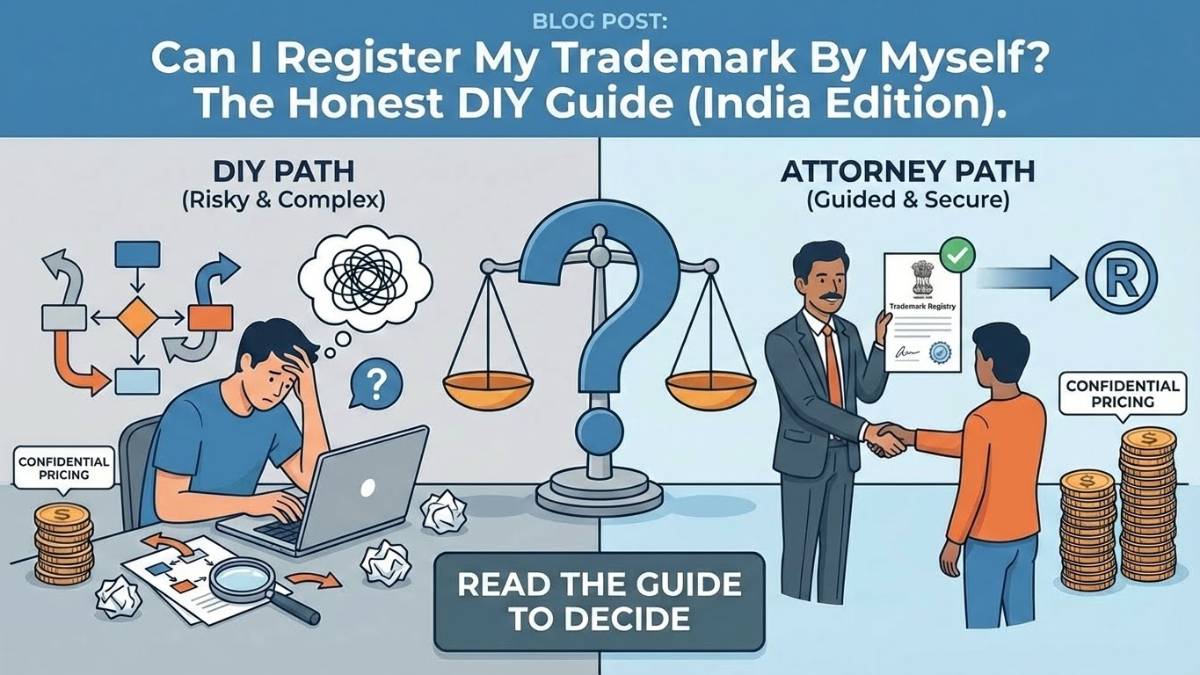
Can you register a trademark by yourself? The short answer is yes. The USPTO (United States Patent and Trademark Office) does not require you to hire an attorney if you live in the United States. You can log into their website, fill out the forms, pay the fee, and hit submit.
But asking "Can I?" is the wrong question. The better question is "Should I?"
Trademark law is not like filing for a driver's license. It is an adversarial legal process. When you file an application, you are effectively asking the government to grant you a monopoly on a word, phrase, or logo. The government employs attorneys whose sole job is to find reasons to say no. If you make a mistake in your application, you often cannot fix it. You lose your filing fee and have to start over.
This guide will walk you through the DIY process, the hidden traps that catch 50% of self-filers, and how to decide if you are ready to go it alone.
Phase 1: The Prep Work (Where Most People Fail)
Most people start by designing a logo. That is a mistake. Before you draw a single line or fill out a single form, you have to ensure the name is actually available.
1. The "Knockout" Search
A simple Google search is not enough. You need to search the USPTO database (TESS) to see if anyone has registered a mark that is confusingly similar to yours. Note the phrase "confusingly similar." It does not mean "identical."
If you want to register "Delta Plumbing" and someone else owns "Delta Pipes," your application will likely be rejected. The government cares about whether a consumer would be confused, not whether the spelling is exact.
2. The Distinctiveness Test
Not all names can be trademarked. If your name is "The Best Pizza Shop," you will be rejected immediately. That is considered "descriptive" or "generic." You cannot own the words that describe what you sell, because that would stop other pizza shops from describing their food.
To pass, your mark needs to be:
Arbitrary: A real word used in an unrelated context (e.g., Apple for computers).
Fanciful: A made-up word (e.g., Kodak, Exxon).
Suggestive: Hints at the product without describing it (e.g., Netflix).
Phase 2: The Filing Process
If you have cleared your name, you are ready to file. Here is the step-by-step workflow for the DIY filer.
Step 1: Choose Your Application Type
The USPTO offers two main options:
TEAS Plus: This is cheaper (around $250 per class) but stricter. You must choose your goods/services from a pre-approved list. This is the best option for DIYers because it reduces the chance of making a technical error.
TEAS Standard: This is more expensive (around $350 per class) but allows you to write your own descriptions. Avoid this unless you have a very unique product that does not fit standard categories.
Step 2: Select Your Class
Trademarks are organized into 45 different "classes" of goods and services. If you sell t-shirts, you are in Class 25. If you sell coffee beans, you are in Class 30.
The Trap: You only get protection in the classes you pay for. If you register your name for a podcast (Class 41) but later decide to sell merch, your podcast trademark does not protect your t-shirts. You would need to file a new application.
Step 3: Provide a Specimen
You must prove you are actually using the mark in commerce. You will need to upload a photo (a "specimen") of your product with the mark on it.
For Products: A photo of the label, tag, or the box itself. A mock-up or a digital rendering is not allowed and will get you rejected.
For Services: A screenshot of your website showing the mark near the "Order Now" or "Contact Us" button.
Phase 3: The Wait and The Fight
Once you hit submit, you wait. It currently takes about 6 to 8 months for an examining attorney to even look at your file.
When they do, one of two things happens:
Approval: Your mark is published for opposition. If no one complains for 30 days, you are registered.
Office Action: The attorney finds a problem. They send you a letter (an Office Action) explaining why you are rejected. You have 3 months to write a legal argument convincing them they are wrong.
This is where DIY fails. Responding to an Office Action requires citing case law and legal precedent. It is difficult for a non-lawyer to win these arguments.
The Cost Breakdown: DIY vs. Attorney (India Context)
Item | DIY Cost | Attorney Cost |
Search | ₹0 (IP India Public Search) | ₹500 – ₹5,000 |
Filing Fee (Govt.)* | ₹4,500 – ₹9,000 | ₹4,500 – ₹9,000 |
Legal / Professional Fee | ₹0 | ₹2,000 – ₹15,000 |
Risk of Rejection/Objection | ~50% (High risk of objection) | ~10–15% |
Total Estimated | ₹4,500 – ₹9,000 | ₹7,000 – ₹29,000 |

AMA Legal Solutions
Trusted with a 4.7 Google Rating, over 10,000+ Clients Served, 25,000+ Cases Handled, and more than 40+ Years of Experience in providing strategic legal defense and debt resolution across India.
Our media coverages





Client Reviews
""I tried to file my own trademark for my coffee shop. I missed a similar name in a slightly different category and lost my $250 fee plus six months of waiting. Next time, I'm hiring a pro." - Anupam Tyagi, Small Business Owner"
Anupam Tyagi
"The guide on distinctiveness was a lifesaver. I almost tried to register a descriptive name that would have been rejected instantly. Switched to a 'fanciful' name and sailed through!" - Romila Udkan, Software Developer"
Romila Udkan
Frequently Asked Questions
Related Articles

How to Trust Law Associates for Loan Settlement
Ensure Successful Loan Settlement with Trusted Legal Experts
Read Article
Expert Loan Settlement Lawyer: Minimize Amount, Maximize Waiver
Unlocking the Secrets to Successful Loan Settlements in India
Read Article
Mastering Loan Settlement of Personal Loan by Bajaj Finance
Navigate Bajaj Finance Loan Settlements with Expert Legal Insights
Read ArticleAbout Author
Anuj Anand Malik
View ProfileAnuj Anand Malik, Founder of AMA Legal Solutions, is a trusted advocate, loan settlement expert, legal advisor, and banking lawyer. With over a decade of experience in loan settlement, corporate law, financial disputes, and compliance, he leads a result-driven law firm based in India that helps individuals, startups, and businesses achieve legal and financial stability.
Connect on LinkedInNeed Legal Help?
Get expert advice on loan settlement and debt relief.
Call +91-8700343611Request Callback