
To check if a debt settlement letter is fake or real, a borrower must verify seven mandatory legal essentials: the letter must be issued directly on official bank corporate letterhead rather than an outsourced recovery agency stationary, feature a verifiable Core Banking Solution (CBS) internal reference number, be signed by an authorized bank officer with verifiable employee credentials, direct payment exclusively into the borrower designated loan account rather than third-party or personal UPI accounts, explicitly state full and final discharge under Section 63 of the Indian Contract Act, 1872, commit to quashing Section 138 and Section 25 criminal litigation, and specify a binding timeline for the issuance of an unconditional No Dues Certificate. Any compromise document lacking official banking domain email authentication or demanding cash handover to recovery agents is fraudulent under the Indian Penal Code.
The Epidemic of Forged Settlement Letters in Indian Banking & Debt Recovery
In modern Indian debt recovery, distressed retail borrowers and MSME entrepreneurs facing financial distress frequently fall prey to predatory collection networks. When an account defaults and passes the 90-day non-performing asset (NPA) threshold, commercial banks and Non-Banking Financial Companies (NBFCs) often assign recovery mandates to third-party collection agencies. Driven by aggressive commission targets, unethical recovery personnel exploit borrower desperation by creating and circulating fabricated One-Time Settlement (OTS) sanction letters.
These forged documents replicate institutional typography, display copied bank logos, and offer irresistible discounts. Borrowers, believing their financial ordeal is ending, transfer substantial sums through digital payment handles or cash. Weeks later, they discover the devastating reality: the lending bank has no record of the settlement, the transferred funds were siphoned into unauthorized accounts, the loan remains active with compounding penal interest, and magistrate court summons under Section 138 of the Negotiable Instruments Act, 1881 continue unabated.
🚨 Common Modus Operandi of Fake Settlement Scams
- WhatsApp PDF Sanctions: Unofficial collection agents send low-resolution PDF sanction letters via personal WhatsApp numbers, insisting that immediate payment is required within 24 hours to prevent police arrest.
- Collection Agency Stationery: The letter is printed on the letterhead of a recovery vendor or tele-calling agency rather than the actual banking corporation.
- Spoofed & Generic Email Addresses: Correspondence arrives from free public email providers (such as Gmail, Yahoo, or Outlook) or spoofed domain names that mimic bank handles (e.g., support-hdfcsettlement.in instead of the genuine institutional domain).
- Diverted Payment Channels: The letter directs payment to an individual recovery agent bank account, an agency escrow, or a personal UPI ID, falsely claiming it is a nodal collection gateway.
Statutory Foundations of an Authentic Bank OTS Sanction Letter
A debt settlement letter is not an informal receipt or a casual assurance; it is an executive bilateral contract governed under established Indian statutory enactments and regulatory circulars of the Reserve Bank of India. For a settlement letter to possess judicial enforceability, it must satisfy three foundational legal pillars:
Section 63 of the Indian Contract Act, 1872: “Every promisee may dispense with or remit, wholly or in part, the performance of the promise made to him, or may extend the time for such performance, or may accept instead of it any satisfaction which he thinks fit.”
Under the doctrine of Accord and Satisfaction codified in Section 63, a promisee (the lending bank) is legally empowered to accept a reduced sum in total extinguishment of the contract. Once this agreement is formalized in writing by an authorized officer and the compromise sum is received, the original debt obligation is legally extinguished. Any subsequent claim by the bank for the remaining balance constitutes a breach of contract and promissory estoppel.
Reserve Bank of India Directives on Compromise Settlements
Under the Reserve Bank of India (Prudential Framework for Resolution of Stressed Assets) and the subsequent Framework for Compromise Settlements and Technical Write-offs, the central bank mandates that:
- Board-Approved Compromise Mandates: All compromise settlements must strictly adhere to the lender board-approved compromise policy, outlining delegation of financial authority and transparent eligibility criteria.
- Delegated Sanctioning Authority: A settlement sanction letter can only be signed by an officer invested with specific financial delegation (such as an Assistant General Manager, Chief Manager - Stressed Assets, or Zonal Credit Head), never an unaccredited field recovery agent.
- Section 65B Electronic Evidentiary Compliance: When settlement letters are delivered electronically via email, they must comply with Section 65B of the Indian Evidence Act, 1872 (now Bharatiya Sakshya Adhiniyam) by originating from verifiable corporate email servers with cryptographic server headers.
The 7 Essential Elements: How to Check if the Debt Settlement Letter is Fake or Real
Before remitting any compromise funds towards an alleged arrangement, every borrower and legal counsel must subject the document to rigorous forensic examination across these seven critical parameters:
1Official Bank Corporate Letterhead & Watermark
MANDATORYA valid settlement letter must be printed on the official corporate stationary of the principal lending bank or NBFC. It must feature the institution registered corporate logo, official registered office address, Corporate Identity Number (CIN), and high-resolution background watermarking. If the letter is printed on plain paper, features jagged or pixelated logos downloaded from search engines, or bears the name of an outsourced recovery vendor, it is counterfeit.
2Core Banking Solution (CBS) Internal Reference Number
VERIFIABLEEvery genuine OTS sanction generated by a banking institution is assigned a unique, system-generated tracking number (e.g., SAMB/OTS/2026-27/08492). This reference number is logged in the bank Core Banking Solution (CBS) such as Finacle or BaNCS. A borrower or their legal counsel can present this reference number at any official branch or verify it through the bank grievance portal. If a letter contains no reference number, or if branch staff state that the number does not exist in their internal intranet, the letter is a complete fabrication.
3Authorized Signatory Credentials & Banking Domain Email
INSTITUTIONALThe document must display the complete name, official employee code, branch/vertical designation, and signature stamp of an authorized bank official holding delegated financial powers. Furthermore, if the letter was delivered digitally, it must originate directly from an institutional banking domain (e.g., @icicibank.com, @sbi.co.in, @axisbank.com). Under Reserve Bank of India IT governance norms, official settlement communications sent via public domain addresses carry zero evidentiary validity and are considered unauthorized.
4Full & Final Extinguishment Clause under Section 63
LEGAL IMMUNITYThe letter must contain explicit statutory language confirming that the sanctioned compromise amount constitutes“full, final, and complete discharge of all outstanding contractual liabilities” in respect of the specified loan account. It must explicitly state that the remaining balance, penal charges, and accrued interest are irrevocably waived. If the letter ambiguous language indicating that the payment will merely be adjusted as a part-payment or that the bank reserves rights to revive the remaining debt, the document fails to provide legal settlement protection.
5Direct-to-Account Payment Mechanism (Zero Third Parties)
CRITICAL AUDITThis is the single most vital fraud detection checkpoint. A valid settlement letter will only instruct the borrower to deposit funds directly into their own active loan account number or submit a crossed Demand Draft drawn payable directly to the institutional name of the lender (e.g., “HDFC Bank Ltd - A/c No. XXXXXXXXXXXX”). Any instruction to remit funds to an agency account, third-party private company, or an individual recovery agent UPI ID is fraudulent. Under Indian banking law, payments made to third parties do not reduce CBS debt obligations.
6Compounding of Criminal Cases & Litigation Withdrawal
JUDICIAL SHIELDIf the lender has initiated legal action—such as criminal proceedings under Section 138 of the Negotiable Instruments Act, 1881 for cheque dishonour, Section 25 of the Payment and Settlement Systems Act, 2007 for NACH mandate failure, or civil arbitration under the Arbitration and Conciliation Act, 1996—the settlement letter must contain an unambiguous covenant obligating the lender to file applications for compounding of offenses and withdraw all pending judicial petitions upon receipt of funds.
7Mandatory Delivery Timeline for No Dues Certificate (NDC) & CIBIL Update
FINAL CLOSUREA genuine sanction letter specifies an exact timeframe (typically 15 to 30 calendar days from payment clearance) within which the bank will issue an unconditional No Dues Certificate (NDC) and return any undrawn security cheques or collateral documents. Additionally, the letter must formally confirm that the lending institution will report the loan status as “Settled” to all four RBI-registered credit bureaus (CIBIL, Experian, Equifax, and CRIF High Mark) in accordance with the Credit Information Companies (Regulation) Act, 2005.
Commercial Realities: Advocate-Led Verification vs. Free DIY Templates vs. Corporate Retainers
When evaluating whether a settlement letter is legitimate, borrowers are caught between risky shortcuts and unaffordable traditional legal avenues. Understanding the comparative strengths and structural vulnerabilities of each option is vital for securing genuine debt relief without financial exploitation.
⚠️ The Dangerous Illusion of Free DIY Online Templates
Automated online settlement letter generators and free downloaded samples cannot verify the authenticity of a bank sanction. Generic templates provide zero ability to audit Core Banking Solution internal references, cannot interface with bank zonal stressed asset committees, and have no legal standing under the Advocates Act, 1961. Relying on an automated form generator leaves borrowers completely defenseless when rogue collection agents issue forged letters.
⚖️ The Prohibitive Burden of Corporate Law Firm Retainers
Traditional corporate law firms operate on open-ended hourly billing schedules and demand substantial upfront retainers. For distressed individuals or small business owners already facing severe liquidity shortages, these corporate legal fee structures create additional financial anxiety. Borrowers require cost predictability, rapid document authentication, and senior advocate representation without recurring billing shocks.
Institutional Comparison: Settlement Letter Vetting & Legal Protection
| Legal Feature & Capability | Free DIY Online Templates | Unregulated Recovery Apps | Corporate Law Firms | AMA Legal Solutions |
|---|---|---|---|---|
| Forensic CBS Sanction Audit | Zero Capability | No Banking Access | Institutional Audit | Direct Stressed Asset Verification |
| Court Standing (Advocates Act) | Zero Standing | No Legal Standing | Full Court Standing | Full Court Standing (Vakalatnama) |
| Advocate-Client Privilege (Sec 126) | None | None (Exposed Data) | Privileged | Strict Statutory Privilege |
| Section 138 & 25 Compounding | Incapable of Defense | Cannot Represent | Compounding Petitions | Judicial Compounding & Quashing |
| Commercial Advisory Structure | Unverified / Unregulated | Monthly Subscriptions | Hourly Rates & High Retainers | Transparent Fixed Legal Advisory |
| No Dues Certificate Enforcement | High Risk of Fake Letters | Administrative Only | Legal Follow-up | Advocate-Enforced Bank Delivery |
AMA Legal Solutions fills this critical commercial void. We provide accessible, transparent, fixed legal advisory without hourly markups or surprise retainers. Distressed borrowers receive senior advocate document verification, institutional bank liaison, and magistrate court litigation defense with absolute cost transparency.
The 5-Step Forensic Legal Verification Protocol
When a borrower presents a purported debt settlement letter to our legal team, we implement an uncompromising five-step forensic verification protocol before any funds are released:
Corporate Domain & Electronic Header Authentication
We verify that the digital document originated from an authenticated corporate email server belonging to the bank, evaluating cryptographic DKIM, SPF, and DMARC mail headers to rule out address spoofing or intermediate tampering.
Core Banking Solution (CBS) Internal Sanction Audit
Our advocates interface directly with the designated branch manager and zonal stressed assets department to cross-reference the unique sanction reference number against the bank live CBS database, confirming that the approval is officially recorded.
Signatory Power of Attorney & Delegation Vetting
We verify that the signing officer possesses legitimate delegation of powers under the bank board-approved compromise policy and that their employee credentials match internal banking directories.
Statutory Clause Scrutiny & Section 138 Compounding Enforcement
We scrutinize the contractual clauses to ensure absolute debt extinguishment under Section 63 of the Indian Contract Act, incorporating explicit commitments for the compounding and withdrawal of all pending Section 138 NI Act and Section 25 PSSA court cases.
Supervised Direct Account Payment & NDC Delivery
Payment is executed strictly into the designated loan master account via traceable banking instruments. Following clearance, we enforce the statutory delivery of an unconditional bank No Dues Certificate and verify updated reporting across credit bureaus.
Forensic Verification Architecture: Fake vs Real Debt Settlement Letters
Comprehensive checklist of essential security markers mandated under Indian banking law and RBI compromise guidelines.
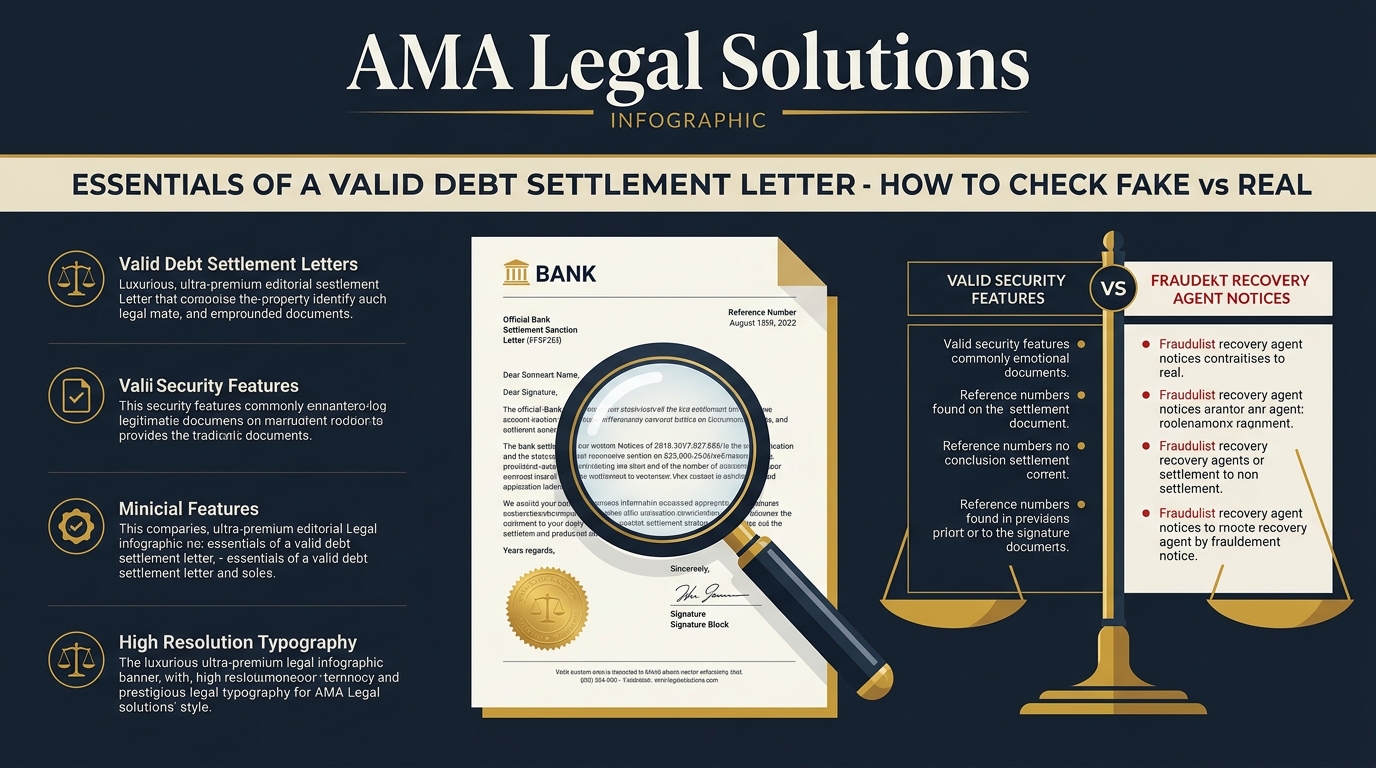
Statutory Note: Under Section 63 of the Indian Contract Act, 1872 and RBI Master Directions, only institutional bank sanction letters with verifiable CBS tracking numbers provide permanent legal extinguishment of debt.
Catastrophic Risks of Paying on a Fake Settlement Letter
Transferring funds pursuant to a counterfeit debt settlement letter causes catastrophic financial and judicial damage. Because the transaction occurs outside the bank Core Banking Solution parameters, the legal fallout is severe:
❌ Continued Liability & Loss of Funds
Monies paid to an unauthorized recovery agent or third-party account are treated as zero payment by the lending bank. The principal loan balance remains completely unpaid, interest compounds daily, and the borrower loses their hard-earned money.
❌ Ongoing Section 138 Criminal Prosecution
Because the bank legal vertical never sanctioned the compromise, pending criminal cases under Section 138 of the Negotiable Instruments Act or Section 25 of the Payment and Settlement Systems Act proceed unabated, resulting in bailable or non-bailable warrants.
❌ Permanent Credit Bureau Damage (CIBIL Write-Off)
Without a legitimate settlement agreement logged on the bank CBS, the account is eventually flagged as “Written Off” or “Suit Filed” across CIBIL, Experian, and Equifax, destroying creditworthiness for up to seven years.
❌ Forfeiture of Genuine OTS Eligibility
Lenders may interpret unauthorized third-party arrangements as deliberate evasion, leading the bank compromise committee to revoke future settlement concessions and initiate immediate asset attachment or salary garnishee proceedings.
Criminal & RBI Statutory Remedies Against Fraudulent Recovery Agents
Indian law provides potent criminal and regulatory remedies against recovery personnel and agencies that fabricate settlement documents. When our advocates uncover a forged settlement notice, we initiate swift statutory countermeasures:
⚖️ First Information Report (FIR) under Indian Penal Code / BNS
We draft and lodge criminal complaints before the police authorities for registration of an FIR under Section 420 (Cheating),Section 468 (Forgery for purpose of cheating), Section 471 (Using as genuine a forged document), andSection 384 (Extortion) of the Indian Penal Code (or corresponding sections under the Bharatiya Nyaya Sanhita).
🏛️ Escalation under the RBI Integrated Ombudsman Scheme, 2021
Under the Reserve Bank of India Master Direction on Managing Risks in Outsourcing of Financial Services, principal lenders bear vicarious liability for the unlawful actions of contracted recovery agencies. We submit formal petitions before the Banking Ombudsman to enforce immediate penalty sanctions and secure institutional debt resolution.
💻 National Cyber Crime Reporting Portal Filing
Where forged letters are circulated via WhatsApp, spoofed emails, or fake payment links, we report the digital identifiers and fraudulent UPI IDs to the National Cyber Crime Reporting Portal (cybercrime.gov.in) to trigger bank account freezing and telecommunication blacklisting.
Frequently Asked Questions on Checking Debt Settlement Letters
Review clear statutory answers to the most urgent questions regarding the verification and legal enforceability of bank One-Time Settlement letters in India:
More Legal Debt Relief & Settlement Guides
Explore our authoritative statutory guides on debt settlement, recovery defense, and credit score rehabilitation:
Debt Settlement Letter Format & Negotiation →
Statutory proposal drafting, bank negotiation, and RBI OTS framework.
What is Debt Settlement? →
Statutory meaning, RBI OTS directives, and borrower rights in India.
Debt Settlement Kya Hota Hai? →
Complete legal process, RBI OTS rules, and advocate advisory.
Best Debt Settlement Service in India →
Advocate-led compromise resolution and institutional representation.
When to Choose Debt Settlement? →
Critical signs, legal timing, and financial distress evaluation.
Best Debt Settlement Waiver →
Advocate-led OTS negotiation and maximum RBI statutory concessions.
Settlement vs Debt Consolidation →
Comparing legal liabilities, interest compounding, and credit impacts.
Settlement vs Loan Write-Off →
Balance sheet technical write-offs versus bilateral accord and satisfaction.
Stop Recovery Agent Harassment Legally →
Invoking RBI Fair Practices Code, cease-and-desist notices, and court relief.
Statutory References & Regulatory Authorities
- • Reserve Bank of India (RBI): Prudential Framework for Resolution of Stressed Assets & Compromise Settlements
- • Legislative Department of India: Section 63, Indian Contract Act, 1872 (Accord & Satisfaction)
- • eCourts Integrated Services: Negotiable Instruments Act, 1881 (Section 138 Compounding Procedures)
- • Credit Information Companies (Regulation) Act, 2005: Statutory Reporting Standards for Settled Accounts
- • National Cyber Crime Reporting Portal: Cyber Crime Reporting of Document Forgery & Financial Cheating

AMA Legal Solutions
Premier Stressed Assets, Banking Litigation & Dispute Resolution Law Chamber
Founded by Advocate Anuj Anand Malik, AMA Legal Solutions is an elite Indian legal practice dedicated to defending borrowers, entrepreneurs, and retail consumers against aggressive banking practices, fraudulent recovery rackets, and unmanageable debt spirals.
Operating under transparent, fixed legal advisory without hourly markups or surprise retainers, our advocates conduct forensic audits of settlement letters, protect clients under statutory advocate-client privilege (Section 126 of the Indian Evidence Act, 1872), defend against Section 138 NI Act and Section 25 PSSA summons, and secure authentic, bank-issued No Dues Certificates.