
A debt settlement letter is a binding statutory instrument governed under Section 63 of the Indian Contract Act, 1872 and the Reserve Bank of India (RBI) Framework for Compromise Settlements and Technical Write-offs, whereby a borrower formally petitions a lending institution to remit a portion of their contractual debt in exchange for an agreed lump-sum compromise payment. When drafted by an enrolled banking advocate, the settlement proposal carries formal 'without prejudice' legal protection, incorporates verified forensic ledger audits separating principal from unconscionable penal compounding charges, and establishes documented financial hardship. This formal legal submission obligates bank compromise committees to evaluate the proposal under regulatory fair practice guidelines, halts coercive recovery harassment, and secures an authentic, bank-sealed No Dues Certificate (NDC).
The Statutory Basis and Legal Meaning of a Debt Settlement Letter
In Indian commercial law, a debt settlement letter is not an informal plea for leniency or an admission of guilt. Rather, it represents an actionable contractual offer made under the doctrine of Accord and Satisfaction codified in the Indian Contract Act, 1872. When unmanageable financial disruption—such as corporate insolvency, business closure, sudden medical emergencies, or involuntary job loss—prevents a borrower from servicing agreed Equated Monthly Installments (EMIs), continuing to accrue predatory compounding penal interest creates mutual deadlocks.
Section 63 of the Indian Contract Act, 1872: “Every promisee may dispense with or remit, wholly or in part, the performance of the promise made to him, or may extend the time for such performance, or may accept instead of it any satisfaction which he thinks fit.”
Under Section 63, lending institutions possess statutory authority to accept a discounted lump-sum payment in complete discharge of the entire underlying debt. When the borrower tenders the approved compromise amount, the original loan contract is legally extinguished, extinguishing any residual right of the bank to initiate recovery suits, enforce collateral claims, or dispatch recovery collection agents.
The Two Distinct Legal Dimensions of a Settlement Letter
Borrowers navigating distressed debt must recognize that the term debt settlement letter refers to two fundamentally distinct, interconnected legal instruments:
Advocate One-Time Settlement (OTS) Hardship Dossier
Drafted by an enrolled advocate on formal legal stationery, this document represents the borrower's structured compromise petition. It sets forth audited forensic accounting isolating genuine principal disbursements, substantiates verifiable financial hardship, and serves as formal documentary defense under Section 126 of the Indian Evidence Act, 1872.
Institutional Bank OTS Sanction Letter
Issued on the official corporate letterhead of the lending bank or NBFC, bearing authorized managerial signatures and branch seals. It formally codifies the approved compromise sum, outlines strict payment deadlines, and covenants the withdrawal of Section 138/25 litigation alongside the issuance of an unconditional No Dues Certificate.
Navigating this delicate bilateral exchange requires deep institutional familiarity with the Reserve Bank of India (RBI) Compromise Framework and the internal delegation of financial powers governing bank credit sanction committees.
Commercial Reality: Advocate Drafting vs. Free DIY Templates vs. Corporate Law Firms
When facing relentless recovery calls and formal legal notices, borrowers often seek immediate online solutions. However, the commercial method chosen to draft and present a debt settlement letter directly determines whether the lending bank engages in good-faith negotiations or escalates coercive criminal proceedings.
| Key Evaluation Parameter | Free DIY Online Templates | Advocate-Led Fixed Legal Advisory | Traditional Corporate Law Firms |
|---|---|---|---|
| Legal Standing & Authority | Zero standing under Advocates Act, 1961; treated as informal correspondence. | Enrolled High Court Advocates issuing formal Vakalatnama and privileged legal notices. | Full statutory standing, but cases frequently delegated to junior associates. |
| Fee Structure & Cost Predictability | Appears free, but triggers devastating financial losses through rejected proposals and default compounding. | Transparent, fixed legal advisory without hourly billing markups or unexpected retainers. | Open-ended hourly billing, high upfront retainers, and extra charges for routine correspondence. |
| Confidentiality & Privilege | Zero legal privilege; sensitive personal data exposed to unregulated online template portals. | Absolute advocate-client privilege under Section 126 of the Indian Evidence Act, 1872. | Full advocate-client privilege protected under statutory evidence norms. |
| Forensic Ledger Dissection | None; blindly accepts the bank's inflated balance containing illegal penal interest. | Forensic audit separating genuine principal from unconscionable penal charges under RBI circulars. | Detailed forensic audit available, but charged as costly additional accounting hours. |
| Section 138 & 25 Courtroom Defense | None; template cannot enter courtroom appearances or file compounding petitions. | Direct advocate representation before Judicial Magistrates and National Lok Adalat benches. | Courtroom appearances provided, but billed at premium hourly litigation rates. |
| Halting Recovery Agent Harassment | Ignored by third-party recovery agencies; harassment continues unabated. | Immediate cease-and-desist under RBI Fair Practices Code; recovery routed to legal counsel. | Formal legal notices served, but often delayed by complex corporate firm hierarchies. |
Why Free Automated DIY Settlement Letter Templates Fail in Practice
Borrowers facing financial distress frequently search for free downloadable debt settlement letters online. While copying a generic template may seem cost-free, in banking litigation it routinely triggers catastrophic consequences:
- Inadvertent Forfeiture of the Limitation Defense: Under Section 18 of the Limitation Act, 1963, an unqualified written acknowledgment of debt resets the statutory three-year limitation clock for civil recovery suits. Ill-conceived DIY templates frequently include boilerplate confessions of total outstanding liability, inadvertently reviving time-barred loans and arming bank recovery lawyers with written evidence in court.
- Absence of the 'Without Prejudice' Doctrine: An advocate-certified settlement letter is strictly marked ‘WITHOUT PREJUDICE’ under Section 23 of the Indian Evidence Act, 1872. This ensures that the compromise proposal cannot be cited in judicial proceedings as an admission of default if settlement talks collapse. Generic online templates omit this statutory safeguard, leaving borrowers vulnerable.
- Immediate Rejection by Bank Compromise Committees: Institutional Stressed Asset Resolution Committees review thousands of defaulted files. Boilerplate internet letters lacking audited documentation, medical certificates, or verifiable financial hardship dossiers are flagged as non-serious and rejected without consideration.
- Zero Courtroom Representation: When recovery agencies file criminal complaints under Section 138 of the Negotiable Instruments Act or Section 25 of the Payment and Settlement Systems Act, a downloaded document cannot file a bail petition, contest summoning orders, or compound offenses.
To understand how advocate-led negotiation contrasts with unregulated third-party agents, explore our detailed analysis of the best debt settlement service in India and our guide on choosing the right legal loan settlement company.
The Anatomy of an Enforceable Debt Settlement Proposal Letter
Drafting an authoritative debt settlement letter requires surgical legal precision. Every clause must withstand institutional scrutiny by bank legal departments and statutory review by Judicial Magistrates or Lok Adalat benches. An advocate-drafted settlement dossier incorporates six critical legal pillars:
1. The 'Without Prejudice' Legal Heading & Statutory Preamble
The document must prominently state that all negotiations are conducted ‘Without Prejudice’ under Section 23 of the Indian Evidence Act, 1872. This prevents the lending institution from weaponizing the compromise petition as an unconditional admission of liability in ongoing or future civil recovery or criminal proceedings.
2. Verification of Sanction Terms & Forensic Ledger Dissection
Rather than accepting the bank's inflated total outstanding claim, the letter presents an itemized audit. It dissects the opening principal disbursed, total repayments tendered across the loan tenure, and isolates exorbitant penal interest, bounce charges, and late fees levied in violation of the RBI Fair Practices Code.
3. Comprehensive Hardship Dossier & Evidentiary Proof
Under the RBI Compromise Settlement Framework, bank sanctioning authorities must record documented justification for approving haircuts. The advocate-drafted letter appends certified hardship evidence: termination letters, income tax returns showing collapsed revenue, audited balance sheets, hospital discharge summaries, or disability certificates establishing genuine inability to pay.
4. Realistic Compromise Offer & Concrete Liquidity Sourcing
The proposal specifies an exact, legally defensible compromise sum derived from genuine principal obligations. It establishes the verifiable source of settlement funds—such as family contributions, liquidation of modest ancestral assets, or third-party friendly loans—reassuring the bank committee that immediate liquidity is available upon sanction.
5. Mandatory Conditions Precedent (Compounding & Litigation Withdrawal)
The proposal expressly conditions the release of funds upon the bank executing written covenants to: (a) compound and withdraw all active complaints under Section 138 of the NI Act and Section 25 of the PSSA; (b) recall all arbitration proceedings; and (c) issue an official, unconditional No Dues Certificate within fifteen days of final payment.
6. Regulatory Enforcement & Anti-Harassment Caveats
The letter incorporates a statutory notice instructing the lender to immediately direct all future communication to the appointed advocate. It cites the RBI directives on recovery agents, placing the bank on formal notice that further residential visits, workplace confrontations, or coercive calls will result in regulatory complaints before the Banking Ombudsman.
For a strategic overview of optimizing concession percentages, review our comprehensive breakdown of securing the best debt settlement waiver through institutional legal negotiations.
The 5-Step Legal Protocol: From Letter Drafting to Debt Extinguishment
Executing an effective One-Time Settlement requires an advocate-led chronological roadmap. Each milestone is engineered to insulate the borrower from criminal liability, stop aggressive recovery tactics, and secure authentic documentation.
Forensic Ledger Audit & Penal Interest Segregation
Our banking advocates conduct a meticulous audit of loan agreements, account statements, and repayment histories. We strip away compounding default interest, penal levies, and unauthorized administrative charges to establish the true principal liability for negotiation.
Drafting Evidence-Backed Hardship Dossier Under Section 63
We draft an airtight, advocate-certified One-Time Settlement proposal letter under Section 63 of the Indian Contract Act, 1872. The petition articulates verifiable hardship reasons, supported by certified medical, employment, or business income evidence, creating an undeniable paper trail for bank compromise sanction committees.
Vakalatnama Service & Statutory Anti-Harassment Notice
Simultaneously with proposal submission, our advocates serve an official Vakalatnama and legal notice under the RBI Master Direction on Fair Practices Code. This places the bank and its recovery agencies on notice that all direct borrower contact must cease immediately, transferring communication to our legal team.
Institutional Compromise Committee Representation & Sanction Vetting
Our senior legal counsel negotiates directly with bank zonal managers and compromise sanctioning committees. Upon approval, we subject the issued Bank OTS Sanction Letter to forensic legal verification, confirming its authenticity, verifying authorized signatory credentials, and ensuring unambiguous clauses on litigation withdrawal.
Controlled Fund Remittance, Court Withdrawal & No Dues Certificate
Settlement funds are remitted strictly into the verified loan account under advocate supervision. Our team then oversees the filing of compounding applications before Judicial Magistrates to dispose of Section 138 cases, followed by procuring the official, stamped bank No Dues Certificate (NDC).
Borrowers wondering when to initiate this protocol can consult our guide on when to choose debt settlement and the step-by-step procedures outlined in loan settlement karwana hai.
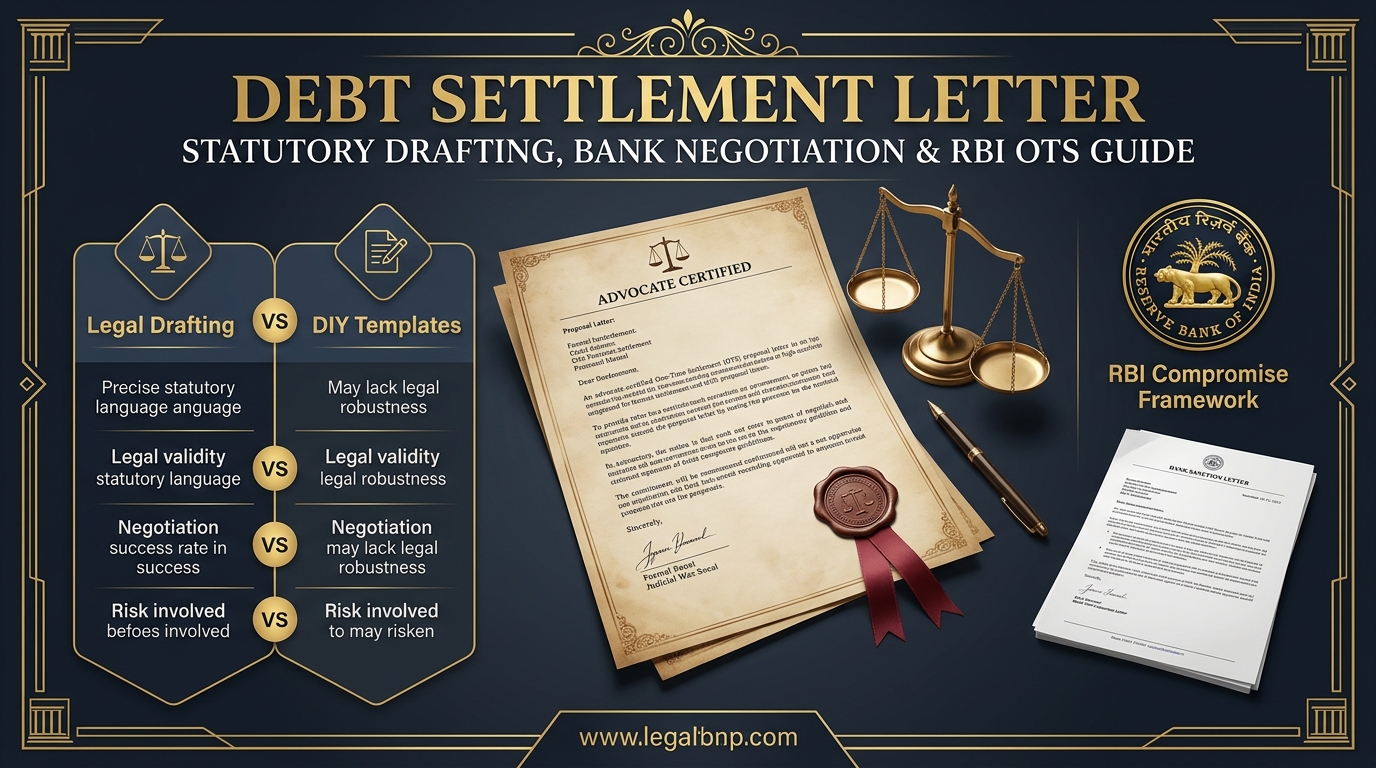
Advocate-Certified Debt Settlement Letter vs. DIY Templates
A visual blueprint contrasting advocate-drafted statutory hardship petitions under RBI frameworks with unverified online DIY downloads.
How an Advocate Settlement Letter Defends Against Section 138 & Section 25 Notices
Lenders frequently utilize statutory provisions under Section 138 of the Negotiable Instruments Act, 1881 (cheque dishonour) and Section 25 of the Payment and Settlement Systems Act, 2007 (failed NACH auto-debits) to apply criminal pressure to civil debt defaults. An advocate-drafted debt settlement letter serves as an indispensable judicial shield during this phase.
Establishing Absence of Mens Rea and Disproving Fraudulent Intent
By submitting an evidence-backed One-Time Settlement proposal under advocate certification, the borrower establishes a formal contemporaneous record of bona fide intent to resolve stressed liabilities. This rebuts aggressive lender allegations under Section 415 and Section 420 of the Indian Penal Code (or Bharatiya Nyaya Sanhita) that the borrower entered the credit contract with deceitful or fraudulent intention.
Compounding of Offenses Under Section 147 of the Negotiable Instruments Act
Unlike non-compoundable criminal charges, offenses under Section 138 are expressly compoundable by statute. Once an advocate-drafted settlement proposal is accepted and the compromise figure is remitted, the complainant bank is legally required under Section 147 of the NI Act to join in filing an application for compounding, resulting in complete acquittal and dismissal of proceedings by the Judicial Magistrate.
Furthermore, where formal legal representation is established, our advocates can petition the court to refer the ongoing dispute to a National Lok Adalat established under the Legal Services Authorities Act, 1987. A settlement award pronounced by a Lok Adalat bench holds the binding force of a non-appealable civil court decree, permanently barring the lender from subsequent litigation.
For in-depth procedural guidance on handling cheque bounce legal notices, consult our detailed resource on Section 138 cheque bounce notice defense for personal loans.
Spotting Counterfeit Recovery Agent Letters vs. Authentic Bank OTS Sanction Letters
One of the most dangerous hazards in Indian debt recovery is the proliferation of fraudulent settlement letters generated by rogue third-party collection agencies. Collection recovery agents operating on commissions frequently issue fake compromise sanction letters on fabricated letterheads to extract partial payments from vulnerable borrowers, only for the bank to credit the payment as normal interest while keeping the default account active.
| Verification Attribute | Fake Collection Agency Letter | Authentic Bank OTS Sanction Letter |
|---|---|---|
| Letterhead & Issuing Domain | Scanned, low-resolution bank logos or letters sent from generic Gmail/Yahoo domains. | Crisp official bank stationery delivered from verifiable institutional email domains (@hdfcbank.com, @icicibank.com, @sbi.co.in). |
| Authorized Signatory & Employee ID | Unspecified signatures, stamped as ‘Recovery Officer’ without employee payroll codes or contact numbers. | Explicit name, official employee code, designation (Chief Manager/Zonal Head), and official desk phone number. |
| Payment Account Destination | Demands funds remitted to collection agency accounts, digital wallets, or third-party intermediary accounts. | Mandates payment directly and exclusively into the borrower's own specific loan account number. |
| Litigation & NDC Undertaking | Vague statements like ‘account will be resolved’ without mentioning Section 138 withdrawal or NDC timelines. | Unambiguous legal clauses binding the bank to withdraw court cases, halt recovery, and issue a No Dues Certificate within a fixed period. |
Our banking litigation team verifies every settlement sanction letter directly with the bank's nodal legal officers and Stressed Assets branches prior to authorizing any fund remittance, ensuring absolute protection against recovery agency fraud. To safeguard your legal rights against unlawful intimidation, see our comprehensive manual on stopping bank recovery agent harassment legally in India.
Securing the Official Bank No Dues Certificate (NDC) & CIBIL Rectification
Remitting the sanctioned compromise payment does not conclude the legal settlement process. The debt obligation is only definitively extinguished when the lending institution delivers an official No Dues Certificate (NDC) or Account Closure Letter under the corporate seal of the bank.
The Legal Weight of the No Dues Certificate
An authentic No Dues Certificate operates as a complete release under Sections 62 and 63 of the Indian Contract Act, 1872. It officially records that the lending bank has received full and final satisfaction, that no outstanding financial liability remains against the borrower or guarantors, and that the bank irrevocably relinquishes all contractual liens, hypothecations, and claims against the borrower's properties.
CIBIL Status: ‘Settled’ vs. ‘Written Off’
Under the Credit Information Companies (Regulation) Act, 2005 (CICRA), banks are statutorily required to update credit bureau records (TransUnion CIBIL, Experian, Equifax, CRIF High Mark) within thirty days of settlement.
- Settled Status: Indicates that the borrower and lender reached a mutual compromise agreement, with the agreed sum paid in full. The balance outstanding becomes zero, halting Days Past Due (DPD) compounding and allowing the borrower to rehabilitate their credit profile over eighteen to twenty-four months.
- Written Off Status: Signifies that the lender unilaterally marked the account as an unrecovered loss while retaining full legal rights to pursue recovery and legal attachment indefinitely.
For an exhaustive comparison of credit implications, review our statutory guides on the difference between loan settlement and closure on CIBIL and loan write-off vs loan settlement.
Frequently Asked Questions on Debt Settlement Letters
Authoritative statutory answers on debt settlement letter drafting, legal protections, bank negotiations, and official account closure in India.
More Legal Guides & Stressed Assets Advisory
Explore our comprehensive knowledge base of banking litigation, dispute resolution, and borrower rights:
Statutory References & Official Regulatory Portals
Authoritative legislative acts, judicial authorities, and central regulatory bodies governing debt compromise settlements:
India Code Official Legislative Repository • Remission and Accord and Satisfaction.
Compromise Settlements & Master Directions on Fair Practices Code.
Dishonour of Cheques & Compounding of Criminal Proceedings.
Statutory Conciliation & Non-Appealable Civil Court Decrees.

AMA Legal Solutions
Pan-India Banking Litigation • Debt Settlement • Commercial Dispute Resolution
Our Stressed Assets & Debt Settlement Legal Solutions
AMA Legal Solutions is India's premier law firm dedicated to defending borrowers against unlawful financial recovery practices. Led by Senior Advocate Anuj Anand Malik, our banking litigation practice group executes forensic ledger audits, drafts authoritative One-Time Settlement letters, defends against Section 138/25 criminal proceedings, and negotiates directly with bank compromise committees under transparent fixed legal advisory with zero hidden retainers.