
The best debt settlement service in India is an advocate-led legal advisory firm enrolled with the Bar Council of India that negotiates formal One-Time Settlements (OTS) under Reserve Bank of India compromise frameworks and Section 63 of the Indian Contract Act, 1872. Unlike unregulated commercial agencies or DIY templates, advocate representation provides statutory immunity against recovery agent harassment under the RBI Fair Practices Code, courtroom defense against Section 138 Negotiable Instruments Act and Section 25 Payment and Settlement Systems Act proceedings, and forensic vetting of bank sanction letters to secure authentic No Dues Certificates. AMA Legal Solutions delivers this institutional representation through transparent, fixed legal advisory without unpredictable hourly retainers or corporate markups.
What Truly Defines the Best Debt Settlement Service in India?
Navigating severe debt distress requires far more than automated mathematical calculations or aggressive telephonic negotiations. When an individual, salaried professional, or commercial enterprise faces compounding defaults across credit cards, personal loans, or unsecured business facilities, the resolution process moves directly into the realm of Indian banking regulations, contract law, and judicial litigation.
The term “best debt settlement service” is frequently co-opted by commercial marketing agencies, call centers, and app-based debt counseling intermediaries. However, under Indian law, the definitive benchmarks that distinguish true premier legal representation from non-legal commercial entities center on four critical capabilities:
1. Statutory Standing Under the Advocates Act, 1961
Only advocates enrolled with a State Bar Council possess the legal authority to execute a Vakalatnama, enter an appearance before Judicial Magistrates, civil courts, and Lok Adalat benches, and serve binding statutory notices. Commercial agencies operate outside this statutory umbrella and cannot legally represent or defend a borrower before judicial bodies.
2. Absolute Advocate-Client Privilege Under Section 126 Evidence Act
Under Section 126 of the Indian Evidence Act, 1872, all communications, asset disclosures, financial statements, and strategies shared between a client and their enrolled advocate are statutorily privileged and inadmissible as adverse evidence in court. Conversely, communications with private commercial debt settlement companies enjoy zero legal confidentiality and are vulnerable to subpoena or disclosure.
3. Direct Stressed Asset Committee Institutional Access
Institutional bank compromise decisions are not made by low-level tele-callers or third-party collection agencies. They are governed by internal Circulars and determined by Zonal Stressed Assets Resolution Committees. An authoritative legal service engages directly with institutional credit risk heads and legal managers, presenting forensic hardship documentation that satisfies bank internal audit mandates.
4. End-to-End Criminal Notice Defense & Compounding
Lenders frequently leverage quasi-criminal mechanisms under Section 138 of the Negotiable Instruments Act, 1881 (cheque dishonour) and Section 25 of the Payment and Settlement Systems Act, 2007 (NACH auto-debit failure) to coerce borrowers. The best debt settlement service provides comprehensive litigation defense, bail facilitation, and statutory compounding before magistrate benches and National Lok Adalats.
The Statutory & RBI Regulatory Framework Governing Debt Settlement
Debt settlement in India is a recognized statutory remedy codified across multiple legislative enactments and central bank directives. Understanding this regulatory framework empowers distressed borrowers to recognize that compromise settlement is an institutional legal right, not a favor bestowed by lending institutions.
Section 63, Indian Contract Act, 1872
Codifies the statutory doctrine of remission and satisfaction. It explicitly allows a promisee (the lending bank or NBFC) to dispense with or remit, wholly or in part, the performance of the promise made to them, or accept instead of it any satisfaction which they think fit, legally discharging the borrower.
RBI Compromise Settlements Framework
The Reserve Bank of India Framework for Compromise Settlements and Technical Write-offs empowers supervised lending entities to execute One-Time Settlements (OTS) with distressed borrowers, mandating board-approved policies, transparent delegation of sanction powers, and verifiable hardship audits.
Legal Services Authorities Act, 1987 (Lok Adalat)
Under Section 21 of the Act, an award rendered by a National Lok Adalat bench on an agreed compromise settlement holds the status of a formal civil court decree. It is final, legally binding on both bank and borrower, and non-appealable in any court of law.
RBI Master Direction on Fair Practices Code
Establishes binding operational standards governing debt collection. Lenders and contracted recovery agents are prohibited from employing verbal abuse, public intimidation, calling outside statutory hours (8:00 AM to 7:00 PM), or intruding into borrower workplaces.
Judicial Principle: Defaulting on an unsecured financial facility due to genuine economic distress constitutes a civil breach of contract under Indian law, not a criminal offence. The Supreme Court of India has established that criminal breach of trust requires proof of dishonest or fraudulent intent at the inception of the loan agreement.
Commercial Comparison: Advocate Advisory vs. Commercial Agencies vs. Corporate Law Firms
When seeking debt relief, borrowers in India encounter multiple market options: automated online DIY templates, unregulated private commercial agencies, high-cost corporate law firms, or advocate-led fixed legal advisory. Evaluating the legal enforceability, court standing, and cost structure of each model is critical before committing your financial future.
| Evaluation Dimension | Free Online DIY Templates | Unregulated Settlement Apps | Corporate Law Firms | AMA Legal Solutions |
|---|---|---|---|---|
| Legal Standing (Advocates Act) | Zero Court Standing | No Legal Standing | Full Court Standing | Full Court Standing (Vakalatnama) |
| Advocate-Client Privilege | None | None (Data Exposed) | Protected | Strict Statutory Privilege (Sec 126) |
| Section 138 / Section 25 Defense | Incapable of Defense | Cannot Represent | Comprehensive Defense | Magistrate Defense & Compounding |
| RBI Anti-Harassment Enforcement | Ignored by Lenders | Ineffective Follow-ups | Formal Legal Notices | Immediate Cease-and-Desist & Ombudsman |
| Cost & Billing Model | Unverified / DIY | Recurring Subscriptions | Heavy Retainers & Hourly Bills | Transparent Fixed Legal Advisory |
| OTS Sanction Letter Vetting | High Risk of Fake Letters | Administrative Only | Forensic Legal Review | Advocate-Certified Bank Authentication |
Why Free DIY Online Templates Fail in Court and Before Bank Committees
In an attempt to conserve cash, distressed borrowers frequently search online for free settlement letters, generic hardship templates, or automated legal notice drafts. While appealing in concept, relying on automated DIY templates is one of the most hazardous missteps in banking litigation.
⚠️ Fatal Inadvertent Admissions of Liability
Boilerplate online templates often contain generic sentences acknowledging the full validity of inflated ledgers, unbundled late fees, and compounding penal charges. When sent directly by a borrower, these statements constitute binding admissions of civil liability under Sections 17 to 21 of the Indian Evidence Act, 1872, depriving the borrower of statutory defenses when the lender files a summary recovery suit under Order XXXVII of the Code of Civil Procedure.
⚠️ Disregard by Institutional Compromise Committees
Bank Zonal Stressed Assets Committees operate under strict internal governance protocols audited by internal compliance officers and the Reserve Bank of India. Generic, copy-pasted letters downloaded from internet blogs fail to satisfy institutional audit standards. They lack structured evidentiary proofs—such as medical disability certificates, corporate dissolution records, or forensic ledger reconciliations—causing bank committees to reject petitions out of hand.
⚠️ Absence of Judicial Courtroom Representation
A template cannot stand before a Metropolitan Magistrate when a summons or bailable warrant is issued under Section 138 of the Negotiable Instruments Act or Section 25 of the Payment and Settlement Systems Act. Only an enrolled advocate can enter a physical or digital appearance, argue against interim compensation applications under Section 143A, and steer the dispute toward Lok Adalat conciliation.
The Advantage of Transparent Fixed Advisory over Corporate Law Firm Retainers
Traditional corporate law firms maintain high structural overheads and bill clients on open-ended hourly rates or substantial advance monthly retainers. For an individual, salaried employee, or small business owner already struggling with liquidity contraction, entering an open-ended hourly legal engagement introduces severe financial risk.
AMA Legal Solutions pioneered a transparent, fixed legal advisory model tailored specifically for stressed asset resolution. This approach guarantees complete financial transparency without compromising the caliber of senior advocate representation:
Zero Hourly Markups
All legal work—including document review, legal notice drafting, bank negotiations, and follow-ups—is conducted under a clear, agreed scope of work without ticking billable clocks or unexpected administrative overheads.
Elimination of Rolling Retainers
Unlike commercial debt counseling agencies that extract ongoing monthly subscription debits regardless of progress, our fixed legal advisory aligns directly with tangible milestones: ledger audit, notice defense, and final settlement sanction.
Predictable Capital Planning
Borrowers can reserve their liquid capital specifically for the negotiated One-Time Settlement compromise payment directly to the lending institution, rather than exhausting critical funds on runaway legal retainers.
Eligible vs. Ineligible Debts Matrix for Settlement in India
A foundational requirement for selecting the best debt settlement service is understanding which types of credit facilities can be legally compromised under Indian banking jurisprudence. Applying debt settlement to ineligible assets can trigger immediate recovery lawsuits and property foreclosure.
✅ Legally Eligible Debts (Unsecured)
- •Personal Loans: Unsecured term loans from scheduled commercial banks and digital NBFCs where no asset hypothecation exists.
- •Credit Card Outstandings: Revolving credit balances, cash advance debt, and converted credit card EMIs subject to high finance charges.
- •Digital Instant Lending Apps: Short-term fintech credit facilities governed under RBI Digital Lending Guidelines.
- •Unsecured MSME & Business Credit: Collateral-free working capital lines and professional business term borrowings.
❌ Ineligible Debts (Secured / SARFAESI)
- •Home Loans & Mortgages: Governed by the SARFAESI Act, 2002; lenders can initiate property attachment under Section 13(4) without court intervention.
- •Auto & Vehicle Loans: Subject to hypothecation agreements; non-payment results in lawful vehicle repossession.
- •Gold & Security-Backed Loans: Pledged physical gold or securities are auctioned by the lender under the Indian Contract Act.
- •Statutory & Tax Liabilities: GST, income tax assessments, and government revenues cannot be compromised via civil settlement.
The 5-Step Advocate-Led Debt Settlement Protocol
Executing an institutional compromise settlement requires methodical adherence to banking regulations, evidentiary protocols, and judicial timelines. AMA Legal Solutions executes every case through our proprietary five-step legal workflow:
Forensic Ledger Audit & Penal Interest Dissection
Our banking legal team audits all original sanction letters, statements of account, and repayment records. We mathematically separate legitimate principal liabilities from compound penal interest, bounce surcharges, and unauthorized collection fees, establishing an accurate baseline for institutional negotiations.
Statutory Cease-and-Desist Notice Under RBI Guidelines
We execute a formal Vakalatnama and serve statutory cease-and-desist notices upon the lending institution and its authorized collection agencies. This formally invokes the RBI Master Direction on Fair Practices Code, legally mandating that all future communication occur exclusively through designated legal counsel and halting recovery agent harassment.
Advocate Hardship Dossier Preparation Under Section 63
We prepare an evidence-backed One-Time Settlement (OTS) dossier establishing genuine insolvency, job loss, business collapse, or medical distress. Formulated under Section 63 of the Indian Contract Act, 1872, this legal petition demonstrates bona fide inability to maintain original terms and disproves willful default classifications.
Bank Compromise Committee Negotiation & Sanction Letter Vetting
Senior litigation advocates represent your interests directly before the bank's Zonal Stressed Assets Resolution Committee. Upon securing an offer, we forensically vet the official bank OTS sanction letter to ensure it is issued on authentic corporate letterhead, contains valid authorization signatures, and covenants complete debt extinguishment.
Settlement Execution, No Dues Certificate Enforcement & CIBIL Rehabilitation
Compromise funds are paid directly to the bank's official loan account—never to intermediary accounts. Following payment, we enforce delivery of the authentic bank No Dues Certificate (NDC), file compounding petitions to withdraw pending court cases, and monitor credit bureau status updates under the Credit Information Companies Act.
Best Debt Settlement Service in India: Advocate-Led Resolution Model
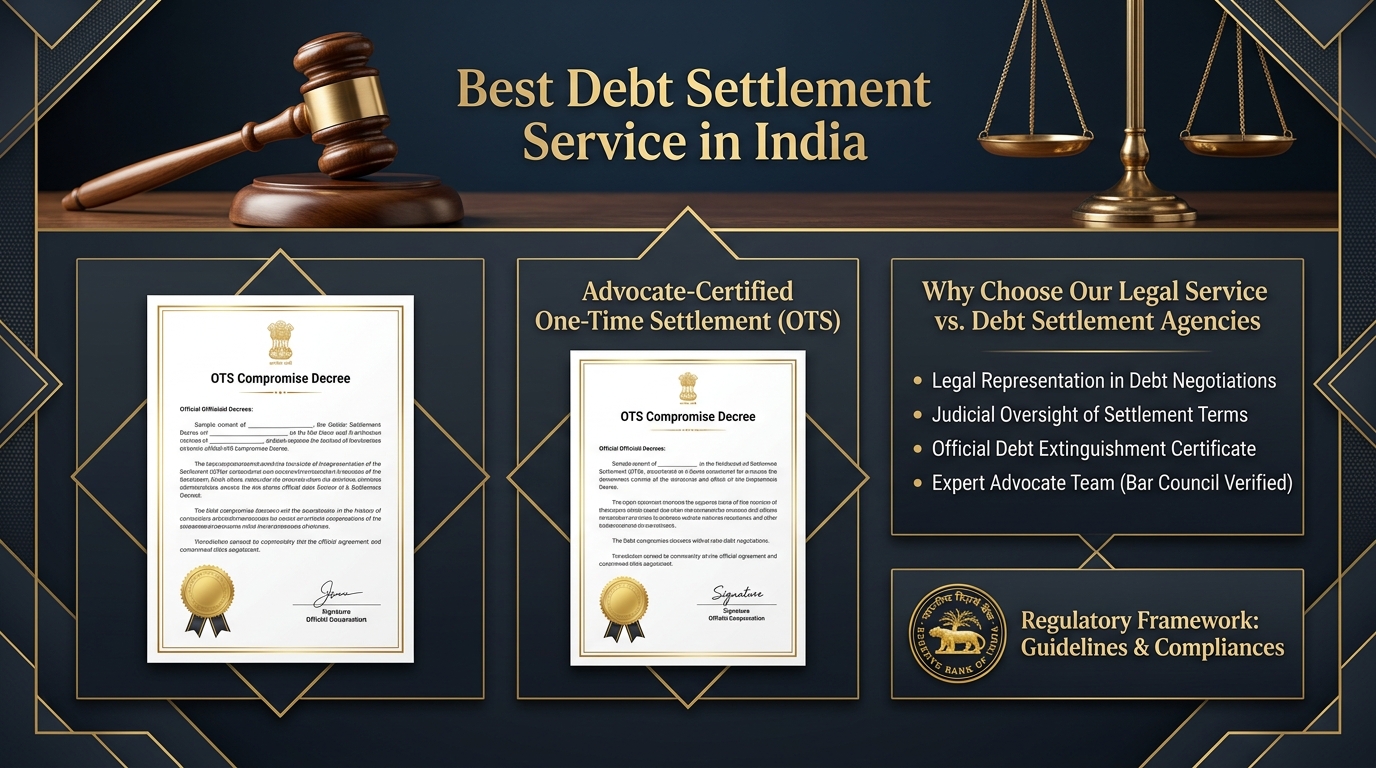
Comprehensive legal framework illustrating advocate standing under the Advocates Act, RBI compromise settlement guidelines, forensic ledger analysis, court defense against criminal notices, and authentic No Dues Certificate delivery.
Judicial Defense: Neutralizing Section 138 NI Act & Section 25 PSS Act Complaints
The primary weapon deployed by aggressive lending institutions to intimidate defaulting borrowers is the initiation of quasi-criminal proceedings. These proceedings are engineered to convert a civil breach of contract into a courtroom emergency:
Section 138 of the Negotiable Instruments Act, 1881
Deals with the dishonour of cheques for insufficiency of funds. Lenders frequently present undated security cheques obtained during loan onboarding, triggering a 15-day statutory demand notice that must be answered with legal precision.
Section 25 of the Payment and Settlement Systems Act, 2007
Creates statutory criminal liability for the failure of electronic NACH or ECS automated debits. The procedural rules and defenses mirror Section 138 proceedings, demanding formal legal representation before magistrate benches.
How Advocates Protect Borrowers Against Criminal Coercion
When you retain AMA Legal Solutions, our senior litigation advocates execute three coordinated legal protections:
- Timely Statutory Reply: We draft and serve a comprehensive legal reply within the mandatory 15-day window, documenting bona fide hardship, challenging inflated claim figures, and disproving fraudulent intention under Section 415 of the Indian Penal Code.
- Magistrate Court Representation & Bail: If the lender files a formal complaint before a Judicial Magistrate First Class (JMFC) or Metropolitan Magistrate (MM), our litigation advocates appear on your behalf, secure bail, and prevent coercive non-bailable warrants.
- Compounding & Quashing: Both Section 138 and Section 25 offences are compoundable under Indian law. Upon completing the One-Time Settlement, we present the agreement before a National Lok Adalat or magistrate court to compound the offence and dismiss all proceedings.
Enforcing RBI Anti-Harassment Rules & Restoring Borrower Dignity
No lending institution, whether a major private bank, public sector bank, or NBFC, has the legal right to subject borrowers or their families to threats, public humiliation, or persistent harassment. The Reserve Bank of India enforces strict compliance through its Master Direction on Fair Practices Code and Master Circular on Recovery Agents.
🛡️ Key Protections Under RBI Directives
When recovery agents breach these standards, AMA Legal Solutions serves formal legal notices upon the bank's Principal Nodal Officer and escalates complaints directly to the Reserve Bank of India Integrated Ombudsman Scheme, 2021. If necessary, we pursue civil damages and criminal injunctions before competent courts.
Vetting the Bank OTS Sanction Letter & Securing the No Dues Certificate
A critical differentiator of the best debt settlement service is the ability to protect borrowers from fraudulent or defective settlement letters. Unauthorized collection agents routinely forge settlement letters or issue letters lacking institutional sanction, causing funds to be misallocated toward interest without closing the loan.
Essential Checklist of an Authentic Bank OTS Sanction Letter
CIBIL Score Impact & Long-Term Credit Rehabilitation
Borrowers frequently inquire about the credit score consequences of settling a debt. Under the Credit Information Companies (Regulation) Act, 2005, lenders are legally mandated to report account resolutions to credit bureaus including TransUnion CIBIL, Experian, CRIF High Mark, and Equifax.
When a debt is compromised, the account status reflects as ‘Settled’ rather than ‘Closed’. While this reflects that the loan was discharged through a concession, it produces two vital financial benefits:
- Halts Days Past Due (DPD) Compounding: An unresolved delinquent account continues to accrue worsening DPD flags every month (e.g., 90, 120, 180 DPD), continually degrading your credit score. Settlement permanently stops this negative scoring cascade.
- Extinguishes Legal Liabilities: By obtaining an authentic No Dues Certificate, the borrower eliminates the risk of future civil recovery lawsuits, bank account freezes, and asset attachments.
Following settlement, our legal advisory team guides borrowers through credit rehabilitation: verifying bureau reporting to ensure outstanding balances reflect zero, maintaining utility and secured credit lines, and rebuilding credit scores to prime status within eighteen to twenty-four months.
Frequently Asked Questions on Best Debt Settlement Service in India
Authoritative statutory answers to essential questions regarding legal representation, compromise guidelines, and borrower rights in India.
More Legal Guides on Debt Settlement & Banking Litigation
Explore comprehensive resources prepared by our senior banking litigation advocates to help you navigate debt resolution, borrower rights, and credit repair:
Critical insolvency triggers and legal thresholds for initiating One-Time Settlement.
Comprehensive guide to compromise settlements and borrower rights under RBI rules.
How senior advocates negotiate maximum legal waivers and interest write-offs.
Institutional legal resolution and commercial negotiation under central bank directives.
Detailed analysis of debt settlement statutes, Lok Adalats, and RBI frameworks.
Comparing consolidation loans with One-Time Settlement to choose the right strategy.
Legal procedures to halt recovery harassment under the RBI Fair Practices Code.
How senior advocates defend cheque bounce notices and compound complaints.
Understanding bureau remarks and practical credit repair steps following resolution.
Statutory References & Regulatory Authorities
Every legal argument and advisory framework presented on this page is anchored in official Indian statutes and central bank regulations:
Statutory doctrine of accord and satisfaction for compromise settlements.
India Code Legislative Database →Regulatory standards for recovery agents, calling hours, and grievance redressal.
Reserve Bank of India Portal →Statutory provisions for dishonoured cheques and compounding of offenses.
India Code Legislative Database →Statutory defense against dishonour of electronic mandates (NACH / ECS).
India Code Legislative Database →Section 21 statutory framework for Lok Adalat compromise awards as civil decrees.
National Legal Services Authority (NALSA) →Rules governing credit reporting, ‘Settled’ remarks, and balance updates.
India Code Legislative Database →
AMA Legal Solutions
India's Premier Advocate-Led Banking & Stressed Assets Law Firm
Google Verified Firm Rating
Founded by Senior Advocate Anuj Anand Malik, AMA Legal Solutions is dedicated to protecting consumers, salaried professionals, and entrepreneurs from predatory lending, unlawful recovery harassment, and aggressive financial litigation. Operating with strict adherence to Bar Council of India standards, our litigation advocates represent clients nationwide across civil courts, magistrate benches, and National Lok Adalats.