
A borrower should choose debt settlement when unsecured debt servicing obligations exceed fifty percent of verifiable monthly income, severe financial hardship makes full principal repayment impossible within three to five years, and accounts have crossed ninety days of delinquency into Non-Performing Asset (NPA) status under Reserve Bank of India guidelines. Under Section 63 of the Indian Contract Act, 1872, debt settlement legally extinguishes outstanding debt obligations through a discounted lump-sum compromise, stopping compound interest accrual and halting coercive recovery litigation. Choosing advocate-led representation ensures statutory immunity against recovery agent harassment, quashes criminal proceedings under Section 138 of the Negotiable Instruments Act, 1881 and Section 25 of the Payment and Settlement Systems Act, 2007, and guarantees the issuance of an authentic bank No Dues Certificate.
Critical Triggers: When to Choose Debt Settlement in India
Deciding when to transition from regular debt servicing to a formal One-Time Settlement (OTS) is one of the most critical financial and legal decisions an individual or business owner can make. Debt settlement is not an evasion of liability; rather, it is a statutorily recognized resolution mechanism designed for situations where continued full repayment has become mathematically impossible or legally self-destructive.
Borrowers facing severe distress frequently make the mistake of exhausting emergency savings, liquidating retirement funds, or taking predatory high-interest informal loans in a futile attempt to service unmanageable bank EMIs. Recognizing the six core indicators of structural insolvency enables borrowers to seek timely advocate representation under Reserve Bank of India (RBI) compromise frameworks before irreparable financial damage occurs:
1. Debt-to-Income (DTI) Ratio Exceeding Fifty Percent
When cumulative monthly unsecured Equated Monthly Installments (EMIs) and revolving minimum credit card dues exceed fifty to sixty percent of verifiable net monthly earnings, the borrower enters the critical insolvency zone. In this state, basic living expenditures, housing costs, and healthcare obligations cannot be sustained without taking on additional secondary debt, creating an inescapable compounding debt trap.
2. Involuntary Livelihood Destruction or Catastrophic Hardship
Genuine, documented financial hardship—including sudden corporate retrenchment, business dissolution, loss of primary commercial contracts, permanent disability, or catastrophic family medical emergencies—renders original loan agreements commercially frustrated. Under Section 63 of the Indian Contract Act, 1872, Indian law explicitly empowers lenders to accept reduced performance when original contractual expectations cannot be fulfilled due to bona fide distress.
3. The Minimum Payment Trap: Zero Principal Reduction
When credit card holders continuously pay only the “Minimum Amount Due” (MAD), finance charges compounding at annualized rates of forty to fifty-four percent, coupled with late-payment surcharges and Goods and Services Tax (GST), consume virtually the entire payment. Even after months of diligent payments, the principal debt remains intact or increases. Debt settlement stops this compounding hemorrhage by freezing the ledger and negotiating a conclusive resolution.
4. Delinquency Crossing Ninety Days Past Due (NPA Classification)
Under the Reserve Bank of India Prudential Framework for Resolution of Stressed Assets, an account delinquent for more than ninety consecutive days is statutorily classified as a Non-Performing Asset (NPA). Once an account becomes an NPA, institutional lenders must allocate mandatory capital provisions against the bad loan, creating regulatory incentives for bank compromise committees to approve advocate-negotiated settlements with substantial waivers.
5. Commencement of Recovery Agent Intimidation & Harassment
When lending institutions outsource collection files to third-party recovery agencies that resort to abusive phone calls, late-night contacts, unannounced residential visits, or workplace intrusions, self-negotiation has broken down. Choosing advocate-led debt settlement immediately invokes the RBI Master Direction on Fair Practices Code, shielding the borrower behind formal legal representation.
6. Receipt of Statutory Demand Notices (Section 138 / Section 25)
The service of formal legal notices under Section 138 of the Negotiable Instruments Act, 1881 (cheque bounce) or Section 25 of the Payment and Settlement Systems Act, 2007 (electronic mandate dishonour) signals that the lender is preparing magistrate court litigation. Retaining an advocate at this junction transforms judicial exposure into an institutional compromise settlement before a National Lok Adalat bench.
Strategic Assessment: Debt Settlement vs. Debt Consolidation vs. Loan Restructuring
Before choosing debt settlement, a distressed borrower must understand the clear differences between debt settlement, debt consolidation, and loan restructuring. Choosing the incorrect pathway can exacerbate financial vulnerability, waste limited capital reserves, and invite aggressive recovery litigation.
| Strategic Dimension | Debt Consolidation Loan | Bank Loan Restructuring | Advocate-Led Debt Settlement (OTS) |
|---|---|---|---|
| Core Mechanism | Taking a new large loan to pay off multiple smaller debts | Extending loan tenure or adjusting interest rates with existing lender | Negotiating a discounted lump-sum compromise to extinguish debt permanently |
| Principal Obligation | 100% Principal + New Interest | 100% Principal + Extended Interest | Extinguished via Significant Concession / Haircut |
| Required Credit Rating (CIBIL) | Must be above 750 (Strict eligibility) | Account must be Standard (No active defaults) | Accessible during severe delinquency and NPA status |
| Cash Flow Requirement | Requires stable, verifiable ongoing monthly income | Requires guaranteed capacity to pay revised monthly EMIs | Requires one-time compromise corpus, ending ongoing monthly EMIs |
| Recovery Harassment Shield | None (Purely financial product) | Temporary hold during bank internal review | Immediate statutory cease-and-desist under RBI guidelines |
| Section 138 Criminal Defense | Inapplicable | Inapplicable | Statutory compounding and withdrawal of court proceedings |
| Final Legal Outcome | Ongoing debt liability for 3 to 7 years | Extended debt liability for 5 to 10 years | Complete extinguishment & authentic No Dues Certificate |
Strategic Takeaway: If you possess a high credit score and verifiable income to comfortably service lower interest rates, debt consolidation is ideal. However, if your DTI ratio has collapsed, delinquency has crossed ninety days, or you are facing Section 138 notices, debt consolidation will be rejected by banks. In that scenario, debt settlement is your sole viable legal exit.
Commercial Realities: Advocate-Led Advisory vs. DIY Templates vs. Corporate Retainers
When borrowers realize that debt settlement is necessary, they often evaluate how to navigate the process. In India, borrowers typically consider four routes: free automated online DIY templates, unregulated private settlement apps, traditional corporate law firms, or transparent fixed advocate advisory. Understanding the legal standing and commercial reality of each model is essential to protecting your rights.
⚠️ The Fatal Flaw of Free DIY Online Templates
Automated settlement letter generators and free online templates downloaded from the internet have zero evidentiary standing under the Advocates Act, 1961. Bank recovery managers routinely disregard generic letters. Worse, generic DIY letters frequently contain inadvertent admissions of unconditional liability or omit statutory reservations, destroying the borrower's defense in magistrate court when criminal proceedings under Section 138 or Section 25 are instituted.
⚠️ The Trap of Unregulated Private Settlement Agencies & Apps
Private debt settlement companies and app-based intermediaries are non-legal commercial entities. They possess no legal authority to represent clients before judicial magistrates or Lok Adalat benches. They operate without advocate-client confidentiality under Section 126 of the Indian Evidence Act, 1872, routinely extract recurring monthly administrative subscriptions without guaranteed legal outcomes, and cannot halt unlawful recovery agent harassment.
⚖️ The Excessive Cost of Traditional Corporate Law Firms
Traditional corporate law firms operate on open-ended hourly billing structures and demand heavy advance retainers. For an individual or small business owner already experiencing severe cash flow depletion, paying unpredictable hourly legal fees compounds financial distress without providing cost certainty.
Institutional Comparison: Representation Model & Enforceability
| Legal Feature & Capability | Free DIY Online Templates | Unregulated Settlement Apps | Corporate Law Firms | AMA Legal Solutions |
|---|---|---|---|---|
| Judicial Court Standing (Advocates Act) | Zero Standing | No Legal Standing | Full Court Standing | Full Court Standing (Vakalatnama) |
| Advocate-Client Privilege (Section 126) | None | None (Data Exposed) | Protected | Strict Statutory Privilege |
| Section 138 & 25 Criminal Defense | Incapable of Defense | Cannot Represent | Comprehensive Defense | Immediate Representation & Compounding |
| RBI Anti-Harassment Enforcement | Ignored by Banks | Limited Follow-up | Statutory Notice | Immediate Cease-and-Desist & Ombudsman |
| Commercial Advisory Structure | Unverified / Unregulated | Monthly Subscriptions | Heavy Retainers & Hourly Bills | Transparent Fixed Advisory Model |
| No Dues Certificate (NDC) Vetting | High Risk of Fake Letters | Administrative Only | Forensic Legal Vetting | Advocate-Certified Bank Authentication |
AMA Legal Solutions bridges this commercial divide. We provide distressed borrowers with high-caliber senior advocate litigation shielding, comprehensive forensic ledger audits, and institutional negotiation under RBI compromise frameworks on an accessible, transparent, fixed legal advisory model—eliminating open-ended corporate retainers and hourly billable fees.
When NOT to Choose Debt Settlement in India
Understanding when debt settlement is inappropriate is just as important as knowing when to choose it. Attempting debt settlement under the wrong circumstances can trigger catastrophic asset loss or unnecessary credit impairment. Borrowers should avoid debt settlement under the following specific conditions:
❌ Secured Loans (Home, Property, Auto & Gold Loans)
Secured credit lines are governed by the SARFAESI Act, 2002. Because the lender holds registered mortgage deeds or hypothecations, they do not need to accept compromise settlements. After ninety days of default, secured lenders can issue a 60-day demand notice under Section 13(2) and take physical possession of the property under Section 13(4) through an order of the Chief Metropolitan Magistrate or District Magistrate under Section 14.
❌ Temporary, Short-Term Cash Flow Dips
If your financial setback is temporary—such as transitioning between jobs for thirty to sixty days or awaiting verified business receivables—choosing debt settlement is premature. A short-term liquidity dip is best resolved through a temporary moratorium request, tenure extension, or personal emergency reserves to preserve your credit rating.
❌ Upcoming Mortgage or High-Value Credit Applications
When an account is settled, the credit bureau status reflects as ‘Settled’. While this halts destructive Days Past Due compounding, it creates a temporary barrier to obtaining prime-rate mortgage loans for twelve to twenty-four months. If you plan to apply for a home loan within the next year, prioritize full repayment or restructuring over settlement.
❌ Presence of Substantial Liquid Investments
If a borrower possesses liquid mutual funds, fixed deposits, or unencumbered shares that can satisfy debts without destroying basic household sustainability, attempting to force a compromise settlement can backfire. Banks conduct asset profiling and may classify such defaults as ‘willful’, which disqualifies the borrower from compromise settlements under RBI directives.
The 5-Step Legal Debt Settlement Protocol
Once the strategic decision to choose debt settlement is made, executing the resolution requires meticulous adherence to Indian statutory procedure and banking regulations. AMA Legal Solutions manages the process through a structured five-step legal protocol:
Financial Distress Diagnostics & Forensic Ledger Audit
Our legal team conducts a forensic audit of all loan sanction letters, statements of account, and repayment histories. We identify and isolate compounding penal charges, unauthorized processing surcharges, and illegitimate collection expenses from the genuine principal balance, establishing the baseline for compromise negotiations.
Statutory Cease-and-Desist Notice Under RBI Guidelines
We execute a formal Vakalatnama and serve statutory legal notices upon the lending institution and its authorized collection agencies. This formally invokes the RBI Master Direction on Fair Practices Code, legally prohibiting harassment, late-night telephone calls, unannounced visits, and third-party disclosures.
Advocate Hardship Dossier Preparation Under Section 63
We compile an evidence-backed One-Time Settlement (OTS) dossier substantiating genuine insolvency, medical hardship, job termination, or commercial downturn. Anchored under Section 63 of the Indian Contract Act, 1872, this legal petition demonstrates that the borrower is bona fide distressed and not a willful defaulter.
Bank Compromise Committee Negotiation & Sanction Letter Vetting
Our senior advocates negotiate directly with the bank's Zonal Stressed Assets Committee and Credit Risk Officers. We forensically examine the resulting OTS sanction letter to verify that it is issued on authentic bank stationery, bears authorized signatures, and contains an explicit, irrevocable covenant for complete debt extinguishment.
Settlement Execution, No Dues Certificate Delivery & CIBIL Rehabilitation
Funds are remitted directly to the lender's official loan account—never to intermediary collection accounts. Following payment, we enforce the delivery of the authentic bank No Dues Certificate (NDC), secure the withdrawal or compounding of magistrate court complaints, and manage credit bureau reporting updates under the Credit Information Companies Act.
When to Choose Debt Settlement: Strategic Decision Framework
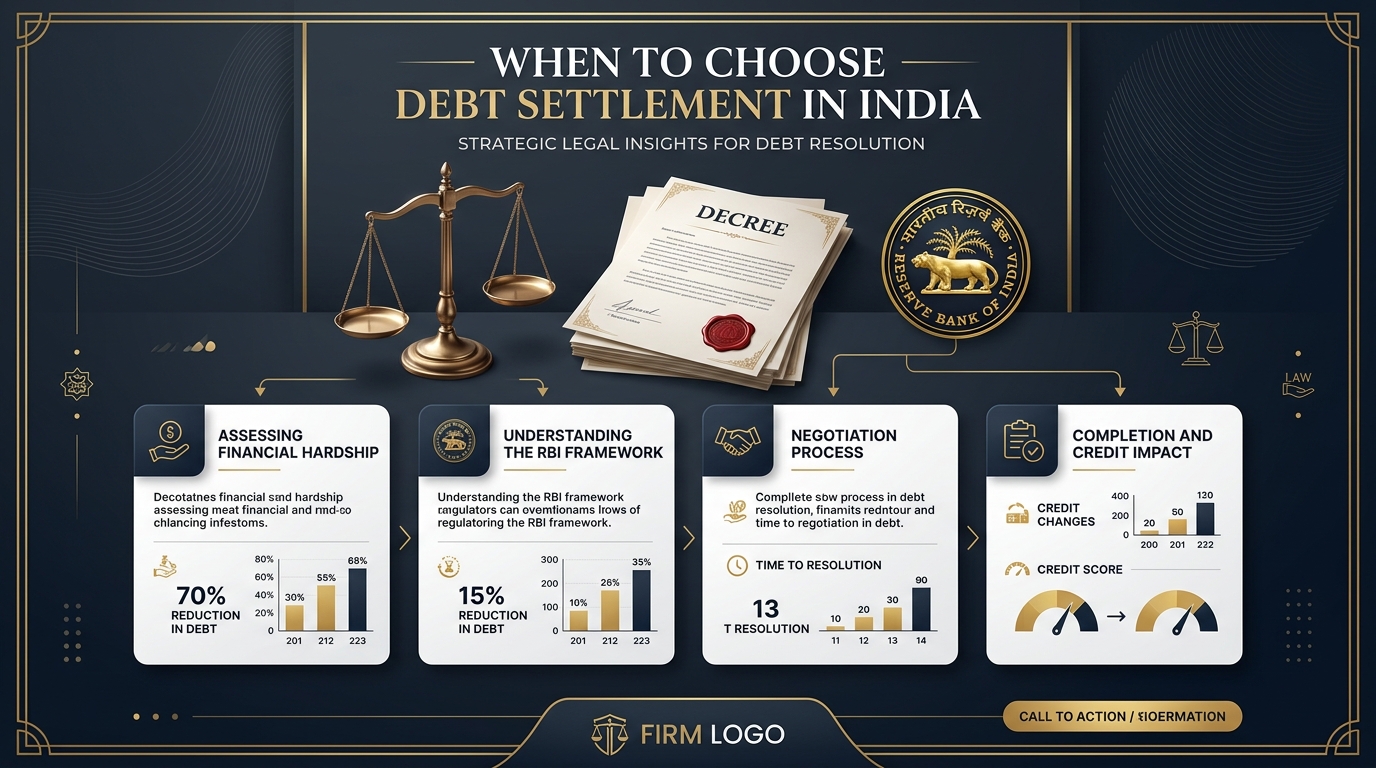
Visual decision blueprint illustrating insolvency diagnostics, comparative strategy assessment, institutional bank committee negotiations under RBI guidelines, and permanent account extinguishment via an authentic No Dues Certificate.
Judicial Shield: Defending Section 138 NI Act & Section 25 PSS Act Complaints
Borrowers who default on unsecured personal loans or credit card obligations often receive threatening legal notices alleging criminal culpability. Lenders commonly deploy two statutory provisions to apply intense courtroom pressure:
Section 138 of the Negotiable Instruments Act, 1881
Enacted to penalize the dishonour of cheques issued for the discharge of a legally enforceable debt. Lenders often present undated security cheques obtained during initial loan disbursement and issue a 15-day statutory demand notice when returned unpaid.
Section 25 of the Payment and Settlement Systems Act, 2007
Statutorily equivalent to Section 138, this enactment criminalizes the electronic dishonour of National Automated Clearing House (NACH) or Electronic Clearing Service (ECS) auto-debit mandates due to insufficient account balance.
How Advocates Neutralize Criminal Exposure During Settlement
Under Indian jurisprudence, simple inability to service an unsecured loan is strictly a civil breach of contract and not a criminal offence. The Supreme Court of India has held that criminal breach of trust or cheating under Section 415/420 of the Indian Penal Code requires proof of fraudulent intent at the inception of the contract.
When you retain AMA Legal Solutions, our advocates execute three coordinated legal maneuvers:
- Statutory Reply to Legal Notice: We draft a comprehensive legal reply within the statutory 15-day window, documenting bona fide hardship, challenging erroneous ledger additions, and formally recording that blank security cheques were misapplied.
- Magistrate Court Representation & Bail Formalities: If a formal complaint is instituted before a Judicial Magistrate First Class (JMFC) or Metropolitan Magistrate (MM), our litigation advocates represent you, secure bail, and prevent coercive non-bailable warrants.
- Compounding of Offense via Lok Adalat: Both Section 138 and Section 25 are compoundable offenses under Indian law. We formalize the OTS agreement before a National Lok Adalat bench, which issues a judicial decree quashing the criminal complaint permanently.
Enforcing RBI Anti-Harassment Rules & Borrower Protection
No lending institution, bank recovery department, or outsourced collection agency has the legal authority to intimidate, humiliate, or harass a borrower. The Reserve Bank of India has established strict operational guidelines under its Master Circular on Recovery Agents and Master Direction on Fair Practices Code.
🛡️ Statutory Protections Under RBI Directives
When collection agents breach these statutory guidelines, AMA Legal Solutions serves formal legal notices to the bank's Principal Nodal Officer. If non-compliance continues, we escalate grievances directly to the Reserve Bank of India Integrated Ombudsman Scheme, 2021 and pursue civil compensation and criminal restraining orders before appropriate courts.
Vetting the Bank OTS Sanction Letter & Securing the No Dues Certificate
A common danger facing borrowers attempting self-negotiation is falling victim to unauthorized collection agent scams. Predatory collection agents frequently forge settlement letters or direct borrowers to transfer funds into third-party accounts, only for the bank to treat the funds as partial payment against accumulated interest without closing the account.
Essential Checklist of an Authentic Bank OTS Sanction Letter
- Official Bank Letterhead: The document must be printed on the official corporate stationery of the scheduled commercial bank or registered NBFC.
- Verifiable Reference Number: The letter must contain a unique tracking code that can be authenticated on the bank's core banking database.
- Authorized Signatory: It must be signed and stamped by an authorized zonal officer with their designation, employee code, and official seal.
- Clear Waiver Schedule: The letter must explicitly document the total outstanding balance, the negotiated settlement sum, the full waiver on principal and interest, and the payment schedule.
- Mandatory NDC Covenant: The sanction letter must explicitly state that upon receipt of the agreed settlement sum, the loan account will be closed with zero balance and an unconditional No Dues Certificate will be issued.
At AMA Legal Solutions, our senior advocates perform thorough forensic authentication of the OTS sanction letter before advising any client to release settlement funds. Once paid, we enforce the delivery of the final No Dues Certificate (NDC), ensuring permanent legal closure.
CIBIL Score Impact & Long-Term Credit Rehabilitation
A vital factor when deciding when to choose debt settlement is its effect on your credit profile. Under the Credit Information Companies (Regulation) Act, 2005 (CICRA), lending institutions are statutorily required to report account payment status to credit information bureaus like TransUnion CIBIL, Experian, Equifax, and CRIF High Mark on a monthly basis.
Understanding ‘Settled’ vs. Unchecked Compounding Default
When an OTS is completed, the credit bureau records the remark as ‘Settled’. While this causes a temporary drop in credit score, it permanently halts the catastrophic Days Past Due (DPD) counter that would otherwise continue incrementing every 30 days, causing severe ongoing credit damage.
Rebuilding Credit Above 750 Over 18 to 24 Months
A ‘Settled’ remark does not permanently prevent credit restoration. Borrowers can systematically rebuild their credit score back to 750 and above within eighteen to twenty-four months through disciplined credit practices: obtaining a secured credit card backed by a fixed deposit, maintaining credit utilization below thirty percent, paying all utility bills on time, and verifying that bureaus correctly update the outstanding balance to zero.
Frequently Asked Questions on When to Choose Debt Settlement
Authoritative statutory answers to critical questions regarding debt distress thresholds, legal timings, and borrower protections in India.
More Legal Guides on Debt Settlement & Banking Litigation
Explore comprehensive resources prepared by our senior banking advocates to help you navigate debt resolution, borrower rights, and credit repair:
Comprehensive guide to compromise settlements and borrower rights under RBI rules.
Detailed analysis of debt settlement laws, Lok Adalat resolution, and central bank frameworks.
Compare debt consolidation loans with One-Time Settlement to choose the right strategy.
Understand technical write-offs versus compromise settlements on credit records.
Legal procedures to halt recovery harassment under RBI Fair Practices Code.
How senior advocates defend cheque bounce notices and compound complaints.
Understanding bureau remarks and practical credit repair steps following resolution.
Comparing commercial agencies with advocate-led law firms for debt resolution.
Step-by-step legal guidance when monthly EMI burdens surpass total income.
Statutory References & Regulatory Authorities
Every legal argument and advisory framework presented on this page is anchored in official Indian statutes and central bank regulations:
Statutory doctrine of accord and satisfaction for compromise settlements.
India Code Legislative Database →Regulatory standards for recovery agents, calling hours, and grievance redressal.
Reserve Bank of India Portal →Statutory provisions for dishonoured cheques and compounding of offenses.
India Code Legislative Database →Statutory defense against dishonour of electronic mandates (NACH / ECS).
India Code Legislative Database →Section 21 statutory framework for Lok Adalat compromise awards as civil decrees.
National Legal Services Authority (NALSA) →Rules governing credit reporting, ‘Settled’ remarks, and balance updates.
India Code Legislative Database →
AMA Legal Solutions
India's Premier Advocate-Led Banking & Stressed Assets Law Firm
Google Verified Firm Rating
Founded by Senior Advocate Anuj Anand Malik, AMA Legal Solutions is dedicated to protecting consumers, salaried professionals, and entrepreneurs from predatory lending, unlawful recovery harassment, and aggressive financial litigation. Operating with strict adherence to Bar Council of India standards, our litigation advocates represent clients nationwide across civil courts, magistrate benches, and National Lok Adalats.