Quick Answer: What is the Best Debt Settlement Company in India?
The best debt settlement company in India is an advocate-led legal advisory operating strictly under the Advocates Act, 1961 and Reserve Bank of India (RBI) compromise settlement frameworks. Unlike unregulated digital apps or private tele-calling agencies, a premier legal firm provides formal legal representation, serves statutory cease-and-desist notices to stop recovery agent harassment immediately, defends borrowers against Section 138 NI Act cheque bounce and Section 25 PSS Act NACH summons, eliminates compounding penal charges, negotiates 40% to 75% One Time Settlement (OTS) waivers, and secures authentic bank-issued No Dues Certificates (NDCs).
The Consumer & Commercial Debt Crisis in India
The rapid proliferation of unsecured retail credit, high-interest credit cards, revolving lines of credit, and algorithmic Buy Now Pay Later (BNPL) loans across India has created unprecedented financial exposure for millions of middle-class households, salaried executives, and MSME entrepreneurs. When external economic disruptions, sudden job losses, corporate restructuring, or severe medical emergencies strike, servicing multiple monthly Equated Monthly Installments (EMIs) carrying annualized percentage rates (APR) of 18% to 42% becomes mathematically impossible.
Once a borrower misses consecutive payment cycles, commercial lenders immediately trigger exorbitant default interest rates, late fees, and bounce charges. Within 90 days of non-payment, the loan account is categorized as a Non-Performing Asset (NPA). At this critical juncture, banks and NBFCs frequently outsource loan files to aggressive, unregulated third-party collection agencies that deploy illegal coercive measures. Selecting the best debt settlement company in India is not merely a financial strategy; it is a vital statutory shield to protect your dignity, your family, and your constitutional rights under Indian law.
Advocate-Led Law Firms vs. Unregulated Debt Settlement Agencies
"Under Indian jurisprudence, debt resolution is fundamentally a legal dispute rooted in the Indian Contract Act, 1872 and Negotiable Instruments Act, 1881. Entrusting commercial negotiations to unregulated private agencies or call-center aggregators exposes borrowers to financial fraud, lack of judicial defense, and ongoing litigation risk."
When evaluating service providers for debt resolution, commercial borrowers must scrutinize the operational model and legal authority of the firm. Unregulated agencies frequently operate through non-transparent subscription models, collecting substantial non-refundable advance fees while having zero standing to appear before a judicial magistrate.
| Evaluation Parameter | Advocate-Led Law Firm (AMA Legal) | Unregulated Settlement Agency / App |
|---|---|---|
| Statutory Legal Standing | Enrolled under Advocates Act, 1961; Authorized Court Representation | Private Commercial Entity; Zero Legal Standing in Court |
| Anti-Harassment Power | Statutory Cease-and-Desist Notices backed by RBI Ombudsman Complaints | Informal phone requests routinely ignored by recovery agents |
| Judicial Summons Defense | Vakalatnama filing & Defense in Section 138 / Section 25 cases | Cannot draft legal replies or represent clients in Court / Lok Adalat |
| Settlement Authentication | Forensic audit of bank compromise letters & NDC enforcement | High risk of fake settlement letters or unapproved discounts |
| Advocate-Client Privilege | 100% Confidentiality protected under Indian Evidence Act | No legal privilege; client financial data frequently shared |
RBI Master Directions & Legal Framework for Compromise Settlements
Debt settlement in India is not an informal compromise; it is an institutionalized statutory mechanism governed by the RBI Master Directions on Compromise Settlements and Technical Write-offs. Under these regulatory directives, every Regulated Entity (RE)—including public sector banks, private scheduled commercial banks, and systemically important NBFCs—must maintain a board-approved policy for compromise settlements.
RBI Prudential Mandate: Regulated Entities are legally authorized to undertake compromise settlements in respect of non-performing accounts, providing an equitable exit for genuine borrowers experiencing distress while maximizing net present value recovery for the lending institution.
The statutory negotiation process focuses on distinguishing genuine commercial hardship from willful default. By submitting an authoritative One Time Settlement (OTS) legal petition backed by verifiable financial evidence (such as hospital records, income tax returns, audited balance sheets, or termination notices), our senior advocates compel the bank's internal Stressed Asset Committee to waive 100% of accumulated penal interest and execute substantial haircuts on the principal sum. For a detailed breakdown of bank-specific policies, see our comprehensive guide on One Time Settlement Schemes for Personal Loans.
Statutory Borrower Rights & Anti-Harassment Enforcement
The Reserve Bank of India has established stringent regulations regarding recovery practices to prevent harassment and human rights violations. Borrowers undergoing loan default retain fundamental statutory rights that no recovery agency or bank official can violate:
Recovery agents are strictly prohibited from calling or visiting borrowers before 8:00 AM and after 7:00 PM under the RBI Fair Practices Code.
Lenders cannot disclose your loan details or contact relatives, neighbors, friends, or employers to extract debt repayment.
Once an advocate is formally retained, lenders must direct all communication exclusively to the legal counsel's office.
Violations of recovery guidelines expose banks to severe financial penalties and regulatory censure via the RBI Integrated Ombudsman Scheme.
If you are facing abusive collection calls, unauthorized home visits, or threats of unlawful detention, explore our statutory guide on How to Stop Bank Recovery Agents Harassment Legally in India.
The 5-Step Legal Debt Settlement Protocol
At AMA Legal Solutions, our senior banking litigation advocates implement a structured, 5-stage legal protocol designed to maximize waiver percentages and provide ironclad protection throughout the debt resolution cycle:
Forensic Ledger Audit & Hardship Assessment
Our banking litigation advocates conduct an exhaustive forensic analysis of your personal loan sanction letter, statement of accounts, and repayment history, segregating inflated compounding interest, late payment penalties, and GST surcharges from the genuine principal sum.
Statutory Cease-and-Desist & Anti-Harassment Notice
We serve formal legal representation notices on all lending banks, NBFCs, and third-party recovery agencies under the Advocates Act, 1961 and RBI Master Directions, ordering an immediate halt to all unauthorized home visits, workplace intrusions, and abusive phone calls.
Drafting the Comprehensive OTS Legal Hardship Petition
We draft an authoritative One Time Settlement (OTS) brief supported by verified documentary proofs of income loss, commercial insolvency, or medical emergency, establishing statutory defenses and proposing a realistic, discounted lump-sum compromise.
Direct Institutional Negotiations with Stressed Asset Committees
Our senior advocates interface directly with the bank's zonal recovery verticals, collection heads, and credit settlement committees to negotiate maximum waivers (40% to 75%) and eliminate 100% of accumulated penal finance interest charges.
Bank Sanction Letter Authentication & No Dues Certificate Enforcement
Before any settlement funds are deposited, our legal team meticulously verifies the official bank settlement sanction letter to prevent fraud. Following payment, we enforce prompt issuance of the No Dues Certificate (NDC) and credit bureau reporting updates.
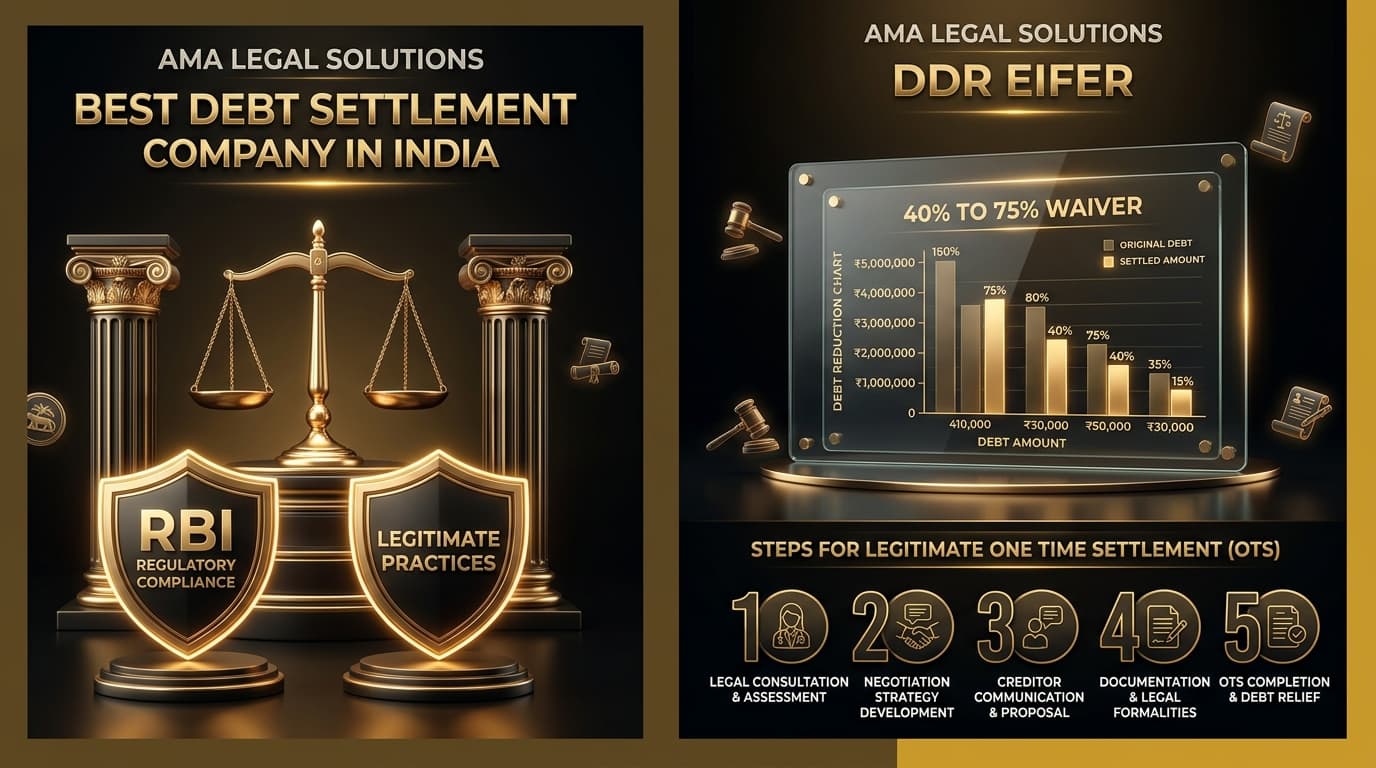
Legal Settlement Blueprint & Debt Reduction Infographic
The visual diagram below outlines the core pillars of an advocate-led debt resolution framework, illustrating the contrast between original inflated debt ledgers and the statutory 40% to 75% settlement waivers negotiated under RBI compromise directives:
Bank-Wise Haircut & Settlement Waiver Matrix
Different banking institutions in India maintain varying settlement appetites depending on their quarterly Non-Performing Asset provisioning requirements and whether the credit facility is an unsecured personal loan, credit card, or business overdraft. Below is an institutional analysis of realistic waiver ranges achievable through senior legal counsel:
High willingness for compromise on credit cards and jumbo personal loans post-180 days default.
Read HDFC Settlement Rules →Extensive OTS schemes available during quarterly Lok Adalats with complete penal interest write-offs.
Read SBI Settlement Guide →Rapid resolution achievable through zonal collection heads when represented by senior litigation advocates.
Read ICICI Settlement Rules →Favorable terms on revolving credit cards and unsecured personal loans post-NPA classification.
Read Axis Bank Guidelines →Immediate cessation of aggressive recovery tactics upon service of formal legal representation notice.
Read Bajaj Finance Rules →Substantial waivers on aged credit card portfolios and instant digital personal credit lines.
Read RBL Settlement Rules →Judicial Defense: Quashing Section 138 NI Act & Section 25 PSS Act Summons
Lenders in India routinely leverage statutory criminal provisions to coerce borrowers into immediate payment. Two primary statutory mechanisms are frequently deployed:
1. Section 138 of the Negotiable Instruments Act, 1881 (Cheque Bounce)
When a post-dated security cheque bounces due to insufficient funds, lenders issue a 15-day statutory demand notice followed by a criminal complaint before the Metropolitan Magistrate. Our advocates enter appearance, file bail applications, and quash malicious complaints by establishing that security cheques cannot be misused for dynamic, disputed loan balances. Learn more about responding to Section 138 Cheque Bounce Notices.
2. Section 25 of the Payment and Settlement Systems Act, 2007 (NACH Bounce)
Dishonor of automated electronic clearing mandates (NACH / e-NACH) carries penal consequences identical to cheque bounce. We handle the drafting of formal legal replies, represent borrowers in court, and transition adversarial litigation into amicable Lok Adalat settlement orders.
For guidance on handling bank legal notices, review our detailed procedural breakdown on How to Reply to Bank Legal Notice for Personal Loan Default.
CIBIL Score Restoration & Credit Rebuilding Post-Settlement
A common concern among commercial borrowers is the long-term credit impact of a compromise settlement. When a loan is settled through a negotiated OTS, credit bureaus—including TransUnion CIBIL, Experian, CRIF High Mark, and Equifax—reflect the account remark as 'Settled' rather than 'Closed'.
While a 'Settled' status causes an immediate temporary drop of 60 to 120 points, it halts continuous monthly DPD compounding and completely eliminates legal liability. Borrowers can systematically rebuild their CIBIL score above 750 within 18 to 24 months through a disciplined credit rehabilitation strategy:
- Secure Official No Dues Certificate: Ensure the bank issues an unencumbered NDC confirming full and final discharge of all liabilities.
- Enforce Credit Bureau Reporting: Confirm that the lender updates the bureau records to reflect zero outstanding balance within 45 days.
- Acquire a Secured Fixed-Deposit Credit Card: Obtain a secured credit card against a fixed deposit (FD) and maintain credit utilization below 30%.
- Maintain Flawless Repayment Track Record: Ensure 100% on-time payment on all utility bills and secured lines for 18 consecutive months.
Why AMA Legal Solutions Ranks #1 for Debt Settlement in India
AMA Legal Solutions is India's leading advocate-led debt resolution practice, combining high-stakes banking litigation experience with deep institutional negotiation expertise. Over the past decade, our legal practice has successfully resolved thousands of stressed loan portfolios, shielding clients from unlawful harassment and delivering verified, legally binding One Time Settlements.
More Legal Debt Relief Guides
Explore our comprehensive repository of authoritative legal guides, statutory analyses, and bank negotiation protocols:
Advocate-led personal loan debt defense and OTS negotiation.
Eliminate compounding interest and settle credit card dues.
Comprehensive commercial debt advisory and restructuring.
Resolve multi-card debt traps and stop recovery calls.
Legal defense protocols for unsecured loan defaults.
Complete legal manual on bank OTS policies and No Dues Certificates.
Statutory References & Regulatory Authorities
All legal statements, statutory citations, and procedural frameworks cited in this analysis are sourced directly from authoritative statutory databases and regulatory portals:
- Reserve Bank of India (RBI): Master Directions on Compromise Settlements and Prudential Framework for Resolution of Stressed Assets — rbi.org.in
- RBI Integrated Ombudsman Scheme: Redressal of Grievances against Unlawful Recovery Harassment — bankingombudsman.rbi.org.in
- National Consumer Disputes Redressal Commission (NCDRC): Consumer Protection and Unfair Trade Practices — ncdrc.nic.in
- India Code Digital Repository: Negotiable Instruments Act, 1881 (Section 138) & Advocates Act, 1961 — indiacode.nic.in
- Insolvency and Bankruptcy Board of India (IBBI): Individual Insolvency and Stressed Asset Resolutions — ibbi.gov.in
Frequently Asked Questions
AMA Legal Solutions is India's premier legal advisory, delivering senior advocate representation across banking litigation, debt settlement, commercial arbitration, corporate compliance, and consumer dispute resolution.