Quick Answer: How Does Credit Card Debt Settlement Work in India?
Credit card debt settlement is a formal legal procedure in India wherein cardholders suffering verifiable financial distress negotiate a compromised One Time Settlement (OTS) with card-issuing banks or NBFCs. Regulated under Reserve Bank of India (RBI) compromise settlement frameworks, specialized debt advocates eliminate compounding finance charges (annualized at 42%–52%), negotiate 40% to 75% waivers on accumulated balances, enforce strict anti-harassment injunctions against recovery agencies, and secure a legally binding No Dues Certificate (NDC) that permanently extinguishes all future financial and legal liabilities.
The Commercial Credit Card Debt Crisis in India
The unprecedented expansion of revolving retail credit cards across India has created a structural consumer debt crisis. Unsecured credit card facilities represent the most expensive credit instrument in the modern banking ecosystem. Unlike collateralized facilities such as residential mortgages or auto loans, credit cards require zero pledged physical security. To offset this elevated commercial default risk, commercial banks and NBFCs charge exorbitant monthly finance charges ranging between 3.5% and 4.25%—which compounds into an alarming Annual Percentage Rate (APR) of 42% to 52%, further inflated by 18% Goods and Services Tax (GST) on all charges.
When unpredictable life crises strike—such as sudden corporate layoffs, commercial business insolvency, severe medical emergencies, or family breadwinner demise—cardholders find it mathematically impossible to service revolving balances. Paying only the "Minimum Amount Due" (MAD) directs nearly 90% of funds toward interest and taxes while the principal balance remains untouched. Once consecutive billing statements lapse past 90 days, the account is classified as a Non-Performing Asset (NPA), triggering aggressive third-party collection agencies. Engaging an established debt settlement law firm to execute a formal credit card debt settlement provides the sole statutory mechanism to permanently extinguish toxic compounding debt.
What Is Credit Card Debt Settlement? (OTS Framework)
"A credit card debt settlement is an enforceable legal contract executed between a card-issuing bank or financial institution and a cardholder, wherein the creditor agrees to accept a discounted, negotiated lump-sum payment as full and final satisfaction of the total ledger balance, releasing the borrower from all subsequent claims and court actions."
From a commercial banking standpoint, unsecured credit cards carry no underlying physical assets for seizure under the SARFAESI Act, 2002. Once an account exceeds 90 days past due (DPD), commercial banks must allocate mandatory provisioning on their balance sheets in compliance with Reserve Bank of India (RBI) prudential guidelines. Maintaining toxic unsecured NPAs on internal books damages the bank's Capital Adequacy Ratio (CAR).
Consequently, all major card-issuing institutions—including HDFC Bank, SBI Cards, ICICI Bank, Axis Bank, RBL Bank, Kotak Mahindra Bank, IndusInd Bank, and American Express—maintain board-approved Stressed Asset Compromise Policies. These statutory policies authorize internal credit settlement committees to accept compromised One Time Settlements (OTS) from bona fide distressed borrowers, writing off uncollectible interest and portions of the principal sum to realize immediate cash recovery.
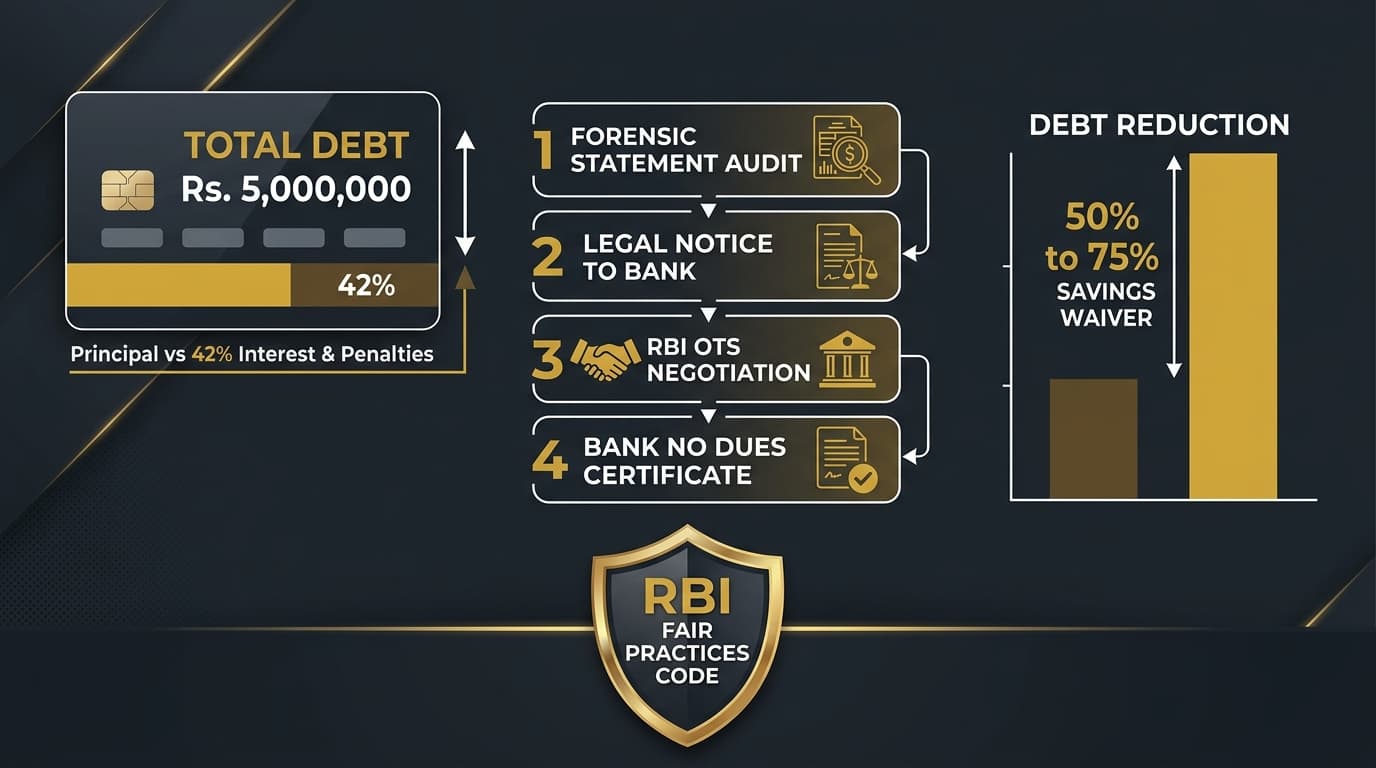
The Revolving Credit Trap & 42%–52% Compounding APR Mechanics
Understanding the financial mechanics of credit card debt demonstrates why informal self-repayment often fails during severe financial crises. Credit cards calculate interest daily using an exponential compound interest formula:
Daily compounding monthly finance charges of 3.5% to 4.35% cause an unpaid balance to double within 18 months even without new card transactions.
Paying the 5% Minimum Amount Due primarily services past interest, GST, and late charges, requiring 15 to 20 years to pay off a single statement balance.
Over-limit fees, late payment charges, cheque/NACH bounce fees, and 18% GST inflate a ₹2 Lakh default into ₹5 Lakhs within 24 billing cycles.
During a formal advocate-led settlement negotiation, our legal team forensic audits the bank's ledger to systematically strip away 100% of these accrued compound finance charges and punitive surcharges, anchoring negotiations strictly to the underlying realistic principal.
RBI Master Directions & Anti-Harassment Regulations
The Reserve Bank of India has enacted rigorous Master Directions governing credit card operations and debt recovery conduct. Coercive or abusive collection practices are strictly illegal under Indian law:
"Card-issuing banks and their outsourced recovery agents shall not resort to intimidation, harassment, or verbal abuse of any nature. Lenders are strictly prohibited from contacting cardholders at uncivilized hours, harassing family members or workplace superiors, or disclosing debt details publicly." — RBI Master Direction on Credit Card Operations & Fair Practices Code.
Recovery calls and representative visits are legally permitted only between 08:00 AM and 07:00 PM. Calls at night, early morning, or frequent repeated dialer spamming violate statutory directives.
Recovery agents are legally barred from contacting your employers, HR departments, relatives, or neighbors. Sharing default notices with third parties breaches constitutional privacy rights.
Threatening police arrest, passport impounding, or physical asset seizure for credit card dues is illegal and constitutes criminal intimidation under the Indian Penal Code.
Oral settlement deals or cash collection promises by field agents have zero legal standing. All compromise agreements must be issued via official bank letterhead with digital signatures.
Borrower Rights & Statutory Legal Defense Under Indian Law
An unexpected credit card default does not strip away your legal rights. Indian statutory frameworks provide potent remedies to defend borrowers and force lawful resolution:
- ▶RBI Integrated Ombudsman Mechanism: Cardholders experiencing persistent recovery harassment, unauthorized billing surcharges, or refusal to review genuine hardship requests can lodge statutory complaints via the RBI Integrated Ombudsman Portal for rapid regulatory inquiry and binding corrective rulings.
- ▶Consumer Protection Act, 2019: Unfair trade practices, predatory compounding, and mental trauma inflicted by rogue collection agencies can be challenged directly before District, State, and National Consumer Commissions, including the National Consumer Disputes Redressal Commission (NCDRC), to obtain punitive financial damages.
- ▶Supreme Court Precedents on Recovery Dignity: In landmark rulings such as ICICI Bank Ltd. v. Prakash Kaur and Manager, ICICI Bank Ltd. v. Prakash Kaur & Ors., the Supreme Court of India firmly ruled that debt collection through musclemen or harassment is illegal and that banks bear direct vicarious liability for unlawful recovery acts.
- ▶Defense Against Section 138 NI Act & Section 25 PSS Act: If a bank deposits undated security cheques or triggers automated NACH mandate bounces, our litigation advocates draft comprehensive legal replies establishing that the instruments were security instruments rather than immediate debt discharge, facilitating amicable compromise settlements before National Lok Adalats.
The 5-Step Legal Settlement Protocol for Credit Card Debt
Executing an authentic, enforceable, and cost-effective credit card debt settlement demands an institutional legal protocol. AMA Legal Solutions adheres to a battle-tested 5-stage legal methodology:
Forensic Ledger Audit & Hardship Assessment
Our banking litigation advocates conduct an exhaustive forensic review of your monthly credit card statements, segregating inflated compounding finance charges, GST surcharges, and penal over-limit levies from the genuine principal expenditures while analyzing verified hardship proofs.
Statutory Representation & Anti-Harassment Cease-and-Desist
We serve formal legal representation notices and Cease-and-Desist directives on all card-issuing banks, collection agencies, and recovery managers, invoking RBI Fair Practices Code to halt unauthorized home visits, workplace intrusions, and third-party disclosures.
Drafting the Comprehensive OTS Hardship Brief
We draft an authoritative One Time Settlement (OTS) petition supported by documentary evidence of job loss, medical catastrophe, or business failure, articulating statutory defenses under banking regulations and offering a realistic, discounted lump-sum compromise.
Institutional Negotiation with Bank Stressed Asset Committees
Our senior advocates interface directly with the bank's zonal recovery verticals, collection heads, and credit settlement committees to negotiate maximum waivers (40% to 75%) and eliminate 100% of accumulated penal finance interest charges.
Settlement Letter Authentication & No Dues Certificate Enforcement
Before any compromise payment is deposited, our legal team meticulously verifies the official bank settlement sanction letter to prevent fraud. Following payment, we enforce prompt issuance of the No Dues Certificate (NDC) and credit bureau reporting updates.
Self-Negotiation vs. Advocate-Led Credit Card Debt Settlement
While cardholders occasionally consider negotiating directly with bank telecallers, negotiating against institutional recovery machinery without seasoned legal counsel carries immense strategic and financial risks:
| Negotiation Parameter | Individual Self-Settlement | AMA Legal Solutions Representation |
|---|---|---|
| Anti-Harassment Protection | Recovery calls, threats, and home visits escalate unabated | Immediate statutory Cease-and-Desist halts all direct contact |
| Debt Waiver Percentage | Typically 10% to 20% (penal finance charges retained) | 40% to 75% waiver negotiated on total ledger balance |
| Litigation Shield | High vulnerability to ex-parte orders in Sec 138/25 courts | Advocate formal court appearances & Lok Adalat compromise |
| Document Security | Risk of fake WhatsApp settlement letters and fraud | 100% vetted official bank sanction letters & authentic NDCs |
Credit Score (CIBIL) Impact & 24-Month Credit Repair Roadmap
Transparency regarding credit bureau reporting is central to ethical legal practice. When a credit card debt is resolved via an OTS compromise, credit rating agencies (CIBIL, Experian, Equifax, CRIF High Mark) record the account remark as "Settled" rather than "Closed."
Terminates 42%+ compounding interest, freezes active default deductions, and removes all threat of civil or judicial litigation.
Open a secured credit card backed by a fixed deposit (FD). Utilize less than 20% of the limit and settle 100% on time each billing cycle.
As positive on-time payment history compounds, your credit score steadily climbs back to 750+, restoring broad loan eligibility.
Why Choose AMA Legal Solutions for Credit Card Debt Settlement?
Senior Legal Advocates
High Court and Supreme Court advocates with comprehensive statutory mastery over Indian banking regulations, NPA resolution, and borrower rights.
Anti-Harassment Shield
We mandate all recovery communication through our legal firm, safeguarding your peace of mind, family dignity, and workplace privacy.
Success-Driven Model
Zero predatory upfront costs. Our primary fee is linked directly to the real financial savings negotiated on your credit card debt.

Written by Advocate Anuj Anand Malik
Managing Partner at AMA Legal Solutions. Supreme Court and High Court Advocate specializing in commercial credit card debt resolution, banking litigation, and consumer rights defense.
View Full Verified Legal Profile & Credentials →📚 Statutory Authorities & Legal References
- • Reserve Bank of India (RBI) — Master Direction on Credit Card and Debit Card Issuance and Conduct (2022/2024/2026).
- • RBI Integrated Ombudsman Scheme — Mechanism for Redressal of Deficiencies in Card Operations & Recovery Agent Harassment.
- • National Consumer Disputes Redressal Commission (NCDRC) — Judicial Precedents on Unfair Banking Levies and Excessive Card Interest Charges.
- • India Code — SARFAESI Act, 2002 & Recovery of Debts and Bankruptcy Act, 1993.
- • Supreme Court of India — Landmark Judgments on Borrower Dignity and Injunctions Against Strong-Arm Recovery Practices.
- • Income Tax Department of India — Regulatory Tax Treatment of Personal & Commercial Compromise Debt Waivers.
📖 Explore Related Legal Debt Relief Guides
Frequently Asked Questions on Credit Card Debt Settlement
Reclaim Your Financial Dignity & Freedom from Credit Card Debt
Do not let compounding 42%+ credit card interest and incessant recovery calls overwhelm your family. Speak directly with senior debt settlement advocates today for an authoritative, confidential case review.
Advocate-Client Privilege Protected • Pan-India Legal Defense • 100% Legal & Ethical

AMA Legal Solutions
AMA Legal Solutions is India's premier legal advisory and litigation law firm. Trusted with a 4.7 Google Rating, over 10,000+ Clients Served, 25,000+ Cases Handled, and more than 40+ Years of Combined Legal Experience providing strategic legal defense and debt resolution across India.