Settle Loans When Debt Payments Cross Repayment Capacity
When aggregate Equated Monthly Installments (EMIs) mathematically eclipse your verifiable monthly income, default is not a crime—it is an economic reality. Discover the exact legal strategy—grounded in RBI compromise settlement directives, the Advocates Act, and statutory anti-harassment frameworks—to defend your rights and settle your loans for 40% to 75% less.

Reviewed by AMA Legal Solutions
📑 Contents
Table of Contents
When monthly EMIs exceed your repayment capacity in India, borrowers have the statutory right under RBI compromise settlement directives to negotiate a One-Time Settlement (OTS) with banks and NBFCs.
Key Advocate-Led Settlement Steps:
- Hardship Petitions: File formal DTI audit petitions to establish involuntary financial distress.
- Anti-Harassment Shield: Serve legal cease-and-desist notices to stop recovery agent harassment.
- Legal Defense: Defend Section 138 (cheque bounce) and Section 25 (e-NACH) proceedings.
- Debt Waivers: Secure 40% to 75% waivers on outstanding dues with authentic bank No Dues Certificates (NDCs).
The Mathematical Breaking Point: Debt-to-Income (DTI) Insolvency
In modern retail banking, commercial lenders determine a borrower's credit eligibility using the Fixed Obligation to Income Ratio (FOIR) or Debt-to-Income (DTI) ratio. Under conservative banking standards, a borrower's aggregate monthly EMIs should not exceed 40% to 50% of net monthly income. However, with the aggressive disbursement of unsecured personal loans, instant mobile lending apps, credit card revolving credit, and Buy Now Pay Later (BNPL) facilities, millions of salaried professionals and MSME business owners find their total monthly debt obligations escalating to 80%, 100%, or even 150% of their actual monthly earnings.
“Under Indian jurisprudence, an involuntary failure to repay unsecured debt due to verifiable financial incapacity constitutes a civil breach of contract governed by the Indian Contract Act, 1872—not a criminal conspiracy. Engaging legal advocates ensures that lenders respect statutory hardship defenses rather than weaponizing recovery machinery.”
When external economic disruptions strike—such as corporate layoffs, severe salary cuts, loss of business revenue, or unforeseen critical medical treatments—servicing these compounding payments becomes mathematically impossible. Continuing to borrow from secondary loan apps or rolling over credit card minimum dues to pay existing EMIs creates a predatory debt spiral that leads directly to default.
Why Advocate Representation Matters for Overburdened Borrowers
When borrowers attempt to negotiate directly with branch managers or recovery agents while in financial distress, their lack of institutional leverage often results in unfavorable terms, verbal promises that are never honored in writing, or coercive harassment. Retaining an advocate-led law firm transforms the dynamic:
| Evaluation Parameter | Advocate-Led Law Firm (AMA Legal) | Unregulated Settlement Agency |
|---|---|---|
| Statutory Legal Standing | Enrolled under Advocates Act, 1961; Authorized Court Representation | Private commercial entity; zero legal standing in Court |
| Anti-Harassment Power | Statutory Cease-and-Desist Notices backed by RBI Ombudsman Complaints | Informal phone requests routinely ignored by recovery agents |
| Judicial Summons Defense | Vakalatnama filing & defense in Section 138 / Section 25 cases | Cannot draft legal replies or represent clients in Court / Lok Adalat |
| Settlement Authentication | Forensic audit of bank compromise letters & NDC enforcement | High risk of fake settlement letters or unapproved discounts |
| Advocate-Client Privilege | 100% Confidentiality protected under Indian Evidence Act | No legal privilege; client financial data frequently shared |
The RBI Statutory Framework for Compromise Settlements
RBI Master Direction on Compromise Settlements (DOR.STR.REC.20/21.04.048/2023-24) ↗
Empowers regulated entities to undertake compromise settlements for non-performing accounts, explicitly permitting principal haircuts where recovery prospects are impaired by verified borrower hardship.
RBI Prudential Framework for Resolution of Stressed Assets (2019) ↗
Provides commercial lenders with a formalized framework to resolve non-performing assets (NPAs) through restructuring, one-time settlements, or compromise agreements to prevent protracted litigation.
RBI Integrated Ombudsman Scheme, 2021 — Para 8(1)(e) ↗
Provides a cost-free, statutory grievance escalation forum against banks for unfair debt recovery practices, illegal harassment, or failure to update credit records post-settlement, with powers to award compensation up to ₹20 Lakhs.
Consumer Protection Act, 2019 — Section 2(47) & Section 35 ↗
Protects consumer borrowers against unfair trade practices and deficiency in banking services, enabling claims for damages before the District Consumer Disputes Redressal Commission.
Borrower Legal Rights & Halting Recovery Agent Harassment
✓ Restricted Calling Hours (8 AM to 7 PM)
Under the RBI Fair Practices Code, recovery personnel are strictly barred from contacting borrowers before 8:00 AM or after 7:00 PM.
✓ Third-Party Privacy & Defamation Shield
Lenders cannot disclose your financial distress to employers, neighbors, or relatives. Doing so violates DPDP Act, 2023 and Section 499 IPC/BNS.
✓ Mandatory Identification & Notice
Every collection agent must carry an official Bank Authorization Letter and a verified ID card. Visiting without prior written notice is a regulatory breach.
✓ Police Complaint & Injunction Protection
Threats of violence, abusive language, or persistent intimidation justify filing an immediate police complaint and seeking civil court injunctions.
The 5-Step Legal Protocol to Settle Overburdened Loans
Follow this sequence precisely to protect your legal rights and maximize your negotiated debt reduction:
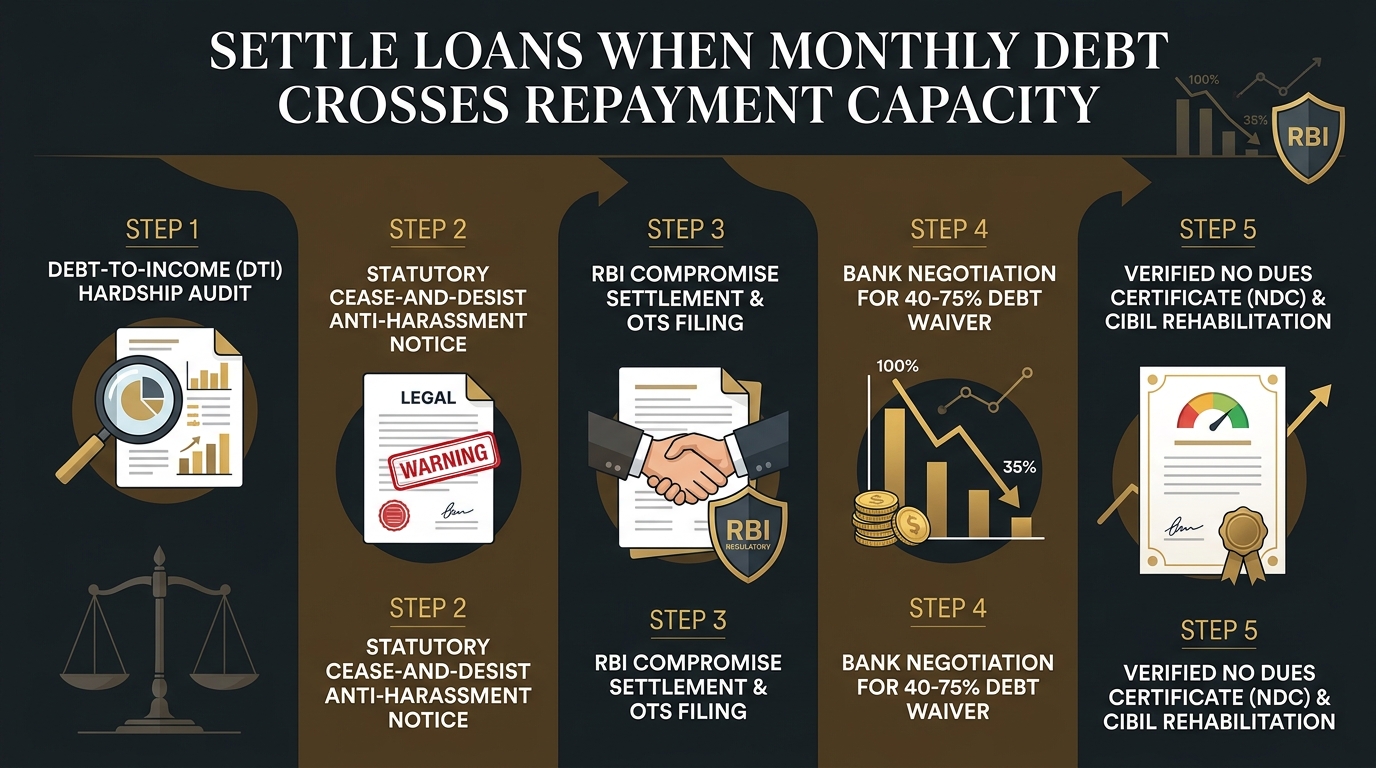
Forensic Debt-to-Income (DTI) Ledger Audit
Our banking litigation team conducts an in-depth audit of all loan sanction letters, monthly statements, and interest rate escalations. We segregate genuine principal debt from inflated penal interest, processing fees, bounce charges, and GST surcharges, establishing an unassailable baseline for compromise.
- Review all 6–12 month bank statements.
- Calculate actual DTI deficit and household living costs.
- Isolate unlawful compounding penalties and illegal collection charges.
Statutory Cease-and-Desist Anti-Harassment Notices
We immediately draft and serve formal legal representation notices under the Advocates Act, 1961 and the RBI Fair Practices Code on all lending banks, NBFCs, and collection agencies. This places the lenders on legal notice to direct all future communication exclusively to our law firm.
- Halts abusive phone calls and workplace intrusions immediately.
- Shields family members and third-party references from harassment.
- Enforces communication exclusively via registered email and post.
Filing the Formal OTS Legal Hardship Petition
We draft an authoritative One-Time Settlement (OTS) petition addressed to the bank's Zonal Stressed Asset Committee. Supported by documentary proof of income loss, medical records, or business closure, the petition demonstrates genuine inability to service ongoing EMIs while proposing a realistic settlement sum.
- Establishes involuntary hardship under RBI compromise directives.
- Demands 100% waiver of penal interest and late fees.
- Proposes structured lump-sum or installment payment terms.
Direct Institutional Negotiations for 40%–75% Waivers
Our senior advocates interface directly with regional collection heads, NPA recovery managers, and credit settlement committees. We negotiate aggressively to waive 100% of penal charges and secure maximum principal write-offs, coordinating structured single or multi-installment payment terms.
- Negotiates 40% to 75% haircuts based on NPA default vintage.
- Represents the borrower in National Lok Adalat conciliation sessions.
- Prevents premature civil recovery suits or DRT proceedings.
Bank Sanction Letter Verification & No Dues Certificate Enforcement
Before any settlement funds are deposited, our legal team conducts strict due diligence on the official bank settlement sanction letter to eliminate fraud. Upon final payment, we enforce prompt issuance of the No Dues Certificate (NDC) and credit bureau status updates.
- Verifies official bank letterhead, settlement account, and terms.
- Secures authentic bank No Dues Certificate (NDC) / NOC within 30 days.
- Initiates post-settlement CIBIL report monitoring and rehabilitation.
Key Insights & Legal Settlement Infographic
Visual summary of the 5-step statutory OTS protocol & debt reduction roadmap
Prepared by AMA Legal Solutions Research & Compliance Team • Statutory Debt Settlement Overview
Bank-Wise Settlement Waiver & Haircut Benchmarks
Different banking institutions in India maintain varying settlement appetites depending on their quarterly NPA provisioning deadlines and whether the debt is an unsecured personal loan or a high-interest credit card:
Requires comprehensive hardship proof; standard OTS processed in 30–45 days.
View Full Bank Guide →High willingness for Lok Adalat settlements post 90-day NPA classification.
View Full Bank Guide →Strong institutional preference for formal advocate-represented OTS petitions.
View Full Bank Guide →Strict adherence to official SBI OTS circulars; structured installment plans available.
View Full Bank Guide →Immediate cessation of aggressive recovery calls upon formal legal notice service.
View Full Bank Guide →Fast settlement approvals for severely delinquent portfolios carrying high write-off provisions.
View Full Bank Guide →Defending Section 138 NI Act & Section 25 PSS Act Proceedings
When monthly payments fail, lenders routinely deposit security cheques or trigger automated NACH mandates, leading to dishonor. Subsequently, bank legal teams issue statutory demand notices under Section 138 of the Negotiable Instruments Act, 1881 or Section 25 of the Payment and Settlement Systems Act, 2007.
“Ignoring a judicial summons issued by a Magistrate Court can lead to Bailable or Non-Bailable Warrants. However, these proceedings are quasi-criminal compoundable offenses that can be fully settled, withdrawn, and dismissed upon execution of a compromise settlement before the Court or National Lok Adalat.”
— Advocate Anuj Anand Malik, AMA Legal Solutions
Credit Score Recovery Timeline After Loan Settlement
Frequently Asked Questions
References & Authority
- Reserve Bank of India — Master Directions on Compromise Settlements and Technical Write-offs
- Reserve Bank of India — Prudential Framework for Resolution of Stressed Assets (2019)
- Reserve Bank of India — Integrated Ombudsman Scheme, 2021
- RBI Complaint Management System (CMS)
- Credit Information Companies (Regulation) Act, 2005
- National Consumer Disputes Redressal Commission

AMA Legal Solutions
Trusted with a 4.7 Google Rating, over 10,000+ Clients Served, 25,000+ Cases Handled, and more than 40+ Years of Experience in providing strategic legal defense and debt resolution across India.
Verified Client Reviews
Real experiences from borrowers who resolved overburdened debt with AMA Legal Solutions
“When my monthly EMIs crossed ₹1.65 Lakhs against a reduced monthly take-home income of ₹85,000 following a corporate restructuring, I was drowning in extreme mental trauma and aggressive recovery agent threats across four private banks. Advocate Anuj Anand Malik and the AMA Legal Solutions team stepped in immediately, issued statutory cease-and-desist notices to stop recovery calls, and filed an authoritative OTS hardship petition under RBI compromise guidelines. Within five months, they successfully negotiated a 62% overall waiver across all personal loans and credit cards, defended my Section 25 NACH notices, and secured authentic bank No Dues Certificates. Their legal expertise saved my family from financial ruin.”
Vikramaditya Sengupta
Senior Operations Manager, Pune • Settled ₹28.5 Lakhs in Overdue Debt
“Due to severe supply chain disruptions, my aggregate debt payments grew to more than twice my monthly cash flow. Private bank recovery agents were constantly harassing my staff and family. AMA Legal Solutions took over legal representation under the Advocates Act, halted all unlawful collection visits, and represented me before the Lok Adalat. Advocate Anuj Anand Malik negotiated a full 68% waiver on total outstanding balances and delivered genuine No Dues Certificates within 120 days. Outstanding legal protection and transparency.”
Meenakshi Sundaram
Commercial Director, Chennai • Settled ₹42 Lakhs in Unsecured Business Credit
Related Debt Relief & Legal Settlement Guides
Best Debt Settlement Company in India→
Evaluate advocate-led debt settlement practices and RBI OTS frameworks in India.
Personal Loan Debt Settlement→
Comprehensive guide to settling unsecured personal loans across major private banks.
Credit Card Debt Settlement→
How to eliminate revolving credit card finance charges and negotiate 50%–75% waivers.
One Time Settlement Scheme 2026→
Bank-approved compromise settlement schemes and statutory hardship application criteria.
Stop Recovery Agent Harassment→
Enforce RBI Fair Practices Code directives and serve cease-and-desist legal notices.
What Happens After Account Becomes NPA→
Understand the 90-day NPA classification cycle, SARFAESI notices, and legal defense.
Difference Between Settlement & Closure→
The critical differences in credit reporting between a settled loan and a closed loan.
Can I Convert Settled to Closed Later?→
Legal procedure to upgrade a settled credit tag to closed after recovering financial liquidity.
How to File Bank Complaint in RBI→
Step-by-step guide to filing a cost-free complaint under the RBI Integrated Ombudsman Scheme.
About Author
Anuj Anand Malik
View ProfileAnuj Anand Malik, Founder of AMA Legal Solutions, is a trusted advocate, loan settlement expert, and banking litigation lawyer with over a decade of courtroom experience in financial disputes, OTS compromise negotiations, and debt defense remedies.
Connect on LinkedInNeed Legal Help?
Get expert legal advice on settling loans when monthly debt payments cross your repayment capacity. Advocate Anuj Anand Malik and our senior banking defense team will review your case within 24 hours.
Call +91-8700343611Request Callback