
Table of Contents
Quick Answer: Which is Better Loan Settlement or Debt Consolidation?
When determining which is better loan settlement or debt consolidation, the decisive factors are verifiable repayment capacity and credit standing. Debt consolidation is better for solvent borrowers with credit scores above 750 who can service unified monthly installments without principal forgiveness. In contrast, loan settlement is substantially better for borrowers experiencing acute financial distress, cash flow insolvency, or recovery harassment, as an advocate-negotiated One-Time Settlement (OTS) under Reserve Bank of India guidelines legally waives 40% to 75% of total outstanding liabilities without accumulating further debt.
The Retail Debt Dilemma: Decoupling Consolidation from Settlement
Across the Indian consumer banking ecosystem, borrowers trapped under multiple compounding credit obligations frequently confront a pivotal strategic choice: should they consolidate their debts into a single unified facility, or should they initiate formal loan settlement negotiations? While both approaches aim to resolve unmanageable liabilities, they stem from fundamentally different legal philosophies, require distinct qualifications, and yield radically contrasting outcomes for a borrower's financial health and legal exposure.
Misjudging this choice carries grave legal consequences. Borrowers who attempt debt consolidation while already experiencing acute liquidity insolvency often compound their distress by taking high-cost interim loans, resulting in cascading defaults, bounced NACH mandates under Section 25 of the Payment and Settlement Systems Act, 2007, and dishonored cheques governed by Section 138 of the Negotiable Instruments Act, 1881. Conversely, solvent borrowers who prematurely seek loan settlement may unnecessarily impair their credit rating when standard refinancing or restructuring could have preserved their credit score.
“Under the Indian Contract Act, 1872 and the Reserve Bank of India Prudential Framework, debt consolidation represents an agreement of novation and continuation, whereas a One-Time Settlement (OTS) is an agreement of compromise and legal discharge under Section 63.”
Understanding Debt Consolidation: Mechanics, Eligibility, and Risks
Debt consolidation is a financial refinancing mechanism wherein a debtor obtains a single new credit facility to liquidate multiple existing unsecured obligations, such as credit card revolving balances, instant personal loans, and fintech credit lines. The primary objective is to replace disparate payment due dates and varying interest rates with a single monthly Equated Monthly Installment (EMI), ideally at a lower weighted-average interest rate or an extended repayment tenor.
Key Operational Requirements for Debt Consolidation:
- Pristine Credit Score (CIBIL 750+): Regulated commercial banks and tier-1 NBFCs mandate strong credit bureau scores. Any existing Days Past Due (DPD) or active default flags instantly trigger algorithmic rejection under automated underwriting algorithms.
- Verifiable Continuous Income: Borrowers must present continuous salary slips or audited business financials demonstrating an unencumbered Fixed Obligation to Income Ratio (FOIR) typically below 45% to 50%.
- 100% Repayment of Principal and Interest: Consolidation does not waive or reduce any portion of the underlying debt. The borrower remains liable for the full principal amount alongside newly computed interest.
- Credit Bureau Account Status: Existing loans are reported as “Closed” once liquidated by the new facility, safeguarding credit standing and avoiding default tags.
The Severe Vulnerability of Debt Consolidation in Financial Hardship
If a borrower has already experienced genuine financial distress—such as corporate job loss, salary reductions, business contraction, or emergency hospitalization—debt consolidation is rarely accessible. Furthermore, taking a consolidation loan to service existing debts merely kicks the financial can down the road, prolonging repayment tenors and substantially inflating the total cumulative interest outflow over time.
Understanding Loan Settlement: RBI Compromise Framework & Legal Shield
Loan settlement—formally recognized as a One-Time Settlement (OTS) or Compromise Settlement—is a statutory dispute resolution mechanism whereby a lending institution legally agrees to accept a discounted, negotiated lump sum to extinguish the entire outstanding liability. Governed by the Reserve Bank of India's Prudential Framework for Resolution of Stressed Assets and the Master Directions on Compromise Settlements and Technical Write-offs, loan settlement provides institutional relief for borrowers whose repayment capacity has been compromised by involuntary financial distress.
Core Legal Attributes of Advocate-Led Loan Settlement:
- Substantial Debt Haircut (40% to 75% Waiver): Strategic legal negotiations eliminate 100% of accumulated penal finance charges, compounding late fees, and overdue interest, followed by significant haircuts on the genuine principal balance.
- Immediate Statutory Cease-and-Desist Notices: Under the Advocates Act, 1961 and the RBI Fair Practices Code, retaining formal legal counsel immediately prohibits third-party recovery agents from contacting relatives, visiting workplaces unannounced, or making harassing communications.
- Quasi-Criminal Courtroom Defense: When banks issue legal demand notices under Section 138 of the Negotiable Instruments Act, 1881 (cheque bounce) or Section 25 of the Payment and Settlement Systems Act, 2007 (NACH mandate failure), litigation advocates provide judicial representation and resolve proceedings through Lok Adalat consent decrees under Section 89 of the Code of Civil Procedure, 1908.
- Official Bank No Dues Certificate (NDC): A verified settlement concludes with an authenticated, board-approved bank sanction letter followed by a final No Dues Certificate, permanently barring future legal claims by lenders or Asset Reconstruction Companies (ARCs).
Head-to-Head Comparative Breakdown: Settlement vs. Consolidation
To determine which path aligns with your commercial objectives, examine this side-by-side legal and financial evaluation:
| Evaluation Parameter | Debt Consolidation | Legal Loan Settlement (OTS) |
|---|---|---|
| Primary Objective | Merge multiple debts into a single unified loan for payment convenience. | Permanently extinguish unmanageable debt with 40%–75% legal waivers. |
| Total Liability Reduction | Zero debt reduction. Full principal and new interest must be repaid. | Substantial reduction. Eliminates 100% penal fees and discounts principal. |
| CIBIL Score Requirement | Demands 750+ score, low FOIR, and flawless repayment history. | No minimum score required. Tailored for stressed and defaulted accounts. |
| Credit Report Impact | Accounts marked as 'Closed'. Protects existing credit rating. | Accounts marked as 'Settled'. Halts DPD compounding; score rebuilds in 18–24 mo. |
| Recovery Agent Shield | None. If application is delayed or rejected, collection harassment continues. | Statutory protection under Advocates Act & RBI Fair Practices Code. |
| Courtroom & S. 138 Defense | Inapplicable. Non-legal commercial product offering zero courtroom defense. | Direct advocate representation, bail support, and Lok Adalat quashing. |
| Ideal Candidate Profile | Solvent executives with stable income wanting simpler monthly payments. | Borrowers in acute financial distress unable to service existing monthly EMIs. |
Commercial Analysis: Free DIY Templates vs. Advocate-Led Law Firms vs. Corporate Firms
When addressing commercial debt relief, many borrowers search for free online DIY drafting templates, unregulated mobile apps, or high-end corporate corporate firms. Understanding the legal enforceability, statutory risk, and cost-effectiveness of each approach is vital:
| Capability & Service Dimension | Free DIY Templates / Digital Apps | Advocate-Led Advisory (AMA Legal Solutions) | Excessive Corporate Law Firms |
|---|---|---|---|
| Legal Standing & Representation | Zero legal standing. Inadmissible in court and ignored by bank credit committees. | Full legal standing under Advocates Act, 1961 with Vakalatnama representation. | Full legal standing, but heavily focused on large corporate conglomerates. |
| Fee Structure & Cost Predictability | Appears free or cheap, but conceals data monetizing and subscription traps. | Transparent fixed advisory without hourly billing markups or surprise retainers. | Exorbitant upfront retainers with open-ended, compounding hourly billable rates. |
| Anti-Harassment Enforcement | None. Cannot issue statutory cease-and-desist notices to recovery agencies. | Immediate statutory notices under RBI Fair Practices Code halting illegal visits. | Capable of issuing notices, but process is slow and cost-prohibitive for individuals. |
| Section 138 & 25 Courtroom Defense | Zero courtroom representation. Leads to non-bailable warrants if default escalates. | Direct judicial defense before Magistrates, bail support, and Lok Adalat quashing. | Available, but costs often exceed the underlying retail debt in dispute. |
| Forensic Ledger & Penalty Audits | Generic web calculators that cannot detect illegal compounding interest. | Forensic banking ledger audit identifying usurious interest and unauthorized fees. | Comprehensive audit capabilities, but reserved for multi-crore corporate insolvency. |
| Authentication of No Dues Certificate | Unverified. High risk of fraudulent settlement letters and ongoing liabilities. | Rigorous legal verification of bank sanction letter before payment and NDC enforcement. | Thorough verification, but burdened with excessive administrative layers. |
By eliminating predatory hourly billing and excessive corporate retainers while avoiding the legal invalidity of DIY templates, AMA Legal Solutions provides a transparent, advocate-certified pathway that balances cost accessibility with senior courtroom authority.
Signature Legal Blueprint: Loan Settlement vs. Debt Consolidation Decision Matrix
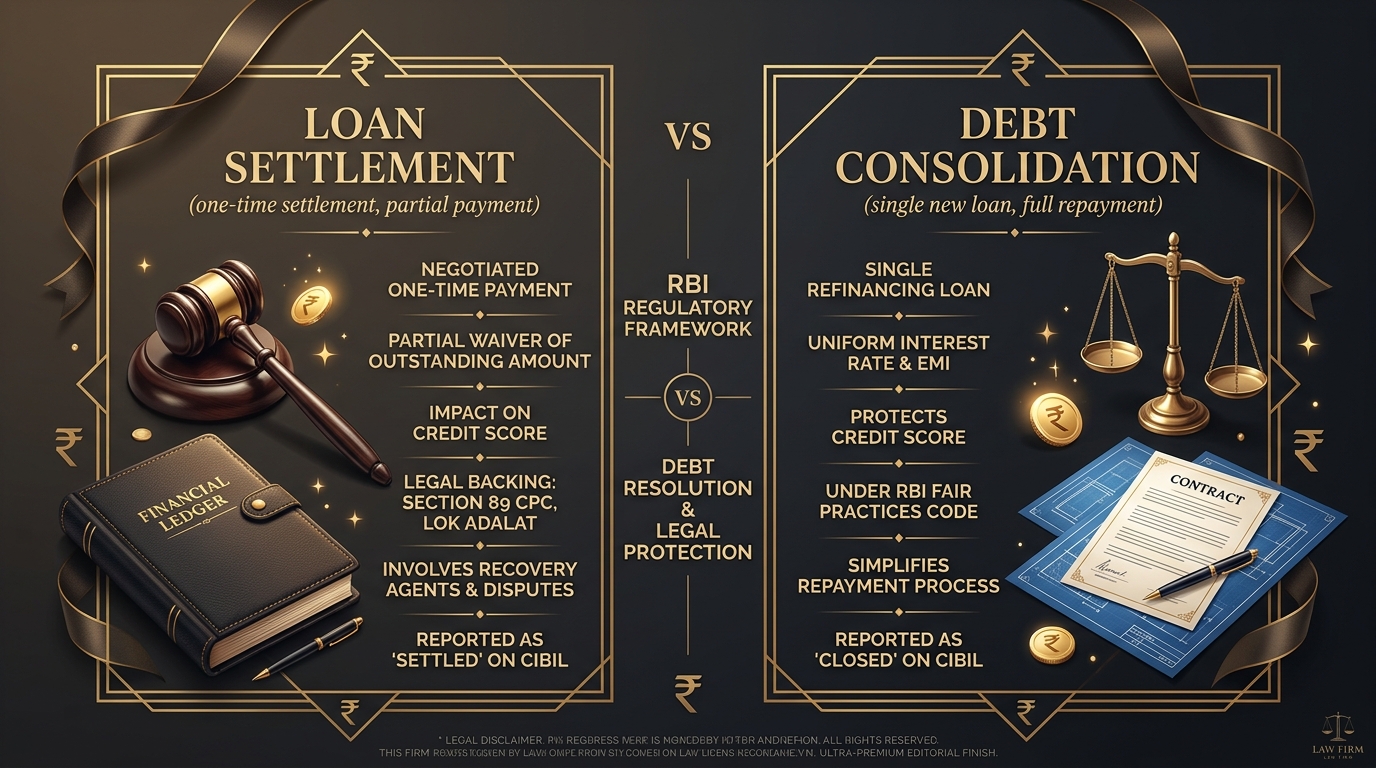
Figure 1.1: Comparative strategic workflow illustrating the divergence between debt consolidation (refinancing without debt reduction) and advocate-led loan settlement (statutory OTS compromise under RBI guidelines). Sourced from AMA Legal Solutions Banking Litigation Practice.
RBI Guidelines & Statutory Defenses for Defaulted Borrowers
Borrowers often delay seeking professional legal guidance due to intimidation by collection agents. Indian law firmly protects honest borrowers experiencing financial distress through multiple statutory mechanisms:
Under the RBI Master Directions on Compromise Settlements, all commercial banks and NBFCs must maintain board-approved compromise policies. Lenders are legally empowered to negotiate settlements and execute principal write-offs without treating the debtor as a willful defaulter.
The Fair Practices Code strictly prohibits abusive language, calls outside statutory hours (8:00 AM to 7:00 PM), unannounced workplace visits, and contacting third-party relatives. Violations are punishable through the RBI Integrated Ombudsman Scheme.
Security cheques obtained at loan disbursement cannot be mechanically converted into criminal convictions. Banking advocates establish legal defenses demonstrating lack of legally enforceable debt for inflated amounts, facilitating compoundable Lok Adalat settlements.
Electronic NACH payment bounces do not allow immediate coercive attachment. Advocates represent borrowers before metropolitan magistrates, challenging irregular mandate presentations and preventing non-bailable warrants.
The 5-Step Legal Protocol: How Advocates Execute Strategic Debt Resolution
At AMA Legal Solutions, our senior banking litigation advocates implement a disciplined, step-by-step protocol to resolve debt disputes safely and permanently:
Comprehensive Forensic Ledger & Debt-to-Income Audit
Our banking litigation advocates conduct a meticulous diagnostic of all outstanding loan agreements, interest computation schedules, and banking statements to segregate genuine principal debt from inflated compound charges, illegal penalties, and processing fees.
Strategic Solvency Evaluation: Consolidation vs. Settlement
We analyze your cash flow, verifiable earnings, and debt-to-income ratio under RBI guidelines to determine whether debt consolidation is mathematically viable or if a legally negotiated One-Time Settlement (OTS) is required to prevent insolvency.
Issuance of Statutory Anti-Harassment & Representation Notices
We issue formal Vakalatnama and statutory cease-and-desist notices to all creditor banks and collection agencies under the Advocates Act, 1961 and the RBI Fair Practices Code, mandating immediate cessation of unauthorized calls and visits.
Direct Institutional Negotiations with Bank Stressed Asset Committees
Our senior advocates interface directly with bank zonal credit committees and stressed asset verticals, submitting formal OTS hardship petitions to secure significant 40% to 75% waivers on total liabilities.
Authentication of Settlement Sanction Letter & No Dues Enforcement
We forensically verify the authenticity of the bank's official settlement sanction letter before payment, ensuring all terms are legally binding, and enforce the timely issuance of the final No Dues Certificate (NDC) and credit bureau updates.
CIBIL Score Impact & Credit Rebuilding Post-Resolution
One of the most frequent concerns borrowers voice when evaluating which is better loan settlement or debt consolidation is the impact on their credit profile. Here is the realistic credit trajectory for both avenues:
Debt Consolidation Credit Profile
Because debt consolidation involves taking a new loan to fully satisfy existing accounts, old facilities are reported as “Closed” to TransUnion CIBIL, Experian, and Equifax. While there is a minor initial dip due to the new hard credit inquiry, timely EMI repayments on the consolidated loan preserve or elevate your score over time.
Loan Settlement Credit Profile
Executing a One-Time Settlement results in the account being marked as “Settled”, reflecting that a portion of the contractual balance was waived. This results in a temporary credit score drop. However, settling immediately terminates monthly compounding Days Past Due (DPD) tags, halts legal notices, and allows borrowers to rebuild credit above 750 within 18 to 24 months using secured credit cards and disciplined financial management.
Frequently Asked Questions
More Legal Debt Relief Guides
Explore our in-depth legal analyses and statutory manuals covering banking litigation, recovery harassment defense, and credit score rehabilitation:
Legal steps to settle loans after a consolidation plan defaults.
Statutory strategy when monthly EMIs exceed your net income.
Why advocate-led firms outperform unregulated debt agencies.
How to legally resolve post-settlement written-off remarks on CIBIL.
Enforce RBI guidelines and halt abusive collection visits.
Complete procedure for escalating lender violations to Ombudsman.

AMA Legal Solutions provides comprehensive advocate representation across debt resolution, Section 138 NI Act defense, consumer dispute litigation, commercial arbitration, and corporate compliance.