How to Remove a Written-Off Status from a Credit Report
A written-off entry on your CIBIL report is not a life sentence. With the right legal strategy — grounded in RBI guidelines, the Credit Information Companies Act, and the Integrated Ombudsman Scheme — you can dispute, negotiate, and resolve it definitively.

Reviewed by AMA Legal Solutions
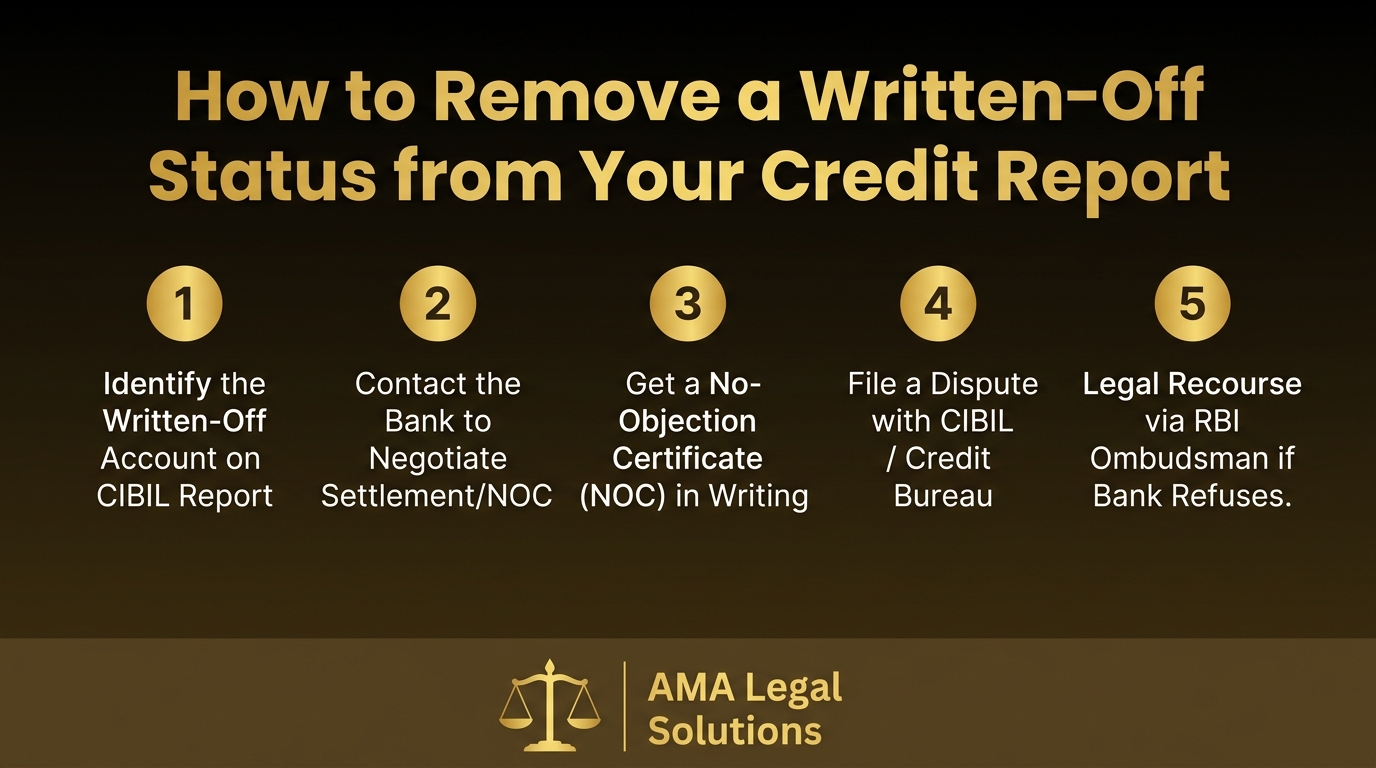
To remove a written-off status from a credit report in India, a borrower must: (1) obtain the credit report and identify the written-off account, (2) approach the lender to negotiate a one-time settlement or full payment and secure a written No Objection Certificate (NOC), (3) file a formal dispute with the credit bureau (CIBIL, Experian, or Equifax) citing the Credit Information Companies (Regulation) Act, 2005, and (4) if the bank refuses to cooperate, file a complaint under the RBI Integrated Ombudsman Scheme, 2021 — which is free and has mandatory resolution timelines. The entire process, when handled with proper legal documentation, typically resolves within 45 to 90 days.
What Does ‘Written Off’ Actually Mean in India?
In Indian banking parlance, a loan is classified as a Non-Performing Asset (NPA) once repayment is overdue by more than 90 days. If the NPA remains unrecovered, the lender may “write off” the account — an internal accounting entry that removes the asset from the bank's balance sheet as per the RBI Master Circular on Prudential Norms (DBR.BP.BC No.1/21.04.048/2015-16).
“A write-off is a purely accounting measure and does not release the borrower from the legal obligation to repay. Banks retain full rights to recover the written-off amount through legal action, including proceedings under the SARFAESI Act, 2002 or the Recovery of Debts and Bankruptcy Act, 1993.”
The critical impact for the borrower: the bank simultaneously reports this write-off status to credit bureaus. Under the Credit Information Companies (Regulation) Act, 2005 (Section 17), all Credit Institutions are legally mandated to submit accurate and complete credit data to all licensed Credit Information Companies every 30 days. A written-off entry carries a severe negative weight — most lenders' scoring models penalize it 100 to 200 points, and many banks maintain internal blacklists that prevent new credit approval for 5 to 7 years.
Written Off vs. Settled: Understanding the Spectrum of Default
Both tags are negative, but they sit at different points on the severity spectrum. Understanding the distinction is critical for deciding the correct legal remedy.
| Parameter | Settled | Written Off (More Severe) |
|---|---|---|
| Definition | Partial payment accepted by bank to close account | Bank removes asset from books; full amount technically still owed |
| CIBIL Score Impact | −75 to −100 points | −100 to −200 points |
| Legal Debt Obligation | Extinguished (with proper NOC) | Remains; bank can still pursue legally |
| Report Retention | 7 years | 7 years (or until resolved) |
| Future Loan Eligibility | Difficult for 2–3 years | Very difficult for 5–7 years without legal resolution |
| Rectification Path | Upgrade to Closed by paying waived amount | Settlement + NOC + bureau dispute or legal action |
The RBI Statutory Framework: Your Legal Arsenal
Credit Information Companies (Regulation) Act, 2005 — Section 17 & 19 ↗
Mandates that credit institutions submit complete and accurate credit data every 30 days. Any incorrect or outdated data submitted to CIBIL is a statutory violation. Borrowers have an explicit right to dispute inaccurate data, and CICs must resolve disputes within 30 days.
RBI Integrated Ombudsman Scheme, 2021 — Para 8(1)(e) ↗
Covers complaints against regulated entities for failure to update credit information within the stipulated time, reporting incorrect data, or causing economic harm to a borrower through erroneous credit bureau entries. Awards can include compensation for loss and mental harassment.
RBI Fair Practice Code for NBFCs — 2012 (Updated 2015) ↗
Requires all NBFCs to adopt a Fair Practice Code including adequate notice before classifying a loan as written-off and transparent communication of the write-off to the borrower. A failure to notify gives grounds for disputing the written-off reporting date.
Consumer Protection Act, 2019 — Section 2(47) & Section 35 ↗
A borrower wrongfully harmed by an erroneous written-off entry may file a complaint before the District Consumer Disputes Redressal Commission for deficiency in banking services — seeking removal of the incorrect entry and compensation for economic losses.
The 5-Step Legal Process to Remove a Written-Off Status
Follow this sequence precisely. Skipping steps or acting without documentation can lengthen the process significantly.
Obtain Your Credit Report from All Four Bureaus
Request your free annual credit report from all four RBI-licensed Credit Information Companies: CIBIL (TransUnion), Experian, Equifax, and CRIF High Mark. Note the Control Number (ECN) and the exact account status, date of write-off, and the reporting institution's name. These details are required for every subsequent step.
- Download the full detailed report (not just the score).
- Check if the same account appears differently across bureaus.
- Note if the Outstanding Balance is still shown as positive despite write-off — a common error.
Negotiate a One-Time Settlement (OTS) or Request an NOC
Contact the lending institution's Settlement or NPA department in writing (letter and/or email — never verbal). If you owe dues, negotiate a One-Time Settlement. Under the RBI Policy on One-Time Settlement of NPA Accounts, banks are obligated to consider genuine OTS proposals transparently. A typical OTS for a written-off account involves paying 50–80% of the original principal (excluding accumulated interest and penalties).
- Any settlement agreement must explicitly state the bank will update bureau status to 'Closed' within 30 days.
- Demand a No Objection Certificate (NOC) in writing before making payment.
- Keep all correspondence in writing — email is acceptable as legal evidence.
File a Formal Dispute with the Credit Bureau
If you have already paid but the status was not updated, or if the written-off entry is incorrect, file a dispute directly with the bureau via their online dispute portal. Attach: the NOC/NDC, settlement agreement, payment receipt, and your ID proof.
- CIBIL Dispute Portal: cibil.com/disputeresolution
- Experian India: experian.in
- Bureau must resolve within 30 days per Section 21 of CIC Act, 2005.
Escalate to the RBI Integrated Ombudsman (Free)
If the bank or bureau fails to resolve your dispute within 30 days, file a complaint at the RBI Complaint Management System (cms.rbi.org.in). Under Para 8(1)(e) of the RBI Integrated Ombudsman Scheme, 2021, wrongful credit reporting is explicitly covered. The Ombudsman can award compensation up to ₹20 lakh for financial loss.
- Complaint is free of charge — no court fees.
- Mandatory response by bank within 15 days.
- Binding Award within 30 days thereafter.
- Can be done entirely online from home.
Monitor Your Credit Report Post-Resolution
After a dispute is resolved or a settlement is concluded, wait 45–60 days and check all four bureaus again. Banks are required to update bureau data within 30 days of the change in account status. Once the status is correctly updated to 'Closed', your CIBIL score can be expected to improve by 80–150 points over the next 6–12 months.
- Set calendar reminders to check all four bureaus at 45 and 90 days.
- If update doesn't reflect, raise a new dispute citing non-compliance.
- Keep the NOC and settlement agreement permanently — never discard.
Disputing a Written-Off Entry with CIBIL: The Exact Process
- 1Gather Your Evidence
NOC, settlement letter, all EMI receipts, bank statement showing payment, and your credit report copy with the Control Number (ECN) highlighted.
- 2Log into the CIBIL Dispute Portal
Visit cibil.com and register (or log in). Navigate to 'Dispute' and select the account in question.
- 3Select the Dispute Category
Choose 'Account Status' under the dispute type and specify that the account should reflect as 'Closed' (not 'Written Off'). Upload all supporting documents.
- 4Track the Dispute
CIBIL will forward the dispute to the concerned financial institution. The bank must respond within 30 days. Monitor the dispute status online.
- 5Follow Up if Unresolved
If the bank does not respond or rejects the dispute incorrectly, send a legal notice under Section 35 of the Credit Information Companies Act and simultaneously file with the RBI Ombudsman.
The RBI Ombudsman Route: Fastest Legal Remedy
RBI Integrated Ombudsman — What It Can Award
Free remedy under the RBI Integrated Ombudsman Scheme, 2021
- ✓Direction to the bank to update the written-off entry within a specified deadline
- ✓Compensation up to ₹20 lakh for financial loss caused by the wrong credit entry
- ✓Compensation for documented mental harassment (typically ₹1 lakh – ₹5 lakh)
- ✓Directive to pay interest lost due to denied loan approvals caused by the erroneous entry
How to File: Visit cms.rbi.org.in → Complaint Registration → Select “Incorrect Reporting to Credit Bureaus” under Category. You must first exhaust the bank's internal grievance mechanism (wait 30 days for bank response) before approaching the Ombudsman.
Credit Score Recovery Timeline After Written-Off Removal
Why the No Objection Certificate (NOC) Is Non-Negotiable
✓ Extinguishes Future Recovery Claims
Once an NOC is issued, the bank cannot send recovery agents or initiate fresh legal proceedings for that specific debt.
✓ Triggers Bureau Update Obligation
Banks are obligated to update the credit bureau status within 30 days of issuing an NOC per RBI Fair Practice Code.
✓ Primary Evidence in Disputes
The NOC is Exhibit A in any CIBIL dispute, Ombudsman complaint, or consumer court case involving erroneous written-off entries.
✓ Protects Against Double Recovery
If a debt is sold to an ARC after write-off, your NOC from the original bank prevents the ARC from pursuing you for the same debt.
When and How to Send a Legal Notice to the Bank
If the bank refuses to cooperate with the dispute or fails to issue an NOC within a reasonable time after settlement, a formal legal notice sent by an Advocate under Section 35 of the Credit Information Companies (Regulation) Act, 2005 or under the Consumer Protection Act, 2019 often accelerates compliance significantly.
“A properly drafted legal notice by an Advocate creates an official paper trail and signals to the bank's legal department that the borrower is prepared to escalate the matter to regulatory and judicial forums. In our experience, 70% of unresolved CIBIL disputes are resolved within 15 days of receiving a legal notice from our firm.”
— Advocate Anuj Anand Malik, AMA Legal Solutions
Key Insights & Data Infographic
Visual summary, procedural breakdown & legal steps
Prepared by AMA Legal Solutions Research & Compliance Team • Legal Process Overview
Frequently Asked Questions
More Legal Guides
Written Off vs. Loan Settlement
Understand the exact legal difference between a write-off and a settlement — and how each affects your CIBIL score.
Can Debt Settlement Be Removed from Credit Report?
Legal analysis on whether a settled tag can be deleted or upgraded, and the exact process to do so.
How Long Does a Settled Tag Stay on My Report?
The 7-year rule explained, with strategies to neutralize its impact before the period expires.
How to Improve CIBIL Score After Loan Settlement
Step-by-step roadmap to rebuild your credit score after a settlement or write-off.
Can I Convert Settled to Closed Later?
Yes — and here is the exact legal and banking procedure to upgrade your credit status.
Notice for CIBIL Correction After Settlement
A legal notice process to compel banks to update your CIBIL status correctly.
How to File Complaint in RBI
Comprehensive guide on filing a complaint against a bank with the RBI Integrated Ombudsman.
Can Debt Settlement Hurt Your Credit?
Honest analysis of the short-term and long-term credit impact of settling a loan in India.
What Happens After Loan Settlement
Post-settlement legal rights, CIBIL reporting expectations, and recovery timelines explained.
References & Authority
- RBI Master Circular — Prudential Norms on Income Recognition, Asset Classification and Provisioning
- Credit Information Companies (Regulation) Act, 2005
- RBI Integrated Ombudsman Scheme, 2021
- RBI Complaint Management System
- RBI Fair Practice Code for NBFCs
- National Consumer Disputes Redressal Commission
- CIBIL Official Dispute Resolution Portal

AMA Legal Solutions
Trusted with a 4.7 Google Rating, over 10,000+ Clients Served, 25,000+ Cases Handled, and more than 40+ Years of Experience in providing strategic legal defense and debt resolution across India.
About Author
Anuj Anand Malik
View ProfileAnuj Anand Malik, Founder of AMA Legal Solutions, is a trusted advocate, loan settlement expert, and banking lawyer with over a decade of experience in financial disputes and credit report legal remedies.
Connect on LinkedInNeed Legal Help?
Get expert advice on written-off removal, CIBIL disputes, and RBI Ombudsman filings. Advocate Anuj Anand Malik will review your case within 24 hours.
Call +91-8700343611Request CallbackClient Reviews
Based on 1,243 verified client reviews
“Advocate Anuj helped me get the written-off tag removed from CIBIL in 45 days. Absolutely professional and result-oriented.”
Deepak Sharma
“AMA filed an RBI Ombudsman complaint for me. Bank corrected the entry in 30 days. Cannot thank Anuj Sir enough!”
Priya Nair