How to Settle Loans After a Failed Debt Consolidation Plan
When a debt consolidation loan, balance transfer, or credit counseling scheme collapses under the weight of compounded interest and rigid EMIs, multiple creditors escalate recovery actions simultaneously. Discover the definitive advocate-led legal strategy to separate your creditor liabilities, invoke RBI compromise settlement frameworks, halt recovery harassment, and secure 40% to 75% waivers with authentic No Dues Certificates.

Founder & Senior Advocate • Reviewed by AMA Legal Solutions
5-Step RBI Compromise Settlement Protocol
Advocate-Led Representation for Multi-Lender Defaults
100% Statutory Banking Law Grounding
RBI Master Circular & Lok Adalat OTS
Over 10,000+ Borrowers Defended
Section 138 & 25 Anti-Harassment Defense
Table of Contents
To settle loans after a failed debt consolidation plan in India, you must separate your multi-lender debt and negotiate individual One-Time Settlements (OTS) directly with each bank or NBFC under RBI compromise settlement directives.
The advocate-led legal procedure includes:
- Unbundling Liabilities: Auditing individual accounts to separate true principal from inflated penal charges.
- Halting Harassment: Serving formal legal notices to stop recovery agents under RBI Fair Practice Codes.
- Defending Legal Notices: Defending against Section 138 (cheque bounce) and Section 25 (e-NACH) actions.
- Securing Waivers: Obtaining official bank sanction letters with 40% to 75% waivers and authentic No Dues Certificates (NDCs).
Why Debt Consolidation Plans Collapse in India: The Structural Flaw
Debt consolidation is heavily marketed by financial institutions and fintech intermediaries as an all-in-one remedy for distressed borrowers. The proposition appears seductive: take a single large personal loan or balance transfer facility to wipe out multiple high-interest credit cards and short-term digital loans, consolidating chaos into a single monthly EMI.
In reality, debt consolidation in the Indian retail lending market suffers from severe structural vulnerabilities that frequently trigger total financial collapse for middle-class borrowers:
⚠️ Front-Loaded Amortization & Processing Fees
Consolidation loans incur 2%–4% processing fees, stamp duties, and mandatory insurance premiums. During the first 12–18 months, up to 70% of each EMI payment services interest rather than reducing the underlying principal.
⚠️ Unclosed Credit Lines & Double-Indebtedness
Borrowers who take a consolidation loan often fail to obtain formal written account closures from earlier card issuers. As emergency medical expenses or living costs arise, available credit limits are reused, doubling total debt exposure.
⚠️ The Monolithic EMI Trap
When multiple small debts are replaced by one massive monthly EMI (e.g., ₹60,000–₹1,20,000/month), a single salary delay or business loss triggers immediate default on the entire portfolio, triggering rapid legal escalation.
⚠️ Unregulated Private Counseling Agencies
Unaccredited debt management agencies often collect monthly fees while delaying creditor payments, leaving borrowers exposed to arrest warrants, cheque bounce cases, and arbitration orders without legal defense.
“Consolidation does not eliminate debt—it merely rearranges the terms and extends the duration. When income shocks occur, the rigid payment schedule breaks down, leaving the borrower with heavier interest burdens and aggressive recovery agents from multiple institutions simultaneously.”
Pivoting from Failed Consolidation to One-Time Settlement (OTS)
Once a debt consolidation plan collapses, attempting to take further loans or restructuring facilities only exacerbates financial distress. The lawful, permanent solution is to pivot toward individual One-Time Settlements (OTS) with each creditor institution.
| Strategic Dimension | Debt Consolidation Plan (Failed) | Advocate-Led Loan Settlement (OTS) |
|---|---|---|
| Total Liability Impact | 100% principal + interest + processing charges paid over 3–7 years | 40% to 75% legal waiver on aggregate balance |
| Monthly Cashflow Requirement | High, rigid monthly EMI requiring flawless ongoing income | Zero recurring EMIs; settled via structured lump-sum installments |
| Creditor Stance & Harassment | Default triggers simultaneous recovery calls across all lenders | Advocate issues cease-and-desist notices; discussions redirected to legal counsel |
| Statutory Protection | Purely contractual; no institutional immunity against cheque bounce | Governed by RBI Compromise Directions & Lok Adalat conciliation awards |
| Final Closure Instrument | Conditional upon servicing multi-year interest schedules | Unconditional bank No Dues Certificate (NDC) & CIBIL closure |
The RBI Statutory Framework for Loan Compromise Settlements
Many borrowers erroneously believe that banks cannot legally waive loan dues. Under the Reserve Bank of India's landmark regulatory framework, compromise settlements are an officially recognized, institutionalized mechanism for resolving distressed debt.
RBI Circular on Compromise Settlements and Technical Write-offs
Notification No. DOR.STR.REC.20/21.04.048/2023-24 (June 8, 2023)
The Reserve Bank of India mandates all Scheduled Commercial Banks, Non-Banking Financial Companies (NBFCs), Primary Urban Co-operative Banks, and All-India Financial Institutions to put in place board-approved policies for undertaking compromise settlements with borrowers experiencing genuine distress. Key provisions include:
- Delegation of Authority: Clear internal approval matrices specifying which bank committee (Zonal Manager, General Manager, or Executive Committee) has the power to sanction waiver percentages based on unrecoverable principal and interest.
- Time-Bound Resolution: Regulated entities must process genuine compromise settlement applications without unnecessary administrative delays.
- Mandatory Reporting & Cooling Period: Directs transparent reporting to credit bureaus upon execution of the settlement agreement and payment realization.
To access the full legal text, consult the official RBI Framework on Compromise Settlements (rbi.org.in) and the RBI Master Circular on Prudential Norms on Income Recognition and Asset Classification (IRAC Norms).
The 5-Step Legal Protocol to Settle Loans After a Failed Consolidation
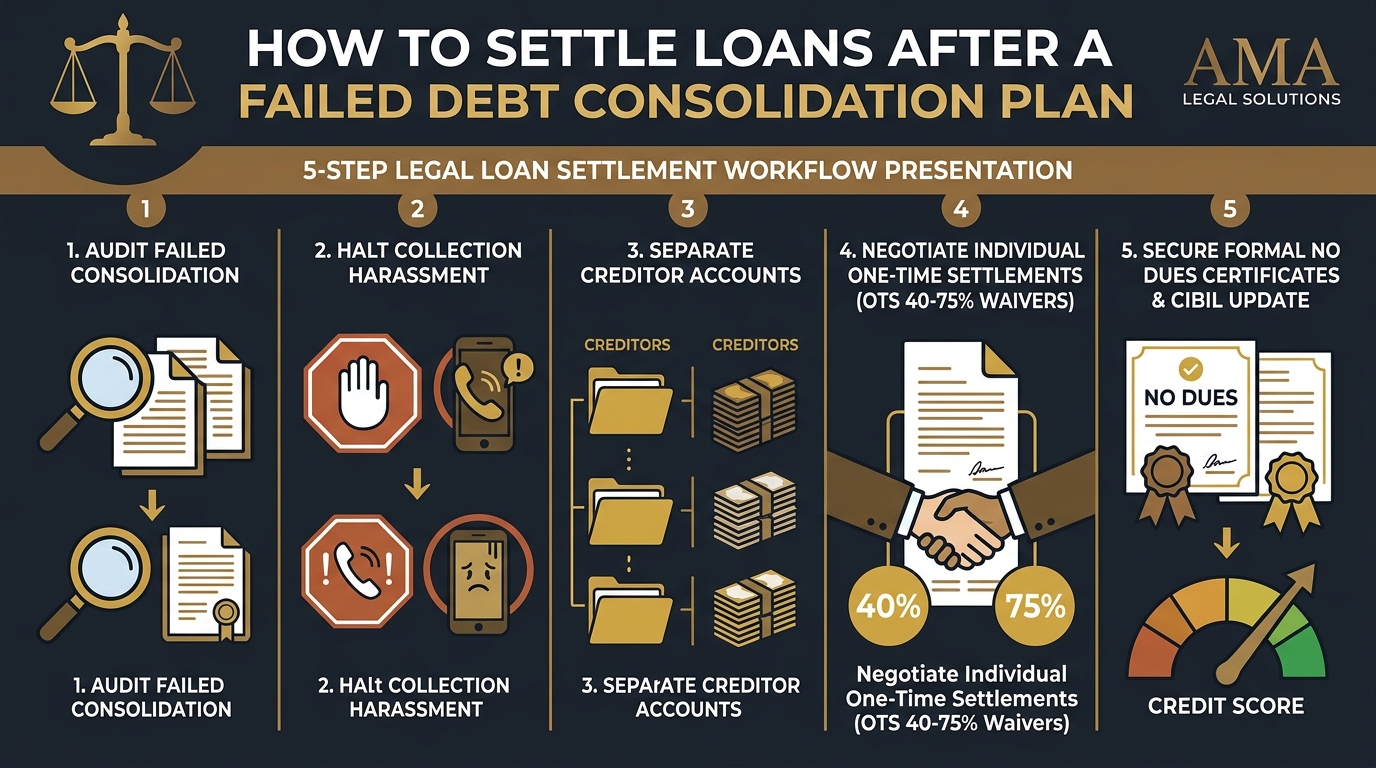
Navigating multi-creditor defaults after a failed consolidation requires a disciplined, legally insulated sequence. Below is the precise 5-step workflow executed by AMA Legal Solutions:
Comprehensive Debt & Liability Unbundling Audit
Our legal team pulls comprehensive credit reports from CIBIL, Experian, and CRIF High Mark to reconstruct the exact liability chain. We identify which underlying accounts were partially paid versus completely unclosed, calculate the true principal amounts versus inflated penal interest, and classify each creditor based on legal risk (e.g., whether post-dated cheques or active e-NACH mandates exist).
Issuance of Legal Cease-and-Desist Notices Against Harassment
We dispatch formal legal representations under the Advocates Act, 1961 to the collection departments and nodal officers of all involved banks and NBFCs. The notice cites the RBI Master Circular on Recovery Agents, forbidding unauthorized home visits, workplace intimidation, abusive phone calls, and third-party disclosures, and redirecting all communication to our law office.
Submission of Hardship Dossiers & Individual OTS Negotiations
Rather than dealing with recovery call centers, our advocates submit documented hardship dossiers (medical records, salary reduction certificates, GST returns, termination letters) directly to the Special Asset Management (SAM) or NPA Resolution Committees of the lenders. We structure viable settlement proposals targeting 40% to 75% waivers on the principal balance.
Vetting Formal Bank Sanction Letters & Defending Legal Notices
Never pay a single rupee based on an informal verbal promise or recovery agent WhatsApp message. Our lawyers meticulously vet the official OTS Sanction Letter issued on bank letterhead with authorized digital signatures. We ensure the letter explicitly confirms that the agreed payment fully discharges all civil and criminal liabilities, including withdrawing any Section 138 NI Act or arbitration proceedings.
Securing No Dues Certificates (NDC) & Bureau Record Updating
Following payment remittance, we enforce the timely issuance of formal No Objection / No Dues Certificates within the 30-day statutory window mandated under the Credit Information Companies (Regulation) Act, 2005. We track CIBIL, Experian, and Equifax updates to ensure the status is converted from delinquent/written-off to settled/closed.
Failed Debt Consolidation Settlement Workflow Infographic
Visual representation of the 5-step advocate-led resolution roadmap
Prepared by AMA Legal Solutions Research & Compliance Team • Statutory Debt Resolution Guide
Bank Settlement Waiver Benchmarks (40% to 75% Haircuts)
Settlement waiver percentages depend upon the category of loan, asset age in NPA books, and the quality of legal representation. Below are typical statutory compromise settlement benchmarks achieved by AMA Legal Solutions across major Indian banking sectors:
Complete waiver of 42% annualized finance charges, late fees, and up to 50% principal haircut.
Full interest waiver + substantial reduction on outstanding principal ledger balance.
Elimination of unlawful compounding penalties and closure on verifiable sanctioned principal.
Note: Actual waiver percentages are determined through bilateral legal negotiation based on documented borrower hardship and lender recovery risk under RBI guidelines.
Defending Against Section 138 NI Act, Section 25 PASA, & Arbitration
When consolidation loans collapse, lenders frequently weaponize post-dated security cheques and electronic mandate bounces to intimidate borrowers into repayment. Understanding your statutory defenses is essential:
1. Section 138 of the Negotiable Instruments Act, 1881 (Cheque Bounce)
Cheques collected as blank “security” at loan inception cannot be arbitrarily filled with inflated default amounts without proper reconciliation. A reply to a statutory legal notice must be dispatched within 15 days of receipt by an advocate, establishing that the cheque was a security instrument rather than for an existing crystallized debt.
2. Section 25 of the Payment and Settlement Systems Act, 2007 (e-NACH Failure)
Like cheque bounces, repeated automated NACH mandate failures can attract quasi-criminal complaints. Our advocates ensure that ongoing compromise negotiations are placed on judicial record, neutralizing criminal intent (mens rea) and facilitating Lok Adalat settlements where all complaints are unconditionally dismissed.
3. Unilateral Arbitration Proceedings
Under Supreme Court precedents (including Perkins Eastman and TRF Limited), unilateral appointment of sole arbitrators by NBFCs is legally void. We challenge defective arbitration appointments under Section 11 and Section 14 of the Arbitration and Conciliation Act, 1996, halting ex-parte award enforcement.
Enforcing Anti-Harassment Protections Under RBI Directives
Loan default is strictly a civil breach of contract; it is not a criminal offense. The Reserve Bank of India has established stringent Fair Practice Codes and Anti-Harassment Directives that protect every borrower:
Mandatory Prohibitions on Bank Recovery Agents:
- Strict prohibition on calling before 8:00 AM or after 7:00 PM.
- Absolute ban on contacting family members, employers, friends, or neighbors.
- Prohibition of abusive language, physical intimidation, or unannounced workplace visits.
- Mandatory disclosure of agent identity, authorized ID cards, and bank authorization letters.
If collection agents violate these rules, AMA Legal Solutions immediately escalates complaints to the RBI Complaint Management System (cms.rbi.org.in) and files petitions under the RBI Integrated Ombudsman Scheme, 2021, which awards damages and forces bank management to restrain aggressive collection agencies.
Securing Authentic No Dues Certificates & CIBIL Credit Repair
The settlement journey is not complete until every legal document confirming debt extinguishment is in your possession. Our legal team supervises the post-settlement compliance phase:
📄 Verification of No Dues Certificate
We verify that the NDC issued by the bank contains specific reference to the original loan account number, confirmation of full payment of agreed settlement terms, and explicit closure of all legal claims.
📈 Credit Bureau Update & Dispute Filing
Under Section 21 of the Credit Information Companies Act, banks must update credit bureau records within 30 days. If the bank delays or leaves the account as delinquent, we file legal dispute notices to compel rectification.
Frequently Asked Questions
Quotable statutory answers on loan settlement after failed consolidation
More Legal Guides & Resources
Settle Loans When Monthly Debt Crosses Capacity→
What to do when total monthly debt payments exceed your verifiable repayment capacity.
How to Remove Written-Off Status from Credit Report→
Step-by-step legal dispute process to upgrade written-off entries to closed.
Best Debt Settlement Company in India→
How advocate-led debt resolution outperforms unregulated private agencies.
Credit Card Debt Settlement Process→
Legal strategies to settle revolving credit card debts with maximum interest waivers.
Personal Loan Debt Settlement Guide→
Complete walkthrough of negotiating One-Time Settlements for unsecured personal loans.
Loan Settlement vs. Closure Impact on CIBIL→
Understand the score differences and how to convert a settled tag to closed.
What Happens After Loan Account Becomes NPA→
Legal stages of non-performing assets, SMA classification, and statutory rights.
How to Stop Bank Recovery Agents Harassment→
Enforce RBI recovery guidelines and file police and ombudsman complaints.
One Time Settlement Scheme Guide 2026→
Current bank OTS policies, waiver benchmarks, and Lok Adalat conciliation schedules.
🏛️ Statutory Citations & Official References
- Reserve Bank of India — Framework on Compromise Settlements and Technical Write-offs (DOR.STR.REC.20/21.04.048/2023-24)
- Reserve Bank of India — Master Circular on Recovery Agents and Conduct Guidelines
- Reserve Bank of India — Prudential Norms on Income Recognition, Asset Classification (IRAC)
- Credit Information Companies (Regulation) Act, 2005 (Statutory Accuracy Norms)
- Reserve Bank of India Integrated Ombudsman Scheme, 2021
- Reserve Bank of India Complaint Management System (CMS)
- National Consumer Disputes Redressal Commission (NCDRC)
- Insolvency and Bankruptcy Board of India (IBBI Individual Insolvency Norms)

AMA Legal Solutions
India's premier banking law and debt settlement firm. Trusted with a 4.9 Google Rating, over 10,000+ Clients Defended, and ₹150+ Crores in Debt Resolved. We safeguard borrowers from illegal recovery tactics and secure legally binding, board-approved One-Time Settlements under RBI directives.
👨⚖️ Lead Banking Advocate
Advocate Anuj Anand Malik is India's foremost debt resolution lawyer with over a decade of specialization in RBI compromise settlements, Lok Adalat representations, and borrower criminal defense.
Connect on LinkedInConsolidation Default Crisis?
Stop recovery harassment and negotiate structured 40%–75% OTS waivers with bank management. Speak directly with our legal team.
📞 Call +91-8700343611Request Legal Case ReviewVerified Client ReviewsVerified
Based on 1,380 verified borrower reviews across India
“I took a ₹14 Lakh personal loan to consolidate 5 credit cards and 2 app loans. Within 6 months my business slowed down and the consolidated EMI became impossible. Recovery agents began threatening my family. Advocate Anuj Anand Malik and AMA Legal Solutions stepped in, issued anti-harassment legal notices, and negotiated separate OTS settlements with 55% waivers. Their legal backing saved my sanity.”
Vikram Malhotra
Gurugram • July 2026
“After my debt management plan through an unregulated agency collapsed, 3 private banks sent Section 138 notices. Advocate Anuj Malik represented me in Lok Adalat, consolidated the settlements into clear RBI-compliant OTS agreements, and got all legal notices withdrawn with proper NOCs.”
Sunita Deshmukh
Mumbai • June 2026