Loan Settlement Kab Krna Chaiye? Right Time, Legal Process & RBI OTS Guide
Navigating unmanageable debt requires knowing the exact legal moment to transition from stressful repayments to a structured compromise. Discover when loan settlement should be initiated under Reserve Bank of India guidelines, how the 90-day NPA classification milestone unlocks institutional settlement powers, how enrolled advocates halt recovery harassment under the Bharatiya Nyaya Sanhita, and why a transparent fixed legal advisory model delivers enforceable No Dues Certificates without corporate firm hourly retainers.

Founder & Senior Advocate • Reviewed by Team AMA Legal Solutions
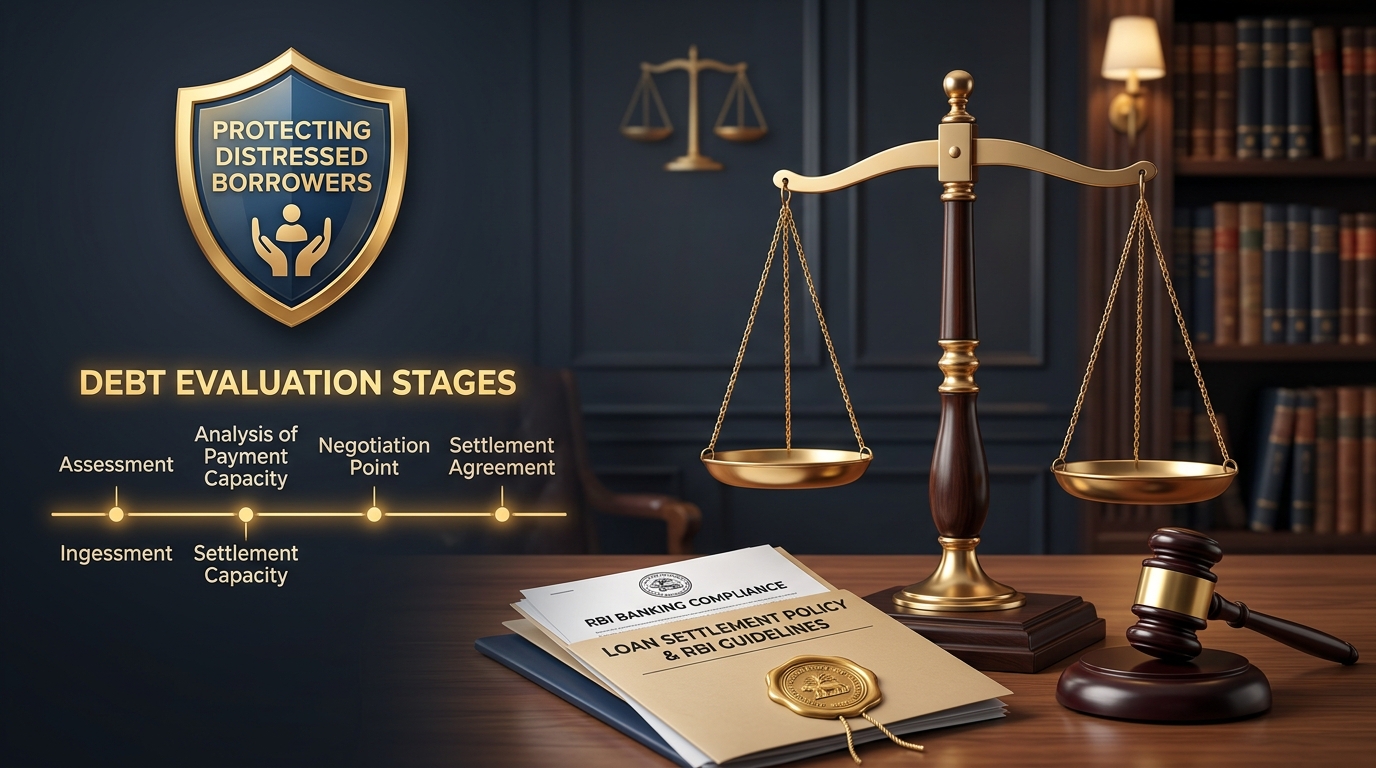
Debt Evaluation & Strategic Timing
Statutory NPA Milestones • RBI OTS Directives • Enforceable NDCs
Google Verified Client Reviews
Borrowers Legally Protected
Banking & Debt Cases Handled
Combined Courtroom Experience
Quick Legal Summary: Loan Settlement Kab Krna Chaiye
Loan settlement should be initiated when a borrower encounters severe, involuntary financial distress that renders continued EMI payments mathematically unsustainable, and the credit facility has crossed the 90-day overdue milestone to become classified as a Non-Performing Asset (NPA) under Reserve Bank of India prudential norms. Attempting premature settlement during active payment cycles results in automatic rejection by institutional credit systems, whereas waiting until court notices or unregulated recovery agent harassment escalate without legal representation severely weakens negotiating leverage. Engaging enrolled High Court advocates under a transparent fixed legal advisory model establishes statutory hardship, neutralizes coercive collection practices, and secures an authentic board-approved No Dues Certificate without the unpredictable hourly retainers of corporate firms or the legal perils of uncertified DIY templates.
6 Critical Legal & Financial Triggers: Loan Settlement Kab Krna Chaiye?
Deciding when to transition from attempting regular debt repayment to pursuing a structured One-Time Settlement (OTS) is the single most consequential choice an overleveraged borrower must make. In the Indian banking ecosystem, debt compromise is an extraordinary contractual remedy governed by board-approved recovery policies and statutory guidelines issued by the Reserve Bank of India. Initiating this process at the wrong time—either too early before the lender possesses the institutional power to write down debt, or too late after uncontested execution decrees have been obtained—can destroy both financial stability and legal defense.
Borrowers must evaluate their circumstances against six verifiable statutory and financial triggers to determine whether their situation qualifies for an advocate-led loan settlement:
Involuntary & Irreversible Loss of Repayment Capacity
Loan settlement is intended for individuals confronting bona fide hardship—such as permanent job termination, prolonged commercial failure, sudden critical illness, or the loss of an earning family member. Under RBI directives, borrowers who intentionally withhold payments despite having liquid wealth are classified as willful defaulters under the Master Circular on Willful Defaulters, disqualifying them from compromise settlements. When financial insolvency is genuine, substantiated by medical records, termination notices, or tax audit losses, settlement becomes a legitimate statutory relief.
The 90-Day Delinquency Threshold (NPA Classification)
Under the RBI Master Circular on Prudential Norms on Income Recognition, Asset Classification and Provisioning (IRAC), scheduled commercial banks and NBFCs cannot entertain principal debt haircuts on standard performing assets. The account must surpass 90 consecutive days of overdue interest or principal to be officially categorized as a Non-Performing Asset. Once classified as NPA, lenders are statutorily required to allocate mandatory capital provisions, providing risk committees with the formal accounting authority to sanction compromise waivers.
Total Monthly Debt Commitments Exceeding 60% of Disposable Income
When aggregate monthly EMI obligations across multiple unsecured personal loans, credit card balances, and digital lending apps exceed 60% of take-home earnings, the borrower enters a structural debt spiral. In this destructive phase, individuals often borrow from new fintech apps or high-interest payday sources merely to service existing interest charges. Settlement should be initiated before compounding late fees and penal interest render recovery mathematically impossible.
Escalation to Third-Party Recovery Harassment & Privacy Breaches
When lenders assign collection to external recovery agencies that resort to continuous threatening phone calls, unannounced home visits outside permitted hours (before 8:00 AM or after 7:00 PM), or unlawful contact of workplaces and relatives, immediate legal intervention is imperative. This escalation signals that internal bank dialogue has ceased, requiring enrolled High Court advocates to step in, halt coercive practices under criminal and cyber statutes, and force the dispute back into institutional legal negotiation.
Receipt of Statutory Notices Under Section 138 NI Act or Section 25 PSSA
The delivery of a formal demand notice alleging cheque dishonour under Section 138 of the Negotiable Instruments Act, 1881 or electronic NACH mandate bounce under Section 25 of the Payment and Settlement Systems Act, 2007 marks a critical transition into quasi-criminal litigation. Borrowers have an inflexible 15-day window from receipt to file an advocate-certified reply. This statutory reply establishes genuine bona fide dispute, challenges inflated compound interest, and creates the legal foundation for compounding the offence through a binding compromise settlement.
Invocation of Unilateral Arbitration Proceedings
When a financial institution invokes Section 21 of the Arbitration and Conciliation Act, 1996 and appoints a sole arbitrator unilaterally, the dispute enters formal adjudication. Failure to challenge unilateral appointment under the Supreme Court judgments in Perkins Eastman and TRF Ltd can lead to an ex-parte arbitral award that operates as a court decree. Engaging experienced banking counsel at this juncture halts unilateral proceedings and transforms the arbitration forum into a conciliation platform to execute an agreed One-Time Settlement.
The 90-Day Banking Delinquency Timeline: SMA-0 to NPA Classification
To understand precisely when to initiate loan settlement, borrowers must comprehend how Indian lending institutions classify delinquent credit under Reserve Bank of India regulations. Lenders do not treat overdue accounts uniformly; rather, automated algorithmic systems categorize loans into progressive risk tiers based on the number of Days Past Due (DPD).
| Classification Stage | Days Past Due (DPD) | Bank Action & Institutional Stance | Settlement Feasibility & Strategic Advisory |
|---|---|---|---|
| Special Mention Account 0 (SMA-0) | 1 to 30 Days | Automated SMS, email alerts, and internal collection calls. The loan is categorized as a standard performing asset. | Not Recommended for OTS. Credit committees will reject compromise requests. Use this period to consolidate evidence of financial hardship. |
| Special Mention Account 1 (SMA-1) | 31 to 60 Days | Intensified telephonic collection, assignment to field agents, cancellation of existing credit card limits. | Early Strategic Consultation. Settle discussions remain premature for banks, but counsel should review loan contracts for usurious penalties. |
| Special Mention Account 2 (SMA-2) | 61 to 90 Days | Imminent default warning, threat of legal notice, aggressive outsourced recovery pressure, preparation for NPA transfer. | Pre-NPA Legal Notice. Advocates issue Cease-and-Desist notices against abusive agents and position the borrower for compromise talks. |
| Non-Performing Asset (NPA) | 91+ Days | Mandatory capital provisioning under RBI IRAC norms. Account transferred to Stressed Assets Resolution Branch (SARB). | Optimal Window for Settlement. Bank boards possess full statutory authority to approve substantial waivers on penal interest and principal compromise. |
| Doubtful & Loss Asset | 12+ Months to Multi-Year | 100% capital provisioning completed, assignment to Asset Reconstruction Companies (ARCs) or technical write-off. | Maximum Leverage for OTS. Lenders view recovery as total write-off. Experienced advocates secure decisive debt compromise and extinguishment. |
“Under the Reserve Bank of India Master Circular on Compromise Settlements and Technical Write-offs, regulated entities are mandated to put in place board-approved policies for entering into compromise settlements with borrowers in genuine distress. The institutional willingness to grant substantial debt concessions crystallizes once the delinquency surpasses the 90-day threshold and triggers mandatory capital provisioning.”
Commercial Reality: Enrolled Advocate Representation vs Corporate Law Firms vs Free DIY Templates
When individuals realize it is time to settle their loans, they face a vital commercial choice regarding their legal representation. Navigating institutional debt settlement requires understanding the profound differences between an accessible, transparent fixed legal advisory model, traditional corporate law firms designed for multinational conglomerates, and free or cheap automated DIY online templates that lack courtroom enforceability.
| Legal & Strategic Dimension | AMA Legal Solutions (Fixed Advisory) | Corporate Law Firms | Free / Cheap DIY Online Templates |
|---|---|---|---|
| Fee Transparency & Cost Predictability | Transparent fixed legal advisory. No surprise hourly markups, open-ended retainers, or hidden billing. | Excessive hourly billing rates and recurring monthly retainers designed for commercial litigation. | Free or deceptive low-cost subscription; provides zero actual legal advocacy or courtroom defense. |
| Statutory Standing Under Advocates Act, 1961 | Enrolled High Court advocates authorized to appear, plead, and represent before all judicial forums. | Full advocate standing, but generally prioritize high-value institutional corporate mandates. | Zero legal standing. Unauthorized practice of law; cannot file vakalatnama or appear in court. |
| Halting Recovery Agent Harassment | Immediate statutory Cease-and-Desist notices issued under BNS 351/308, IT Act, and RBI Fair Practices. | Formal legal notices available, but often delayed by elaborate corporate onboarding and fee retainers. | Totally ineffective. Recovery agencies routinely shred automated templates lacking advocate authority. |
| Quashing Section 138 & Section 25 PSSA Notices | Formal statutory rebuttal within mandatory 15-day window, compounding under Section 147 NI Act. | Handled competently, but billable court appearances drastically multiply the overall legal burden. | Dangerous failure. Cannot draft customized statutory replies, risking non-bailable warrants. |
| Limitation Act Section 18 Risk Management | All communications drafted “Without Prejudice” to strictly prevent restarting the 3-year limitation clock. | Properly managed under standard commercial litigation safeguards. | Extreme hazard. Generic letters often inadvertently admit debt, restarting statutory liability periods. |
| Attorney-Client Privilege (S. 126 Evidence Act) | Complete statutory confidentiality protecting all financial records and private communications. | Full statutory advocate confidentiality applies. | None. Private data is stored on third-party servers and frequently monetized to collection agencies. |
| Authentic No Dues Certificate Verification | Forensic verification of board approval, authorized signatory seal, e-mandate revocation & CIBIL update. | Conducted thoroughly, but subject to substantial hourly partner review charges. | Zero verification. Borrowers regularly accept fake or conditional letters, leaving accounts open. |
RBI Master Circular & Statutory Framework Governing Loan Compromise
Loan settlement is not an informal favor granted by bank managers; it is a legally codified contractual extinguishment anchored in Indian jurisprudence. The substantive legal foundation rests upon Section 63 of the Indian Contract Act, 1872, which explicitly recognizes that every promisee may dispense with or remit, wholly or in part, the performance of the promise made to them, or may accept instead of it any satisfaction which they think fit. When a lender agrees in writing to accept a lesser sum in complete discharge of the outstanding liability, the original debt is legally extinguished.
In contemporary banking practice, this contractual principle is strictly structured by regulatory directions issued by the Reserve Bank of India:
RBI Master Circular on Compromise Settlements
Under circular DOR.STR.REC.20/21.04.048/2023-24, the Reserve Bank of India mandates that all commercial banks, cooperative banks, and NBFCs establish board-approved compromise settlement policies. These guidelines mandate transparent delegation of settlement authority, objective criteria for assessing borrower distress, and strict mechanisms for technical write-offs without arbitrary discrimination.
Legal Services Authorities Act, 1987 (Lok Adalat)
Under Section 19 and Section 20 of the Legal Services Authorities Act, 1987, pending debt disputes and pre-litigation recovery matters may be referred to National Lok Adalats. An award passed by a Lok Adalat bench carries the status of a conclusive Civil Court decree under Section 21, permanently terminating the lender's right to pursue further litigation.
RBI Fair Practices Code & Recovery Agent Norms
The Reserve Bank of India Directions strictly prohibit banks and NBFCs from using uncivilized, threatening, or coercive tactics in loan recovery. Lenders are vicariously liable for breaches committed by their contracted recovery agents, empowering borrowers to file statutory grievances before the RBI Integrated Ombudsman and police cyber cells.
Credit Information Companies Act (CICRA, 2005)
Following settlement execution, Section 21 of the Credit Information Companies (Regulation) Act, 2005 compels financial institutions to transmit accurate, updated account data to credit bureaus (CIBIL, Equifax, Experian, and CRIF High Mark) within 30 days, recording the outstanding balance as zero.
Key Insights & Data Infographic
Visual summary, statistical trends & procedural breakdown
Prepared by AMA Legal Solutions Research & Analytics Team • Data & Compliance Overview
Handling Section 138 NI Act, Section 25 PSSA & Court Summons
A frequent catalyst that forces borrowers to ask loan settlement kab krna chaiye is the sudden delivery of a formal advocate legal notice under Section 138 of the Negotiable Instruments Act, 1881 for cheque dishonour or Section 25 of the Payment and Settlement Systems Act, 2007 for electronic NACH mandate failure. These statutory provisions introduce quasi-criminal liability, creating immense distress for borrowers who mistakenly assume that immediate arrest is inevitable.
Under Indian law, both Section 138 NI Act and Section 25 PSSA mandate strict procedural compliance before a magistrate court can take cognizance:
The Inflexible 15-Day Statutory Response Window
Upon receipt of a statutory notice, the borrower has exactly 15 days to respond or make payment. If no payment or rebuttal is made, the lender may file a criminal complaint within 30 days thereafter. Engaging enrolled advocates to draft a comprehensive statutory reply accomplishes three decisive legal goals:
- Challenging Enforceable Debt: Demonstrating that the claimed balance includes unconscionable accumulated penal interest and illegal processing charges violating the Usurious Loans Act, 1918 and RBI fair practice directions.
- Security Instrument Defense: Proving that cheques or electronic mandates were obtained as conditional security instruments at the time of loan disbursement rather than delivered in discharge of an already crystallized, legally enforceable debt.
- Opening Compounding Channels: Formally invoking Section 147 of the Negotiable Instruments Act, which makes offences under Section 138 compoundable, laying the statutory basis for a binding compromise settlement that completely quashes court proceedings.
Neutralizing Recovery Agent Harassment Under BNS & RBI Directives
Many borrowers erroneously believe that when recovery agents harass them with endless calls, abusive language, or visits to their homes and workplaces, they must immediately capitulate and pay whatever amount is demanded. In reality, coercive debt collection practices are illegal under Indian criminal law and directly violate Reserve Bank of India regulatory standards.
Criminal Offenses Under the Bharatiya Nyaya Sanhita, 2023
Abusive recovery calls and threats constitute criminal intimidation under Section 351 of the Bharatiya Nyaya Sanhita, 2023 (formerly Section 503/506 IPC). Demanding extortionate fees under threat of social defamation is punishable under Section 308 of the BNS (formerly Section 384 IPC). Furthermore, unauthorized disclosure of loan defaults to third parties, colleagues, or neighbours violates the right to privacy affirmed as a fundamental right by the Supreme Court of India in the landmark K.S. Puttaswamy judgment.
Advocate Cease-and-Desist Intervention
When AMA Legal Solutions enters appearance on behalf of a distressed borrower, our advocates issue formal statutory Cease-and-Desist directives to the bank or NBFC nodal officers and collection heads. Under Section 126 of the Indian Evidence Act, 1872, all communication must be directed to the borrower's authorized legal counsel. Notifying lenders of imminent complaints before the RBI Integrated Ombudsman and State Police Cyber Cells halts third-party harassment instantly, restoring dignity and allowing settlement negotiations to proceed on lawful terms.
5-Step Strategic Protocol for Timing & Executing Loan Settlement
Executing a legally binding, irreversible loan settlement requires an organized statutory methodology. At AMA Legal Solutions, our enrolled advocates follow a rigorous five-step protocol to protect borrower rights and achieve complete debt extinguishment:
Forensic Contract & Solvency Audit
Our advocates examine the underlying loan agreement, Key Fact Statements (KFS), statement of accounts, and accumulated charges. We isolate illegal compounding interest, calculate the actual principal exposure, and assemble verifiable financial hardship documentation.
Immediate Anti-Harassment Restraint & Notice Rebuttal
We dispatch statutory Cease-and-Desist directives to the lending institution, terminating third-party collection contact. If Section 138 NI Act or Section 25 PSSA notices have been received, we file formal advocate replies within the 15-day statutory window.
Strategic Representation Before Bank Settlement Committees
Once the account reaches optimal NPA status, our advocates submit a formal compromise petition under the RBI Master Circular. We negotiate directly with the bank's Stressed Assets Resolution Branch (SARB) or credit committee, seeking maximal waiver on penal charges.
Forensic Vetting of Board-Approved Settlement Sanction Letter
We verify that the settlement offer is officially issued on official bank letterhead with an authentic reference number, signed by an authorized signatory, and explicitly states that remittance constitutes full and final settlement with complete extinguishment of all civil and criminal claims.
Procurement of No Dues Certificate, Mandate Revocation & Bureau Correction
Following settlement payment via verified banking channels, we ensure the lender issues a definitive No Dues Certificate (NDC), deactivates all e-NACH mandates on the NPCI portal, withdraws court complaints, and reports the account as settled with zero balance to CIBIL, Equifax, and Experian.
Securing Authentic No Dues Certificate (NDC) & CIBIL Revival
A loan settlement is only as good as the closure documentation that confirms it. Countless borrowers who attempt DIY settlement or deal informally with collection agents discover years later that their loan was never closed; rather, the payment was booked as a partial recovery, leaving the account accumulating compound penal interest and destroying their credit standing.
To achieve complete legal and financial freedom, borrowers must insist upon three mandatory closure confirmations:
Authentic No Dues Certificate (NDC)
Must be printed on official bank or NBFC letterhead, bearing the name, employee code, and official seal of the authorized manager, explicitly certifying that all claims against the borrower stand fully satisfied.
NPCI e-NACH Mandate Revocation
The lending institution must formally cancel recurring auto-debit instructions on the National Payments Corporation of India portal, preventing future unlawful auto-debits and bounce charges from bank accounts.
Credit Bureau Status: Settled • Zero Balance
Under CICRA regulations, the lender must transmit updated records within 30 days. The account status will reflect as “Settled” with current outstanding balance updated to zero, enabling credit score revival.
Client Reviews
“When my industrial supply business suffered severe setbacks, my personal loan and credit card EMIs quickly surpassed my disposable income. I was wondering loan settlement kab krna chaiye and made the initial mistake of trying generic online draft letters, which the bank completely ignored while third-party agents began showing up at my residence. Traditional corporate law firms quoted prohibitive hourly retainers that were impossible for my situation. AMA Legal Solutions provided an advocate-led fixed advisory model with total transparency. Advocate Anuj Anand Malik intervened immediately with statutory Cease-and-Desist notices that stopped the harassment in its tracks. Once my accounts reached the 90-day NPA milestone, their team negotiated directly with the bank credit committee under RBI compromise guidelines, securing a clean One-Time Settlement and an authentic No Dues Certificate without hidden legal fees.”
Vikram Malhotra
Manufacturing Operations Head, Pune • September 2026
“I was caught in an exhausting debt cycle with multiple unsecured personal loans after severe medical treatments in my family. When Section 25 PSSA NACH bounce notices and arbitration letters arrived, I panicked about what to do and when to settle. Advocate Anuj Anand Malik and the team at AMA Legal Solutions analyzed my debt profile, drafted comprehensive statutory legal replies, and represented me throughout the institutional negotiation. Their transparent fixed legal advisory model eliminated any fear of runaway legal costs. They structured an enforceable settlement under RBI compromise norms, dismissed the pending court complaints, and ensured my credit bureau files were updated with authentic zero-balance discharge letters.”
Deepika Sen
Senior IT Business Analyst, Bengaluru • August 2026
Frequently Asked Questions
More Legal Guides & Related Resources
References & Authority
- Reserve Bank of India (RBI): Master Circular on Compromise Settlements and Technical Write-offs (DOR.STR.REC.20/21.04.048/2023-24)
- National Legal Services Authority (NALSA): National Lok Adalat Guidelines & Judicial Decrees
- Indian Contract Act, 1872: Section 63 (Remission of Performance & Contractual Discharge)
- Supreme Court of India: Landmark Precedents on Debt Recovery, Arbitration & Privacy Rights
- RBI Integrated Ombudsman Scheme: Grievance Filing Against Unlawful Recovery Harassment

AMA Legal Solutions
Trusted with a 4.7 Google Rating, over 10,000+ Clients Served, 25,000+ Cases Handled, and more than 40+ Years of Experience in providing strategic legal defense and debt resolution across India.
Our media coverages





About Author
Anuj Anand Malik
View ProfileAnuj Anand Malik, Founder of AMA Legal Solutions, is a trusted advocate, loan settlement expert, legal advisor, and banking lawyer. With over a decade of experience in loan settlement, corporate law, financial disputes, and compliance, he leads a result-driven law firm based in India that helps individuals, startups, and businesses achieve legal and financial stability.
Connect on LinkedIn