What Is the Difference Between Credit Card Write-Off and Settlement?
Explore how credit card write-offs and settlements differ in legal implications and processes.

Anuj Anand Malik
Reviewed by AMA Legal Solutions
Key Takeaways: Understanding the difference between credit card write-offs and settlements is crucial for managing debt in India. A write-off reflects a bank's classification of unpaid dues as a loss, while a settlement constitutes a negotiated agreement to pay a reduced amount. Both processes carry implications for credit score and legal liabilities.
Introduction to Credit Card Write-Offs and Settlements in India
When evaluating What Is the Difference Between Credit Card Write-Off and Settlement? in India, understanding the applicable statutory framework, legal procedures, and strategic rights is essential. Understanding the difference between credit card write-off and settlement is crucial for anyone managing credit card debt in India. Both processes have unique implications on one's financial health and credit score. A credit card write-off occurs when a bank categorizes unpaid dues as a loss, while a credit card settlement involves an agreement between the borrower and lender to resolve the debt partially. It's essential for borrowers to comprehend these options to make informed decisions about their financial responsibilities.
Statutory Framework & Governing Legal Provisions
The Reserve Bank of India (RBI) provides the primary regulatory framework guiding credit card write-offs and settlements. According to RBI guidelines, an account is classified as a non-performing asset (NPA) if payments are overdue for more than 90 days. This classification triggers the write-off process under specific conditions. Conversely, settlements are contractual agreements governed by the principle of mutual consent, crucially informed by the Banking and Finance Law.
Judicial precedents stress that a write-off is an accounting exercise that does not extinguish the debt, whereas a settlement, being a negotiated compromise, fully or partially resolves the outstanding dues if conducted in good faith.
Comprehensive Analysis of Credit Card Write-Offs
A credit card write-off signifies that a lender no longer expects a borrower to pay back the debt using traditional methods. However, this internal accounting move does not eliminate the borrower's liability. The process involves classifying the account as an NPA, provisioning for losses, and then writing off the debt after diligent recovery efforts.
From a procedural standpoint, the write-off process comprises several steps: identification of delinquent accounts, classification as NPA, provisioning losses, making the write-off decision, and reporting to credit bureaus. This affects the borrower's credit report, marking the account as "Written-Off." These actions, however, do not free the borrower from future legal or collection actions by the bank, who might still seek repayment or sell the debt to third-party recovery agents.
Detailed Examination of Credit Card Settlements
In contrast to a write-off, a settlement involves negotiating a reduced payoff amount agreeable to both lender and borrower. This occurs when the borrower faces financial hardship and cannot settle the full outstanding debt. The settlement process starts with initiating discussions, negotiating terms, drafting an agreement, making a partial payment, and finally updating the credit report to "Settled."
Upon settling, the borrower typically receives a No Objection Certificate (NOC), signifying the lender's agreement that the debt is closed. However, the settlement status might still negatively affect the credit score, often seen as less favorable than a fully paid account. For expert guidance on settlements, refer to Credit Card Settlement in India.
Key Insights & Data Infographic
Visual summary, statistical trends & procedural breakdown
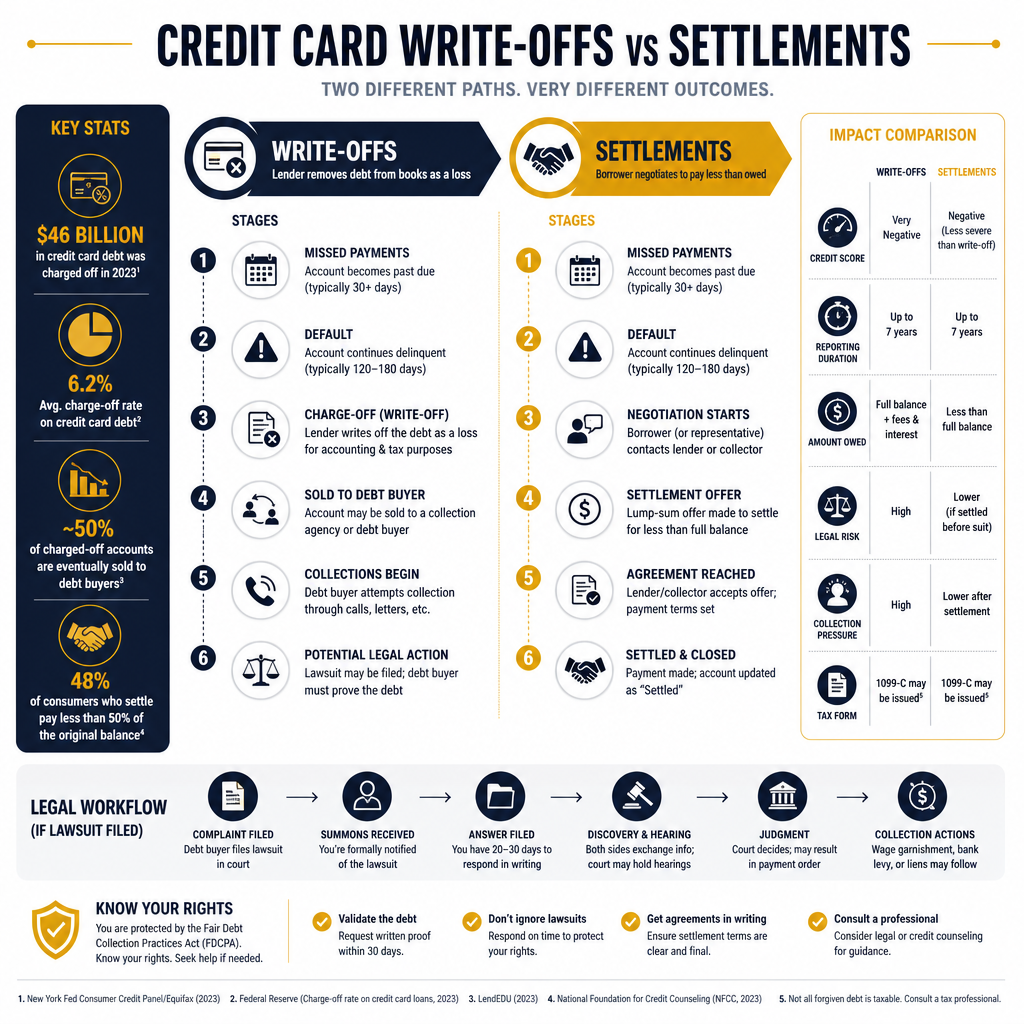
Prepared by AMA Legal Solutions Research & Analytics Team • Data & Compliance Overview

Halt Recovery Agent Harassment Legally
Comparative Analysis: Write-Offs vs. Settlements
The fundamental difference between a credit card write-off and settlement lies in the creditor's approach to unresolved debts. In a write-off, the debt remains legally owed, allowing potential future collection efforts. On the other hand, a settlement reduces overall debt liability through direct negotiation, concluding with a formally closed account, despite a potential hit to credit scores.
Table: Comparison of Write-Offs and Settlements
| Parameter / Option | Legal Basis & Requirements | Key Procedures / Considerations | Strategic Advantage with Counsel |
|---|---|---|---|
| Write-Off | Based on RBI's NPA guidelines | Debt remains payable; potential for legal action | Advisory on possible future liabilities |
| Settlement | Mutual consent and contract laws | Debt partially paid; credit report updated as "Settled" | Negotiation strategy for debt reduction |
| Impact on Credit | Negative, stays on report until paid | Seek dispute resolution if inaccurately reported | Address issues with credit correction agencies |
| Credit Report Status | "Written-Off" | Stay informed about future recovery actions | Legal aid in handling recovery agent disputes |
Legal Safeguards and Consumer Rights Associated with Each Option
Consumers dealing with a credit card write-off or settlement have specific rights and protections. Under the Consumer Protection Act, 2019, borrowers can challenge unfair practices and seek redress. Other safeguards include the RBI's code for fair recovery practices, preventing harassment and ensuring transparency in credit reporting.
Legal representation can strengthen a borrower's position, offering protections through formal agreements such as settlements. Knowing and exercising these rights is essential for negotiating favorable outcomes without unnecessary penalties.
Common Pitfalls and Risks in Write-Offs and Settlements
Borrowers often misunderstand that a write-off results in zero liability, leaving them vulnerable to unexpected recovery attempts. Similarly, failing to ensure a complete and recorded settlement can leave unresolved liabilities that may resurface later.
The use of unregulated debt settlement companies might also expose borrowers to additional risks. Always verify their credentials and consider professional legal counsel to avoid mishandling exits from debts.
Strategic Conclusion: Securing Legal Assurance with AMA Legal Solutions
The difference between credit card write-off and settlement carries both practical and legal impacts. Whether you are grappling with the complexities of the banking system or cautiously managing repayment plans, having professional legal assistance can lead to more secure and informed decisions.
At AMA Legal Solutions, our registered advocates provide trusted guidance and representation to effectively navigate credit card debts and related financial complexities. With expertise in both negotiations and legal remedies, AMA Legal Solutions assures full advocacy rights, protecting your interests under the Advocates Act, 1961.
Having the right legal team ensures that all consumer protection laws are enforced, offering peace of mind and the assurance of optimal outcomes. For tailored legal strategies and help resolving credit card issues, contact AMA Legal Solutions today.
Popular Searches & Topics
Commonly searched legal queries and keywords related to this article
Need Strategic Legal Defense for Your Situation?
Our banking & litigation advocates review your notices, debt liability, and recovery issues under complete advocate-client secrecy.

AMA Legal Solutions
Trusted with a 4.7 Google Rating, over 10,000+ Clients Served, 25,000+ Cases Handled, and more than 40+ Years of Experience in providing strategic legal defense and debt resolution across India.
Our media coverages





Frequently Asked Questions
Related Articles

How to Negotiate Credit Card Write-Off: A Practical Guide (2026)
Unlock effective strategies for negotiating credit card write-offs and reclaim financial control.
Read Article
Earned Wage Access & Salary Advance App Loan Settlement in India (2026)
Protect your relieving letter and FnF pay while settling salary-advance loans.
Read Article
Can You Get Another Credit Card After Settlement? Understanding Your Options in 2026
Explore your eligibility for a new credit card post-settlement and essential legal insights.
Read ArticleAbout Author
Anuj Anand Malik
View ProfileAnuj Anand Malik, Founder of AMA Legal Solutions, is a trusted advocate, loan settlement expert, legal advisor, and banking lawyer. With over a decade of experience in loan settlement, corporate law, financial disputes, and compliance, he leads a result-driven law firm based in India that helps individuals, startups, and businesses achieve legal and financial stability.
Connect on LinkedInNeed Legal Representation?
Evaluate your defense against recovery agents, notices, or structure your loan settlement directly with Senior Advocates.
Call +91-8700343611