Earned Wage Access & Salary Advance App Loan Settlement in India (2026)
Protect your relieving letter and FnF pay while settling salary-advance loans.

Anuj Anand Malik
Reviewed by AMA Legal Solutions

Key Takeaways: Facing job loss, layoff, or resignation while carrying outstanding dues on fintech payroll apps should never compromise your career or livelihood. When navigating earned wage access and salary advance app loan settlement india, salaried employees hold formidable statutory protections. Under Section 7 of the Payment of Wages Act, 1936 and the Code on Wages, 2019, employers are legally prohibited from executing unauthorized deductions from your Full and Final (FnF) settlement on behalf of third-party fintech lenders without a judicial court decree. Furthermore, under Section 27 of the Indian Contract Act, 1872 and Article 21 of the Constitution, companies cannot withhold mandatory service records, such as your relieving letter or experience certificate, to act as collection agents for partner NBFCs. By issuing advocate-backed representation, revoking payroll mandates, and utilizing RBI Fair Practices Codes, distressed professionals can halt workplace harassment and negotiate a formal One-Time Settlement (OTS) with 50% to 75% waivers on uncollateralized balances.
Introduction: Earned Wage Access and Salary Advance App Loan Settlement in India
The contemporary Indian corporate landscape has undergone rapid digitization in payroll disbursement and employee financial wellness. Over recent years, millions of salaried employees across IT services, corporate startups, business process outsourcing (BPO) centers, retail enterprises, and manufacturing firms have been introduced to on-demand salary solutions. Marketed under modern corporate wellness banners, these digital tools promise instant liquidity between paychecks. However, when economic headwinds, restructuring, or sudden layoffs occur, corporate employees quickly discover that navigating earned wage access and salary advance app loan settlement india is one of the most legally misunderstood challenges in consumer finance.
What begins as a convenient mechanism to withdraw a few thousand rupees for emergency household expenditures frequently metastasizes into an aggressive debt trap. Employees who face involuntary retrenchment, corporate restructuring, or medical emergencies find themselves pursued by digital collection agencies that deploy high-pressure tactics. Even more concerning, corporate Human Resources (HR) departments frequently attempt to seize an exiting employee's Full and Final (FnF) salary or threaten to hold back career-critical exit documentation—such as experience certificates and relieving letters—until third-party fintech debts are fully cleared. Resolving these disputes through authorized earned wage access and salary advance app loan settlement india protects the worker's career and financial stability.
Salaried professionals must recognize that employment contracts and credit arrangements are legally segregated under Indian law. A default on an unsecured consumer loan does not give an employer the statutory power to confiscate statutory wages, nor does it allow partner non-banking financial companies (NBFCs) to sabotage an individual's background verification (BGV) profile. If you have been terminated, laid off, or forced to resign while holding outstanding fintech dues, exploring structured loan settlement for salaried people under the guidance of seasoned banking advocates provides an authorized, legally binding path to financial recovery and career protection.
How Payroll-Linked Earned Wage Access (EWA) & Corporate Tie-Up Salary Loans Work (Refyne, Jify, FatakPay, SalarySe, Fibe & Bank Corporate Schemes)
To establish an effective defense when negotiating earned wage access and salary advance app loan settlement india, an employee must first understand the structural difference between pure liquidity withdrawal and formal digital lending. In India's fintech ecosystem, platforms such as Refyne, Jify, FatakPay, SalarySe, and EarlySalary (now Fibe) operate under distinct commercial architectures that blur the line between earned compensation and credit.
1. Pure Earned Wage Access (Accrued Salary Withdrawal)
In a pure Earned Wage Access model, an employee accesses money they have already earned during the ongoing billing cycle. For example, if a software engineer earns ₹60,000 per month and works 15 days, they have legally accrued ₹30,000 in gross wages. Platforms like Refyne or Jify partner with corporate employers to integrate directly with internal Human Resource Management Systems (HRMS) such as Darwinbox, Keka, or Workday. The employee draws ₹15,000 against their accrued salary, paying a nominal transaction convenience fee (e.g., ₹99 to ₹199). On payday, the employer's automated payroll system deducts ₹15,000 from the net salary credit and remits it directly back to the EWA platform. Pure EWA is technically an advance on earned income, not a financial loan product.
2. Payroll-Deducted NBFC Salary Advance Loans
In contrast, many corporate wellness apps function as Digital Lending Applications (DLAs) acting as Loan Service Providers (LSPs) for underlying Reserve Bank of India (RBI) regulated NBFCs or private commercial banks. For instance, when borrowers access facilities through platforms like Fibe (Social Worth Technologies / EarlySalary Services NBFC) or corporate overdraft tie-ups, they are not merely withdrawing earned days; they are executing a legally binding unsecured personal loan agreement. These facilities often feature:
- Fixed monthly Equated Monthly Installments (EMIs) or short-term balloon tenures (30 to 90 days).
- Annual Percentage Rates (APRs) ranging from 18% to 36% or more when factoring in processing charges and rollover costs.
- Automated e-NACH mandates registered against the employee's salary account, alongside tripartite payroll deduction consents signed during onboarding.
If you have accumulated unsustainable short-term debt through corporate digital lenders, executing a formal Fibe loan settlement or engaging the underlying NBFC directly through legal channels enables you to challenge inflated administrative fees and restructure or compromise the balance lawfully.
3. Direct Employer Staff Loans and Internal Company Advances
The third category involves internal corporate welfare loans granted directly from the employer's balance sheet (such as relocation advances, company vehicle loans, or emergency festival advances). Here, no third-party fintech app or NBFC is involved. The employer acts as the primary creditor under the employment contract, subject to statutory limits governing internal advances.
Understanding which specific category your debt falls into is crucial for executing earned wage access and salary advance app loan settlement india. The statutory matrix below outlines these critical legal distinctions:
| Operational Dimension | Pure Earned Wage Access (EWA) | Payroll-Deducted NBFC Salary Advance Loan | Direct Employer Staff Loan / Advance |
|---|---|---|---|
| Nature of Transaction | Pre-payment of wages already accrued for days worked. | Unsecured credit facility / short-term personal loan. | Corporate staff advance from company treasury. |
| Regulatory Regime | Payment of Wages Act & state Shops and Establishments laws. | RBI Digital Lending Directions & NBFC Regulations. | Indian Contract Act & Internal HR Employment Manual. |
| Lending Entity | Fintech platform partnered with employer payroll. | RBI-registered NBFC or Scheduled Commercial Bank. | Corporate employer (sole creditor). |
| Credit Bureau Reporting | No credit reporting (not classified as a credit tradeline). | Mandatory reporting to CIBIL, Experian, Equifax, and CRIF. | No external credit bureau reporting. |
| Payroll Deduction Mechanism | Automated pre-tax/post-tax payroll adjustment on payday. | Tripartite payroll debit or direct bank e-NACH mandate. | Contractual salary offset authorized by employment terms. |
| Recourse Upon Layoff / Resignation | Limited strictly to accrued days in final working month. | Civil loan recovery against employee; cannot block relieving letter. | Offset against FnF subject to 50% statutory wage ceilings. |
As demonstrated, if your facility is an external NBFC loan, the lending institution must comply with statutory digital lending directives and cannot utilize your employer as an extrajudicial debt enforcement agency during third-party digital loan recovery.
What Happens When You Are Laid Off or Resign? The Full-and-Final (FnF) Salary Deduction Clause Explained
When an employee resigns or faces sudden retrenchment, the transition triggers the corporate Full and Final (FnF) settlement process. In typical corporate workflows, the FnF calculation reconciles earned days, encashable privileged leaves (PL), contractual bonuses, gratuity entitlements, and statutory deductions. However, employees with active app-based advances frequently find their entire final pay packet withheld by HR departments citing "third-party app integration agreements."
The Mechanics of the FnF Recovery Trap
When you onboarded onto an app like Refyne, Jify, or FatakPay, the app typically prompted you to accept digital terms and conditions that included a "Payroll Deduction Authorization" or "Tripartite Corporate Agreement." Under these standard clauses, the employee ostensibly authorizes the employer to withhold unrecovered advance amounts from their final compensation upon separation. In reality, when sudden corporate downsizing or unexpected layoffs occur, the outstanding loan balance frequently exceeds the net salary of the final 30 days.
Consequently, HR managers often zero-out the employee's final payout, leaving them without a single rupee of liquid cash to survive the transitional unemployment period. In extreme situations, employers demand that the employee deposit additional funds into the company bank account before they will process the exit clearance. For a recently terminated professional, understanding your rights regarding earned wage access and salary advance app loan settlement india is essential to halting this predatory practice immediately.
Why Sudden Unemployment Alters the Legal Landscape
Corporate layoffs, organizational downsizing, and health-induced resignations constitute bona fide financial hardship. In these situations, attempting to enforce full recovery against statutory termination pay is not only commercially irrational but legally vulnerable. If you find yourself stripped of your livelihood, consulting an advocate to structure a job lost loan settlement allows you to shield your essential survival capital, challenge unlawful FnF deductions, and negotiate manageable terms with the lending app under statutory fintech debt resolution frameworks.
Can Your Employer Legally Withhold Your Relieving Letter, Experience Certificate, or PF Because of an External Fintech Loan?
The most pervasive and damaging form of coercion faced by exiting professionals is the withholding of essential career documents. Company HR departments frequently issue ultimatums: "Until you pay off your ₹75,000 loan balance with our fintech partner, we will not issue your Relieving Letter or Experience Certificate." This threat causes intense panic because modern Indian employers and background verification (BGV) agencies require an official relieving letter before confirming a new job offer.
The Statutory Bar Under Section 27 of the Indian Contract Act, 1872
Indian jurisprudence is unequivocal: an employer cannot withhold service records or exit documentation to force debt recovery. Section 27 of the Indian Contract Act, 1872 explicitly renders void any agreement or contractual action that restrains an individual from exercising a lawful profession, trade, or business. The High Courts across India, including landmark judgments from the Bombay High Court and Delhi High Court, have repeatedly held that withholding an experience certificate or relieving letter is an indirect, illegal restraint on trade. Establishing this distinction is paramount during earned wage access and salary advance app loan settlement india.
Service records are factual confirmations of past employment and work performed; they are not financial collateral. An employer has no proprietary right to convert an employee's professional credentials into a security pawn for a third-party lending institution. When an enterprise attempts to obstruct your future livelihood, serving a formal legal notice for experience letter and relieving letter through senior legal counsel rapidly compels corporate management to release the required documents without delay.
Absolute Immunity of Provident Fund (PF) and Gratuity
HR departments often threaten to offset unpaid fintech loans against an employee's accumulated Provident Fund (PF) or Gratuity. This threat is completely contrary to Indian federal statute:
- Section 10 of the Employees' Provident Funds and Miscellaneous Provisions Act, 1952: The statute establishes absolute immunity for PF balances. PF accumulations cannot be assigned, charged, attached by any court decree, or deducted by an employer to settle private debts. Any employer attempting to divert PF contributions toward a fintech loan commits a non-bailable statutory offense.
- Section 13 of the Payment of Gratuity Act, 1972: Gratuity payable to an employee is statutorily protected against attachment in execution of any decree or order of any civil, revenue, or criminal court. Furthermore, under Section 4(6) of the Act, gratuity can only be forfeited if the employee was terminated for riotous conduct, moral turpitude, or causing willful damage to company property—never for defaulting on an external financial loan.
To provide complete clarity on your rights upon separation, review the statutory entitlement breakdown in the comparative table below:
| Exit Component / Entitlement | Can Employer Withhold or Deduct for Fintech Loan? | Governing Indian Statutory Authority | Permissible Employer Action vs. Legal Remedy |
|---|---|---|---|
| Relieving Letter & Experience Certificate | STRICTLY ILLEGAL | Section 27, Indian Contract Act, 1872 & Article 21. | Must be issued upon handover. Issue mandatory legal notice if withheld. |
| Accumulated Provident Fund (PF) | ABSOLUTE STATUTORY IMMUNITY | Section 10, Employees' Provident Funds Act, 1952. | Employer has zero right of offset. Report violations directly to EPFO. |
| Statutory Gratuity Entitlements | ABSOLUTE STATUTORY IMMUNITY | Section 13, Payment of Gratuity Act, 1972. | Protected from civil attachment. File claim before Controlling Authority. |
| Earned Monthly Salary (Days Worked) | RESTRICTED (Max 50% for direct advances) | Section 7, Payment of Wages Act / Code on Wages. | Cannot be seized for third-party NBFC loans without court decree. |
| Privileged Leave (PL) Encashment | CANNOT BE SEIZED WITHOUT CONSENT | State Shops and Establishments Acts. | Part of statutory terminal dues; subject to formal wage claim. |
| Company Assets (Laptop, Access Card) | EMPLOYER MAY RETAIN UNTIL RETURNED | Contractual Handover Terms. | Employee must return all physical company equipment to complete exit. |
Recognizing these boundaries empowers you to stand firm during exit interviews and enforce the statutory rules governing earned wage access and salary advance app loan settlement india.
Key Insights & Data Infographic
Visual summary, statistical trends & procedural breakdown
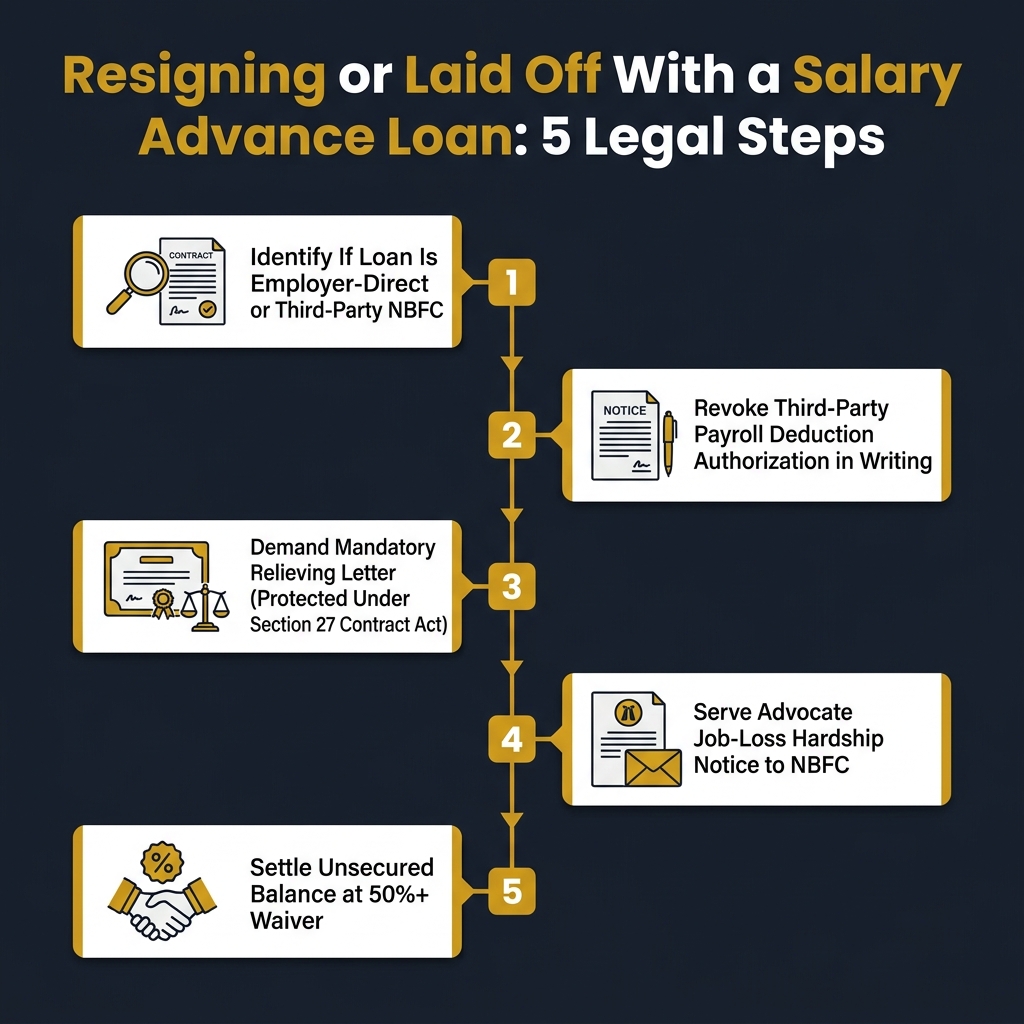
Prepared by AMA Legal Solutions Research & Analytics Team • Data & Compliance Overview

Halt Recovery Agent Harassment Legally
Payment of Wages Act & Employment Contract Boundaries: Employer's Direct Loan vs. Third-Party NBFC Partner Loan
When analyzing the validity of FnF salary offsets, Indian labor jurisprudence draws an unbreachable boundary between internal employer advances and third-party commercial loans. A thorough examination of the Payment of Wages Act, 1936 and its modern successor, the Code on Wages, 2019, reveals why HR departments routinely overstep their legal powers in earned wage access and salary advance app loan settlement india.
The Exhaustive Mandate of Section 7 (Payment of Wages Act)
Section 7 of the Payment of Wages Act, 1936 (and Section 18 of the Code on Wages, 2019) codifies the fundamental principle of wage protection: wages must be paid to an employee without deductions of any kind, except those explicitly authorized by statute. The permissible deduction categories enumerated by Parliament are strictly exhaustive:
- Statutory deductions for income tax (TDS), provident fund (EPF), and professional tax.
- Deductions for authorized absence from duty.
- Deductions for damage to or loss of company goods expressly entrusted to the employee, subject to formal inquiry.
- Recovery of advances granted directly by the employer from company funds, subject to federal rules.
- Deductions made under the written order of a competent civil court (such as a formal garnishee order).
Third-party fintech apps, digital payday lenders, and partnered NBFCs do not appear anywhere in the statutory list of permissible deductions. In the eyes of the law, a loan taken from an app is a private civil contract executed between the borrower and the financial institution. The employer is neither a judicial court nor an authorized debt collector. Unless an NBFC obtains a formal attachment order from a competent District Court or Debt Recovery Tribunal, an employer that deducts money from an employee's salary or FnF packet to satisfy an external fintech debt commits an unauthorized deduction. This principle forms the core statutory foundation of fintech debt settlement in India.
The 50% Aggregate Ceiling on Deductions
Even where legitimate deductions are permitted—such as recovery of genuine employer-granted advances—Section 7(3) of the Payment of Wages Act imposes a strict statutory ceiling: the total amount of deductions from wages in any wage period shall not exceed 50% of the employee's total earnings (extended to 75% only where deductions include payments to cooperative credit societies). Under no circumstances can an employer lawfully wipe out 100% of an employee's paycheck or final settlement.
If your former employer has confiscated your final pay packet under the pretext of loan app dues, you are not powerless. By issuing a not being paid FnF want to send legal notice communication, you can initiate formal proceedings before the jurisdictional Labour Commissioner under Section 15 of the Payment of Wages Act. Employers face severe financial penalties and mandatory compensation orders up to ten times the deducted amount for executing unauthorized wage withholdings.
Stopping Salary-Advance NBFCs From Calling Your New Employer's HR or Background Verification (BGV) Agency
Perhaps the most insidious tactic deployed by rogue digital lenders and aggressive collection agencies is workplace harassment. When an employee defaults on a salary advance app after changing jobs or being laid off, recovery agents frequently resort to unlawful pressure tactics aimed at sabotaging the debtor's professional reputation. Defending against these reputational attacks is an integral part of earned wage access and salary advance app loan settlement india.
Common Workplace Intimidation Practices
Defaulters routinely report collection agencies engaging in egregious violations:
- Calling corporate switchboards and asking for company leadership to report that an employee is a "financial fraudster."
- Sending mass emails to corporate HR email addresses (e.g.,
hr@company.comorcareers@company.com) threatening to initiate police raids at company headquarters. - Contacting third-party Background Verification (BGV) agencies (such as AuthBridge, First Advantage, or HireRight) attempting to inject negative comments into the professional's employment history.
- Reaching out to previous supervisors, team leads, or workplace colleagues whose phone numbers were harvested through illegal phone-contact permissions.
Regulatory Defenses: RBI Digital Lending Directions & DPDP Act, 2023
Every single one of these actions is strictly unlawful under prevailing Indian statutory frameworks:
- RBI Master Direction on Fair Practices Code for Lenders: The Reserve Bank of India strictly prohibits recovery agents from contacting borrowers before 8:00 AM or after 7:00 PM, calling colleagues or employers, using abusive or threatening language, and visiting workplaces without prior formal notice. Lenders are directly liable for the misconduct of their recovery agents.
- RBI Guidelines on Digital Lending: LSPs and DLAs are barred from accessing mobile phone resources such as contact lists, call logs, media files, and location data. Contacting third parties to shame a borrower constitutes a direct breach of RBI operational licenses.
- Section 6(4) of the Digital Personal Data Protection (DPDP) Act, 2023: Borrowers possess an unconditional right to withdraw data processing consents at any time. Once an employee revokes consent for a fintech app to contact their employer or access their data, continued communication with workplace personnel constitutes an actionable breach of statutory data privacy laws, attracting severe penalties before the Data Protection Board of India.
When these unlawful intrusions occur during earned wage access and salary advance app loan settlement india, your legal counsel will immediately issue a formal Cease-and-Desist Legal Notice to the NBFC's Principal Nodal Officer, Managing Director, and collection agencies. Putting the lender on formal notice that their tactics violate RBI directives and constitute criminal defamation and intimidation under the Bharatiya Nyaya Sanhita (BNS) reliably halts workplace outreach immediately.
Step-by-Step Process to Delink Payroll Deductions and Negotiate a 50%+ Post-Layoff One-Time Settlement (OTS)
Successfully resolving fintech salary debt requires a disciplined, step-by-step strategy. When executed correctly alongside experienced legal counsel, pursuing earned wage access and salary advance app loan settlement india allows you to delink your career from the debt and achieve a permanent, debt-free resolution through a negotiated One-Time Settlement (OTS).
Step 1: Audit Loan Documentation and Identify the Real Lender
Many borrowers do not know who actually lent them money. Fintech apps are merely consumer-facing interfaces. Your legal team begins by auditing your Key Fact Statement (KFS), loan agreement, and CIBIL report to identify the actual RBI-registered NBFC or bank behind the app (such as EarlySalary Services, KrazyBee, DMI Finance, Northern Arc, or SMFG India Credit). Identifying the licensed balance-sheet entity is crucial because corporate NBFCs are strictly regulated by RBI oversight, whereas unregulated apps lack legal standing.
Step 2: Formally Revoke Payroll and e-NACH Deduction Mandates
To regain control over your financial liquidity, you must revoke all active auto-debit authorizations:
- Revoking Employer Payroll Consents: Submit a formal, written communication to your former employer's HR and payroll department explicitly revoking any prior authorization to deduct third-party fintech dues from your salary, FnF settlement, or terminal benefits. Cite Section 7 of the Payment of Wages Act and confirm that any unauthorized deduction will be challenged before the Labour Commissioner.
- Canceling Bank e-NACH / UPI Autopay Mandates: Log into your net banking or NPCI mandate portal to stop automated recurring debits linked to the loan. If you are experiencing prolonged unemployment, learning how to manage loan with no job provides essential frameworks for allocating scarce capital toward basic survival necessities rather than unsecured digital debits.
Step 3: Serve an Advocate-Drafted Hardship and Anti-Harassment Representation
Your legal advocates draft and serve a comprehensive legal representation on the partner NBFC. This document accomplishes three decisive legal goals:
- It formally notifies the lender of your change in employment status, corporate retrenchment, or documented financial hardship, disproving any fraudulent intent or willful default.
- It invokes RBI Fair Practices Codes and the DPDP Act, prohibiting the lender and its recovery agents from contacting your workplace, HR managers, BGV agencies, or family members.
- It directs all future communications regarding the account exclusively to your appointed legal counsel, insulating you from daily harassment.
Step 4: Formulate and Table the One-Time Settlement (OTS) Proposal
Once predatory recovery tactics have been stopped and the debt is recognized as an unsecured, distressed retail asset, your advocates initiate formal compromise negotiations. Unsecured salary advance loans carry high capital risk for NBFCs once a borrower separates from their employer. Lenders are fully aware that pursuing recovery through protracted civil court trials costs significantly more than the outstanding debt.
Your legal team presents an empirical hardship dossier—including termination letters, layoff notices, bank statements, and family medical expenses—and tables an OTS offer typically ranging between 25% and 50% of the legitimate principal balance. The proposal requires a 100% complete waiver of all penal interest, late fees, bounce charges, and unannounced administrative levies.
Step 5: Verify the Official OTS Sanction Letter
Never transfer settlement funds based on verbal promises or WhatsApp messages from recovery agents. A compromise settlement is valid only when the lending NBFC issues a formal, stamped, and signed OTS Sanction Letter on its official corporate letterhead. Your advocates verify that the sanction letter explicitly details:
- The precise compromise amount and mutually agreed payment timeline.
- An explicit clause stating that payment of the settlement amount constitutes full and final satisfaction of all claims.
- An unconditional commitment that the lender will revoke all pending recovery notices, arbitration claims, or Section 25 PASSA / Section 138 NI Act proceedings.
- A clear timeline for updating all four credit information companies (CIBIL, Experian, Equifax, CRIF High Mark) to reflect the account closure.
Step 6: Execute Payment and Secure the No Dues Certificate (NDC)
Once the sanction letter has been legally vetted, payment is remitted directly into the lender's designated corporate collection account—never to an individual agent's UPI ID. Upon verification of receipt, your advocates secure the unconditional No Dues Certificate (NDC) or Closure Letter from the NBFC. By completing this disciplined process, you achieve a lawful conclusion to earned wage access and salary advance app loan settlement india, protecting your professional reputation and extinguishing your debt permanently.
Strategic Conclusion: Protect Your Relieving Letter, FnF & Career with AMA Legal Solutions
Corporate layoffs, organizational downsizing, and career transitions are challenging life events that require resilience and strategic clarity. Falling behind on high-interest digital salary advances does not make you a criminal, nor does it strip away your statutory rights as an employee and citizen. In the modern corporate economy, pursuing earned wage access and salary advance app loan settlement india is a legitimate, recognized legal path to resolve unpayable unsecured debts without sacrificing your career prospects.
Your professional reputation, relieving letter, and hard-earned terminal wages are the foundation of your future economic mobility. Permitting an aggressive fintech lender or an overreaching HR department to compromise those assets can have catastrophic consequences for your career trajectory. Attempting to manage aggressive recovery desks while searching for a new job is overwhelming. Professional legal representation levels the playing field immediately.
At AMA Legal Solutions, our dedicated team of senior banking and employment advocates specializes in defending salaried professionals against unlawful recovery practices and negotiating deep-haircut debt compromise closures. We intervene directly between you, your employer, and the lending NBFCs—halting workplace harassment, compelling the immediate release of withheld relieving letters, and securing enforceable One-Time Settlement agreements. If you are struggling under digital salary advance loans or facing threats to your FnF settlement, explore our comprehensive loan settlement services and loan settlement in India solutions, and contact AMA Legal Solutions today for an immediate, confidential legal consultation.
Popular Searches & Topics
Commonly searched legal queries and keywords related to this article
Need Strategic Legal Defense for Your Situation?
Our banking & litigation advocates review your notices, debt liability, and recovery issues under complete advocate-client secrecy.
References & Authority
- Reserve Bank of India - Master Direction on Digital Lending Directions (Direct Disbursals and Repayments)
- Ministry of Labour and Employment - Payment of Wages Act, 1936 (Section 7 Permissible Deductions)
- Ministry of Labour and Employment - Code on Wages, 2019 (Chapter III - Payment of Wages & Deductions)
- Indian Contract Act, 1872 - Section 27 Restraint of Trade and Employee Service Records Jurisprudence
- Employees' Provident Fund Organisation (EPFO) - Section 10 EPF Act Immunity from Attachment
- Ministry of Labour and Employment - Payment of Gratuity Act, 1972 (Section 13 Protection of Gratuity)
- Ministry of Electronics and Information Technology - Digital Personal Data Protection (DPDP) Act, 2023 (Section 6 Consent Withdrawal)
- Reserve Bank of India - Master Direction on Fair Practices Code for Non-Banking Financial Companies (NBFCs)

AMA Legal Solutions
Trusted with a 4.7 Google Rating, over 10,000+ Clients Served, 25,000+ Cases Handled, and more than 40+ Years of Experience in providing strategic legal defense and debt resolution across India.
Our media coverages





Frequently Asked Questions
Related Articles

How to Negotiate Credit Card Write-Off: A Practical Guide (2026)
Unlock effective strategies for negotiating credit card write-offs and reclaim financial control.
Read Article
What Is the Difference Between Credit Card Write-Off and Settlement?
Explore how credit card write-offs and settlements differ in legal implications and processes.
Read Article
Can You Get Another Credit Card After Settlement? Understanding Your Options in 2026
Explore your eligibility for a new credit card post-settlement and essential legal insights.
Read ArticleAbout Author
Anuj Anand Malik
View ProfileAnuj Anand Malik, Founder of AMA Legal Solutions, is a trusted advocate, loan settlement expert, legal advisor, and banking lawyer. With over a decade of experience in loan settlement, corporate law, financial disputes, and compliance, he leads a result-driven law firm based in India that helps individuals, startups, and businesses achieve legal and financial stability.
Connect on LinkedInNeed Legal Representation?
Evaluate your defense against recovery agents, notices, or structure your loan settlement directly with Senior Advocates.
Call +91-8700343611