Credit Card Settlement in India: Process, Eligibility, CIBIL Impact and Legal Guidance
Practical insights and legal strategies for navigating credit card settlements in India

Anuj Anand Malik
Reviewed by AMA Legal Solutions
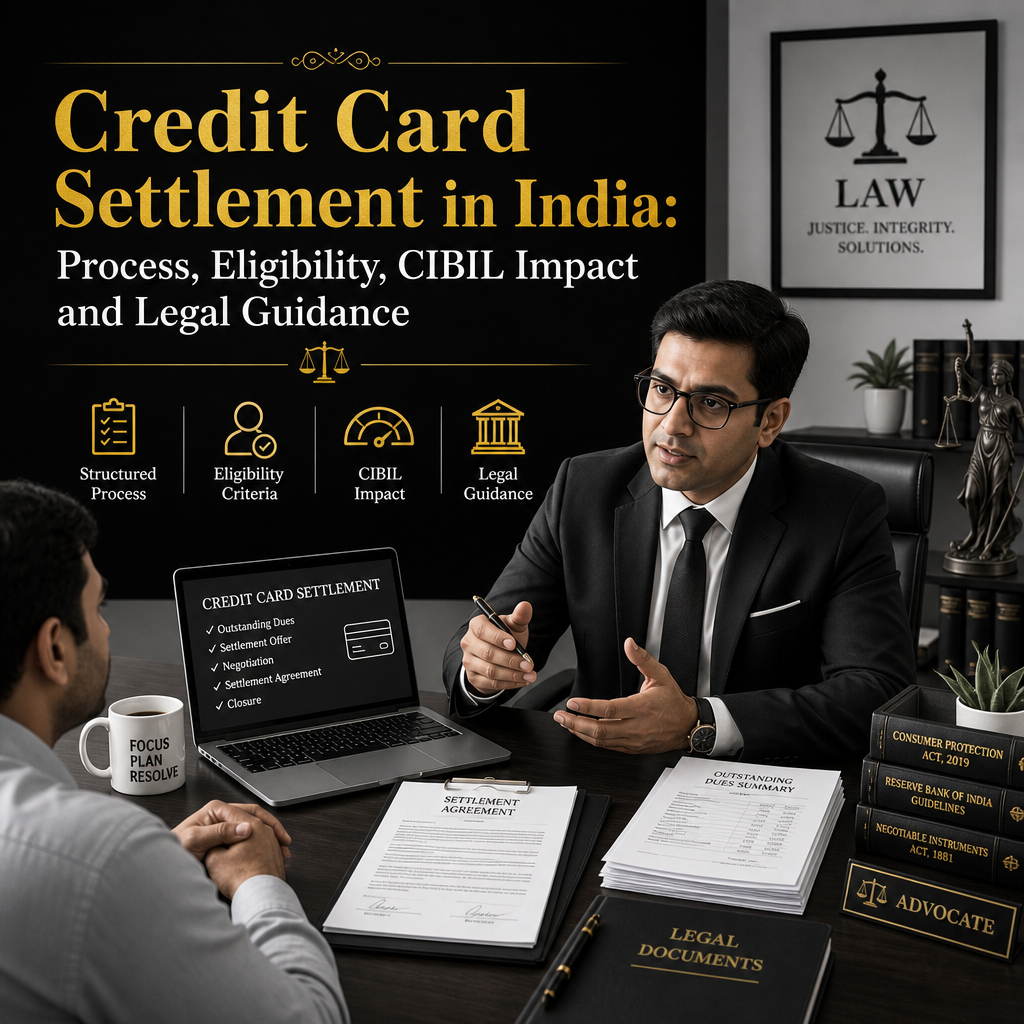
Key Takeaways: Credit card settlement in India allows borrowers to negotiate with lenders to resolve outstanding dues for a reduced amount, which can alleviate financial stress when full repayment is not feasible. This process involves understanding financial circumstances, preparing negotiation proposals, and obtaining lender agreement, as settlements can impact credit scores and require careful attention to documentation.
Credit Card Settlement in India: Process, Eligibility, CIBIL Impact and Legal Guidance
Credit cards can be extremely useful when managed responsibly.
But when outstanding balances begin to accumulate, a credit card can quickly become a source of financial stress.
A missed payment may be followed by interest, charges, increasing outstanding dues, and repeated communication from the card issuer or its authorized recovery agents.
For someone already facing financial difficulties, paying the entire outstanding amount can sometimes become extremely challenging.
This is where credit card settlement in India may become an option worth understanding.
Credit card settlement is a process through which a borrower and the card issuer may mutually agree to resolve outstanding dues for an agreed settlement amount.
At AMA Legal Solutions, we assist eligible borrowers in understanding their legal and practical options concerning credit-card debt, lender negotiations, recovery-related matters, and settlement.
What Is Credit Card Settlement?
Credit card settlement refers to an arrangement where the cardholder and the lender mutually agree to settle outstanding dues for an agreed amount instead of repayment of the entire outstanding balance.
Settlement is different from simply paying the minimum amount due.
It is also different from normal credit-card closure.
The final settlement amount depends on several factors, including:
Outstanding amount
Payment history
Financial hardship
Account status
Lender policies
Negotiation
Borrower's ability to arrange the proposed amount
Most importantly, a settlement amount cannot be guaranteed before the lender formally agrees to it.
Why Do Credit Card Dues Become Difficult to Manage?
Credit-card debt can become difficult because the outstanding amount may continue to grow when balances remain unpaid.
Borrowers may find themselves dealing with:
Multiple credit cards
High outstanding balances
Missed payments
Interest and applicable charges
Multiple monthly obligations
Reduced income
Job loss
Business losses
Unexpected expenses
Recovery calls
The problem can become even more complicated when someone is using one credit facility to pay another.
Eventually, the borrower may reach a point where the total outstanding amount is simply beyond their immediate repayment capacity.
When Can Credit Card Settlement Be Considered?
Settlement may be considered when a borrower is facing genuine financial difficulty and is unable to repay the full outstanding amount.
For example, a borrower may have experienced:
Loss of employment
Significant income reduction
Business losses
Medical or emergency expenses
Family financial responsibilities
Multiple unsecured debts
Excessive monthly repayment obligations
However, settlement should not automatically be considered the best option.
If you can continue making regular payments, you should understand the implications of settlement before proceeding.
The correct approach depends on your individual circumstances.
How Does Credit Card Settlement Work?
Step 1: Understand Your Outstanding Amount
Start by determining exactly how much is outstanding.
Review:
Principal or outstanding balance
Interest
Late-payment charges
Other applicable charges
Overdue amount
Account status
Having accurate information is essential before beginning negotiations.
Step 2: Assess Your Financial Capacity
The next step is to determine how much you can realistically arrange.
A settlement proposal should be based on actual financial capacity.
Making a promise that cannot be fulfilled may complicate negotiations further.
Step 3: Prepare a Settlement Proposal
A settlement proposal can then be presented to the lender.
The proposal should explain the borrower's financial circumstances and the amount that can realistically be arranged.
Step 4: Negotiate With the Card Issuer
The lender may accept the proposal, reject it, or ask for a revised amount.
Negotiation is therefore a significant part of the settlement process.
Professional assistance can help organize the communication and documentation involved.
Step 5: Obtain Written Confirmation
If the lender agrees to settlement, obtain written confirmation containing the agreed terms.
Review:
Settlement amount
Payment deadline
Payment instructions
Terms of settlement
Documentation to be issued after payment
Step 6: Make the Agreed Payment
Once the terms are formally agreed, the borrower should make the payment according to the agreed arrangement.
Maintain all payment records.
Step 7: Obtain Settlement Documentation
After completion, obtain the appropriate documentation from the lender confirming the settlement.
Keep these documents safely.
Does Credit Card Settlement Affect CIBIL?
This is one of the most important considerations.
Credit-card settlement can affect your credit profile because a settled account is different from an account that has been fully repaid.
The exact reporting and impact depend on the lender and the individual's credit history.
Therefore, anyone considering settlement should understand the potential effect before proceeding.
Settlement should be viewed as a debt-resolution option rather than a method of avoiding the financial consequences of unpaid debt.
Key Insights & Data Infographic
Visual summary, statistical trends & procedural breakdown
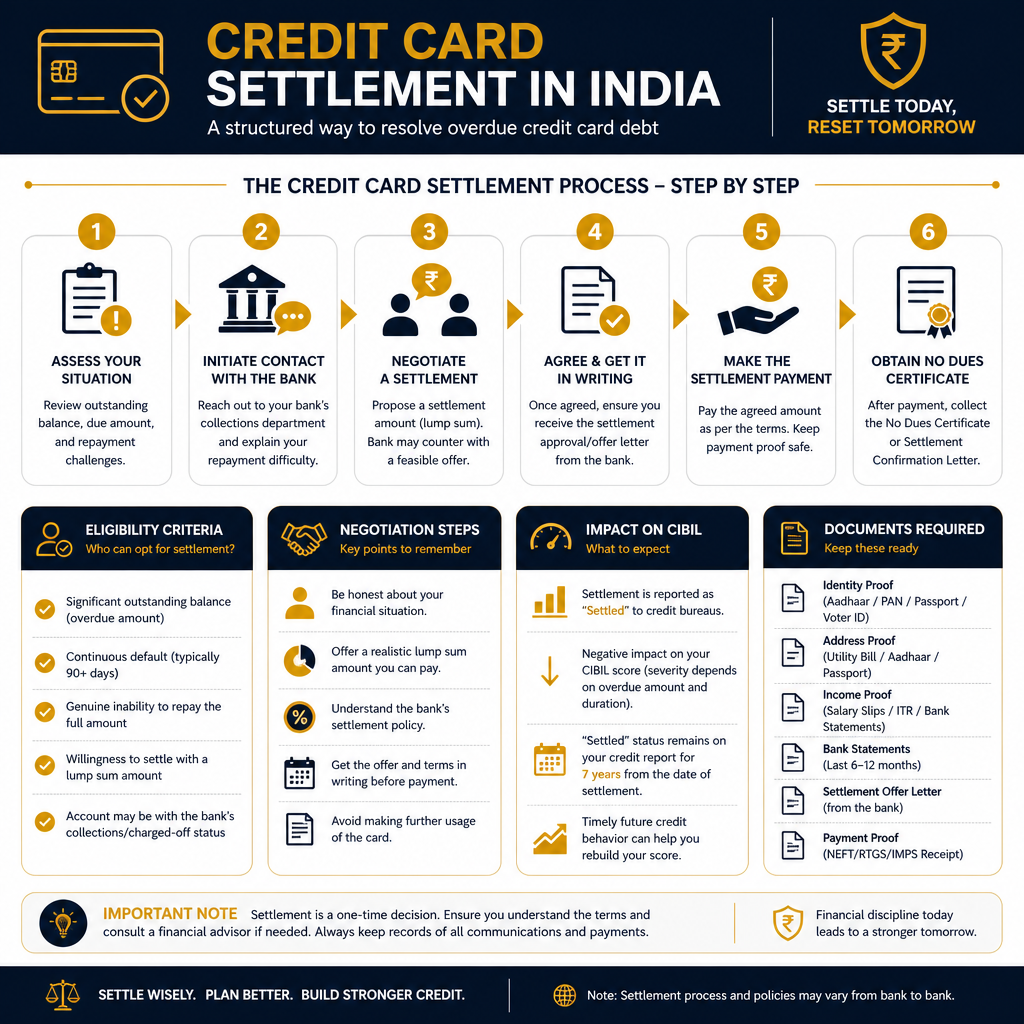
Prepared by AMA Legal Solutions Research & Analytics Team • Data & Compliance Overview

Halt Recovery Agent Harassment Legally
Credit Card Settlement vs Credit Card Closure
These terms are often confused.
Credit Card Closure
Closure generally means the account is closed after the applicable dues have been paid according to the lender's terms.
Credit Card Settlement
Settlement involves an agreement between the borrower and lender to resolve the outstanding dues for an agreed settlement amount.
These are not the same thing.
Understanding the distinction is important before making a decision.
Can Credit Card Settlement Stop Recovery Calls?
Settlement negotiations may help create a structured communication process with the lender, but settlement does not automatically mean that all recovery communication stops immediately.
If you are receiving inappropriate recovery communications, you should preserve records of calls and messages and understand your rights.
RBI instructions require regulated entities and their recovery agents to avoid intimidation and harassment in debt collection. The RBI has also specified restrictions concerning the timing and manner of recovery calls.
How AMA Legal Solutions Can Help
Credit-card debt can involve both financial and legal issues.
AMA Legal Solutions assists eligible borrowers with:
Credit-card settlement
Debt-resolution assistance
Lender negotiation
Legal consultation
Recovery-related matters
Review of legal notices
Assistance concerning arbitration matters
Documentation and settlement guidance
Every case is different.
Our approach is based on understanding the borrower's financial circumstances and the nature of the outstanding account before determining the appropriate course of action.
Important Things to Know Before Credit Card Settlement
Before proceeding, remember:
Settlement requires lender approval.
The settlement amount is not guaranteed.
Settlement is different from full repayment.
Settlement may affect your credit profile.
Terms vary between lenders.
Always obtain written settlement terms.
Keep payment receipts and settlement documents.
Understand applicable professional or service fees before engaging any service provider.
Final Thoughts
Credit-card debt can feel overwhelming, particularly when outstanding balances have continued to increase and repayment has become difficult.
But ignoring the problem generally does not make it disappear.
The first step is to understand your financial position and the options available.
If you are facing genuine financial hardship and are unable to repay your credit-card dues in full, credit card settlement in India may be an option worth exploring.
AMA Legal Solutions can assist eligible borrowers with legal guidance, lender communication, negotiation, and debt-resolution matters.
The goal should not simply be to reduce an outstanding amount.
The goal should be to work toward a structured and sustainable financial resolution.
Frequently Asked Questions
1. What is credit card settlement in India?
Credit-card settlement is an agreement between a cardholder and lender to resolve outstanding dues for a mutually agreed settlement amount.
2. Can I settle my credit card dues?
You may be able to explore settlement if you are experiencing genuine financial hardship, subject to the lender's policies and approval.
3. Does credit card settlement affect CIBIL?
A settled account can affect your credit profile because settlement is different from full repayment.
4. Can AMA Legal Solutions guarantee a credit-card settlement?
No. The final settlement amount and acceptance depend on the lender and the circumstances of the individual case.
5. How long does credit-card settlement take?
There is no universal timeline. It depends on the lender, account status, negotiations, documentation, and payment arrangements.
6. Is credit-card settlement the same as closing a credit card?
No. Settlement and regular closure are different outcomes and may have different implications.
7. Can I settle multiple credit cards?
Multiple accounts can potentially be addressed separately, subject to the circumstances and respective lenders' policies.
8. Should I settle my credit card or continue paying?
The appropriate option depends on your financial capacity, outstanding debt, and long-term financial circumstances. Consider the implications of both options before proceeding.
Need Strategic Legal Defense for Your Situation?
Our banking & litigation advocates review your notices, debt liability, and recovery issues under complete advocate-client secrecy.

AMA Legal Solutions
Trusted with a 4.7 Google Rating, over 10,000+ Clients Served, 25,000+ Cases Handled, and more than 40+ Years of Experience in providing strategic legal defense and debt resolution across India.
Our media coverages





Frequently Asked Questions
Related Articles

Can Bank or Loan App Remotely Lock Phone for EMI Default? RBI Rules (2026)
An investigative breakdown of RBI's Remote Device Locking Directions—explaining why lenders cannot lock your phone for personal loans, the mandatory 30/60 DPD safeguards on financed devices, the Rs. 250/hour delay penalty, and how to settle device & app loans.
Read Article
How Recovery Agents Get Your Personal Details and How to Prevent It in India (2026)
An investigative legal breakdown of the 7 hidden channels debt collectors use to trace your phone numbers, family contacts, employer, and address - and the exact statutory shields under RBI 2026 Directions and the DPDP Act, 2023 to stop them.
Read Article
willdrafting.in indias first online will drafting platform get your will in few minutes
Discover the swift and secure way to draft your will online in India today
Read ArticleAbout Author
Anuj Anand Malik
View ProfileAnuj Anand Malik, Founder of AMA Legal Solutions, is a trusted advocate, loan settlement expert, legal advisor, and banking lawyer. With over a decade of experience in loan settlement, corporate law, financial disputes, and compliance, he leads a result-driven law firm based in India that helps individuals, startups, and businesses achieve legal and financial stability.
Connect on LinkedInNeed Legal Representation?
Evaluate your defense against recovery agents, notices, or structure your loan settlement directly with Senior Advocates.
Call +91-8700343611