How Recovery Agents Get Your Personal Details and How to Prevent It in India (2026)
An investigative legal breakdown of the 7 hidden channels debt collectors use to trace your phone numbers, family contacts, employer, and address - and the exact statutory shields under RBI 2026 Directions and the DPDP Act, 2023 to stop them.

Anuj Anand Malik
Reviewed by AMA Legal Solutions
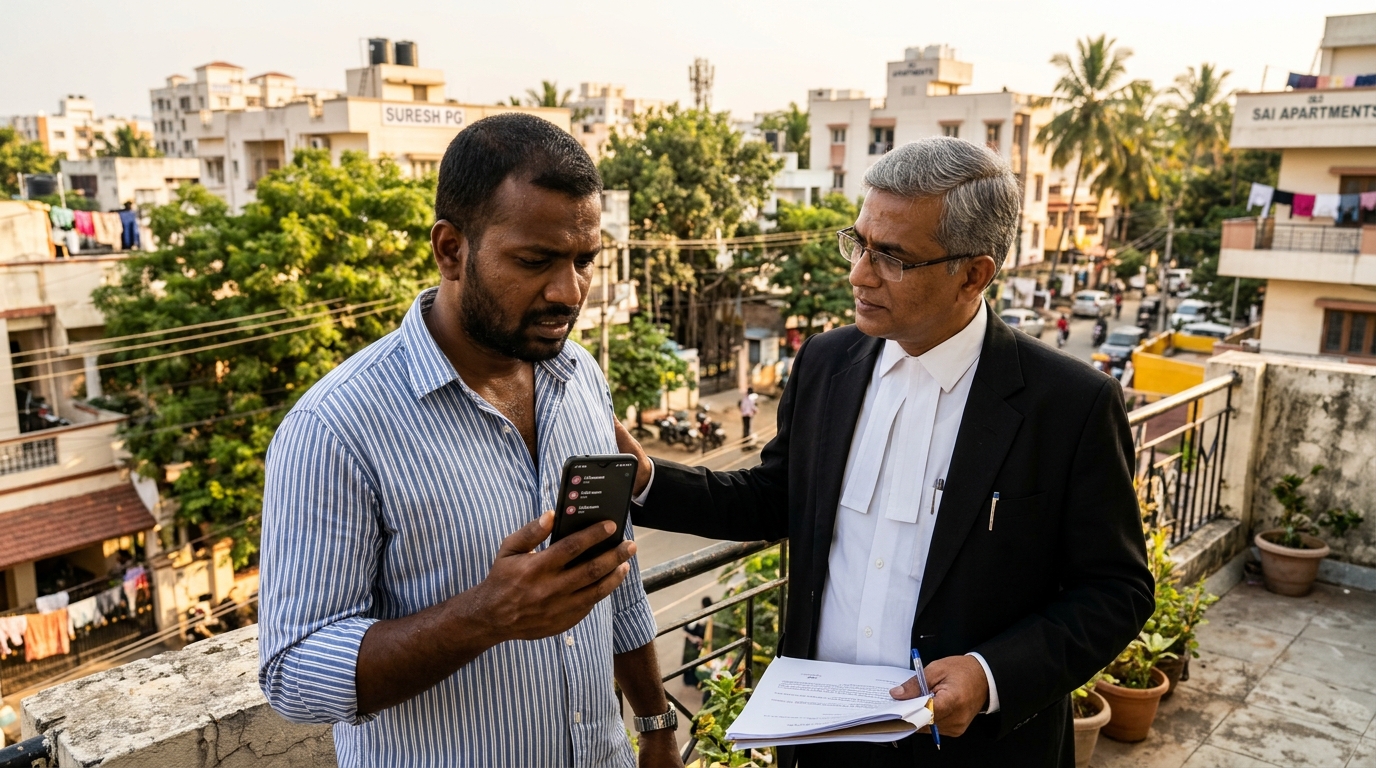
Key Takeaways: Understanding how recovery agents get your personal details and how to prevent it is your first line of legal defense when facing financial distress in India. Recovery agencies track borrowers through seven primary channels: credit bureau "skip-tracing" tools (such as CIBIL Locate Plus), historical bank statements and UPI transfer logs, original loan application references, invasive mobile app permissions, social media OSINT (LinkedIn/Facebook), reverse telecom/Truecaller lookups, and local field inquiries. Under the Reserve Bank of India (RBI) 2026 Recovery Conduct Directions, the Digital Personal Data Protection (DPDP) Act, 2023, and Section 72A of the IT Act, 2000, contacting your relatives, friends, colleagues, or employer to shame you is strictly illegal. Borrowers can immediately shut down unauthorized data tracking by revoking app permissions, serving a formal DPDP Act Consent Withdrawal and Advocate Representation Notice through AMA Legal Solutions, and escalating breaches to the RBI Ombudsman (cms.rbi.org.in).
Introduction: Understanding How Recovery Agents Get Your Personal Details and How to Prevent It
One of the most terrifying experiences for an Indian borrower struggling with a missed EMI or credit card default is receiving a panicky phone call from an elderly parent, a sibling, an estranged relative, or a workplace HR manager saying: "Someone from a bank recovery department just called me about your loan default." Even borrowers who change their SIM card, relocate to a new apartment, or switch companies are often shocked at how quickly third-party collection agencies track down their unlisted mobile numbers and new office addresses.
When investigating how recovery agents get your personal details and how to prevent it, it is crucial to distinguish between two very different ecosystems operating in India in 2026: regulated institutional lenders (Scheduled Commercial Banks and RBI-registered NBFCs) and predatory digital lending apps (unregulated instant loan APKs). While regulated banks rely on institutional financial databases, credit bureau "skip-tracing" APIs, and historical KYC trails, rogue digital apps rely on illegal spyware permissions that scrape your device's contact book and photo gallery.
Regardless of how your information was obtained, Indian law draws an ironclad boundary: a loan or credit card is a private civil contract strictly between the lender and the primary borrower (or a signed legal guarantor). Disclosing your debt status to your family, friends, neighbors, or employer is a severe statutory violation. In this exhaustive legal guide prepared by the banking and cyber litigation team at AMA Legal Solutions, we expose the exact technical and investigative mechanisms recovery agents use to harvest your personal data and provide a step-by-step legal and digital playbook to stop them permanently.
The 7 Hidden Channels: How Recovery Agents Get Your Personal Details in India
Collection agencies do not rely on guesswork. Modern debt recovery in India combines automated API data enrichment, financial forensics, and traditional field investigation—collectively known in the banking industry as Skip Tracing. Below are the seven exact mechanisms explaining how recovery agents get your personal details when an account enters default or Non-Performing Asset (NPA) status.
1. Credit Bureau "Skip-Tracing" Tools (CIBIL Locate Plus, Experian & CRIF)
Many borrowers assume that changing their primary mobile number or moving to a new house makes them invisible to their bank. In reality, India's four licensed Credit Information Companies—TransUnion CIBIL, Experian, Equifax, and CRIF High Mark—offer specialized commercial skip-tracing products (such as CIBIL's Locate Plus and portfolio monitoring alerts) to member banks and NBFCs.
Because your financial identity in India is permanently anchored to your PAN Card and Aadhaar Number, the moment you apply for any new service requiring KYC—such as a new bank account, a postpaid mobile connection, a consumer durable EMI for a phone or appliance, a Buy-Now-Pay-Later (BNPL) line, or even a credit check by a new landlord or employer—the new institution submits your updated mobile number and current address to the credit bureau. Your old lender receives an automated "skip alert" revealing your newly updated contact coordinates within 24 to 72 hours.
2. Digital Lending App (DLA) Permissions & Phonebook Scraping
If you ever installed an instant personal loan app, a 7-day payday loan APK, or even certain aggressive fintech apps prior to revoking permissions, the onboarding screen likely prompted you to hit "Allow" on access to your Contacts, Call Logs, SMS Messages, Storage/Photos, and Location.
The millisecond you granted those permissions, the app's background script uploaded your entire phonebook (every saved contact name, relationship label like "Mom", "Dad", "Boss", or "Landlord", and phone number) along with your recent call frequency logs to a remote cloud server. Even if you uninstall the app the very next day, your entire contact list remains stored on the collection agency's dialer server. When you miss a payment by even one day, automated robo-dialers and call-center agents systematically target the people you call most frequently to manufacture social humiliation.
3. Original Loan Application Forms, References & Workplace HR Disclosures
When you originally applied for a personal loan, auto loan, or credit card, the digital or physical application form required you to fill out mandatory fields that most borrowers forget about years later:
- Two Personal/Family References: Banks require the names, relationships, addresses, and phone numbers of two references during loan origination. While references are legally not guarantors and carry zero financial liability, recovery agents routinely dial these reference numbers first when your primary phone goes unanswered.
- Official Employer & Corporate Email Data: To verify your income, you provided your official company email address, office landline, HR verification email, and corporate building address. Recovery agents use these records to call reception desks, message HR departments, or show up outside corporate tech parks.
- Co-Applicant and Ancestral KYC Addresses: Your Aadhaar card, passport, or electricity bill submitted during KYC often contains your parents' permanent residential address in your hometown, allowing field agents in that city to visit your family home.
4. Bank Statement Forensics, NACH Mandates & Reverse UPI Lookups
This is one of the least understood yet most common ways recovery agents find your spouse, parents, or close friends—even if you never listed them as references and never installed a loan app. When you applied for the loan, you submitted 6 to 12 months of your primary savings or salary bank statements (either as a PDF or via an Account Aggregator).
Skip-tracing analysts comb through your historical bank statement entries looking for recurring IMPS, NEFT, and UPI transactions. Every UPI narration in a bank statement typically reads like UPI/DR/3123456789/RAMESH SHARMA/SBIN/9876543210@ybl. From that single line, a recovery agent extracts:
- The full legal name of the person you regularly transfer money to (often your spouse, father, brother, or house owner).
- Their 10-digit mobile number embedded inside the UPI ID (e.g.,
9876543210@okaxisor@paytm). - Even if they only have a phone number, typing that number into any UPI app (GPay, PhonePe, Paytm) immediately reveals the registered banking name linked to that number!
5. Open-Source Intelligence (OSINT): LinkedIn, Facebook, Instagram & EPFO Trails
Modern collection agencies employ dedicated desktop skip-tracers who use Open-Source Intelligence (OSINT) techniques to map your social and professional life:
- LinkedIn & Corporate Directories: The moment you update your LinkedIn profile with a new job title or company name, skip-tracers find your new employer's headquarters phone number and guess your corporate email format (
firstname.lastname@company.com). - EPFO / UAN Employment Verification: In extreme skip cases, unscrupulous agencies attempt to cross-verify Universal Account Number (UAN) service history or corporate PF filings to identify which company is currently deducting your Provident Fund.
- Facebook & Instagram Social Graphs: If your social media profiles are public, agents scan your tagged family photos, anniversary posts, comment sections, and location check-ins to identify your spouse, siblings, or business partners and message them directly.
6. Truecaller Reverse Lookups & Unregulated Data Broker Leaks
Collection call centers routinely run borrower numbers and family numbers through reverse-directory tools like Truecaller, Eyecon, and leaked third-party marketing databases. If your number is saved by acquaintances with your company name or residential society name (e.g., "Rahul Verma DLF Phase 3"), Truecaller exposes that metadata instantly. Furthermore, rogue call centers operating outside RBI supervision often purchase illicitly leaked consumer databases from telecom vendors, insurance portals, or e-commerce delivery logs matching your name and pin code.
7. Ground-Level Field Inquiries (Pretexting With Watchmen & Neighbors)
When digital skip-tracing hits a wall, collection agencies dispatch local field agents (often on two-wheelers) to your last known residential or office address. Rather than announcing themselves as bank recovery agents—which causes security guards to turn them away—they frequently use "pretexting": pretending to be an urgent courier delivery boy, an Amazon/Flipkart parcel executive, a passport verification clerk, or an old college friend asking the building watchman, society office, or next-door kirana shopkeeper: "Where did Sharma ji shift? Do you have his new mobile number to deliver this parcel?"
Legal vs. Illegal Data Collection: What Indian Law & RBI 2026 Guidelines Permit
Understanding how recovery agents get your personal details and how to prevent it requires knowing where legitimate contact tracing ends and criminal harassment begins. Both the Reserve Bank of India (RBI)—through its Fair Practices Code, Digital Lending Directions, and the reinforced 2026 RBI Conduct of Recovery Agents Directives—and the Parliament of India have enacted strict legal boundaries.
| Data Source / Recovery Tactic | Legal Status in India (2026) | Governing Law / RBI Directive | Legal Remedy for Borrower |
|---|---|---|---|
| Contacting Primary Borrower or Signed Guarantor (8:00 AM – 7:00 PM only) | Permitted (Strictly regulated, non-abusive, recorded calls only) | RBI Master Direction on Recovery Agents & Fair Practices Code | Demand Bank Authorization Letter, IIBF DRA ID Card, and official written notice |
| Scraping Phone Contacts, Call Logs, or Photo Gallery via Loan App | Strictly Illegal (Blanket ban on phone resource access) | RBI Digital Lending Directions & Section 66E / 72A IT Act, 2000 | File RBI Sachet complaint, Cyber Crime 1930 report & DPDP Act complaint |
| Calling Family, Relatives, Friends, or Neighbors to Reveal Debt | Strictly Illegal (Breach of confidentiality & third-party harassment) | RBI Privacy Mandate, DPDP Act 2023 & Section 356 BNS (Defamation) | Serve Advocate Cease-and-Desist Notice & escalate to RBI Ombudsman |
| Calling Workplace HR, Boss, or Colleagues / Visiting Office to Shame | Strictly Illegal (Unlawful intimidation & reputational damage) | RBI Recovery Code, Section 351 BNS (Criminal Intimidation) & Civil Tort | Issue immediate legal notice to bank Nodal Officer & claim compensation |
| Creating WhatsApp Groups with Family / Sending Morphed Photos | Non-Bailable Criminal Offense (Cyber extortion & privacy violation) | Sections 308, 79 & 351 BNS, 2023 + Sections 66E & 67 IT Act, 2000 | Immediate Police FIR & National Cyber Crime Portal (cybercrime.gov.in) |
4 Powerful Laws That Protect Your Personal Data from Recovery Agents in 2026
Whenever a recovery agent threatens to call your relatives, visit your workplace, or leak your details, citing the exact statutory provisions below immediately shifts the balance of power in your favor. Banks and NBFCs face massive regulatory fines and license suspension when their outsourced vendors violate these four laws:
1. The RBI Master Directions & 2026 Recovery Conduct Framework
Under the Reserve Bank of India's binding directives applicable to all Commercial Banks, NBFCs, Housing Finance Companies, and Cooperative Banks:
- Strict Vicarious Liability: Banks and NBFCs are 100% legally accountable for the actions of their outsourced recovery agencies and Loan Service Providers (LSPs). A bank cannot claim that a third-party telecaller acted "independently."
- Absolute Ban on Third-Party Disclosure: Agents are strictly forbidden from disclosing your loan default to family members, friends, neighbors, or employers who have not signed as a co-borrower or legal guarantor. Even listed "application references" can only be contacted once solely to ascertain whereabouts if the borrower is completely unreachable—never to disclose debt figures, demand money, or shame the borrower.
- Mandatory 8:00 AM to 7:00 PM Window: No call, SMS, WhatsApp message, or field visit is permitted before 8:00 AM or after 7:00 PM.
- Mandatory IIBF Certification & Prior Notice: Every recovery agent must hold a valid Debt Recovery Agent (DRA) certificate from the Indian Institute of Banking & Finance (IIBF), carry an official bank authorization letter, and the bank must formally notify you of the agency's details before any agent contacts you.
2. The Digital Personal Data Protection (DPDP) Act, 2023
The implementation of the Digital Personal Data Protection (DPDP) Act, 2023 has revolutionized borrower privacy rights in India:
- Data Fiduciary Accountability: Under the DPDP Act, your bank or NBFC is the Data Fiduciary, and the collection agency is a Data Processor. Under Section 8 of the Act, the Data Fiduciary bears absolute legal liability for any unauthorized data processing by its recovery vendor.
- Purpose Limitation & Data Minimization: Personal data submitted for KYC or bank statement income verification cannot be repurposed to stalk your family members or scrape UPI contacts.
- Right to Withdraw Consent (Section 6): You have the statutory right to withdraw consent for any non-essential third-party data access (such as mobile app permissions or contacting reference numbers), and penalties for severe data breaches under the DPDP Act reach up to ₹250 Crore.
3. The Information Technology (IT) Act, 2000 (Sections 66E, 72 & 72A)
Under Section 72A of the Information Technology Act, 2000, any intermediary, bank official, or outsourced recovery agent who has secured access to your personal financial information under a lawful contract and intentionally discloses that personal information to third parties (like your employer, neighbors, or relatives) without your consent—or in breach of contract—commits a criminal offense punishable with imprisonment up to 3 years, or a fine up to ₹5,00,000, or both.
4. The Bharatiya Nyaya Sanhita (BNS), 2023
When recovery agents cross into threats, abuse, or workplace scenes, their conduct attracts criminal prosecution under the Bharatiya Nyaya Sanhita (BNS), 2023:
- Section 351 BNS (Criminal Intimidation): Threatening injury to your person, reputation, or property (including threatening to ruin your reputation at your office or in your housing society) carries up to 2 years imprisonment.
- Section 356 BNS (Criminal Defamation): Publicly announcing your default to neighbors, colleagues, or WhatsApp groups to harm your reputation.
- Section 308 BNS (Extortion): Coercing money from you or your elderly parents by putting them in fear of public humiliation or fake arrest warrants.
- Section 79 BNS: Using abusive, filthy, or sexually colored language toward a female borrower or a borrower's wife, mother, or sister.
Key Insights & Data Infographic
Visual summary, statistical trends & procedural breakdown
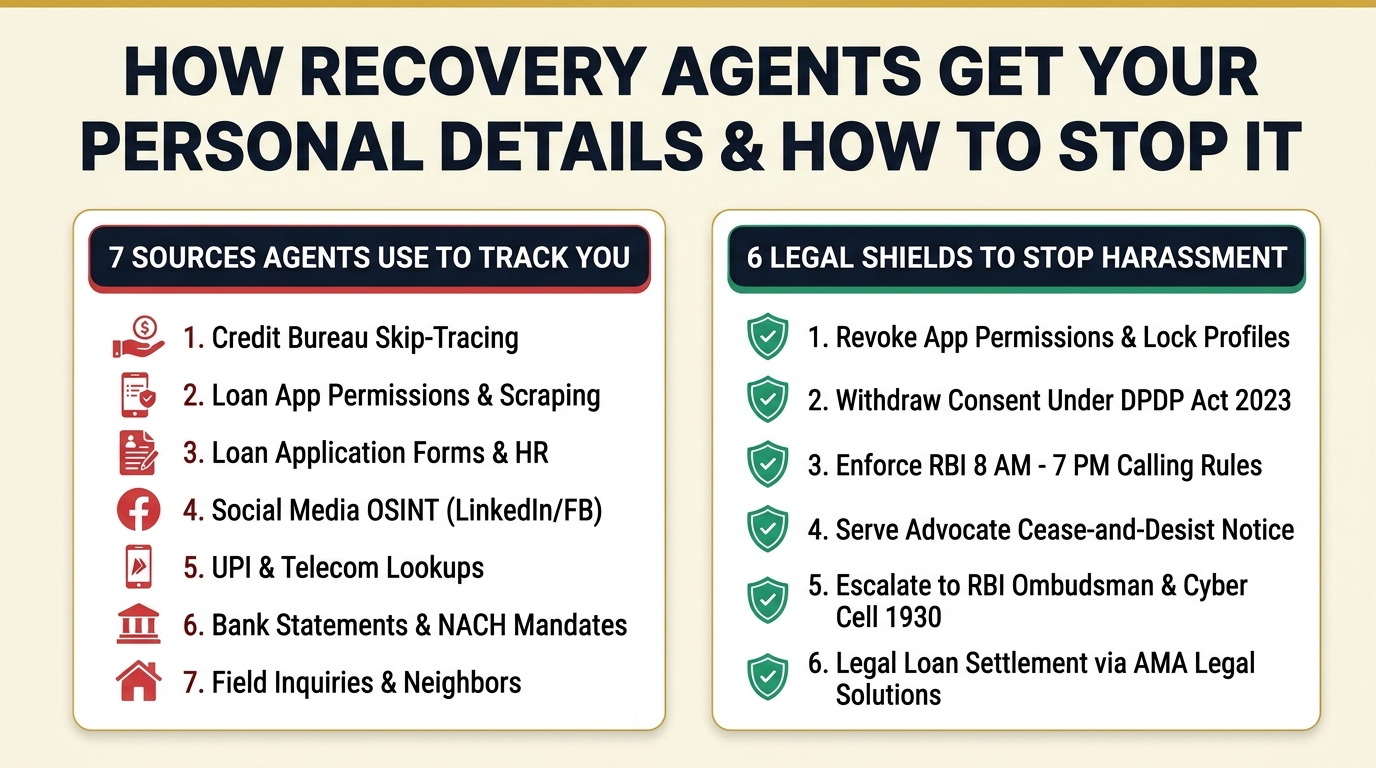
Prepared by AMA Legal Solutions Research & Analytics Team • Data & Compliance Overview

Halt Recovery Agent Harassment Legally
Step-by-Step Prevention Guide: How to Stop Recovery Agents From Getting Your Personal Details
If you anticipate a missed EMI, are already facing default, or want to lock down your digital footprint immediately, execute this 6-Point Privacy & Legal Lockdown Protocol right away. Knowing how recovery agents get your personal details and how to prevent it works best when you combine technical digital hygiene with formal advocate intervention.
Step 1: Execute an Immediate Smartphone & App Permission Lockdown
Do not simply uninstall a lending or fintech app before revoking its permissions—otherwise, background tokens may remain active.
- Open your phone's Settings → Privacy / Permission Manager.
- Check Contacts, Call Logs, SMS, Microphone, Location, and Files/Media. Immediately set every banking, NBFC, BNPL, or loan app to "Don't Allow".
- Clear the app's Storage Cache and Data, and only then uninstall non-essential lending apps.
- Visit
myaccount.google.com/permissionsand revoke third-party access for any financial or credit-scoring scripts connected to your Gmail account (which agents sometimes use to read job offer letters or utility bills).
Step 2: Scrub Your Truecaller, UPI & Social Media OSINT Footprint
Cut off the desktop skip-tracing tools collection agencies use to locate your workplace and relatives:
- De-list or Sanitize Truecaller: Open Truecaller, edit your profile name to simple initials (removing your surname, company name, or city), and use Truecaller's official Unlist Phone Number privacy setting so reverse lookups fail.
- Hibernate or Lock LinkedIn: While resolving a default, either temporarily hibernate your LinkedIn account or turn off public visibility in Settings → Visibility → Edit Your Public Profile so skip-tracers outside your network cannot see your current employer.
- Lock Facebook & Instagram: Activate "Lock Profile" on Facebook and switch Instagram to Private, ensuring your friend list and tagged family photos are hidden from non-followers.
- Disable Mobile Number Lookup on UPI: In Google Pay, PhonePe, and Paytm privacy settings, disable the option that allows unknown users outside your contacts to look up your UPI profile via your 10-digit mobile number if you use a secondary number.
Step 3: Serve a Formal DPDP Act Consent Withdrawal & Privacy Notice to the Lender
Before recovery agents escalate to calling references or visiting your workplace, send a formal written notice by email and registered post to the Bank/NBFC's Principal Nodal Officer (PNO) and Data Protection Officer (DPO). Explicitly state:
- That under Section 6 of the Digital Personal Data Protection (DPDP) Act, 2023 and the RBI Fair Practices Code, you formally withdraw any purported consent to contact third-party references, family members, or workplace numbers.
- That you are aware of your financial obligation, are experiencing genuine financial hardship, and require all future communication to be restricted strictly to your registered email address or your appointed legal counsel.
- That any disclosure of your debt to a third party will immediately trigger a prosecution complaint under Section 72A of the IT Act, 2000 and an escalation to the RBI Ombudsman.
Step 4: Appoint Registered Legal Counsel to Redirect All Recovery Communication
Why do recovery agents call your relatives and office in the first place? Because they perceive an unrepresented individual borrower as an easy target for psychological pressure. The single most effective legal shield under Indian law is appointing a registered law firm like AMA Legal Solutions.
When our advocates serve a formal Advocate Representation and Anti-Harassment Legal Notice on the bank's legal and collections department under the Advocates Act, 1961, the bank is legally put on notice that you are represented by counsel. Our legal team sets up structured call forwarding and legal representation so that recovery agents must deal directly with seasoned banking advocates rather than harassing you or your family.
Step 5: Escalate Privacy Violations Through the Official Regulatory Matrix
If an agent has already called a relative, colleague, or neighbor, do not argue with the telecaller. Quietly record the call, take screenshots of the caller's number and call timestamp from your relative's phone, and escalate through these four official Indian statutory channels:
| Escalation Authority | Official Portal / Helpline | When to Use This Channel | Expected Statutory Outcome |
|---|---|---|---|
| 1. Bank / NBFC Principal Nodal Officer (PNO) | Official Nodal Officer Email (Listed on Bank Website) | First mandatory step whenever an agent calls relatives, uses abuse, or calls after 7:00 PM | Immediate recall of file from rogue agency & written assurance within 7–15 days |
| 2. RBI Integrated Ombudsman (RB-IOS) | cms.rbi.org.in or Toll-Free 14448 |
If Bank fails to stop third-party harassment within 30 days (or immediately in severe breaches) | Regulatory directive against Bank + financial compensation up to ₹20 Lakh for mental harassment |
| 3. National Cyber Crime Reporting Portal | cybercrime.gov.in or Helpline 1930 |
When digital loan apps scrape contact lists, create WhatsApp groups, or morph photos | Cyber police freeze rogue payment gateways, block numbers & register IT Act FIR |
| 4. RBI Sachet Portal & Local Police Station | sachet.rbi.org.in / Local SHO or SP Office |
Unregistered loan apps or physical trespassing/threats by field agents at home or office | Criminal action under Sections 351, 356 & 308 of Bharatiya Nyaya Sanhita (BNS), 2023 |
Step 6: Resolve the Underlying Debt Permanently via Legal Loan Settlement (OTS)
Stopping data harvesting and third-party harassment buys you breathing room, but the permanent solution to ending Credit Bureau skip-tracing and collection calls forever is resolving the underlying loan contract. If job loss, medical emergency, business failure, or salary cuts have made full repayment impossible, you have the legal right to negotiate a formal One-Time Settlement (OTS).
Through our specialized loan settlement services and credit card debt settlement practice, the advocates at AMA Legal Solutions negotiate directly with the bank's central Zonal Settlement Committee—often waiving 100% of penal interest and late fees and reducing the principal outstanding by 40% to 75% depending on the delinquency stage—culminating in an official No Dues Certificate (NDC) that legally terminates all recovery tracking permanently.
What Should You Tell Relatives or HR If a Recovery Agent Calls Them?
If a recovery agent manages to call your family member, friend, or HR manager before your legal shield is in place, instruct your contacts to follow this exact 30-second script:
- Never Confirm Any Details: Your relative or colleague should state firmly: "I am neither a co-borrower nor a guarantor on any loan. Under RBI guidelines and the DPDP Act, 2023, disclosing someone else's financial details to me is a criminal offense."
- Demand the Caller's Identity & Bank Name: Ask: "Give me your full name, your IIBF DRA Registration Number, the name of your collection agency, and which bank authorized this call, because this call is being recorded for an RBI Ombudsman and Cyber Cell complaint." (In 95% of cases, rogue telecallers disconnect the call immediately upon hearing this).
- Send You the Screenshot: Ask your contact to take a screenshot of the call log showing the phone number, exact time, and call duration, and forward it to your advocate at AMA Legal Solutions so it can be attached as hard evidence in your legal notice against the bank.
Why Choose AMA Legal Solutions to Stop Recovery Harassment & Protect Your Privacy?
Unlike unregulated commercial debt-relief agencies or call-center intermediaries that have no legal standing in Indian courts, AMA Legal Solutions is a full-service, Bar Council-registered law firm led by Advocate Anuj Anand Malik with over 40+ years of combined institutional experience and 25,000+ cases handled across India.
- Strict Advocate-Client Privilege: All your financial disclosures are protected under statutory advocate-client privilege.
- Immediate Legal Notice & Anti-Harassment Shield: We draft and serve enforceable legal notices citing the RBI 2026 Recovery Conduct Directions, the DPDP Act 2023, and the BNS 2023 directly on the lender's Principal Nodal Officer and Legal Department.
- Pan-India Court, Lok Adalat & DRT Representation: Whether you are facing arbitration proceedings, a Section 138 cheque bounce notice, or SARFAESI/DRT action, our litigation advocates represent you in court across all Indian states.
- End-to-End Debt Resolution: From stopping illegal third-party calls on Day 1 to securing a verified One-Time Settlement (OTS) letter and No Dues Certificate, we handle the entire legal process so you can rebuild your financial life with dignity.
Strategic Conclusion: Reclaim Your Privacy and Financial Peace Today
Now that you understand how recovery agents get your personal details and how to prevent it, remember that financial hardship is never a crime in India—annotations on a CIBIL report do not strip you of your fundamental right to privacy under Article 21 of the Constitution of India or the statutory protections of the DPDP Act, 2023 and RBI guidelines. Never allow rogue recovery agents to intimidate you into taking high-interest app loans to pay off existing EMIs.
If you or your family members are experiencing invasive tracking, workplace calls, or recovery harassment, take decisive legal action today. Contact AMA Legal Solutions for a confidential case evaluation with our senior banking and cyber law advocates, and put an impenetrable legal shield between your family and aggressive debt collectors.
Popular Searches & Topics
Commonly searched legal queries and keywords related to this article
Need Strategic Legal Defense for Your Situation?
Our banking & litigation advocates review your notices, debt liability, and recovery issues under complete advocate-client secrecy.
References & Authority
- Reserve Bank of India (RBI) - Master Circular & Directions on Recovery Agents Engaged by Banks
- Reserve Bank of India (RBI) - Guidelines on Digital Lending & Ban on Contact List Access
- Reserve Bank of India (RBI) - Complaint Management System (CMS) & Integrated Ombudsman Portal
- Reserve Bank of India (RBI) - Sachet Portal for Reporting Unauthorized Digital Lending Apps
- Ministry of Electronics and Information Technology (MeitY) - Digital Personal Data Protection (DPDP) Act, 2023
- National Cyber Crime Reporting Portal (Ministry of Home Affairs, Govt. of India)
- India Code - Information Technology Act, 2000 & Bharatiya Nyaya Sanhita (BNS), 2023
- SettleLoans - Legal Consequences of Recovery Agents Calling Family Members
- SettleLoans - Changing Phone Number and Address to Avoid Loan Recovery Agents
- CredSettle - RBI Digital Lending Rules: Ban on Accessing Contacts and Photo Gallery

AMA Legal Solutions
Trusted with a 4.7 Google Rating, over 10,000+ Clients Served, 25,000+ Cases Handled, and more than 40+ Years of Experience in providing strategic legal defense and debt resolution across India.
Our media coverages





Frequently Asked Questions
Related Articles

Can Bank or Loan App Remotely Lock Phone for EMI Default? RBI Rules (2026)
An investigative breakdown of RBI's Remote Device Locking Directions—explaining why lenders cannot lock your phone for personal loans, the mandatory 30/60 DPD safeguards on financed devices, the Rs. 250/hour delay penalty, and how to settle device & app loans.
Read Article
willdrafting.in indias first online will drafting platform get your will in few minutes
Discover the swift and secure way to draft your will online in India today
Read Article
Why Loan Settlement in the Month of Oct is Beneficial for Borrowers (2026)
Explore key advantages of settling loans in October for a fresh financial start.
Read ArticleAbout Author
Anuj Anand Malik
View ProfileAnuj Anand Malik, Founder of AMA Legal Solutions, is a trusted advocate, loan settlement expert, legal advisor, and banking lawyer. With over a decade of experience in loan settlement, corporate law, financial disputes, and compliance, he leads a result-driven law firm based in India that helps individuals, startups, and businesses achieve legal and financial stability.
Connect on LinkedInNeed Legal Representation?
Evaluate your defense against recovery agents, notices, or structure your loan settlement directly with Senior Advocates.
Call +91-8700343611