Can Bank or Loan App Remotely Lock Phone for EMI Default? RBI Rules (2026)
An investigative breakdown of RBI's Remote Device Locking Directions—explaining why lenders cannot lock your phone for personal loans, the mandatory 30/60 DPD safeguards on financed devices, the Rs. 250/hour delay penalty, and how to settle device & app loans.

Anuj Anand Malik
Reviewed by AMA Legal Solutions
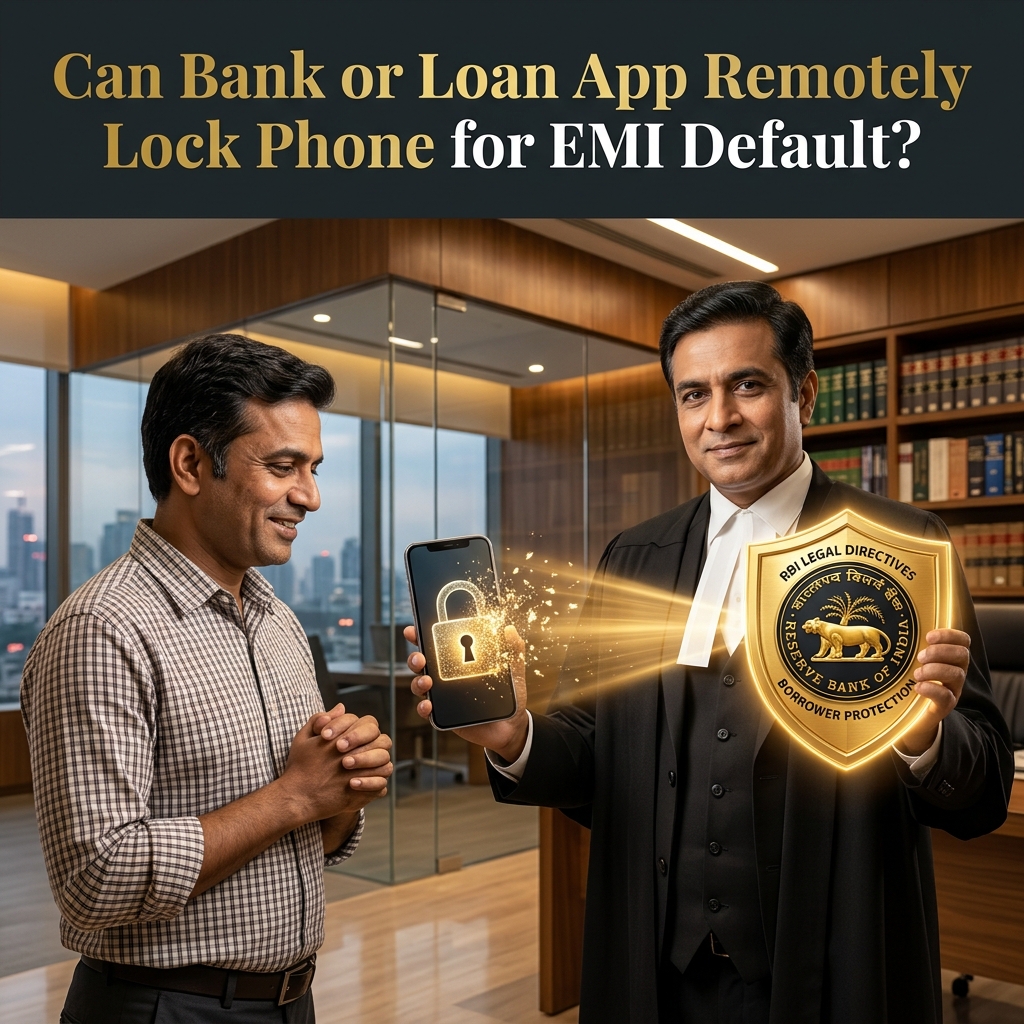
Key Takeaways: When borrowers ask can bank or loan app remotely lock phone for emi default in India, the Reserve Bank of India (RBI) Responsible Business Conduct Directions establish an ironclad legal boundary: banks, NBFCs, and digital lending apps are 100% prohibited from remotely locking your smartphone, tablet, or laptop for defaults on personal loans, credit cards, business loans, or cash apps. Remote device restriction via Mobile Device Management (MDM) software is legally permissible ONLY if the specific loan was taken explicitly to finance the purchase of that physical device—and even then, lenders cannot impose any restriction during the first 30 Days Past Due (DPD), cannot block outgoing calls before 60 DPD, and can never disable incoming calls, SMS, Emergency SOS, or essential work tools. Furthermore, if a lender wrongfully locks your phone or fails to unlock a financed device within 1 hour of payment, they are liable to pay the borrower a statutory penalty of Rs. 250 per hour. Borrowers facing digital coercion can permanently remove MDM locks and resolve overdue debt through AMA Legal Solutions.
Introduction: Can Bank or Loan App Remotely Lock Phone for EMI Default in India?
Imagine waking up on a Monday morning to find your smartphone screen frozen with a bright red warning banner: "This device has been locked by your lender due to an overdue EMI. Pay immediately to restore access." Suddenly, you cannot open your banking UPI apps, cannot access your office emails, cannot view your medical prescriptions, and—if you are a gig worker, delivery partner, or salaried executive—you are instantly cut off from your primary source of livelihood.
Across India in 2026, millions of borrowers who bought smartphones on no-cost consumer durable EMIs or downloaded instant personal loan apps are urgently searching: can bank or loan app remotely lock phone for emi default? For years, aggressive Non-Banking Financial Companies (NBFCs) and unregulated digital lending apps exploited enterprise Mobile Device Management (MDM) software—such as Google Zero-Touch Enrollment, Samsung Knox Guard, PayJoy, and third-party admin-lock APKs—to turn a borrower's personal mobile phone into a digital hostage the very morning an EMI bounced.
Recognising that a smartphone in modern India is not a luxury gadget but essential digital public infrastructure tied to a citizen's fundamental right to livelihood under Article 21 of the Constitution of India, the Reserve Bank of India (RBI) intervened with sweeping regulatory guardrails under its updated Responsible Business Conduct Directions. In this exhaustive legal guide authored by the banking and cyber litigation team at AMA Legal Solutions, we break down the exact statutory rules governing can bank or loan app remotely lock phone for emi default, expose how to claim the mandatory Rs. 250 per hour compensation penalty for illegal device locking, and explain how to permanently terminate MDM firmware locks through a formal One-Time Settlement (OTS).
RBI's Strict Ban on Remote Device Locking for Personal Loans, Credit Cards & Unsecured Cash Loans
To answer can bank or loan app remotely lock phone for emi default accurately, Indian banking law draws a sharp legal line between two completely different categories of credit: General Unsecured/Secured Loans versus Specific Device-Financing Loans.
Under the RBI's Responsible Business Conduct framework and Digital Lending Directions, Regulated Entities (Scheduled Commercial Banks, Small Finance Banks, and RBI-registered NBFCs) and their Lending Service Providers (LSPs) are strictly and unconditionally barred from remotely locking or disabling a borrower's smartphone, tablet, or computer for defaults on:
- Unsecured Personal Loans: Whether you borrowed Rs. 20,000 from a fintech app or Rs. 15 Lakhs from a major bank, your personal smartphone is not the hypothecated collateral for a cash personal loan.
- Credit Card Dues & RuPay UPI Credit Lines: No credit card issuer or collection agency has any legal authority to install device-control software or restrict your mobile hardware for unpaid credit card bills.
- Digital Payday Loans & Instant Cash Apps: Any instant loan APK that demands "Device Administrator" or "Accessibility Service" permissions during onboarding to brick your phone upon default is committing a criminal cyber offense under Section 43 and Section 66 of the Information Technology Act, 2000.
- Vehicle, Home, Education, or MSME Business Loans: Defaulting on an auto loan, two-wheeler loan, or business overdraft never entitles a lender to tamper with your personal communication device.
In short, if you took a cash personal loan or credit line and a recovery agent threatens over WhatsApp that "our technical team will lock your IMEI number and brick your mobile phone by 5:00 PM today if you do not pay the EMI," that threat is 100% illegal and technically bogus unless you maliciously granted admin-lock spyware permissions to a rogue app. Even legitimate lenders investigating how recovery agents get your personal details and how to prevent it are strictly forbidden from weaponizing remote device locks on cash loans.
When Is Device Locking Legally Permitted? The Narrow Exception for Consumer Durable Device-Financing Loans
If remote locking is banned for personal and cash loans, when can bank or loan app remotely lock phone for emi default lawfully? The RBI permits remote device restriction under one narrow, tightly regulated exception: when the loan was taken specifically and exclusively to purchase that exact physical smartphone or electronic device (commonly known as a Consumer Durable EMI Loan or Mobile Finance Loan).
For example, if you walked into a retail electronics store (such as Croma, Reliance Digital, Vijay Sales, or a local mobile shop) and purchased a Rs. 35,000 smartphone on zero-down-payment EMI financed by an NBFC—such as Bajaj Finserv, DMI Finance (including Samsung Finance+), TVS Credit, HDB Financial Services, Home Credit, or IDFC First Bank—the physical phone itself is hypothecated as the primary security for the loan.
Mandatory Origination Conditions Before Any Device Can Be Enrolled in MDM
Even for a consumer durable mobile EMI loan, an NBFC cannot arbitrarily lock a handset unless all four statutory preconditions were satisfied at the time of purchase:
- Explicit Key Fact Statement (KFS) & Loan Agreement Disclosure: The loan contract and Key Fact Statement signed by the borrower must explicitly disclose that the financed handset is enrolled in a Mobile Device Management (MDM) software lock and detail the exact graduated timeline of restrictions upon default.
- Explicit, Granular Informed Consent: The borrower must provide separate, documented consent acknowledging the installation of the device-financing control software at origination.
- Board-Approved Fair Recovery Policy: The Regulated Entity must have a publicly accessible, Board-approved policy governing device restriction that strictly adheres to the RBI's 30-day and 60-day cooling thresholds.
- Strict Data Privacy Separation (Zero Personal Data Scraping): The MDM locking tool is legally restricted to enforcing hardware/app access controls. Under the Digital Personal Data Protection (DPDP) Act, 2023 and RBI Digital Lending rules, the MDM software cannot read, copy, upload, or scrape your personal photos, WhatsApp chats, contact list, call logs, or banking passwords.
Mandatory Graduated Timeline Under RBI Rules: 0–30 DPD Ban, 30–60 DPD Partial Lock & Emergency SOS Protection
Before the RBI's updated Responsible Business Conduct guardrails, consumer durable lenders routinely triggered a complete screen lock within 24 to 48 hours of a single bounced EMI. When evaluating can bank or loan app remotely lock phone for emi default under the current regulatory regime, instantaneous locking is completely outlawed. Lenders must follow a mandatory three-stage graduated timeline measured by Days Past Due (DPD):
Stage 1: 0 to 30 Days Past Due (DPD) — Complete Prohibition on Any Device Lock
During the first 30 calendar days after an EMI due date is missed, the lender is strictly prohibited from placing any restriction or lock whatsoever on the financed smartphone. During this 0–30 DPD window, the lender may only send polite payment reminders via SMS, email, or in-app push notifications and must send mandatory prior written advance intimation warning the borrower before any future restriction is triggered.
Stage 2: 30 to 60 Days Past Due (DPD) — Graduated App Restrictions Only (Outgoing Calls Protected)
If the EMI remains unpaid past the 30-day mark (31 to 60 DPD) and the lender has served formal prior notice, the lender may initiate gradual, limited functional restrictions (such as restricting access to non-essential entertainment, gaming, or social media apps). However, the RBI explicitly mandates that outgoing voice calls cannot be blocked before 60 Days Past Due.
Stage 3: Beyond 60 Days Past Due (60+ DPD) — Broader Restrictions Subject to Protected Essential Services
Only after the loan crosses 60 consecutive Days Past Due—and after multiple statutory notices have expired—can the lender enforce broader device restrictions, including limiting general outgoing calls. However, even at 60+ DPD or 90+ DPD (NPA stage), the lender is permanently barred from turning the phone into a completely dead brick. The following essential functions must remain unlocked and operational at all times:
- Incoming Voice Calls: You must always be able to receive incoming phone calls from family, employers, doctors, or legal counsel.
- SMS Services: Incoming and essential SMS messages (including OTPs required to make digital loan repayments or access government services) must never be blocked.
- Emergency SOS & Helpline Numbers: Dialing emergency services (112, Police 100, Ambulance 108, Cyber Crime 1930, Fire 101) must remain 100% unrestricted.
- Critical Work & Livelihood Functionality: Tools essential for employment, work, and making the loan repayment itself must remain accessible.
| Loan Category / Delinquency Stage | Can Bank or Loan App Remotely Lock Phone for EMI Default? | Permissible vs. Prohibited Technical Actions (RBI 2026 Rules) | Borrower's Immediate Legal Remedy |
|---|---|---|---|
| Personal Loans, Credit Cards & Cash Loan Apps (Any DPD) | Strictly Illegal (0% Permitted) | Total ban on MDM installation, IMEI locking, or screen disabling regardless of overdue duration. | File RBI CMS complaint + Cyber Crime (1930) FIR under Sections 43/66 IT Act; claim Rs. 250/hour penalty. |
| Device-Financed EMI Loan: 0 to 30 Days Past Due (DPD) | Prohibited (Cooling & Notice Period) | Zero functional restrictions allowed. Lender can only send SMS/email payment reminders and pre-lock intimation. | Serve legal notice to NBFC Grievance Officer demanding immediate unlock + Rs. 250/hour statutory compensation. |
| Device-Financed EMI Loan: 31 to 60 Days Past Due (DPD) | Partial App Restriction Only | Non-essential apps may be restricted after prior notice, but outgoing calls, incoming calls, SMS & SOS cannot be blocked. | Escalate outgoing-call block to RBI Ombudsman (cms.rbi.org.in); initiate hardship restructuring or OTS. |
| Device-Financed EMI Loan: 60+ Days Past Due (DPD) | Permitted With Mandatory Safeguards | Broader device lock allowed, but incoming calls, SMS, Emergency SOS (112) & payment portal access must stay active. | Negotiate a One-Time Settlement (OTS) through AMA Legal Solutions to permanently remove MDM firmware. |
| Post-Payment / Post-OTS Settlement Unlock Window | Mandatory Full Unlock Within 1 Hour | Lender must lift all MDM restrictions within 60 minutes of overdue clearance; permanent un-enrollment upon loan closure/OTS. | Automatic entitlement to Rs. 250 per hour compensation for every hour of delay beyond 1 hour. |
Key Insights & Data Infographic
Visual summary, statistical trends & procedural breakdown

Prepared by AMA Legal Solutions Research & Analytics Team • Data & Compliance Overview

Halt Recovery Agent Harassment Legally
The 1-Hour Unlock Mandate & Rs. 250 Per Hour Statutory Compensation Penalty Against Non-Compliant Lenders
One of the most powerful consumer-protection weapons introduced in the RBI's Responsible Business Conduct framework directly addresses what happens after a borrower pays their overdue EMI or settles their loan, or when a lender locks a phone in violation of the 30/60 DPD rules.
Historically, thousands of Indian consumers complained that even after paying their bounced EMI via UPI, their smartphone remained locked for 3 to 7 days because the NBFC's server failed to sync or the collection agent demanded illegal "unlocking fees." To crush this abuse, the RBI enacted two strict operational mandates:
- The 60-Minute (1-Hour) Mandatory Unlock Rule: The moment a borrower pays the overdue EMI amount or pays the agreed One-Time Settlement (OTS) tranche, the lender's automated system must lift all remote device restrictions within 1 hour (60 minutes)—24x7, including weekends and bank holidays.
- The Rs. 250 Per Hour Statutory Compensation Penalty: If a Regulated Entity (bank or NBFC) fails to unlock the device within 1 hour of receiving payment, OR if the lender wrongfully locks a device (such as locking before 30 DPD, blocking outgoing calls before 60 DPD, or locking a phone for a personal cash loan), the lender is legally liable to pay the borrower a compensatory penalty of Rs. 250 for every hour of delay or wrongful restriction!
Let us put that math into perspective: if an NBFC wrongfully locks your smartphone on Day 10 of default, or leaves your phone locked for just 48 hours (2 days) after you paid your overdue amount, the lender owes you 48 hours × Rs. 250 = Rs. 12,000 in statutory compensation—which often exceeds the entire EMI of the mobile phone itself! When our advocates at AMA Legal Solutions audit a client's consumer durable or fintech loan where illegal device locking occurred, we immediately compute the accrued Rs. 250/hour statutory penalty and set it off against the principal outstanding to force a massive debt waiver.
How Rogue Digital Lending Apps Use Illegal MDM Spyware to Brick Phones (And Cyber Cell Remedies)
While RBI-registered NBFCs like Bajaj Finance, DMI Finance, and TVS Credit operate within the consumer durable MDM framework, borrowers asking can bank or loan app remotely lock phone for emi default must also beware of unregulated 7-day payday loan apps and rogue digital lending APKs.
When a distressed borrower downloads an unauthorized loan app outside the official Google Play Store (or via a phishing link sent on WhatsApp/Telegram), the app frequently asks for two dangerous Android system permissions:
- Device Administrator (
BIND_DEVICE_ADMIN) Permission: Gives the rogue app the ability to reset your screen lock PIN/password, lock the screen remotely, and block uninstallation of the app. - Accessibility Services Permission: Allows the app to read everything on your screen and automatically click buttons in the background to prevent you from opening your phone's Settings menu.
How to Remove an Illegal Spyware Lock From a Rogue Loan App
If an unregistered cash loan app has hijacked your phone screen or changed your lock-screen PIN, follow this immediate technical and legal protocol:
- Boot Your Android Phone into 'Safe Mode': Press and hold your physical Power button, then press and hold the on-screen "Power Off" icon until the "Reboot to Safe Mode" prompt appears. In Safe Mode, all third-party loan apps are completely disabled.
- Revoke Device Admin & Uninstall: Once inside Safe Mode, go to Settings > Security > Device Admin Apps (or Special App Access), uncheck the rogue loan app, and then go to Settings > Apps to uninstall the malicious APK and revoke all Contacts/Storage permissions.
- File an Immediate Cyber Crime & RBI Sachet Complaint: Report the illegal APK on the National Cyber Crime Portal (
cybercrime.gov.inor dial 1930) and on the RBI Sachet Portal (sachet.rbi.org.in). Never pay extortion money to an illegal APK, as they will never unlock your phone and will only demand double the amount.
| Type of Violation / Harassment | Governing Statutory Provision | Competent Regulatory / Judicial Forum | Penalty on Lender & Relief for Borrower |
|---|---|---|---|
| Locking Phone Before 30 DPD or Delaying Unlock > 1 Hour After Payment | RBI Responsible Business Conduct Directions on Remote Device Locking | Lender Principal Nodal Officer & RBI Integrated Ombudsman (cms.rbi.org.in) |
Mandatory immediate unlock + Rs. 250 per hour statutory compensation credited to borrower. |
| Locking Phone for Personal Loan, Credit Card, or Cash App Default | RBI Digital Lending Directions & Section 43 / Section 66 of the IT Act, 2000 | RBI CMS Portal + National Cyber Crime Helpline (1930 / cybercrime.gov.in) |
Criminal prosecution for computer tampering (up to 3 years imprisonment / Rs. 5 Lakh fine) + damages. |
| Scraping Contacts/Photos via MDM Software or Threatening Family | Digital Personal Data Protection (DPDP) Act, 2023 & Section 351 BNS, 2023 | Data Protection Board / RBI Ombudsman / Local Police Station SHO | Heavy regulatory fines on Regulated Entity + Cease-and-Desist shielding via advocate notice. |
| Refusing to Permanently Remove MDM Software After Loan Settlement (OTS) | Consumer Protection Act, 2019 (Deficiency in Service & Unfair Trade Practice) | RBI Ombudsman & District Consumer Disputes Redressal Commission | Permanent over-the-air (OTA) MDM un-enrollment + No Dues Certificate (NDC) + mental agony compensation. |
How to Permanently Unlock Your Device & Settle Consumer Durable / NBFC Loans via AMA Legal Solutions
Many borrowers who financed a Rs. 40,000 to Rs. 1,50,000 smartphone, laptop, or tablet alongside multiple personal loans and credit cards find themselves trapped in a vicious cycle: when job loss, salary delay, or medical emergencies hit, they cannot pay all their EMIs—and the consumer durable NBFC uses the threat of remote phone locking to force them to borrow from high-interest instant loan apps.
Understanding can bank or loan app remotely lock phone for emi default gives you the legal leverage to break this cycle permanently through a structured One-Time Settlement (OTS) handled by AMA Legal Solutions:
- Step 1: Forensic Audit of Your Loan Agreement & DPD Timeline: Our banking and cyber advocates inspect your Key Fact Statement (KFS), loan category, and exact DPD history. If the lender locked your device before 30 DPD, blocked outgoing calls before 60 DPD, or locked a non-financed device, we serve an immediate Statutory Legal Notice demanding immediate unlocking and quantifying your accrued Rs. 250/hour compensation claim.
- Step 2: Stopping Third-Party Recovery Harassment: We serve a formal Advocate Representation and Cease-and-Desist Notice on the NBFC's Principal Nodal Officer, stopping recovery agents from calling your family references, visiting your home without 24-hour notice, or threatening your workplace.
- Step 3: Negotiating a Lump-Sum One-Time Settlement (OTS): For borrowers in genuine financial hardship, we negotiate directly with the lender's central settlement desk to waive 100% of late fees, bounce charges, and penal charges, settling the principal outstanding for a fraction of the demand (typically 40% to 70% waiver depending on the delinquency stage).
- Step 4: Mandatory Permanent MDM Un-Enrollment & No Dues Certificate (NDC): A critical mistake borrowers make when settling a mobile EMI loan on their own is paying the settlement amount without ensuring the lender permanently de-registers the phone's IMEI/serial number from the enterprise MDM server (such as Knox Guard or Google Zero-Touch). Our advocates ensure that the OTS sanction terms explicitly mandate permanent over-the-air (OTA) MDM removal within 1 hour of OTS payment alongside a formal No Dues Certificate (NDC).
Strategic Conclusion: Protect Your Digital Livelihood and Settle Your Debt Legally
The legal answer to can bank or loan app remotely lock phone for emi default in 2026 is unambiguous: your smartphone is your lifeline to banking, employment, healthcare, and emergency safety, and no bank, NBFC, or digital lending app is above the law. Lenders cannot touch your device for personal loans or credit cards, cannot lock a financed phone during the first 30 days of default, can never disable incoming calls, SMS, or Emergency SOS, and must pay you Rs. 250 for every hour they wrongfully lock your device or delay unlocking it beyond 60 minutes after payment.
If your phone has been unlawfully locked by an NBFC or loan app, or if you are struggling with overdue consumer durable EMIs, personal loans, and recovery harassment, do not give in to illegal coercion. Contact AMA Legal Solutions today for a confidential consultation with Senior Advocate Anuj Anand Malik and our pan-India banking litigation team to unlock your device, enforce your RBI compensation rights, and settle your debts permanently with legal dignity.
Popular Searches & Topics
Commonly searched legal queries and keywords related to this article
Need Strategic Legal Defense for Your Situation?
Our banking & litigation advocates review your notices, debt liability, and recovery issues under complete advocate-client secrecy.
References & Authority
- Reserve Bank of India (RBI) - Responsible Business Conduct Amendment Directions on Recovery & Remote Device Locking
- Reserve Bank of India (RBI) - Master Guidelines on Digital Lending & Lending Service Providers (LSPs)
- Reserve Bank of India (RBI) - Complaint Management System (CMS) & Integrated Ombudsman Portal
- Reserve Bank of India (RBI) - Sachet Portal for Reporting Unauthorized Digital Lending Apps
- India Code - Information Technology Act, 2000 (Sections 43, 66 & 72A)
- Ministry of Electronics and Information Technology (MeitY) - Digital Personal Data Protection (DPDP) Act, 2023
- National Cyber Crime Reporting Portal (Ministry of Home Affairs, Govt. of India - Helpline 1930)
- India Code - Bharatiya Nyaya Sanhita (BNS), 2023 (Sections 308 & 351)

AMA Legal Solutions
Trusted with a 4.7 Google Rating, over 10,000+ Clients Served, 25,000+ Cases Handled, and more than 40+ Years of Experience in providing strategic legal defense and debt resolution across India.
Our media coverages





Frequently Asked Questions
Related Articles
How Recovery Agents Get Your Personal Details and How to Prevent It in India (2026)
An investigative legal breakdown of the 7 hidden channels debt collectors use to trace your phone numbers, family contacts, employer, and address - and the exact statutory shields under RBI 2026 Directions and the DPDP Act, 2023 to stop them.
Read Article
willdrafting.in indias first online will drafting platform get your will in few minutes
Discover the swift and secure way to draft your will online in India today
Read Article
Why Loan Settlement in the Month of Oct is Beneficial for Borrowers (2026)
Explore key advantages of settling loans in October for a fresh financial start.
Read ArticleAbout Author
Anuj Anand Malik
View ProfileAnuj Anand Malik, Founder of AMA Legal Solutions, is a trusted advocate, loan settlement expert, legal advisor, and banking lawyer. With over a decade of experience in loan settlement, corporate law, financial disputes, and compliance, he leads a result-driven law firm based in India that helps individuals, startups, and businesses achieve legal and financial stability.
Connect on LinkedInNeed Legal Representation?
Evaluate your defense against recovery agents, notices, or structure your loan settlement directly with Senior Advocates.
Call +91-8700343611