
Professional debt settlement help in India is an advocate-supervised legal process wherein licensed legal counsel represents distressed borrowers to negotiate a formal One-Time Settlement (OTS) with commercial banks and non-banking financial companies (NBFCs) under the Reserve Bank of India (RBI) Prudential Framework for Resolution of Stressed Assets and Section 63 of the Indian Contract Act, 1872. Specialized debt settlement help immediately halts unlawful recovery agent harassment through statutory Vakalatnamas, defends against coercive criminal complaints under Section 138 of the Negotiable Instruments Act and Section 25 of the Payment and Settlement Systems Act, and secures an authentic, bank-stamped No Dues Certificate (NDC) under transparent fixed legal advisory without hourly markups or open-ended retainers.
Statutory Meaning & Regulatory Framework of Debt Settlement in India
In Indian commercial and banking jurisprudence, debt settlement is not an informal request for charity or an unregulated concession. Rather, debt settlement represents a legally binding bilateral contract recognized under Section 63 of the Indian Contract Act, 1872, which codifies that every promisee may dispense with or remit, wholly or in part, the performance of the promise made to them, or may accept instead of it any satisfaction which they think fit. When a banking institution executes a compromise settlement agreement with a borrower, the payment of the agreed settlement sum completely and irrevocably discharges the borrower from all further legal liability.
From a regulatory standpoint, institutional debt settlement is anchored in clear mandates issued by the central banking authority. The Reserve Bank of India (RBI) Framework for Compromise Settlements and Technical Write-offs, read alongside the Master Direction on Fair Practices Code for Lenders, establishes that regulated entities—including all scheduled commercial banks, public sector lenders, regional rural banks, and non-banking financial companies (NBFCs)—must maintain transparent, board-approved compromise settlement policies. These institutional guidelines permit authorized bank committees to sanction substantial waivers on penal interest, late payment penalties, and compounded interest, and in cases of documented insolvency, to accept haircuts on the principal outstanding balance.
📜 Key Statutory Pillars of Indian Debt Settlement
- •Section 63, Indian Contract Act, 1872: Empowers creditors to remit or accept reduced satisfaction to fully extinguish contractual obligations.
- •RBI Circular on Compromise Settlements: Obligates banks and NBFCs to maintain objective, board-approved compromise frameworks for stressed accounts without discrimination.
- •Section 21, Legal Services Authorities Act, 1987: Confers the status of a final, non-appealable civil court decree upon compromise settlements executed before the Lok Adalat.
- •Section 126, Indian Evidence Act, 1872: Confers absolute legal privilege on all client communications, balance sheets, and financial disclosures made to enrolled advocates.
The Commercial Reality: Transparent Advocate Advisory vs. Free DIY Templates vs. Corporate Law Firms
When facing severe financial distress, borrowers often search for immediate debt settlement help. In doing so, borrowers encounter three distinct avenues: free automated DIY templates found on unregulated internet websites, traditional corporate law firms charging exorbitant hourly retainers, and specialized advocate-led legal practices offering transparent fixed legal advisory. Understanding the commercial and legal differences between these alternatives is critical to securing genuine debt relief and avoiding legal jeopardy.
“A debt settlement negotiation is a formal legal dispute conducted against institutional bank legal cells. Submitting an unverified DIY internet template or hiring an unregulated call-center agency provides zero legal protection when a bank files a criminal complaint under Section 138 of the Negotiable Instruments Act. Legal accessibility requires transparent fixed advisory, direct advocate accountability, and enforceable courtroom defense.”
Why Free Automated Online DIY Templates Fail in Banking Practice
Automated online forms and generic settlement draft templates may appear cost-effective initially, but they present grave structural risks:
- Zero Evidentiary Standing: Institutional bank compromise committees follow rigorous internal audit controls. A boilerplate template letter lacking formal forensic financial accounting or certified hardship proofs is routinely rejected by credit risk managers without review.
- Accidental Admission of Liability: Poorly drafted DIY letters frequently contain inadvertent acknowledgments of debt that restart the three-year limitation period under the Limitation Act, 1963, inadvertently forfeiting the borrower's statutory defenses.
- Total Absence of Criminal Courtroom Defense: When a bank serves a statutory notice under Section 138 of the Negotiable Instruments Act or Section 25 of the Payment and Settlement Systems Act, an internet template cannot draft a tailored statutory reply, enter an appearance before a Judicial Magistrate, or prevent bailable warrants.
Why Uncapped Corporate Law Firm Retainers Are Ill-Suited for Distressed Borrowers
Traditional multi-tier corporate law firms operate on hourly billing models, junior associate staffing markups, and open-ended retainer agreements. For an individual or small business owner already struggling with monthly liquidity, committing to unpredictable legal billing creates compounding anxiety. In contrast, AMA Legal Solutions champions commercial accessibility through transparent fixed legal advisory. Borrowers receive senior advocate representation, comprehensive ledger audits, anti-harassment injunctions, and full bank negotiations with complete financial predictability and zero surprise retainers.
| Evaluation Criteria | Free Online DIY Templates | Corporate Law Firms | AMA Legal Solutions |
|---|---|---|---|
| Legal Standing in Court | None (Non-enforceable forms) | Enrolled Advocates | Enrolled Senior Advocates |
| Attorney-Client Privilege | No legal privilege | Yes (Section 126 Evidence Act) | 100% Confidential Legal Privilege |
| Fee & Cost Predictability | Free download, but zero outcome | Uncapped hourly billing & retainers | Transparent Fixed Legal Advisory |
| Recovery Harassment Halt | Ignored by recovery agencies | Notice served on billable hours | Immediate Statutory Vakalatnama |
| Section 138 Criminal Defense | Cannot appear or defend in court | Additional litigation retainers | Integrated Legal Representation |
| Bank NDC Verification | Risk of fake collection receipts | Formal document review | Forensic CBS & Zonal Signatory Audit |
Eligible Debts vs. Ineligible Facilities: What Loans Can Be Settled?
A foundational step in seeking professional debt settlement help is distinguishing between unsecured credit facilities, which are prime candidates for compromise settlements, and secured credit lines governed by asset-recovery statutes. Lenders evaluate settlement proposals based on collateral coverage, underlying security, and the commercial cost of protracted litigation.
| Credit Facility Type | Settlement Feasibility | Applicable Legal Mechanism | Advocate Strategic Role |
|---|---|---|---|
| Unsecured Personal Loans | Highly Eligible | RBI Stressed Assets Framework • Sec 63 Contract Act | Audit penal charges, compile hardship dossier, negotiate OTS letter. |
| Credit Card Outstandings | Highly Eligible | Usurious interest challenge • RBI Master Directions | Eliminate compounded annualized finance charges and late fee markups. |
| Fintech & Instant Loan Apps | Highly Eligible | RBI Digital Lending Guidelines • IT Act Data Privacy | Halt unlawful contact list scraping and enforce regulated recovery rules. |
| Unsecured Business Loans | Eligible with Proof | MSME Restructuring • Bank Stressed Assets Wing | Present audited balance sheets demonstrating commercial insolvency. |
| Home Loans & Mortgages | Conditional / Limited | SARFAESI Act, 2002 • Sec 13(2) & Sec 13(4) | File DRT Securitisation Applications to restrain auction during restructuring. |
| Vehicle / Auto Loans | Conditional | Hypothecation Agreement • Arbitration Act, 1996 | Restrain extrajudicial vehicle repossession through Section 9 petitions. |
The 5-Step Legal Debt Settlement Protocol at AMA Legal Solutions
Executing a successful compromise settlement requires a methodical, litigation-tested procedure. Our senior advocates implement a five-step legal protocol designed to safeguard your rights, eliminate coercive collection tactics, and secure authentic debt extinguishment.
Comprehensive Ledger Audit & Forensic Charge Dissection
Our banking legal team scrutinizes your original loan agreement, sanction schedules, and multi-year statement of accounts. We isolate illegitimate penal interest, annualized compound finance charges, insurance premiums added without consent, and bounce charges. By dissecting the account ledger, we establish the true principal benchmark, stripping away inflated collection claims.
Issuance of Statutory Representation Notice & Anti-Harassment Injunction
An enrolled advocate serves a formal Vakalatnama and legal notice upon the lender's managing director and collection heads. Citing the RBI Master Directions on Fair Practices Code and Supreme Court directives, this notice informs the creditor that you are represented by counsel. The notice legally forbids third-party recovery agents from contacting your workplace, calling outside statutory hours, or visiting your residence.
Formulation of Evidentiary Hardship Dossier Under Section 63
Banks require verifiable evidence to justify debt waivers to their statutory auditors and credit committees. We draft a comprehensive legal dossier documenting bona fide hardship—including termination letters, medical diagnosis records, salary reduction slips, or business balance sheets. This evidence-based petition substantiates that the proposed compromise is commercially advantageous for the bank compared to uncollectible litigation.
Institutional Bank Committee Negotiation & Sanction Letter Authentication
Our senior advocates represent you directly before bank stressed asset committees, circle legal managers, and National Lok Adalat benches. Once a compromise is reached, we conduct a forensic audit of the formal OTS sanction letter. We verify that the document is issued on genuine corporate letterhead, contains a verifiable CBS reference number, and includes explicit clauses discharging all future claims.
Supervised Payment Execution & No Dues Certificate Enforcement
Payment is routed exclusively and directly into your designated bank loan account—never through third-party escrow or intermediary accounts. Upon confirmation of receipt, we enforce the delivery of an unconditional, bank-stamped No Dues Certificate (NDC). Furthermore, our counsel monitors the mandatory reporting to CIBIL, Experian, and CRIF High Mark to record the account as formally settled.
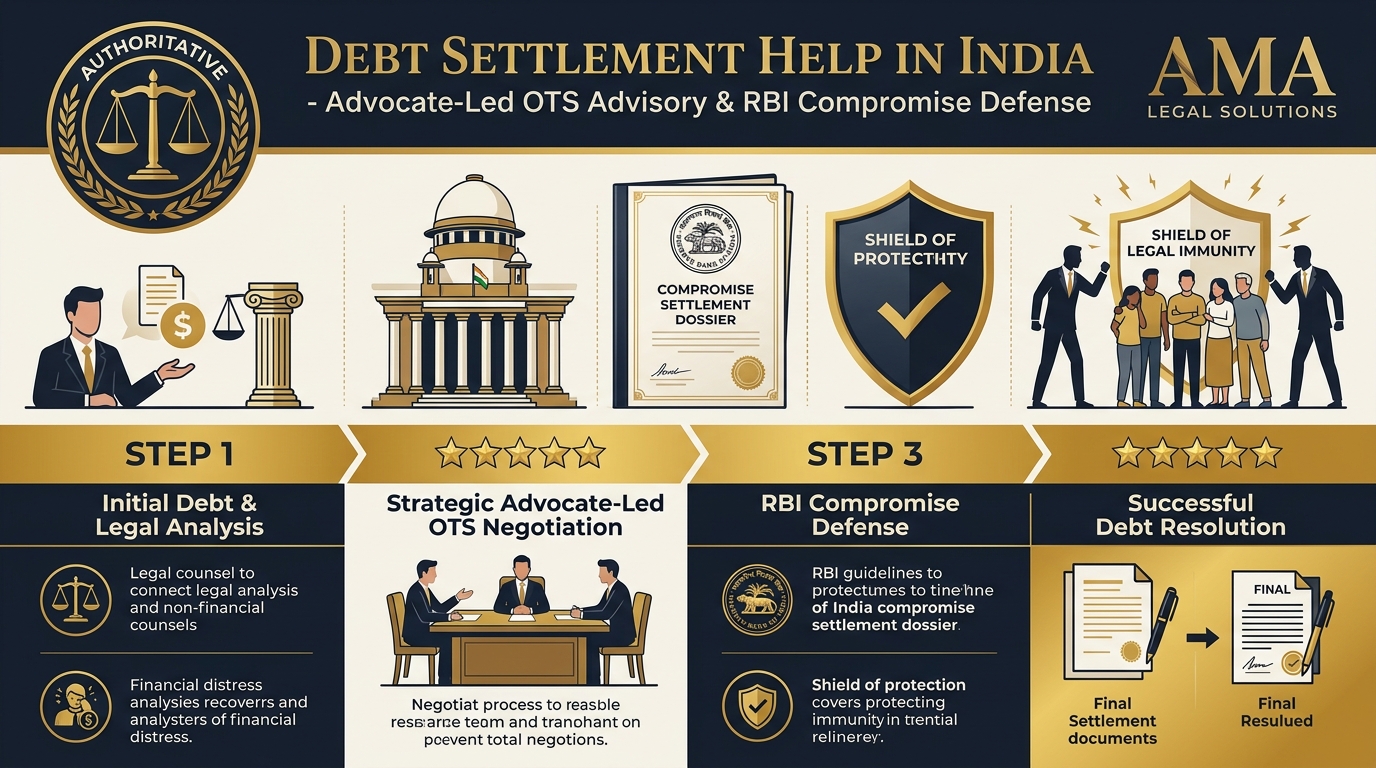
Institutional Debt Resolution & RBI Compromise Workflow
Visualizing the five-stage advocate-led protocol: forensic ledger review, statutory Vakalatnama issuance under RBI fair practice directives, evidentiary hardship filing, bank committee compromise negotiation, and enforceable No Dues Certificate issuance.
Defending Criminal Litigation: Section 138 NI Act & Section 25 PSSA
A common pressure tactic employed by banking institutions and NBFCs is converting civil loan defaults into criminal litigation. When security cheques or electronic NACH mandates fail due to insufficient funds, lenders frequently issue statutory demand notices under Section 138 of the Negotiable Instruments Act, 1881 or Section 25 of the Payment and Settlement Systems Act, 2007.
⚖️ Strategic Legal Defense Protocols in Magistrate Courts
1. Mandatory 15-Day Reply Window: Under Section 138(b) of the NI Act, an accused recipient has fifteen days from receipt of statutory notice to respond. Our advocates draft a comprehensive legal reply establishing that the dishonoured cheque was delivered as an undated security instrument rather than for a matured debt, rebutting the statutory presumption under Section 139.
2. Rebutting Fraudulent Intent Under IPC / BNS: A civil inability to pay does not constitute criminal breach of trust or cheating. In accordance with Supreme Court jurisprudence, financial distress arising from economic misfortune lacks mens rea (guilty mind), rendering criminal cheating complaints legally untenable.
3. Compounding of Offenses Under Section 147: Section 147 of the Negotiable Instruments Act provides that every offense punishable under the Act is compoundable. When our advocates execute an OTS agreement, we insert a mandatory clause requiring the bank's legal representative to appear before the Judicial Magistrate and file a joint compounding petition to withdraw the complaint in its entirety.
Enforcing RBI Anti-Harassment Directives: Shielding Borrowers from Coercion
Third-party recovery agencies frequently deploy intimidatory tactics, unsolicited phone calls to relatives, workplace confrontations, and public humiliation. These abusive practices violate regulatory frameworks and constitutional rights. Retaining legal counsel creates an enforceable barrier against collection misconduct.
Binding Rules Enforced by Advocate Representation
- •Permitted Calling Window: The RBI Master Direction mandates that recovery agents may only communicate between 8:00 AM and 7:00 PM. Calls outside this window are actionable regulatory violations.
- •Strict Ban on Third-Party Privacy Violations: Recovery agents are strictly prohibited from contacting your colleagues, friends, neighbors, or employers regarding your financial obligations.
- •Mandatory Identification & Authorization: Every recovery representative must carry formal bank identification, an authorization letter, and an official notice of debt assignment. Unidentified recovery agents have zero legal standing.
- •Regulatory Recourse via RBI Ombudsman: If an agency violates these standards after advocate notification, our team files formal complaints through the RBI Complaint Management System (CMS) under the Integrated Ombudsman Scheme, 2021, and initiates contempt or civil tort proceedings.
Sanction Letter Verification & Securing the No Dues Certificate (NDC)
One of the greatest hazards facing unrepresented borrowers is making settlement payments against forged or unauthorized settlement letters issued by rogue recovery agents. Paying money without rigorous legal verification often results in the sum being credited as a regular part-payment, leaving the loan account active and subject to ongoing interest compounding.
🔍 Forensic Checklist for Valid Debt Settlement Letters
Official Bank Letterhead
Must display the bank's registered corporate name, CIN, logo, and zonal office address.
Unique CBS Reference Number
Must include a system-generated reference traceable directly within the bank's central core software.
Signatory Authority & Official Domain
Signed by an authorized branch or circle manager with official designation and verified bank domain email.
Full & Final Extinguishment Clause
Explicitly states that upon receipt of the agreed sum, the entire loan account is closed with zero future claims.
Once payment is completed in accordance with the authenticated letter, our legal counsel ensures the issuance of an official No Dues Certificate (NDC) or Closure Letter. This document is your permanent legal shield against future asset attachment, third-party collection claims, or legal proceedings.
CIBIL Score Impact & Strategic Post-Settlement Credit Rehabilitation
Transparency regarding credit score consequences is an essential component of honest legal counsel. Under the Credit Information Companies (Regulation) Act, 2005, when a loan is resolved through a compromise settlement, the lending institution reports the account to credit bureaus with the remark ‘Settled’.
Settled vs. Written-Off: The Critical Distinction
A ‘Settled’ status confirms that the creditor entered into a mutual compromise, received the agreed satisfaction, and extinguished the debt obligation. In contrast, an account classified as ‘Written Off’ or ‘Post-Write-Off Settled’ indicates that the lender unilaterally wrote off the balance as bad debt while retaining ongoing rights of recovery. While a settled account results in a temporary score decrease, it immediately terminates destructive monthly Days Past Due (DPD) accumulation.
The 24-Month Credit Restoration Roadmap
- 1.Obtain Secured Credit Card: Open a fixed-deposit-backed secured credit card with a scheduled commercial bank to initiate positive credit reporting.
- 2.Maintain Sub-30% Credit Utilization: Restrict monthly credit card usage to below thirty percent of the available credit limit and settle the entire balance on time.
- 3.Audit Bureau Records Every Quarter: Review your CIBIL, Experian, and Equifax reports every ninety days to ensure no obsolete DPD marks or phantom accounts remain active.
- 4.Re-establish Pristine Repayment History: Consistent, disciplined repayment over eighteen to twenty-four months restores creditworthiness for future personal or home finance.
Frequently Asked Questions About Debt Settlement Help
Authoritative statutory answers addressing common legal, commercial, and procedural concerns regarding debt settlement in India.
Explore Related Legal Debt Relief Guides
Access comprehensive legal guides authored by our banking and dispute resolution advocates to understand your statutory options.
Best Debt Settlement Law Firm in India →
Advocate-led RBI compromise frameworks and courtroom defense strategies across Indian jurisdictions.
Debt Settlement Letter Drafting →
Essential legal clauses, evidentiary hardship attachments, and bank negotiation protocols.
Valid vs. Fake Settlement Letters →
How to conduct a forensic check on CBS reference numbers and protect against fraudulent collection notices.
What is Debt Settlement? →
Detailed statutory meaning, legal rights under Section 63, and RBI OTS framework breakdown.
Loan Settlement vs. Debt Consolidation →
Comparative legal and commercial evaluation of principal write-offs versus restructured repayment loans.
Section 138 NI Act Defense Guide →
Magistrate summons defense, statutory replies, and compounding procedures under Section 147.
Protection from Recovery Harassment →
Statutory steps to enforce RBI fair practices codes and file complaints against rogue agencies.
Lok Adalat Loan Settlement Guide →
How to secure binding civil court decrees under the Legal Services Authorities Act, 1987.

AMA Legal Solutions
Premier Banking & Dispute Resolution Law Firm • India
AMA Legal Solutions is an established Indian law firm dedicated to defending borrowers against unfair banking practices, excessive interest compounding, and unlawful recovery coercion. Led by Advocate Anuj Anand Malik, our legal team provides constitutional representation before Civil Courts, Debt Recovery Tribunals (DRT), High Courts, and National Lok Adalat benches. We combine deep banking litigation acumen with transparent fixed legal advisory to ensure complete debt resolution without surprise retainers.