Why Loan Settlement is Not a Criminal Offence in India
Understanding Loan Settlements: Legal Insights and Debunking Myths

Anuj Anand Malik
Reviewed by AMA Legal Solutions

Key Takeaways: Loan settlement is a civil process, not a criminal offence in India. It allows borrowers to negotiate debt relief based on RBI guidelines, without intent of fraud. Understanding legal distinctions and maintaining clear communication with lenders are crucial. Proper documentation can prevent legal disputes, ensuring informed financial decisions for borrowers.
Understanding Loan Settlement in the Indian Context
Loan settlement in India is a legal process that allows borrowers to negotiate with lenders to pay a portion of their outstanding debt, thereby resolving the liability without fulfilling the entire loan amount. This process is significant for borrowers facing financial distress, as it offers an alternative to lengthy and costly litigation. Under Indian law, settling a loan does not constitute a criminal offence. It is a civil matter that deals with contractual obligations between the borrower and the lender.
Loan settlement typically involves the borrower approaching the bank or financial institution to propose a reduced payoff amount. This option is generally considered when the borrower is unable to pay the full loan amount due to unforeseen circumstances like job loss, medical emergencies, or economic downturns. The lender assesses the borrower's financial situation and may agree to a settlement if it appears to be in both parties' best interests.
It is crucial to understand that while settling a loan can impact one's credit score, it provides immediate relief from financial strain. Borrowers should ensure all communication with the lender is documented, as this can be crucial if disputes arise later. For more comprehensive assistance with Loan Settlement Services or understanding the intricacies of Banking and Finance Law, it is advisable to consult with a legal expert.
Legal Framework: Why Loan Settlement Isn't Criminal
The Indian legal framework explicitly differentiates between civil and criminal offenses. Loan settlement, a civil matter, involves negotiating with creditors to repay less than the owed amount, thus resolving the debt outside court. It is crucial to understand that loan settlement is not inherently fraudulent or criminal.
Under Indian law, a criminal offense involves intent to commit wrongdoing. Loan agreements are contractual obligations, and defaulting on them does not imply criminal intent. The Reserve Bank of India (RBI) provides guidelines for settlements, emphasizing the restructuring of debt and repayment capabilities. This reinforces that the process is a legitimate financial strategy, not a criminal act.
Settlements are encouraged under the Banking and Finance Law, where frameworks allow borrowers to negotiate waiver or reduction in interest rates, thus easing financial burdens. The Criminal Law does not prosecute borrowers for genuine defaults, aligning with the principle that inability to pay does not constitute a criminal act unless there is proven fraudulent intent.
Borrowers should be aware of their rights and engage in transparent communication with their lenders to avoid misunderstandings. Understanding the legal distinction can help alleviate fears of criminal charges when entering settlement negotiations, ensuring borrowers make informed financial decisions.
Distinguishing Between Civil and Criminal Liabilities in Loan Defaults
Understanding the distinction between civil and criminal liabilities is crucial for borrowers facing loan defaults. In India, loan defaults primarily incur civil liabilities rather than criminal ones. Civil liabilities pertain to monetary obligations that are enforceable through civil courts. This means that if you default on a loan, the bank or financial institution may initiate a civil suit to recover the outstanding amount.
Conversely, criminal liabilities involve actions considered offenses against the state, carrying penalties like fines or imprisonment. Loan defaults, on their own, do not constitute a criminal offence under Indian law. It is important to note, however, that associated fraudulent activities, such as presenting forged documents to acquire a loan, can attract criminal charges.
When Does a Loan Default Stay Civil?
- Non-payment due to financial hardship, without any fraudulent intent.
- Delays due to unforeseen circumstances, with attempts to resolve the issue.
Borrowers should understand that while defaulting is a serious matter, it lacks the criminal implications often feared. It's advisable to seek legal guidance, such as through Loan Settlement Services, to explore solutions like debt restructuring. Additionally, understanding the Banking and Finance Law can help borrowers better navigate their obligations and rights.
RBI Guidelines on Loan Settlement and Their Implications
The Reserve Bank of India (RBI) provides comprehensive guidelines for loan settlement procedures, ensuring a structured and fair resolution process for both borrowers and banks. These guidelines clarify that loan settlement is a civil matter rather than a criminal one. The RBI mandates banks to follow specific protocols when negotiating settlements, emphasizing a transparent approach.
When engaging in a loan settlement, banks must adhere to the RBI's Fair Practices Code. This includes providing borrowers with clear information about the settlement terms and conditions. Importantly, borrowers should be informed that opting for settlement does not equate to criminal liability, as the issue remains within the realm of civil litigation.
The implications of these guidelines are significant. By ensuring that borrowers are aware of their rights and the non-criminal nature of loan settlements, the RBI aims to reduce the stigma associated with defaults. Furthermore, banks are encouraged to consider the borrower's financial situation and capacity to repay, fostering a more empathetic approach.
Borrowers facing financial distress can explore various loan settlement options provided under RBI guidelines, or seek assistance through banking and finance law services. By understanding these guidelines, borrowers can navigate settlements more effectively, avoiding unnecessary legal complications.
Common Misconceptions About Loan Settlements and Criminality
Many borrowers mistakenly believe that settling a loan equates to criminal activity. Such misconceptions often stem from aggressive recovery tactics and misinformation. It's crucial to understand that loan settlement is a civil matter, not a criminal one.
1. Loan Settlement vs. Criminal Offence
A loan settlement involves negotiating with your lender to pay back a portion of your debt, which is purely a contractual agreement. Unlike criminal activities, settlements are legally recognized ways to resolve financial distress. Banks prefer settlements over prolonged litigation.
- Why It's Not Criminal: Settlements are mutual agreements, and no laws are broken.
- When It's Misunderstood: Borrowers can feel threatened by formal notices.
- How to Address: Always communicate through written channels to clarify misunderstandings.
2. Recovery Agent Threats
Recovery agents may imply criminal consequences, but they lack the authority to initiate criminal proceedings. The RBI guidelines prohibit harassment, ensuring borrower protection. Understanding your rights can mitigate fear and prevent escalation.
- Important: Any threat of arrest or criminal charges is unlawful in the context of loan recovery.
- Exception: Criminal charges may arise in cases of fraud or deceit.
- Action: Report any harassment to the bank and the authorities immediately.
Practical Steps for Negotiating a Loan Settlement
Negotiating a loan settlement effectively can significantly ease your financial burden without infringing on legal boundaries. Here are practical steps to guide you through the process:
1. Assess Your Financial Position
Begin by evaluating your current financial status. Calculate all your incomes, existing liabilities, and monthly expenses. This assessment will help you determine a realistic settlement amount you can propose to the bank.
2. Initiate Communication with the Lender
Reach out to your lender to discuss the possibility of a loan settlement. It's crucial to be transparent about your financial difficulties and genuine in your intent to resolve the issue. Explain your situation clearly and propose a reasonable settlement plan.
3. Negotiate Terms Professionally
During negotiations, aim for an amicable agreement. Understand the lender's standpoint and negotiate terms that are feasible for both parties. Be prepared to compromise on certain aspects to reach a mutually beneficial arrangement. For more insights, refer to Loan Settlement Services.
4. Document Everything
Keep a record of all communications and agreements. This documentation is crucial in case of any disputes in the future. Ensure that the final settlement agreement is documented in writing and signed by both you and the lender.
5. Seek Legal Advice if Necessary
Consulting with an experienced lawyer can provide you with valuable insights and protect your interests. They can also assist in drafting a strong proposal. Consider services related to Banking and Finance Law for professional guidance.
Key Insights & Data Infographic
Visual summary, statistical trends & procedural breakdown
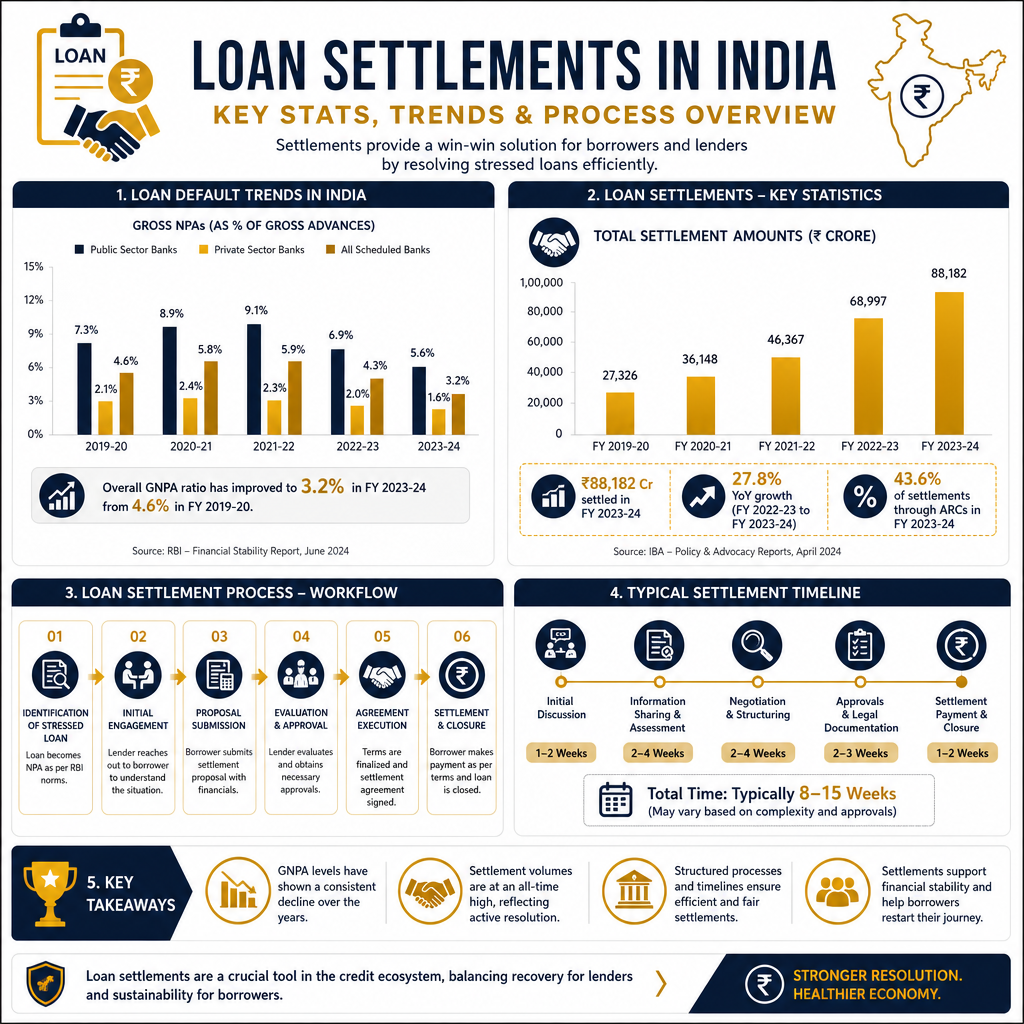
Prepared by AMA Legal Solutions Research & Analytics Team • Data & Compliance Overview

Halt Recovery Agent Harassment Legally
Borrower's Legal Rights During Loan Recovery Processes
In India, borrowers have several legal rights during loan recovery processes that protect them from coercive actions. Firstly, banks and recovery agents must adhere to the guidelines set by the Reserve Bank of India (RBI). Recovery agents cannot resort to harassment, and borrowers can file a complaint if such incidents occur. Moreover, banks are required to provide detailed notices before initiating recovery proceedings.
Borrowers should also know that loan settlement is not a criminal offence and cannot lead to criminal charges. If faced with legal notices or harassment, it’s crucial to respond appropriately to legal notices to protect one's interests. Additionally, borrowers can explore alternative resolutions through loan settlement services that facilitate negotiations with banks.
| Parameter / Criterion | Key Details / Legal Provision | Timeline / Practical Impact |
|---|---|---|
| RBI Guidelines | Prohibits harassment; mandates fair practices | Immediate upon default |
| Notice Requirement | Bank must send prior notice before recovery | Usually 30 days before action |
| Complaint Against Harassment | File with bank or RBI Ombudsman | Act promptly as soon as harassment occurs |
| Legal Recourse | Approach DRT or civil court if necessary | Varies based on case complexity |
Understanding these rights empowers borrowers to navigate the recovery process without fear. It’s advisable to seek legal assistance for personalized advice and to ensure that all actions taken are within the legal framework.
The Role of Arbitration and Mediation in Loan Settlements
Arbitration and mediation play a crucial role in ensuring that loan settlements are not categorized as criminal offences. These alternative dispute resolution (ADR) methods provide a legal framework where borrowers and financial institutions can amicably negotiate repayment terms, without the adversarial nature of court trials.
Arbitration involves a neutral third party, known as an arbitrator, who evaluates the dispute and makes a binding decision. This process is generally quicker and less formal than court proceedings, allowing both parties to present their case in a less intimidating environment. Arbitration is especially beneficial in resolving complex financial disputes, as it offers a definitive resolution while maintaining confidentiality.
Mediation, on the other hand, involves a mediator who facilitates communication between the parties to help them reach a mutually acceptable agreement. Unlike arbitration, the mediator does not make decisions but rather guides the conversation, enabling both parties to explore potential solutions. Mediation emphasizes collaboration and allows borrowers to propose realistic repayment plans, fostering a sense of partnership rather than conflict.
These ADR methods are essential in the Indian financial landscape, as they provide borrowers a chance to resolve loan issues without the stigma of criminality, promoting constructive dialogue and preserving relationships with financial institutions.
Structured Table: Legal Remedies and Their Implications
Understanding the legal remedies available to borrowers in India is crucial when facing loan default issues, as they navigate the complexities of loan settlements. Knowing these remedies not only reassures borrowers that loan settlement is not a criminal offence but also guides them on effective ways to manage defaults. Below is a structured table summarizing key legal remedies, their implications, and practical timelines.
| Parameter / Criterion | Key Details / Legal Provision | Timeline / Practical Impact |
|---|---|---|
| SARFAESI Act Application | Empowers banks to recover dues without court intervention. Borrowers can appeal to the DRT. | 60 days notice period; DRT appeal within 45 days post notice. |
| Debt Recovery Tribunal (DRT) | Borrowers can contest bank claims here. Loan settlement terms can be negotiated. | DRT hearings may extend over several months; crucial for resolving disputes. |
| Arbitration Proceedings | Often stipulated in loan agreements as a dispute resolution method. | Resolution can be faster than courts; typically 6-12 months. |
| Consumer Protection Act | Borrowers can challenge unfair bank practices affecting their settlements. | Average case resolution within 6-18 months; crucial for addressing grievances. |
For borrowers seeking detailed pathways for loan settlement, exploring services like our Loan Settlement Services and Banking and Finance Law can offer strategic insights and assistance in effectively managing debt and legal obligations. Understanding these remedies highlights that loan settlements are civil matters, not criminal offences.
Key Supreme Court and High Court Judgments on Loan Settlements
Understanding the judicial stance on loan settlements is crucial, as it clarifies that loan settlement is not a criminal offence. The judicial system in India has consistently held that loan defaults, while financially troubling, do not equate to criminal actions unless accompanied by fraudulent intentions.
In the landmark case of Narender Singh vs. State of Punjab, the Supreme Court reinforced that defaults due to genuine financial distress cannot be criminalized. The court emphasized that civil remedies, like restructuring or settlements, are more appropriate approaches for resolution.
Another critical judgment came from the Bombay High Court in the case of SBI vs. M/s Transcon, where the court ruled that coercive actions against borrowers for defaults could not be justified as criminal behavior. This solidified the stance that settlements are a civil matter, aiming to protect borrowers from undue harassment.
For those facing legal challenges, exploring loan settlement services can provide clarity and guidance on navigating these civil processes. These judgments underscore the importance of understanding one's legal rights in the realm of banking and finance law.
Impact of Loan Settlements on Credit Scores and Future Borrowing
Loan settlement can indeed impact your credit score, and understanding this is crucial for borrowers. When you settle a loan, the lender agrees to accept a payment less than the full amount owed. This action typically results in the credit report being marked as "settled," which indicates to future lenders that the borrower did not pay the full loan amount.
Credit Score Implications
Settling a loan can decrease your credit score, as it reflects a failure to repay the debt in full. The impact on your credit score varies, but it can be significant, especially if you have a strong credit history. The "settled" status remains on your credit report for seven years, affecting your creditworthiness during that period.
Future Borrowing Challenges
Although loan settlement is not a criminal offence, it may hinder future borrowing opportunities. Lenders may perceive you as a higher risk, leading to higher interest rates or denial of loan applications. Borrowers should explore Loan Settlement Services to manage loans effectively and potentially mitigate these impacts.
- Consider debt restructuring options to maintain a healthier credit profile.
- Proactively communicate with creditors to explore alternative resolutions.
- Utilize resources like How to Repair Your Credit Score for guidance on improving credit.
Ultimately, while a loan settlement may relieve immediate financial stress, it requires careful consideration of its long-term effects on financial health.
Lawyer's Tips for Successfully Navigating Loan Settlement Negotiations
When approaching loan settlement negotiations, it's crucial to understand that loan settlement is not a criminal offence. Hence, borrowers can engage in discussions with confidence. Here are some essential tips to maximize your success in these negotiations:
1. Gather Comprehensive Documentation
Before initiating any negotiation, collect all relevant financial and loan documents, including correspondence with the bank. This helps establish a clear picture of your financial standing and loan history.
2. Open Transparent Communications
Maintain open and honest communication with your lender. Clearly articulate your financial challenges and your willingness to settle the debt. This approach often leads to more favorable terms. For detailed strategies, consider our Loan Settlement Services.
3. Understand Your Rights
Be aware of your rights as a borrower. Familiarize yourself with RBI guidelines and the legal framework surrounding loan settlements. Our Legal Rights Against Recovery Agent Harassment page can provide more insights.
4. Propose a Realistic Settlement Offer
Calculate what you can realistically pay and propose a reasonable settlement offer. Banks are more likely to accept offers that reflect a genuine attempt to settle the debt.
- Ensure your offer is backed by evidence of financial distress.
- Emphasize any recent changes in your employment or income status.
5. Consider Professional Assistance
Engaging a legal expert can significantly enhance your negotiation position. Legal professionals can structure negotiations to protect your interests and improve outcomes. Explore more at our Banking and Finance Law page.
Popular Searches & Topics
Commonly searched legal queries and keywords related to this article
Need Strategic Legal Defense for Your Situation?
Our banking & litigation advocates review your notices, debt liability, and recovery issues under complete advocate-client secrecy.

AMA Legal Solutions
Trusted with a 4.7 Google Rating, over 10,000+ Clients Served, 25,000+ Cases Handled, and more than 40+ Years of Experience in providing strategic legal defense and debt resolution across India.
Our media coverages





Client Reviews
"Thanks to AMA Legal Solutions, I was able to settle my loan without any legal hassles. Their team is incredibly knowledgeable and supportive."
Sandeep Pillai
"The team at AMA Legal Solutions helped me understand loan settlement nuances, ensuring I was protected legally. Their advice was invaluable!"
Neha Menon
"AMA Legal Solutions provided exceptional guidance during my loan settlement process. Their expertise ensured a fair agreement with my lender. Highly recommend!"
Ravi Sharma
"Navigating through financial distress was made easier with AMA Legal Solutions. Their professional approach to loan settlement was commendable."
Arjun Verma
"AMA Legal Solutions made the loan settlement process transparent and less intimidating. Their expertise is unmatched."
Pooja Iyer
Frequently Asked Questions
Related Articles
RuPay Credit Card on UPI Default & Credit Line on UPI Settlement (2026)
Micro-transactions on RuPay UPI Credit Cards and pre-approved 'Credit Lines on UPI' have triggered a massive wave of 42%+ APR revolving debt traps. Find out if defaulting blocks your personal savings UPI and how to settle RuPay UPI credit dues for 30%–50%.
Read Article
Paytm, PhonePe & BharatPe Daily EDI Merchant Loan Settlement (2026)
Drowning in Equated Daily Installment (EDI) merchant loans where 100% of your daily QR Soundbox collections are auto-swept before you can pay suppliers or rent? Learn how retail shopkeepers and MSMEs legally halt QR sweeps and negotiate a 50%+ OTS.
Read Article
Can Bank or Loan App Remotely Lock Phone for EMI Default? RBI Rules (2026)
An investigative breakdown of RBI's Remote Device Locking Directions—explaining why lenders cannot lock your phone for personal loans, the mandatory 30/60 DPD safeguards on financed devices, the Rs. 250/hour delay penalty, and how to settle device & app loans.
Read ArticleAbout Author
Anuj Anand Malik
View ProfileAnuj Anand Malik, Founder of AMA Legal Solutions, is a trusted advocate, loan settlement expert, legal advisor, and banking lawyer. With over a decade of experience in loan settlement, corporate law, financial disputes, and compliance, he leads a result-driven law firm based in India that helps individuals, startups, and businesses achieve legal and financial stability.
Connect on LinkedInNeed Legal Representation?
Evaluate your defense against recovery agents, notices, or structure your loan settlement directly with Senior Advocates.
Call +91-8700343611