RuPay Credit Card on UPI Default & Credit Line on UPI Settlement (2026)
Micro-transactions on RuPay UPI Credit Cards and pre-approved 'Credit Lines on UPI' have triggered a massive wave of 42%+ APR revolving debt traps. Find out if defaulting blocks your personal savings UPI and how to settle RuPay UPI credit dues for 30%–50%.

Anuj Anand Malik
Reviewed by AMA Legal Solutions
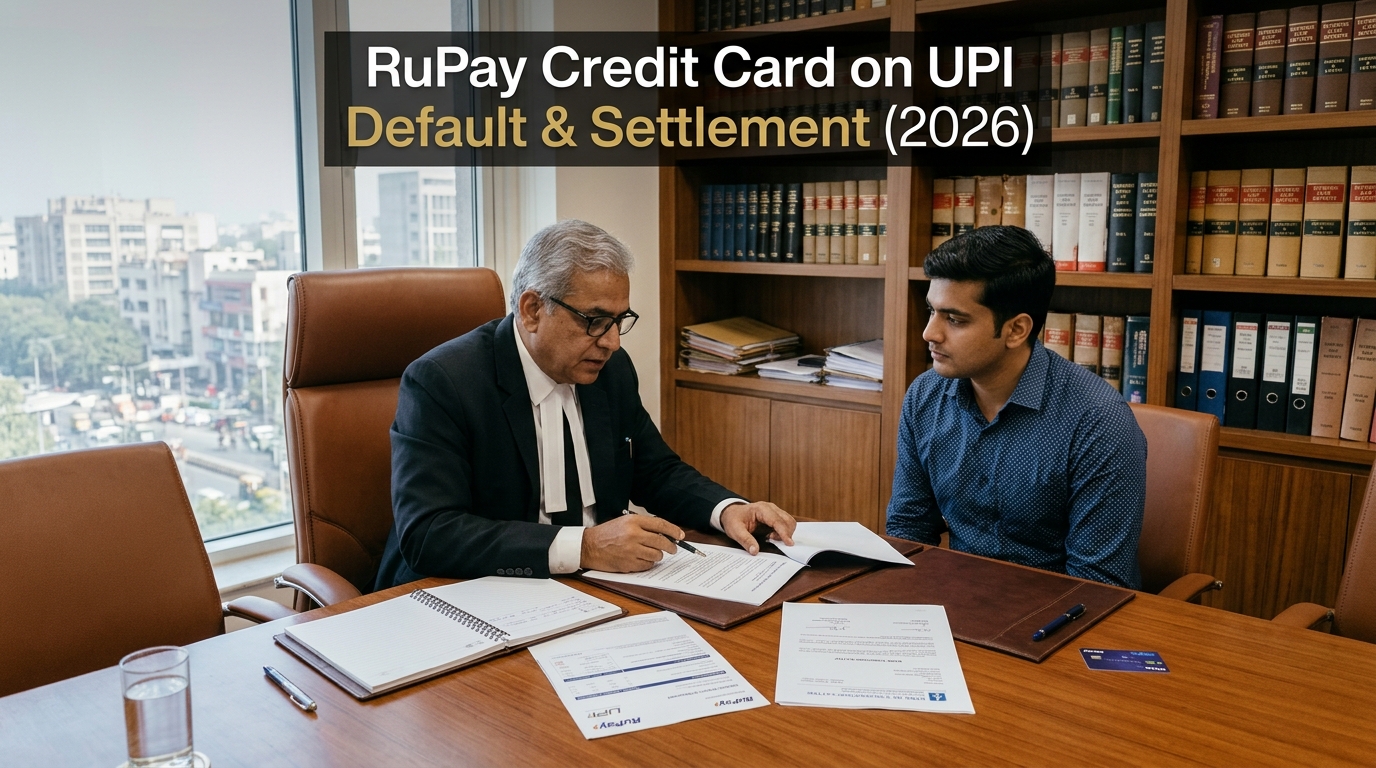
Key Takeaways: The rapid convergence of National Payments Corporation of India (NPCI) virtual credit rails and UPI apps has triggered an unprecedented debt wave: navigating a rupay credit card on upi default and loan settlement is now the most critical legal challenge facing salaried professionals and retail consumers across India. Linking virtual RuPay credit cards to Google Pay, PhonePe, Paytm, CRED, Kiwi, or Jupiter removes the psychological friction of spending, transforming everyday Rs. 50 tea stalls and grocery QR scans into a compounding 42% to 48% APR revolving debt trap. Borrowers commonly panic over whether a credit card default will freeze their personal savings UPI IDs or lead to an 'NPCI national blacklist.' Under RBI Master Directions on Credit Cards and NPCI operating frameworks, an unsecured credit card default does NOT disable your savings bank UPI handle across different banks, nor can third-party recovery agents freeze your UPI rails. However, if your card and savings account belong to the same bank, the lender may exercise a statutory banker's lien under Section 171 of the Indian Contract Act. Through formal legal representation from loan settlement services at AMA Legal Solutions, borrowers can halt recovery harassment, isolate liquid savings, and negotiate a legally binding One-Time Settlement (OTS) with a 50% to 75% waiver on outstanding dues.
Introduction: The Rise of RuPay Credit Card on UPI Default and Loan Settlement in India
Between 2016 and 2022, Unified Payments Interface (UPI) established itself as the digital lifeblood of the Indian economy. For half a decade, UPI operated strictly on an asset-backed model: consumers could only scan and pay using money already sitting in their savings or current accounts. However, the regulatory revolution led by the Reserve Bank of India (RBI) and the National Payments Corporation of India (NPCI) authorizing the linkage of RuPay credit cards to UPI—followed by pre-sanctioned 'Credit Lines on UPI'—fundamentally transformed India's retail payments architecture.
Suddenly, millions of young salaried employees, gig-economy workers, and small traders who had never qualified for premium metal cards were granted instant virtual RuPay credit cards. Leading issuers—including HDFC Bank (Tata Neu RuPay), State Bank of India (SimplySAVE RuPay), Axis Bank (Indian Oil RuPay), ICICI Bank (Coral RuPay), Kotak Mahindra Bank, Punjab National Bank, Yes Bank, and fintech neo-platforms like Kiwi and Jupiter—onboarded cardholders with zero physical paperwork. By integrating these virtual cards directly into Google Pay, PhonePe, Paytm, and BHIM, spending borrowed money became as casual as scanning a street-corner QR code.
Yet, frictionless spending carries devastating financial consequences. When consumer credit is decoupled from physical plastic and stripped of checkout friction, behavioral spending discipline collapses. In 2026, Indian banking data reveals that micro-transactions—Rs. 80 for morning coffee, Rs. 250 for quick-commerce groceries on Blinkit or Zepto, Rs. 600 for weekend cab rides—are charged to virtual RuPay credit limits multiple times daily. By month's end, cardholders face consolidated statements exceeding Rs. 75,000 to Rs. 2,50,000 on cards issued against monthly salaries of barely Rs. 40,000. When financial shocks hit—job layoffs, medical crises, or business downturns—the revolving interest rate of 3.5% to 4% per month (42% to 52% APR annualized) triggers an inescapable financial vortex, leading directly to the need for a formal rupay credit card on upi default and loan settlement.
At AMA Legal Solutions, our banking litigation attorneys have observed an exponential surge in inquiries from borrowers trapped in virtual UPI card debt. Defaulters face aggressive tele-calling agencies, abusive WhatsApp messages threatening police arrests, and widespread misinformation claiming that defaulting on a RuPay card will permanently brick their mobile phone or black-flag their national Aadhaar-linked UPI identity. In this definitive legal analysis, Senior Advocate Anuj Anand Malik dissects the regulatory, statutory, and practical mechanics of RuPay card defaults on UPI, dispels common banking myths, explains your defense against recovery harassment, and outlines the exact legal pathway to achieve a 50% to 75% One-Time Settlement (OTS).
How Daily QR Scan-and-Pay on RuPay Credit Cards & UPI Credit Lines Quietly Snowballs Into 45% APR Debt
To understand why executing a rupay credit card on upi default and loan settlement requires specialized legal strategy, one must examine the distinct psychological and mathematical traps engineered into UPI credit products.
Historically, traditional credit cards enforced a natural spending barrier: the physical act of opening a wallet, extracting a plastic card, handing it to a merchant cashier, inserting it into a Point-of-Sale (POS) terminal, and entering a four-digit PIN created mental friction. This friction encouraged cardholders to reserve credit cards for major purchases—consumer durables, flight tickets, electronics, or hospital bills.
1. Elimination of the 'Pain of Paying'
Behavioral economists have long proven that digital interfaces minimize the psychological 'pain of paying.' RuPay on UPI eliminated the last physical barrier. When a consumer taps their smartphone camera against a BharatQR code at a petrol pump or grocery stall, the UPI application offers a drop-down menu of funding sources. The virtual RuPay credit card is frequently pre-selected by default. Because the transaction completes in under three seconds with a simple 6-digit UPI PIN, the borrower loses real-time perception of cash depletion. Over 30 days, dozens of micro-transactions accumulate silently into an unmanageable aggregate sum.
2. The Devastating 5% Minimum Amount Due (MAD) Mirage
When the monthly credit card statement arrives, the total amount due might stand at Rs. 1,20,000, while the statement prominently highlights a minimum amount due in credit card meaning of merely Rs. 6,000 (5% of the outstanding balance). Uninformed cardholders assume that paying the Minimum Amount Due keeps the account in good standing without penalty. This is one of modern banking's most lucrative deceptions:
- Loss of the Interest-Free Grace Period: The moment a borrower pays anything less than 100% of the total statement balance, the interest-free grace period (typically 45 to 50 days) is immediately revoked for all existing dues AND all subsequent new purchases.
- Daily Compounding Interest: Finance charges ranging from 3.5% to 4.2% per month (42% to 50.4% APR) are calculated retroactively from the exact transaction date of every single Rs. 100 or Rs. 500 QR scan.
- 18% GST on All Finance Charges: Under Indian tax law, Goods and Services Tax (GST) at 18% is levied on every rupee of interest, late fee, and processing charge, accelerating ledger inflation.
- Negative Amortization: The 5% Minimum Amount Due is applied first toward GST, then toward late fees, then toward finance charges, leaving almost zero allocation toward reducing the actual principal. Within 8 to 12 months, a borrower who has faithfully paid Rs. 50,000 in minimum dues discovers that their principal balance has actually increased!
3. Multi-App Credit Stacking and Small-Ticket Debt Traps
The proliferation of co-branded UPI credit cards has exacerbated this debt cycle. It is common for a salaried professional to hold three or four virtual cards simultaneously: an HDFC Tata Neu RuPay card for utility bills, an Axis Bank Indian Oil RuPay card for fuel, an SBI SimplySAVE card for groceries, and a Kiwi or Jupiter virtual credit line for peer-to-merchant dining. When cash flow tightens, borrowers rotate payments between cards or resort to credit card cash-out apps, paying predatory 3% gateway surcharges to manufacture liquidity. When the revolving carousel stops, the borrower faces systemic default across multiple banking institutions, necessitating a comprehensive multiple credit card loan settlement.
Recognizing that micro-transaction compounding is designed for lender profitability is the first step toward seeking a structured rupay credit card on upi default and loan settlement before the account slips into irreversible legal proceedings.
Myth vs. Fact: Will Defaulting on a RuPay UPI Credit Card Freeze Your Savings Bank UPI on GPay, PhonePe or Paytm?
The single greatest source of panic among consumers facing a rupay credit card on upi default and loan settlement is the fear of digital isolation. Collection agencies exploit this technical ambiguity ruthlessly, telling borrowers: "If you do not clear your RuPay card bill by 5:00 PM today, your entire UPI ID will be blocked, and you will not be able to send or receive money even from your savings account."
Is this claim legally and technologically true? As seasoned legal counsel handling digital banking disputes, AMA Legal Solutions categorically confirms: NO. Defaulting on a RuPay credit card does NOT block or freeze your personal savings bank UPI account on Google Pay, PhonePe, Paytm, or BHIM, provided your savings account is maintained at an independent, separate banking institution.
The Decoupled Architecture of the National Payments Corporation of India (NPCI)
To demystify how UPI operates under the hood, consider the structural separation mandated by NPCI and RBI regulations:
- Virtual Payment Address (VPA) as an Agnostic Switch: Your UPI Virtual Payment Address (e.g., yourname@okhdfcbank or 9876543210@ybl) is an agnostic routing handle administered by NPCI and Third-Party Application Providers (TPAPs). It is simply an addressing mechanism that routes transactional requests to specific underlying account rails.
- Independent Funding Instruments: Within a single UPI application (such as PhonePe or Google Pay), a user can link multiple, completely independent funding sources:
- Bank Account A (e.g., State Bank of India Savings Account)
- Bank Account B (e.g., ICICI Bank Salary Account)
- Virtual Credit Card C (e.g., HDFC Tata Neu RuPay Credit Card)
- Pre-sanctioned Credit Line D (e.g., Axis Bank Credit Line on UPI)
- Instrument-Specific Suspension: When you default on your RuPay credit card (Instrument C), the card issuer (HDFC Bank) transmits a decline code to the NPCI switch strictly for that specific card token. NPCI disables transaction processing for that card handle alone. NPCI does not possess the statutory authority, technical mandate, or regulatory power to disable your independent Savings Account A or B at other banking institutions.
What Actually Happens to Your UPI Apps During a RuPay Default?
When default occurs, the following technical sequence takes place:
- Card Blockade: The card-issuing bank places a block (temporary at 30–60 DPD; permanent at 90 DPD NPA classification) on the credit card account. Any attempt to scan a QR code and select the RuPay card as the payment method will result in an automated error: "Transaction declined by issuing bank: Card inactive or limit exhausted."
- Unimpeded Savings Transfers: You can continue to scan QR codes, transfer funds to friends and family (P2P), receive salary credits, pay electricity bills, and order food through UPI by selecting your linked savings account at any non-lender bank.
- Safe Practice — Immediate Digital Unlinking: While the savings rail remains technically functional, AMA Legal Solutions advises all defaulting cardholders to open their UPI apps, navigate to payment methods, and manually tap "Remove Card" or "Unlink Account" for the defaulted RuPay card. This prevents accidental transaction attempts, eliminates confusing error prompts, and ensures that automated background recurring mandates linked to the card do not generate unexpected app errors.
Understanding this technical reality neutralizes the psychological blackmail employed by collection agents, allowing borrowers to approach their rupay credit card on upi default and loan settlement with clarity and legal composure.
Same-Bank Lien Warning: What Happens If Your RuPay Credit Card and Savings UPI Are in the Same Bank?
While an unsecured RuPay credit card default cannot affect savings accounts held in external banks, a severe statutory trap exists when your credit card and your primary savings or salary account are maintained within the same commercial bank.
For example, if you hold an SBI SimplySAVE RuPay Credit Card on UPI and also maintain your primary salary savings account with State Bank of India, defaulting on the card creates an immediate and perilous legal exposure under Indian contract law.
The Statutory Power: Banker's General Lien Under Section 171
Under Section 171 of the Indian Contract Act, 1872, commercial bankers retain a codified common-law right known as the Banker's General Lien and Right of Set-Off. Section 171 states:
"Bankers, factors, wharfingers, attorneys of a High Court and policy-brokers may, in the absence of a contract to the contrary, retain as a security for a general balance of account, any goods bailed to them..."
In contemporary retail banking jurisprudence, the Supreme Court of India and various High Courts have consistently upheld that when a customer maintains positive liquid balances in a deposit account (savings or current account) while simultaneously defaulting on a separate debt obligation (such as an overdue credit card or personal loan) within the same banking entity, the bank has the statutory right to combine accounts and set off deposits against the delinquent balance.
How the Same-Bank Sweep Operates in Practice
When your RuPay credit card default crosses 60 to 90 Days Past Due (DPD):
- Automated Internal Lien Placement: The bank's centralized core banking solution (CBS) places an automated administrative hold or 'lien mark' on your savings account. If your savings balance is Rs. 45,000 and your overdue credit card bill is Rs. 60,000, your available balance for withdrawal or UPI transfers is reduced to Rs. 0.
- Direct Auto-Debit / Account Sweeps: On the day your employer deposits your monthly salary, the core banking system automatically sweeps the incoming credit directly into the delinquent credit card ledger without prior court orders or manual intervention.
- Failure of Savings UPI: Because your savings account balance has been frozen or marked with a lien by the bank, any attempt to make a UPI payment from that savings account will fail with error codes such as "Account blocked / Lien exists" or "Insufficient available funds." In this scenario, your savings UPI is indeed incapacitated—not because NPCI blocked UPI, but because your own bank legally seized your deposit liquidity under Section 171!
The Mandatory Ring-Fencing Protocol by AMA Legal Solutions
To prevent clients from being left without grocery or rent money while negotiating a rupay credit card on upi default and loan settlement, our legal team enforces a strict Ring-Fencing Protocol at the earliest sign of financial distress:
- Immediate Salary Account Redirection: If your defaulted RuPay credit card is with Bank X, immediately submit a formal payroll change request to your employer's HR or accounts department, redirecting your salary to Bank Y—a completely independent Scheduled Commercial Bank where you hold zero outstanding debt or credit card accounts.
- Severing Auto-Debit and e-NACH Mandates: Review all active e-mandates and cancel internal auto-debit authorizations linked to the same-bank savings account to prevent sudden liquidity sweeps.
- Maintaining Minimum Balance Only: Ensure that the account held at the card-issuing bank contains only the bare statutory minimum balance, shielding your family's living capital while our advocates initiate structured settlement discussions.
| Digital Banking Rail / Account Category | Default Scenario: RuPay Credit Card on UPI | Technical & Legal Impact on Account Functionality | Permissible Lender Action & Statutory Protection |
|---|---|---|---|
| Virtual RuPay Credit Card on UPI (Same or Different Bank) | Default > 30–90 DPD on card statement | Permanently Blocked / Suspended: Tokenized card is disabled on NPCI switch; merchant QR scans using card fail instantly. | Lender can report delinquency to CIBIL, charge late fees, and initiate civil recovery; cannot freeze hardware or mobile phone. |
| Savings Account & UPI at the SAME Bank (e.g., HDFC Card + HDFC Savings) | Default > 60–90 DPD on card statement | High Risk of Lien / Total Freeze: Bank can freeze available balance, place lien marks, and auto-sweep incoming salary credits. | Section 171 Indian Contract Act: Bank possesses lawful Banker's Lien and Right of Set-Off across internal deposit accounts. |
| Savings Account & UPI at a DIFFERENT Bank (e.g., HDFC Card + SBI Savings) | Default > 90+ DPD on card statement | 100% Fully Functional & Protected: UPI handle, P2P transfers, merchant QR scans, and salary credits operate without disruption. | Zero Jurisdiction: The card-issuing bank has no legal authority or technical capability to attach or freeze an external bank account. |
| Pre-Sanctioned 'Credit Line on UPI' (Overdraft Facility) | Default on monthly interest/repayment quota | Credit Rail Revoked: Drawing power reduced to Rs. 0; linked savings balance remains accessible unless same-bank lien applied. | Governed by RBI IRAC prudential norms; classified as NPA at 90 DPD; recovery governed under civil contract law. |
| Third-Party UPI Handles (Google Pay, PhonePe, Paytm Apps) | Unsecured credit default on card instrument | Completely Active: TPAP application functions normally for all unlinked, valid payment instruments and external bank accounts. | TPAPs are technology facilitators, not judicial authorities; collection agent claims of an 'app-wide permanent block' are legally fraudulent. |
Key Insights & Data Infographic
Visual summary, statistical trends & procedural breakdown
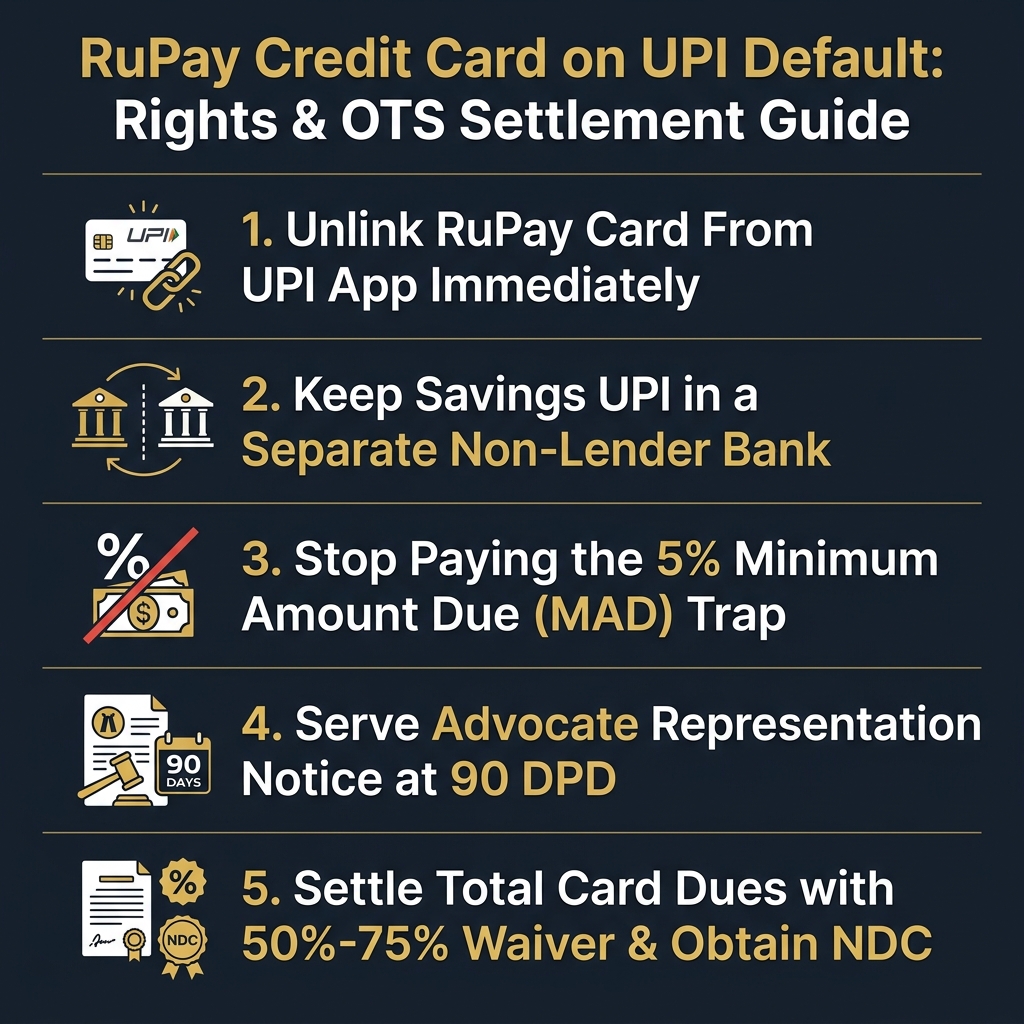
Prepared by AMA Legal Solutions Research & Analytics Team • Data & Compliance Overview

Halt Recovery Agent Harassment Legally
NPCI & RBI Rules on 'Credit Line on UPI' Overdrafts vs. Unsecured RuPay Credit Cards
When seeking a rupay credit card on upi default and loan settlement, borrowers frequently confuse two distinct credit mechanisms enabled on the UPI platform: RuPay Credit Cards on UPI versus Credit Lines on UPI. While both allow scan-and-pay on credit, their regulatory classification, interest computation, and settlement dynamics differ significantly under Reserve Bank of India (RBI) and NPCI frameworks.
1. RuPay Credit Cards on UPI: Revolving Credit Cards
A RuPay credit card on UPI is a traditional revolving credit card issued under the RBI Master Direction – Credit Card and Debit Card – Issuance and Conduct Directions, 2022 (updated 2026). Even though it is virtual and provisioned via a UPI app token, it is governed strictly by credit card regulations:
- Unsecured Revolving Facility: Cardholders receive a fixed credit limit, a monthly billing statement, an interest-free credit period (up to 50 days), and a calculated Minimum Amount Due.
- High Interest Structure: Monthly finance charges range from 3.4% to 4.5% (effective APR of 40% to 54%).
- Settlement Flexibility: Because credit cards represent purely unsecured retail exposure with minimal capital provisioning requirements post-write-off, banks maintain high settlement flexibility. Under the RBI Compromise Settlement Framework, credit committees routinely grant 50% to 75% waivers on residual credit card balances once the account passes the 90-to-180 DPD NPA threshold.
2. Credit Line on UPI: Pre-Sanctioned Digital Overdrafts
Introduced pursuant to RBI circulars and NPCI operational guidelines (such as Circular UPI-OC-171 and addendums), 'Credit Line on UPI' is an entirely different financial animal:
- Nature as a Pre-Sanctioned Bank Overdraft: A Credit Line on UPI is an intraday or revolving overdraft line sanctioned directly by a commercial bank or Small Finance Bank against a customer's savings profile.
- Interest on Actual Utilization: Unlike credit cards with fixed statement grace periods, a Credit Line on UPI typically begins accruing interest from Day 1 of fund drawdown, calculated on an agreed daily or monthly rate (often 18% to 32% APR).
- Purpose-Bound Restrictions: In 2025 and 2026, NPCI introduced Merchant Category Code (MCC) validation, prohibiting credit line drawdowns for speculative investments, cryptocurrency, or cash-out transfers, restricting usage to verified merchant QR categories.
- Regulatory Asset Classification: Under the RBI's prudential norms, if interest or principal on a Credit Line on UPI remains unpaid for more than 90 days, the entire overdraft facility is classified as a Non-Performing Asset (NPA). Because the facility is directly attached to the banking relationship, banks often attempt to convert defaulted credit lines into structured term personal loans before considering a formal One-Time Settlement.
Understanding whether your delinquent balance represents a revolving RuPay card or a pre-sanctioned digital credit line is essential. When our advocates at AMA Legal Solutions step in, we audit the original Key Fact Statement (KFS) and sanction documentation to ensure that your rupay credit card on upi default and loan settlement is structured under the most advantageous regulatory provisions, maximizing the waiver percentage while protecting your broader banking rights.
How Recovery Agents Harass RuPay UPI Card Defaulters (And Why Threatening an 'NPCI Blacklist' Is a Lie)
Because RuPay credit cards on UPI are marketed heavily to young, first-time digital borrowers, recovery agencies rely on intense psychological intimidation, technical fabrications, and social humiliation to extract payments.
If you have missed payments on an HDFC Tata Neu, SBI SimplySAVE, Axis, or ICICI RuPay card, you have likely received automated calls or aggressive WhatsApp messages containing alarming claims. As senior consumer debt attorneys, we expose the most common recovery lies and establish the legal reality under Indian law:
Lie #1: "NPCI Has Blacklisted Your Aadhaar & PAN Across All Indian Banking"
The Legal Reality: This is a complete fabrication. The National Payments Corporation of India (NPCI) is an umbrella organization for operating retail payments and settlement systems in India. It is NOT a credit bureau, a law enforcement body, or a judicial tribunal. NPCI does not maintain an 'Aadhaar blacklist,' nor does it possess legal authority to blacklist citizens from opening savings accounts, receiving government subsidies, or executing digital payments. The only entities authorized by law to track default histories are licensed Credit Information Companies (TransUnion CIBIL, Experian, Equifax, and CRIF High Mark) governed by the Credit Information Companies (Regulation) Act, 2005 (CICRA).
Lie #2: "Police Are Registering an FIR for UPI Digital Cheating Under BNS"
The Legal Reality: Collection agents routinely threaten to file criminal complaints under Section 318 (Cheating) of the Bharatiya Nyaya Sanhita (BNS), 2023, claiming that using a virtual RuPay card and failing to pay constitutes digital fraud. The Supreme Court of India has held in dozens of landmark rulings—including Satishchandra Ratanlal Shah v. State of Gujarat and Dalip Kaur v. Jagnar Singh—that mere inability to repay an unsecured commercial credit facility does NOT constitute criminal cheating. To establish cheating, the lender must prove fraudulent intention at the very inception of the contract. Defaulting due to financial hardship, salary loss, or business failure is strictly a civil contractual breach. Local police stations have zero jurisdiction to intervene in credit card collections or arrest defaulting borrowers.
Lie #3: "We Will File a Section 25 PSSA / Section 138 Cheque Bounce Case Tomorrow"
The Legal Reality: Section 138 of the Negotiable Instruments Act applies strictly to physical paper cheques. For digital credit cards, if an e-NACH auto-debit mandate fails, banks can theoretically invoke Section 25 of the Payment and Settlement Systems Act, 2007 (PSSA). However, Section 25 requires a rigid statutory procedure: the lender must serve a formal written demand notice within 30 days of the bounce, granting the borrower a mandatory 15-day statutory window to respond. Furthermore, Section 25 offenses are compoundable and bailable. When our advocates serve a formal hardship representation, banks virtually never pursue criminal trials for retail card balances, preferring an amicable civil settlement.
Statutory Protections Under RBI Master Directions on Recovery Agents
Under the RBI's comprehensive regulations governing recovery practices, borrowers are protected by strict legal boundaries:
- Time Window Mandate: Recovery agents are strictly barred from calling or visiting borrowers before 8:00 AM or after 7:00 PM.
- Ban on Abusive Language & Defamation: Agents cannot use foul, threatening, or intimidating language, nor can they contact your employers, colleagues, friends, or family members. Calling references whose numbers were scraped from phone contacts is an explicit violation of the Digital Personal Data Protection (DPDP) Act, 2023, and RBI guidelines.
- Prohibition on Physical Intimidation: Visiting your workplace or residence to cause a public scene constitutes criminal intimidation under Section 351 of the Bharatiya Nyaya Sanhita (BNS), 2023.
- Mandatory Identification: Any recovery representative must display a formal identity card and an official letter of authorization from the lending bank containing your specific loan account number.
When collection agencies violate these codified standards, AMA Legal Solutions immediately serves a Cease-and-Desist Legal Notice on the bank's Managing Director and Principal Nodal Officer, filing simultaneous complaints with the RBI Integrated Ombudsman (cms.rbi.org.in), instantly silencing rogue recovery calls.
Step-by-Step Process to Negotiate a 50% to 75% One-Time Settlement (OTS) on RuPay UPI Credit Cards
Resolving delinquent virtual card debt requires a systematic, legally sound strategy. Attempting to negotiate informally with tele-callers usually results in wasted funds, as informal agents often pocket token payments as 'processing fees' without updating the bank's core ledger. Here is the verified 5-step legal protocol deployed by AMA Legal Solutions to achieve a successful rupay credit card on upi default and loan settlement:
Step 1: Financial & Tradeline Forensic Audit
The process begins with an exhaustive legal audit of your credit card documentation. Our team examines your monthly credit card statements, billing ledgers, Key Fact Statement (KFS), and CIBIL credit report. We calculate the exact 'Core Principal'—the actual quantum of funds spent at merchant counters—stripping away accumulated late fees, over-limit charges, 45% APR finance charges, and 18% GST surcharges. In many cases, we discover that borrowers who have paid minimum dues for over a year have already repaid 60% to 80% of their original principal in interest alone.
Step 2: Working Capital Isolation & App Unlinking
Before initiating negotiations, we ensure your financial stability. As detailed in our Ring-Fencing Protocol, we guide you to open a fresh savings account in an unlinked bank, re-route salary credits, unlink the delinquent RuPay card from all UPI applications (Google Pay, PhonePe, Paytm), and revoke recurring auto-debit mandates. This stops unpredictable account sweeps, preserving your liquid funds for living expenses and the eventual settlement pool.
Step 3: Service of Advocate Representation & Hardship Notice
Our senior advocates draft and serve a formal Representation and Legal Hardship Notice on the bank's Credit Card Operations Division, Principal Nodal Officer, and Internal Ombudsman. This legal instrument accomplishes three critical objectives:
- It formally informs the bank that AMA Legal Solutions represents you, legally demanding that all tele-calling and agency contact cease immediately pursuant to RBI Fair Practices regulations.
- It documents your bona fide, verified financial hardship—such as involuntary job loss, business revenue collapse, critical medical illness, or family emergency—substantiated by documentary evidence (pink slips, hospital discharge summaries, or bank statement shrinkage).
- It officially petitions the bank's competent authority for a One-Time Settlement (OTS) under the RBI Framework for Compromise Settlements and Technical Write-offs.
Step 4: Central Credit Committee Negotiation & Haircut Structuring
Once the card account crosses the 90-to-180 DPD threshold and is designated as a Non-Performing Asset (NPA) or technically written off, it moves from front-end recovery agencies to the bank's centralized Special Asset Management / Compromise Settlement Committee. Our senior legal team negotiates directly with authorized bank executives. Leveraging our forensic ledger audit and proven financial hardship, we secure:
- 100% Complete Waiver of Penal Charges: Total erasure of all accumulated finance charges, late payment fees, bounce charges, and GST levies.
- 50% to 75% Waiver on Principal Balance: Negotiating the final settlement amount down to just 25% to 50% of the total outstanding dues, structured either as a single lump-sum or across convenient multi-tranche installments.
Step 5: Verification of Formal Settlement Sanction Letter, Direct Payment & NDC Issuance
We enforce rigorous closing protections to ensure complete legal finality:
- We review and verify the official One-Time Settlement (OTS) Sanction Letter issued on the bank's formal corporate letterhead. We verify that the letter explicitly cites your specific card account number, states the exact negotiated settlement sum, specifies realistic payment due dates, and confirms that payment will result in full and final discharge of all civil and criminal liabilities.
- Payment is remitted directly into the bank's verified settlement pool account via official banking channels (NEFT/RTGS)—never to a recovery agent's personal account.
- Following payment verification, we ensure the bank issues an unconditional No Dues Certificate (NDC) or Loan Closure Letter, and updates the account status to Credit Information Companies (CIBIL) as 'Settled' with zero future claim.
For borrowers struggling across multiple banking institutions, our comprehensive guide on the credit card settlement process in India and our overview of top credit card banks offering settlement in India provide deeper institutional benchmarks.
| Issuing Bank / Fintech Platform | Popular RuPay Credit Card Products on UPI | Average Settlement Timeline (Post-Default) | Typical Advocate-Negotiated OTS Waiver Range |
|---|---|---|---|
| HDFC Bank | HDFC Tata Neu Plus / Infinity RuPay, HDFC Freedom RuPay, Regalia RuPay | 90 to 180 Days Past Due (NPA Stage) | 55% to 70% Total Waiver (100% waiver of penal interest; 40%–60% principal haircut) |
| State Bank of India (SBI Card) | SBI SimplySAVE RuPay, BPCL SBI Card Octane RuPay, Shaurya RuPay | 120 to 180 Days Past Due | 50% to 65% Total Waiver via National Lok Adalat or Central SAMG Settlement Desk |
| Axis Bank | Axis Indian Oil RuPay, Axis Neo RuPay, Axis My Zone RuPay Card | 90 to 150 Days Past Due | 50% to 70% Total Waiver upon verification of documented employment disruption |
| ICICI Bank | ICICI Coral RuPay Credit Card, ICICI HPCL Super Saver RuPay | 90 to 180 Days Past Due | 50% to 65% Total Waiver structured across lump-sum or 2-to-3 monthly tranches |
| Kotak Mahindra Bank | Kotak League RuPay, Kotak Indian Oil RuPay, MOJO RuPay | 90 to 150 Days Past Due | 55% to 75% Total Waiver on uncollateralized virtual credit balances |
| Yes Bank & IDFC First Bank | Yes Bank Freo RuPay, IDFC FIRST Digital RuPay, FIRST Power RuPay | 90 to 120 Days Past Due | 50% to 70% Total Waiver through formal advocate legal representation |
| Kiwi & Jupiter (Fintech Issuers) | Kiwi Axis Virtual RuPay, Jupiter CSB Edge RuPay Credit Card | 60 to 120 Days Past Due | 45% to 65% Total Waiver negotiated directly with partner sponsor banks (CSB/Axis) |
Strategic Conclusion: Clear Your UPI Credit Card Debt Trap with AMA Legal Solutions
The digitization of retail credit through RuPay on UPI has provided unparalleled convenience, but it has also created an aggressive debt trap for millions of honest Indian consumers. Waking up to daily automated collection calls, threatening legal notices, and escalating 45% APR interest compounding can feel overwhelming. However, remember this fundamental legal reality: you are an Indian citizen with inviolable constitutional and consumer rights, and you do not have to endure harassment or accept financial ruin.
Executing a formal rupay credit card on upi default and loan settlement is a legally recognized, statutory resolution framework sanctioned by the Reserve Bank of India. It allows honest individuals who have suffered legitimate economic setbacks to halt extortionate recovery harassment, strip away usurious penalties, settle their debts for an affordable fraction of the balance, and reclaim their peace of mind and financial independence.
At AMA Legal Solutions, our experienced banking defense advocates have successfully settled thousands of credit card and unsecured loan accounts across India. We deal directly with the senior credit committees and legal heads of every major Scheduled Commercial Bank and NBFC. We protect your personal privacy, enforce the RBI Fair Practices Code, and secure legally ironclad settlement letters and No Dues Certificates that extinguish your liabilities permanently.
Do not allow virtual credit card debt to jeopardize your career, your family's dignity, or your financial future. Contact AMA Legal Solutions today to schedule an immediate, confidential legal consultation with Senior Advocate Anuj Anand Malik and our specialized debt resolution team. Let us review your statements, halt collection harassment, and construct the definitive legal strategy to achieve complete financial freedom.
Popular Searches & Topics
Commonly searched legal queries and keywords related to this article
Need Strategic Legal Defense for Your Situation?
Our banking & litigation advocates review your notices, debt liability, and recovery issues under complete advocate-client secrecy.
References & Authority
- National Payments Corporation of India (NPCI) - Operational Guidelines on Linking RuPay Credit Cards on UPI & Credit Line on UPI
- Reserve Bank of India (RBI) - Master Direction – Credit Card and Debit Card – Issuance and Conduct Directions
- Reserve Bank of India (RBI) - Framework for Compromise Settlements and Technical Write-offs
- India Code - Indian Contract Act, 1872 (Section 171 - General Lien of Bankers)
- Reserve Bank of India (RBI) - Guidelines on Digital Lending & Lending Service Providers (LSPs)
- Reserve Bank of India (RBI) - Fair Practices Code for Regulated Entities & Conduct of Recovery Agents
- India Code - Payment and Settlement Systems Act, 2007 (Section 25 - Dishonour of Electronic Funds Transfer)
- Ministry of Electronics and Information Technology (MeitY) - Digital Personal Data Protection Act, 2023

AMA Legal Solutions
Trusted with a 4.7 Google Rating, over 10,000+ Clients Served, 25,000+ Cases Handled, and more than 40+ Years of Experience in providing strategic legal defense and debt resolution across India.
Our media coverages





Frequently Asked Questions
Related Articles
Paytm, PhonePe & BharatPe Daily EDI Merchant Loan Settlement (2026)
Drowning in Equated Daily Installment (EDI) merchant loans where 100% of your daily QR Soundbox collections are auto-swept before you can pay suppliers or rent? Learn how retail shopkeepers and MSMEs legally halt QR sweeps and negotiate a 50%+ OTS.
Read Article
Can Bank or Loan App Remotely Lock Phone for EMI Default? RBI Rules (2026)
An investigative breakdown of RBI's Remote Device Locking Directions—explaining why lenders cannot lock your phone for personal loans, the mandatory 30/60 DPD safeguards on financed devices, the Rs. 250/hour delay penalty, and how to settle device & app loans.
Read Article
How Recovery Agents Get Your Personal Details and How to Prevent It in India (2026)
An investigative legal breakdown of the 7 hidden channels debt collectors use to trace your phone numbers, family contacts, employer, and address - and the exact statutory shields under RBI 2026 Directions and the DPDP Act, 2023 to stop them.
Read ArticleAbout Author
Anuj Anand Malik
View ProfileAnuj Anand Malik, Founder of AMA Legal Solutions, is a trusted advocate, loan settlement expert, legal advisor, and banking lawyer. With over a decade of experience in loan settlement, corporate law, financial disputes, and compliance, he leads a result-driven law firm based in India that helps individuals, startups, and businesses achieve legal and financial stability.
Connect on LinkedInNeed Legal Representation?
Evaluate your defense against recovery agents, notices, or structure your loan settlement directly with Senior Advocates.
Call +91-8700343611