Paytm, PhonePe & BharatPe Daily EDI Merchant Loan Settlement (2026)
Drowning in Equated Daily Installment (EDI) merchant loans where 100% of your daily QR Soundbox collections are auto-swept before you can pay suppliers or rent? Learn how retail shopkeepers and MSMEs legally halt QR sweeps and negotiate a 50%+ OTS.

Anuj Anand Malik
Reviewed by AMA Legal Solutions
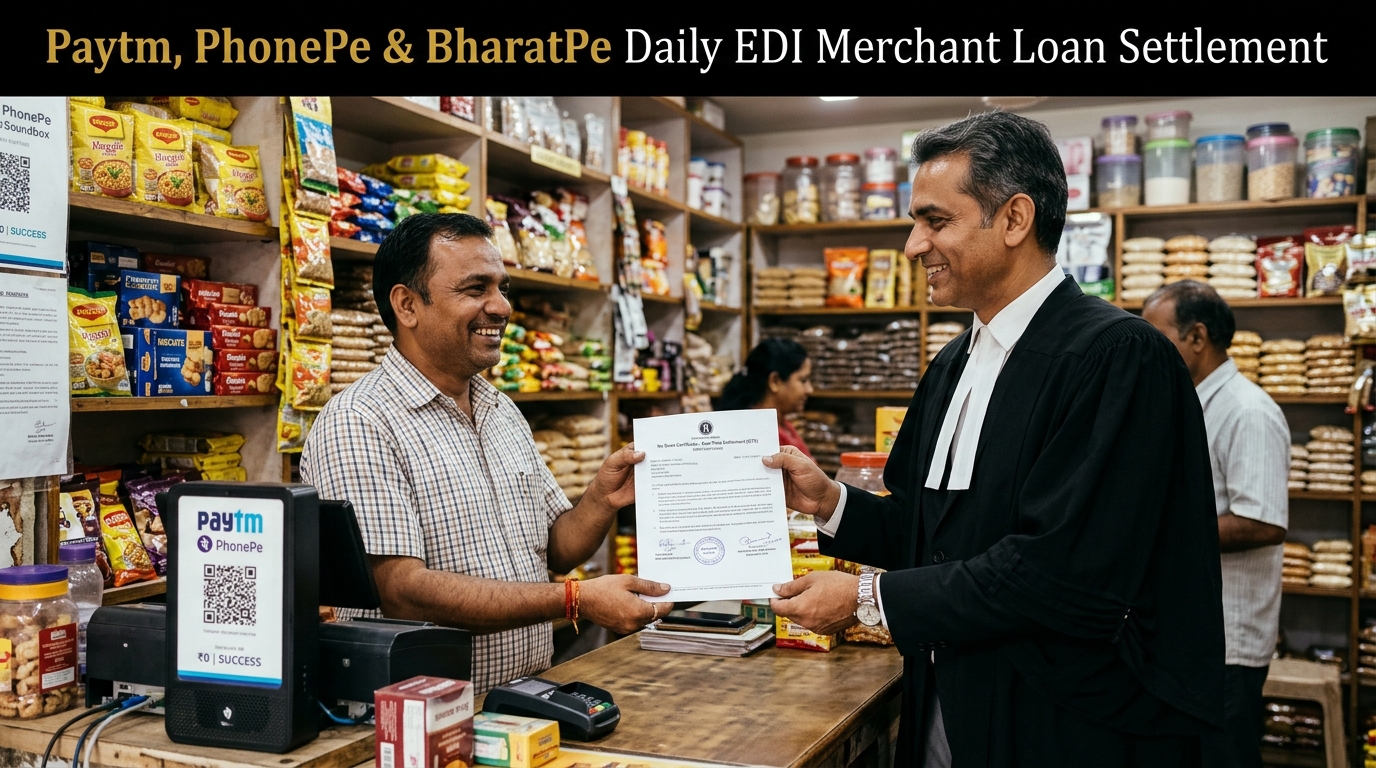
Key Takeaways: For retail shop owners, kirana merchants, restaurant operators, and traders across India, navigating a paytm phonepe bharatpe daily edi merchant loan settlement is often the only legal path to survival when daily QR Soundbox collections are trapped in an automatic debt spiral. Payment aggregators like Paytm, PhonePe, and BharatPe do not lend from their own balance sheets; they act as Lending Service Providers (LSPs) for partner NBFCs such as SMFG India Credit, Poonawalla Fincorp, Aditya Birla Finance, Northern Arc, and Piramal Capital. When revenues drop, the automated daily sweep of 100% of your customer UPI payments leaves zero working capital to purchase stock, pay store rent, or clear distributor invoices. Under Reserve Bank of India (RBI) Digital Lending Guidelines and MSME Rehabilitation Frameworks, merchants have the legal right to revoke automated split-settlement mandates, protect their business current accounts, halt recovery agent harassment on the shop floor, and negotiate a formal One-Time Settlement (OTS) with 45% to 65% principal haircuts through loan settlement services provided by AMA Legal Solutions.
Introduction: The Paytm, PhonePe & BharatPe Daily EDI Merchant Loan Settlement Crisis in India
Every morning across India, over 35 million retail merchants, small shopkeepers, chemist counters, cafe operators, and wholesale traders open their store shutters with a common ritual: powering on their digital UPI Soundbox. For years, digital payment apps—principally Paytm, PhonePe, and BharatPe—revolutionized Indian commerce by enabling frictionless QR payments. However, behind the cheerful voice announcement of "Paytm par 500 rupaye prapt hue" lies a deep financial quagmire that has trapped hundreds of thousands of micro and small business owners: the paytm phonepe bharatpe daily edi merchant loan settlement crisis.
When business is booming, taking an instant digital business loan or Merchant Cash Advance (MCA) disbursed directly through your merchant dashboard appears effortless. There are no heavy collateral requirements, no formal balance sheet audits, and no lengthy branch visits. The lender deposits Rs. 2 Lakhs, Rs. 5 Lakhs, or even Rs. 15 Lakhs into your current account within minutes. But the repayment mechanism attached to these facilities is radically different from traditional business credit: instead of an Equated Monthly Installment (EMI), you are enrolled in an Equated Daily Installment (EDI) or a daily percentage split-settlement sweep.
The moment consumer footfall declines, seasonal downturns strike, local market competition intensifies, or wholesale supplier costs surge, this automated daily sweep becomes fatal. If your store collects Rs. 4,000 on a quiet Tuesday and your daily EDI obligation is Rs. 3,500, the payment gateway algorithm automatically deducts Rs. 3,500 at midnight, leaving you with barely Rs. 500 to restock dairy, vegetables, or FMCG goods. Within weeks, the shopkeeper cannot pay distributor bills, supplier credit lines freeze, rent defaults occur, and the merchant enters an inescapable liquidity freeze. For distressed micro-enterprises, exploring a structured paytm phonepe bharatpe daily edi merchant loan settlement becomes the only viable legal remedy to rescue their enterprise from permanent closure.
At AMA Legal Solutions, our banking litigation and corporate debt defense advocates represent kirana merchants, restaurant franchises, electronics dealers, and retail shop owners nationwide. In this comprehensive legal treatise, we dismantle the mechanics of the daily EDI loan trap, identify the regulated NBFC balance sheets backing your QR app, establish your statutory rights under RBI guidelines, and present the definitive legal strategy to achieve a debt-free exit without losing your business.
How Equated Daily Installment (EDI) & Merchant Cash Advance (MCA) Loans Actually Work Behind the Scenes
To understand why a paytm phonepe bharatpe daily edi merchant loan settlement requires specialized legal handling, one must first dissect the algorithmic architecture of digital merchant lending in India.
Traditional commercial banking relies on monthly cash flow cycles: a borrower receives trade revenue throughout 30 days and pays an EMI on a scheduled date. If cash flow is temporarily delayed, the borrower has a 30-day window to arrange funds, manage working capital, or utilize overdraft facilities. In stark contrast, fintech merchant credit is engineered around high-frequency micro-extractions:
1. The Equated Daily Installment (EDI) Model
In a standard EDI loan, the total principal along with flat interest charges (often carrying an effective Annual Percentage Rate or APR ranging between 24% and 42%) is divided by the loan tenure measured in days—typically 180, 270, or 365 calendar days. For instance, on a Rs. 5,00,000 loan tenure of 300 days with interest, the merchant is billed a fixed sum of approximately Rs. 2,100 to Rs. 2,400 every single day, including Sundays and public holidays.
2. The Revenue-Split Settlement (Merchant Cash Advance) Sweep
In variable MCA structures, the fintech platform contracts for an agreed "deduction percentage" (typically 15% to 30%, but sometimes escalating to 50% or 100% of daily digital transactions). As customers scan the counter QR code to pay for groceries, meals, or apparel, the payment aggregator acts as the collection gatekeeper. Before the net settlement batch is triggered to the merchant's external bank account at 11:00 PM or 6:00 AM, the algorithm automatically extracts the day's loan quota. If daily transaction volumes drop below the minimum threshold, the platform triggers an automated e-NACH / UPI AutoPay debit directly against the merchant's linked bank account.
3. Why the EDI Structure Creates a Compounding Liquidity Trap
While fintech marketing pitches EDIs as "painless micropayments," financial economists and legal professionals recognize the structural danger of daily auto-sweeps:
- Destruction of Working Capital Velocity: Retail trade survives on inventory turnover. When daily collections are siphoned off daily, merchants cannot pay wholesalers in cash, forfeiting critical 2% to 5% cash purchase discounts and losing supplier goodwill.
- Double-Dipping via Auto-Debit Bounces: If digital QR collections on a given day are insufficient to cover the full EDI, the platform triggers an automatic bank hit (e-Mandate / NACH). When the bank account balance is also inadequate, the merchant is slapped with severe bank bounce charges (Rs. 295 to Rs. 590 per failure) plus lender late fees—multiplying penal costs exponentially every single day!
- Soundbox Psychological Hostage: Because the Soundbox broadcasts every transaction aloud, shopkeepers feel intense social pressure. When the app begins showing negative balances or flashing collection alerts on the merchant app, psychological panic sets in, prompting many to consider an urgent paytm phonepe bharatpe daily edi merchant loan settlement.
Who Is the Real Lender? Mapping Payment Aggregators to Partner NBFCs (SMFG, Poonawalla, Northern Arc, Aditya Birla, L&T & Piramal)
A widespread misconception among retail shopkeepers is that they borrowed money directly from Paytm (One97 Communications), PhonePe Private Limited, or BharatPe (Resilient Innovations). When collection agents call or visit, they frequently announce themselves as "Paytm recovery" or "BharatPe loan department."
Under Indian banking law, this is legally inaccurate. Neither Paytm, PhonePe, nor BharatPe holds a commercial banking or NBFC license to disburse balance-sheet credit directly. Under the RBI's Master Directions on Digital Lending, these fintech platforms operate strictly as Lending Service Providers (LSPs). They provide digital customer acquisition, underwriting algorithms, merchant settlement rails, and technology front-ends. The actual risk-bearing financial institution that approved your loan, disbursed the capital, and reports to CIBIL is an RBI-registered Non-Banking Financial Company (NBFC) or a private bank.
When executing a paytm phonepe bharatpe daily edi merchant loan settlement, negotiating with the front-end fintech app's customer care chatbot or regional field sales executive is legally futile. The formal One-Time Settlement (OTS) sanction letter and legal No Dues Certificate (NDC) must be issued directly by the competent credit committee of the underlying NBFC. Below is the statutory mapping of leading payment platforms to their institutional lending partners:
Paytm (One97 Communications / Paytm Payments Services)
Paytm's digital merchant lending operations rely on a consortium of major institutional NBFCs. Primary lending partners include SMFG India Credit (formerly Fullerton India), Poonawalla Fincorp, Piramal Capital & Housing Finance, Aditya Birla Finance Limited, Tata Capital, and Clix Capital. When you seek a Paytm loan settlement, your legal notice and financial restructuring petition must be addressed directly to the Principal Nodal Officer of these specific partner NBFCs.
PhonePe (PhonePe Lending Services / PhonePe Business)
PhonePe partners with prominent NBFCs including Northern Arc Capital, InCred Financial Services, Aditya Birla Finance, and Western Capital Advisors to disburse merchant cash credit lines and term loans. Legal settlement demands must be routed to the respective partner NBFC's central NPA management division.
BharatPe (Resilient Digi Services Private Limited)
BharatPe facilitates merchant loans through its affiliated NBFC arm, BharatPe Capital (Trillionloans / Resilient Finance Private Limited), alongside institutional co-lenders such as PayU Finance India Private Limited, SG Finserve Limited, OXYZO Financial Services, Muthoot FinCorp, and South Indian Bank. Resolving overdue merchant dues requires legal negotiation with both the LSP platform and the respective underlying co-lending balance sheet.
Pine Labs & Razorpay
Point-of-Sale (POS) terminal provider Pine Labs and payment aggregator Razorpay (Razorpay Capital) partner with lenders like Kotak Mahindra Bank, Axis Bank, IIFL Finance, and Vivriti Capital for merchant term credit. Restructuring these facilities follows identical statutory lines.
| Digital Payment Platform (LSP Front-End) | Underlying Partner NBFCs & Scheduled Banks (Real Legal Lenders) | Typical Loan Products & Recovery Collection Mechanism | Benchmark OTS Principal Haircut Range (Advocate-Negotiated) |
|---|---|---|---|
| Paytm for Business | SMFG India Credit, Poonawalla Fincorp, Piramal Capital, Aditya Birla Finance, Tata Capital | Collateral-free Merchant Loans (Rs. 50,000 to Rs. 20 Lakhs); Daily EDI swept from batch QR settlements + e-NACH backup | 45% to 65% Principal Waiver (100% waiver of accrued late interest and bounce penalties) |
| PhonePe Business | Northern Arc Capital, InCred Financial Services, Aditya Birla Finance, Western Capital | Merchant Growth Loans & Cash Advances (Rs. 1 Lakh to Rs. 15 Lakhs); Automated daily deduction from daily Soundbox UPI collections | 40% to 60% Principal Waiver based on validated business hardship and audit of trading statements |
| BharatPe for Business | BharatPe Capital (Trillionloans), PayU Finance, SG Finserve, OXYZO, Muthoot FinCorp, South Indian Bank | BharatPe Easy Loans (Rs. 25,000 to Rs. 10 Lakhs); Daily QR deduction percentage sweep (10% to 40% of customer payments) | 50% to 70% Principal Waiver on residual balances after delinking QR auto-sweep |
| Pine Labs POS | Kotak Mahindra Bank, IIFL Finance, Vivriti Capital, Northern Arc | POS Merchant Overdraft / Term Loan; Automatic deduction from daily credit/debit card card-swipe batch settlements | 35% to 55% Principal Waiver upon business turnover distress verification |
| Razorpay Capital | Vivriti Capital, IIFL Finance, Fibe (EarlySalary), Liquiloans | Working Capital Loans & Cash Advances for e-commerce and retail sellers; Automatic deduction from daily settlement tranches | 40% to 60% Principal Waiver through formal structured legal representation |
Understanding this institutional hierarchy is essential: when a shopkeeper attempts to settle directly through the app, customer service representatives often state that "settlement is not possible on EDI loans." This is simply untrue. NBFC credit committees evaluate Non-Performing Assets (NPAs) strictly based on recovery risk and statutory provisioning. Engaging legal counsel who deals directly with NBFC leadership transforms the entire negotiation dynamic in a paytm phonepe bharatpe daily edi merchant loan settlement.
Why 100% Daily QR Settlement Sweeps Destroy Small Shop Working Capital (And Your Legal Right to Delink)
The most brutal operational issue reported by shopkeepers is the total hijacking of daily cash flow. When an EDI loan falls into arrears—even by a few days—the automated algorithms of Paytm, PhonePe, or BharatPe frequently increase the deduction percentage from the agreed 20% to 100% of incoming customer payments!
Consider the real-world operational catastrophe this causes for a kirana store, a pharmacy, or a small clothing boutique:
- Supplier Defaults: The shop owner orders milk, bread, provisions, or raw materials on 24-hour credit. Customers pay via UPI, and the Soundbox announces the receipt. But when the merchant checks their bank balance, the money is gone—swept into the loan pool account. The shopkeeper cannot pay the milk vendor or vegetable distributor the following morning.
- Distributor Blacklisting: In Indian retail, once distributors stop receiving cash payments, they immediately halt stock deliveries. The shop's shelves empty out, customers migrate to competing neighborhood stores, and gross daily revenue collapses from Rs. 15,000 to Rs. 2,000 within a month.
- Forced Personal Borrowing: To keep the store open, distressed merchants turn to local moneylenders charging 5% to 10% monthly interest or download predatory instant loan apps, plunging into catastrophic debt compounding.
Your Statutory Legal Right to Delink QR Settlements and Revoke Auto-Debit Consent
Lenders and fintech representatives often tell borrowers that "you cannot stop QR deductions until the loan is fully cleared" or that "delinking the QR code is a criminal act." Under Indian jurisprudence, these statements are legally baseless and false.
Here are your fundamental legal protections under Indian banking law:
- The Digital Lending Guidelines Mandate: The Reserve Bank of India's Digital Lending Guidelines mandate that all loan servicing, disbursements, and repayments must occur strictly between the borrower's bank account and the Regulated Entity's (NBFC's) bank account, without pass-through or pool accounts controlled by LSPs. Lenders cannot arbitrarily confiscate 100% of merchant revenues without leaving working capital essential for enterprise survival.
- Right to Revoke e-Mandate / UPI AutoPay: Under the RBI's Circular on Processing of e-Mandates for Recurring Transactions, a consumer or commercial borrower possesses the absolute statutory right to revoke or withdraw recurring auto-debit mandates at any time through their net banking portal or UPI application. Revoking an auto-debit mandate is a civil contractual decision, not a criminal act. While the underlying civil liability to pay legitimate dues remains, the lender cannot execute unconsented automatic bank sweeps once authorization is formally withdrawn.
- Separation of Payment Services from Debt Recovery: A merchant is not legally bound to use a single payment aggregator's QR code for all commercial transactions. A business owner is entirely within their legal rights to introduce a standalone bank UPI QR code (issued directly by a PSU bank or private bank) or collect payments via direct NEFT/IMPS or cash to preserve business working capital while negotiating a paytm phonepe bharatpe daily edi merchant loan settlement.
Specialized assistance for different commercial sectors is available through our dedicated guides for loan settlement for kirana and shop owners, loan settlement for restaurant owners, and loan settlement for traders and wholesalers.
Key Insights & Data Infographic
Visual summary, statistical trends & procedural breakdown
Prepared by AMA Legal Solutions Research & Analytics Team • Data & Compliance Overview

Halt Recovery Agent Harassment Legally
Can Payment Apps Send Field Agents to Disrupt Your Shop or Threaten Customers? RBI MSME Protection Rules
When daily EDI deductions stop because the merchant has delinked the QR code or experienced a decline in digital revenue, aggressive recovery mechanisms are unleashed. Lenders dispatch third-party collection agents who frequently visit the retail shop or counter.
Merchants commonly ask: Can payment apps send field agents to disrupt your shop, sit on the counter, or threaten customers in front of the public?
The definitive legal answer is ABSOLUTELY NOT. Such conduct constitutes a flagrant breach of the RBI Fair Practices Code, the RBI Master Directions on Recovery Agents, and Indian criminal law under the Bharatiya Nyaya Sanhita (BNS), 2023.
Statutory Prohibitions Governing Recovery Conduct at Commercial Establishments
Under the RBI's codified recovery regulations, Regulated Entities (banks and NBFCs) and their appointed recovery agencies are bound by strict legal parameters:
- Strict Time Window (8:00 AM to 7:00 PM Only): No recovery agent, agency representative, or fintech executive is permitted to call, message, or visit a merchant before 8:00 AM or after 7:00 PM under any circumstances.
- Absolute Prohibition on Counter Disruption & Customer Harassment: Recovery agents cannot enter a shop and cause a public scene, shout in the presence of retail customers, prevent customers from making purchases, sit behind the billing counter, or block store ingress and egress. Such behavior is categorized as unlawful interference with trade and criminal intimidation under Section 351 of the Bharatiya Nyaya Sanhita (BNS), 2023.
- Ban on Third-Party Disclosure & Defamation: Agents cannot disclose the merchant's debt status to neighboring shopkeepers, landlords, market association members, delivery personnel, or family members. Informing third parties of a borrower's overdue loan violates the borrower's fundamental Right to Privacy under Article 21 and the Digital Personal Data Protection (DPDP) Act, 2023.
- Mandatory Identification & Authority Letter: Every recovery agent visiting a business establishment must carry a certified identity card and an official, signed authorization letter from the lending NBFC specifically bearing the borrower's loan account number. Demanding payment into personal UPI accounts or in un-receipted cash is an extortion offense under Section 308 of the BNS, 2023.
The Section 25 PSSA / Section 138 NI Act Reality Check
When an EDI auto-sweep fails or an e-NACH mandate bounces, recovery agents routinely send threatening WhatsApp messages claiming that "a Non-Bailable Warrant (NBW) has been issued against you under Section 25 of the Payment and Settlement Systems Act, 2007" or that "police will arrive at your shop within 2 hours to seal your premises."
As senior banking advocates at AMA Legal Solutions, we emphasize the reality of Indian jurisprudence:
- No Immediate Police Arrest: Loan default is strictly a civil dispute arising out of commercial contract breach. Local police officers have zero statutory authority to arrest a borrower, recover money on behalf of an NBFC, or seal a private commercial retail shop for unsecured loan arrears.
- The Mandatory 15-Day Statutory Notice Procedure: Under Section 25 of the Payment and Settlement Systems Act, 2007 (which governs electronic mandate dishonor identically to Section 138 of the Negotiable Instruments Act for physical cheques), a lender cannot directly initiate court proceedings. The lender must first serve a formal demand notice in writing within 30 days of receiving the mandate bounce intimation. The merchant then has 15 full calendar days from receipt of the notice to respond or arrange payment.
- Bailable, Compoundable Proceedings: Even if a complaint under Section 25 PSSA is subsequently filed before a Judicial Magistrate, the offense is bailable and compoundable. The Magistrate's court actively encourages amicable settlement. When our advocates step in, we serve a comprehensive legal response demonstrating business hardship, challenging flawed interest calculations, and transitioning the entire dispute from adversarial litigation to a structured paytm phonepe bharatpe daily edi merchant loan settlement.
| Operational Metric / Parameter | Trapped in Daily EDI Auto-Sweep Cycle | Advocate-Negotiated Merchant OTS Settlement |
|---|---|---|
| Daily Working Capital Impact | Severe: 20% to 100% of daily digital customer payments are siphoned off automatically, starving the shop of inventory restocking capital. | Protected: QR auto-sweeps are legally severed; 100% of daily retail turnover remains in the merchant's business account for stock and operations. |
| Effective Interest & Penal Cost | Astronomical: 24% to 42% base APR compounded daily by Rs. 295–Rs. 590 bank bounce fees and lender penal interest. | Zero Future Interest: 100% of accumulated bounce charges, late penalties, and overdue interest are completely waived by the NBFC credit committee. |
| Principal Debt Obligation | 100% of original principal remains outstanding, with payments eroded primarily by high daily interest allocations. | 45% to 65% Principal Haircut: The merchant repays only an agreed fraction of the principal in a single lump-sum or structured installments. |
| Recovery Agent Visits & Shop Harassment | Persistent, aggressive field visits, shouting in front of retail customers, and intimidating WhatsApp messages to family or references. | Completely Halted: A formal Advocate Representation Notice legally redirects all lender communications to legal counsel, shielding the shop counter. |
| Legal Threat (Section 25 PSSA / Section 138) | Constant anxiety from automated legal notices and threatening messages regarding bailable warrants and police action. | Permanent Resolution: Execution of the NBFC OTS Agreement legally compounds and withdraws all pending legal notices and statutory complaints. |
| Final Closure & Credit Bureau Standing | Indefinite debt spiral leading to NPA classification, severe CIBIL erosion, and potential commercial asset attachment. | Formal Closure: Issuance of an official No Dues Certificate (NDC) and reporting of loan account as 'Settled' with zero future liability. |
Step-by-Step Legal Strategy to Convert a Daily EDI Trap Into a Lump-Sum or Multi-Tranche One-Time Settlement (OTS)
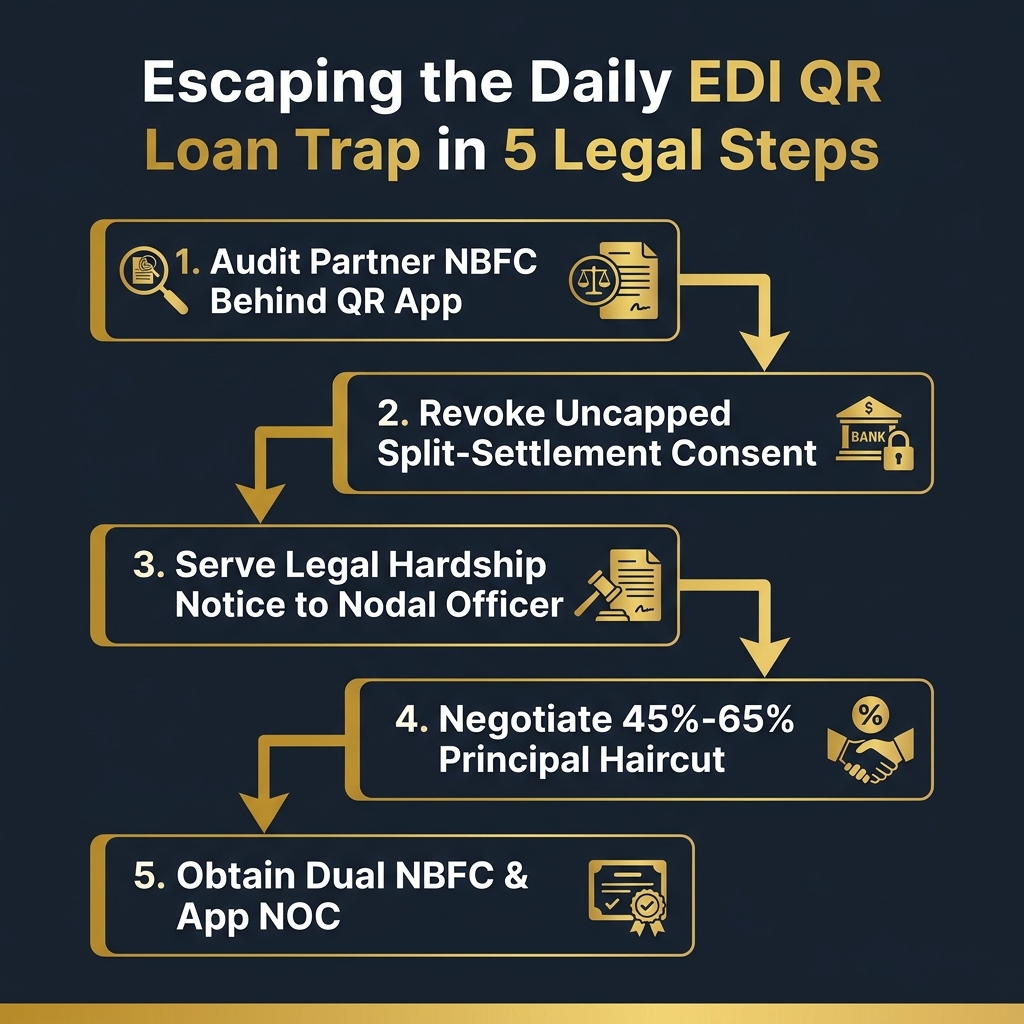
Escaping a daily EDI merchant loan trap requires a precise, legally sound sequence of actions. Attempting to stop payments haphazardly without formal legal representation often triggers aggressive litigation or severe bank account freezes. Here is the proven 5-step protocol deployed by AMA Legal Solutions to execute a successful paytm phonepe bharatpe daily edi merchant loan settlement:
Step 1: Forensic Loan Agreement Audit & NBFC Identification
Our banking legal team accesses your digital loan contract, Key Fact Statement (KFS), Sanction Letter, and loan account ledger from your merchant dashboard. We uncover the exact corporate identity of the underlying partner NBFC (such as SMFG India Credit, Poonawalla Fincorp, or Northern Arc), audit the effective Annual Percentage Rate (APR) charged, and calculate the exact total amount already extracted via daily sweeps versus the true principal disbursed. In countless cases, we discover that the borrower has already repaid 70% to 90% of the original principal through daily micropayments, but algorithmic interest compounding shows an inflated outstanding balance.
Step 2: Working Capital Ring-Fencing & Lawful Payment Delinking
To prevent your retail business from suffocating while negotiations proceed, we advise on lawfully ring-fencing your working capital. This involves opening a fresh, unencumbered current account in a separate Scheduled Commercial Bank and establishing a standalone bank UPI QR code for daily store sales. Simultaneously, we serve written instructions to revoke unconsented split-settlement sweeps and cancel active e-mandates in accordance with RBI consumer directives, ensuring that every rupee earned from retail customers goes directly to purchasing inventory and paying staff.
Step 3: Service of Advocate Representation & Anti-Harassment Notice
We draft and serve a formal Advocate Representation and Cease-and-Desist Notice on the Principal Nodal Officer, Head of Collections, and Managing Director of the lending NBFC, with a copy marked to the front-end LSP (Paytm, PhonePe, or BharatPe). This legal notice achieves three critical objectives:
- It formally notifies the lender that AMA Legal Solutions represents the merchant in all matters concerning the loan account, requiring all future communications to be addressed solely to our legal offices.
- It cites the RBI Fair Practices Code and relevant provisions of the Bharatiya Nyaya Sanhita, putting the NBFC on strict notice that any field agent visiting the shop, shouting before customers, or calling after hours will lead to immediate criminal complaints and regulatory escalation before the RBI Ombudsman.
- It establishes the merchant's bona fide financial hardship (such as documented business losses, balance sheet shrinkage, medical emergencies, or local market disruption), laying the statutory groundwork for a formal One-Time Settlement petition under RBI MSME rehabilitation guidelines.
Step 4: Central Settlement Desk Negotiation & Principal Haircut Structuring
Once the loan moves into the Special Mention Account (SMA-2) or Non-Performing Asset (NPA) category, it transitions from operational field collection to the NBFC's central risk recovery desk. Our senior advocates negotiate directly with authorized credit committee executives. Leveraging our forensic audit findings, documentation of financial hardship, and the lender's statutory provisioning requirements, we negotiate a significant waiver:
- 100% Waiver of All Penal Surcharges: Total elimination of accumulated daily late fees, bounce charges, legal processing fees, and compounding penal interest.
- 45% to 65% Principal Haircut: Restructuring the residual principal balance into a realistic, highly discounted lump-sum figure.
- Flexible Multi-Tranche Payment Terms: For shopkeepers unable to produce a single lump sum immediately, we negotiate structured settlement schedules spread across 2 to 4 monthly installments, allowing the business to fund the settlement purely from operational profits.
Step 5: Verification of Formal Settlement Letter, Payment & Dual NOC Issuance
The single most dangerous error a merchant can make is transferring funds based on a verbal promise or WhatsApp message from a recovery agent. Our legal team enforces strict closing safeguards:
- We review and verify the official One-Time Settlement (OTS) Sanction Letter issued on the formal corporate letterhead of the lending NBFC, verifying the exact settlement amount, payment deadlines, loan account number, and explicit commitment to mark the loan as fully discharged.
- The settlement amount is deposited directly into the NBFC's official designated collection account via RTGS, NEFT, or official merchant portal payment—never to an individual or third-party agency.
- Upon payment verification, we secure an official No Dues Certificate (NDC) / Loan Closure Letter from the NBFC and ensure that the digital payment platform (Paytm, PhonePe, or BharatPe) permanently unlinks the merchant's profile, resets the merchant dashboard balance to zero, and terminates all active auto-debit mandates across all banking networks.
Protecting Your Shop's Current Account, GST Registration & Udyam Profile During Merchant Loan Settlement
For micro, small, and medium enterprise (MSME) owners, a commercial loan settlement involves unique regulatory considerations that do not apply to individual personal loan defaults. Retail business owners are understandably concerned about the collateral impact of a paytm phonepe bharatpe daily edi merchant loan settlement on their commercial identity:
1. Current Account Safeguards & The Right of Set-Off
Under Section 171 of the Indian Contract Act, 1872, banks possess a common law "Right of General Lien and Set-Off," allowing them to seize funds from an account held in their institution to satisfy a delinquent loan within the same institution. If your merchant loan was disbursed by an NBFC partnered with a bank where you maintain your primary business current account, that bank might attempt to freeze or debit incoming sales. To insulate your enterprise, our legal team ensures that your operating commercial accounts are completely unbundled and held with independent banking institutions that maintain zero credit exposure to the lending NBFC.
2. Preserving GST Registration & Input Tax Credit (ITC)
A civil merchant loan settlement has zero negative impact on your Goods and Services Tax (GST) registration or Input Tax Credit (ITC) eligibility. Defaulting on an unsecured fintech loan or negotiating an OTS with an NBFC does not trigger any notification to the GST Network (GSTN), nor does it empower a commercial lender to block your GST portal credentials or cancel your GSTIN. Your statutory tax obligations and commercial invoicing rights remain fully intact throughout the settlement process.
3. Udyam Registration & MSME Statutory Protections
If your enterprise holds a valid Udyam Registration Certificate under the Micro, Small and Medium Enterprises Development (MSMED) Act, 2006, you are cloaked with substantial statutory shields. Under the Reserve Bank of India's Framework for Revival and Rehabilitation of Micro, Small and Medium Enterprises (MSMEs), banks and registered NBFCs are encouraged to explore enterprise restructuring and debt resolution mechanisms prior to initiating aggressive coercive recovery actions against viable small businesses. Presenting your Udyam credential as part of our formal advocate settlement petition substantially elevates the merchant's negotiating standing before the NBFC's credit committee.
4. Credit Bureau (CIBIL Commercial & CIBIL TransUnion) Implications
Transparency regarding credit reporting is a hallmark of AMA Legal Solutions. When a loan is settled via an OTS, the NBFC reports the account status to credit information companies (CIBIL, Experian, Equifax, CRIF High Mark) as "Settled" rather than "Closed." This reflects that the lender accepted a concession to close the loan. While this reporting impacts your commercial and personal credit score in the short term, it accomplishes the following vital outcomes:
- It instantly terminates the continuous, catastrophic accumulation of 30, 60, and 90+ DPD delinquency markers that permanently cripple creditworthiness.
- It eliminates all legal exposure, civil suits, and Section 25 PSSA quasi-criminal proceedings.
- It establishes a clean financial slate, enabling the merchant to rebuild credit over 18 to 24 months through prudent financial management and disciplined trade credit.
Strategic Conclusion: Rescue Your Business from Daily EDI Debt with AMA Legal Solutions
The rise of digital payments transformed retail commerce across India, but the predatory architecture of Equated Daily Installments and algorithmic auto-sweeps has pushed countless diligent shopkeepers, restaurant owners, and traders to the brink of financial ruin. If you are waking up every morning filled with dread because your QR Soundbox is siphoning away every rupee needed to purchase stock, pay rent, and feed your family, remember this fundamental truth: you are not powerless, and you do not have to fight aggressive lending giants alone.
A structured paytm phonepe bharatpe daily edi merchant loan settlement is a recognized, statutory commercial exit designed to revive distressed enterprises, halt unconscionable daily sweeps, eliminate usurious penalties, and extinguish debt with complete legal finality. Through the dedicated advocacy of AMA Legal Solutions, hundreds of micro-enterprises across Delhi NCR, Mumbai, Bengaluru, Hyderabad, Chennai, Kolkata, Pune, Ahmedabad, and every tier-2 and tier-3 commercial hub in India have reclaimed their financial freedom, protected their shopfronts from recovery harassment, and saved their livelihoods.
Do not allow automated algorithms and aggressive recovery agents to destroy the business you spent years building. Contact AMA Legal Solutions today to schedule an immediate legal consultation with Senior Advocate Anuj Anand Malik and our specialized commercial debt resolution team. We will analyze your loan agreements, halt unauthorized sweeps, protect your store counter, and deliver a negotiated settlement that puts your enterprise back on the path to enduring profitability.
Popular Searches & Topics
Commonly searched legal queries and keywords related to this article
Need Strategic Legal Defense for Your Situation?
Our banking & litigation advocates review your notices, debt liability, and recovery issues under complete advocate-client secrecy.
References & Authority
- Reserve Bank of India (RBI) - Master Guidelines on Digital Lending & Lending Service Providers (LSPs)
- Reserve Bank of India (RBI) - Framework for Revival and Rehabilitation of Micro, Small and Medium Enterprises (MSMEs)
- Reserve Bank of India (RBI) - Fair Practices Code for Non-Banking Financial Companies (NBFCs)
- India Code - Payment and Settlement Systems Act, 2007 (Section 25 - Dishonour of Electronic Funds Transfer)
- Ministry of Micro, Small and Medium Enterprises (MSME) - Udyam Registration Portal
- Reserve Bank of India (RBI) - Complaint Management System (CMS) & Integrated Ombudsman Portal
- Ministry of Electronics and Information Technology (MeitY) - Digital Personal Data Protection (DPDP) Act, 2023
- India Code - Bharatiya Nyaya Sanhita (BNS), 2023 (Sections 308 & 351)

AMA Legal Solutions
Trusted with a 4.7 Google Rating, over 10,000+ Clients Served, 25,000+ Cases Handled, and more than 40+ Years of Experience in providing strategic legal defense and debt resolution across India.
Our media coverages





Frequently Asked Questions
Related Articles
RuPay Credit Card on UPI Default & Credit Line on UPI Settlement (2026)
Micro-transactions on RuPay UPI Credit Cards and pre-approved 'Credit Lines on UPI' have triggered a massive wave of 42%+ APR revolving debt traps. Find out if defaulting blocks your personal savings UPI and how to settle RuPay UPI credit dues for 30%–50%.
Read Article
Can Bank or Loan App Remotely Lock Phone for EMI Default? RBI Rules (2026)
An investigative breakdown of RBI's Remote Device Locking Directions—explaining why lenders cannot lock your phone for personal loans, the mandatory 30/60 DPD safeguards on financed devices, the Rs. 250/hour delay penalty, and how to settle device & app loans.
Read Article
How Recovery Agents Get Your Personal Details and How to Prevent It in India (2026)
An investigative legal breakdown of the 7 hidden channels debt collectors use to trace your phone numbers, family contacts, employer, and address - and the exact statutory shields under RBI 2026 Directions and the DPDP Act, 2023 to stop them.
Read ArticleAbout Author
Anuj Anand Malik
View ProfileAnuj Anand Malik, Founder of AMA Legal Solutions, is a trusted advocate, loan settlement expert, legal advisor, and banking lawyer. With over a decade of experience in loan settlement, corporate law, financial disputes, and compliance, he leads a result-driven law firm based in India that helps individuals, startups, and businesses achieve legal and financial stability.
Connect on LinkedInNeed Legal Representation?
Evaluate your defense against recovery agents, notices, or structure your loan settlement directly with Senior Advocates.
Call +91-8700343611