Loan for Debt Settlement: Navigating Financial Relief
Expert guidance on securing loans for effective debt settlement

Anuj Anand Malik
Reviewed by AMA Legal Solutions

Key Takeaways: Debt settlement loans can offer financial relief by consolidating debts into a single payment, often with better terms. It's critical to understand the legal obligations and potential impact on credit score. Consult a legal expert to ensure compliance with RBI guidelines and explore alternative strategies if needed. Always choose an RBI-registered lender to avoid fraud and protect your consumer rights.
Understanding Loans for Debt Settlement: A Legal Overview
Loans for debt settlement can be a vital tool for Indian borrowers seeking financial relief. These loans allow individuals to consolidate multiple debts into a single payment, often with more favorable terms. The legal framework governing such loans is influenced by both Banking and Finance Law and RBI guidelines. Comprehending these laws is essential to ensure that borrowers make informed decisions.
Key Legal Considerations
When considering a loan for debt settlement, borrowers must be aware of the legal obligations they are entering into. It's important to review the loan agreement meticulously to understand interest rates, repayment schedules, and any additional charges. The agreement should comply with the standards set by the Reserve Bank of India (RBI) to protect consumer rights.
- Review the loan agreement for hidden fees and clauses.
- Ensure the lender is RBI-registered to avoid fraudulent activities.
- Understand the implications of defaulting on the new loan.
Borrowers should also consult with legal experts for personalized advice, ensuring that the settlement plan aligns with their financial capabilities. Legal assistance can provide guidance on negotiating better terms or exploring alternative options such as Debt Consolidation & Restructuring. Ultimately, understanding these legal nuances can empower borrowers to manage their debts effectively while safeguarding their financial future.
Key Considerations Before Opting for a Debt Settlement Loan
When contemplating a debt settlement loan, it’s crucial to assess several key factors to make an informed decision. Understanding these considerations can help prevent further financial strain and ensure that the chosen path aligns with long-term goals.
Evaluate Your Financial Situation
Begin by conducting a thorough analysis of your financial health. Assess your income, expenses, and outstanding debts. This evaluation will help determine if a debt settlement loan is the most suitable option for your circumstances. Consider alternative strategies like Debt Consolidation & Restructuring if it aligns better with your financial objectives.
Understand the Terms and Conditions
Before proceeding, scrutinize the loan terms, including interest rates, repayment tenure, and any fees involved. A transparent understanding of these terms will prevent unexpected financial burdens down the line. It’s advisable to have a legal expert review the agreement to ensure you’re fully aware of the implications.
Impact on Credit Score
Be mindful that opting for a debt settlement loan can affect your credit score. While it may offer immediate relief, the long-term impact on your creditworthiness should not be overlooked. Learning how to recover your credit standing post-settlement is crucial. Explore strategies outlined in How to Repair Your Credit Score.
Seek Professional Advice
Engaging with a legal advisor specializing in Loan Settlement Services can provide valuable insights and guide you through the process. Professional guidance ensures that you’re making a decision that is legally sound and financially wise.
By considering these factors, you can navigate debt settlement loans more effectively, ensuring financial stability in the long run.
Comparing Legal Remedies: Loans vs. Debt Settlement Plans
When facing financial distress, borrowers often weigh between taking a loan for debt settlement or opting for structured debt settlement plans. Each has its unique advantages and legal implications, which should be carefully considered. Loans can provide immediate relief, but increase liabilities. Debt settlement plans may involve negotiations, reducing the total owed but can impact credit scores.
Key Differences and Considerations
Borrowers should evaluate several factors, including cost, legal standings, and long-term impacts on their financial health. While loans offer a direct infusion of capital, debt settlement plans focus on reducing the existing burden through negotiations. Both strategies have their merits, but choosing the right one depends on individual circumstances and future financial goals. For professional guidance, consider consulting with banking and finance law experts.
| Parameter / Criterion | Key Details / Legal Provision | Timeline / Practical Impact |
|---|---|---|
| Immediate Relief | Loans provide immediate funds but increase liabilities. | Short-term solution, long-term debt management required. |
| Cost Implications | Loans involve interest rates; settlements reduce principal owed. | Loans can be costly over time; settlements can reduce total payable. |
| Impact on Credit Score | Loans can maintain credit if repaid timely; settlement impacts negatively. | Varies based on repayment behavior and negotiation success. |
| Legal Procedures | Loans require formal agreements and compliance; settlements involve negotiation. | Loan processes are straightforward; settlements require strategic negotiation. |
| Professional Assistance | Legal and financial advisors recommended for both options. | Advisors help navigate legal and financial complexities. |
Choosing between a loan and a debt settlement plan requires an understanding of both legal and financial repercussions. Borrowers should also consider consulting with specialists in loan settlement services to understand implications better and tailor strategies to their specific needs.
Step-by-Step Guide to Securing a Loan for Debt Settlement
Securing a loan for debt settlement can be a strategic move to regain financial stability. Here's a detailed guide to help you through the process:
1. Assess Your Financial Situation
Start by evaluating your current financial position. Identify your total debt, monthly expenses, and income. This will give you a clear picture of the loan amount you require for settlement.
2. Choose the Right Loan Type
Consider options such as personal loans or debt consolidation loans. Each has different terms and interest rates. Research thoroughly to find a loan that matches your needs.
3. Check Your Credit Score
Your credit score significantly impacts your loan eligibility and interest rates. Obtain your credit report and ensure there are no errors. To learn more about improving your score, visit our guide on How to Repair Your Credit Score.
4. Compare Lenders
Research and compare different lenders. Look at their interest rates, fees, and repayment terms. This ensures you choose the most favorable option that fits your settlement plan.
5. Gather Necessary Documents
Prepare all required documents, such as bank statements, income proof, and identification. These are crucial for the application process.
6. Apply for the Loan
Once you have selected a lender, submit your loan application. Be accurate and truthful in your disclosure to avoid processing delays.
7. Negotiate and Use Funds Wisely
Negotiate with your creditors for a favorable settlement using the loan amount. For strategic insights, explore our resources on Loan Settlement Services.
Rights and Obligations: Borrowers vs. Lenders
In the realm of debt settlement, understanding the rights and obligations of both borrowers and lenders is crucial. Borrowers have the right to be treated fairly, in accordance with the Reserve Bank of India's (RBI) guidelines, which prohibit harassment and abusive practices by recovery agents. Simultaneously, borrowers are obliged to meet repayment terms as outlined in their loan agreements unless renegotiated through settlement.
Lenders, on the other hand, possess the right to initiate recovery processes if borrowers default, yet they must adhere to legal protocols and timelines. Understanding these dynamics can aid borrowers in navigating their financial obligations and advocating for themselves effectively in debt settlement scenarios.
| Parameter / Criterion | Key Details / Legal Provision | Timeline / Practical Impact |
|---|---|---|
| Borrower's Right | Protection from harassment under RBI guidelines | Immediately applicable upon default |
| Borrower's Obligation | Repayment per loan agreement, unless settled | Continuous until the debt is settled |
| Lender's Right | Initiate legal recovery proceedings | After specified default period |
| Lender's Obligation | Adherence to legal processes and timelines | Mandatory during recovery |
For borrowers, knowing your rights can be a powerful tool when negotiating with lenders. If you're facing challenges, consider exploring loan settlement services to help manage your situation effectively.
Evaluating Eligibility: Criteria for Debt Settlement Loans
When considering a loan for debt settlement, understanding the eligibility criteria is essential. Financial institutions typically assess your financial standing, credit history, and the nature of your debts. Here's what you need to know:
Financial Assessment
- Your current income and employment stability are crucial. Lenders prefer borrowers with a steady source of income to ensure loan repayment capability.
- Total outstanding debt is evaluated to determine if the loan will significantly aid in debt reduction.
Credit History and Score
- A satisfactory credit score increases the likelihood of approval, though some financial institutions may accommodate those with lower scores under specific conditions.
- Past payment behavior is reviewed to assess risk. Consistent late payments may complicate approval.
Debt Nature and Type
- Lenders evaluate the type of existing debts. For instance, unsecured debts like credit cards are often prioritized for settlement loans.
- Collateral-backed loans might require alternate strategies; thus, understanding corporate law and compliance can be advantageous.
Meeting these criteria can facilitate a smoother application process. It's advisable to consult with a financial advisor or legal expert to explore debt consolidation and restructuring options tailored to your situation.
Key Insights & Data Infographic
Visual summary, statistical trends & procedural breakdown
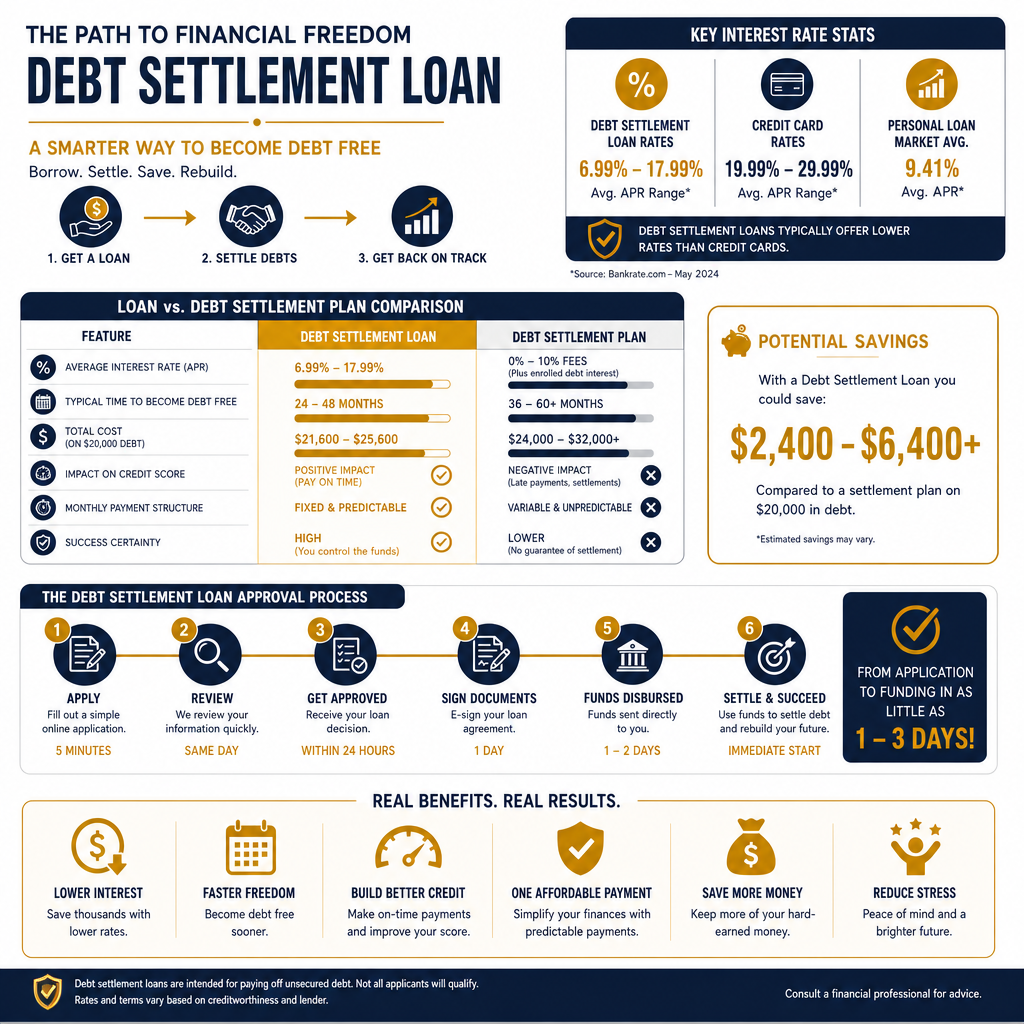
Prepared by AMA Legal Solutions Research & Analytics Team • Data & Compliance Overview
Risks and Benefits of Debt Settlement Loans
Debt settlement loans can provide a vital lifeline for individuals grappling with mounting debt. However, before proceeding, it's essential to weigh both the benefits and risks involved.
Benefits
- Consolidation: A debt settlement loan can consolidate multiple debts into a single loan, simplifying repayment.
- Reduced Stress: By negotiating your debt, you might reduce the total amount owed, relieving financial pressure.
- Credit Score Improvement: Successfully settling debts can ultimately lead to improved credit scores over time, especially when combined with strategies outlined in our guide on repairing credit scores.
Risks
- Credit Score Impact: Initially, settling debts may negatively impact your credit score, as settled debts can be marked negatively on credit reports.
- Potential Fees: Debt settlement loans often come with high fees, including service charges and interest rates, which can add to your financial burden.
- Incomplete Settlements: Not all creditors may agree to settlement terms, leaving you with unresolved debts. Understanding loan settlement services can provide further insights into managing such situations.
To effectively navigate these complexities, borrowers should seek professional guidance and consider consulting with experts who specialize in banking and finance law.
Timeline: From Application to Disbursement
Understanding the timeline involved in securing a loan for debt settlement is crucial for borrowers seeking financial relief. The process typically involves several stages, each varying in duration based on individual circumstances and lender policies.
Initial Consultation and Documentation
The journey begins with an initial consultation where borrowers discuss their financial situation with the lender. It is essential to gather and submit necessary documentation, including proof of income, bank statements, and outstanding debt details. This stage can take anywhere from a few days to a week, depending on the completeness of the documents.
Application Review and Approval
Once all documents are submitted, the lender reviews the application. This involves assessing the borrower's financial health and creditworthiness. Typically, this review process lasts around one to two weeks. For faster approval times, ensure all documents are accurate and complete.
Offer and Negotiation
After approval, the lender provides a loan offer detailing terms and conditions. Borrowers should carefully review and negotiate terms if necessary to ensure favorable conditions. This phase can be quick, taking just a few days, or extend up to a couple of weeks if negotiations are extensive.
Final Approval and Disbursement
Upon agreement on terms, the lender issues a final approval. The loan is then disbursed, often within a few days. It’s important to communicate effectively with your lender to avoid delays. Remember, services like Banking and Finance Law can provide additional support throughout this process.
Impact of Loans on Credit Scores and Financial Health
Taking a loan for debt settlement can influence your credit score and financial health in various ways. Initially, applying for a loan involves a credit inquiry, which might slightly reduce your credit score. However, if managed responsibly, a debt settlement loan can stabilize your finances by consolidating multiple debts into one manageable payment.
Credit Score Considerations
Timely repayment of a debt settlement loan can positively affect your credit score over time. Consistent payments demonstrate financial discipline and may gradually improve your creditworthiness. Conversely, missed payments can lead to a sharp decline in your score, complicating future credit opportunities.
- Immediate impact: Slight reduction due to credit inquiry.
- Long-term impact: Potential improvement with disciplined repayment.
- Risks: Missed payments can significantly damage credit scores.
Managing Financial Health
Beyond credit scores, loan settlement services can help by easing the financial burden through reduced interest rates and consolidated payments. This process can improve liquidity, allowing better management of essential expenses. However, borrowers should be wary of over-reliance on loans, which can lead to a cycle of debt.
Consider exploring other options like debt consolidation and restructuring to better understand the full spectrum of solutions available. Assessing your financial situation comprehensively before opting for any loan is crucial to ensuring sustainable financial health.
Common Mistakes in the Debt Settlement Loan Process
When considering a loan for debt settlement, borrowers often make several critical errors that can derail the process. Understanding these pitfalls can save time, money, and stress.
Failing to Research Lenders
Many individuals neglect to thoroughly research lenders. It's crucial to compare terms, interest rates, and fees of potential lenders. Choosing a lender without adequate research can result in unfavorable terms, leading to higher costs in the long run.
Overlooking Settlement Amounts
Borrowers often accept the first settlement offer without negotiating. This can lead to paying more than necessary. Instead, borrowers should negotiate terms, as lenders may be willing to settle for less to recover part of the debt.
Not Understanding the Impact on Credit Scores
Settling a loan can negatively impact credit scores, yet many borrowers are unaware. It's vital to understand this impact and explore alternatives with less credit damage, or work on repairing your credit score post-settlement.
Ignoring Legal Advice
Some borrowers proceed without legal guidance, which can be detrimental. Consulting a legal expert ensures that rights are protected and the settlement process is handled correctly. Engaging with banking and finance law professionals can provide clarity and support.
- Neglecting to read the fine print of the settlement agreement.
- Failing to maintain communication with lenders or legal advisors.
- Rushing into settlements due to stress without considering long-term implications.
Navigating RBI Guidelines and Consumer Rights
When considering a loan for debt settlement, understanding the Reserve Bank of India's (RBI) guidelines and your consumer rights is crucial. The RBI has established several directives to protect borrowers from unfair practices and to ensure transparent dealings by financial institutions.
Firstly, banks must adhere to the Fair Practices Code, which mandates clear communication and prohibits misleading information. This ensures borrowers receive accurate details about loan terms and repayment obligations. Furthermore, banks are required to give a notice period before classifying any account as a Non-Performing Asset (NPA), giving borrowers a chance to settle their dues.
Consumer Rights Under RBI Guidelines
- Right to Fair Treatment: Borrowers should not face harassment by recovery agents. If you experience undue pressure, knowing your legal rights against recovery agent harassment is essential.
- Right to Grievance Redressal: Financial institutions must have a grievance redressal mechanism. Borrowers can escalate unresolved issues to the Banking Ombudsman.
- Right to Privacy: Your financial and personal information should be handled with confidentiality. Any breach of this right can be challenged legally.
Adhering to these guidelines not only ensures compliance but also empowers borrowers in their banking and finance dealings, providing a foundation for fair negotiation in debt settlement scenarios.
Practical Case Studies: Real-World Debt Settlement Scenarios
Understanding real-world debt settlement scenarios can provide invaluable insights for borrowers. Here, we explore some practical cases that highlight the complexities and strategies involved in achieving successful debt settlements.
Case Study 1: MSME Struggling with Overdraft
A medium-sized enterprise in Delhi faced severe cash flow issues, leading to default on its overdraft facility. The firm engaged with Debt Consolidation & Restructuring services to negotiate a settlement. By presenting a detailed business recovery plan, they managed to secure a 40% reduction in outstanding debt, payable over 18 months.
Case Study 2: Personal Loan Default
A salaried individual in Mumbai received a legal notice for loan default due to job loss. With professional advice, they approached the bank, highlighting their efforts to gain employment. The bank agreed to a settlement with a 35% waiver on penalties, contingent on a lump-sum payment within six months.
Case Study 3: Credit Card Debt Settlement
An IT professional in Bangalore accumulated significant credit card debt. The individual utilized Credit Card Debt Settlement strategies, presenting evidence of financial distress due to medical expenses. The credit card issuer agreed to a 50% debt reduction, with flexible payment terms over 24 months.
These cases underscore the importance of proactive engagement and strategic negotiation when addressing debt settlements. Borrowers should seek expert guidance to navigate these often-complex processes effectively.
Popular Searches
AMA Legal Solutions
Trusted with a 4.7 Google Rating, over 10,000+ Clients Served, 25,000+ Cases Handled, and more than 40+ Years of Experience in providing strategic legal defense and debt resolution across India.
Our media coverages





Frequently Asked Questions
Related Articles

Understanding Debt Clearance Companies in India
Navigate debt settlement with top legal tips and insights
Read Article
Best Way to Settle Credit Card Debt in India
Practical Legal Strategies for Indian Borrowers
Read Article
Best Debt Solution: Legal Paths to Financial Freedom
Explore effective legal strategies for resolving debt issues in India.
Read ArticleAbout Author
Anuj Anand Malik
View ProfileAnuj Anand Malik, Founder of AMA Legal Solutions, is a trusted advocate, loan settlement expert, legal advisor, and banking lawyer. With over a decade of experience in loan settlement, corporate law, financial disputes, and compliance, he leads a result-driven law firm based in India that helps individuals, startups, and businesses achieve legal and financial stability.
Connect on LinkedInNeed Legal Help?
Get expert advice on loan settlement and debt relief.
Call +91-8700343611Request Callback