Understanding the Usurious Loans Act: Relief for Borrowers
Navigate the Usurious Loans Act to protect your financial interests

Anuj Anand Malik
Reviewed by AMA Legal Solutions
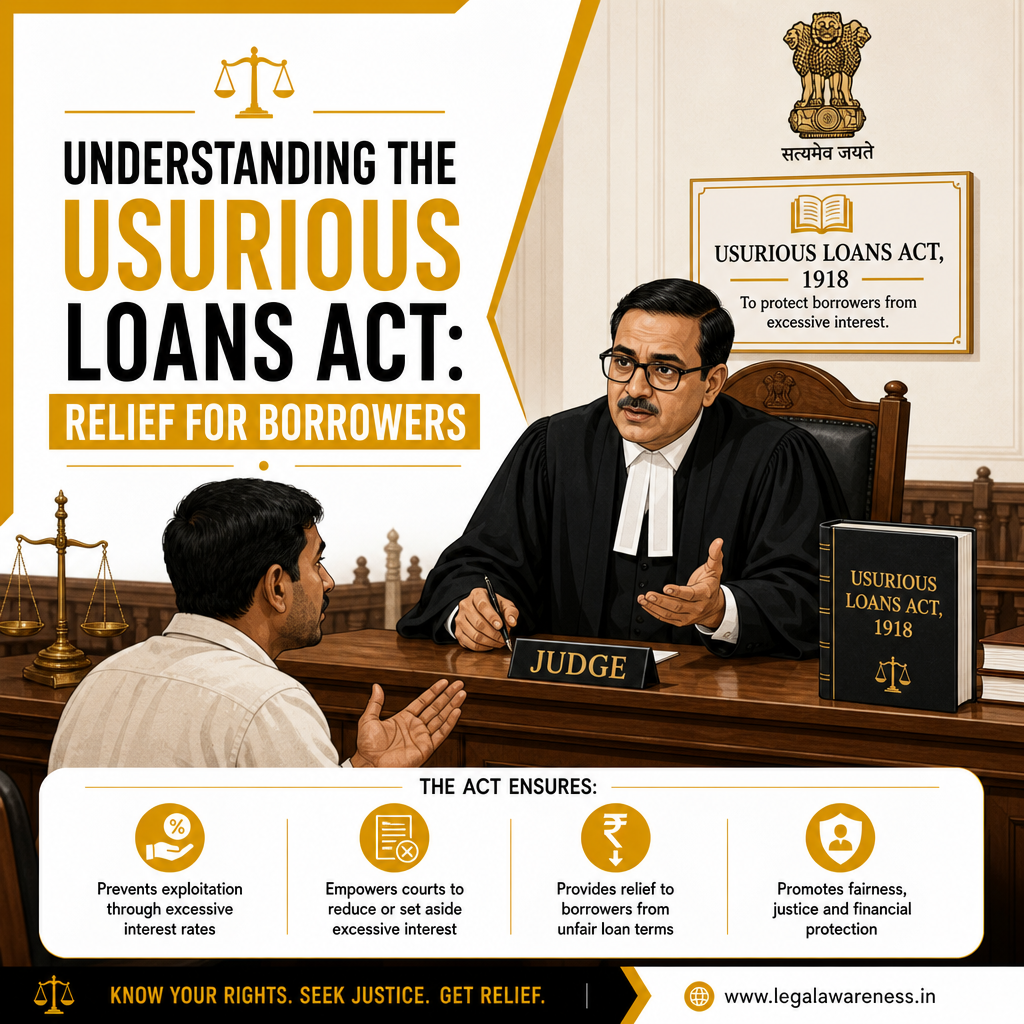
Key Takeaways: The Usurious Loans Act protects Indian borrowers from excessive interest rates by setting legal limits and enabling court intervention. It is crucial for borrowers to understand this Act to challenge unfair loan terms, seeking legal assistance when necessary to alleviate financial burdens and ensure fair treatment.
Introduction: How the Usurious Loans Act Impacts Borrowers
The Usurious Loans Act primarily serves as a protective shield for borrowers against exorbitant interest rates that can lead to severe financial distress. This legislation ensures that lenders do not exploit borrowers by charging excessively high interest rates, thereby promoting fair lending practices. Borrowers often find themselves entrapped by high interest rates, especially in urgent financial situations, which can further exacerbate their monetary challenges.
For Indian borrowers, particularly those within the salaried and MSME sectors, the Act provides a crucial legal framework to contest unfair loan terms. By setting legal limits on interest rates, it offers borrowers a defense mechanism against predatory lending, thus safeguarding consumer rights. Borrowers facing challenges with loan repayment due to steep interest rates can seek recourse under this Act, potentially alleviating their financial burdens.
Moreover, the Usurious Loans Act complements other legal avenues such as Loan Settlement Services by allowing borrowers to negotiate terms and protect themselves from unconscionable financial obligations. Understanding the provisions of this Act is essential for borrowers seeking relief from oppressive loan terms and exploring options for Debt Consolidation & Restructuring to manage their debts more effectively.
Understanding Usurious Loans: What Borrowers Need to Know
The Usurious Loans Act is an essential piece of legislation aimed at protecting borrowers from excessively high interest rates on loans, often termed usurious loans. For borrowers in India, understanding this Act can be a game-changer, particularly if they feel overwhelmed by high-interest obligations.
Why the Act Matters: It imposes limits on interest rates, ensuring they are fair and not exploitative. If you are facing financial stress due to a high-interest loan, this Act may provide a legal basis to challenge unfair terms.
When Does It Apply?
The Act is applicable when the interest rates charged by a lender significantly exceed market norms. Borrowers suspecting usurious rates should assess their loan agreements carefully. Consulting with professionals in Banking and Finance Law can provide further clarity and action steps.
How to Navigate the Act:
- Review Loan Terms: Scrutinize the terms for any disproportionate interest rates.
- Seek Legal Support: Engage a lawyer experienced in Loan Settlement for legal recourse.
- Document Everything: Maintain records of all communications and agreements with your lender.
Awareness of the Usurious Loans Act empowers borrowers. By understanding and leveraging such legislative tools, borrowers can better negotiate terms and potentially reduce their financial burdens.
Legal Definition and Implications of Usurious Loans in India
The Usurious Loans Act, 1918, serves as a legal safeguard for borrowers against exorbitantly high interest rates imposed by lenders. Usurious loans refer to those where the interest charged exceeds a legally permissible rate, making the debt onerous for the borrower. The Act empowers courts to intervene, reducing excessive interest and providing relief to the borrower.
The Act's significance lies in its provision for borrowers to challenge unfair loan terms. Courts assess the fairness of interest based on factors like prevailing market rates, the borrower's financial situation, and the lender's conduct. Should a loan be deemed usurious, the court may adjust the interest rate to a reasonable level, ensuring repayment remains feasible.
Implications for Borrowers
- Right to Redress: Borrowers can seek legal recourse, challenging excessive interest as per the Act.
- Protection Mechanism: The Act acts as a deterrent against predatory lending practices.
- Legal Guidance: Consulting with experts in Loan Settlement Services can provide effective strategies for dealing with usurious loans.
- Impact on Credit: Legal intervention may lead to restructuring of the debt, impacting credit scores positively if managed effectively.
Borrowers facing usurious loans should understand their rights under the Act and seek assistance from professionals specializing in Banking and Finance Law. By doing so, they can ensure fair treatment and protect themselves from predatory financial practices.
Rights and Protections for Borrowers Under the Usurious Loans Act
The Usurious Loans Act provides significant protections to borrowers, ensuring that interest rates are not exorbitantly high, thus preventing exploitation. It is crucial for borrowers to understand their rights to safeguard themselves against unfair lending practices. Under this Act, lenders are restricted from charging interest rates beyond a certain threshold, thereby providing a financial cushion to borrowers.
What Borrowers Need to Know
- Lenders cannot arbitrarily increase interest rates beyond the legal limit established by the Usurious Loans Act.
- Borrowers have the right to contest usurious interest rates in court, potentially leading to rate reductions.
- The Act mandates transparency in lending agreements, requiring clear disclosures of interest rates and terms.
Borrowers facing exorbitant interest demands can seek legal recourse through Loan Settlement Services or consult experts in Banking and Finance Law. Knowing these rights empowers borrowers to make informed decisions and challenge unjust financial burdens effectively. By leveraging these protections, borrowers can ensure fair treatment and negotiate better terms with their lenders, potentially mitigating financial distress caused by high-interest loans.
How to Identify If Your Loan is Usurious
Determining whether your loan is usurious involves understanding the terms of your loan agreement and comparing them to legal standards. Usurious loans charge excessively high-interest rates that exceed the limits set by the law, thereby exploiting borrowers financially.
Steps to Identify Usurious Loans
- Interest Rate Check: Compare the interest rate stated in your loan agreement with the maximum permissible rate under the relevant state laws. Any rate exceeding this threshold is considered usurious.
- Loan Agreement Review: Thoroughly examine your loan agreement for any hidden charges or fees that could effectively increase the interest rate, making it usurious.
- Consult Legal Resources: Seek advice from professionals knowledgeable in banking and finance law, as they can provide insights into whether your loan terms are legally acceptable.
- Use of Loan Calculators: Utilize loan calculators to dissect the total cost of borrowing, helping you identify if the effective interest rate seems disproportionately high.
By following these steps, borrowers can protect themselves from exploitative lending practices. If you suspect your loan is usurious, it is crucial to take action promptly. Seeking professional advice can be beneficial in resolving such issues and safeguarding your financial interests.
Steps to Take if You Suspect Your Loan is Usurious
If you suspect your loan is usurious, it's essential to take immediate action to protect your financial interests. First, review the loan agreement thoroughly to understand the terms, including interest rates and additional fees. Usurious loans often feature excessively high interest rates that surpass the legal limit, which can vary by region.
Consult a Legal Expert
Engage a lawyer specializing in loan settlement and banking law to assess whether your loan terms violate the Usurious Loans Act. A legal expert can offer guidance on the legality of the interest rates applied and help determine the most effective course of action.
Gather Documentation
- Collect all relevant documents such as the loan agreement, repayment schedule, and proof of payments made.
- Keep records of all communications with the lender.
Negotiate with the Lender
Before proceeding with legal action, attempt to negotiate with your lender. Clearly express your concerns regarding the usurious nature of the loan and request a revision of the terms. Highlighting your awareness of your legal rights can sometimes result in favorable adjustments or settlements.
File a Legal Complaint
If negotiations fail, your lawyer may recommend filing a complaint with the appropriate legal authorities. This step may involve civil litigation, and your lawyer can provide comprehensive support throughout the process.
By following these steps, you can effectively address a usurious loan situation while safeguarding your financial interests.
Key Insights & Data Infographic
Visual summary, statistical trends & procedural breakdown
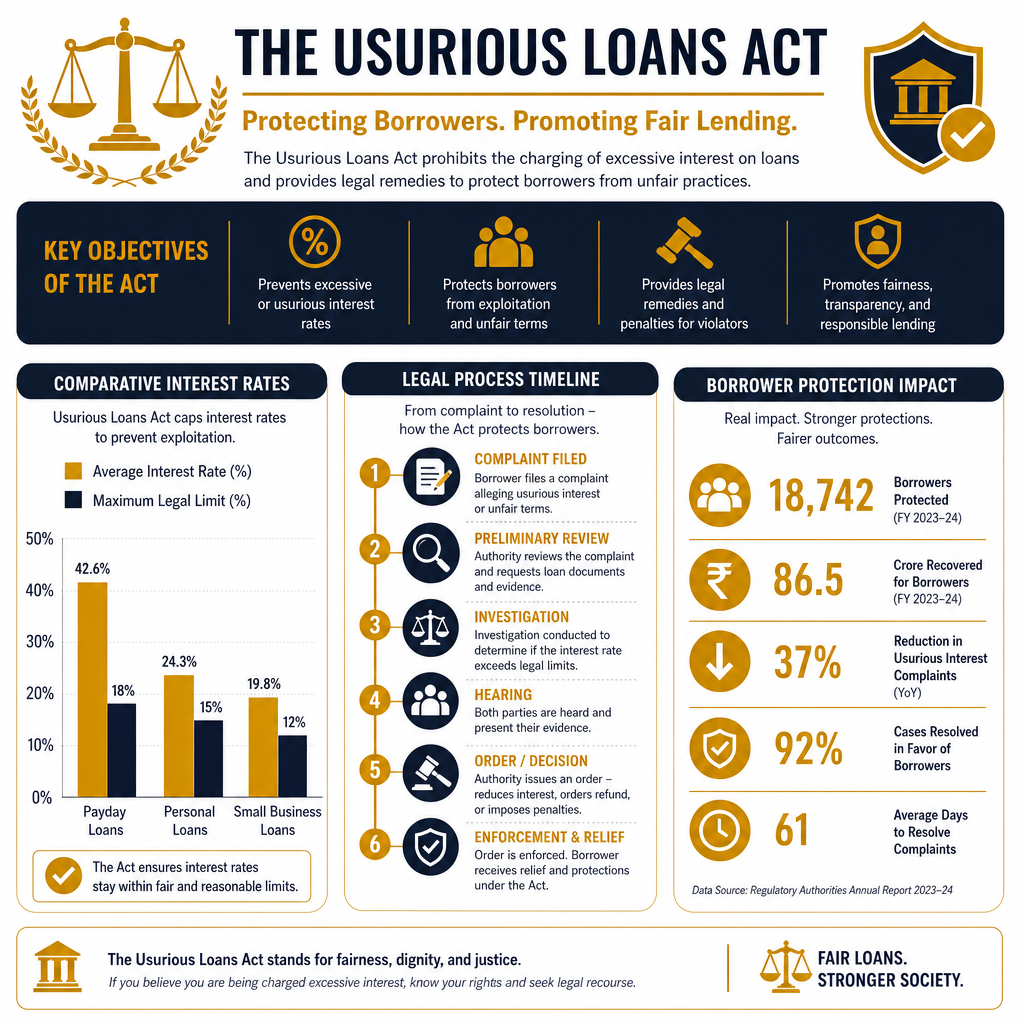
Prepared by AMA Legal Solutions Research & Analytics Team • Data & Compliance Overview

Halt Recovery Agent Harassment Legally
Legal Remedies Available to Borrowers Under the Act
The Usurious Loans Act provides critical relief to borrowers by addressing excessive interest rates. Borrowers can seek legal redress if they believe the interest imposed is exorbitant. The Act empowers courts to reassess and adjust such interest rates. Borrowers should be aware that legal proceedings under this Act require evidence of unreasonable charges.
In cases where borrowers face loan settlement challenges due to high interest rates, the Act provides a framework for initiating disputes. Furthermore, it encourages fair practices by lenders, safeguarding consumer rights. Legal intervention becomes necessary when lenders exploit their position, imposing unfair terms.
Steps to Take if You Believe You Are Affected
- Gather all loan-related documents and evidence of interest rates.
- Consult with a legal expert to assess the validity of your claim.
- File a petition in the appropriate court, citing the Usurious Loans Act.
- Prepare to present your case with comprehensive documentation.
Borrowers should understand the practical impact of this Act. When lenders fail to adhere to fair interest practices, the Act enables legal recourse, promoting equitable lending practices. For guidance on filing a petition, seek assistance from banking and finance law professionals.
| Parameter / Criterion | Key Details / Legal Provision | Timeline / Practical Impact |
|---|---|---|
| Excessive Interest Complaint | File a petition citing Usurious Loans Act | Typically resolved within 6-12 months |
| Adjustment of Interest Rates | Court may modify the interest rate | Immediate upon court order |
| Legal Documentation | Collect all loan and communication records | Preparation phase, 1-3 months |
| Consultation with Experts | Engage with financial and legal advisors | Continuous, as needed |
Comparison of Usurious Loan Penalties Across States
The application of the Usurious Loans Act varies across Indian states, resulting in differences in penalties and enforcement. Understanding these variations can be crucial for borrowers seeking relief. While some states impose strict penalties to deter lenders from charging exorbitant interest rates, others provide more lenient frameworks. Here, we examine the comparative landscape of these penalties and what borrowers should be aware of.
| State | Key Details / Legal Provision | Timeline / Practical Impact |
|---|---|---|
| Maharashtra | Strict enforcement with penalties including financial restitution to borrowers. | Immediate relief available upon filing a complaint; generally resolved in 3-6 months. |
| Tamil Nadu | Moderate penalties focusing on interest rate caps and lender sanctions. | Resolution typically takes 4-8 months, depending on case complexity. |
| Karnataka | Emphasizes borrower education and voluntary settlement before legal action. | Cases often settled within 6 months through arbitration. |
| West Bengal | Enforcement includes severe penalties, with a focus on lender compliance checks. | Enforcement action can span 6-12 months due to thorough investigation processes. |
| Uttar Pradesh | Less stringent penalties; focuses on rectification of irregularities. | Resolution timelines can vary widely, from 8 months to over a year. |
Borrowers should be aware of these differences when dealing with usurious loans. Seeking local legal advice is advisable to navigate state-specific requirements effectively. Utilizing loan settlement services can facilitate smoother resolution processes.
Key Court Judgments on Usurious Loans Explained
Understanding the impact of the Usurious Loans Act on borrowers involves examining key court judgments that have shaped its application. These judgments provide clarity on the Act's reach and limitations in protecting borrowers from excessive interest rates. Over the years, Indian courts have delivered several landmark decisions that underscore the Act's relevance.
Notable Judgments
One significant judgment is from the Supreme Court, which reinforced the principle that lenders must adhere to reasonable interest rates, emphasizing consumer protection. This judgment has been pivotal in cases where borrowers faced exorbitant interest demands.
- The Madras High Court ruled that any interest exceeding the statutory cap is unenforceable, ensuring relief for debt-laden individuals.
- In another case, the Bombay High Court highlighted that the Act covers all forms of loans, including informal loans, thereby extending its protective umbrella to a broader audience.
These court interpretations of the Usurious Loans Act have been instrumental in shaping equitable lending practices. Borrowers facing similar issues may benefit from exploring our Loan Settlement Services for strategic relief. For more information on how this impacts current banking practices, visit our Banking and Finance Law section.
Role of RBI Guidelines in Preventing Usurious Lending Practices
The Reserve Bank of India (RBI) plays a pivotal role in curbing usurious lending practices, ensuring consumer protection and financial stability. These guidelines set clear parameters for interest rates, transparency, and the ethical conduct of banks and non-banking financial companies (NBFCs).
Interest Rate Regulations
RBI guidelines specify the maximum interest rates that can be charged by financial institutions. This prevents lenders from exploiting borrowers with exorbitant rates, thus safeguarding consumers from falling into debt traps. By capping interest rates, the RBI ensures that loans remain affordable and within reach of the average borrower.
Transparent Lending Practices
Transparency is crucial in lending. RBI mandates that all lenders provide a detailed breakdown of loan terms, including interest rates, processing fees, and penalty charges. This ensures borrowers understand the full cost of borrowing, enabling informed decision-making.
- Lenders must disclose all terms and conditions clearly in the loan agreement.
- Borrowers should be informed about their legal rights and obligations.
- Loan Settlement Services can help resolve disputes arising from unclear terms.
Consumer Grievance Redressal
The RBI requires all financial institutions to establish robust grievance redressal mechanisms. Borrowers facing issues such as harassment or unfair treatment can approach the designated officials. If unsatisfied, they can escalate the matter to the Banking Ombudsman, ensuring accountability and resolution.
For detailed insights on banking regulations, refer to our Banking and Finance Law section.
Practical Tips for Negotiating Loan Terms with Lenders
Negotiating loan terms can be a daunting task, but being well-prepared and informed can make a significant difference. Here’s how borrowers can effectively negotiate with lenders:
Understand Your Financial Position
Before entering negotiations, have a clear understanding of your financial situation. This includes your monthly income, expenses, and any outstanding debts. A well-prepared borrower is more likely to secure favorable terms. Utilize resources like Banking and Finance Law for comprehensive guidance.
Communicate Clearly and Confidently
Approach the negotiation with confidence and clarity. Clearly articulate your situation and what loan terms you are seeking. It is crucial to remain polite yet firm, ensuring that your needs are understood.
Leverage Legal Knowledge
Familiarize yourself with the regulations of the Loan Settlement Services and the Usurious Loans Act to identify any unfair terms. This knowledge can strengthen your negotiating position.
- Present Alternatives: Offer alternative terms that you find more manageable, such as extended repayment periods or reduced interest rates.
- Highlight the Benefits: Explain how modified terms will ensure timely payments, benefiting both parties.
- Document Everything: Keep a record of all communications and agreements to prevent future disputes.
Successfully negotiating loan terms can alleviate financial strain and prevent further debt accumulation. Always consult with a legal expert when in doubt, as they can provide tailored advice suited to your unique circumstances.
Checklist for Borrowers to Avoid Usurious Loan Agreements
Borrowers must exercise caution when entering into loan agreements to avoid falling into usurious traps. The Usurious Loans Act provides relief, but proactive steps can prevent exploitation. Here’s a checklist:
Understand Loan Terms
- Read the fine print carefully and ensure you understand all terms and conditions.
- Check the interest rate against RBI guidelines to ensure it is not excessive.
Evaluate Lender Credibility
- Research the lender's reputation and verify their registration with relevant authorities.
- Consult with a legal expert if unsure about the lender’s credibility.
Compare Offers
- Compare loan offers from multiple lenders to find the most favorable terms.
- Be wary of offers that seem too good to be true, as they may involve hidden costs.
Seek Legal Advice
- Engage a legal professional to review the loan agreement before signing.
- Consider consulting the Loan Settlement Services at AMA Legal Solutions for guidance.
By diligently following these steps, borrowers can protect themselves from unfair lending practices and secure a fair loan agreement.
Popular Searches & Topics
Commonly searched legal queries and keywords related to this article
Need Strategic Legal Defense for Your Situation?
Our banking & litigation advocates review your notices, debt liability, and recovery issues under complete advocate-client secrecy.

AMA Legal Solutions
Trusted with a 4.7 Google Rating, over 10,000+ Clients Served, 25,000+ Cases Handled, and more than 40+ Years of Experience in providing strategic legal defense and debt resolution across India.
Our media coverages





Client Reviews
"AMA Legal Solutions were instrumental in helping me understand my rights as a borrower. Their professional approach ensured a satisfactory resolution."
Anjali Verma
"AMA Legal Solutions helped me challenge unfair loan terms under the Usurious Loans Act. Their expertise saved me from exorbitant interest rates. Highly recommended!"
Ravi Sharma
"The team at AMA Legal Solutions is highly knowledgeable in banking law. They provided clear guidance and effective solutions for my loan issues."
Deepak Singh
"Thanks to AMA Legal Solutions, I was able to successfully negotiate better loan terms. Their deep knowledge of banking laws was invaluable."
Priya Mehta
"Exceptional service! AMA Legal Solutions provided great insights into the Usurious Loans Act and guided me through a difficult financial situation."
Arjun Kapoor
Frequently Asked Questions
Related Articles

RuPay Credit Card on UPI Default & Credit Line on UPI Settlement (2026)
Micro-transactions on RuPay UPI Credit Cards and pre-approved 'Credit Lines on UPI' have triggered a massive wave of 42%+ APR revolving debt traps. Find out if defaulting blocks your personal savings UPI and how to settle RuPay UPI credit dues for 30%–50%.
Read Article
Paytm, PhonePe & BharatPe Daily EDI Merchant Loan Settlement (2026)
Drowning in Equated Daily Installment (EDI) merchant loans where 100% of your daily QR Soundbox collections are auto-swept before you can pay suppliers or rent? Learn how retail shopkeepers and MSMEs legally halt QR sweeps and negotiate a 50%+ OTS.
Read Article
Can Bank or Loan App Remotely Lock Phone for EMI Default? RBI Rules (2026)
An investigative breakdown of RBI's Remote Device Locking Directions—explaining why lenders cannot lock your phone for personal loans, the mandatory 30/60 DPD safeguards on financed devices, the Rs. 250/hour delay penalty, and how to settle device & app loans.
Read ArticleAbout Author
Anuj Anand Malik
View ProfileAnuj Anand Malik, Founder of AMA Legal Solutions, is a trusted advocate, loan settlement expert, legal advisor, and banking lawyer. With over a decade of experience in loan settlement, corporate law, financial disputes, and compliance, he leads a result-driven law firm based in India that helps individuals, startups, and businesses achieve legal and financial stability.
Connect on LinkedInNeed Legal Representation?
Evaluate your defense against recovery agents, notices, or structure your loan settlement directly with Senior Advocates.
Call +91-8700343611