Why is My Bank Account Frozen or Liened?
Uncover the Reasons and Legal Remedies for Account Freezes

Anuj Anand Malik
Reviewed by AMA Legal Solutions

Key Takeaways: Account freezes occur due to loan defaults, legal orders, or fraud suspicions. Immediate contact with your bank and legal advice are crucial. Understanding RBI guidelines and consumer rights can aid resolution. Timely action and documentation are key in unfreezing accounts. Legal support is essential for navigating complexities.
Understanding Account Freezes: What Borrowers Need to Know
An account freeze by a bank can be both sudden and distressing. It typically occurs when certain criteria are met, such as defaults on loan repayments, legal disputes, or suspicion of fraudulent activities. Banks may temporarily suspend account operations to prevent further liabilities or financial risks associated with these situations.
Reasons for Account Freezes
Here are common reasons why banks freeze accounts:
- Loan Defaults: Failure to meet loan repayment schedules may lead to an account freeze, especially when legal notices have been ignored. Consider exploring Loan Settlement Services for resolutions.
- Legal Orders: A court order, such as those arising from ongoing Civil Litigation and Disputes, can mandate a freeze to secure owed amounts.
- Fraud Suspicion: Unusual transactions may raise red flags, prompting banks to freeze accounts until investigations are complete.
Steps to Address an Account Freeze
Borrowers should proactively engage with their banks to understand the specific reasons for the freeze. Gathering relevant documentation and seeking legal advice from professionals, such as those specializing in Banking and Finance Law, can facilitate a quicker resolution.
In some cases, negotiating a settlement or restructuring of debts can help lift the freeze. Understanding the bank's perspective and having a comprehensive view of one’s rights will be instrumental in navigating through these challenges effectively.
Legal Grounds for Freezing or Placing a Lien on Accounts
Understanding the legal grounds for freezing or placing a lien on bank accounts is crucial. In India, banks are legally empowered to freeze accounts or place liens under certain conditions. This action is often a result of compliance with regulatory directives or to secure outstanding debts. It is essential for account holders to know the specific reasons and legal justifications for such measures.
Regulatory Compliance and Court Orders
Banks may freeze or lien accounts to comply with regulatory directives issued by authorities such as the Reserve Bank of India or under court orders. This typically occurs in cases involving legal disputes, money laundering investigations, or tax evasion suspicions. Legal notices may precede account actions, ensuring adherence to due process.
Loan Defaults and Recoveries
Account freezing can also occur due to loan defaults. When borrowers fail to meet repayment obligations, banks may secure their interest by freezing accounts to recover outstanding amounts. This may be part of a broader recovery strategy, which might also include pursuing legal actions such as civil litigation.
In summary, freezing or liening bank accounts is a mechanism to protect financial institutions' interests while adhering to legal mandates. It is advisable for account holders to resolve outstanding issues promptly and seek professional legal assistance if necessary.
Common Reasons Banks Freeze Accounts: A Detailed Look
Freezing a bank account or placing a lien can be unsettling, particularly if you're unaware of the reasons. Banks typically take such measures due to various financial and legal obligations. Understanding these reasons can help borrowers address the issues effectively.
1. Legal Compliance and Court Orders
Banks must comply with court orders, such as attachments or garnishments, often due to unpaid debts or legal disputes. For example, if you default on a loan and a court orders a recovery, your account may be frozen until the debt is settled.
- Unpaid loan or credit card debts
- Pending litigation or judgment against you
- Non-compliance with tax obligations
2. Suspicious Activities
To protect your funds, banks monitor accounts for unusual transactions. Activities that deviate from your regular banking pattern may trigger a security alert, leading to a temporary freeze while the bank investigates further.
- Sudden large withdrawals or transfers
- Multiple transactions in unfamiliar locations
- Frequent cash deposits exceeding typical limits
3. Regulatory Requirements
Reserve Bank of India (RBI) guidelines necessitate banks to freeze accounts under certain conditions, especially if there's a failure to update Know Your Customer (KYC) details.
- Incomplete or outdated KYC information
- Violation of banking regulations
Understanding these common reasons can help you take proactive measures. In many cases, resolving issues like updating KYC or responding to a bank legal notice may promptly unfreeze your account. Always ensure regular communication with your bank to avoid unforeseen account holds.
How Lien Orders Work: The Legal Process Explained
Understanding how lien orders are executed is crucial for borrowers facing financial distress. A lien is a legal claim against your bank account, often resulting from unpaid debts or legal judgments. Here's a step-by-step explanation of how this process unfolds:
Legal Notification and Verification
The process begins when a creditor, such as a bank or government agency, files a claim in court. Upon verification, the court issues a lien order, notifying your bank of the legal obligation to freeze your account. It's essential to address any such loan settlement issues promptly to avoid account restrictions.
Bank Compliance
Upon receiving the lien order, the bank is legally compelled to freeze the specified account(s). This action ensures that the funds are preserved for potential debt recovery, impacting account holders significantly.
Legal Remedies and Resolution
Borrowers have the right to seek legal remedies. Engaging in arbitration and dispute resolution can provide a pathway to contest the lien or negotiate terms for debt repayment. Understanding the legal framework can facilitate timely resolution.
| Parameter / Criterion | Key Details / Legal Provision | Timeline / Practical Impact |
|---|---|---|
| Legal Notice Issuance | Creditor initiates a claim in court | Immediate – Court issues lien order |
| Bank Compliance | Bank freezes the account upon order | Within a few days of notice |
| Borrower Notification | Account holder receives official notification | Varies – Depends on bank's process |
| Legal Recourse | Option to contest or settle the debt | Can extend over several weeks |
Understanding the timeline and legal implications of lien orders is vital. Taking prompt action by consulting legal professionals can mitigate adverse effects and potentially lead to a favorable outcome. For further assistance, consult with Banking and Finance Law experts.
Immediate Steps to Take If Your Account is Frozen
Discovering that your bank account is frozen or under lien can be distressing. Taking prompt action is crucial to mitigate the situation. Here's what you should do:
Understand the Reason
Immediately contact your bank to understand why the freeze or lien has been placed. The reason could range from unpaid debts to suspicious account activity. Knowing the exact cause will guide your next steps.
Gather Documentation
- Collect all relevant documents like account statements, loan agreements, and any correspondence from the bank.
- Prepare a chronological log of events to present a clear picture when communicating with bank officials or legal advisors.
Consult a Legal Expert
Engage a lawyer with experience in Banking and Finance Law for tailored advice. A legal expert can help you understand your rights and the technicalities involved in resolving banking disputes.
Communicate with the Bank
Request a meeting with your bank manager to discuss the situation. Be calm and prepared to negotiate a resolution. If the issue relates to a loan, you may want to explore options like Loan Settlement Services to clear debts and unfreeze your account.
Review Your Credit Report
Check your credit report for any inaccuracies that might have contributed to the account freeze. Addressing these promptly can prevent future issues and support your case in discussions with the bank.
Legal Rights of Account Holders Facing a Freeze or Lien
When a bank account is frozen or placed under a lien, account holders in India have specific legal rights designed to protect their financial interests. The first step is to understand the reason behind the freeze or lien. Banks are obligated to notify account holders, often citing reasons such as unpaid debts, legal disputes, or regulatory compliance issues.
Right to Information
As an account holder, you have the right to request detailed information about the freeze or lien. Contact your bank and ask for relevant documentation or notifications explaining the action. This transparency requirement is in accordance with Banking and Finance Law in India.
Right to Appeal
If you believe the freeze or lien is unjustified, you have the right to appeal. Filing a written complaint with the bank's grievance redressal system is the starting point. If unresolved, you may approach the Banking Ombudsman or seek assistance from legal professionals, such as experts in Loan Settlement Services.
Right to Access Funds
- Basic living expenses: Even if an account is frozen, Indian law provides provisions to access funds for essential needs.
- Exemptions: Certain funds, such as salaries or retirement benefits, may be exempt from liens under specific conditions.
Understanding these rights can help navigate the complexities of bank freezes and liens effectively, ensuring you remain informed and protected.
Key Insights & Data Infographic
Visual summary, statistical trends & procedural breakdown
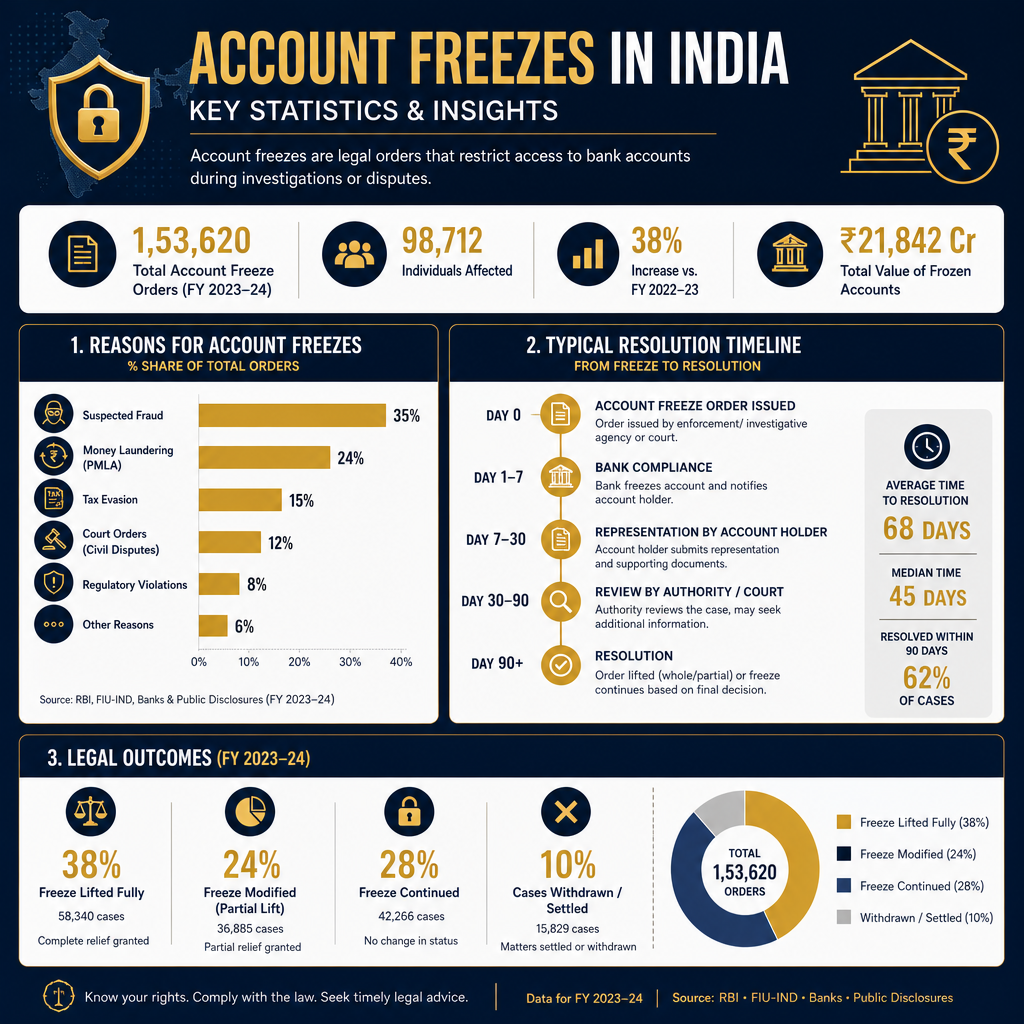
Prepared by AMA Legal Solutions Research & Analytics Team • Data & Compliance Overview

Halt Recovery Agent Harassment Legally
Procedural Steps vs Timelines: Navigating Account Freezes
When a bank account is frozen or placed under lien, it often follows a distinct set of procedures. Understanding these steps and their associated timelines can help navigate this challenging situation effectively. The immediate action usually involves identifying the reason for the freeze or lien, followed by communication with the bank. Engaging with legal remedies is crucial once initial inquiries are made. Remember, each step has its own timeline and legal nuances.
Key Steps and Timelines
Upon noticing a freeze, the first step is to contact the bank to determine the cause, whether it's due to a loan default, legal action, or RBI directive. It's advisable to gather all relevant documents and consult with a banking law expert for tailored advice.
| Parameter / Criterion | Key Details / Legal Provision | Timeline / Practical Impact |
|---|---|---|
| Initial Notification | Bank must inform account holder of freeze | Typically within a few days of action |
| Reason Clarification | Account holder contacts bank for details | Immediate; usually resolved within a week |
| Legal Consultation | Consult a banking legal expert | Within a week of freeze |
| Resolution Steps | Address issue via loan repayment or legal challenge | Varies; can take 1-2 months |
| Final Account Status | Bank lifts freeze or lien after resolution | Depends on resolution complexity |
During this process, a crucial element is timely legal advice, which can expedite resolution and reduce stress. Consulting dispute resolution experts may further aid in navigating complex legal discussions with banks, ensuring a fair outcome for all parties involved.
Consumer Rights and Obligations Under RBI Guidelines
The Reserve Bank of India (RBI) provides comprehensive guidelines protecting consumer rights in cases where accounts are frozen or liened. As a consumer, understanding these rights is critical, particularly if you face unexpected account restrictions. Banks must inform you promptly about the freeze or lien, specifying the reasons and any corrective actions needed. This transparency ensures you are aware of the situation and can take appropriate steps.
Key Rights Under RBI Guidelines
- Right to Information: Banks are obligated to clearly communicate the reason for the account freeze or lien and the steps required to resolve the issue. This includes any documentation you need to provide.
- Right to Rectification: If the freeze was erroneous, you have the right to have it rectified immediately. This may involve providing additional information or documentation to the bank.
- Right to Appeal: In cases of dispute, consumers can escalate the matter to the Banking Ombudsman if the bank’s response is unsatisfactory.
As a borrower, maintaining awareness of these rights can prevent unwarranted financial stress. For further guidance and strategic support with your banking issues, consider exploring our Banking and Finance Law services, or contact our experts for tailored advice.
Comparison of Legal Remedies: Freezes vs Liens
Understanding the distinction between account freezes and liens is crucial for borrowers facing financial concerns. While both are methods used by banks to secure debts, they differ significantly in application and implications.
Account Freezes
An account freeze restricts access to funds, effectively immobilizing the account until the issue prompting the freeze is resolved. Freezes often occur due to suspicious activities, court orders, or regulatory non-compliance. During a freeze, account holders cannot withdraw funds, though deposits may still be accepted. Quick action, such as consulting a legal expert, can facilitate resolution and restore access.
Liens
A lien grants the bank a legal claim over the funds or assets within an account, typically arising from unpaid debts. Unlike freezes, liens are formalized through legal proceedings, and they remain until the debt is settled. Liens impact credit scores and may lead to asset liquidation.
- Account freezes are typically temporary and resolved through clarification or legal intervention.
- Liens are more enduring, requiring debt repayment or negotiation for removal.
For borrowers, understanding these distinctions aids in choosing the appropriate legal remedy and mitigating financial implications. Seeking guidance from experienced legal professionals can be invaluable in navigating these challenges effectively.
Practical Tips for Negotiating with Banks and Lien Holders
When your account is frozen or under a lien, effective negotiation can be crucial in resolving the issue swiftly. The first step is understanding why the account was frozen. Often, it relates to unpaid dues or legal judgments.
Gather Essential Documentation
Before initiating conversations, compile all relevant documents such as loan agreements, bank statements, and any communication from the bank. This helps in presenting a clear picture of your financial situation.
Communicate Clearly and Professionally
Always approach the bank or lien holder with a professional demeanor. Clearly explain your current financial situation and propose a realistic plan for resolution. Indicate your willingness to cooperate and negotiate terms that are manageable for you.
Propose a Reasonable Payment Plan
Consider a feasible payment plan that demonstrates your commitment to settling the dues. This could be a one-time settlement or a structured repayment over time. Refer to our Banking and Finance Law services for assistance in drafting suitable agreements.
Seek Legal Assistance
Engaging a lawyer specializing in banking disputes can significantly bolster your negotiation position. They can help interpret legal notices and represent your interests effectively. For more guidance, explore our Debt Consolidation & Restructuring services.
- Understand the bank's perspective: Knowing their concerns can help you propose solutions that address both parties' interests.
- Remain patient: Negotiations may take time, especially if multiple parties are involved.
- Keep records: Document all communications with the bank or lien holder for future reference.
Structured and informed negotiation efforts can often lead to a mutually beneficial resolution, minimizing financial stress and restoring access to your account.
Case Studies: Real-Life Scenarios of Account Freezes
Understanding real-life scenarios can shed light on why banks may freeze or put a lien on accounts. Consider the case of Mr. Sharma, a small business owner who faced unexpected account freezes. After defaulting on a secured loan, his bank froze his account due to suspected misuse of collateral. Mr. Sharma approached a legal expert, who guided him through the Loan Settlement Services process, allowing him to negotiate terms and ultimately regain access to his funds.
Another example involves Ms. Raj, who experienced a lien on her savings account after a misunderstanding with her credit card provider. The bank enforced the lien due to an unpaid credit card bill, but Ms. Raj was unaware of the charges. By contacting her bank and providing proof of error, she managed to resolve the issue. This highlights the importance of maintaining accurate financial records and communication with banks.
For individuals facing similar challenges, seeking advice from Banking and Finance Law professionals can be crucial. Legal experts can offer guidance on handling account freezes, ensuring that affected parties understand their rights and the steps needed to address such situations effectively.
Expert Legal Advice on Preventing and Resolving Freezes
Having your bank account frozen or subjected to a lien can be daunting. To prevent this, it's crucial to maintain good communication with your bank and promptly address any notifications or legal notices. Regularly monitor account activities to catch discrepancies early. If your account is already frozen, understanding the reasons-whether it's due to unpaid debts or legal disputes-is vital.
Steps to Prevent Account Freezes
- Maintain open communication with your bank. Respond to their communications promptly and honestly.
- Regularly review your financial obligations and settle debts on time to avoid legal actions like liens.
- Consult with a legal expert to ensure compliance with banking regulations and avoid inadvertently triggering freezes.
Resolving an Existing Freeze
To address a freeze, engage with the bank immediately to understand the underlying cause. It's advisable to negotiate payment terms if possible or seek a legal resolution through loan settlement services. Additionally, consider legal assistance for drafting a settlement agreement to formalize any negotiations.
In more complex cases involving legal disputes or errors, you might need to initiate legal proceedings to contest unwarranted freezes. Consulting with a lawyer specializing in civil litigation can provide a strategic advantage in resolving such issues effectively.
Popular Searches & Topics
Commonly searched legal queries and keywords related to this article
Need Strategic Legal Defense for Your Situation?
Our banking & litigation advocates review your notices, debt liability, and recovery issues under complete advocate-client secrecy.

AMA Legal Solutions
Trusted with a 4.7 Google Rating, over 10,000+ Clients Served, 25,000+ Cases Handled, and more than 40+ Years of Experience in providing strategic legal defense and debt resolution across India.
Our media coverages





Client Reviews
"AMA Legal Solutions provided exceptional guidance during my account freeze issue. Their expertise in banking law was evident, and they resolved my concerns promptly."
Rohan Sharma
"Excellent service by AMA Legal Solutions. They helped me lift the freeze on my account and provided guidance on how to prevent future issues. True professionals!"
Anil Kumar
"AMA Legal Solutions turned a stressful situation around with their thorough understanding of banking litigation. Highly recommend their services for anyone facing similar issues."
Vikram Chawla
"I was impressed by the swift action taken by AMA Legal Solutions. Their proactive approach and clear communication were key in resolving my bank account freeze."
Sneha Mehta
"The legal team at AMA Legal Solutions was professional and knowledgeable. They helped me understand my rights and navigate the complexities of an account lien efficiently."
Priya Patel
Frequently Asked Questions
Related Articles
RuPay Credit Card on UPI Default & Credit Line on UPI Settlement (2026)
Micro-transactions on RuPay UPI Credit Cards and pre-approved 'Credit Lines on UPI' have triggered a massive wave of 42%+ APR revolving debt traps. Find out if defaulting blocks your personal savings UPI and how to settle RuPay UPI credit dues for 30%–50%.
Read Article
Paytm, PhonePe & BharatPe Daily EDI Merchant Loan Settlement (2026)
Drowning in Equated Daily Installment (EDI) merchant loans where 100% of your daily QR Soundbox collections are auto-swept before you can pay suppliers or rent? Learn how retail shopkeepers and MSMEs legally halt QR sweeps and negotiate a 50%+ OTS.
Read Article
Can Bank or Loan App Remotely Lock Phone for EMI Default? RBI Rules (2026)
An investigative breakdown of RBI's Remote Device Locking Directions—explaining why lenders cannot lock your phone for personal loans, the mandatory 30/60 DPD safeguards on financed devices, the Rs. 250/hour delay penalty, and how to settle device & app loans.
Read ArticleAbout Author
Anuj Anand Malik
View ProfileAnuj Anand Malik, Founder of AMA Legal Solutions, is a trusted advocate, loan settlement expert, legal advisor, and banking lawyer. With over a decade of experience in loan settlement, corporate law, financial disputes, and compliance, he leads a result-driven law firm based in India that helps individuals, startups, and businesses achieve legal and financial stability.
Connect on LinkedInNeed Legal Representation?
Evaluate your defense against recovery agents, notices, or structure your loan settlement directly with Senior Advocates.
Call +91-8700343611