Supreme Court Rules on Repossession of Hypothecated Vehicles
Legal Methods Only: No Forceful Repossession Allowed

Anuj Anand Malik
Reviewed by AMA Legal Solutions
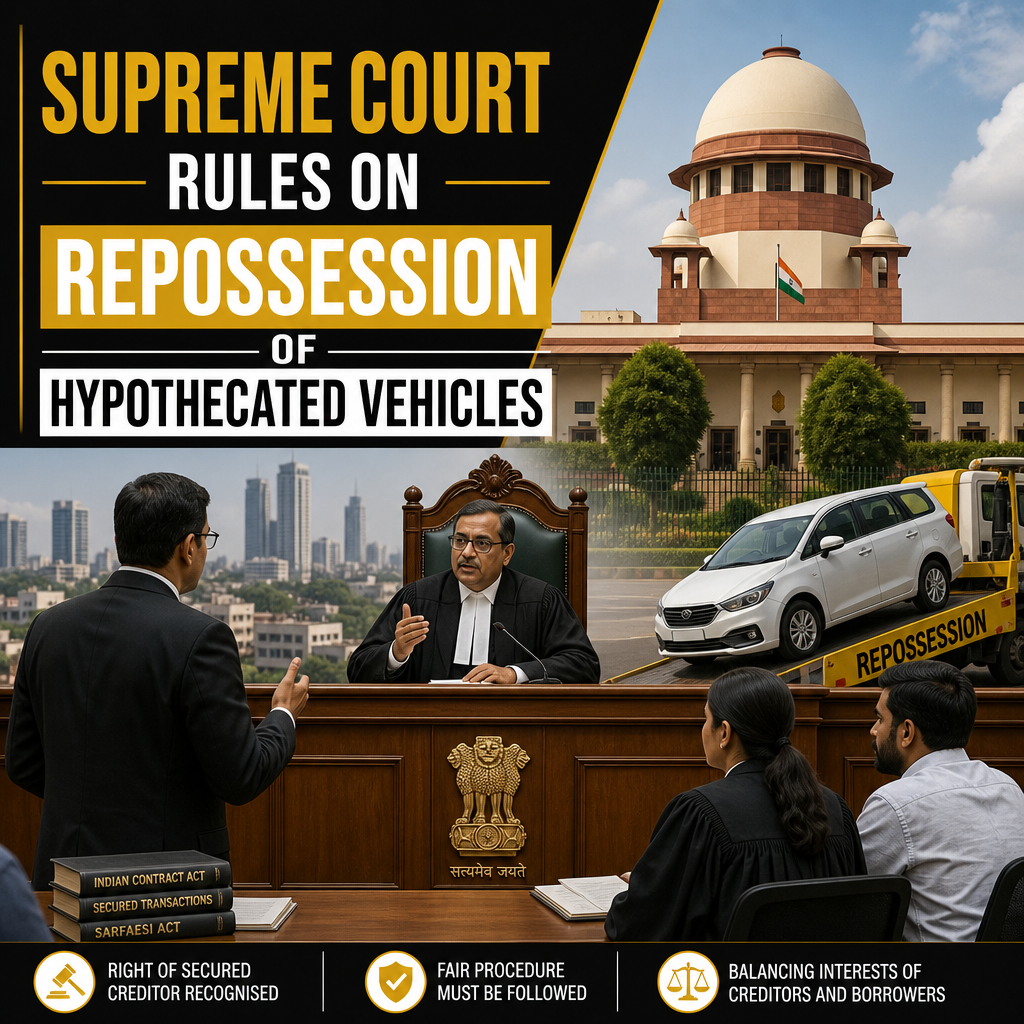
Key Takeaways: The Supreme Court ruling reinforces the importance of adhering to legal repossession procedures, protecting borrower rights, and maintaining contractual integrity. Financiers must issue legal notices before repossession, and borrowers have avenues to contest unfair practices. This decision promotes transparency, fairness, and trust in financial dealings.
Understanding the Supreme Court's Landmark Ruling
The Supreme Court's decision on September 16, 2026, set a crucial precedent in the realm of loan recovery and the repossession of hypothecated vehicles. The ruling clarifies that financiers cannot resort to force, deceit, or any means that violate the terms of the loan agreement to repossess vehicles. This emphasizes the sanctity of legal procedures, requiring that all recovery efforts respect the borrower's legal rights and contractual agreements.
Key Aspects of the Ruling
- Legal Compliance: Financiers must strictly adhere to legal procedures for repossession, ensuring actions are neither arbitrary nor oppressive.
- Contractual Integrity: The terms outlined in the loan agreements must be meticulously followed to avoid disputes.
- Role of Courts: Any action towards repossession must involve due process, potentially requiring judicial intervention to uphold fairness and accountability.
This landmark ruling reinforces the importance of legal adherence in loan recovery processes. Borrowers facing vehicle repossession should be aware of their banking and finance law rights. If you are approached for repossession, understanding how to properly respond to bank notices could make a significant difference in protecting your interests. It’s a vital reminder for both financial institutions and borrowers to operate within the legal framework, promoting trust and transparency in financial dealings.
Exploring the Legal Framework: Loan Agreements and Repossession Rights
The Supreme Court's ruling on September 16, 2026, underscores the critical importance of adhering to the legal framework governing loan agreements and repossession rights. In India, the Banking and Finance Law plays a significant role in determining the lawful procedures financiers must follow when reclaiming hypothecated vehicles.
Key Elements of Loan Agreements
Loan agreements typically outline the terms and conditions under which a loan is granted. These documents specify the borrower's obligations, interest rates, repayment schedules, and repossession rights. The agreement serves as a binding contract that both parties must honor in good faith.
Legal Repossession Rights
- Repossession must be conducted through legal procedures. Unlawful practices such as using force, deceit, or breaking the terms of the agreement are prohibited.
- Financiers must issue a notice to the borrower detailing the default and allowing for resolution before repossession.
- Court intervention may become necessary if the borrower contests the repossession or if the financier attempts to repossess without proper legal notice.
Borrowers can protect themselves by understanding their rights and obligations under the loan agreement and seeking Loan Settlement Services if they face financial difficulties. Legal avenues provide a structured path for both parties to resolve disputes and ensure that repossession is handled lawfully and ethically.
Self-Help Repossession: Legal vs. Illegal Practices
The Supreme Court's recent ruling has clearly defined the boundaries between legal and illegal self-help repossession practices. Legally, financiers can repossess hypothecated vehicles only if they strictly adhere to the terms outlined in the loan agreement, ensuring compliance with legal procedures. Any attempt to repossess using force or deceit is deemed illegal. This aligns with principles of fairness and borrower rights, highlighting the importance of transparency in the loan settlement process.
Comparing Legal and Illegal Practices
| Parameter / Criterion | Key Details / Legal Provision | Timeline / Practical Impact |
|---|---|---|
| Legal Procedure | Repossession is conducted per the contract and legal guidelines. | Must notify the borrower and follow due legal processes. |
| Illegal Practice | Use of force or deceit for repossession. | Immediate legal consequences and potential damages. |
| Notification Requirement | Written notice to the borrower prior to repossession. | Minimum 15 days before initiating action. |
| Borrower's Rights | Right to challenge any illegal repossession in court. | Immediate legal recourse available. |
Understanding these distinctions is crucial for borrowers. Engaging with a knowledgeable lawyer specializing in banking and finance law can provide guidance on managing these situations effectively. Legal recourse is available for those affected by unlawful repossession attempts, safeguarding consumer rights against unfair practices.
Analyzing the Court's Decision: Key Takeaways for Borrowers and Financiers
The recent Supreme Court ruling establishes a critical precedent in the domain of vehicle repossession, emphasizing the legal framework that financiers must adhere to. The court categorically ruled that any form of force or deceit in repossessing hypothecated vehicles is impermissible. This decision reinforces the necessity for financiers to operate strictly within the legal boundaries set by the terms of the loan agreement.
Key Takeaways for Borrowers
- Borrowers should be aware of their rights under the loan agreement, ensuring that they are not subjected to unlawful repossession tactics.
- In case of any unauthorized actions by financiers, borrowers can seek legal recourse through alternative resolutions.
- Documentation of all interactions with financiers can serve as vital evidence if legal intervention becomes necessary.
Key Takeaways for Financiers
- Financiers must ensure that all repossession activities are strictly in compliance with the legal procedures outlined in the loan agreement.
- Employing force or deceit not only risks legal penalties but may also damage the lender's reputation and future business prospects.
- It's advisable for financiers to consult legal experts in banking and finance law to ensure compliance and mitigate risks.
This landmark judgment serves as a significant reminder of the importance of upholding ethical and legal standards in debt recovery processes, ultimately safeguarding the interests of both borrowers and financiers.
Step-by-Step: Legal Procedures for Vehicle Repossession
When it comes to repossessing a hypothecated vehicle, financiers must adhere to strict legal protocols. Recent Supreme Court rulings emphasize that repossession cannot occur through force or deceit. Below are the step-by-step legal procedures that financiers must follow in compliance with Indian law.
Step 1: Assess Loan Agreement Terms
Begin by reviewing the loan agreement. Ensure it clearly states the conditions under which repossession is permissible. Deviating from these terms can lead to legal complications.
Step 2: Issue a Legal Notice
A legal notice should be sent to the borrower outlining the default and the intent to repossess the vehicle. This notice should provide a reasonable timeframe for the borrower to rectify the default or negotiate alternative resolutions. Banking and Finance Law services can assist in drafting this notice.
Step 3: Seek Legal Recourse
If the borrower fails to respond adequately, the financier should file a case in the appropriate legal forum. This could involve initiating a civil suit for repossession. Engaging Civil Litigation and Disputes experts will ensure that legal procedures are meticulously followed.
Step 4: Obtain Repossession Order
Upon judicial approval, a repossession order is granted. This legal document authorizes the financier to take possession of the vehicle, ensuring compliance with judicial mandates.
Step 5: Conduct Repossession Peacefully
Execute the repossession in a non-confrontational manner. Use professional agents who understand the legal boundaries, avoiding any form of intimidation or force.
Adhering to these legal steps not only protects the financier’s rights but also safeguards against potential legal disputes. For further guidance, consider consulting with experts at AMA Legal Solutions.
Impact on Borrowers: Rights and Protections under the New Ruling
The recent Supreme Court ruling significantly strengthens the legal protections for borrowers facing vehicle repossession. Under this new directive, banks and financiers must adhere strictly to legal procedures when reclaiming hypothecated vehicles. This means that any form of coercion, deceit, or forceful seizure is strictly prohibited.
Borrowers now have the right to demand transparency and legal compliance from lenders. If faced with unlawful repossession attempts, borrowers can file a complaint with the appropriate legal authorities. Additionally, borrowers are encouraged to seek professional legal advice to ensure their rights are protected.
Enhanced Legal Recourse
- Borrowers can now contest any unauthorized repossession, leveraging laws that require financiers to act within legal bounds.
- In case of disputes, borrowers may consider Arbitration and Dispute Resolution for a fair settlement.
- For detailed guidance, borrowers are advised to consult with legal experts specializing in Banking and Finance Law.
These protections ensure that borrowers are not left vulnerable to aggressive recovery tactics. It's crucial for borrowers to stay informed about their rights and the legal avenues available to challenge any breach of these newly established protections.
Key Insights & Data Infographic
Visual summary, statistical trends & procedural breakdown
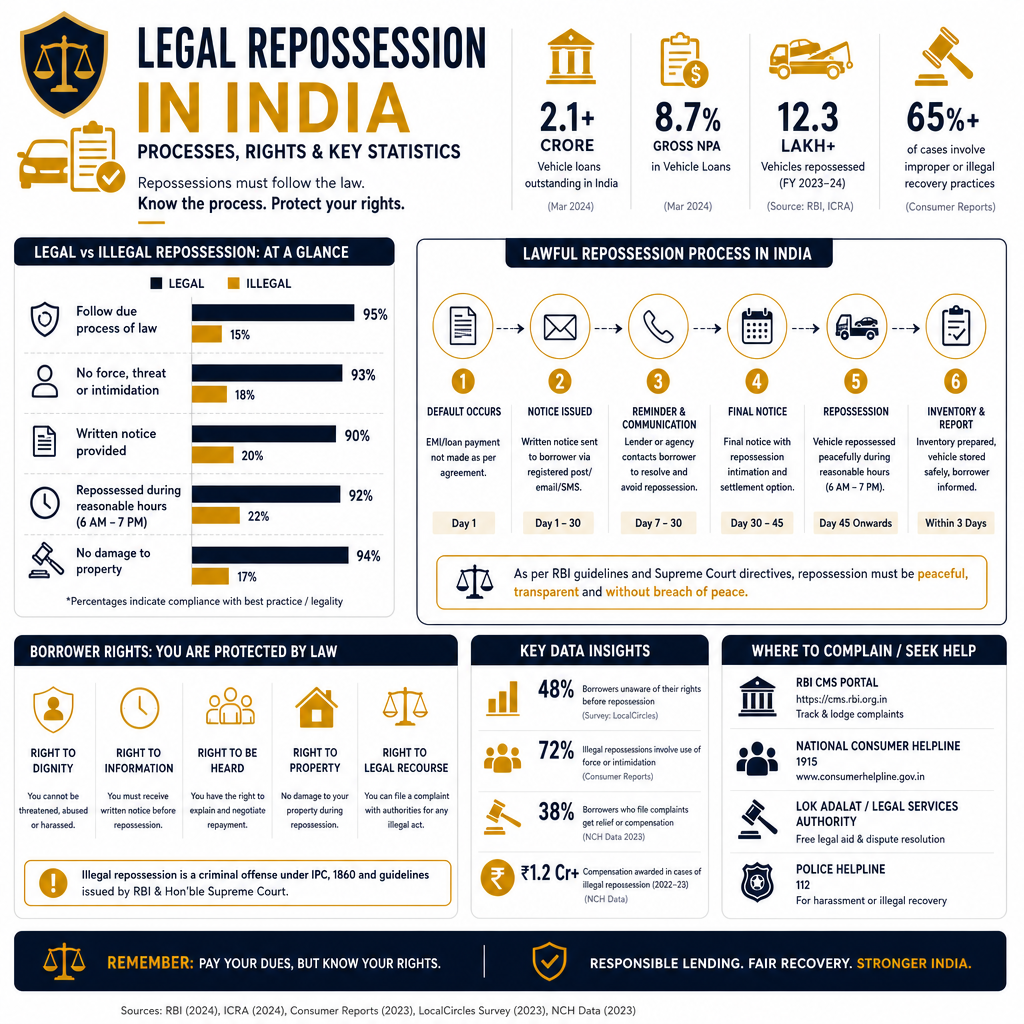
Prepared by AMA Legal Solutions Research & Analytics Team • Data & Compliance Overview
The Financier's Perspective: Legal Compliance and Business Practices
In light of the Supreme Court's recent ruling, financiers must ensure that their repossession practices adhere strictly to legal frameworks. The court emphasized that any attempt to repossess a hypothecated vehicle must not involve force, deceit, or breaches of the loan agreement terms. This decision underscores the importance of following legally sanctioned procedures to maintain compliance and protect the financier's reputation.
Adherence to Legal Protocols
Financiers are required to execute repossessions only through authorized channels. Engaging in banking and finance practices that deviate from the sanctioned protocols can result in severe legal repercussions. Therefore, it is crucial for financial institutions to establish robust internal compliance systems that align with the latest judicial pronouncements.
Implementing Best Business Practices
- Integrate legal compliance training for staff involved in repossession activities.
- Ensure all repossession notices are sent in writing, detailing the borrower's rights and obligations.
- Engage with borrowers proactively to explore alternatives such as loan settlements before initiating repossession.
- Maintain transparent communication with borrowers to prevent misunderstandings and foster trust.
- Regularly review and update repossession policies to conform with evolving legal standards.
By adhering to these practices, financiers not only comply with the law but also enhance customer relations and mitigate potential conflicts. Proper diligence and adherence to the Supreme Court's guidelines are essential for sustainable business operations in the financial sector.
Comparing Legal Remedies: Borrowers vs. Financiers
The recent Supreme Court ruling on 16.09.2026 mandates that financiers must adhere to legal processes for repossession of hypothecated vehicles. This decision strengthens the legal position of borrowers, ensuring that repossession cannot occur through force or deceit. This section compares the legal remedies available to both borrowers and financiers, providing clarity on procedural rights and obligations.
Borrowers' Remedies
- Challenge unlawful repossession in court.
- Seek damages for breach of contract or harassment.
- Negotiate settlement terms through mediation.
Financiers' Remedies
- Initiate repossession through legal notices and court orders.
- Engage in arbitration to settle disputes.
- File suits for recovery of dues in civil courts.
| Parameter / Criterion | Key Details / Legal Provision | Timeline / Practical Impact |
|---|---|---|
| Repossession Protocol | Must be conducted legally, without force or deceit as per Supreme Court ruling. | Immediate compliance required to avoid legal consequences. |
| Legal Action | Borrowers can challenge repossession in court; financiers file for recovery. | Varies; court processes may take months to resolve. |
| Negotiation and Settlement | Mediation encouraged to reach amicable settlements. | Can significantly reduce resolution time if successful. |
| Arbitration | Used as an alternative dispute resolution method, if agreed by contract. | Typically faster than court litigation, resolving in a few months. |
For borrowers, understanding these remedies is crucial to safeguarding their rights. Similarly, financiers should ensure compliance with legal protocols to avoid penalties. Learn more about effective loan settlement strategies to navigate these challenges.
Case Studies: Past Incidents of Unlawful Repossession
Examining real-life scenarios helps illustrate the misuse of power by financiers in repossessing vehicles. In one instance, a borrower in Mumbai reported that recovery agents forcibly took possession of his vehicle without prior notice, violating the terms of the loan agreement. Such aggressive tactics are not only illegal but also distressing for borrowers.
Another case from Bangalore highlighted a scenario where deceit was used. Here, a borrower was tricked into signing a document under the pretense of a routine inspection, only to find later that it was an authorization for repossession. Such actions blatantly disregard the legal requirements for vehicle repossession.
The Supreme Court's ruling on 16.09.2026 reaffirms that loan settlements must adhere strictly to legal protocols, prohibiting any forceful or deceitful actions. Borrowers should be aware of their rights and consult experts when faced with such situations. For those dealing with similar issues, understanding the legal frameworks can offer a path to remedy and prevent further unlawful actions.
These cases underscore the necessity for borrowers to be vigilant and informed about their rights, emphasizing the importance of transparent communication and adherence to legal statutes in repossession matters.
Practical Advice for Borrowers: Navigating Loan Defaults
Facing a loan default can be daunting, but understanding your rights and options is key. The Supreme Court, on 16.09.2026, emphasized that repossession of hypothecated vehicles must adhere to legal protocols. As a borrower, it's crucial to stay informed about these rights. Here’s how you can navigate through a loan default situation effectively:
Communicate Proactively
Engage with your lender as soon as you anticipate payment difficulties. Transparent communication can often lead to favorable solutions such as restructuring your loan terms. For detailed guidance on restructuring, explore our Loan Settlement Services.
Understand Legal Protocols
Creditors cannot unjustly use force or deceit to recover hypothecated assets. Ensure that any repossession effort aligns with the terms outlined in your loan agreement. Familiarize yourself with the rights available under Banking and Finance Law to protect yourself from illegal practices.
Seek Legal Assistance
If you're threatened with unlawful recovery practices, consult legal experts immediately. A qualified lawyer can help you understand your position and take appropriate action. Explore options for Arbitration and Dispute Resolution to resolve conflicts efficiently.
- Document all communications with the lender for reference.
- Review your loan agreement thoroughly to understand your obligations.
- Consider negotiation or settlement options that may prevent repossession.
Important Considerations for Financiers: Adhering to Legal Standards
In light of the recent Supreme Court ruling on 16.09.2026, financiers must exercise caution and adhere to legal standards when considering repossession of hypothecated vehicles. The judgment clarifies that self-help repossession must not involve force, deceit, or non-compliance with loan agreement terms. Legal avenues should be the primary route for recovery, ensuring the protection of both the financier’s and the borrower's rights.
Legal Compliance
Financiers should strictly adhere to the terms outlined in the loan agreement. Any deviation could lead to legal repercussions. It is crucial to review the agreement's repossession clauses and ensure all actions align with these terms. In cases where repossession is justified, following due legal process is imperative.
Risk Management
Non-compliance with legal standards can result in significant liabilities, including litigation and reputational damage. Implementing a robust internal compliance framework is essential. Regular training for staff on legal standards and borrower rights can mitigate the risk of non-compliance. For detailed insights on managing repossession within legal frameworks, visit our Banking and Finance Law services.
Alternative Dispute Resolution
Before opting for repossession, financiers should explore alternative dispute resolutions, such as negotiation or mediation, to amicably settle disputes. Engaging in Arbitration and Dispute Resolution can provide a legally sound and less confrontational path to resolve conflicts.
- Ensure all repossession actions are documented and communicated transparently to the borrower.
- Evaluate each case individually to determine the most appropriate legal recourse.
- Stay updated with any changes in legal guidelines and Supreme Court rulings regarding repossession.
Timeline of Legal Processes: From Default to Repossession
When a borrower defaults on a vehicle loan, the legal process for repossession begins, aligning with the legal and civil procedures mandated in India. Understanding this timeline can help borrowers manage the situation effectively.
1. Default Notification
Initially, the lender issues a default notice to the borrower, alerting them of the missed payments. This notice typically outlines the overdue amount and provides a grace period, usually 30 days, to rectify the default.
2. Legal Notice
If the default persists beyond the grace period, the lender may issue a formal legal notice. This document warns the borrower of impending legal action and provides another opportunity to settle the dues.
3. Filing a Legal Suit
Upon failure to respond to the legal notice, the lender may file a suit in a civil court. This process adheres to the principles of Arbitration and Dispute Resolution, ensuring fairness and due process in court proceedings.
4. Court Proceedings
The court assesses the case and may pass an order for repossession. This order authorizes the lender to repossess the vehicle but strictly through legal means, respecting the borrower’s rights.
5. Execution of Repossession
Following the court order, repossession occurs under legal supervision. The lender must ensure compliance with legal protocols, avoiding forceful or deceitful actions during vehicle recovery.
Understanding these steps and seeking legal counsel early can help borrowers navigate the complexities of vehicle loan defaults. For further guidance, consider exploring our loan settlement services.
Popular Searches

AMA Legal Solutions
Trusted with a 4.7 Google Rating, over 10,000+ Clients Served, 25,000+ Cases Handled, and more than 40+ Years of Experience in providing strategic legal defense and debt resolution across India.
Our media coverages





Client Reviews
"I am grateful for the knowledgeable advice and support received from AMA Legal Solutions in resolving my financial disputes."
Anil Kumar
"AMA Legal Solutions' thorough understanding of banking law was crucial in protecting my rights during a complex legal battle."
Vikram Singh
"The team at AMA Legal Solutions helped me navigate the complex loan settlement process with ease and professionalism."
Priya Kapoor
"AMA Legal Solutions provided exceptional guidance during my vehicle repossession case. Their expertise ensured a fair and legal resolution."
Rakesh Mehta
"Thanks to AMA Legal Solutions, I successfully contested an unjust repossession attempt. Their legal acumen is unmatched."
Neha Sharma
Frequently Asked Questions
Related Articles

How to Trust Law Associates for Loan Settlement
Ensure Successful Loan Settlement with Trusted Legal Experts
Read Article
Expert Loan Settlement Lawyer: Minimize Amount, Maximize Waiver
Unlocking the Secrets to Successful Loan Settlements in India
Read Article
Mastering Loan Settlement of Personal Loan by Bajaj Finance
Navigate Bajaj Finance Loan Settlements with Expert Legal Insights
Read ArticleAbout Author
Anuj Anand Malik
View ProfileAnuj Anand Malik, Founder of AMA Legal Solutions, is a trusted advocate, loan settlement expert, legal advisor, and banking lawyer. With over a decade of experience in loan settlement, corporate law, financial disputes, and compliance, he leads a result-driven law firm based in India that helps individuals, startups, and businesses achieve legal and financial stability.
Connect on LinkedInNeed Legal Help?
Get expert advice on loan settlement and debt relief.
Call +91-8700343611Request Callback