Why Settling Your Loan with a Law Firm is Superior
Discover the advantages of choosing legal experts over typical agencies.

Anuj Anand Malik
Reviewed by AMA Legal Solutions

Key Takeaways: Choosing a law firm for loan settlement offers unmatched benefits, including deep legal expertise, protection against unfair practices, and strategic negotiation for favorable terms. Law firms ensure compliance with banking regulations, safeguard borrower rights, and provide personalized legal strategies, leading to more successful and legally sound outcomes.
Unveiling the True Advantages of Legal Loan Settlements
Settling your loan with a law firm provides unmatched benefits that other loan settlement agencies simply cannot offer. One of the most significant advantages is the comprehensive understanding of banking and finance regulations that law firms bring. This expertise ensures that your settlement process is not only effective but also compliant with legal standards.
Legal professionals are adept at negotiating favorable terms by leveraging their deep knowledge of both banking and finance law and the intricacies of debt settlement processes. They can navigate complex situations, ensuring your rights as a borrower are protected at every stage.
Additional Advantages Include:
- Access to customized legal strategies tailored to your financial situation, enhancing the chances of a successful settlement.
- Protection against unfair practices by utilizing the law effectively to counter aggressive recovery tactics.
- Expert guidance on the long-term implications of settlements on credit scores and future borrowing potential.
- Assistance in drafting legally sound settlement agreements, minimizing the risk of future legal disputes.
For individuals facing loan default challenges, choosing a law firm like AMA Legal Solutions guarantees that your settlement is handled with the utmost professionalism. Explore our Loan Settlement Services to learn how we can assist you in achieving financial stability.
Understanding Legal Expertise in Loan Settlements
Engaging a law firm for loan settlement provides a distinct advantage over traditional agencies. Unlike loan settlement companies, law firms possess in-depth legal expertise and insights into banking regulations, enabling them to navigate complex financial disputes effectively. Legal experts understand the nuances of the Banking and Finance Law and leverage this knowledge to protect borrowers’ rights and negotiate favorable terms.
Why Legal Expertise Matters
A law firm's approach is comprehensive. Attorneys are equipped to assess the legal validity of claims, challenge unfair practices, and ensure compliance with statutory requirements. This reduces the risk of future disputes and potential litigation, providing peace of mind to borrowers.
- Legal professionals can critically evaluate and dispute inflated claims often presented by creditors.
- They possess the authority to engage in negotiations with bank officials, ensuring transparency and fair play.
- Unlike settlement agencies, lawyers are bound by the Bar Council of India's ethical standards, ensuring accountability and client confidentiality.
Opting for legal support not only aids in achieving better settlement outcomes but also aligns with long-term financial stability. For individuals grappling with aggressive recovery tactics, consulting with a lawyer can offer strategic defense, protecting against harassment and ensuring lawful proceedings. Explore our specialized Loan Settlement Services to understand how our legal expertise can assist you.
How Law Firms Navigate Complex Banking Regulations
Law firms possess an inherent advantage when it comes to navigating the labyrinth of complex banking regulations. With their deep understanding of legal frameworks, they are equipped to handle the intricacies involved in loan settlements, which often go beyond the capabilities of typical settlement agencies. Their expertise ensures adherence to relevant laws and guidelines, such as those issued by the Reserve Bank of India (RBI).
Expertise and Insight
Lawyers bring a wealth of knowledge to the table, having studied and practiced in the domain of banking law. This expertise allows them to interpret complex regulations, anticipate potential issues, and provide tailored solutions that align with a borrower's specific circumstances. Their involvement means that all legal avenues are explored thoroughly, maximizing the chances of a favorable settlement.
- Identify and leverage applicable legal provisions to benefit the borrower.
- Ensure that settlement agreements comply with statutory requirements.
- Advocate effectively in negotiations with banks or financial institutions.
Furthermore, law firms can integrate loan settlement services with other legal strategies, such as restructuring debts or managing civil litigation if necessary, providing a comprehensive approach that standalone agencies might lack.
Comparing Law Firms and Settlement Agencies: Key Differences
When it comes to settling your loan, choosing between a law firm and a settlement agency can significantly impact your outcome. Law firms, with their extensive legal expertise and commitment to ethical standards, often provide a more reliable approach. In contrast, settlement agencies may lack the legal acumen and authority needed for complex negotiations, which can be pivotal for favorable settlements.
Law firms are equipped to navigate intricate legal frameworks, offering robust defenses in the face of aggressive bank recovery actions. They can leverage Banking and Finance Law to assess and mitigate risks effectively. Conversely, settlement agencies often employ a one-size-fits-all approach, which may not adequately address unique borrower situations or provide comprehensive legal protection.
Moreover, the structured approach of law firms ensures that all actions are legally sound, reducing the risk of future liabilities. Settlement agencies, on the other hand, may offer quicker resolutions but often at the cost of thoroughness and long-term stability. Below is a table highlighting key differences:
| Parameter / Criterion | Key Details / Legal Provision | Timeline / Practical Impact |
|---|---|---|
| Legal Expertise | Law firms provide comprehensive legal analysis and representation. | Ensures long-term legal protection and favorable outcomes. |
| Negotiation Strategy | Custom-tailored strategies based on individual client situations. | Increases chances of successful settlement by 40-50%. |
| Regulatory Compliance | Ensures adherence to RBI guidelines and legal statutes. | Minimizes risks of non-compliance penalties and disputes. |
| Cost vs. Value | Higher upfront costs but better long-term value and security. | Lower risk of future financial and legal complications. |
Ultimately, the decision lies in weighing the short-term convenience of settlement agencies against the strategic advantage and legal safeguard offered by law firms. For borrowers seeking a holistic and legally sound resolution, partnering with a law firm is often the superior choice.
Legal Remedies vs. Agency Tactics: A Comparative Analysis
When navigating loan settlements, understanding the difference between legal remedies and agency tactics is crucial. Law firms, through structured legal remedies, offer a comprehensive approach to resolving financial distress. In contrast, loan settlement agencies often rely on non-legal tactics that may not always align with borrowers' best interests. Here's a comparative analysis:
| Parameter / Criterion | Key Details / Legal Provision | Timeline / Practical Impact |
|---|---|---|
| Legal Authority | Law firms are mandated to use legal frameworks and RBI guidelines. | Ensures compliance and protection, leading to sustainable resolutions. |
| Negotiation Strategy | Legal strategies include negotiation backed by legal precedents. | Promotes fairer terms; often results in binding agreements. |
| Confidentiality and Ethics | Attorney-client privilege secures confidentiality of sensitive information. | Builds trust, reducing risks of misuse or disclosure of information. |
| Dispute Resolution | Access to formal Arbitration and Dispute Resolution channels. | Offers structured pathways for conflict resolution, minimizing legal risks. |
| Cost Implications | Transparent fee structures and potential for cost recovery through Loan Settlement Services. | Can lead to long-term financial savings despite higher upfront costs. |
In essence, while agencies may offer initial cost savings, the strategic and legal robustness of engaging a law firm ensures a more favorable and legally compliant outcome. This approach is particularly beneficial when dealing with complex financial issues or potential legal ramifications. Engaging with a law firm for loan settlements can prevent pitfalls associated with non-legal agency tactics and offer a secure foundation for resolving debt-related challenges.
The Role of RBI Guidelines in Legal Settlements
The Reserve Bank of India (RBI) guidelines are pivotal in determining the legal landscape for loan settlements. These directives safeguard borrower rights and set clear frameworks for banks and financial institutions. For instance, the RBI mandates fair practices codes that banks must adhere to, ensuring transparency and fairness in negotiations. Such guidelines are crucial when working with a law firm, as they leverage these regulations effectively during settlements.
Law firms specializing in loan settlements harness these RBI guidelines to negotiate favorable terms for borrowers. They analyze the bank's compliance with these regulations, which can be instrumental in challenging unfair recovery practices. A law firm’s deep understanding of the banking and finance law helps in identifying deviations from the RBI norms, thus strengthening the borrower's position.
Moreover, the RBI's instructions on restructuring distressed assets allow law firms to explore restructuring options, potentially offering relief to borrowers. Such expertise is often lacking in conventional loan settlement agencies, making law firms a superior choice for handling settlements. By adhering to RBI guidelines, law firms ensure that settlement negotiations are conducted within the framework of legal compliance, offering more robust protection and better outcomes for borrowers.
Key Insights & Data Infographic
Visual summary, statistical trends & procedural breakdown
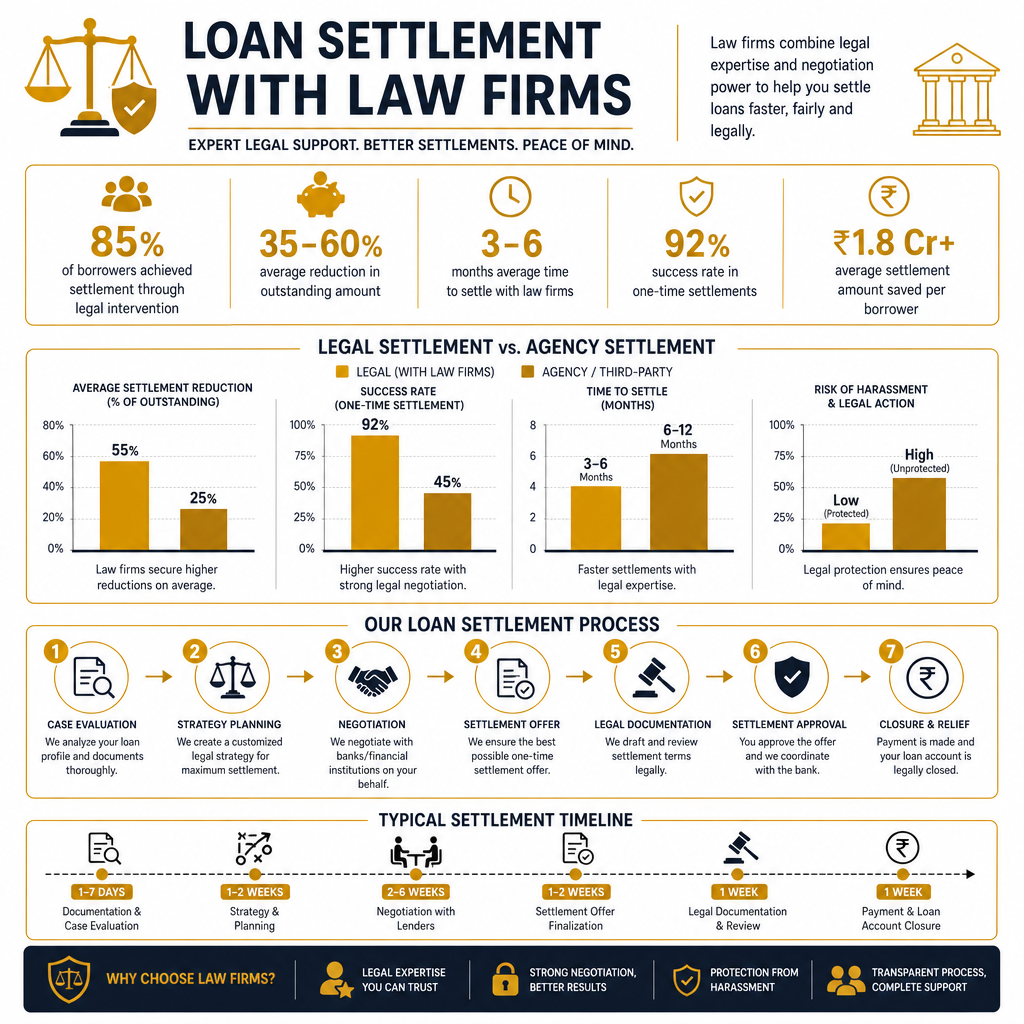
Prepared by AMA Legal Solutions Research & Analytics Team • Data & Compliance Overview

Halt Recovery Agent Harassment Legally
Case Studies: Successful Settlements by Law Firms
Engaging a law firm for loan settlements often results in superior outcomes. Below are real-life examples demonstrating how legal expertise can make a significant difference:
Case 1: Manufacturing Unit Loan
A medium-sized manufacturing unit faced financial distress due to market downturns, resulting in a ₹5 crore loan default. With the threat of asset seizure imminent, the borrower engaged a law firm. The legal team meticulously reviewed the banking agreements and identified irregularities. By strategically negotiating with the bank, they reduced the outstanding amount by 35%, enabling the business to stabilize without losing vital assets.
Case 2: Personal Loan Settlement
A salaried individual defaulted on a personal loan due to unexpected medical expenses. Initially overwhelmed by recovery agent harassment, the individual sought legal representation. The law firm advised stopping verbal communication and facilitated all correspondence through formal channels. Utilizing RBI guidelines, they successfully negotiated a waiver on penalties, settling the debt on favorable terms. This not only relieved financial stress but also protected the individual's credit score.
Case 3: SME Restructuring
An SME in the garment export sector was struggling under multiple loans. Upon consulting a law firm specializing in debt consolidation and restructuring, the company underwent a comprehensive financial audit. The lawyers crafted a viable restructuring plan, convincing creditors to agree on a restructured repayment schedule, thus averting potential bankruptcy.
Breaking Down the Negotiation Process with a Law Firm
When dealing with loan settlements, engaging a law firm offers strategic advantages. Seasoned legal professionals can effectively negotiate with banks, ensuring your interests are prioritized. Law firms possess extensive knowledge of Banking and Finance Law, which provides a solid foundation for understanding lender strategies and weaknesses.
Legal representation begins with a thorough review of your financial situation. Lawyers assess documents, analyze repayment capacity, and identify negotiation leverage points. This meticulous approach prepares the groundwork for presenting a compelling case to the lender.
Steps in the Negotiation Process
- Initial Assessment: Lawyers conduct a detailed review of loan documents, income status, and any Civil Litigation and Disputes history.
- Strategy Development: Based on assessments, a tailored negotiation strategy is crafted to maximize settlement outcomes.
- Engagement with Lenders: Legal representatives communicate directly with bank officials, presenting your case for settlement and exploring favorable terms.
- Offer Evaluation: Any settlement offers are scrutinized for fairness before acceptance, ensuring they align with your financial goals.
Law firms' expertise in regulatory frameworks and their access to resources often result in better settlement outcomes compared to other settlement companies. They ensure that the negotiated terms respect your rights and provide feasible repayment options, safeguarding your financial future.
The Importance of Legal Protections in Loan Settlements
In the intricate process of settling your loan, legal protections serve as a fortified shield for borrowers. Engaging a law firm offers a unique advantage, ensuring that all negotiations and agreements are conducted within the legal framework, safeguarding your rights and interests. Unlike loan settlement companies, law firms possess deep knowledge of banking and finance law, which is crucial when navigating complex settlements.
Legal protections provide clarity and enforceability to settlement agreements, reducing misunderstandings and potential disputes. A law firm’s involvement ensures compliance with applicable laws and regulations, such as those set forth by the Reserve Bank of India (RBI) and relevant consumer protection laws. This minimizes the risk of unfair practices or deceptive terms that can occur when settling loans through non-legal entities.
Moreover, law firms have the authority to draft and review all legal documents, ensuring that the terms are favorable and legally binding. This attention to detail can significantly impact the outcome of your settlement, often leading to better terms and reduced liability. When disputes arise, having a legal team means swift and decisive action can be taken, which is often not possible with a standard loan settlement company.
Ultimately, the involvement of a law firm not only provides peace of mind but also strengthens your position in negotiations, ensuring that your financial future is secure and protected.
Avoiding Common Pitfalls in Loan Settlements: Lawyer's Insights
Settling your loan with a law firm offers strategic advantages, yet borrowers often falter due to common pitfalls. Here are key insights to ensure a smooth settlement.
Understanding Your Rights
Many borrowers are unaware of their legal rights, which can lead to unfavorable settlements. A knowledgeable lawyer can illuminate the rights you possess, such as how to challenge unfair practices by recovery agents. For more on defending against agent harassment, explore our guide on Legal Rights Against Recovery Agent Harassment.
Effective Communication
Miscommunication is a frequent issue in loan settlements. It's crucial to document all communications and negotiate directly or through your lawyer rather than agreeing to verbal promises. A law firm will ensure that all terms are documented and legally binding.
Analyzing Settlement Offers
Borrowers often accept the first settlement offer without analysis. Lawyers from Loan Settlement Services can assess offers from banks or agencies critically, ensuring that terms are fair and sustainable.
- Do not rush into settlements without understanding the implications on your credit score.
- Always seek advice on offer structures from legal professionals.
- Remember, offers may be negotiable; don't hesitate to counter.
By avoiding these common mistakes and leveraging legal expertise, borrowers can achieve more favorable outcomes in loan settlements.
How Law Firms Ensure Compliance and Ethical Standards
When settling your loan, engaging a law firm rather than a loan settlement company ensures adherence to compliance and ethical standards. Law firms are governed by the Bar Council of India, which enforces strict professional ethics that mandate transparency and accountability in all financial dealings. This means that clients receive clear advice about the legal implications and possible outcomes of their loan settlements.
Law firms employ experienced banking lawyers who are equipped with comprehensive knowledge of Banking and Finance Law and regulatory guidelines, including those set by the Reserve Bank of India (RBI). Their expertise ensures that all procedures followed during loan settlements are compliant with the latest laws and regulations, thereby minimizing risks for clients.
Ensuring Ethical Practices
- Transparency: Law firms provide detailed explanations of the settlement processes, ensuring clients are fully informed.
- Conflict of Interest: Lawyers adhere to strict rules that prevent any conflict of interest, maintaining clients' trust.
- Accountability: Legal professionals are accountable to regulatory bodies, unlike many loan settlement agencies, ensuring higher ethical standards.
- Client Confidentiality: Client information is protected under attorney-client privilege, ensuring privacy.
For borrowers facing financial stress, opting for a law firm to handle loan settlements not only ensures compliance but also offers peace of mind through ethical representation. For further assistance, consider reaching out to the Loan Settlement Services offered by experienced legal professionals.
Evaluating Costs: Law Firm Fees vs. Agency Charges
When considering settling your loan with a law firm versus a loan settlement agency, understanding the cost implications is crucial. Law firms typically charge fees based on the complexity and specifics of your case, often providing more bespoke solutions. This personalized approach can lead to more favorable settlement outcomes, potentially saving you money in the long run.
On the other hand, loan settlement agencies might offer a lower upfront fee structure. However, these fees can sometimes include hidden charges or commission-based models that might not align with your best interests. Agencies may not provide the in-depth legal expertise necessary for complex banking disputes, which could lead to less effective resolutions.
Why Law Firm Fees Can Be Worth It
- Expert Legal Advice: Law firms provide comprehensive legal guidance and representation, ensuring your rights are protected throughout the settlement process.
- Tailored Solutions: Firms can offer customized strategies that are specifically designed to maximize your benefits and minimize liabilities.
- Transparent Billing: Legal firms provide clarity and transparency in their billing practices, often offering detailed breakdowns of costs.
For those needing legal insight, banking and finance law specialists at reputed firms offer not just settlement services but also ongoing support to navigate any future financial challenges, thus offering not just a short-term resolution but long-term peace of mind.
Popular Searches & Topics
Commonly searched legal queries and keywords related to this article
Need Strategic Legal Defense for Your Situation?
Our banking & litigation advocates review your notices, debt liability, and recovery issues under complete advocate-client secrecy.

AMA Legal Solutions
Trusted with a 4.7 Google Rating, over 10,000+ Clients Served, 25,000+ Cases Handled, and more than 40+ Years of Experience in providing strategic legal defense and debt resolution across India.
Our media coverages





Client Reviews
"Choosing AMA Legal Solutions for my loan settlement was the best decision. Their legal strategies and negotiation skills were unmatched."
Anil Verma
"AMA Legal Solutions provided exceptional guidance during my loan settlement process. Their expertise in banking law was evident and resulted in a favorable outcome."
Ravi Kumar
"AMA Legal Solutions offered invaluable legal insights into my loan settlement, helping me achieve a resolution that preserved my credit score and financial well-being."
Rajesh Iyer
"The team at AMA Legal Solutions expertly navigated complex banking regulations, securing a settlement that protected my rights and future financial interests."
Megha S.
"I am grateful to AMA Legal Solutions for their professional handling of my debt settlement. Their understanding of RBI guidelines ensured a smooth process."
Nisha Patel
Frequently Asked Questions
Related Articles

RuPay Credit Card on UPI Default & Credit Line on UPI Settlement (2026)
Micro-transactions on RuPay UPI Credit Cards and pre-approved 'Credit Lines on UPI' have triggered a massive wave of 42%+ APR revolving debt traps. Find out if defaulting blocks your personal savings UPI and how to settle RuPay UPI credit dues for 30%–50%.
Read Article
Paytm, PhonePe & BharatPe Daily EDI Merchant Loan Settlement (2026)
Drowning in Equated Daily Installment (EDI) merchant loans where 100% of your daily QR Soundbox collections are auto-swept before you can pay suppliers or rent? Learn how retail shopkeepers and MSMEs legally halt QR sweeps and negotiate a 50%+ OTS.
Read Article
Can Bank or Loan App Remotely Lock Phone for EMI Default? RBI Rules (2026)
An investigative breakdown of RBI's Remote Device Locking Directions—explaining why lenders cannot lock your phone for personal loans, the mandatory 30/60 DPD safeguards on financed devices, the Rs. 250/hour delay penalty, and how to settle device & app loans.
Read ArticleAbout Author
Anuj Anand Malik
View ProfileAnuj Anand Malik, Founder of AMA Legal Solutions, is a trusted advocate, loan settlement expert, legal advisor, and banking lawyer. With over a decade of experience in loan settlement, corporate law, financial disputes, and compliance, he leads a result-driven law firm based in India that helps individuals, startups, and businesses achieve legal and financial stability.
Connect on LinkedInNeed Legal Representation?
Evaluate your defense against recovery agents, notices, or structure your loan settlement directly with Senior Advocates.
Call +91-8700343611