Multiple e-NACH & UPI Autopay Bounce Charges Harassment: RBI Rules & Settlement (2026)
Stop repeated e-NACH bounce charges under NPCI rules and get a 100% OTS waiver.

Anuj Anand Malik
Reviewed by AMA Legal Solutions
Key Takeaways: When loan borrowers face financial stress, predatory lenders frequently unleash automated debit scripts that present the same electronic mandate five to ten times in a single billing cycle. Navigating multiple e nach bounce charges harassment rbi rules and loan settlement requires understanding that the National Payments Corporation of India (NPCI) and the Reserve Bank of India (RBI) strictly cap re-presentations to a maximum of two retries per cycle with a mandatory cooling period. Furthermore, under RBI's Fair Lending Practice Circular (DoR.MCS.REC.28), lenders are prohibited from capitalizing bounce charges or charging compound interest on unpaid penalty fees. While cancelling an e-NACH mandate must be handled prudently to avoid retaliatory Section 25 PASSA criminal complaints, borrowers can invoke their statutory rights via Section 25 Payment and Settlement Act legal defense and file an RBI complaint against bank overreach. At AMA Legal Solutions, our legal team routinely strips away 100% of accumulated bounce and penal charges, compelling banks and NBFCs into structured loan settlement services and securing 40% to 65% principal haircuts for sustainable financial recovery.
Introduction: The Multiple e-NACH Bounce Charges Harassment Trap in India
In modern Indian banking, few experiences are more demoralizing than opening your bank statement during a period of financial hardship only to discover that your entire remaining balance has been wiped out by automated bank fees. For thousands of salaried employees, self-employed professionals, and small business owners navigating multiple e nach bounce charges harassment rbi rules and loan settlement, electronic clearing systems designed for seamless financial convenience have been weaponized into ruthless cash-extraction machines.
When you initially avail a personal loan, consumer durable credit, or digital credit line from a commercial bank or Non-Banking Financial Company (NBFC), the lender requires you to authenticate an electronic National Automated Clearing House (e-NACH) mandate, an Electronic Clearing Service (ECS) mandate, or a UPI Autopay mandate. This digital authorization empowers the lender to automatically debit your equated monthly installment (EMI) directly from your savings or current account on a specified date each month.
However, when unexpected financial catastrophes strike—such as sudden medical emergencies, corporate layoffs, business revenue collapses, or severe cash-flow crunches—and your account balance falls below the EMI sum, a devastating predatory cycle begins. Rather than contacting the borrower to structure a temporary moratorium or amicable repayment schedule, many aggressive lenders program algorithmic debit bots that repeatedly re-present the failed mandate against the empty account. Every single failed presentation triggers a catastrophic double-penalty: your own bank slaps an "Inward Return / ECS Dishonour Fee" of Rs. 295 to Rs. 590 (including 18% GST), while the lending institution levies a separate "Cheque / NACH Bounce Charge" of Rs. 400 to Rs. 1,000 plus compounding penal interest.
Borrowers caught in the crosshairs of multiple e nach bounce charges harassment rbi rules and loan settlement often find their bank accounts pushed deep into negative balances before they can even purchase basic groceries or pay utility bills. When family members or friends wire emergency funds to help the borrower survive, the host bank instantly swallows the money to satisfy accumulated bounce penalties. Understanding the legal, regulatory, and procedural framework governing electronic mandate re-presentations is the only way to break this predatory cycle and transition toward a clean debt resolution via loan settlement in India.
How Predatory Repeated NACH Presentations Turn a Rs. 50,000 EMI Default Into Rs. 40,000 of Pure Bounce Charges
To recognize why regulatory intervention became mandatory, one must examine the ruthless arithmetic deployed by aggressive fintech lenders and private NBFCs. A central issue in multiple e nach bounce charges harassment rbi rules and loan settlement is the compounding destruction of bank balances caused by predatory re-presentations that bear no relation to authentic debt recovery.
1. The Algorithmic "Balance Sweeping" Mechanism
In conventional physical banking, a cheque could only be presented across the clearing counter once or twice before being returned with a physical return memo. In contrast, digital payment gateways and sponsor banks operating on the NPCI NACH platform can submit automated XML debit batches electronically within seconds. Rogue recovery departments exploit this technological speed by programming automated retry scripts:
- First Presentation (Due Date - e.g., 5th of the Month): The primary EMI of Rs. 15,000 fails due to insufficient funds. The destination bank debits an inward return charge of Rs. 500 + 18% GST (Rs. 590). Simultaneously, the lender adds a Rs. 590 bounce fee to the loan ledger. Total immediate penalty: Rs. 1,180.
- Second Presentation (8th of the Month): Without any prior communication, the lender resubmits the debit file. It bounces again. Another Rs. 1,180 is drained across the bank account and loan ledger.
- Third, Fourth, and Fifth Presentations (12th, 16th, and 20th): The automated script continues hitting the empty account every 3 to 4 days. In extreme cases reported against fintech apps and entities like Bajaj Finance or IDFC First Bank, mandates have been triggered up to 8 to 12 times in a single thirty-day cycle!
- Random Odd-Amount Splits: Some rogue digital lending platforms split a single Rs. 15,000 EMI into three separate micro-debits of Rs. 5,000 each and submit them simultaneously, multiplying the resulting bounce penalties threefold in a single morning!
2. The Devastating Ledger Trap for Defaulting Borrowers
Borrowers trapped in multiple e nach bounce charges harassment rbi rules and loan settlement discover that lenders debit bounce fees while their own bank slaps return penalties, rapidly transforming a manageable cash-flow deficit into insurmountable mathematical insolvency. Consider a salaried borrower who misses three consecutive EMIs of Rs. 15,000 over a 90-day period. Under standard contractual terms, the pure principal and interest arrears total Rs. 45,000.
However, if the lender executed 8 failed debit presentations per month, the borrower experiences 24 total bounces across 90 days. At a combined penalty of Rs. 1,180 per bounce, an astounding Rs. 28,320 in pure bounce fees is generated. When the lender stacks late payment penal charges, overdue interest, and collection administrative fees on top, the borrower's total outstanding ledger inflates to over Rs. 85,000—nearly double the original missed obligation! When the borrower finally gathers Rs. 15,000 to resume payments, the lender's automated accounting software allocates the entire payment toward clearing accumulated bounce fees and penal interest, leaving the core principal completely untouched.
| Component / Charge Type | Levying Entity | Typical Cost Per Bounce (INR) | Frequency / Trigger Mechanism | Legality Under RBI & NPCI Directives | Settlement Waiver Benchmark at AMA Legal Solutions |
|---|---|---|---|---|---|
| Inward Return / ECS Dishonour Fee | Borrower's Savings / Current Bank | Rs. 250 to Rs. 500 + 18% GST (Rs. 295 to Rs. 590) | Levied automatically every time an incoming e-NACH/ECS debit file is returned unpaid. | Permitted once per billing cycle; multiple same-month charges for identical mandate violate Fair Practices Code. | Direct refund dispute or ledger reconciliation offset via Banking Ombudsman complaint. |
| Lender NACH Bounce / Dishonour Penalty | Lending Bank or NBFC (Originator) | Rs. 350 to Rs. 750 + 18% GST (Rs. 413 to Rs. 885) | Added to the borrower's loan account statement upon receiving return memo from NPCI. | Illegal if capitalized into principal balance or subjected to compounding interest under RBI 2024 circular. | 100% Mandatory Waiver in any formal One-Time Settlement (OTS) negotiated by counsel. |
| Penal Interest / Overdue Interest | Lending Bank or NBFC | 24% to 36% per annum on unpaid balance | Compounded daily or monthly on overdue EMIs and accumulated penalty charges. | Strictly Banned: RBI mandates penalty must be reasonable "penal charges", not capitalized interest. | 100% Mandatory Waiver during structured legal compromise settlements. |
| UPI Autopay Failure Charge | Payment Aggregator / Bank | Rs. 25 to Rs. 250 | Triggered when a recurring UPI Autopay mandate fails due to zero balance in linked UPI account. | Must strictly comply with 24-hour advance pre-debit SMS/email notification rule. | Full reversal upon demonstrating failure of mandatory pre-debit opt-out alert. |
NPCI NACH Operating Circulars & RBI e-Mandate Velocity Rules: How Many Re-Presentations Are Actually Legal?
Lenders and third-party recovery agencies frequently tell terrified borrowers that they have the unlimited legal right to hit their bank account every single day until the money is recovered. This assertion is a blatant legal falsehood. When examining multiple e nach bounce charges harassment rbi rules and loan settlement, NPCI debit re-presentation guidelines impose strict caps on lender attempts and prescribe stringent regulatory consequences for non-compliant financial institutions.
1. NPCI Procedural Guidelines on NACH Debit Re-Presentation
The National Payments Corporation of India (NPCI), which manages and operates the National Automated Clearing House (NACH) infrastructure under the regulatory supervision of the Reserve Bank of India, has issued detailed procedural circulars (including Master Circulars and Circulars NPCI/2023-24/NACH/007, 012, and 014) to eliminate systemic transaction congestion and protect bank customers from endless debit harassment:
- The Maximum 2-Retry Ceiling: Under NPCI operational guidelines, a user institution (the corporate lender or sponsor bank) is restricted to presenting a returned transaction a maximum of two times following the original failed attempt. In total, no more than three presentations (1 original + 2 re-presentations) are permissible for any single monthly installment!
- Mandatory 3-Day Cooling Period: Lenders are strictly barred from re-presenting a bounced NACH mandate on consecutive days. NPCI rules mandate a minimum cooling period of at least three business days from the date of the return memo before any subsequent re-presentation can be routed through the clearing house.
- Affirmative Customer Confirmation Requirement: NPCI circulars explicitly state that prior to initiating a re-presentation, the creditor institution should take positive confirmation from the borrower regarding the availability of funds in their account. Executing blind, automated re-presentations against an account known to be distressed constitutes a direct breach of clearing protocols.
- Severe Penalties for High Return Ratios (>50% Bounce Rate): NPCI enforces strict portfolio-level discipline. Under phased return-management frameworks, if a lender's corporate utility code experiences an ACH Debit return rate exceeding 50% in a calendar month, NPCI levies escalating financial fines (up to Rs. 5 per returned item) and completely bars the lender from registering new NACH mandates until its default ratios improve!
2. RBI's 24-Hour Pre-Debit Notification Rule for e-Mandates & UPI Autopay
Enforcing NPCI velocity limits is a crucial pillar of multiple e nach bounce charges harassment rbi rules and loan settlement defense across retail and MSME loan portfolios. Under the Reserve Bank of India's comprehensive Framework for Processing of e-mandates for Recurring Transactions (governing cards, prepaid wallets, and UPI AutoPay):
- Mandatory 24-Hour Advance Alert: The issuer bank or payment app is legally required to send an SMS and email notification to the account holder at least 24 hours prior to the actual debit execution.
- Actionable Opt-Out Mechanism: The pre-debit alert must clearly state the merchant name, debit amount, scheduled date, and provide a direct digital link or facility allowing the customer to opt-out, pause, or cancel the scheduled transaction before funds are pulled.
- Prohibition on Surprise Night Hits: Automated midnight or early-morning debit presentations executed without prior 24-hour statutory notice represent an actionable regulatory violation subject to immediate restitution.
| Regulatory Dimension / Rule | Official NPCI / RBI Mandate | Predatory Ground Practice by Rogue Lenders | Governing Statutory / Regulatory Circular | Actionable Legal Remedy & Borrower Protection |
|---|---|---|---|---|
| Re-Presentation Frequency Cap | Maximum 2 re-presentations per billing cycle (total 3 attempts maximum). | Submitting 5 to 12 debit hits in a single month against an exhausted savings account. | NPCI NACH Debit Procedural Guidelines & Return Management Circulars (007/014). | Serve formal legal notice citing NPCI utility code breach; demand immediate charge reversal. |
| Inter-Attempt Cooling Period | Mandatory minimum interval of 3 business days between successive presentations. | Hitting the bank account on consecutive mornings (e.g., 5th, 6th, and 7th). | NPCI Clearing House Operating Standards. | Lodge formal dispute with destination bank to block unlawful consecutive clearing files. |
| Advance Debit Notification | Mandatory SMS/email notification at least 24 hours prior to recurring debit execution. | Debiting accounts silently without warning, denying borrower time to arrange funds or pause. | RBI Framework for Processing of E-Mandates for Recurring Transactions. | Demand full refund of inward return charges from bank due to absence of statutory 24-hour notice. |
| Penal Charge Accounting | Penalties must be reasonable, separate penal charges; zero capitalization or interest. | Adding bounce charges to loan principal and compounding interest at 36% APR. | RBI Circular DoR.MCS.REC.28/01.01.001/2023-24 (Fair Lending Practice). | Recalculate loan ledger to pure principal; strip 100% of compounded penalty figures in OTS. |
| Mandate Cancellation Right | Unconditional right of customer to revoke recurring mandate at any time via net banking. | Banks refusing mandate stop requests claiming "lender NOC is mandatory". | RBI Master Direction on Customer Service in Banks & Payment Systems Rules. | File Banking Ombudsman complaint under Section 8 of the Integrated Ombudsman Scheme. |
RBI's Fair Lending Practice Circular on Penal Charges: Why Capitalizing Bounce Fees & Compounding Interest Is Illegal
For decades, commercial banks and NBFCs utilized default charges not merely as administrative cost recovery, but as a multi-billion-rupee revenue enhancement engine. Under the landmark DoR.MCS.REC.28 circular, multiple e nach bounce charges harassment rbi rules and loan settlement frameworks strictly forbid capitalizing bounce charges or using default fees to inflate lender profit margins.
1. The Core Mandates of RBI Circular DoR.MCS.REC.28/01.01.001/2023-24
To eliminate predatory penalty practices, the Reserve Bank of India enacted historic directives entitled 'Fair Lending Practice – Penal Charges in Loan Accounts' (made fully applicable to all commercial banks and NBFCs across India). This regulatory framework establishes four non-negotiable statutory rules:
- Strict Ban on "Penal Interest": Lenders are prohibited from levying penalties in the form of penal interest added to the contractual lending rate. Any charge for non-compliance with loan conditions must be treated strictly as an isolated "penal charge".
- Absolute Prohibition on Capitalization: There shall be no capitalization of penal charges! Lenders are legally barred from adding bounce charges, late fees, or penalty levies to the outstanding principal loan balance. No further interest can ever be computed or accrued on penal charges!
- Parity for Individual Borrowers: The circular mandates that penal charges levied on individual retail borrowers (for non-business purposes) shall not be higher than charges levied on corporate borrowers for similar defaults. Lenders cannot exploit vulnerable retail consumers with disproportionate penalty regimes.
- Mandatory Board-Approved Transparency: The quantum of penal charges must be strictly reasonable, proportionate to default costs, clearly disclosed in the Key Fact Statement (KFS), and published prominently on the lender's public website.
2. The Regulatory Consequences for Rogue Lenders
Lenders violating these directives during multiple e nach bounce charges harassment rbi rules and loan settlement face severe regulatory scrutiny from the Banking Ombudsman and potential enforcement action under the Banking Regulation Act, 1949. If a bank or NBFC has been silently debiting Rs. 590 bounce fees, stacking them onto your outstanding principal balance, and charging 30% APR interest on those accumulated fees, their entire account statement is legally tainted and vulnerable to challenge. When our advocates step in, we utilize our specialized guide on how to challenge bank statement and account statement to mathematically expunge every illegally capitalized penalty from the creditor's ledger.
Key Insights & Data Infographic
Visual summary, statistical trends & procedural breakdown
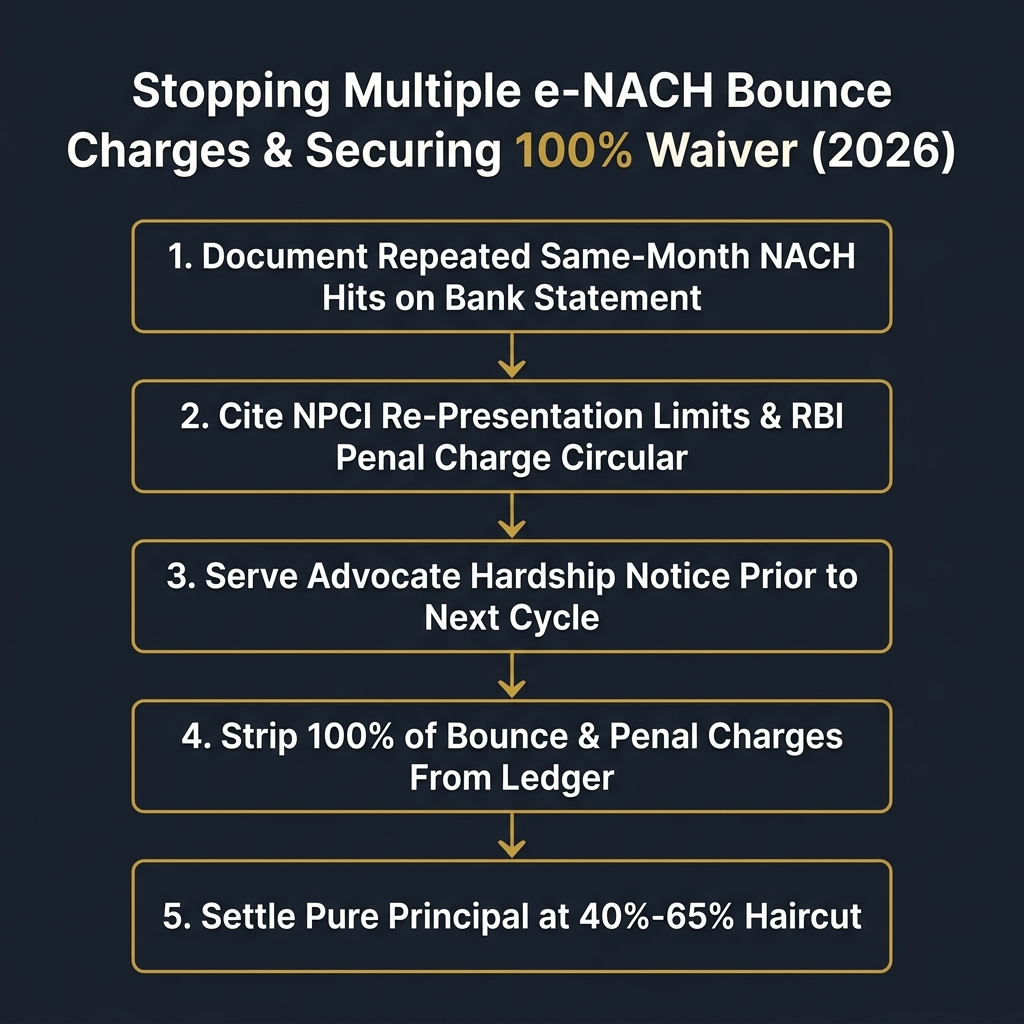
Prepared by AMA Legal Solutions Research & Analytics Team • Data & Compliance Overview

Halt Recovery Agent Harassment Legally
Step-by-Step Guide to Auditing and Disputing Unlawful Bank Return Charges vs. Lender Dishonour Penalties
Conducting a forensic statement audit is the primary procedural step in multiple e nach bounce charges harassment rbi rules and loan settlement when building an unassailable borrower defense. If your bank account has been drained by repeated bounce charges, you must execute a methodical, legally documented counter-offensive.
Step 1: Download and Segregate the Dual Ledger Statements
Obtain two distinct documents covering the entire default period: (a) your complete Savings/Current Bank Account Statement from your home branch, and (b) the comprehensive Loan Statement of Account (SOA) directly from the lending institution. Cross-reference every single debit hit:
- Highlight every entry labeled "ACH Ret", "NACH Return Charges", "ECS Inward Return", "Mandate Bounce Fee", or "Debit Return Penalty".
- Calculate the exact number of presentations executed for each calendar month. Any count exceeding three attempts (or any attempts spaced closer than 3 business days) constitutes direct evidence of an NPCI velocity violation.
- Calculate the total amount deducted by your savings bank versus the total fees debited on the lender's loan ledger.
Step 2: Serve a Formal Demand Notice on Your Host Bank
Your savings bank has a statutory fiduciary duty to protect your deposits against unauthorized or abusive clearing operations. Draft and submit a formal representation to your bank's Branch Manager and Principal Nodal Officer stating:
- The lender exceeded NPCI clearing limits by submitting repeated debit files without mandatory cooling intervals.
- The bank failed to transmit the mandatory 24-hour pre-debit notification required under the RBI E-Mandate Framework.
- Demand an immediate refund and reversal of all inward return charges resulting from unauthorized re-presentations within seven working days.
Step 3: Escalate to the RBI Integrated Ombudsman Scheme (CMS Portal)
If your bank or NBFC fails to refund the charges or continues permitting predatory re-presentations within 30 days, file an immediate statutory complaint on the RBI Complaint Management System (cms.rbi.org.in). Citing our resource on filing an RBI complaint against bank malpractice, lodge your grievance under the following grounds:
- Non-adherence to RBI Instructions on Fair Lending Practices (Circular DoR.MCS.REC.28).
- Breach of NPCI NACH Procedural Guidelines on presentation velocity and customer consent.
- Violation of Section 8 of the RBI Integrated Ombudsman Scheme, 2021 (deficiency in banking service and unjust enrichment).
The RBI Ombudsman wields statutory authority to direct commercial banks to reverse 100% of wrongful inward return charges and award compensation of up to Rs. 1,00,000 for mental agony and harassment caused by systemic service deficiencies.
Should You Cancel or Stop Your e-NACH Mandate? Navigating Section 25 PASSA Risks Safely With an Advocate
Evaluating whether to stop a recurring mandate under multiple e nach bounce charges harassment rbi rules and loan settlement requires balancing Section 25 PASSA liabilities against immediate account drainage. When faced with relentless Rs. 590 deductions, many borrowers instinctively log into their net banking portal and click "Cancel Mandate" or "Stop Payment". While this instantly halts automated withdrawals, doing so without legal representation can trigger serious criminal exposure.
1. Understanding Section 25 of the Payment and Settlement Systems Act, 2007 (PASSA)
Under Indian law, electronic debits are protected by criminal enforcement provisions identical to cheque bounce laws. Section 25 of the Payment and Settlement Systems Act, 2007 states that where an electronic funds transfer initiated through an authorized payment system fails due to insufficiency of funds or because it exceeds the amount arranged to be paid, the payer is deemed to have committed a criminal offence punishable by imprisonment for a term of up to two years, or with a fine which may extend to twice the amount of the electronic funds transfer, or with both.
When you stop a mandate or allow it to bounce repeatedly, institutional lenders routinely issue a formal 30-Day Demand Notice under Section 25(1)(b) of the Act. If you fail to discharge the full demanded sum within 15 days of receiving the notice, the lender files a formal criminal complaint before the Metropolitan Magistrate or Judicial Magistrate First Class (JMFC). Review our dedicated analysis on Section 25 Payment and Settlement Act legal defense to understand your rights before criminal summons are issued.
2. The Advocate-Guided Protective Revocation Protocol
To safely stop automated account drainage without exposing yourself to avoidable criminal prosecution, AMA Legal Solutions deploys a sophisticated, legally sound three-step protective protocol:
- Establish Documented Financial Hardship: Prior to mandate cancellation, our advocates serve an official representation upon the lender's Credit Committee and Nodal Officer, placing your financial distress (job loss, business closure, medical crisis) on the formal record. This completely destroys any prosecutorial allegation of "fraudulent or dishonest intention from inception".
- Formal Notice of Mandate Revocation & Alternative Mode Request: We invoke the borrower's unconditional right under the RBI E-Mandate Framework to cancel recurring authorizations, explicitly notifying the lender that automated debit facilities are withdrawn to prevent unlawful bounce multiplication. Crucially, the notice formally requests the lender to provide an alternative, manual payment mechanism (such as NEFT/RTGS or virtual account transfer) once compromise terms are finalized.
- Immediate Transition to One-Time Settlement (OTS): Mandate cancellation is never done in isolation. It is immediately paired with a structured, advocate-negotiated compromise proposal. Once the lender understands that the borrower is represented by senior banking counsel who is actively pursuing a formal settlement, the bank halts criminal filings and enters good-faith negotiations.
How AMA Legal Solutions Demands a 100% Waiver of All Bounce, Late, and Penal Charges During One-Time Settlement (OTS)
At AMA Legal Solutions, our core mandate during multiple e nach bounce charges harassment rbi rules and loan settlement is securing a 100% waiver of all bounce charges, late fees, and compounding penalties, ensuring our clients pay only a deeply discounted portion of their genuine, uninflated principal balance. When individual borrowers attempt to negotiate with recovery tele-callers on their own, the collection agent invariably insists that "all system-generated bounce charges must be cleared first before any settlement can be considered." This is an aggressive collection tactic with zero statutory backing.
1. Forensic Balance Reconstruction
When our senior legal team takes over your portfolio—whether you are dealing with HDFC Bank, ICICI Bank, Axis Bank, SBI, Kotak Mahindra Bank, Bajaj Finance, or an IDFC Bank loan settlement—we perform a comprehensive forensic reconstruction of your loan ledger:
- We isolate the authentic original disbursed principal.
- We verify every rupee paid toward principal and contractual interest prior to default.
- We mathematically strip 100% of all accumulated inward return charges, lender dishonour penalties, late payment charges, and capitalized interest components.
- We establish the true, unburdened net principal balance. You can estimate your potential settlement range using our loan settlement amount calculator.
2. Deploying RBI's Compromise Settlement Framework
By converting toxic operational claims into clean One-Time Settlements, multiple e nach bounce charges harassment rbi rules and loan settlement delivers lasting financial recovery backed by statutory authority. Under the Reserve Bank of India's Framework for Compromise Settlements and Technical Write-offs (Circular DOR.STR.REC.20/21.04.048/2023-24), all regulated lending institutions possess clear board-approved mandates to write off uncollectible interest, waive 100% of penal and operational charges, and accept substantial haircuts on the underlying principal balance for non-performing accounts.
Our advocates present an ironclad Settlement Dossier to the bank's Senior Zonal Settlement Committee, proving that forcing the borrower into endless bounce cycles violates RBI Fair Practices and that a structured One-Time Settlement is the most prudent commercial resolution for the institution. We negotiate a legally binding, single or multi-tranche OTS Agreement that locks in a 40% to 65% principal haircut, completely waives hundreds of accumulated bounce fees, and guarantees the issuance of an official, unconditional No Dues Certificate (NDC) alongside clean closure reporting to CIBIL, Experian, Equifax, and CRIF High Mark.
Strategic Conclusion: Stop Account Drainage and Settle Your Principal Debt Today
Taking decisive legal action against multiple e nach bounce charges harassment rbi rules and loan settlement restores borrower dignity and ends banking exploitation permanently. Financial distress is a temporary economic misfortune, not a civil crime. When commercial banks and fintech lenders deploy automated algorithms to repeatedly strike your bank account with Rs. 590 penalties, they are not engaging in lawful debt recovery—they are exploiting technical automation to strip away your last remaining financial lifeline.
You do not have to endure sleepless nights watching your hard-earned salary swallowed by predatory bounce charges, nor do you have to live in fear of abusive recovery tele-callers threatening police action or Section 25 PASSA criminal cases. The law provides comprehensive, unshakeable protections through NPCI debit velocity caps, RBI Fair Lending Directives, the Banking Ombudsman mechanism, and the statutory right to compromise settlement.
At AMA Legal Solutions, our experienced banking and debt resolution advocates stand between you and aggressive institutional lenders. We put an immediate end to unlawful mandate hits, audit and challenge fraudulent statement penalties, shield you against civil litigation and criminal complaints, and negotiate an affordable, dignified One-Time Settlement that permanently wipes your debt slate clean.
If your bank account is currently being drained by multiple e-NACH or UPI Autopay bounce charges, do not wait for your balance to spiral further into negative territory. Explore our specialized loan settlement services, understand your broader statutory safeguards under loan settlement in India, and contact AMA Legal Solutions today to schedule an immediate, confidential strategy session with our senior legal team. Let us defend your financial livelihood and guide you safely back to debt freedom.
Popular Searches & Topics
Commonly searched legal queries and keywords related to this article
Need Strategic Legal Defense for Your Situation?
Our banking & litigation advocates review your notices, debt liability, and recovery issues under complete advocate-client secrecy.
References & Authority
- Reserve Bank of India (RBI) - Circular on Fair Lending Practice - Penal Charges in Loan Accounts (DoR.MCS.REC.28/01.01.001/2023-24 & DoR.MCS.REC.61/01.01.001/2023-24)
- National Payments Corporation of India (NPCI) - Procedural Guidelines for National Automated Clearing House (NACH) & Circulars on Debit Return Management (NPCI/2023-24/NACH/007 & 014)
- Reserve Bank of India (RBI) - Framework for Processing of e-mandates for Recurring Transactions (DPSS.CO.PD.No.447/02.14.003/2019-20 & Updates)
- Payment and Settlement Systems Act, 2007 (Section 25 - Dishonour of Electronic Funds Transfer) - India Code
- Reserve Bank of India (RBI) - Master Direction on Fair Practices Code for Lenders (Recovery and Conduct Norms)
- Reserve Bank of India (RBI) - Framework for Compromise Settlements and Technical Write-offs (DOR.STR.REC.20/21.04.048/2023-24)
- Reserve Bank of India (RBI) - Integrated Ombudsman Scheme, 2021 (Complaint Management System)
- Consumer Protection Act, 2019 (Section 2(47) - Unfair Trade Practices) - India Code

AMA Legal Solutions
Trusted with a 4.7 Google Rating, over 10,000+ Clients Served, 25,000+ Cases Handled, and more than 40+ Years of Experience in providing strategic legal defense and debt resolution across India.
Our media coverages





Frequently Asked Questions
Related Articles
SAMA, Presolv360 & Cordis ODR Notice for Loan Default: Legal Defense & Settlement (2026)
Prevent ex-parte online arbitration awards and negotiate a 50%+ OTS on ODR portals.
Read Article
CIBIL Locate Plus Skip Tracing & Account Aggregator Consent Revocation (2026)
Learn how to revoke Account Aggregator consents and stop CIBIL skip tracing.
Read Article
Understanding Legal Notice: Key Aspects and Procedures in India (2026)
Explore essential insights and practical steps on issuing a legal notice effectively.
Read ArticleAbout Author
Anuj Anand Malik
View ProfileAnuj Anand Malik, Founder of AMA Legal Solutions, is a trusted advocate, loan settlement expert, legal advisor, and banking lawyer. With over a decade of experience in loan settlement, corporate law, financial disputes, and compliance, he leads a result-driven law firm based in India that helps individuals, startups, and businesses achieve legal and financial stability.
Connect on LinkedInNeed Legal Representation?
Evaluate your defense against recovery agents, notices, or structure your loan settlement directly with Senior Advocates.
Call +91-8700343611