Understanding Legal Notice: Key Aspects and Procedures in India (2026)
Explore essential insights and practical steps on issuing a legal notice effectively.

Anuj Anand Malik
Reviewed by AMA Legal Solutions

Legal Notice in India: Meaning, Format, Types, Fees and How to Send One
A legal dispute can arise when someone refuses to repay money, breaches a contract, fails to fulfil an obligation, or interferes with your legal rights. Before taking the matter to court, you may need to consider sending a legal notice.
A legal notice is a formal written communication that informs another party about a grievance, explains the demand being made, and may provide an opportunity to resolve the dispute before further legal action is considered.
In India, a legal notice is mandatory in certain proceedings but not in every legal dispute. The applicable law, the nature of the claim, the terms of an agreement, and the relief sought determine whether a notice is required.
Whether you need a legal notice for money recovery, breach of contract, property disputes, cheque dishonour, employment issues, or a business dispute, understanding the correct procedure can help you avoid unnecessary legal complications.
In this guide, AMA Legal Solutions explains the meaning of a legal notice, when it is required, how to draft and send one, its format, the factors affecting its cost, and what to do if the recipient ignores it.
What Is a Legal Notice?
A legal notice is a formal written communication sent by an individual, business, company, or authorised legal representative to inform another party of a grievance, demand compliance with an obligation, seek payment, or communicate the intention to pursue an appropriate legal remedy.
For example, if someone borrows ₹2 lakh and fails to repay it despite repeated requests, the lender may consider sending a legal notice demanding repayment. Similarly, a business may issue a notice when a customer fails to pay an invoice or a contractual partner breaches an agreement.
A legal notice does not automatically establish liability or guarantee a favourable outcome. Its purpose and legal effect depend on the facts, the applicable law, and the requirements of the particular dispute.
Why Is a Legal Notice Important?
A properly drafted legal notice can help you:
Communicate your grievance: Explain what happened and why you believe your rights have been affected.
Make a formal demand: Specify the payment, action, or compliance you are seeking.
Create a written record: Document the demand and the opportunity provided to resolve the dispute.
Explore settlement: Give the other party an opportunity to respond or negotiate where appropriate.
Prepare for further legal action: Clarify the issues and organise the supporting evidence.
A legal notice should be based on accurate facts and a legally appropriate demand. Sending one is not a substitute for assessing the merits of your claim.
Is a Legal Notice Mandatory Before Filing a Case in India?
No. A legal notice is not compulsory before every court case in India. The requirement depends on the applicable legislation, the nature of the dispute, any contractual conditions, and the remedy being pursued.
1. When a Legal Notice Is Mandatory
Certain laws require notice before a specific legal proceeding can be initiated.
Section 80 of the Code of Civil Procedure, 1908
Section 80 generally requires two months' prior written notice before filing a suit against the Government or a public officer for an act covered by the provision. An exception exists for certain urgent matters, where a suit may be instituted with the court's leave, subject to the statutory conditions.
Section 138 of the Negotiable Instruments Act, 1881
In qualifying cheque dishonour cases, the payee or holder must issue a written demand notice within 30 days of receiving information from the bank regarding dishonour. The drawer then has 15 days from receipt of the notice to make payment. Additional statutory conditions and limitation requirements apply before a complaint can be filed.
These deadlines are important, and an ordinary demand letter should not automatically be assumed to satisfy a statutory notice requirement.
2. When a Legal Notice Is Advisable
A legal notice may be useful in many civil and commercial disputes, even when it is not generally mandatory.
Examples include:
Recovery of money or unpaid loans.
Unpaid invoices and business dues.
Breach of contract.
Property-related disputes.
Certain consumer complaints and refund disputes.
Employment-related claims.
Disputes concerning contractual obligations.
The relevant agreement and applicable legislation should be checked because some disputes have specific notice requirements.
3. When You May Proceed Without a Legal Notice
Some criminal complaints, urgent applications, writ proceedings, and matrimonial matters may be initiated without a prior private legal notice, depending on the circumstances and applicable law.
The absence of a general notice requirement does not mean that notice is unnecessary in every case. Before proceeding, verify whether a statute, agreement, or procedural rule requires it.
Types of Legal Notices in India
The appropriate legal notice depends on the nature of the dispute and the relief being sought.
1. Legal Notice for Money Recovery
A legal notice for money recovery may be considered when a person, borrower, customer, or business fails to pay an amount that is legally due.
It may relate to an unpaid loan, business transaction, invoice, contractual payment, or another recoverable debt.
The notice should identify the transaction, amount claimed, relevant payment obligations, supporting evidence, and the action requested.
2. Legal Notice for Breach of Contract
A breach-of-contract notice may be appropriate when one party fails to fulfil an obligation under an agreement.
Examples include non-payment, failure to deliver goods, non-performance of services, or failure to comply with agreed contractual terms.
Depending on the agreement and applicable law, the notice may seek performance, corrective action, payment, compensation, or another appropriate remedy.
For related assistance, explore AMA Legal Solutions' legal services.
3. Legal Notice for Property Disputes
Property-related notices may concern unpaid consideration, possession, contractual obligations, interference with property rights, or other disputes.
Such matters may require examination of sale deeds, agreements, ownership records, payment documents, and correspondence. The correct legal approach depends on the nature of the property dispute and the remedy sought.
4. Legal Notice for Cheque Dishonour
A notice under Section 138 of the Negotiable Instruments Act is a statutory demand notice relating to qualifying cheque dishonour cases.
The requirements concerning the cheque, underlying liability, bank communication, service of the notice, payment period, and filing deadline must be carefully observed.
5. Legal Notice for Employment Disputes
Employment-related notices may concern unpaid salary, contractual dues, disputed termination, breach of employment terms, or other workplace issues.
The correct procedure depends on the employment arrangement, relevant labour laws, contractual terms, and the nature of the claim.
6. Legal Notice for Consumer Disputes
A consumer-related notice may address defective goods, deficient services, non-delivery, unresolved refunds, or another consumer grievance.
A notice may help communicate the complaint and requested resolution, but it is not a mandatory prerequisite for every consumer complaint.
7. Legal Notice for Business and Commercial Disputes
Businesses may send legal notices concerning unpaid invoices, commercial contracts, supply agreements, service agreements, or other business obligations.
Depending on the dispute, the applicable contract may prescribe notice periods, methods of service, or dispute-resolution procedures.
Legal Notice Format in India
A legal notice should clearly state the relevant facts, grievance, demand, and applicable legal or contractual basis. The following is a general illustration for an ordinary civil demand, not a universal statutory format.
LEGAL NOTICE
Date: [Insert date]
From:
[Name and address of sender]
To:
[Name and address of recipient]
Subject: Legal notice regarding [nature of dispute]
Dear Sir/Madam,
That my client, [name], states that [describe the relevant transaction, agreement, or relationship].
That on [date], [describe the material events and obligations, referring to relevant documents where appropriate].
That despite [describe previous requests or communications], the matter remains unresolved because [state the factual basis of the grievance].
That you are hereby called upon to [specify the payment, action, or remedy sought] within [insert the appropriate or legally prescribed period, where applicable].
That if the matter is not resolved within the applicable period, my client reserves the right to pursue such legal remedies as may be available under applicable law.
This notice is issued without prejudice to my client's rights and remedies available under applicable law.
Yours faithfully,
[Name and signature]
[Sender or authorised advocate, as applicable]
Important: Statutory notices may require specific wording, time limits, and methods of service. Obtain legal advice where necessary before using a template.
How to Send a Legal Notice in India: Step-by-Step Process
Sending a legal notice requires more than preparing a letter. The facts, supporting documents, recipient details, and applicable legal requirements must be reviewed.
Step 1: Identify the Legal Issue
Determine what happened, which obligation was allegedly breached, and what you want the recipient to do.
For example, a demand for repayment may require a different approach from a notice concerning property rights or contractual performance.
Step 2: Check the Applicable Law and Deadline
Determine whether the notice is mandatory, whether a prescribed format or method of service applies, and whether a statutory deadline must be met.
Do not assume that sending a notice automatically extends the limitation period for filing a case.
Step 3: Collect Supporting Documents
Gather relevant agreements, invoices, receipts, bank statements, payment records, emails, messages, and previous correspondence.
The notice should be consistent with the available evidence.
Step 4: Draft the Legal Notice
Set out the relevant facts chronologically, identify the grievance, state the demand, and refer to the applicable legal or contractual provisions where appropriate.
Avoid unsupported allegations, exaggerated claims, and demands without a proper legal basis.
Step 5: Verify the Recipient's Details
Check the recipient's name, address, and identity. If the recipient is a company, ensure the correct legal entity is identified.
Step 6: Send the Notice
Depending on the circumstances and applicable law, the notice may be sent through registered post, speed post, courier, or another appropriate method.
Where a law prescribes a particular mode of service, that requirement must be followed.
Step 7: Preserve Proof of Service
Keep a copy of the notice, dispatch receipt, tracking details, acknowledgement, returned envelope, and relevant electronic records.
Step 8: Decide the Next Step
The recipient may comply, negotiate, dispute the allegations, send a reply, or remain silent.
Review the response and consider the appropriate remedy based on the facts and applicable law.
Can You Send a Legal Notice Online?
Yes. Several stages of the process can be completed online, including consultation, document sharing, reviewing a draft, communicating with an advocate, and coordinating dispatch.
However, preparing a notice online does not remove the need to comply with legal requirements. The notice must be accurate, addressed correctly, served appropriately, and issued within any applicable statutory deadline.
Electronic communication should not automatically be treated as a substitute for a prescribed method of service.
Can You Send a Legal Notice Without a Lawyer?
In many ordinary civil disputes, an individual can prepare and send a legal notice without engaging an advocate. However, self-drafting may not be appropriate for every matter.
Professional legal review may be particularly useful for:
Statutory notices with strict deadlines.
High-value money recovery claims.
Commercial and contractual disputes.
Property ownership or possession disputes.
Contract termination and compensation claims.
Notices that may lead to court proceedings.
The objective is not simply to send a notice, but to ensure that it accurately reflects the facts, identifies the correct legal basis, and seeks an appropriate remedy.
How Much Does a Legal Notice Cost in India?
There is no single fixed fee for every legal notice. The cost depends on the complexity of the dispute, the amount involved, the documents requiring review, and the professional services engaged.
Possible costs include:
Initial legal consultation.
Document review.
Drafting and revision.
Advocate's professional fee.
Printing, postage, courier, or dispatch expenses.
Additional work if the matter continues.
A straightforward payment demand may require less work than a complex commercial or property dispute.
Before engaging a service provider, clarify what the fee includes and whether revisions, dispatch, replies, or further proceedings are charged separately.
For assistance with your matter, visit the official AMA Legal Solutions website.
Key Insights & Data Infographic
Visual summary, statistical trends & procedural breakdown
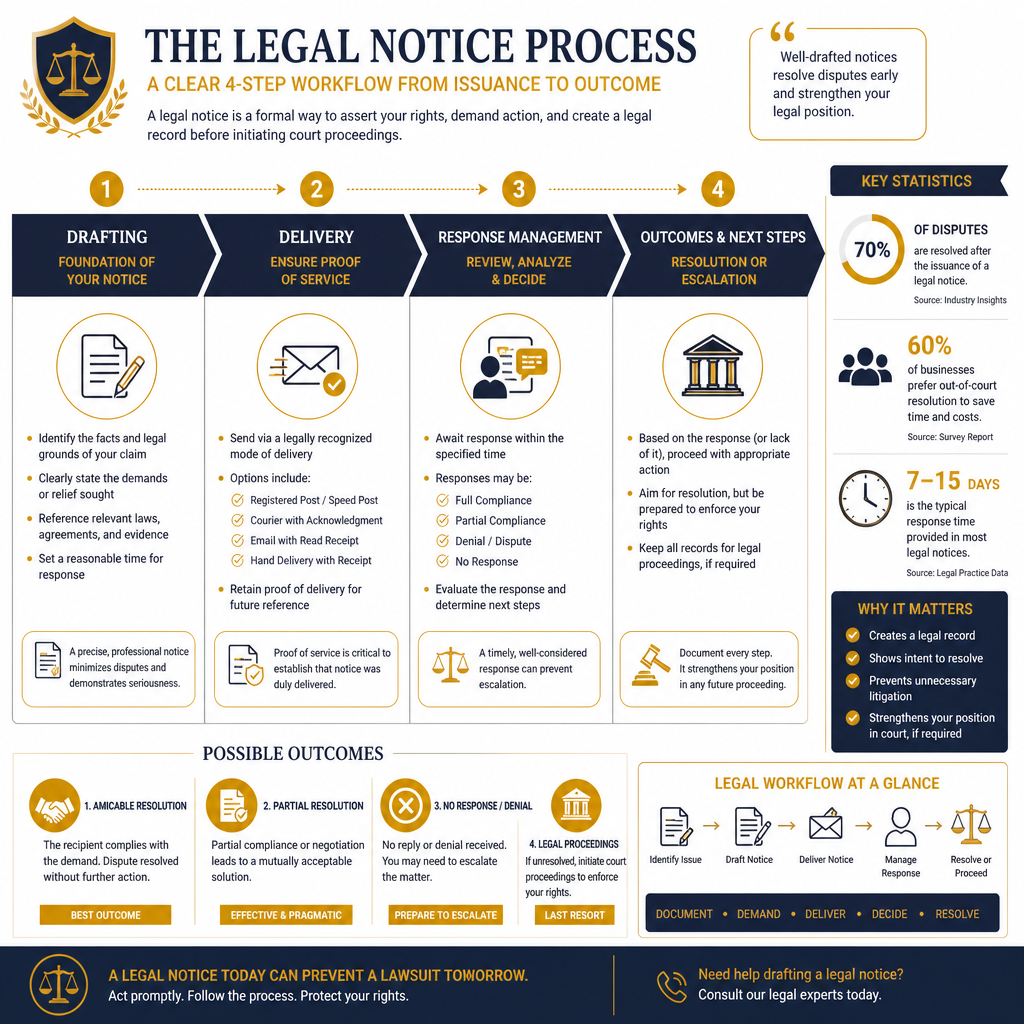
Prepared by AMA Legal Solutions Research & Analytics Team • Data & Compliance Overview

Halt Recovery Agent Harassment Legally
What Happens After a Legal Notice Is Sent?
After a notice is served, the recipient may respond in different ways.
The recipient complies: The recipient may pay the amount demanded or fulfil the obligation, potentially resolving the dispute.
The recipient negotiates: The parties may agree on payment terms, instalments, a settlement, or another resolution. Any agreement should be documented clearly.
The recipient disputes the allegations: The response should be reviewed against the available evidence and applicable law.
The recipient ignores the notice: Silence does not automatically establish liability. The sender should assess the evidence, service records, limitation period, and available legal remedies.
The matter proceeds to legal action: If the dispute remains unresolved, the appropriate legal remedy may be considered, subject to the applicable law and procedural requirements.
What Should You Do If You Receive a Legal Notice?
Receiving a legal notice does not automatically mean that a court case has been filed or that you have been found liable. However, it should be taken seriously.
Read the notice carefully and identify the allegations and demands.
Verify the facts against your agreements, payment records, and correspondence.
Check any statutory or procedural deadlines.
Preserve the notice, envelope, and supporting documents.
Obtain legal advice where the consequences may be significant.
Prepare an appropriate response based on the facts and applicable law.
A reply may deny incorrect allegations, clarify the facts, raise legal objections, or propose a resolution where appropriate.
Do not ignore a statutory deadline or admit liability without understanding the consequences.
For matters involving contractual or financial disputes, you can explore AMA Legal Solutions' services to identify the relevant area of legal assistance.
How to Reply to a Legal Notice
A reply should address the allegations accurately and explain the recipient's position based on the facts and applicable law.
Depending on the dispute, it may include:
A reference to the notice received.
Responses to the material allegations.
Relevant supporting documents.
Appropriate legal or contractual objections.
A clear statement of the recipient's position.
A proposed resolution, where suitable.
Not every notice requires the same response. A reply should not be drafted merely to deny every allegation or make counter-threats. It should be tailored to the actual dispute.
Does Sending a Legal Notice Stop the Limitation Period?
Generally, sending an ordinary legal notice does not automatically suspend, stop, or extend the limitation period for filing a case.
The effect of a notice, acknowledgement, payment, or other communication depends on the applicable law and circumstances. Specific statutory provisions may produce different consequences.
Do not postpone legal action simply because a notice has been sent or the recipient has requested additional time to respond.
Legal Notice vs Court Summons: What Is the Difference?
Basis | Legal Notice | Court Summons |
|---|---|---|
Purpose | Communicates a grievance or demand | Requires a person to appear or respond in proceedings |
Issued by | A party or authorised representative | A court through the applicable procedure |
Stage | Often used before litigation | Connected with formal proceedings |
Legal effect | Does not itself establish that a case has been filed | Indicates that the recipient must attend to the court proceedings |
Response | Depends on the notice and applicable law | Must follow the court's directions and applicable procedure |
A court summons should not be treated as an ordinary private demand letter. Check the issuing court, case details, and applicable response requirements promptly.
Common Mistakes to Avoid When Sending a Legal Notice
Avoid these common mistakes:
Using a generic template without checking the facts.
Addressing the wrong person or legal entity.
Citing an incorrect legal provision or deadline.
Making unsupported factual allegations.
Making vague or legally inappropriate demands.
Using an arbitrary response period where a specific legal period applies.
Assuming that a notice extends the limitation period.
Failing to preserve proof of dispatch and service.
Assuming that silence establishes liability.
Threatening legal action without assessing the available remedy.
A carefully drafted notice should communicate a clear legal position and remain consistent with the supporting evidence.
How AMA Legal Solutions Can Help With Legal Notice Drafting
AMA Legal Solutions provides legal assistance to individuals and businesses dealing with contractual obligations, financial disputes, money recovery, and other legal matters.
Depending on the facts and the scope of engagement, assistance may include:
Reviewing the dispute and supporting documents.
Assessing whether a legal notice is necessary or advisable.
Drafting a legal notice based on the facts and applicable law.
Preparing a reply to a legal notice received.
Advising on negotiations and potential settlement.
Evaluating possible next steps if the dispute remains unresolved.
Our legal services cover areas including civil law, corporate law, banking and finance, arbitration, and related disputes. You can also explore our legal notice drafting and reply services for further information.
The appropriate service and fee depend on the nature and complexity of the matter. No particular legal outcome can be guaranteed.
Need help drafting or replying to a legal notice?
Visit AMA Legal Solutions to discuss your requirements and understand the options available for your matter.
Frequently Asked Questions About Legal Notices in India
1. What is a legal notice in simple words?
A legal notice is a formal written communication that informs another party about a grievance, demand, or legal issue. It may seek payment, compliance with an obligation, or resolution before further legal remedies are pursued.
2. Is a legal notice mandatory before filing a case?
No. A legal notice is not mandatory before every case. Certain laws prescribe notice requirements, while many ordinary civil disputes do not generally require prior notice.
3. How do I send a legal notice?
Identify the dispute, check the applicable law and deadlines, collect supporting documents, draft the notice, verify the recipient's details, and use an appropriate method of service. Keep the notice and proof of dispatch.
4. Can I send a legal notice without a lawyer?
Yes, in many ordinary civil matters. However, legal review may be advisable for statutory notices, complex disputes, substantial claims, or matters involving strict deadlines.
5. How much does a legal notice cost in India?
The cost varies according to the complexity of the dispute, document review, drafting requirements, advocate's professional fee, and dispatch expenses.
6. What happens if someone ignores a legal notice?
Ignoring a notice does not automatically establish liability. The sender should review the evidence, limitation period, and appropriate legal remedy before deciding what to do next.
7. Can I reply to a legal notice myself?
You may respond independently in appropriate cases. However, the reply should address the allegations accurately and preserve any relevant legal objections or defences.
8. Can a legal notice be sent through email or WhatsApp?
Electronic communication may be appropriate in some circumstances, but it should not automatically be treated as satisfying every legal notice requirement. Any prescribed mode of service must be considered.
9. Does a legal notice guarantee money recovery?
No. A legal notice may encourage compliance or facilitate settlement, but recovery depends on the merits of the claim, the evidence, the recipient's response, and the remedies available.
10. Does a legal notice mean that a court case has been filed?
No. A private legal notice does not by itself mean that a case has been filed. Court proceedings follow the applicable filing and procedural requirements.
11. Can a company send a legal notice to another company?
Yes. Companies may issue notices concerning unpaid invoices, contractual breaches, commercial transactions, and other disputes, subject to applicable law and contractual requirements.
12. Can I take legal action without sending a final notice?
In some matters, yes. A separate final notice is not universally required. The applicable statute, agreement, procedural rules, and urgency of the matter should be reviewed first.
Conclusion
A legal notice can be an important step in communicating a demand, documenting a grievance, and exploring the possibility of resolving a dispute before further legal proceedings. However, it is not mandatory or sufficient in every situation.
The correct approach depends on the facts, applicable law, supporting documents, method of service, and relevant limitation period.
Before sending a legal notice or responding to one, assess the legal requirements and the remedies available. Where the matter is complex or involves a statutory deadline, professional legal advice can help you make a more informed decision.
AMA Legal Solutions assists individuals and businesses with legal notice drafting, replies, and related legal matters. Visit amalegalsolutions.com to learn more.
Disclaimer: This article is for general informational purposes and does not constitute legal advice. The applicable law and procedure may depend on the facts and relevant legislation. Obtain advice specific to your circumstances before taking legal action.
Need Strategic Legal Defense for Your Situation?
Our banking & litigation advocates review your notices, debt liability, and recovery issues under complete advocate-client secrecy.

AMA Legal Solutions
Trusted with a 4.7 Google Rating, over 10,000+ Clients Served, 25,000+ Cases Handled, and more than 40+ Years of Experience in providing strategic legal defense and debt resolution across India.
Our media coverages





Frequently Asked Questions
Related Articles

Co-Lending Loan Settlement Between Bank and NBFC in India (RBI 2026)
Confused why your single personal loan shows two different lenders on your CIBIL report (an 80% Bank share and a 20% Fintech NBFC share)? Understand RBI's 2026 Co-Lending & FLDG Directions and how to secure a legally binding OTS that closes both accounts.
Read Article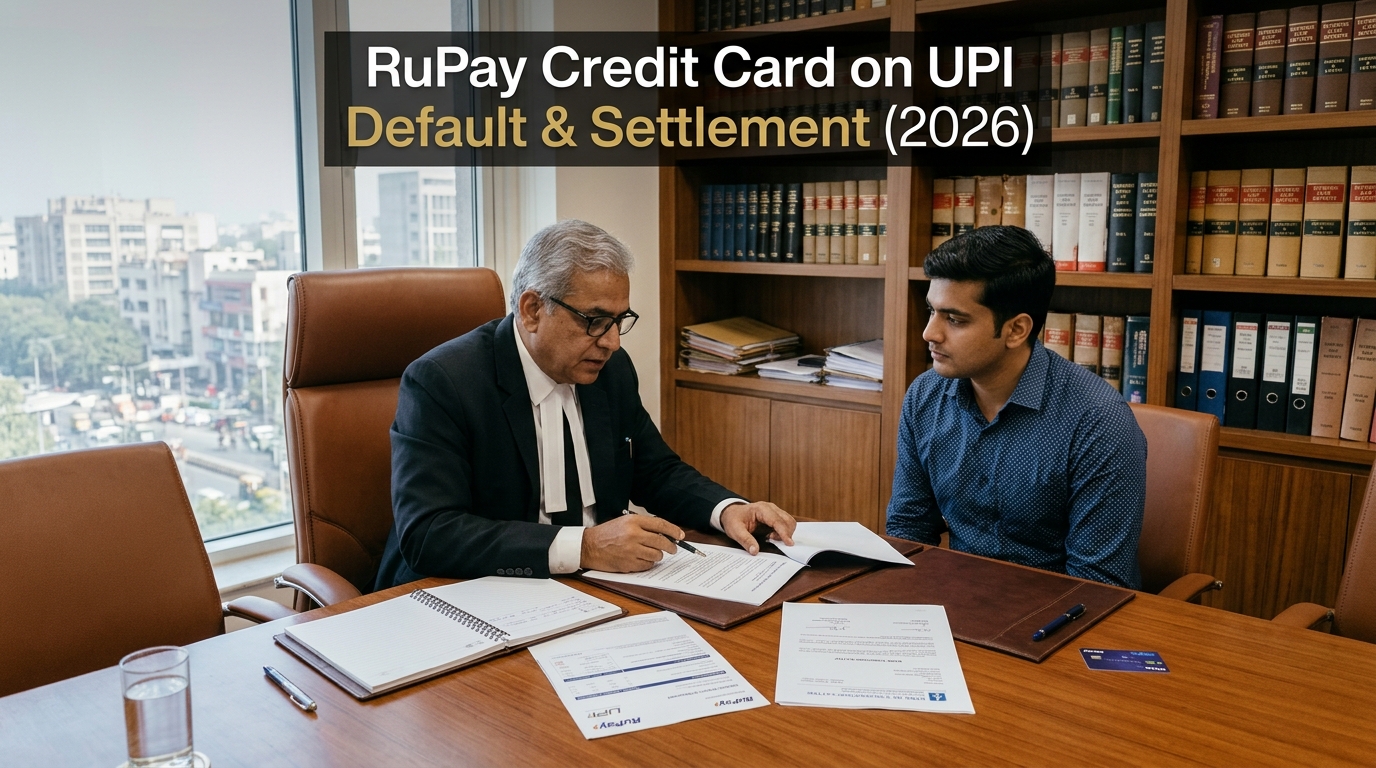
RuPay Credit Card on UPI Default & Credit Line on UPI Settlement (2026)
Micro-transactions on RuPay UPI Credit Cards and pre-approved 'Credit Lines on UPI' have triggered a massive wave of 42%+ APR revolving debt traps. Find out if defaulting blocks your personal savings UPI and how to settle RuPay UPI credit dues for 30%–50%.
Read Article
Paytm, PhonePe & BharatPe Daily EDI Merchant Loan Settlement (2026)
Drowning in Equated Daily Installment (EDI) merchant loans where 100% of your daily QR Soundbox collections are auto-swept before you can pay suppliers or rent? Learn how retail shopkeepers and MSMEs legally halt QR sweeps and negotiate a 50%+ OTS.
Read ArticleAbout Author
Anuj Anand Malik
View ProfileAnuj Anand Malik, Founder of AMA Legal Solutions, is a trusted advocate, loan settlement expert, legal advisor, and banking lawyer. With over a decade of experience in loan settlement, corporate law, financial disputes, and compliance, he leads a result-driven law firm based in India that helps individuals, startups, and businesses achieve legal and financial stability.
Connect on LinkedInNeed Legal Representation?
Evaluate your defense against recovery agents, notices, or structure your loan settlement directly with Senior Advocates.
Call +91-8700343611