Co-Lending Loan Settlement Between Bank and NBFC in India (RBI 2026)
Confused why your single personal loan shows two different lenders on your CIBIL report (an 80% Bank share and a 20% Fintech NBFC share)? Understand RBI's 2026 Co-Lending & FLDG Directions and how to secure a legally binding OTS that closes both accounts.

Anuj Anand Malik
Reviewed by AMA Legal Solutions
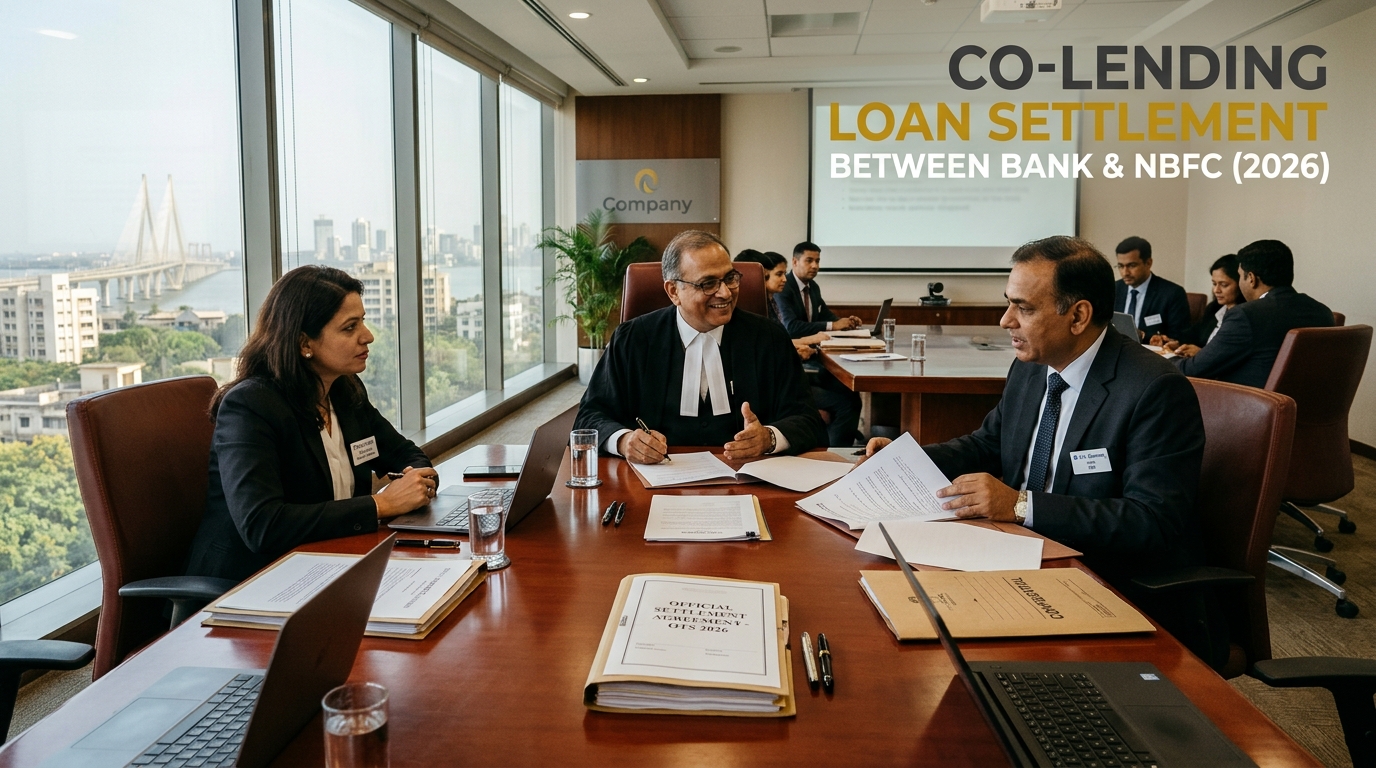
Key Takeaways: Securing a legally binding co lending loan settlement between bank and nbfc in india requires navigating one of the most structurally complex, multi-layered credit ecosystems in the history of Indian retail finance. Borrowers who apply for personal loans via popular fintech platforms like KreditBee, MoneyView, Fibe, Navi, or LazyPay often believe they borrowed from a single app. In reality, under the Reserve Bank of India (RBI) Co-Lending Model (CLM) and the updated 2025/2026 Co-Lending Arrangements Directions, 80% of the loan capital is funded by a major Scheduled Commercial Bank (such as State Bank of India, Bank of Baroda, Federal Bank, or IDFC FIRST Bank) while only 20% (or minimum 10%) is held by the originating NBFC (such as KrazyBee, Whizdm, EarlySalary, or Northern Arc). When default strikes, borrowers discover two separate active Loan Account Numbers (LANs) on their TransUnion CIBIL reports for a single credit facility. If you negotiate an informal settlement directly on the fintech app, you risk paying a partial compromise that clears only the NBFC's 20% exposure—leaving the partner bank's 80% balance active, compounding, and reporting as 'Overdue/NPA' for years! Under RBI's 2026 regulatory framework and the 5% Default Loss Guarantee (DLG/FLDG) caps, lenders are legally mandated to maintain a single-point customer interface and synchronized asset classification. Through professional loan settlement services at AMA Legal Solutions, borrowers can pierce this corporate ping-pong trap, demand unified tripartite settlement sanction letters, obtain consolidated No Dues Certificates (NDCs), and secure complete tradeline erasure across all credit bureaus.
Introduction: Why Co-Lending Loan Settlement Between Bank and NBFC Is India's Most Misunderstood Debt Problem
Over the past half-decade, the digital lending revolution across India has been propelled by a quiet yet massive structural synergy between traditional Scheduled Commercial Banks and agile fintech Non-Banking Financial Companies (NBFCs). For the end consumer sitting in Bengaluru, Mumbai, Delhi-NCR, Pune, or Hyderabad, the borrowing experience feels seamless: you download an application such as KreditBee, MoneyView, Fibe (formerly EarlySalary), Navi, or PayMe India, complete Video KYC in four minutes, punch in your Aadhaar and PAN, and receive Rs. 2,00,000 directly into your salary account within an hour.
However, beneath that polished smartphone user interface lies a sophisticated, syndicated financial contract known as a Co-Lending Arrangement (CLA). Under guidelines formulated by the Reserve Bank of India, commercial banks (which possess low-cost CASA deposit liquidity but lack digital underwriting agility at the grassroots level) join hands with fintech NBFCs (which possess algorithmic credit-scoring models and digital distribution networks). In standard practice, the partner bank funds 80% of the principal loan amount, while the originating NBFC funds the remaining 20% (or under the 2025/2026 directions, a minimum of 10% risk retention on each lender's balance sheet).
As long as the borrower makes regular monthly Equated Monthly Installments (EMIs) via auto-debit (e-NACH), the split architecture remains invisible. The borrower pays into a designated escrow account, and the backend automated clearing house splits the cash flow: 80 paise of every principal rupee flows to the bank, and 20 paise flows to the NBFC. But the moment the borrower suffers an economic catastrophe—such as unexpected corporate layoffs, a medical emergency, business insolvency, or family bereavement—the entire facade crumbles.
When an installment is missed, the borrower does not encounter a single, empathetic institutional lender. Instead, they enter a jurisdictional hall of mirrors where executing a successful co lending loan settlement between bank and nbfc in india becomes an administrative and legal nightmare. Defaulters find themselves harassed by third-party tele-calling agencies retained by the fintech app, while simultaneously receiving harsh statutory demand notices from the partner public-sector or private-sector bank. More alarmingly, when borrowers attempt to resolve their dues, the fintech app claims it cannot modify terms without the bank's written board approval, while branch managers at the bank claim they have zero record of the borrower in their retail branch database because the loan was originated digitally through an API integration!
At AMA Legal Solutions, our banking litigation attorneys have resolved thousands of complex non-performing retail and MSME loans across India. We have witnessed firsthand how innocent borrowers are duped into paying partial settlements that leave them legally exposed to ongoing civil recovery and ruined credit scores. In this definitive 2026 legal treatise, Senior Advocate Anuj Anand Malik demystifies the regulatory architecture of co-lending, breaks down RBI's latest circulars, exposes the dangerous traps of dual CIBIL reporting, and details the exact statutory protocol to execute a comprehensive, single-window co lending loan settlement between bank and nbfc in india.
Why One Loan Shows Up Twice on Your CIBIL Report: The 80:20 Bank–NBFC Co-Lending Architecture Explained
The single most alarming discovery made by borrowers facing delinquency on a fintech personal loan occurs when they download their official credit information report from TransUnion CIBIL, Experian, Equifax, or CRIF High Mark. Instead of seeing a single unsecured personal loan corresponding to the Rs. 3,00,000 they disbursed through their mobile app, they see two distinct, active credit facilities reporting simultaneously:
- Tradeline 1: An unsecured personal loan issued by the fintech NBFC (e.g., KrazyBee Services Pvt Ltd, Whizdm Finance Pvt Ltd, Earlysalary Services Pvt Ltd, or Northern Arc Capital) with a sanctioned limit equal to 20% of the total loan (e.g., Rs. 60,000).
- Tradeline 2: An unsecured personal loan issued by a Scheduled Commercial Bank (e.g., Central Bank of India, Bank of Baroda, Punjab National Bank, Federal Bank, or IDFC FIRST Bank) with a sanctioned limit equal to 80% of the total loan (e.g., Rs. 2,40,000).
Both tradelines reflect the exact same disbursal date, identical repayment tenures, and overlapping payment histories. Yet, to the credit scoring algorithms governing Indian credit bureaus, the borrower appears to have taken two separate loans totaling Rs. 3,00,000, skewing their credit utilization ratio and artificially depressing their CIBIL score. Why does this occur?
1. Statutory Independence Under CICRA, 2005
Under Section 15 and Section 17 of the Credit Information Companies (Regulation) Act, 2005 (CICRA), every Regulated Entity (RE)—whether a Scheduled Commercial Bank, a Small Finance Bank, or a registered Non-Banking Financial Company—is legally classified as a distinct credit institution. By statutory mandate, every credit institution is obligated to submit monthly Member Data submissions to all four licensed credit bureaus, detailing the precise balance sheet exposure held on its books.
Because co-lending is a risk-sharing arrangement where both lenders deploy capital directly from their own balance sheets, neither institution is legally permitted to report the other party's exposure. The partner bank cannot report 100% of the loan because it only owns 80% of the asset. The originating NBFC cannot report 100% because doing so would constitute a fraudulent overstatement of its regulatory loan book. Consequently, both institutions generate separate internal Loan Account Numbers (LANs) and transmit separate monthly tradeline feeds to CIBIL.
2. The Regulatory Key Fact Statement (KFS) Mandate
Under the RBI's comprehensive Digital Lending Guidelines and the Master Direction – Reserve Bank of India (Co-Lending Arrangements) Directions, 2025/2026, lenders are strictly required to issue a standardized Key Fact Statement (KFS) to the borrower prior to loan execution. This KFS must explicitly disclose:
- The precise percentage breakdown between the partner bank and the originating NBFC (traditionally 80:20, or under newer models, 90:10 or 75:25).
- The single blended Annual Percentage Rate (APR) charged across the combined loan.
- The designated Single Point of Contact (SPOC) and Lead Servicing Entity responsible for customer servicing, payment collection, and grievance redressal.
- The specific Loan Account Numbers assigned by both the Bank and the NBFC.
Unfortunately, over 90% of borrowers never read the 15-page electronic KFS during rapid in-app digital onboarding. They click 'Accept' with OTP verification, completely unaware that their single borrowing creates a multi-party consortium liability. When default takes place, attempting to execute a co lending loan settlement between bank and nbfc in india without addressing both underlying balance sheets is the primary reason why thousands of Indian borrowers remain trapped in perpetual debt default.
RBI's Co-Lending Directions (Effective January 2026) & The 5% First Loss Default Guarantee (FLDG) Rule
To curb widespread regulatory arbitrage and operational friction in retail lending partnerships, the Reserve Bank of India instituted sweeping reforms culminating in the Reserve Bank of India (Co-Lending Arrangements) Directions, 2025 (which became fully enforceable on January 1, 2026), superseding the legacy 2020 Priority Sector Co-Lending Model (CLM) circular.
Understanding these modern regulatory pillars is paramount when structuring a co lending loan settlement between bank and nbfc in india, as they provide borrowers with explicit statutory protections against lender fragmentation.
1. Universal Expansion Beyond Priority Sector Lending
Under the obsolete 2020 guidelines, co-lending was legally restricted to Priority Sector Lending (PSL) segments—primarily agriculture, micro-enterprises, and affordable housing. In practice, however, banks and fintechs utilized informal 'Business Correspondent' and 'Lending Service Provider' arrangements to originate hundreds of thousands of crores in unsecured retail personal loans, consumer durable loans, and credit lines.
The 2025/2026 Directions officially brought all forms of non-priority retail and personal lending under the formal Co-Lending Framework. The rules apply uniformly across Scheduled Commercial Banks, All-India Financial Institutions (AIFIs), and registered NBFCs (including Housing Finance Companies). Crucially, the directions mandate that each participating Regulated Entity must retain a minimum of 10% of each individual loan asset on its own balance sheet, eliminating 'zero-risk' fintech origination shells.
2. The Single Blended Interest Rate Architecture
In early co-lending iterations, banks and NBFCs frequently charged separate interest rates (e.g., the bank charged 10% on its 80% share, while the NBFC charged 28% on its 20% share), resulting in chaotic bifurcated repayment demands during default. Under Chapter III of the 2026 Directions, the RBI strictly abolished split pricing:
- Lenders must charge the borrower a single, blended interest rate calculated as the exact weighted average of their individual funding costs.
- No additional origination fees, management surcharges, or hidden servicing margins can be levied on the borrower beyond the disclosed blended APR.
- All repayment installments must be routed through a centralized, automated Escrow Account, strictly prohibiting fintech intermediaries from collecting repayments into proprietary pool accounts.
3. The 5% Default Loss Guarantee (DLG / FLDG) Cap & Its Impact on Settlement
Perhaps the most critical regulatory mechanism governing co-lending defaults is the RBI's framework on Default Loss Guarantee (DLG), commonly known in financial terminology as First Loss Default Guarantee (FLDG). In digital lending partnerships, commercial banks frequently demand that the fintech NBFC guarantee the credit quality of the borrower pool. If borrowers default, the NBFC must make good the loss to the bank from its own capital.
Under the RBI Digital Lending Guidelines and updated prudential directions, the RBI placed a strict statutory ceiling of 5% on Default Loss Guarantees across any digital lending portfolio. The ramifications for a borrower seeking a co lending loan settlement between bank and nbfc in india are monumental:
- Exhaustion of the 5% Cushion: In high-risk unsecured digital loan portfolios, aggregate default rates routinely exceed 8% to 12% during macroeconomic slowdowns. Once the fintech NBFC's 5% statutory FLDG pool is exhausted, the partner bank must absorb 100% of the remaining credit losses directly against its own Common Equity Tier-1 (CET-1) capital.
- Bank Motivation to Settle: Because the partner commercial bank can no longer rely on unlimited fintech indemnity to recover bad loans, its Special Asset Management Group (SAMG) and Stressed Assets Resolution Branch (SARB) are under immense regulatory pressure to clear aging non-performing assets through compromise write-offs.
- Synergistic Compromise: Under the RBI Framework for Compromise Settlements and Technical Write-offs, banks are empowered to grant substantial haircuts (often 50% to 70% on uncollateralized exposures), provided the settlement is executed transparently with full credit committee approval.
The Ping-Pong Trap: When the Fintech App Blames the Partner Bank and the Bank Blames the NBFC During OTS
When an unrepresented borrower falls into default and attempts to negotiate a settlement directly, they almost invariably fall victim to what our litigation team designates as the 'Co-Lending Ping-Pong Trap.' This bureaucratic stalemate is designed to extract maximum collections while evading institutional responsibility.
Consider the typical real-world scenario experienced by a borrower who took a Rs. 2,50,000 personal loan through an app like MoneyView or KreditBee, funded under an 80:20 co-lending agreement with a Scheduled Commercial Bank:
Phase 1: The Fintech Collection onslaught
Between 1 and 60 Days Past Due (DPD), the borrower is bombarded by continuous tele-calling agencies hired by the fintech NBFC. These agents threaten immediate field visits, police complaints, and criminal fraud proceedings. When the desperate borrower explains their bona fide financial hardship—such as salary reduction or illness—and requests a discounted One-Time Settlement, the tele-caller says: "Sir, we can offer you a 40% discount, but you must pay Rs. 80,000 immediately through the payment link on your app."
Phase 2: The Regulatory Stonewall
If the borrower asks whether this payment will fully close both the NBFC account and the partner bank's account on CIBIL, the tele-caller either gives vague oral assurances or states: "Our system handles everything automatically. Just pay the link." However, if the borrower insists on a formal Settlement Sanction Letter signed by both institutions before paying, the fintech support desk changes its tune: "We are only the technology service provider and lead originator. The majority 80% loan belongs to our banking partner. We cannot issue a settlement letter without their formal credit committee clearance, which takes months."
Phase 3: The Banking Dead-End
Frustrated, the borrower walks into the local branch of the partner commercial bank listed on their sanction letter. They present their loan details to the branch manager and request a settlement. The branch manager looks up the bank's Core Banking Solution (CBS) database, frowns, and states: "You do not exist in our branch system. This loan was originated under a centralized digital co-lending API through our Mumbai or Bengaluru corporate treasury. We have no file on you here, no authority to negotiate, and no mechanism to accept cash or demand drafts for this account. You must deal directly with the fintech app."
The Devastating Outcome of Informal Compromise
Trapped between an evasive fintech platform and an indifferent bank branch, the borrower is left in legal limbo. If they surrender to collection pressure and transfer money through the mobile app without a unified legal agreement, disaster strikes: the fintech NBFC credits the payment toward its own 20% exposure, liquidates its operational fee claims, and marks its own tradeline as 'Settled' on CIBIL. Meanwhile, the partner bank—which never consented to the settlement—continues to classify its 80% share as 'Sub-Standard' or 'Doubtful Asset / NPA.' Two years later, the borrower attempts to apply for a home loan, only to discover that the bank's active default has destroyed their creditworthiness!
Executing an authentic co lending loan settlement between bank and nbfc in india requires cutting through this corporate buck-passing through formal legal notices that bind both regulated entities simultaneously.
Key Insights & Data Infographic
Visual summary, statistical trends & procedural breakdown
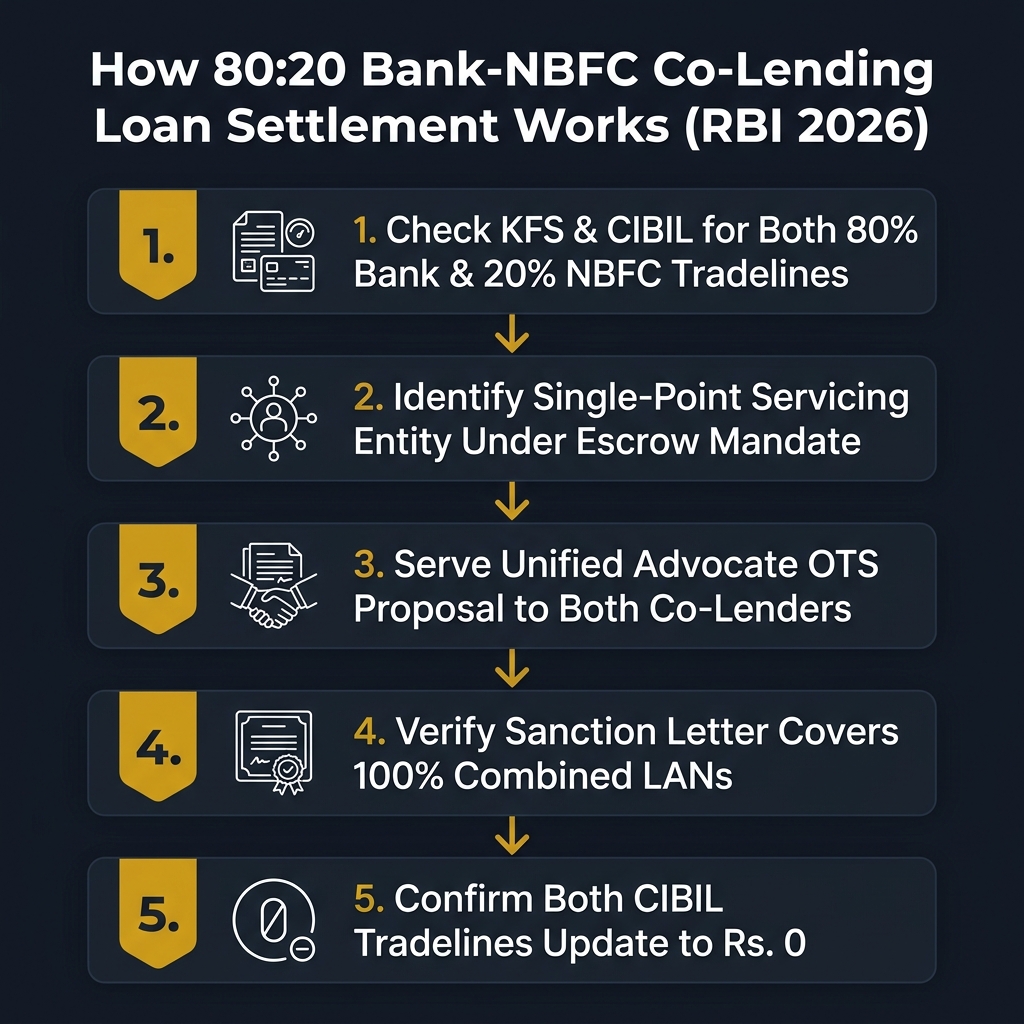
Prepared by AMA Legal Solutions Research & Analytics Team • Data & Compliance Overview

Halt Recovery Agent Harassment Legally
Danger of Defective Partial Settlements: Settling Only the 20% NBFC Portion While the 80% Bank Portion Stays Active
To fully appreciate the legal perils of informal debt resolution, one must analyze the anatomy of a Defective Partial Settlement. In co-lending litigation, this represents the single most frequent dispute brought to AMA Legal Solutions by aggrieved borrowers.
When an uncollateralized co-lending loan goes into distress, the underlying legal relationship is governed by the Law of Contracts (Section 62 of the Indian Contract Act, 1872) and specialized banking regulations. A compromise or novation of debt is legally valid ONLY if executed by all creditors who hold a beneficial interest in the debt asset.
Case Study in Defective Settlement
Consider the case of a retail executive who secured a Rs. 4,00,000 personal loan via an online platform. The loan was co-funded by NBFC 'K' (20% share = Rs. 80,000) and Commercial Bank 'B' (80% share = Rs. 3,20,000). After suffering severe business losses, the borrower defaulted. At 120 DPD, an aggressive recovery agency representing NBFC 'K' offered an oral OTS: pay Rs. 1,00,000 in two installments, and the loan will be closed permanently.
The borrower scraped together Rs. 1,00,000 and remitted it via the app. The app displayed a green checkmark reading "Loan Closed." NBFC 'K' issued an automated digital closure slip for Loan Account Number K-88921.
Fourteen months later, the borrower received a formal legal notice from Bank 'B' demanding Rs. 3,85,000 (representing the bank's original Rs. 3,20,000 principal plus 24% overdue penal interest and compounding finance charges). The borrower was shocked: they assumed the entire debt was settled! When our legal team audited the financial ledgers, the catastrophic reality emerged:
- NBFC 'K' had appropriated Rs. 80,000 toward full satisfaction of its own 20% exposure and pocketed Rs. 20,000 as collection overhead.
- NBFC 'K' had transmitted zero rupees to Bank 'B'.
- Bank 'B' had never been informed of the settlement, had never authorized the haircut, and had classified the borrower's 80% balance as an active Non-Performing Asset (NPA) under RBI IRAC norms.
- The borrower's CIBIL report showed: NBFC 'K' = Settled (Balance Rs. 0); Bank 'B' = Post-Write-Off / Wilful Default (Balance Rs. 3,85,000, Overdue 520 Days).
The Legal Nullity of Unilateral Settlements
Under Indian banking law, an originating NBFC acting as a Lead Servicing Entity cannot unilaterally extinguish the debt owed to an independent commercial bank without an explicit, board-approved Power of Attorney (PoA) or specific written delegation of compromise authority. Without this document, any unilateral settlement letter issued by an app is legally void against the partner bank.
To avoid this catastrophic trap, every co lending loan settlement between bank and nbfc in india handled by AMA Legal Solutions is executed under an ironclad, unified legal framework that legally compels both lenders to sign off before a single rupee is disbursed.
| Co-Lending Ecosystem Partner (Originator / NBFC) | Major 80% Commercial Banking Partners (2026) | Designated Lead Servicing Entity (Single Point of Contact) | Primary Risk of Informal / App-Only Settlement |
|---|---|---|---|
| KrazyBee Services Pvt Ltd (KreditBee Platform) | Central Bank of India, Bank of Baroda, Western Capital, Piramal Finance | KrazyBee Services Pvt Ltd (Mandated under RBI KFS Guidelines) | Fintech app marks 20% NBFC share closed; partner public sector bank continues reporting 80% active NPA on CIBIL. |
| Whizdm Finance Pvt Ltd (MoneyView Platform) | IDFC FIRST Bank, DMI Finance, Northern Arc Capital, Vivriti Capital | Whizdm Finance Pvt Ltd (Operational Lead Interface) | Settlement letter issued on fintech letterhead fails to mention the partner bank's primary Loan Account Number (LAN). |
| Earlysalary Services Pvt Ltd (Fibe Platform) | Axis Bank, HDFC Bank, Tata Capital, Northern Arc | Earlysalary Services Pvt Ltd (Digital Grievance & Servicing Desk) | Borrower pays discounted fee into app; bank treats payment as partial interest recovery and pursues civil recovery for balance. |
| Navi Finserv Limited | State Bank of India, Indian Bank, Canara Bank (Securitized/Co-Lent Tranches) | Navi Finserv Limited (Centralized Servicing Portal) | Discrepancy between automated app payment receipt and bank's physical core banking ledger reconciliation. |
| Northern Arc Capital Limited | Indian Overseas Bank, Union Bank of India, Federal Bank | Northern Arc Capital (Consortium Portfolio Servicer) | Failure to secure dual No Dues Certificates results in blocked commercial credit lines and rejected bureau disputes. |
| Vivriti Capital Limited | State Bank of India, Bank of India, Punjab National Bank | Vivriti Capital (Enterprise & Retail Co-Lending Desk) | Consortium lenders dispute proportional allocation of the settlement proceeds, delaying CIBIL zeroing past 180 days. |
Step-by-Step Legal Protocol for Executing a Unified Single-Window Co-Lending One-Time Settlement (OTS)
Achieving a safe, permanent, and complete resolution of a delinquent co-lending loan requires strict adherence to statutory protocol. At AMA Legal Solutions, our banking defense team utilizes a battle-tested, 5-phase legal methodology to secure a legally unassailable co lending loan settlement between bank and nbfc in india:
Step 1: Forensic Document Discovery & Dual-Tradeline Audit
The journey begins with an exhaustive forensic examination of your credit architecture. We do not rely on summary app dashboards. Instead, our advocates extract:
- The original digital Key Fact Statement (KFS) and Sanction Letter generated at loan inception, identifying the exact equity split (e.g., 80:20 or 90:10) and the full legal corporate identities of both co-lenders.
- The Master Loan Agreement and tripartite service level contracts executed between the bank, the NBFC, and the borrower.
- Comprehensive credit reports from all four licensed Credit Information Companies (TransUnion CIBIL, Experian, Equifax, CRIF High Mark) to map both distinct Loan Account Numbers (LANs), sanctioned amounts, and current DPD delinquency statuses.
- The complete transaction ledger, isolating the pure 'Core Principal' disbursed from exorbitant penal interest, late fees, bounce charges, and GST levies.
For borrowers dealing with institutional originators, our specialized defense resources on Northern Arc loan settlement, Vivriti Capital loan settlement, MoneyView loan settlement, KrazyBee (KreditBee) loan settlement, and Fibe loan settlement provide granular institutional precedents.
Step 2: Service of Statutory Representation & Anti-Harassment Notice
Once the legal baseline is established, our senior advocates serve a comprehensive Statutory Hardship Representation & Legal Cease-and-Desist Notice simultaneously upon:
- The Managing Director and Principal Nodal Officer of the originating fintech NBFC.
- The General Manager (Retail Stressed Assets Resolution) and Principal Nodal Officer of the partner Scheduled Commercial Bank.
- The designated Single Point of Contact (SPOC) named in the KFS under the RBI Co-Lending Directions.
This statutory notice accomplishes four vital legal objectives:
- It establishes formal legal representation under the Advocates Act, 1961, directing both institutions to immediately halt third-party tele-calling, illegal workplace visits, and defamatory contact with relatives under the RBI Fair Practices Code.
- It formally documents the borrower's bona fide financial hardship (job loss, business downturn, medical incapacitation) backed by certified financial exhibits.
- It formally invokes Chapter IV of the RBI (Co-Lending Arrangements) Directions, 2025/2026, compelling the co-lenders to activate their synchronized Single-Window Servicing and Dispute Resolution mechanism.
- It officially petitions both credit committees for an amicable One-Time Settlement (OTS) under the RBI Framework for Compromise Settlements and Technical Write-offs.
Step 3: Centralized Single-Window Negotiation & Haircut Structuring
By law, individual bank branches cannot negotiate co-lending settlements. When structuring a formal co lending loan settlement between bank and nbfc in india, our legal team engages directly with the centralized Special Asset Management Groups (SAMG) and Stressed Asset Committees of both institutions. We structure a unified settlement proposal that reflects commercial reality:
- 100% Elimination of Penal Add-Ons: Total waiver of all accumulated overdue interest, penal charges, legal notices fees, and GST surcharges.
- 40% to 65% Principal Haircut: Negotiating a realistic settlement quantum based on the borrower's verified net asset value and disposable income.
- Pro-Rata Inter-Creditor Apportionment: The negotiated settlement amount is mathematically apportioned between the bank (80%) and the NBFC (20%) in strict accordance with their registered co-lending agreement, ensuring that neither lender can subsequently claim a shortfall.
Step 4: Verification of the Unified Tripartite Settlement Sanction Letter
We enforce rigorous legal scrutiny before advising our client to release a single rupee. The formal OTS Sanction Letter must satisfy three non-negotiable legal criteria:
- Dual-LAN Citation: The letter must explicitly mention BOTH the partner bank's Loan Account Number and the fintech NBFC's Loan Account Number on the face of the document.
- Joint or Consolidated Endorsement: The letter must be issued either jointly under the corporate seals of both institutions or issued by the designated Lead Servicing Entity with an explicit, referenced written authorization resolution from the partner bank's competent authority.
- Full and Final Discharge Clause: The letter must explicitly state that remittance of the negotiated compromise sum constitutes full, final, and absolute discharge of all liabilities, barring both lenders from initiating civil recovery, arbitration, or Section 25 PSSA proceedings.
Step 5: Direct Escrow Remittance & Dual Closure Execution
Settlement funds are never paid into personal accounts or informal collection gateways. Payment is remitted directly into the official, RBI-mandated Co-Lending Escrow Collection Account via verifiable RTGS/NEFT banking rails. Following payment confirmation, our advocates monitor the internal reconciliation process to ensure that the escrow mechanism credits both ledgers simultaneously, laying the groundwork for immediate credit bureau rectification.
Mandatory Dual-Reporting CIBIL Closure & Consolidated No Dues Certificate (NDC) Verification
Paying the settlement amount is only half the battle. In a co lending loan settlement between bank and nbfc in india, the resolution is not legally complete until the borrower holds documentary proof of debt extinction from both entities and their national credit records are permanently updated.
1. Demanding Dual No Dues Certificates (NDCs)
Within 15 to 30 calendar days of settlement remittance, the borrower must receive formal closure documentation. AMA Legal Solutions ensures that our clients receive:
- An unconditional No Dues Certificate (NDC) / Clean Loan Closure Letter issued by the partner Scheduled Commercial Bank, certifying that Loan Account Number
[Bank-LAN]is settled and fully closed with zero residual balance. - An identical unconditional No Dues Certificate issued by the fintech NBFC for Loan Account Number
[NBFC-LAN]. - Or, an official Consolidated Tripartite No Objection Certificate (NOC) jointly signed by authorized signatories of both institutions under corporate power of attorney.
Without these physical/digitally signed documents, any future automated bureau error cannot be legally contested.
2. The Dual-Tradeline CIBIL Synchronization Mandate
Under Section 21 of the Credit Information Companies (Regulation) Act, 2005 (CICRA), credit institutions are legally mandated to update credit bureau data within 30 days of an account status change. In any successful co lending loan settlement between bank and nbfc in india, the following synchronized updates must occur across TransUnion CIBIL, Experian, Equifax, and CRIF High Mark:
- NBFC Tradeline: Current Balance must be updated to Rs. 0, Amount Overdue must reflect Rs. 0, and Account Status must be marked as 'Settled' or 'Post-Write-Off Settled'.
- Bank Tradeline: Current Balance must be updated to Rs. 0, Amount Overdue must reflect Rs. 0, and Account Status must be marked identically as 'Settled'.
- Elimination of Active DPD Counts: Neither tradeline may continue to report aging delinquency (e.g., DPD 180, 210, 240) in subsequent reporting cycles.
3. Escalation Pathways: What If One Lender Fails to Update CIBIL?
In practice, partner commercial banks frequently suffer from operational lag: the fintech NBFC updates its tradeline within three weeks, while the bank's legacy IT systems fail to upload the settlement feed for six months. When this occurs, AMA Legal Solutions initiates a two-pronged legal enforcement protocol:
- Statutory CIBIL Bureau Dispute: We file a formal regulatory dispute on the TransUnion CIBIL dispute portal under Section 18 of CICRA, 2005, appending the settlement sanction letter, verified RTGS bank payment receipts, and the bank's NDC. Under Reserve Bank of India circulars, credit bureaus and member banks are legally obligated to resolve credit reporting disputes within a strict 30-day statutory window. Failure to do so exposes the bank to mandatory daily compensation penalties under RBI's Turnaround Time (TAT) directions!
- RBI Integrated Ombudsman Complaint: If the bank fails to resolve the bureau mismatch within 30 days, our advocates file an immediate regulatory complaint before the Reserve Bank Integrated Ombudsman (cms.rbi.org.in) against the defaulting bank under the Reserve Bank of India (Co-Lending Arrangements) Directions. Because RBI takes a zero-tolerance approach toward non-synchronized co-lending reporting, ombudsman intervention results in rapid tradeline rectification and official confirmation.
| Settlement Dimension | Standard Single-Lender Personal Loan OTS | 80:20 Bank–NBFC Co-Lending Consortium OTS | Legal / Compliance Checkpoint Enforced by AMA Legal Solutions |
|---|---|---|---|
| Lender Parties | Single Regulated Entity (One Bank or One NBFC) | Dual Regulated Entities (One Commercial Bank + One Originating NBFC) | Both institutions must be legally cited and bound in the compromise agreement. |
| Loan Account Numbers (LAN) | Single LAN across all contracts and statements | Two distinct LANs (One internal Bank LAN + One fintech NBFC LAN) | Forensic audit ensures settlement sanction covers 100% combined LAN exposures. |
| CIBIL Tradelines | 1 single tradeline reflecting balance and DPD | 2 separate, concurrent tradelines reporting independently to bureaus | Mandatory post-settlement verification that BOTH tradelines update to Rs. 0 balance. |
| Settlement Sanction Document | Standard OTS letter on single bank letterhead | Unified Tripartite Sanction Letter or Lead-Servicing Letter with Bank PoA | Reject informal app-only checkmarks; demand corporate board-authorized sanction. |
| Payment Destination | Direct branch current account or pool account | RBI-mandated Co-Lending Escrow Collection Account | Remittance via verifiable RTGS/NEFT directly into designated escrow; zero cash to agents. |
| Closure Certification | Single No Dues Certificate (NDC) | Dual NDCs (One from Bank + One from NBFC) or Joint Consortium NOC | Hold both physical/digital NDCs on corporate letterheads to defeat future collection claims. |
| Grievance Escalation | Bank Principal Nodal Officer & RBI Ombudsman | Designated Single-Point SPOC, Dual Nodal Officers & RBI Integrated Ombudsman | Simultaneous notice service creates institutional accountability and prevents finger-pointing. |
Strategic Conclusion: Navigate Complex Co-Lending Settlements with AMA Legal Solutions
The digitization of Indian retail lending has democratized access to instant capital, but it has also constructed an intricate web of legal and regulatory complexities. Facing debt distress on a modern personal loan is no longer just a financial struggle—it is an administrative maze where an unrepresented borrower is easily crushed between the automated collection algorithms of fintech apps and the rigid, bureaucratic inertia of traditional commercial banks.
Attempting to resolve a co-lending delinquency through uncoordinated app payments or informal discussions with tele-callers is a recipe for financial catastrophe. You risk losing your hard-earned settlement funds, clearing only a fraction of your liability, and leaving the majority bank debt to destroy your CIBIL score and trigger aggressive civil litigation. A successful co lending loan settlement between bank and nbfc in india requires senior legal advocates who understand the complex mechanics of syndicated risk-sharing, the 2026 RBI Co-Lending Directions, the 5% FLDG regulatory caps, and the strict dispute resolution frameworks of the Credit Information Companies (Regulation) Act, 2005.
At AMA Legal Solutions, our legal practice is dedicated to championing the rights of Indian borrowers. When you retain our firm, you are not merely hiring a negotiator—you are placing a team of seasoned High Court banking advocates between yourself and aggressive lenders. We immediately halt collection harassment under the RBI Fair Practices Code, audit your loan architecture to identify all hidden banking partners, engage directly with centralized credit committees, and secure legally ironclad, unified settlement letters that wipe away debt permanently.
Whether your co-lending loan originated through KreditBee, MoneyView, Fibe, Navi, or any other leading digital platform, you have the legal right to a dignified, transparent, and comprehensive debt resolution. For a broader overview of statutory debt resolution in our jurisdiction, explore our comprehensive guide on loan settlement in India.
Do not allow dual-tradeline debt traps to jeopardize your financial livelihood, your family's dignity, or your credit future. Contact AMA Legal Solutions today to schedule an immediate, confidential legal consultation with Senior Advocate Anuj Anand Malik and our senior debt resolution team. Let us review your sanction letters, silence recovery calls, and construct the definitive legal strategy to achieve complete financial freedom.
Popular Searches & Topics
Commonly searched legal queries and keywords related to this article
Need Strategic Legal Defense for Your Situation?
Our banking & litigation advocates review your notices, debt liability, and recovery issues under complete advocate-client secrecy.
References & Authority
- Reserve Bank of India (RBI) - Master Direction – Reserve Bank of India (Co-Lending Arrangements) Directions, 2025/2026
- Reserve Bank of India (RBI) - Guidelines on Default Loss Guarantee (DLG / FLDG) in Digital Lending
- Reserve Bank of India (RBI) - Framework for Compromise Settlements and Technical Write-offs
- India Code - Credit Information Companies (Regulation) Act, 2005 (Section 15, 18 & 21)
- Reserve Bank of India (RBI) - Guidelines on Digital Lending & Lending Service Providers (LSPs)
- Reserve Bank of India (RBI) - Fair Practices Code for Regulated Entities & Conduct of Recovery Agents
- India Code - Indian Contract Act, 1872 (Section 62 - Effect of Novation, Rescission, and Alteration of Contract)
- Reserve Bank of India (RBI) - Reserve Bank Integrated Ombudsman Scheme (cms.rbi.org.in)

AMA Legal Solutions
Trusted with a 4.7 Google Rating, over 10,000+ Clients Served, 25,000+ Cases Handled, and more than 40+ Years of Experience in providing strategic legal defense and debt resolution across India.
Our media coverages





Frequently Asked Questions
Related Articles
RuPay Credit Card on UPI Default & Credit Line on UPI Settlement (2026)
Micro-transactions on RuPay UPI Credit Cards and pre-approved 'Credit Lines on UPI' have triggered a massive wave of 42%+ APR revolving debt traps. Find out if defaulting blocks your personal savings UPI and how to settle RuPay UPI credit dues for 30%–50%.
Read Article
Paytm, PhonePe & BharatPe Daily EDI Merchant Loan Settlement (2026)
Drowning in Equated Daily Installment (EDI) merchant loans where 100% of your daily QR Soundbox collections are auto-swept before you can pay suppliers or rent? Learn how retail shopkeepers and MSMEs legally halt QR sweeps and negotiate a 50%+ OTS.
Read Article
Can Bank or Loan App Remotely Lock Phone for EMI Default? RBI Rules (2026)
An investigative breakdown of RBI's Remote Device Locking Directions—explaining why lenders cannot lock your phone for personal loans, the mandatory 30/60 DPD safeguards on financed devices, the Rs. 250/hour delay penalty, and how to settle device & app loans.
Read ArticleAbout Author
Anuj Anand Malik
View ProfileAnuj Anand Malik, Founder of AMA Legal Solutions, is a trusted advocate, loan settlement expert, legal advisor, and banking lawyer. With over a decade of experience in loan settlement, corporate law, financial disputes, and compliance, he leads a result-driven law firm based in India that helps individuals, startups, and businesses achieve legal and financial stability.
Connect on LinkedInNeed Legal Representation?
Evaluate your defense against recovery agents, notices, or structure your loan settlement directly with Senior Advocates.
Call +91-8700343611