CIBIL Locate Plus Skip Tracing & Account Aggregator Consent Revocation (2026)
Learn how to revoke Account Aggregator consents and stop CIBIL skip tracing.

Anuj Anand Malik
Reviewed by AMA Legal Solutions
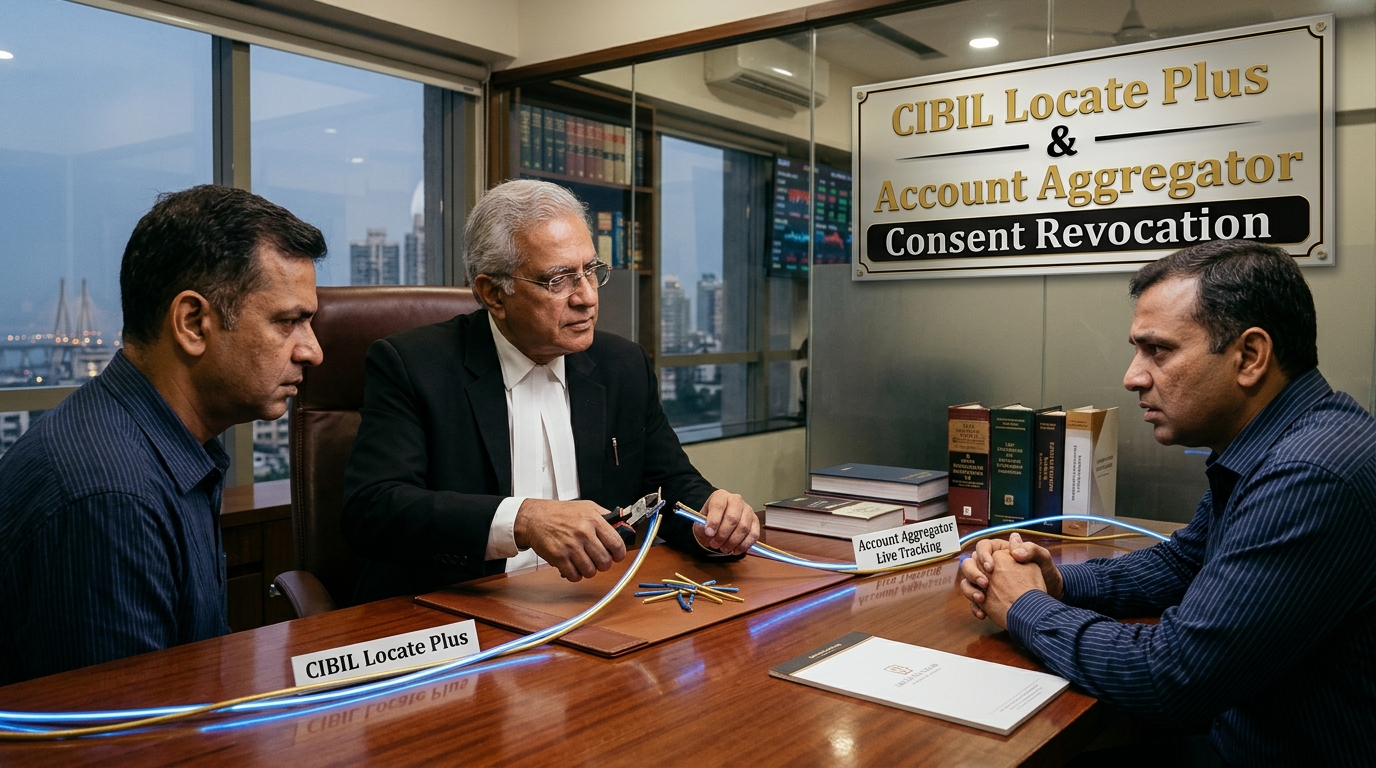
Key Takeaways: Understanding the intricate mechanics of cibil locate plus skip tracing and account aggregator consent revocation is the single most vital defense for any Indian borrower navigating debt default or loan settlement. When an Equated Monthly Installment (EMI) bounces, borrowers are frequently stunned by how recovery agents uncover a newly purchased secondary phone number, identify an unlinked salary account opened at a different commercial bank, or call on the exact morning an employer credits monthly wages. This digital omniscience is not supernatural telepathy or dark-web hacking; it is the calculated deployment of institutional financial surveillance technologies. Commercial banks and Non-Banking Financial Companies (NBFCs) systematically track distressed borrowers through two legal yet aggressive digital conduits: TransUnion CIBIL Locate Plus portfolio skip-tracing networks and open-ended 'Recurring' data-sharing consents embedded within RBI-licensed Account Aggregators (such as Finvu, OneMoney, CAMSfinserv, NADL, and Anumati). By asserting your statutory privacy rights under Section 6(4) of the Digital Personal Data Protection (DPDP) Act, 2023, systematically de-linking consent artefacts across Account Aggregator portals, and engaging professional loan settlement services at AMA Legal Solutions, borrowers can effectively dismantle predatory surveillance, regain privacy, and secure steep One-Time Settlement (OTS) waivers on equal legal footing.
Introduction: CIBIL Locate Plus Skip Tracing and Account Aggregator Consent Revocation Explained
In modern Indian retail debt recovery, the physical bailiff arriving with a warrant has been largely replaced by continuous, automated digital surveillance. When a borrower faces acute financial hardship—such as corporate downsizing in IT corridors, sudden medical expenses, business contraction, or family emergencies—and misses payments on an unsecured personal loan or credit card, a mysterious phenomenon unfolds.
The borrower purchases an unlisted prepaid SIM card to avoid non-stop collection calls, yet within seventy-two hours, third-party recovery tele-callers are dialing that exact unlisted number. The borrower opens a fresh savings account at a completely different public sector bank to protect their family's monthly subsistence grocery funds from aggressive automated e-NACH mandates, yet on the very first day their employer deposits their salary, a recovery agent sends a WhatsApp screenshot citing their exact account balance down to the last rupee.
How does this happen? The answer lies at the intersection of credit bureau data-mining and open-banking consent exploitation. Through cibil locate plus skip tracing and account aggregator consent revocation, Indian borrowers can finally pull back the curtain on this surveillance apparatus. Institutional lenders do not rely on chance; they utilize high-velocity algorithmic tools that ingest every new KYC footprint you generate across India's financial system.
In this authoritative 2026 legal masterclass, Senior Advocate Anuj Anand Malik and the banking defense team at AMA Legal Solutions break down the operational mechanics of TransUnion CIBIL Locate Plus, explain how recurring Account Aggregator (AA) permissions turn your personal bank statement into a live tracking beacon, provide exact step-by-step instructions to revoke consents across all major RBI-licensed aggregators, and explain how invoking the Digital Personal Data Protection (DPDP) Act, 2023 shifts the balance of power during compromise debt settlement.
What Is TransUnion CIBIL 'Locate Plus' and Portfolio Skip-Tracing Used by Indian Banks?
To neutralize creditor surveillance, one must first demystify the enterprise product known across the banking industry as TransUnion CIBIL Locate Plus. While millions of Indian citizens know what is CIBIL score and monitor their 300–900 consumer credit score, few understand the commercial B2B products that credit information companies sell directly to banks, NBFCs, and specialized collection agencies.
1. The Evolution of Bureau-Driven Skip Tracing
In debt recovery terminology, 'skip tracing' refers to the forensic process of locating a debtor who has 'skipped' town, relocated their primary residence, changed their employer, or disconnected their registered telephone numbers. Prior to digital integration, skip tracing was a laborious manual process conducted by private detectives and field recovery agents who physically interrogated neighbors, local grocers, and apartment watchmen.
Today, TransUnion CIBIL—alongside Experian, Equifax, and CRIF High Mark—operates the largest centralized repository of consumer identity and credit behavior in South Asia. Under the Credit Information Companies (Regulation) Act, 2005 (CICRA), over 4,000 member credit institutions continuously transmit monthly Member Data feeds containing consumer identity attributes, including Permanent Account Numbers (PAN), Aadhaar-linked tokens, passport numbers, Voter ID details, physical home addresses, office addresses, landline numbers, and mobile phone numbers.
2. The Mechanics of CIBIL Locate Plus
CIBIL Locate Plus is an enterprise-grade skip-tracing and contact-enhancement application designed explicitly for collection, recovery, and fraud mitigation departments. When a bank flags an account as 90+ Days Past Due (DPD) or Non-Performing Asset (NPA), its collection team uploads the borrower's unique identifier (primarily their 10-digit alphanumeric PAN) into the Locate Plus portal.
The Locate Plus algorithm performs high-velocity fuzzy matching across billions of historical and real-time records submitted by all other credit institutions in India. The output provided to the collection team includes:
- Historical & Contemporary Phone Clusters: Every mobile number ever submitted by the borrower across any credit card application, retail loan inquiry, BNPL (Buy Now Pay Later) checkout, two-wheeler loan, or consumer durable finance facility over the past ten years.
- Alternate Residential Addresses: Every delivery address, rental accommodation, or permanent home address provided to any bank or utility reporting to the bureau.
- Current Employer Coordinates: The most recently reported employer name, corporate email address, and office branch location logged during any recent credit inquiry or corporate payroll partnership.
- Contact Recency & Activity Scores: Locate Plus ranks contact numbers by transaction recency, highlighting which mobile number was used most recently to execute an online transaction or bank inquiry, allowing tele-callers to target the borrower's active handset with surgical precision.
When borrowers ask how recovery agents locate their unlisted contacts, understanding cibil locate plus skip tracing and account aggregator consent revocation provides the foundational answer. Unless you systematically plug the data pipelines that feed this repository, changing your SIM card offers only temporary respite. Therefore, combining cibil locate plus skip tracing and account aggregator consent revocation ensures that both historical bureau records and ongoing data streams are addressed in parallel.
The Hidden Surveillance Trap: How Recurring Account Aggregator (AA) Consents Let Lenders Monitor Your Live Bank Balance
While CIBIL Locate Plus tracks contact coordinates and addresses, it does not reveal the exact live rupee balance sitting in your savings account on the 1st or 30th day of the month. To monitor your cash flows, commercial banks and fintech lenders employ an even more invasive mechanism: unrevoked Recurring Account Aggregator (AA) consents.
1. The Architecture of the RBI Account Aggregator Framework
The Account Aggregator framework, regulated under the Master Direction - Non-Banking Financial Company - Account Aggregator (Reserve Bank) Directions, 2016, was designed by the Reserve Bank of India to democratize access to credit. Regulated by RBI and coordinated through the industry self-regulatory body Sahamati, an Account Aggregator acts as a digital consent manager. It allows consumers to securely share financial data from a Financial Information Provider (FIP) (such as your primary salary bank: HDFC Bank, ICICI Bank, State Bank of India, or Axis Bank) to a Financial Information User (FIU) (the lending bank or fintech NBFC).
Under the RBI framework, data sharing is encrypted, digitally signed, and cannot be executed without explicit user consent captured in a standardized electronic document known as a Consent Artefact.
2. The 'One-Time' vs. 'Recurring' Consent Sleight of Hand
When you originally applied for your loan on a banking website or mobile application, you were prompted to verify your income by linking your bank account via an Account Aggregator (such as Finvu, OneMoney, CAMSfinserv, or Anumati). In the rush of onboarding, borrowers assume they are granting a one-time permission to verify the past six months of bank statements.
However, predatory lending algorithms and fine-print digital interfaces frequently structure the consent artefact as 'Periodic / Recurring' rather than 'One-Time'. A typical deceptive consent artefact includes the following parameters:
- Consent Purpose: 'Account Monitoring & Credit Assessment' (broadly defined).
- Consent Validity Period: 12 to 36 months (matching the entire tenure of the loan facility).
- Fetch Frequency: 'Daily', 'Weekly', or 'On Balance Change'.
- Data Scope: Summary balance, live transaction history, and end-of-day balances.
3. Real-Time Balance Exploitation During Default
When an installment is missed, the lender's automated collection server activates this sleeping recurring consent. Every midnight, or whenever an algorithmic trigger fires, the lender's system queries the Account Aggregator API, which automatically pulls a fresh mini-statement from your salary bank without sending an SMS OTP to your phone (because prior recurring consent was legally established during loan origination!).
The collection agency now possesses real-time financial intelligence:
- They know precisely what date your monthly salary is credited by your employer.
- They know the exact net salary credited after deductions.
- They know if you transferred funds to a spouse or dependent.
- They time their recovery phone calls, WhatsApp messages, and door-to-door visits to occur thirty minutes after your salary arrives, using psychological intimidation when they know you have liquid cash.
This predatory surveillance explains why mastering cibil locate plus skip tracing and account aggregator consent revocation is an absolute prerequisite before entering any debt compromise discussion. If the creditor already knows you have Rs. 50,000 sitting in your account, they will flatly reject your plea of financial hardship and refuse to grant an affordable settlement waiver. For distressed borrowers, the strategic urgency of cibil locate plus skip tracing and account aggregator consent revocation lies in stopping lenders from timing their pressure tactics around monthly payroll deposits.
Step-by-Step Guide to Auditing and Revoking Active Consents on Finvu, OneMoney, CAMSfinserv, Nadal & Anumati
The most empowering statutory protection established by the Reserve Bank of India in its NBFC-AA Master Directions is the unconditional, absolute right of the consumer to revoke consent at any time. Under RBI regulations, an Account Aggregator is legally obligated to provide a simple, accessible mechanism for users to review, manage, pause, and revoke any active consent artefact. The moment you revoke consent, the AA is strictly prohibited from pulling further data from your Financial Information Provider.
Here is the exact step-by-step protocol to audit and revoke active recurring financial tracking across India's leading RBI-licensed Account Aggregators:
1. Revoking Consents on Finvu (Cookiejar Technologies)
- Access the Portal: Download the Finvu mobile app from Google Play Store / Apple App Store, or visit the consumer web portal at
finvu.in. - Login with Registered Mobile: Enter the 10-digit mobile number associated with your bank accounts and authenticate using the 6-digit SMS OTP.
- Navigate to Consents Dashboard: On the bottom navigation bar, tap on the 'Consents' or 'Approvals' tab.
- Audit Active Permissions: Filter by 'Active'. You will see every lending bank, fintech app, or broker that currently holds an active consent artefact. Inspect the 'Frequency'—if it states 'Recurring', this lender is actively monitoring your account.
- Execute Instant Revocation: Tap on the specific lender card, scroll to the bottom, and click 'Revoke Consent'. Select the reason ('No longer required' or 'Privacy preference') and confirm. Finvu immediately transmits an electronic revocation notification to the lending institution and severs the API bridge.
- Delink Bank Accounts (Optional but Recommended): Go to 'Linked Accounts', select your bank, and click 'Delink' to completely remove your account identifier from the aggregator's directory.
2. Revoking Consents on OneMoney (Finsec AA Installments)
- Login to OneMoney: Launch the OneMoney app or visit
onemoney.in. Enter your VPA handle (e.g.,username@onemoney) or registered phone number with OTP. - Review Consent History: Select 'Consent Management' from the main menu. Inspect the list of Financial Information Users (FIUs).
- Inspect Data Expiry: Note the 'Expiry Date' of each consent. Many fintech lenders configure consents that run until December 2028 or 2030!
- Terminate Recurring Streams: Tap on the active consent, review the linked FIP bank accounts, and click 'Revoke'. OneMoney's consent engine invalidates the digital cryptographic signature of the artefact within milliseconds.
3. Revoking Consents on CAMSfinserv (CAMS Financial Information Services)
- Open CAMSfinserv Dashboard: Visit
camsfinserv.comor use their consumer application. - OTP Authentication: Submit your PAN-linked mobile number and verify via OTP.
- Manage Consents: Navigate to the 'Consent History' screen.
- Revoke FIU Permissions: Locate each active entity (especially digital lending NBFCs), click 'View Details', and tap 'Revoke Consent Artefact'. Confirm the prompt to permanently disallow recurring statement pulls.
4. Revoking Consents on Anumati (Perfios AA) & NADL (NESL Asset Data Limited)
- Access Anumati / NADL: Visit
anumati.com(Perfios Account Aggregator) ornadl.co.in. - Enter Credential Identifiers: Authenticate via mobile OTP.
- Execute Revocation: Identify all recurring mandates granted during quick-loan setups. Select each entry and click 'Withdraw / Revoke'.
Executing cibil locate plus skip tracing and account aggregator consent revocation across these five primary aggregators closes over 95% of active open-banking balance tracking channels in India. Before approaching any lender for a one-time settlement, completing cibil locate plus skip tracing and account aggregator consent revocation establishes an essential firewall around your financial data. The table below outlines the direct access pathways and revocation actions across all licensed aggregators.
| Account Aggregator (AA) Name | RBI Registration / Corporate Identity | Consumer Web / App Portal | Step-by-Step Revocation Action | Immediate Legal Effect of Revocation |
|---|---|---|---|---|
| Finvu | Cookiejar Technologies Pvt Ltd (RBI Licensed NBFC-AA) | finvu.in / Finvu Mobile App | Login via Mobile OTP → 'Consents' tab → Filter 'Active' → Click Lender → 'Revoke Consent' → 'Delink FIP Account' | Instantly terminates lender's recurring automated balance checks; cuts off daily/monthly mini-statement feeds from your bank. |
| OneMoney | Finsec AA Installments Pvt Ltd (First Licensed NBFC-AA) | onemoney.in / OneMoney App | Enter VPA Handle/Mobile → 'Consent Management' → Select FIU Lender → Tap 'Revoke' → Confirm Digital Invalidation | Cryptographically invalidates the shared consent token; bank (FIP) refuses further data handshakes to the lender (FIU). |
| CAMSfinserv | CAMS Financial Information Services Pvt Ltd | camsfinserv.com / CAMS Web Portal | Login with PAN/Phone → 'Consent History' → Identify Active Lending NBFCs → Click 'Revoke Consent Artefact' | Severs real-time account summary fetches across all linked public and private sector bank accounts. |
| Anumati | Perfios Account Aggregation Services Pvt Ltd | anumati.com / Perfios AA Web | Authenticate via OTP → 'Active Consents' → Locate Fintech/Bank LAN → Click 'Cancel Mandate' | Stops automated underwriting bots and collection monitoring algorithms from polling salary credit timestamps. |
| NADL | NESL Asset Data Limited (Union Government/PSU Promoted) | nadl.co.in / NADL Portal | Login with Mobile → Go to 'My Consents' → Select Regulated Entity → Click 'Withdraw Consent' | Revokes institutional monitoring access across major public sector banks (SBI, Canara, PNB, Bank of Baroda). |
| Saafe | Saafe Financial Technologies Pvt Ltd | saafe.in / Saafe Mobile App | Login → 'Dashboard' → 'Approved Consents' → Select Creditor → Click 'Revoke Access' | Eliminates automated balance tracking used by emerging neo-banking apps and personal loan originators. |
Key Insights & Data Infographic
Visual summary, statistical trends & procedural breakdown
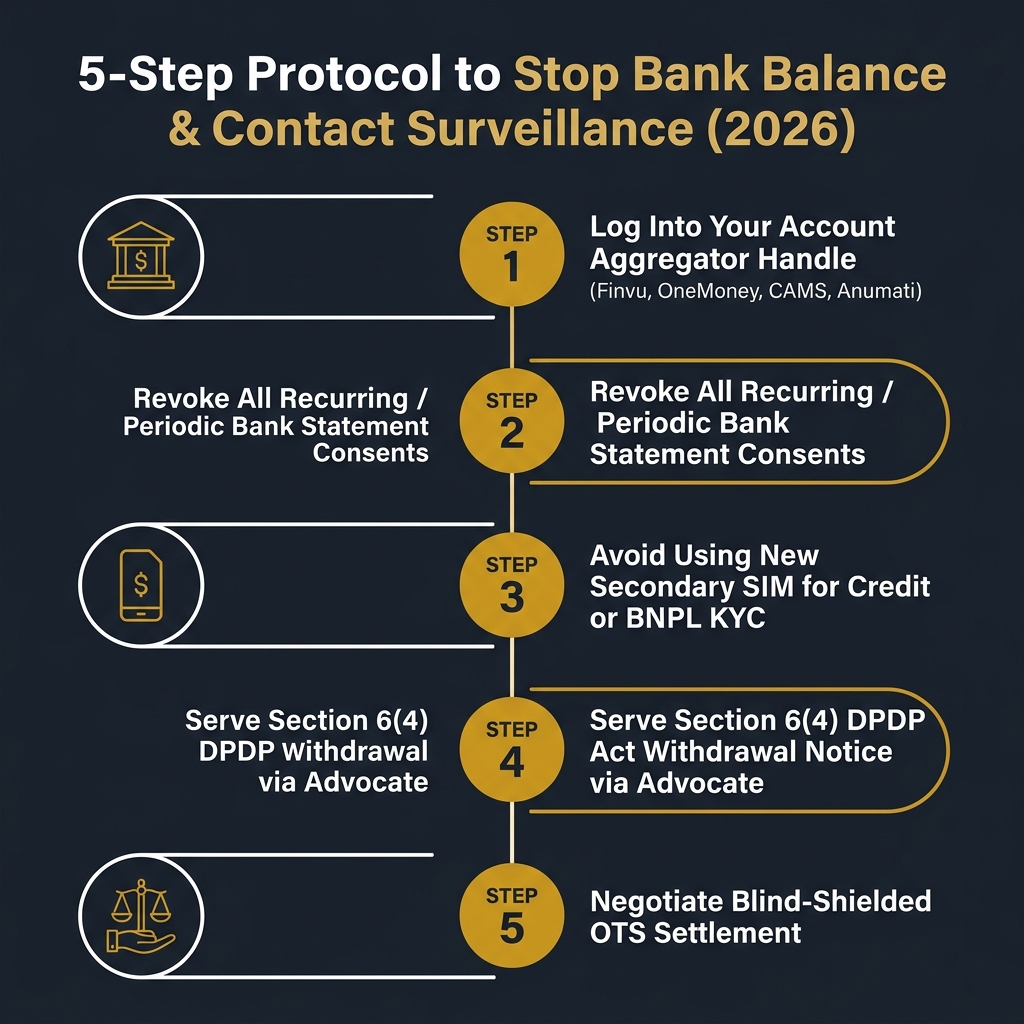
Prepared by AMA Legal Solutions Research & Analytics Team • Data & Compliance Overview

Halt Recovery Agent Harassment Legally
How PAN-Aadhaar KYC Seeding Triggers Automated Bureau Contact Alerts When You Buy a SIM or Open a Bank Account
Many borrowers believe that if they simply delete their Account Aggregator profile and buy a new SIM card, they have achieved total digital invisibility. Unfortunately, TransUnion CIBIL, Experian, and Equifax have engineered a secondary, highly automated surveillance network: Bureau Portfolio Contact Alerts.
1. The Trap of the Telecom & Payment App KYC
When you purchase a new SIM card in India, Department of Telecommunications (DoT) regulations require biometric Aadhaar e-KYC or digital document verification. While telecom service providers (such as Jio, Airtel, or Vodafone Idea) do not directly report your mobile purchase to credit bureaus as a credit facility, the trap occurs the moment you perform any of the following routine actions on that new phone number:
- Linking the New Number to a Payment App: You install Google Pay, PhonePe, or Paytm and link your existing bank account. The payment gateway verifies your identity via banking APIs, updating your registered profile.
- Opening a 'Zero-Balance' Digital Account: You open a digital savings account with a fintech neo-bank or small finance bank (such as Kotak 811, AU Small Finance Bank, or Jupiter) using your PAN and Aadhaar.
- Applying for Any Small Credit or BNPL Line: You make an e-commerce purchase on Amazon or Flipkart and opt for 'Buy Now Pay Later' or a no-cost EMI checkout, entering your new mobile number and PAN.
2. The Trigger: Daily Bureau Inquiry & Contact Feed Ingestion
Under Indian banking compliance, whenever a regulated entity conducts a credit check—even a soft pull for a Rs. 1,000 BNPL limit—or submits its monthly Member Data upload, the new mobile number and residential address are linked to your centralized PAN profile in CIBIL's core database.
Your defaulting lender does not need to manually search for you every day. Instead, they subscribe to CIBIL Portfolio Alerts. The bank uploads a 'Watchlist' of delinquent loan accounts. The moment your PAN profile in the bureau updates with a fresh telephone number, alternate address, or new bank relationship from any source, the bureau's automated system triggers an instant electronic alert to the defaulting lender's recovery team:
'ALERT: High-Priority Contact Update for Defaulter PAN ABCDE1234F. New primary mobile detected: 98XXXXXXXX. Recency: Active within last 48 hours.'
Within minutes, the recovery agency's automated auto-dialer queues your brand-new phone number. This algorithmic trap demonstrates why superficial evasive tactics fail. True protection requires combining cibil locate plus skip tracing and account aggregator consent revocation with strict statutory legal notices served directly upon the lender's corporate hierarchy.
Serving a Statutory Section 6(4) DPDP Act, 2023 Consent Withdrawal Notice to Your Lender's Data Protection Officer
Revoking consents within the Account Aggregator app terminates open-banking API queries, but it does not prevent the lender from querying CIBIL Locate Plus or utilizing third-party data enrichment vendors. To legally bind the lender and prohibit unauthorized tracking across all platforms, borrowers must deploy the most formidable privacy statute in Indian legal history: The Digital Personal Data Protection (DPDP) Act, 2023.
1. The Power of Section 6(4) of the DPDP Act
Under Section 6(4) of the DPDP Act, 2023, every citizen (designated under the statute as the 'Data Principal') possesses an absolute, statutory right to withdraw consent for the processing of their personal data at any time. The statute explicitly mandates that:
- The Data Principal may withdraw consent with the same ease with which consent was initially granted.
- Upon receipt of the withdrawal notice, the Data Fiduciary (the lending bank or NBFC) must cease processing the individual's personal data within a reasonable timeframe, unless continued processing is strictly required under an express statutory law (such as mandatory tax reporting or lawful credit reporting under CICRA).
- The Data Fiduciary must immediately instruct all downstream Data Processors (including collection agencies, skip-tracing vendors, tele-calling centers, and software aggregators) to permanently halt data processing and tracking.
2. Constructing an Enforceable Legal Cease-and-Desist Notice
When borrowers retain AMA Legal Solutions, our High Court advocates do not write informal emails to customer support bots. We draft and serve an ironclad, formal statutory demand letter issued under the Advocates Act, 1961, addressed directly to:
- The designated Data Protection Officer (DPO) and Principal Nodal Officer of the lending institution.
- The Head of Retail Credit Operations and Managing Director of the bank/NBFC.
- The Chief Information Security Officer (CISO) overseeing digital lending APIs.
3. Essential Legal Clauses of the Statutory Withdrawal Notice
A legally binding Section 6(4) DPDP Act representation contains four mandatory components:
- Formal Revocation of Ancillary Consents: The notice explicitly withdraws all historical, implied, or express consents granted for 'portfolio monitoring', 'skip tracing', 'contact enrichment', 'workplace verification', 'Account Aggregator balance fetching', and 'third-party recovery assignment'.
- Limitation to Lawful Core Purpose: It acknowledges the lender's lawful statutory right under CICRA, 2005 to report true historical repayment data to registered credit bureaus, while asserting that using non-consensual skip tracing (such as CIBIL Locate Plus or informal scraping) to stalk alternative numbers, family members, or employers constitutes a direct breach of Section 6 and Section 8 of the DPDP Act.
- Demand for Complete Data Processing Audit: The notice formally demands, under Section 11 of the DPDP Act, a complete summary of all personal data held by the lender, the identities of all third-party recovery agencies with whom the data was shared, and an immediate audit log of all Account Aggregator API calls made over the preceding 12 months.
- Statutory Penalty Warning: It warns the lender that non-compliance or failure to halt third-party harassment will trigger an immediate regulatory petition before the Data Protection Board of India (DPBI)—where corporate penalties for significant data breaches and non-compliance range up to Rs. 250 Crores under Schedule 1 of the DPDP Act!
When a bank's legal department receives an advocacy notice from AMA Legal Solutions invoking Section 6(4) of the DPDP Act, the tone changes overnight. Under the Indian data privacy regime, executing cibil locate plus skip tracing and account aggregator consent revocation is reinforced by formal legal notices that carry heavy statutory penalties for non-compliance. The bank immediately recalls the file from aggressive third-party tele-calling agencies, freezes invasive skip tracing, and redirects the account to its internal Stressed Assets Resolution Branch (SARB) for amicable, lawful settlement.
| Surveillance Technology / Conduit | Operational Mechanism Used by Lenders | Primary Information Extracted by Creditor | Defensive Vulnerability for Borrower | Statutory & Legal Countermeasure Enforced by AMA Legal Solutions |
|---|---|---|---|---|
| TransUnion CIBIL Locate Plus | B2B skip-tracing portal mining cross-institutional credit application data via PAN matching. | Every historical mobile number, alternate residential addresses, and current employer details reported to bureaus. | Borrower changes SIM card or moves home, but bureau flags updated contact within 72 hours of new credit activity. | Serve statutory notice invoking CICRA Section 15 & DPDP Act Section 6(4); prohibit unauthorized contact sharing with third-party recovery tele-callers. |
| Account Aggregator Recurring Consents | Periodic consent artefact pulling automated statement fetches via FIP-FIU open-banking APIs. | Live savings account balance, daily cash inflows/outflows, exact employer salary credit date and net amount. | Lender tracks live bank balance, timing aggressive calls and legal notices to coincide with salary deposits. | Execute instant consent revocation across Finvu, OneMoney, CAMS, and Anumati portals; delink FIP bank accounts. |
| CIBIL Portfolio Watchlist Alerts | Automated bureau monitoring triggers electronic alerts whenever a delinquent PAN exhibits new credit inquiries. | Immediate notification of newly opened bank accounts, small BNPL checkouts, or utility credit checks. | Borrower opens a new account at an unrelated bank; defaulting lender immediately receives alert of new banking relationship. | Strict financial isolation protocol; route transactions through clean non-credit mechanisms until formal OTS closure. |
| Third-Party Data Scraping & Skip Tracing | Unregulated recovery agencies purchase telecom dumps, Truecaller directory matches, and social media scrapers. | Unlisted secondary numbers, family member phone coordinates, workplace colleague directories. | Predatory harassment of relatives, parents, and corporate HR managers to inflict psychological embarrassment. | Issue Advocate Cease-and-Desist Notice under RBI Fair Practices Code & Section 72A IT Act; file police complaint for cyber harassment. |
Why Revoking Financial Surveillance Gives You Maximum Leverage in One-Time Settlement (OTS) Negotiations
In retail banking litigation, information asymmetry dictates who holds the upper hand. When an Indian bank or NBFC negotiates a loan default, their collection strategy is powered entirely by data: if they know your alternate phone numbers, know where you work, and see Rs. 60,000 sitting in your salary account via Account Aggregator tracking, they have zero economic incentive to grant a discount. They will demand 100% of the principal plus exorbitant penal interest, threatening to visit your office or freeze your funds. Institutional recovery desks rely on behavioral profiling; by initiating cibil locate plus skip tracing and account aggregator consent revocation, you eliminate the data points they need to assess your immediate ability to pay.
Executing cibil locate plus skip tracing and account aggregator consent revocation completely reverses this dynamic, creating the precise commercial conditions necessary to achieve a massive debt waiver:
1. Imposing an Institutional Intelligence Blackout
When you revoke Account Aggregator access and serve a statutory DPDP cease-and-desist notice through AMA Legal Solutions:
- The lender's screens go dark. Their collection dashboard displays an error code when querying your live bank balance.
- Third-party tele-calling agencies are legally gagged under threat of multi-crore DPDP Act and RBI Ombudsman penalties.
- The bank can no longer verify whether you are employed, whether you have personal savings, or whether your financial condition has deteriorated further.
2. Accelerating NPA Aging & Capital Provisioning Pressure
Under Reserve Bank of India Income Recognition and Asset Classification (IRAC) norms, commercial banks are subject to strict regulatory timelines:
- At 90 Days Past Due, the loan becomes a Sub-Standard Non-Performing Asset (NPA), forcing the bank to lock up 15% of the outstanding balance in mandatory provisioning capital.
- After 12 months, the asset degrades into the Doubtful-1 (D-1) category, requiring 25% to 40% provisioning.
- Unsecured loans without tangible collateral degrade rapidly toward 100% loss asset provisioning.
When an institutional lender realizes that an account is legally shielded by senior advocates, that financial surveillance is completely severed, and that recovery costs will exceed recoverable value, their Stressed Assets Committee becomes eager to execute a fast compromise resolution under the RBI Framework for Compromise Settlements and Technical Write-offs.
3. Securing 40% to 75% Principal Haircuts
Operating behind this legal shield, the banking defense team at AMA Legal Solutions steps into the negotiation arena. We present certified financial hardship documentation (medical records, termination letters, GST balance sheet contractions) to prove genuine inability to service the contractual debt. Because the lender cannot contradict your financial hardship with illicit live balance tracking, our advocates consistently secure:
- 100% Complete Waiver of Penal Interest & Late Fees: Immediate stripping of all non-contractual default charges, bounce fees, and accrued penal interest.
- 40% to 75% Principal Haircut: Settling unsecured personal loans and credit card dues for a fraction of the outstanding principal balance.
- Structured Installment Plans: Securing 2 to 4 tranches to remit the compromise amount comfortably without asset liquidation.
- Formal Tripartite Settlement Sanction Letter: Guaranteeing that remittance into the bank's core settlement account permanently extinguishes the debt, releases all guarantees, and mandates the issuance of a clean No Dues Certificate (NDC).
Strategic Conclusion: Lock Down Your Financial Data and Settle Your Debt with AMA Legal Solutions
The contemporary Indian credit ecosystem is built on sophisticated surveillance architectures that can easily overwhelm an individual borrower facing economic distress. When recovery agencies harass your relatives, call your unlisted mobile numbers, or cite your private bank balance, they are exploiting gaps in your digital data perimeter. You do not have to endure this psychological warfare.
The law in India provides powerful shields. The Reserve Bank of India's Account Aggregator Master Directions, the Credit Information Companies (Regulation) Act, 2005, and the landmark Digital Personal Data Protection Act, 2023 collectively establish your absolute legal right to financial privacy, data minimization, and immediate consent revocation. But these rights are not self-executing—they require decisive, knowledgeable legal enforcement.
Attempting to negotiate a loan default while your financial accounts remain subject to live creditor surveillance is negotiating with a blindfold against an adversary with radar. Executing cibil locate plus skip tracing and account aggregator consent revocation is the vital first step that blinds the adversary, restores your dignity, and establishes absolute leverage.
At AMA Legal Solutions, our legal practice is devoted to protecting borrowers from predatory collection tactics while engineering permanent, lawful exits from debt traps. Under the leadership of Senior Advocate Anuj Anand Malik, our advocates manage the entire lifecycle of debt resolution: we execute comprehensive digital audits to sever Account Aggregator and bureau surveillance, serve statutory DPDP Act cease-and-desist notices to silence recovery agents, represent you before banking credit committees, and secure ironclad One-Time Settlements with synchronized credit bureau updates across CIBIL, Experian, Equifax, and CRIF High Mark.
If you or your family are experiencing recovery agent harassment, invasive tracking, or unmanageable debt default, take control of your financial destiny today. Learn more about your fundamental legal rights when dealing with recovery agents, understand how recovery agents get your personal details and how to prevent it, or review our specialized cyber law and data protection services and data breach privacy notice.
Do not allow illegal financial surveillance to dictate your financial future. Contact AMA Legal Solutions today to schedule a confidential legal consultation with our senior banking and data privacy advocates. Let our legal team construct an impenetrable wall around your privacy, silence recovery harassment, and guide you to complete financial liberation.
Popular Searches & Topics
Commonly searched legal queries and keywords related to this article
Need Strategic Legal Defense for Your Situation?
Our banking & litigation advocates review your notices, debt liability, and recovery issues under complete advocate-client secrecy.
References & Authority
- Reserve Bank of India (RBI) - Master Direction - Non-Banking Financial Company - Account Aggregator (Reserve Bank) Directions, 2016 (Updated 2025/2026)
- Ministry of Law and Justice - Digital Personal Data Protection Act, 2023 (Section 6 - Consent & Withdrawal, Section 8, Section 13)
- India Code - Credit Information Companies (Regulation) Act, 2005 (CICRA - Section 15, 17, 18 & 21)
- Reserve Bank of India (RBI) - Guidelines on Digital Lending (Data Minimization, Purpose Limitation & Borrower Consent)
- Sahamati - Account Aggregator Ecosystem Architecture, Consent Artefact Standards & Participant Guidelines
- Reserve Bank of India (RBI) - Master Direction on Fair Practices Code for Lenders & Guidelines on Recovery Agents
- India Code - Information Technology Act, 2000 (Section 43A & Section 72A - Data Protection & Disclosure of Information)
- Reserve Bank of India (RBI) - Reserve Bank Integrated Ombudsman Scheme (cms.rbi.org.in)

AMA Legal Solutions
Trusted with a 4.7 Google Rating, over 10,000+ Clients Served, 25,000+ Cases Handled, and more than 40+ Years of Experience in providing strategic legal defense and debt resolution across India.
Our media coverages





Frequently Asked Questions
Related Articles
Multiple e-NACH & UPI Autopay Bounce Charges Harassment: RBI Rules & Settlement (2026)
Stop repeated e-NACH bounce charges under NPCI rules and get a 100% OTS waiver.
Read Article
SAMA, Presolv360 & Cordis ODR Notice for Loan Default: Legal Defense & Settlement (2026)
Prevent ex-parte online arbitration awards and negotiate a 50%+ OTS on ODR portals.
Read Article
Understanding Legal Notice: Key Aspects and Procedures in India (2026)
Explore essential insights and practical steps on issuing a legal notice effectively.
Read ArticleAbout Author
Anuj Anand Malik
View ProfileAnuj Anand Malik, Founder of AMA Legal Solutions, is a trusted advocate, loan settlement expert, legal advisor, and banking lawyer. With over a decade of experience in loan settlement, corporate law, financial disputes, and compliance, he leads a result-driven law firm based in India that helps individuals, startups, and businesses achieve legal and financial stability.
Connect on LinkedInNeed Legal Representation?
Evaluate your defense against recovery agents, notices, or structure your loan settlement directly with Senior Advocates.
Call +91-8700343611