Loan Settlement: A Perspective of Banks and NBFCs
Navigate the complexities of loan settlement with insights from banks and NBFCs.

Anuj Anand Malik
Reviewed by AMA Legal Solutions

Key Takeaways: Loan settlement is essential for resolving outstanding debts and involves strategic negotiations between borrowers and financial institutions. Understanding the legal framework, including the SARFAESI Act and RBI guidelines, is crucial. Transparency and proper documentation can enhance settlement success, offering a structured path to financial relief.
Understanding Loan Settlement: Insights from Banks and NBFCs
Loan settlement is a crucial process that enables borrowers to resolve outstanding debts with banks or Non-Banking Financial Companies (NBFCs). From the perspective of these institutions, loan settlement is not merely a financial adjustment but a strategic decision aimed at minimizing losses while maintaining customer relationships. Typically, banks and NBFCs consider settlements when the borrower faces genuine financial hardship and is unable to repay the loan under the original terms.
Banks and NBFCs assess loan settlements based on several factors, including the borrower's repayment history, the amount outstanding, and potential recovery costs. They often initiate this process after classifying the loan as a Non-Performing Asset (NPA). The classification impacts the financial health of the institution and prompts a more lenient approach toward settlement negotiations.
It is crucial to understand that successful settlements require transparency and honest communication. Borrowers should provide clear documentation of their financial status and propose a realistic repayment plan. By doing so, they increase the likelihood of reaching an agreeable settlement. For detailed guidance and personalized assistance, refer to our Loan Settlement Services or consult our Banking and Finance Law experts.
Legal Framework Governing Loan Settlements in India
The legal framework governing loan settlements in India is complex and multifaceted, involving various statutes and guidelines. Primarily, the Securitisation and Reconstruction of Financial Assets and Enforcement of Security Interest (SARFAESI) Act, 2002, empowers banks and NBFCs to enforce security interests and recover dues without court intervention. This act is crucial for secured creditors in handling loan settlements.
Additionally, the Insolvency and Bankruptcy Code (IBC), 2016, offers a time-bound process for insolvency resolution, applicable to corporate borrowers. The RBI Circulars periodically provide guidelines on restructuring and loan settlements, influencing both secured and unsecured debt resolutions. Borrowers should remain informed about these dynamic guidelines.
Role of the Reserve Bank of India (RBI)
- The RBI issues directives that govern the restructuring of stressed loans, ensuring fairness in settlements.
- RBI guidelines mandate the classification of loans as Non-Performing Assets (NPAs), influencing settlement discussions.
- Special Mention Accounts (SMA) categorization helps lenders identify potential defaults early, affecting negotiation strategies for settlements.
Understanding these legal nuances is essential for borrowers and financial institutions to navigate the settlement process effectively. For comprehensive insights, explore Banking and Finance Law and its implications on loan settlements.
Role of RBI Guidelines in Loan Settlement Procedures
The Reserve Bank of India (RBI) guidelines significantly influence the loan settlement procedures followed by banks and Non-Banking Financial Companies (NBFCs). These guidelines are instituted to ensure transparency, fairness, and protection of borrowers' rights during the settlement process. Understanding these guidelines can empower borrowers to negotiate better terms and avoid common pitfalls.
Key Aspects of RBI Guidelines
- Transparency: Banks and NBFCs must provide clear documentation of outstanding loans, interest rates, and penalties, which helps borrowers make informed decisions.
- One-Time Settlement (OTS): The RBI provides norms for OTS schemes which are intended to provide borrowers an opportunity to clear their dues by paying a one-time reduced amount, thereby closing the loan account.
- Asset Classification and Provisioning Norms: The classification of loans as Non-Performing Assets (NPAs) is regulated by the RBI, impacting how banks and NBFCs handle settlements. Knowing these norms can help borrowers understand the urgency of settling loans before stricter actions are taken.
For borrowers, aligning with these guidelines not only ensures a fair settlement process but also aids in maintaining a healthy credit score. For a comprehensive understanding of these guidelines, consult our Loan Settlement Services or explore our Banking and Finance Law section for more insights.
How Banks and NBFCs Assess Loan Settlement Proposals
When evaluating loan settlement proposals, banks and Non-Banking Financial Companies (NBFCs) consider several critical factors to ensure the repayment willingness and capacity of the borrower. The first step involves analyzing the borrower's current financial situation, including income, assets, and existing liabilities. This helps in determining the feasibility of the proposed settlement amount.
Credit history plays a pivotal role. A borrower's past behavior with credit, reflected in their CIBIL score, is scrutinized to gauge the likelihood of future defaults. Additionally, the specific reasons behind the borrower's financial distress, such as job loss or medical emergencies, are assessed to understand the genuine nature of the hardship.
Documentation and Negotiation
Banks and NBFCs require detailed documentation supporting the borrower's claims, including income proofs and asset declarations. This documentation is crucial for loan settlement negotiations, as it substantiates the borrower's inability to repay the full loan amount.
- Current financial status and income.
- Reason for financial distress.
- Borrower's credit history and CIBIL score.
- Supporting documentation for claims.
Finally, the settlement proposal is evaluated against internal policies and regulatory guidelines to ensure compliance. Banks and NBFCs strive for a balance between recovering dues and maintaining customer relations, making a thorough assessment essential in the banking and finance sector.
The Process of Loan Settlement: Step-by-Step Guide
Loan settlement can be a comprehensive procedure, especially when navigating the expectations of banks and Non-Banking Financial Companies (NBFCs). Here's a step-by-step breakdown.
Step 1: Initial Communication
Engage with the bank or NBFC to express your intent to settle. It's essential to have a clear understanding of your financial situation and to communicate transparently. For detailed assistance, visit our Loan Settlement Services.
Step 2: Debt Evaluation
Both parties assess the outstanding amount. This includes principal, interest, and any penalties. The borrower should request a detailed account statement to identify discrepancies and prepare for negotiations.
Step 3: Negotiation
This critical phase involves negotiating a mutually acceptable settlement amount. Borrowers should aim to reduce the total liability by leveraging factors such as financial hardship or past repayment history. Consideration of Debt Consolidation & Restructuring can also provide alternative solutions.
Step 4: Settlement Agreement
Once terms are agreed upon, a formal agreement is drawn up. This document should be reviewed thoroughly to ensure all terms are favorable and clear.
Step 5: Payment and Closure
Upon successful payment of the agreed settlement amount, the bank or NBFC will issue a No Objection Certificate (NOC) confirming the closure of the loan account.
| Parameter / Criterion | Key Details / Legal Provision | Timeline / Practical Impact |
|---|---|---|
| Initial Offer | Borrower's proposal to settle | Typically within 30 days of communication |
| Evaluation Phase | Assessment of due amount | Up to 15 days |
| Negotiation Meetings | Between borrower and creditor | 1 to 2 meetings over 15 days |
| Agreement Drafting | Legal document finalization | Within 7 days post-negotiation |
| Final Payment | Clearing of settled amount | As per agreed schedule |
Every step in this process demands careful consideration and legal awareness. It is advisable to consult with professionals for a smooth settlement. For more insights, explore our Banking and Finance Law services.
Key Differences: Bank vs NBFC Loan Settlement Approaches
In the realm of loan settlement, it's crucial to understand the distinct approaches taken by banks and Non-Banking Financial Companies (NBFCs). Banks, often guided by stringent regulatory frameworks, prefer a more formalized process, while NBFCs can exhibit flexibility in negotiations due to relatively fewer regulatory constraints. While both institutions aim to recover dues, their methods and timelines can differ significantly.
Understanding Procedural Differences
- Structure and Regulation: Banks operate under strict Reserve Bank of India (RBI) guidelines, ensuring a standardized approach. In contrast, NBFCs have a flexible operational structure, allowing them to adapt quickly to borrower conditions.
- Negotiation Leeway: NBFCs often offer more room for negotiation, considering various factors such as borrower history and market conditions. Banks, however, may adhere rigidly to their policies.
- Speed of Settlement: NBFCs can process settlements more rapidly due to their less bureaucratic structure, whereas banks may have longer processing periods due to hierarchical approval systems.
| Parameter / Criterion | Key Details / Legal Provision | Timeline / Practical Impact |
|---|---|---|
| Regulatory Framework | RBI Guidelines for Banks; Flexible for NBFCs | Banks: Longer due to compliance; NBFCs: Shorter due to adaptability |
| Negotiation Process | Banks: Limited; NBFCs: More accommodating | Banks: Structured; NBFCs: Quick and personalized |
| Approval Hierarchy | Banks require multi-level approvals; NBFCs have a streamlined process | Banks: Longer durations; NBFCs: Faster settlements |
| Risk Assessment | Banks use traditional metrics; NBFCs may use innovative criteria | NBFCs often provide quicker evaluations |
Both banks and NBFCs present unique advantages and challenges. Understanding these differences can help borrowers select the right institution for banking and finance law needs, ensuring a smoother loan settlement process.
Key Insights & Data Infographic
Visual summary, statistical trends & procedural breakdown
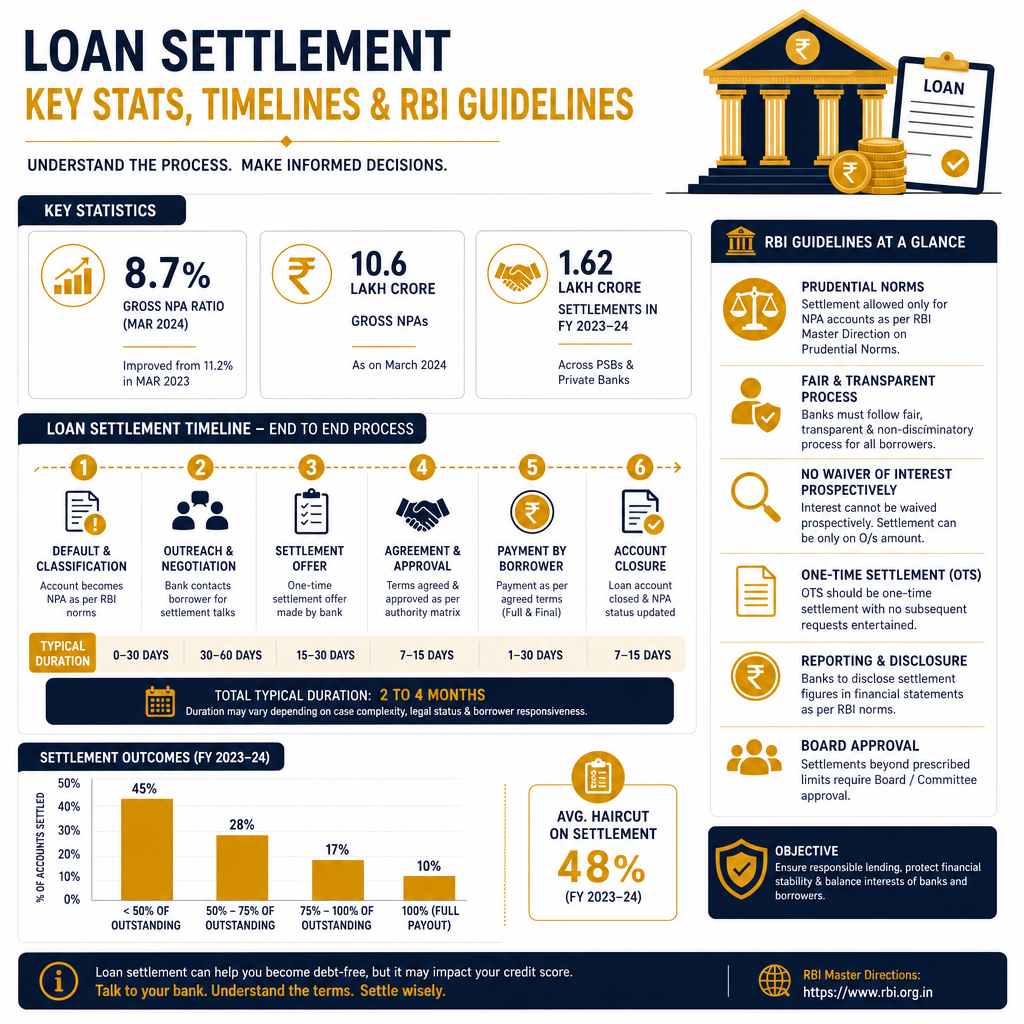
Prepared by AMA Legal Solutions Research & Analytics Team • Data & Compliance Overview
What Borrowers Should Know About Loan Settlement Offers
Loan settlement offers from banks and NBFCs can be a lifeline for borrowers in financial distress. However, understanding the nuances is crucial. These offers allow borrowers to pay a lump sum amount, often less than the total outstanding, to close the loan. This relief comes with its own set of considerations. Firstly, a settled loan is typically marked as "settled" in credit reports, which can affect your credit score negatively, compared to a "closed" status. Therefore, borrowers should weigh the long-term implications on their creditworthiness.
Banks and NBFCs might extend these offers when they perceive that recovery through usual means is unlikely. While it provides immediate relief from debt collection pressures, it often does not fully eliminate the debt's record. Borrowers should engage in thorough discussions with the bank or an expert in loan settlements to negotiate favorable terms, ensuring clarity on the amount, timeline, and any residual obligations.
Timing is a critical factor, as early negotiations often yield better terms. Legal advisors can provide strategic insights on when to propose settlements and how to mitigate negative impacts on credit history. By understanding these facets, borrowers can make informed decisions that align with their financial recovery goals.
Risks and Challenges in Loan Settlements for Borrowers
Loan settlements can appear as a lifeline for borrowers facing financial distress, but they come with inherent risks and challenges that must be carefully navigated. Understanding these challenges is crucial to making an informed decision.
Credit Score Impact
One of the most significant risks is the impact on your credit score. Settling a loan often leads to a negative mark on your credit report, which can affect your ability to secure future credit. This can lower your creditworthiness for several years, complicating new credit acquisitions.
Hidden Costs and Tax Implications
While settling a loan might reduce immediate financial pressure, borrowers often overlook hidden costs such as penalties or processing fees. Additionally, the forgiven debt may be considered taxable income, thus creating a liability during tax filings.
Legal Complications
Loan settlements may sometimes lead to legal complications, especially if terms are not clearly documented or agreed upon. It's imperative to have any settlement agreements reviewed by a legal expert. Consulting services like Loan Settlement Services can help mitigate these risks.
Negotiation Challenges
Negotiating a settlement requires skill and patience. Borrowers often face difficulties in reaching an agreement that satisfies both parties. Inadequate negotiation can result in unfavorable terms. Opting for professional counsel through Banking and Finance Law services can provide strategic advantages.
In summary, while loan settlements offer a path to financial relief, being aware of the associated risks and challenges ensures borrowers make decisions that align with their long-term financial health.
Legal Recourse Available to Borrowers in Loan Settlements
Borrowers facing loan settlement issues have multiple legal avenues to explore to safeguard their interests. The first step often involves examining the contract terms to check for any potential breaches by lenders. In such cases, borrowers may resort to filing a suit for breach of contract under the Indian Contract Act, 1872.
If the bank or NBFC applies undue pressure or employs unfair practices, borrowers can file a complaint with the Banking Ombudsman under the Reserve Bank of India's regulations. This mechanism provides a quick and cost-effective resolution for grievances related to banking services.
For disputes that cannot be settled through the Ombudsman, borrowers can escalate the matter to the consumer court under the Consumer Protection Act, 2019. This step is particularly useful when banking practices infringe upon consumer rights.
Borrowers can also seek arbitration and dispute resolution as an alternative means to resolve conflicts efficiently. In situations where legal notice is served by the bank, it is crucial to reply appropriately to the bank's legal notice to prevent further legal complications.
In cases of harassment by recovery agents, borrowers have the right to lodge a complaint with the police and seek legal injunctions to restrain such activities, utilizing their rights under the Indian Penal Code to prevent misuse of authority.
Case Studies: Successful Loan Settlements with Banks and NBFCs
Loan settlements can be complex, but real-world examples highlight how borrowers can successfully negotiate favorable terms with banks and NBFCs. These cases demonstrate the strategies and outcomes achieved in different scenarios.
Case Study 1: MSME Debt Restructuring
A micro, small, and medium enterprise (MSME) faced financial distress due to market volatility. Engaging with the bank, the company negotiated a debt restructuring plan. By extending the loan tenure and reducing the interest rate, the enterprise stabilized its cash flow, helping it to continue operations. This approach not only alleviated immediate financial pressure but also improved their creditworthiness. For more guidance, explore our Loan Settlement Services.
Case Study 2: Personal Loan Settlement
An individual borrower who lost their job during the pandemic was unable to meet personal loan EMIs. After receiving a legal notice from the bank, they sought legal advice and drafted a detailed response. The borrower proposed a lump-sum payment of 50% of the outstanding amount. The bank accepted this offer, marking the loan as settled in their books. Learn more about responding to legal notices here.
These case studies underscore the importance of proactive communication and negotiation. They illustrate how understanding the perspectives of banks and NBFCs can lead to successful loan settlements, benefiting both borrowers and financial institutions.
Practical Tips for Borrowers: Negotiating Loan Settlements
Successfully negotiating a loan settlement with banks or NBFCs requires a strategic approach. Here are some practical tips to ensure a favorable outcome:
Understand Your Financial Situation
Before approaching your lender, conduct a thorough assessment of your financial status. Know the exact amount you owe and evaluate your capability to repay. This self-assessment will provide a realistic picture of what you can offer during negotiations.
Communicate Honestly
Transparency is crucial. Clearly communicate your financial challenges to the lender. Honest discourse can foster trust and may lead to more favorable terms. If your financial difficulties are recent, explain the situation in detail. This can be particularly relevant when dealing with loan settlement services.
Prepare Documentation
Gather all pertinent documents, including income proofs, expense breakdowns, and any correspondence with the lender. Documentation supports your claims and can expedite the negotiation process.
Know Your Rights
Familiarize yourself with your rights as a borrower. Understanding legal frameworks, such as those outlined in banking and finance law, can empower you during negotiations and prevent exploitation.
Consider Professional Help
Engaging with legal experts or financial advisors can provide additional leverage. Professionals have the expertise to navigate complex negotiations and can often achieve better settlement terms. Should disputes arise, consider exploring arbitration and dispute resolution services.
Structured Data Table: Comparison of Legal Remedies and Timelines
When borrowers face financial difficulties, understanding the various legal remedies and their associated timelines is crucial. Banks and NBFCs offer distinct pathways, each with its advantages and potential drawbacks. Here's a detailed comparison:
Legal Remedies Available
- SARFAESI Act: This remedy is typically used by banks for secured loans, allowing them to recover non-performing assets without court intervention. It's a swift process, but only applicable to secured loans.
- Debt Restructuring: Both banks and NBFCs may offer restructuring options. It involves altering the terms of the loan to make repayment feasible for the borrower. The timeline varies depending on the financial institution's policies and borrower negotiations.
- Arbitration and Dispute Resolution: This method involves a neutral third party to resolve disputes, often leading to quicker settlements. It is preferable for those wanting to avoid lengthy court processes. Learn more about Arbitration and Dispute Resolution.
Timelines for Legal Remedies
- Loan Restructuring: Typically resolved within 60 to 90 days, depending on the complexity of negotiations and the borrower's cooperation.
- SARFAESI Proceedings: Can be completed within 90 days, but may extend if the borrower contests the action.
- Arbitration: Generally faster than litigation, with disputes often resolved in six months, subject to the arbitration clause and parties' cooperation.
For detailed guidance, consider consulting our Loan Settlement Services for personalized strategies tailored to your situation.
Popular Searches

AMA Legal Solutions
Trusted with a 4.7 Google Rating, over 10,000+ Clients Served, 25,000+ Cases Handled, and more than 40+ Years of Experience in providing strategic legal defense and debt resolution across India.
Our media coverages





Client Reviews
"AMA Legal Solutions provided exceptional service in settling my loan. Their knowledge of RBI guidelines was particularly impressive."
Ramesh Patel
"The guidance from AMA Legal Solutions was invaluable. They navigated the loan settlement process with expertise, securing a favorable agreement for me."
Priya Sharma
"The team at AMA Legal Solutions are true experts. They helped me understand my rights and negotiate a fair loan settlement."
Suresh Reddy
"AMA Legal Solutions turned a complex situation into a smooth process, settling my loan efficiently and professionally."
Meena Joshi
"I was stressed about my loan default, but AMA Legal Solutions helped me negotiate a reasonable settlement. Highly recommended!"
Anita Kumar
Frequently Asked Questions
Related Articles

Achieving Loan Settlement in Minimum Time
Expert Strategies to Quickly Resolve Loan Defaults
Read Article
Why is My Bank Account Frozen or Liened?
Uncover the Reasons and Legal Remedies for Account Freezes
Read Article
Mastering 4 Budgeting Methods for a Debt-Free Life
Practical strategies to manage finances and achieve financial freedom.
Read ArticleAbout Author
Anuj Anand Malik
View ProfileAnuj Anand Malik, Founder of AMA Legal Solutions, is a trusted advocate, loan settlement expert, legal advisor, and banking lawyer. With over a decade of experience in loan settlement, corporate law, financial disputes, and compliance, he leads a result-driven law firm based in India that helps individuals, startups, and businesses achieve legal and financial stability.
Connect on LinkedInNeed Legal Help?
Get expert advice on loan settlement and debt relief.
Call +91-8700343611Request Callback