Employer Not Paying Salary: Legal Solutions & Rights
Explore your rights and legal remedies for unpaid salaries in India.

Anuj Anand Malik
Reviewed by AMA Legal Solutions

Key Takeaways: If your salary is delayed, first verify your employment terms and communicate with your employer. Legal options include filing a complaint with the labor commission, mediation, sending a legal notice, or pursuing civil litigation. Employers are bound by the Payment of Wages Act, 1936, to ensure timely salary payments. Understanding your rights and legal remedies is crucial for effective resolution in salary disputes.
Understanding Your Rights as an Employee in India
In India, employees have specific rights protected by labor laws which ensure timely payment of salaries. If an employer fails to pay, the Payment of Wages Act, 1936 and the Minimum Wages Act, 1948 provide legal recourse. Employers are obliged to pay salaries within the stipulated time frame, typically by the 7th or 10th of the following month for most establishments.
Legal Protections and Actions
Employees can approach the labor commission or file a complaint with the competent authority if salaries are withheld. It’s important to first communicate with your employer. If disputes persist, mediation can be an effective step. You can also consider learning about Banking and Finance Law for deeper insights into financial disputes.
- File a complaint with the labor commissioner.
- Engage in mediation for amicable settlement.
- If unresolved, escalate to a civil court.
Seek legal advice if you face persistent issues. For those needing a broader understanding of their options, exploring Civil Litigation and Disputes might provide valuable information. Knowing and exercising your rights can lead to effective resolution and ensure fair treatment in the workplace.
Legal Obligations of Employers Regarding Salary Payments
Employers in India are legally bound to adhere to specific regulations regarding salary payments to ensure the protection of employees' rights. The Payment of Wages Act, 1936 mandates timely and full payment of wages. It specifies that wages must be paid before the 7th of the following month in establishments employing less than 1,000 workers and before the 10th for larger establishments.
Key Regulations Employers Must Follow
- Employers must provide a written salary statement, detailing earned wages, deductions, and net pay.
- They are required to comply with minimum wage laws as specified by state and central government.
- All salary agreements, as per employment contracts, must be honored unless mutually modified.
Failure to comply with these obligations can result in legal consequences, offering employees the right to seek redressal through labor courts. For workers facing salary disputes, understanding the Arbitration and Dispute Resolution mechanisms can be beneficial. Comprehensive legal frameworks exist to support employees, and in cases of non-payment, employees can approach the respective labor commissioner or file a case for Civil Litigation and Disputes.
It is vital for both employers and employees to be aware of these obligations to maintain a harmonious and lawful work environment. Ignorance of such laws can lead to unnecessary disputes, emphasizing the importance of professional legal guidance when needed.
Immediate Steps to Take if Salary is Delayed
When facing a delay in salary, addressing the situation promptly is crucial. Here are immediate steps you can take:
1. Review Employment Agreement
First, examine your employment agreement to understand the payment terms stipulated. This document provides legal backing if there's a breach. If your agreement lacks clarity, consult with a legal expert in Corporate Law and Compliance.
2. Communicate with Your Employer
Approach your employer or HR department to inquire about the delay. Maintain a professional tone and document the communication in writing, such as through email, so you have a record of your inquiries and any responses.
3. Send a Formal Legal Notice
If verbal communication fails, consider sending a formal legal notice. This action often prompts employers to respond promptly. For drafting assistance, explore our Legal Notice and Agreement Drafting services to ensure your notice is legally sound.
4. Seek Legal Guidance
If the issue persists, legal advice is essential. Consulting a lawyer experienced in Civil Litigation and Disputes can provide insights into further legal actions, such as filing a claim in a labor court. Pursuing legal action may be necessary, but always consider reconciliation as a preferred first step.
How to Communicate with Your Employer About Salary Issues
Addressing salary discrepancies with your employer requires tact and professionalism. Begin by scheduling a private meeting with your manager or HR representative. Clearly outline the issue, referencing any previous communications or agreements regarding your salary. It's crucial to remain calm and factual, avoiding emotional language that could escalate the situation.
Steps to Address the Issue
- Prepare documentation of your salary expectations and any discrepancies.
- Use specific examples, such as pay stubs or employment contracts, to support your claim.
- Politely request an explanation for the delay or discrepancy.
- Inquire about the timeline for resolving the issue.
- Follow up the meeting with an email summary to ensure that there is a record of your conversation.
In some cases, misunderstandings can be quickly resolved through direct communication. However, if the issue persists, you may need to consider further steps. Consulting with a legal expert can help you understand your rights and the options available to resolve the situation. You can explore Banking and Finance Law services for professional advice.
Furthermore, reviewing your employment contract for clauses on salary payment and dispute resolution mechanisms can offer additional insights. This might also be the time to consider Civil Litigation and Disputes if negotiations prove unfruitful. Remember, remaining professional and composed throughout the process is key to finding a constructive solution.
Exploring Legal Remedies for Unpaid Salaries
If an employer is not paying your salary, understanding your legal rights is crucial. India’s labor laws provide multiple avenues for recovering unpaid wages. Initially, an aggrieved employee can approach the labor commissioner or file a complaint in the labor court. The Payment of Wages Act, 1936, and the Industrial Disputes Act, 1947, are primary legislations safeguarding employee remuneration.
Legal proceedings can become complex, hence, negotiating directly with the employer could be a preliminary step. If unsuccessful, drafting a legal notice demanding payment is advisable. Should the matter escalate, approaching a labor court or hiring a lawyer specializing in Civil Litigation and Disputes may be necessary.
| Parameter / Criterion | Key Details / Legal Provision | Timeline / Practical Impact |
|---|---|---|
| Initial Step | Direct Negotiation with Employer | 2-4 weeks |
| Legal Notice | Notice Drafting and Sending | 1-2 weeks |
| Labor Commissioner | File a Complaint | 3-6 months |
| Labor Court | File a Case | 6 months - 1 year |
It's essential to maintain thorough documentation of employment terms and communications with the employer. This documentation will support your case if you need to proceed with legal action.
How to File a Complaint with the Labour Commissioner
Filing a complaint with the Labour Commissioner can be a crucial step if your employer is not paying your salary. This process ensures that your grievances are officially recorded and addressed under the legal framework. Here’s a detailed guide on how you can proceed.
Steps to Follow
- Understand Your Rights: Before filing a complaint, it's imperative to understand your legal rights as an employee under Indian labour laws. Familiarize yourself with provisions that protect your salary entitlements.
- Document the Issue: Keep a detailed record of all correspondences with your employer regarding the unpaid salary. This should include emails, messages, or any other form of communication.
- Formal Notice: Send a formal notice to your employer demanding payment of the due salary. This notice can often prompt action and is a necessary step before escalating the matter to the Labour Commissioner.
- Drafting the Complaint: Prepare a written complaint outlining your grievance. Clearly mention the period for which the salary is unpaid, the amount due, and attach supporting documents.
- Submit the Complaint: Submit your complaint to the Labour Commissioner’s office. You may also explore the Civil Litigation and Disputes services for additional legal support.
- Follow Up: After submission, regularly follow up with the Labour Office. They might call you and your employer for a hearing to resolve the issue.
If you're seeking more comprehensive legal assistance, consider exploring our Legal Notice and Agreement Drafting services to enhance your submission.
Key Insights & Data Infographic
Visual summary, statistical trends & procedural breakdown
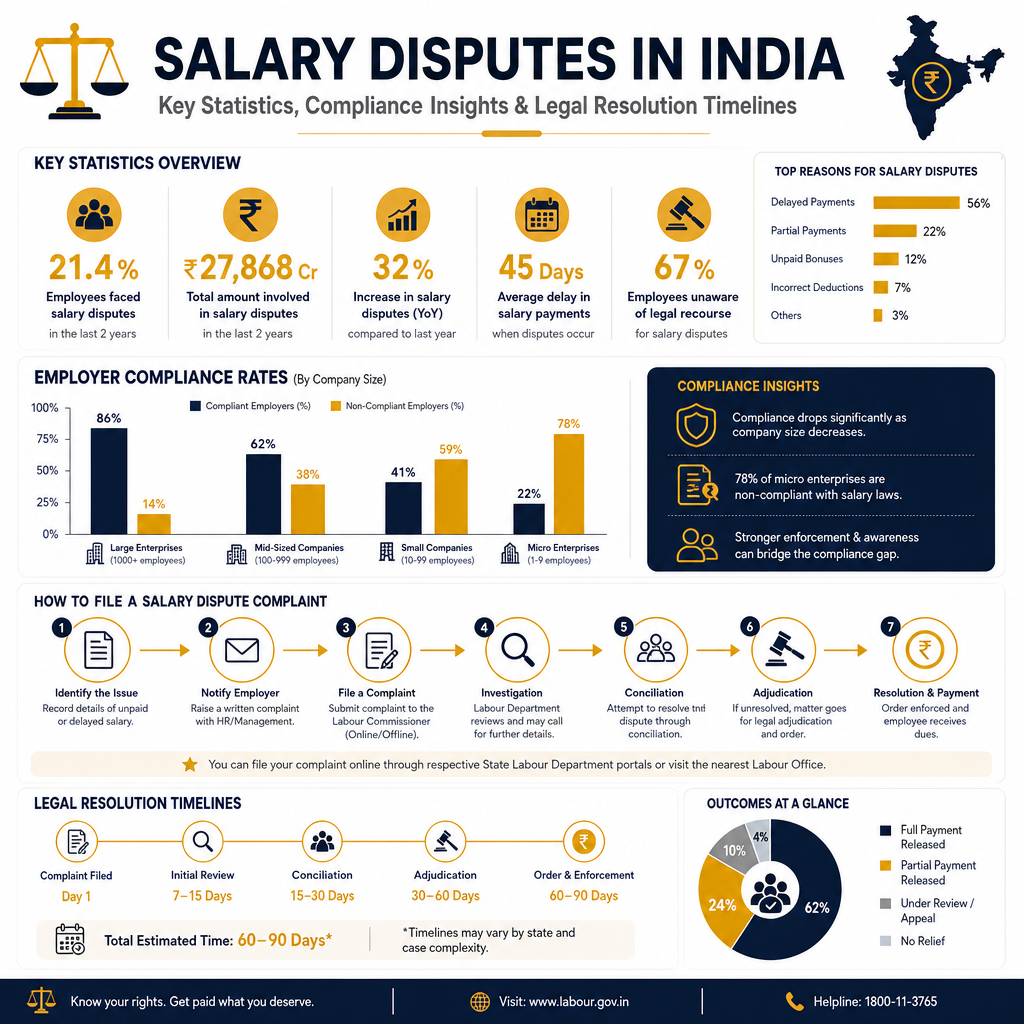
Prepared by AMA Legal Solutions Research & Analytics Team • Data & Compliance Overview

Halt Recovery Agent Harassment Legally
Role of Labour Courts in Salary Disputes
Labour courts in India play a pivotal role in addressing disputes related to unpaid salaries. These courts are specifically designed to handle matters involving employer-employee relationships and ensure that workers receive their due wages. When an employer fails to pay salaries, employees can approach the labour court to seek justice and enforcement of their rights.
To initiate a case, the affected employee must file a complaint with the labour court, detailing the salary dispute. The court then examines the complaint, and upon finding merit, it may summon the employer to provide justification. Labour courts possess the authority to mandate employers to clear pending dues and may also impose fines or penalties for non-compliance.
Legal Process and Outcome
- Filing a Complaint: Employees must submit a detailed complaint that outlines the nature of the dispute and the amount owed.
- Hearing and Evidence: The court will conduct hearings where both parties present evidence and arguments.
- Judgment: Based on the evidence, the court delivers a judgment which could include ordering the employer to pay the outstanding salary.
It's important to note that labour courts aim to expedite such cases to prevent prolonged financial distress. Employees seeking redressal may also consider consulting with legal experts specializing in Civil Litigation and Disputes to ensure a comprehensive approach. Understanding your rights and options is crucial in navigating salary disputes effectively.
Comparison of Legal Remedies: Labour Court vs Civil Court
When faced with the situation of an employer not paying salary, understanding the appropriate legal forum is crucial. Both Labour Court and Civil Court offer remedies, but they serve different purposes and processes. Selecting the right court depends on multiple factors such as the nature of employment, the complexity of the case, and potential outcomes.
Key Differences Between Labour Court and Civil Court
The following table highlights the main distinctions between pursuing a case in Labour Court versus Civil Court:
| Parameter / Criterion | Labour Court | Civil Court |
|---|---|---|
| Applicable to | Workmen under Industrial Dispute Act, 1947 | All employees, including contractual or managerial positions |
| Legal Provision | Industrial Dispute Act, 1947 | Code of Civil Procedure, 1908 |
| Timeline | Generally quicker, around 6-12 months | May take longer, usually 1-3 years |
| Practical Impact | Focuses on reinstatement and back-pay | Primarily monetary compensation |
In the Labour Court, workmen can seek reinstatement and recovery of unpaid wages, while the Civil Court may be more suitable for higher-level employees seeking contractual or financial relief. It's essential to assess individual circumstances and consult with a legal expert to decide the best course of action. For complex disputes involving employment contracts, consider Civil Litigation and Disputes services.
Understanding Arbitration in Salary Disputes
Arbitration serves as a viable alternative for resolving salary disputes when an employer fails to pay wages. It is a private form of dispute resolution where an arbitrator, acting as a neutral third party, listens to both sides before making a binding decision. This method can be less formal and quicker than traditional court procedures, providing employees with a more streamlined path to resolve their issues.
How Arbitration Works
Initially, both parties must agree to arbitration. This agreement is often outlined in the employment contract as an arbitration clause. Once agreed, the process involves selecting an arbitrator with expertise in employment law, who will convene a hearing to understand the dispute. The arbitrator's decision, known as an award, is typically final, and courts rarely overturn it.
- Arbitration is confidential, protecting both the employee's and employer's reputations.
- It is usually quicker than court litigation, often resolving disputes within months.
- The costs associated with arbitration can be lower compared to a court case, making it an attractive option.
For those considering arbitration, consulting with a specialist in Arbitration and Dispute Resolution can provide guidance tailored to specific cases. Understanding the nuances of this process is essential in navigating salary disputes effectively.
Timeline and Process for Recovering Unpaid Salaries
Understanding the timeline and process involved in recovering unpaid salaries is vital for employees facing this issue. The process begins with initiating a formal communication with the employer, outlining the salary dues and requesting immediate payment. It is crucial to document all communications and responses to support your claim legally.
Step 1: Formal Communication
Send a formal email or letter to your employer detailing the unpaid salaries. Clearly mention the amount due, payment period, and request a specific response time, typically within 7 to 14 days. Retain copies of all communication as evidence.
Step 2: Legal Notice
If the employer remains unresponsive or dismissive, consider sending a legal notice. This formal step serves as an official warning and often results in prompt action. Legal notices can be effectively crafted through legal experts specializing in Civil Litigation and Disputes.
Step 3: Filing a Complaint
Should the legal notice fail to elicit a response, you may file a complaint with the Labour Commissioner or approach the appropriate labour court. It's advisable to seek assistance from legal professionals with expertise in Corporate Law and Compliance to navigate this process effectively.
Step 4: Court Proceedings
If all other avenues are exhausted, initiating court proceedings may be necessary. This step can be time-consuming and costly but may be the only option for securing your rightful dues. It is essential to proceed with the guidance of experienced legal counsel to ensure the best possible outcome.
Potential Risks and Challenges in Pursuing Legal Action
Engaging in legal action against an employer for unpaid salary can be a daunting task and requires careful consideration of potential risks. One primary challenge is the risk of retaliation from the employer, which might manifest as termination or unfavorable treatment in the workplace. It is critical to assess the likelihood of this risk and consider seeking advice from a legal expert.
Another significant challenge is the financial cost involved in pursuing legal remedies. Legal proceedings can be costly and time-consuming, which might not be feasible for everyone. Additionally, the civil litigation process in India can often be protracted, leading to potential delays in securing justice.
Challenges of Evidence and Proof
The burden of proof lies with the employee to demonstrate that the salary has not been paid as per the contractual agreement. Collecting concrete evidence such as employment contracts, salary slips, and communication records becomes paramount. Lack of clear documentation can severely undermine your case.
- Retaliation from employer
- Financial and temporal costs
- Lack of evidence
- Prolonged litigation processes
Despite these challenges, understanding your legal options can provide a strategic advantage. It's advisable to explore alternative dispute resolution methods such as arbitration or mediation before proceeding with litigation. Careful planning and legal consultation can mitigate many of these risks, helping you navigate the legal landscape more effectively.
Real-life Case Studies: Successful Salary Recovery
In the realm of salary disputes, actual experiences often illuminate the path to resolution. Consider the case of Mr. Arun, a senior manager at a tech startup. When the startup faced financial challenges, Arun's salary was delayed for three consecutive months. Despite multiple discussions, the issue remained unresolved. Seeking professional advice, Arun approached AMA Legal Solutions for guidance.
After a comprehensive review of his employment contract and subsequent correspondence with the employer, a formal legal notice was drafted. This notice clearly stipulated the legal implications of non-payment and demanded immediate action. Within weeks, the employer responded with a settlement, ensuring full back payment along with compensation for the delay.
Another instance involves Ms. Priya, a junior accountant in a medium-sized firm. Her salary had been withheld for two months due to alleged performance issues. Priya, confident in her work record, reached out for legal assistance. A strategic approach was adopted, leveraging the Arbitration and Dispute Resolution process. This not only facilitated the recovery of her dues but also reinstated her position with an apology from the employer.
These cases underscore the importance of understanding one's rights and the effective use of legal mechanisms to address salary-related grievances. Seeking timely advice can often turn a challenging situation into a successful resolution.
Popular Searches & Topics
Commonly searched legal queries and keywords related to this article
Need Strategic Legal Defense for Your Situation?
Our banking & litigation advocates review your notices, debt liability, and recovery issues under complete advocate-client secrecy.

AMA Legal Solutions
Trusted with a 4.7 Google Rating, over 10,000+ Clients Served, 25,000+ Cases Handled, and more than 40+ Years of Experience in providing strategic legal defense and debt resolution across India.
Our media coverages





Client Reviews
"AMA Legal Solutions provided exceptional support in resolving my salary dispute. Their professional guidance led to a swift resolution."
Amit Sharma
"Excellent service! The lawyers at AMA Legal Solutions were knowledgeable and helped me navigate the complexities of labor law effectively."
Priya Menon
"I am grateful for the assistance provided by AMA Legal Solutions. Their proactive approach in resolving my salary issue was commendable."
Suresh Rao
"The legal team was thorough and understanding of my situation. Their advice was invaluable in dealing with my employer's delay in salary."
Neha Verma
"I highly recommend AMA Legal Solutions. They ensured that I received my due payments and handled my case with utmost professionalism."
Rohan Patil
Frequently Asked Questions
Related Articles

RuPay Credit Card on UPI Default & Credit Line on UPI Settlement (2026)
Micro-transactions on RuPay UPI Credit Cards and pre-approved 'Credit Lines on UPI' have triggered a massive wave of 42%+ APR revolving debt traps. Find out if defaulting blocks your personal savings UPI and how to settle RuPay UPI credit dues for 30%–50%.
Read Article
Paytm, PhonePe & BharatPe Daily EDI Merchant Loan Settlement (2026)
Drowning in Equated Daily Installment (EDI) merchant loans where 100% of your daily QR Soundbox collections are auto-swept before you can pay suppliers or rent? Learn how retail shopkeepers and MSMEs legally halt QR sweeps and negotiate a 50%+ OTS.
Read Article
Can Bank or Loan App Remotely Lock Phone for EMI Default? RBI Rules (2026)
An investigative breakdown of RBI's Remote Device Locking Directions—explaining why lenders cannot lock your phone for personal loans, the mandatory 30/60 DPD safeguards on financed devices, the Rs. 250/hour delay penalty, and how to settle device & app loans.
Read ArticleAbout Author
Anuj Anand Malik
View ProfileAnuj Anand Malik, Founder of AMA Legal Solutions, is a trusted advocate, loan settlement expert, legal advisor, and banking lawyer. With over a decade of experience in loan settlement, corporate law, financial disputes, and compliance, he leads a result-driven law firm based in India that helps individuals, startups, and businesses achieve legal and financial stability.
Connect on LinkedInNeed Legal Representation?
Evaluate your defense against recovery agents, notices, or structure your loan settlement directly with Senior Advocates.
Call +91-8700343611