How to De-Freeze Your Bank Account Frozen by an Arbitrator
Navigate the complexities of regaining access to your bank account after an arbitration freeze.

Anuj Anand Malik
Reviewed by AMA Legal Solutions

Key Takeaways: An arbitration freeze can significantly impact financial stability. Understanding legal grounds, consulting a banking lawyer, and exploring settlement options are crucial steps to unfreeze accounts. RBI guidelines and the Arbitration and Conciliation Act provide the legal framework for such actions, emphasizing the importance of professional legal assistance in these matters.
Understanding the Impact of an Arbitration Freeze on Your Bank Account
An arbitration freeze on your bank account can have significant consequences, impacting your financial stability and liquidity. When an arbitrator mandates a freeze, it means your account is temporarily inaccessible, preventing you from withdrawing funds or conducting transactions. This often occurs during disputes related to loan settlements, where the lender seeks to secure owed funds.
Why an Arbitration Freeze Happens
An arbitration freeze is typically initiated when a lender suspects loan default or disputes over repayment terms. The arbitrator acts as a neutral third party to resolve these disputes, and the freeze is a preventive measure to ensure the borrower does not deplete their assets, complicating the repayment process.
Effects on Daily Financial Activities
- Inability to access funds for daily expenses, which can affect your ability to pay bills or make essential purchases.
- Constraints on business operations if the frozen account is linked to business transactions.
- Potential impact on credit scores due to missed payments resulting from frozen assets.
To address the freeze, it is crucial to understand the Arbitration and Dispute Resolution process and explore avenues such as negotiation or settlement with the assistance of legal experts. For further guidance, consider exploring our Loan Settlement Services to mitigate these impacts and restore access to your accounts effectively.
Legal Grounds for Freezing Bank Accounts in Loan Settlements
In the context of loan settlements, an arbitrator may freeze a bank account to secure the repayment of outstanding dues. This action is generally based on the provisions of the Arbitration and Conciliation Act, 1996, which empowers arbitrators to take interim measures to protect a creditor's interests. However, such measures are not taken lightly and must adhere to legal standards.
Understanding the Arbitrator's Power
Arbitrators possess the authority to issue orders that safeguard the financial interests of lenders. Freezing a bank account can ensure that a borrower does not dissipate assets prior to settling dues. This authority is typically invoked when there is substantial evidence of default or non-cooperation from the borrower.
- The arbitrator must establish that freezing is necessary to prevent asset diversion.
- Borrowers should receive a notice before any action is taken, allowing them to present their case.
- Such orders are generally temporary, designed to preserve the financial status quo until a resolution is reached.
This power underscores the importance of seeking professional advice if faced with such a situation. Consulting experts in Loan Settlement Services or Arbitration and Dispute Resolution can provide tailored guidance to navigate these complex proceedings effectively.
Steps to Initiate the Process of De-Freezing Your Bank Account
If your bank account has been frozen due to an arbitrator's decision in a loan settlement case, prompt action is essential. Here's a structured approach to help you navigate the de-freezing process:
1. Understand the Grounds for Freezing
Start by obtaining a copy of the arbitrator's order. This document will detail the reasons for the account freeze and provide insights into the next legal steps.
2. Consult Your Banking Lawyer
Engage a seasoned banking lawyer who can review the arbitrator's decision and assess viable options. For more information, consider Loan Settlement Services for legal assistance.
3. File an Appeal or Application
Your lawyer may recommend filing an appeal or an application to modify the arbitrator's order. This step may involve presenting a compelling case for why the freeze should be lifted, with documents supporting your financial situation and repayment plans.
4. Comply with Court Requirements
Follow any specific requirements set by the court or tribunal. Timeliness and accurate documentation are crucial in influencing the outcome favorably.
| Parameter / Criterion | Key Details / Legal Provision | Timeline / Practical Impact |
|---|---|---|
| Obtaining Arbitrator's Order | Request order copy from bank or court | Typically within 2-5 business days |
| Consultation with Lawyer | Analyze order and strategize next steps | Initial consultation within 1 week |
| Filing Appeal/Application | Legal preparation and submission | Varies, 2-4 weeks depending on jurisdiction |
| Compliance with Court Instructions | Submit additional documents if required | As per court's timeline, usually 1-2 weeks |
5. Maintain Regular Communication
Keep in touch with your legal advisor to receive updates on the progress. Ensure you understand the next steps and any obligations from your side.
For further assistance, you may wish to explore Banking and Finance Law to understand more about your rights and remedies in such situations.
Key Legal Documents Required for De-Freezing an Account
De-freezing a bank account frozen by an arbitrator in a loan settlement issue involves several legal processes. Critical documents play a pivotal role in this procedure. Here’s a comprehensive list of documents you may need to prepare:
1. Arbitration Award
The arbitration award is paramount as it details the arbitrator’s decision. Ensure you have a certified copy, as it highlights the underlying reasons for the freeze and can be used to substantiate your case in court.
2. Legal Representation Authorization
Appointing a competent lawyer is crucial. You’ll need a power of attorney or formal letter authorizing your legal counsel to act on your behalf for the case proceedings.
3. Bank Account Statements
Collect recent bank account statements to demonstrate the financial impact of the freeze. These documents are essential for negotiating with authorities to expedite the unfreezing process.
4. Correspondence with the Bank and Arbitrator
Maintain a record of all communications with your bank and the arbitrator. This includes emails, letters, and notices relating to the freeze, as they can be pivotal in illustrating your proactive efforts to resolve the matter.
5. Valid Identity and Address Proof
Standard identification documents such as your Aadhaar card, PAN card, and address proof are necessary to verify your identity and entitlement to the account. Ensure these are up-to-date and readily available.
For further assistance, consider exploring loan settlement services to navigate these complexities efficiently.
Navigating Court Procedures: How to File an Application
When your bank account is frozen by an arbitrator, filing an application in court becomes crucial. Begin by consulting with a legal expert experienced in loan settlement cases to guide you through the process. Here's a detailed path to ensure your application is filed correctly:
Step 1: Prepare Your Documentation
Gather all relevant documents, including loan agreements, bank statements, arbitration notices, and any communication with the bank. These documents will serve as evidence supporting your case.
Step 2: Drafting the Application
Your application should clearly state the reasons for the de-freeze request, referencing the arbitration order and explaining any hardship caused by the account freeze. It's advisable to seek help from a lawyer specializing in civil disputes to ensure comprehensive coverage of your arguments.
Step 3: Filing the Application
Submit the application to the appropriate court where the arbitration was conducted. Your lawyer will ensure it complies with court requirements. Pay any necessary fees and obtain a date for your hearing.
Step 4: Court Appearance
Attend the court hearing with your lawyer. Be prepared to present your case, highlighting the necessity of account access for daily operations and personal needs. Adherence to court decorum and procedure is key to a favorable outcome.
By following these steps, you can navigate the court procedures effectively to de-freeze your bank account, mitigating further financial distress.
The Role of RBI Guidelines in Account Freezes and Releases
RBI guidelines play a pivotal role in regulating the freezing and releasing of bank accounts, especially in situations involving loan settlements. The Reserve Bank of India (RBI) ensures that the rights and obligations of both borrowers and lenders are balanced. It mandates banks to adhere to fair practices when exercising their rights to freeze accounts.
According to RBI norms, banks must provide due notice to account holders before taking such actions, ensuring transparency and protecting consumer rights. These guidelines also stipulate that banks evaluate the necessity and proportionality of freezing an account, rather than using it as a blanket measure. This ensures that borrowers are not unduly affected, especially those who are willing to settle their debts.
Release of funds post-freeze can also be influenced by RBI directives. Once the borrower and bank reach an amicable agreement, often through arbitration, banks are obliged to act swiftly in lifting the freeze. Borrowers should be aware of their rights and can seek professional assistance to navigate these complex situations.
For more comprehensive understanding, individuals may explore services related to Banking and Finance Law which cover broader aspects of account management and dispute resolutions.
Key Insights & Data Infographic
Visual summary, statistical trends & procedural breakdown
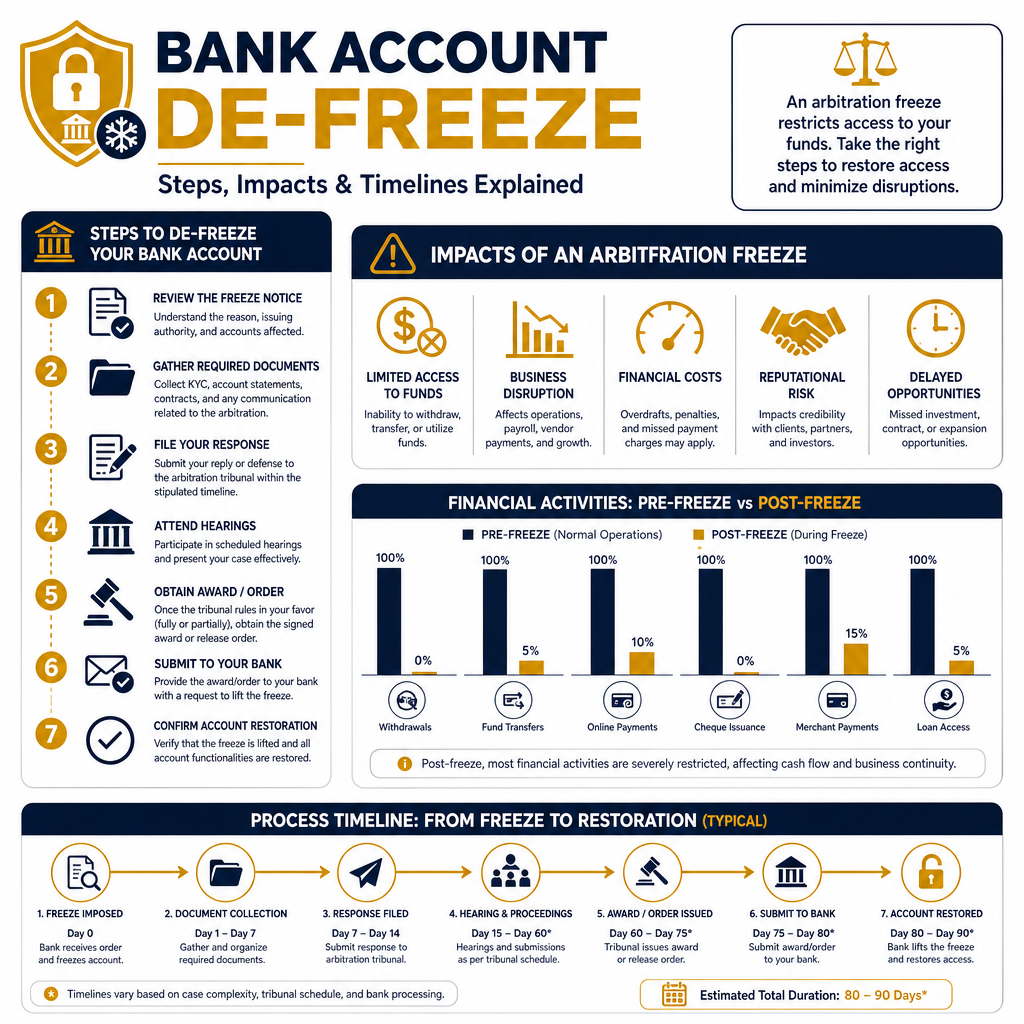
Prepared by AMA Legal Solutions Research & Analytics Team • Data & Compliance Overview

Bank Compromise Settlement & Debt Relief
Comparing Legal Remedies: Arbitration vs. Court Intervention
When facing a frozen bank account due to arbitration in a loan settlement issue, understanding the differences between arbitration and court intervention is crucial. Arbitration is a private method of dispute resolution, while court intervention involves formal judicial proceedings. Each has its own procedures, timelines, and implications for borrowers seeking to de-freeze their accounts.
In arbitration, decisions are typically faster but may lack the comprehensive legal review available in courts. Meanwhile, courts provide a structured environment, ensuring legal formalities and protections. Knowing which path to take can significantly impact the outcome and duration of your case.
| Parameter / Criterion | Key Details / Legal Provision | Timeline / Practical Impact |
|---|---|---|
| Decision Authority | Arbitrator's award is binding; court orders can be appealed | Arbitration is quicker; court can be lengthy |
| Legal Formality | Less formal procedures in arbitration; strict adherence to legal procedures in court | Arbitration is less cumbersome; court requires meticulous documentation |
| Cost Implications | Arbitration may involve fees for arbitrators; court costs include filing and legal fees | Arbitration is typically cost-efficient; court can be expensive |
| Outcome Enforceability | Arbitration awards are enforceable as court orders under the Arbitration Act | Both can enforce decisions, but arbitration requires fewer steps |
For more guidance on navigating these remedies, consider exploring our Arbitration and Dispute Resolution services or delve into Civil Litigation and Disputes for court intervention strategies.
Rights and Obligations of Borrowers Under Arbitration Freeze
When your bank account is frozen due to an arbitration decision in a loan settlement issue, it's crucial to understand your rights and obligations. An arbitration freeze often results from a legal directive aimed at securing assets to satisfy creditor claims. As a borrower, staying informed can protect your interests and provide pathways to resolve the freeze.
Your Rights
- Access to Information: You have the right to receive comprehensive details about the arbitration proceedings and the reasons for the freeze.
- Seeking Legal Counsel: You are entitled to consult with a legal professional who can guide you through the arbitration process and explore potential relief options. Consider connecting with an expert in Arbitration and Dispute Resolution.
- Fair Hearing: You have the right to present your case and any relevant evidence during the arbitration, ensuring you are heard before any further action is taken.
Your Obligations
- Compliance: You must comply with the arbitration order while simultaneously seeking avenues to contest or modify it, if deemed unfair.
- Timely Communication: It is essential to maintain open communication with the arbitrator and creditors. Promptly address any correspondence or inquiries related to the freeze.
- Engagement in Settlement Negotiations: Actively seek to settle the dispute by engaging in meaningful negotiations, potentially reducing the liabilities leading to the account freeze. Explore Loan Settlement Services for effective strategies.
Understanding and exercising these rights and obligations can significantly influence the outcome of your case. It's advisable to familiarize yourself with relevant legal resources and seek professional advice to navigate this complex scenario efficiently.
Common Mistakes to Avoid During the De-Freezing Process
When faced with a frozen bank account due to an arbitration decision, it's crucial to navigate the de-freezing process carefully. Here are common pitfalls to avoid:
Ignoring Legal Notices
One of the biggest mistakes is ignoring the legal notices that may have led to the freezing of your account. Always respond promptly and consider seeking professional advice. Ignoring these notices can complicate the de-freezing efforts.
Delaying Communication with the Bank
Procrastination in communicating with your bank can delay the de-freezing process. Contact your bank immediately to understand their requirements for lifting the freeze. Establishing a clear communication line is essential.
Insufficient Documentation
Providing inadequate documentation to support your case can slow down the process. Ensure all relevant documents, such as the arbitration award and any settlement agreements, are ready for submission. This demonstrates your commitment to resolving the matter.
Overlooking Professional Legal Help
Attempting to handle the situation without professional guidance can be detrimental. Engaging a lawyer experienced in Loan Settlement Services can help you navigate the legal complexities and improve your chances of success.
- Avoid solely relying on verbal agreements; ensure all communications are documented.
- Failing to address the root cause of the freeze, such as a pending debt, can lead to its recurrence.
- Do not underestimate the value of understanding Banking and Finance Law, as it can offer insights into your rights and obligations.
By steering clear of these mistakes, you enhance the prospects of a swift and successful resolution to the freezing issue.
Practical Tips for Negotiating with Arbitrators
Negotiating with arbitrators to de-freeze your bank account requires a strategic approach. Here’s how you can effectively manage the process:
Understand the Arbitrator’s Role
Recognize that arbitrators act as neutral parties to resolve disputes. They interpret the terms of the arbitration agreement and enforce compliance. Understanding their role helps in framing your arguments appropriately.
Prepare Comprehensive Documentation
Gather all necessary documents, such as your loan agreement, payment records, and any correspondence with the bank. Clear documentation is crucial in presenting a convincing case.
Communicate Clearly and Respectfully
Maintain a respectful tone throughout your communications. Clearly express your difficulties and willingness to resolve the issue. Acknowledge any lapses and propose realistic solutions or repayment plans.
Leverage Existing Legal Frameworks
Familiarize yourself with relevant legal frameworks. For instance, refer to regulations under the Arbitration and Conciliation Act, 1996, to highlight any procedural lapses by the bank.
Seek Legal Advice
Consider consulting professionals from Loan Settlement Services to strengthen your negotiation position. Their expertise can provide valuable insights into crafting a more compelling argument.
Negotiate Terms of Settlement
- Offer a feasible repayment schedule.
- Discuss partial payments or restructuring options.
- Seek a reduction in penalty fees or interest rates.
Effective negotiation can lead to a favorable outcome, helping you regain access to your bank account.
Case Studies: Successful De-Freezing of Bank Accounts
When facing the daunting task of de-freezing a bank account frozen by an arbitrator, real-life success stories can offer invaluable insights. Consider the case of Mr. Sharma, a small business owner, who found himself in a financial bind when his account was frozen due to an arbitration claim. By strategically engaging with his bank and leveraging Loan Settlement Services, he successfully negotiated a payment plan, leading to the restoration of his account within two months.
Another noteworthy case involved a salaried individual, Ms. Patel, whose account was unexpectedly frozen. She promptly engaged the services of a legal expert, who guided her through the process of filing the necessary objections and presenting documentary evidence of her regular income. This proactive approach, aligned with Arbitration and Dispute Resolution strategies, resulted in a swift lifting of the freeze, allowing her to resume normal financial activities.
Both cases underscore the importance of timely legal intervention and understanding the nuances of banking and finance law. By approaching the issue with a well-prepared strategy and seeking expert advice, individuals and businesses can effectively navigate the complexities of account de-freezing.
Timeline and Expected Outcomes: What Borrowers Can Anticipate
When your bank account is frozen due to an arbitrator's decision in a loan settlement issue, it’s crucial to understand the timeline and potential outcomes involved. The process often begins with a notification from the bank or arbitrator regarding the reasons for the freeze. Typically, this happens after the arbitration award is passed but can vary depending on the specific circumstances of the case.
Initial Notification and Action: Expect to receive formal communication within a week of the arbitrator’s decision. This is your starting point to challenge or negotiate the freeze. Immediate action, such as consulting a lawyer, is advisable to understand your options and rights.
Expected Outcomes:
- Resolution through Negotiation: Often, engaging with the bank through Loan Settlement Services can lead to a resolution. Negotiating with the bank may result in a favorable outcome, such as a payment plan that allows for gradual repayments, leading to the unfreezing of the account.
- Legal Recourse: If negotiations fail, pursuing legal action might be necessary. This could involve filing an appeal against the arbitrator's decision, a process that may take several months, depending on the court’s schedule.
- Timeline for De-freezing: Once a settlement or court order is achieved, banks typically lift the freeze within two to four weeks. However, this can vary based on the specific instructions provided in the arbitration award or court order.
Understanding this timeline and potential outcomes is critical for borrowers looking to regain access to their accounts and stabilize their financial situation. For more detailed guidance, consider consulting with experts in Arbitration and Dispute Resolution to navigate these complexities effectively.
Popular Searches & Topics
Commonly searched legal queries and keywords related to this article
Need Strategic Legal Defense for Your Situation?
Our banking & litigation advocates review your notices, debt liability, and recovery issues under complete advocate-client secrecy.

AMA Legal Solutions
Trusted with a 4.7 Google Rating, over 10,000+ Clients Served, 25,000+ Cases Handled, and more than 40+ Years of Experience in providing strategic legal defense and debt resolution across India.
Our media coverages





Client Reviews
"The team at AMA Legal Solutions provided invaluable assistance in resolving a complex bank account freeze. Their dedication and knowledge are unmatched."
Anjali Mehta
"Exceptional service from AMA Legal Solutions during my account freeze issue. Their expertise and guidance were pivotal in resolving my financial concerns."
Rahul Verma
"Grateful to AMA Legal Solutions for their effective handling of my arbitration case. Their strategic approach made a significant difference in my situation."
Vikram Gupta
"AMA Legal Solutions expertly navigated my arbitration freeze, restoring access to my account swiftly. Highly recommended for their professionalism and expertise!"
Ravi Sharma
"AMA Legal Solutions turned a daunting arbitration freeze into a manageable process. Their legal acumen and support were instrumental in my case."
Priya Nair
Frequently Asked Questions
Related Articles
RuPay Credit Card on UPI Default & Credit Line on UPI Settlement (2026)
Micro-transactions on RuPay UPI Credit Cards and pre-approved 'Credit Lines on UPI' have triggered a massive wave of 42%+ APR revolving debt traps. Find out if defaulting blocks your personal savings UPI and how to settle RuPay UPI credit dues for 30%–50%.
Read Article
Paytm, PhonePe & BharatPe Daily EDI Merchant Loan Settlement (2026)
Drowning in Equated Daily Installment (EDI) merchant loans where 100% of your daily QR Soundbox collections are auto-swept before you can pay suppliers or rent? Learn how retail shopkeepers and MSMEs legally halt QR sweeps and negotiate a 50%+ OTS.
Read Article
Can Bank or Loan App Remotely Lock Phone for EMI Default? RBI Rules (2026)
An investigative breakdown of RBI's Remote Device Locking Directions—explaining why lenders cannot lock your phone for personal loans, the mandatory 30/60 DPD safeguards on financed devices, the Rs. 250/hour delay penalty, and how to settle device & app loans.
Read ArticleAbout Author
Anuj Anand Malik
View ProfileAnuj Anand Malik, Founder of AMA Legal Solutions, is a trusted advocate, loan settlement expert, legal advisor, and banking lawyer. With over a decade of experience in loan settlement, corporate law, financial disputes, and compliance, he leads a result-driven law firm based in India that helps individuals, startups, and businesses achieve legal and financial stability.
Connect on LinkedInNeed Legal Representation?
Evaluate your defense against recovery agents, notices, or structure your loan settlement directly with Senior Advocates.
Call +91-8700343611