How to File a Complaint Against a Bank or an NBFC in NCH: Legal Guide & Consumer Helpline Procedure
When financial institutions engage in gross deficiency in service, arbitrary interest hikes, unauthorized debit cascades, withholding original property title deeds, or coercive recovery agent harassment, borrowers possess enforceable statutory rights under the Consumer Protection Act, 2019. Discover how advocate-certified drafting and transparent fixed legal advisory empower consumers and commercial borrowers to issue formal pre-litigation notices, lodge airtight grievances via the National Consumer Helpline (NCH) INGRAM portal, leverage the institutional Convergence Scheme, and seamlessly transition to e-Daakhil Consumer Commissions for binding compensation and debt relief.

Founder & Senior Advocate • Reviewed by Team AMA Legal Solutions
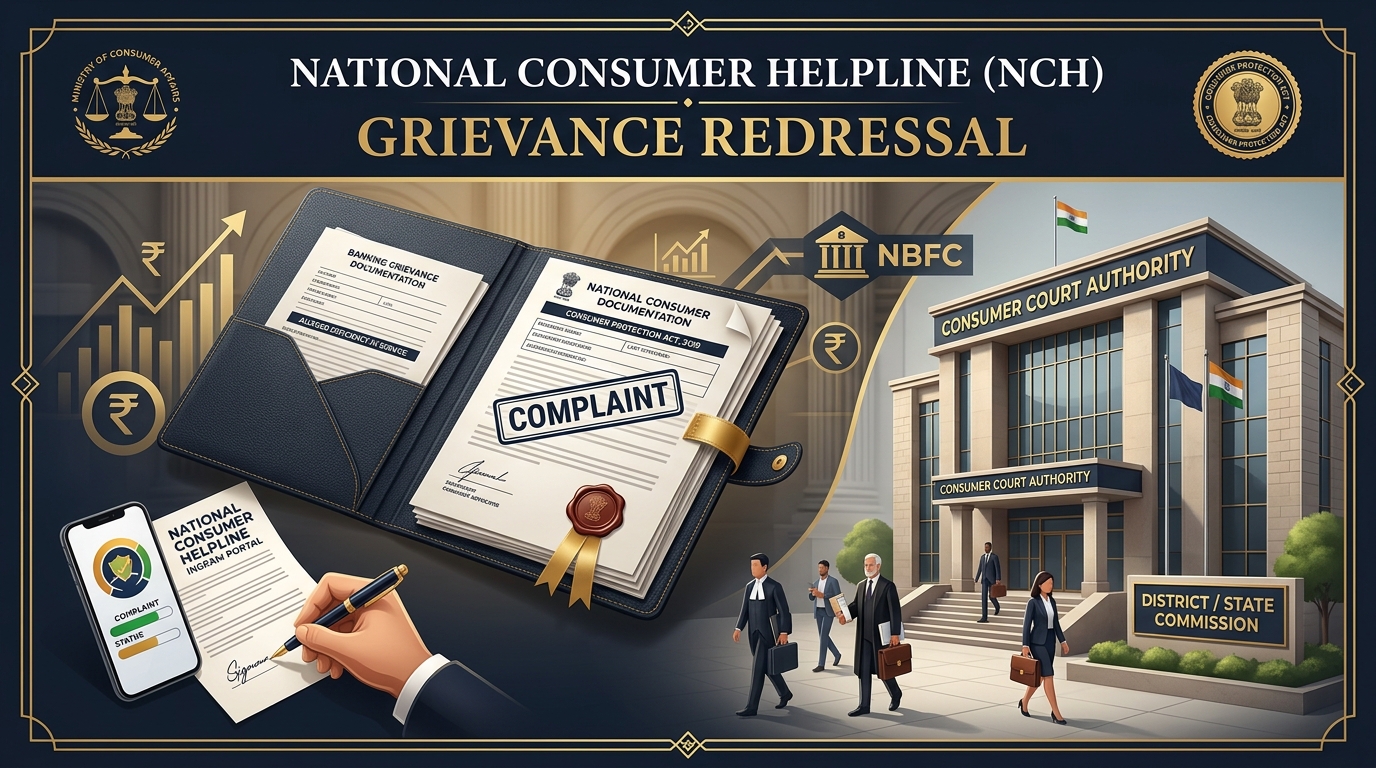
National Consumer Helpline (NCH) Redressal
Statutory INGRAM Procedure & Advocate Representation
Google Verified Client Reviews
Clients Represented Nationwide
Banking & Consumer Disputes Handled
Combined Legal Experience
Quick Legal Answer: How to File a Complaint Against a Bank or an NBFC in NCH
Filing a complaint against a bank or an NBFC in NCH is a statutory pre-litigation consumer grievance process established under the Consumer Protection Act, 2019 and administered by the Department of Consumer Affairs via the Integrated Grievance Redressal Mechanism (INGRAM) portal at consumerhelpline.gov.in and national toll-free helpline 1915. Consumers and commercial borrowers lodge grievances against scheduled commercial banks and non-banking financial companies for deficiency in service, unfair trade practices, unauthorized debits, arbitrary interest rate hikes, delayed release of property title deeds, or unlawful recovery agent harassment. The National Consumer Helpline assigns a unique National Consumer Docket Number and transmits the dispute dossier directly to the regulated entity's designated Principal Nodal Officer under the NCH Convergence Model for time-bound resolution within forty-five to sixty days. If the financial institution fails to resolve the dispute satisfactorily, complainants can immediately escalate the verified dispute record to the competent District Consumer Disputes Redressal Commission via the digital e-Daakhil portal with advocate-assisted legal representation.
Understanding the National Consumer Helpline (NCH) & Consumer Protection Act, 2019 Jurisdiction
The National Consumer Helpline (NCH) is a statutory consumer grievance redressal and pre-litigation conciliation platform established by the Department of Consumer Affairs (DOCA), Ministry of Consumer Affairs, Food and Public Distribution, Government of India. While many borrowers mistakenly believe that banking and financial grievances are exclusively governed by the Reserve Bank of India, the Parliament of India fundamentally broadened consumer protections under the Consumer Protection Act, 2019 (Act No. 35 of 2019).
Under Section 2(42) of the Consumer Protection Act, 2019, the statutory definition of “service” expressly includes “banking, financing, insurance, transport, processing, supply of electrical or other energy, telecom, board or lodging or both, housing construction, entertainment, amusement or the purveying of news or other information.” Consequently, every commercial bank, regional rural bank, cooperative bank, and Non-Banking Financial Company (NBFC) operating in India is subject to consumer law obligations. Any failure to maintain prescribed service standards constitutes an actionable “deficiency in service” under Section 2(11), while deceitful fee structures, unilateral floating interest revisions, and hidden penalties constitute “unfair trade practices” under Section 2(47) or “unfair contract terms” under Section 2(46).
CPA 2019 Section 2(42)
Explicit statutory inclusion of banking and financing under consumer protection laws, granting consumers absolute standing.
INGRAM Digital Network
Integrated Grievance Redressal Mechanism linking over 800 major enterprises and public/private lenders directly with DOCA.
Direct Court Escalation
Unresolved NCH dockets transition seamlessly into formal petitions before District Consumer Commissions via e-Daakhil.
“A customer banking with a scheduled commercial bank or taking financial accommodation from an NBFC does not surrender basic consumer protections. Deficiency in financial service, coercive debt collection, or unilateral alterations of contractual interest spreads entitle the consumer to statutory restitution and punitive damages under the Consumer Protection Act.”— Supreme Court of India in landmark consumer banking jurisprudence
Commercial Reality: Advocate-Certified Fixed Advisory vs Corporate Law Firms vs Free DIY Templates
When confronted with predatory loan recovery practices, unlawful debit deductions, unexplained penal charges, or an NBFC's refusal to release original property title deeds, consumers and business owners encounter three distinct avenues: utilizing “free” generic internet templates, hiring traditional corporate law firms charging prohibitive open-ended retainers, or partnering with specialized banking advocates under a transparent fixed legal advisory model.
Free online templates routinely prove fatal to a consumer's claim. They lack statutory precision under the Advocates Act, 1961, fail to plead the specific statutory requirements of Section 2(11) and Section 2(47) of the Consumer Protection Act, and frequently incorporate unintentional admissions of liability that lender counsel later weaponize in Debt Recovery Tribunal (DRT) or Section 138 Negotiable Instruments Act litigation. Conversely, corporate law firms treat basic consumer disputes as billing opportunities, demanding steep monthly retainers and billing by the hour without delivering cost-effective resolution. AMA Legal Solutions solves this commercial dilemma by providing advocate-drafted statutory notices, precision NCH INGRAM filing, and seamless Consumer Commission representation under an accessible, transparent fixed legal advisory model with zero hourly markups or surprise retainers.
| Evaluation Metric | Free / Cheap Online DIY Templates | Traditional Corporate Law Firms | AMA Legal Solutions (Fixed Advisory) |
|---|---|---|---|
| Statutory Standing Under Advocates Act, 1961 | Zero legal standing; dismissed by bank legal desks as unvetted automated complaints. | Full advocate standing, but frequently delegated to junior associates or paralegals. | Enrolled High Court advocates issue certified statutory notices carrying full legal authority. |
| Fee Predictability & Commercial Structure | Appears free, but results in severe financial detriment through mishandled claims and lost deeds. | Astronomical corporate retainers, uncapped hourly billing, and expensive procedural markups. | Transparent fixed legal advisory; zero hourly meters, zero surprise retainers. |
| Pre-Complaint Notice to Principal Nodal Officer | Informal email sent to general customer care; easily ignored without creating legal liability. | Legally drafted, but billed separately under complex multi-tier retainer schedules. | Statutory legal notice served directly on PNO, Board of Directors, and Nodal desks with post proof. |
| Protection Against Accidental Debt Admissions | Extremely hazardous; frequently admits contested balances, crippling future court defense. | Protected, but requires cumbersome billing authorizations for every draft modification. | Vetted drafting safeguards borrower rights, submitted strictly without prejudice to defense. |
| Immediate Cease-and-Desist for Recovery Harassment | Ignored by third-party recovery agencies; coercive phone calls and visits continue unabated. | Slow turnaround due to bureaucratic inter-departmental clearances. | Rapid 24-48 hour statutory Cease-and-Desist notice served on lender Board & collection agency. |
| Escalation to e-Daakhil Consumer Commissions | Complainant left unassisted; unable to draft formal legal complaint, affidavit, or verify evidence. | Requires fresh retainer agreement and substantial upfront filing and appearance disbursements. | Seamless escalation with complete indexed pleadings, affidavits, and e-Daakhil court representation. |
Recognized Statutory Grounds for Filing Complaints Against Banks & NBFCs in NCH
Under the Consumer Protection Act, 2019, any act of omission, commission, or unilateral contractual breach by a lender constitutes an actionable deficiency. The following six categories represent the most frequent statutory grievances prosecuted by our senior advocates before NCH and Consumer Commissions:
1. Withholding Original Property Title Deeds
Refusal or delay by a bank or NBFC in returning original sale deeds, title documents, and NOCs after complete loan repayment or settlement. This constitutes gross deficiency under Section 2(11) and violates RBI Circular RBI/2023-24/60, entitling the borrower to daily statutory compensation and property damages.
2. Coercive & Abusive Recovery Agent Harassment
Deploying unvetted third-party recovery agents who initiate threatening calls outside permitted hours, contact relatives or employers, visit private residences without authorization, or use abusive language. Such conduct violates Section 2(47) of CPA 2019 and binding Supreme Court rulings in ICICI Bank v. Prakash Kaur.
3. Arbitrary Floating Interest Rate Spreads & Hikes
Unilaterally extending loan tenure or increasing interest margins without prior written notification or borrower consent. Lenders must provide clear disclosure and the option to switch to fixed rates or switch lenders under RBI Reset of Floating Rate circulars.
4. Erroneous CIBIL & Bureau Default Misreporting
Reporting settled or cleared loan accounts as “Written Off”, “Suit Filed”, or “Wilful Default” in violation of the Credit Information Companies (Regulation) Act, 2005 (CICRA), crippling the consumer's commercial creditworthiness.
5. Unauthorized Debits & Predatory Penal Charges
Levying exorbitant bounce charges, excessive penal interest, foreclosure penalties on floating rate loans, or processing unauthorized auto-debits without valid NACH / e-mandate authentication.
6. Refusal to Issue Authentic No Dues Certificates (NDC)
Failing to issue authentic, board-authorized No Dues Certificates and No Objection Certificates after full loan closure or agreed One-Time Settlement (OTS), exposing the borrower to continuous unauthorized collection demands.
The NCH Convergence Scheme: How INGRAM Coordinates with Regulated Lenders
The core mechanism of the National Consumer Helpline is its proprietary **Integrated Grievance Redressal Mechanism (INGRAM)**, developed under the auspices of the Department of Consumer Affairs. Recognizing that courtroom litigation can be protracted, the central government introduced the **NCH Convergence Scheme**—a direct institutional bridge between consumer regulators and registered commercial entities.
Under this convergence model, all major scheduled commercial banks (including State Bank of India, HDFC Bank, ICICI Bank, Axis Bank, Punjab National Bank, Kotak Mahindra Bank, and Bank of Baroda) alongside prominent NBFCs (such as Bajaj Finance, Tata Capital, Aditya Birla Finance, and Mahindra Finance) maintain dedicated internal IT interfaces linked directly to NCH. When our advocates lodge an evidentiary complaint on the INGRAM portal, the platform generates a unique National Consumer Docket Number. This docket is automatically routed into the secure queue of the bank or NBFC's Principal Nodal Officer and Chief Grievance Redressal Desk.
The lender is mandated by the Department of Consumer Affairs to investigate the grievance, upload verifiable transaction ledgers, and attempt a pre-litigation resolution within a standard timeline of **45 to 60 calendar days**. Because the grievance is logged on a central government monitoring portal, financial institutions treat convergence dockets with high institutional priority, significantly increasing the likelihood of an amicable settlement, waiver of unlawful fees, or prompt release of property deeds.
5-Step Statutory Protocol: From Advocate Notice to NCH Resolution
Achieving successful redress against a well-resourced financial institution requires adherence to a rigorous, legally sound protocol. AMA Legal Solutions executes a structured five-step statutory escalation that ensures evidentiary superiority at every stage:
Serving Advocate Pre-Litigation Legal Notice to Bank / NBFC Principal Nodal Officer
Our senior advocates draft and serve a formal statutory legal notice under Section 35 of the Consumer Protection Act, 2019 and relevant RBI Master Directions upon the Branch Manager, Principal Nodal Officer, and Board of Directors of the lender. The notice itemizes every deficiency in service, calculates wrongful deductions, demands immediate cessation of recovery harassment, and sets a strict 15 to 30 day cure period backed by proof of registered postal dispatch.
Compiling Chronological Evidentiary Dossier & Audio-Visual Proof
We assemble an indexed evidentiary dossier comprising contract sanction letters, itemized bank statements, repayment receipts, WhatsApp/SMS intimidation records, and call recordings formatted in compliance with Section 65B of the Indian Evidence Act, 1872. Every factual allegation is tied directly to statutory provisions of CPA 2019 and binding judicial precedents.
Registering Formal Consumer Grievance on National Consumer Helpline (INGRAM & 1915)
We lodge the formal grievance via the INGRAM portal (consumerhelpline.gov.in) and telephonically cross-register the complaint on National Toll-Free Helpline 1915. The system generates an official National Consumer Docket Number, triggering the statutory convergence mechanism and notifying the lender's senior compliance management.
Monitoring Convergence Conciliation, Counter-Pleading Rebuttals & Nodal Negotiation
Throughout the 45 to 60 day convergence evaluation window, our advocates monitor the online docket status, examine any formal reply uploaded by the bank's legal team, file forensic rejoinders to false factual claims, and negotiate directly with the lender's Grievance Redressal Officer to secure favorable conciliation terms.
Enforcing Settlement or Seamless Escalation to District Consumer Commission via e-Daakhil
If the lender agrees to terms, we supervise the execution of full financial restitution, No Dues Certificate issuance, and title deed release. If the bank rejects the complaint or fails to resolve the matter satisfactorily, we immediately transition the complete, verified NCH docket into a formal Consumer Petition filed electronically on the e-Daakhil portal before the competent District Consumer Disputes Redressal Commission.
Official NCH Grievance Redressal & Consumer Commission Escalation Architecture
Statutory escalation from advocate pre-notice, through INGRAM convergence conciliation at consumerhelpline.gov.in, to formal e-Daakhil consumer court petitions and Section 39 compensation decrees.
Halting Unlawful Recovery Agent Harassment Under CPA 2019 & Supreme Court Precedents
Unregulated third-party collection agencies contracted by aggressive lenders routinely subject borrowers and their families to persistent psychological intimidation. Common unlawful tactics include threatening telephone calls before 8:00 AM and after 7:00 PM, confrontations at places of employment, public shaming, sending unauthorized collection agents to private residences, and circulating defamatory messages to contacts extracted via digital lending apps.
The Supreme Court of India in the seminal judgment of ICICI Bank Ltd. v. Prakash Kaur & Anr. [(2007) 2 SCC 711] authoritatively held that banks and financial institutions cannot deploy musclemen or strong-arm methods to recover debts. This principle was further solidified in Sardar Trilok Singh v. Satya Deo Tripathi, establishing that coercive repossession and intimidation constitute actionable civil and criminal wrongs.
Under Section 2(47) of the Consumer Protection Act, 2019, deploying coercive collection practices constitutes an egregious unfair trade practice. When AMA Legal Solutions intervenes, our senior advocates serve an immediate Cease-and-Desist Legal Notice citing these binding Supreme Court precedents alongside the Reserve Bank of India Master Directions on Outsourcing of Financial Services. Concurrently, we lodge an emergency harassment docket on the NCH INGRAM portal. This dual escalation creates a direct legal and regulatory bar: lenders face immediate exposure to punitive compensation and regulatory censure if recovery agents persist with coercive actions during pending consumer conciliation.
Compiling an Airtight Evidentiary Dossier for NCH & Consumer Commissions
The determining factor between a summary rejection and a comprehensive resolution award is the depth and forensic structure of the documentary evidence. Both the NCH convergence officers and Consumer Commission benches evaluate grievances strictly upon written pleadings and substantiated documentary records. Our legal team compiles an indexed, cross-referenced dossier including:
- 1. Certified Pre-Notice & India Post Tracking: Formal advocate legal notice served on the lender's Principal Nodal Officer, complete with postal consignment proof and verified tracking delivery logs establishing that the lender was duly notified.
- 2. Reconciled Financial Ledgers & Bank Statements: Comprehensive account statements with forensic annotations detailing every unauthorized debit, disputed bounce charge, uncontracted interest rate spread, or miscalculated foreclosure penalty.
- 3. Digital Audio-Visual Proof (Section 65B Certified): Audio recordings of coercive recovery calls, screenshots of intimidating WhatsApp or SMS messages, and timestamped security camera footage of unauthorized home visits, accompanied by an advocate-certified Section 65B Indian Evidence Act certificate.
- 4. Loan Agreement Sanction Terms & Repayment Proofs: Original loan sanction letters, Key Fact Statements (KFS), amortisation schedules, and all transaction receipts proving timely EMI payments or agreed settlement payments.
- 5. Statutory & Regulatory Cross-Citations: Direct statutory mapping connecting each instance of lender misconduct to specific sections of the Consumer Protection Act, 2019, RBI Fair Practices Code, and relevant High Court and Supreme Court precedents.
Post-NCH Escalation: Transitioning to e-Daakhil & District Consumer Commissions
While the National Consumer Helpline provides a highly effective pre-litigation conciliation forum, it is fundamentally an administrative and conciliation body. It does not possess contempt powers or the authority to pass unilateral enforceable decrees if a recalcitrant lender adamantly refuses to cooperate or denies the grievance.
This is where advocate-led representation becomes indispensable. If the bank or NBFC fails to resolve the matter within the sixty-day convergence window, AMA Legal Solutions immediately transitions the case to the **Consumer Disputes Redressal Commission** via the central government's digital **e-Daakhil portal (edaakhil.nic.in)**. Under Section 34 of the Consumer Protection Act, 2019, a formal Consumer Complaint can be instituted in the District Commission within whose local jurisdiction the consumer resides or works, eliminating the need to travel to the lender's corporate headquarters.
Because we have already established an unassailable evidentiary record through the statutory pre-notice and the NCH INGRAM docket, the Consumer Commission petition is filed with pre-established proof of deficiency in service under Section 2(11). The lender can no longer claim ignorance or procedural omission, placing the consumer in an overwhelmingly superior bargaining position before the presiding Judicial Member.
Securing Original Property Title Deeds & Credit Bureau CIBIL Restoration
Two of the most damaging consequences of banking misconduct are the prolonged withholding of original property title deeds and erroneous default reporting to credit information companies. Lenders frequently claim that deeds are misplaced in distant central repositories, preventing property owners from selling, leasing, or mortgaging their assets.
Our post-docket legal enforcement protocol targets these two specific remedies with uncompromising vigor:
Physical Document Release
Compelling immediate physical return of original title deeds, sale deeds, and encumbrance certificates with statutory delay compensation.
Bureau Default Expunction
Enforcing statutory updates under CICRA 2005 across CIBIL, Equifax, Experian, and CRIF High Mark to restore credit scores.
Charge Satisfaction
Verifying formal registration of charge satisfaction on CERSAI and Ministry of Corporate Affairs (MCA) registries.
Binding Consumer Remedies, Financial Restitution & Punitive Compensation Under Section 39 CPA 2019
Under Section 39(1) of the Consumer Protection Act, 2019, Consumer Disputes Redressal Commissions possess broad statutory powers to grant definitive, legally binding orders against financial institutions found guilty of deficiency in service or unfair trade practices:
Strategic Comparison: National Consumer Helpline vs RBI Integrated Ombudsman
A frequent question confronted by aggrieved borrowers is whether to file their complaint with the National Consumer Helpline under the Consumer Protection Act, 2019 or with the Reserve Bank of India under the Integrated Ombudsman Scheme, 2021. In reality, both forums serve distinct, complementary functions in a well-orchestrated legal strategy:
🏛️ National Consumer Helpline (NCH)
- • Governing Statute: Consumer Protection Act, 2019 (DOCA).
- • Core Focus: Consumer rights, unfair trade practices, unfair contracts, mental agony compensation.
- • Pre-Litigation Nature: Conciliation via Convergence Model; seamless direct transition to e-Daakhil court.
- • Jurisdiction: Wide consumer standing; handles all banks, NBFCs, and financial service entities.
🏦 RBI Integrated Ombudsman (RB-IOS)
- • Governing Statute: Banking Regulation Act, 1949 & RBI Act, 1934.
- • Core Focus: Regulatory circular adherence, systemic banking codes, technical circular compliance.
- • Quasi-Judicial: Binding awards up to statutory caps; administrative appeal to RBI Executive Director.
- • Jurisdiction: Strictly regulated scheduled banks, specified NBFCs, and payment system participants.
Our senior advocates often execute a coordinated multi-forum approach: serving a unified statutory legal notice, initiating NCH convergence conciliation to trigger Department of Consumer Affairs pressure, and holding an RBI CMS complaint or e-Daakhil consumer petition in reserve should the lender demonstrate intransigence. This dual-track strategy ensures maximum institutional leverage without creating procedural contradictions.
Frequently Asked Questions: Filing Complaints Against Banks & NBFCs in NCH
Section 2(42) of the Consumer Protection Act, 2019 explicitly classifies banking and financing as a statutory service, bringing all scheduled commercial banks, cooperative banks, and non-banking financial companies (NBFCs) under the jurisdiction of the Department of Consumer Affairs. Aggrieved borrowers and account holders can lodge pre-litigation grievances on the NCH INGRAM portal at consumerhelpline.gov.in or via the national toll-free helpline 1915 for deficiency in service, unfair trade practices under Section 2(47), and unfair contract terms under Section 2(46). The Supreme Court of India in Virender Khullar v. American Express Bank Ltd. affirmed that banking customers maintain unequivocal locus standi to seek redress against financial institutions before consumer redressal mechanisms.
More Legal Guides & Consumer Redressal Resources
Statutory Authority & Official Portals

AMA Legal Solutions
Trusted with a 4.7 Google Rating, over 10,000+ Clients Represented, 25,000+ Disputes Handled, and more than 40+ Years of Combined Legal Experience in delivering strategic banking litigation, National Consumer Helpline dispute resolution, anti-harassment defense, and Consumer Commission counsel across India.
About Author
Advocate Anuj Anand Malik specializes in consumer protection litigation, banking disputes, debt resolution defense, and High Court advocacy under the Advocates Act, 1961. He has represented over 10,000 retail and commercial borrowers across High Courts, Consumer Disputes Redressal Commissions, and regulatory bodies nationwide.
Connect on LinkedInNeed Help Filing an NCH Complaint?
Confidential evaluation by Advocate Anuj Anand Malik. Issue statutory pre-notices, halt recovery harassment immediately, and escalate your dispute through the National Consumer Helpline INGRAM portal with complete evidentiary backing.
Call +91-8700343611Client Reviews
VerifiedBased on 1,740 verified corporate & retail reviews across India
“When our bank arbitrarily levied unauthorized foreclosure penalties and delayed returning the original title deeds to our industrial workshop after full loan payoff, we faced severe operational disruption. Corporate law firms demanded exorbitant monthly retainers, while generic online complaint templates were completely disregarded by the bank's zonal office. Advocate Anuj Anand Malik and AMA Legal Solutions represented us under a transparent fixed legal advisory model. They issued a statutory legal notice citing the Consumer Protection Act, 2019, registered our dispute on the National Consumer Helpline INGRAM portal with indexed financial ledgers, and secured full refund of all contested charges alongside immediate release of our property deeds without hidden hourly fees or surprise retainers.”
Vikramaditya Sen
Proprietor, Sen Precision Engineering, Pune • September 2026
“An NBFC unleashed aggressive third-party collection agents who repeatedly harassed our store employees over an alleged ledger discrepancy on a business credit line, while refusing to furnish verified account statements. Free internet consumer complaint forms yielded zero relief, and corporate attorneys quoted unaffordable retainer fees. AMA Legal Solutions stepped in decisively. Advocate Anuj Anand Malik served an immediate Cease-and-Desist notice under Section 2(47) of the Consumer Protection Act, escalated our grievance through NCH, and prepared an airtight e-Daakhil consumer petition. Within three weeks, the NBFC's nodal grievance desk conceded, withdrew all recovery agents, rectified our CIBIL score, and closed the dispute. AMA Legal Solutions provided unparalleled legal excellence with complete fee transparency.”
Meenakshi Sundaram
Director, Sundaram Retail Solutions, Chennai • August 2026