Navigating Unpaid Legal Fees: Challenges for Lawyers
Explore solutions and strategies when faced with unpaid legal fees

Anuj Anand Malik
Reviewed by AMA Legal Solutions

Key Takeaways: Lawyers facing unpaid legal fees should focus on clear, detailed retainer agreements, explore arbitration for disputes, and maintain meticulous billing records. Understanding client financial situations and setting expectations can mitigate non-payment risks, securing fair compensation for legal services in India.
Introduction: The Growing Issue of Unpaid Legal Fees
The challenge of unpaid legal fees has increasingly become a prevalent issue for many practitioners in the legal field. As an experienced lawyer, you understand that while your services are invaluable, the reality of securing timely payment is often fraught with difficulties. This dilemma affects not only your finances but also impacts your ability to manage client relationships efficiently.
The reasons behind unpaid legal fees are manifold. Clients may find themselves facing financial constraints or may be dissatisfied with the services rendered. Moreover, the lengthy litigation process can inflate costs, leading to fee disputes. Such scenarios necessitate a comprehensive approach to managing and potentially mitigating these challenges.
Understanding your client's financial situation and setting clear expectations from the outset can be pivotal in reducing the risk of unpaid fees. This may involve discussing alternative payment arrangements or utilizing services focusing on loan settlement to assist clients facing financial hardships. Additionally, ensuring a well-drafted retainer agreement is crucial, outlining the terms of service and payment conditions explicitly.
For those who find themselves frequently navigating unpaid legal fees, exploring professional avenues such as arbitration and dispute resolution could provide effective recourse in resolving fee-related disputes. By being proactive and informed, it's possible to address this growing issue more effectively, safeguarding your practice and client relations.
Understanding Your Legal Rights as a Lawyer
As a lawyer facing unpaid fees, understanding your legal rights is crucial to safeguarding your practice and ensuring fair compensation for your services. In India, you are entitled to demand payment for the legal services rendered under the contracts and retainers you hold with clients. This right is backed by civil laws governing contract enforcement and recovery of dues.
Invoking Contractual Rights
Your first line of defense is the retainer agreement or fee contract. Ensure it outlines payment terms clearly, including timelines and penalties for late payments. If a client defaults, these contracts serve as evidence to pursue legal action under Civil Litigation and Disputes. It's important to maintain meticulous records of communications and billing to support your claims.
Statutory Remedies
Under Indian law, advocates can file a civil suit for recovery of unpaid dues. The court process can be lengthy, but it remains an effective mechanism to enforce payment. Additionally, if the dues are substantial, initiating an arbitration process can be a viable alternative. As explored in Arbitration and Dispute Resolution, this method often allows for quicker and private settlements.
Understanding these rights and remedies helps you navigate the challenges of unpaid legal fees, ensuring your professional practice remains financially viable and legally protected.
Establishing a Clear Payment Agreement: Steps and Precautions
Establishing a clear payment agreement is critical in preventing disputes over unpaid legal fees. This process should start before any services are rendered. Here are steps to ensure a robust agreement:
Steps to Draft a Payment Agreement
- Detail Scope of Services: Clearly specify the services you will provide. This prevents misunderstandings regarding the extent of work covered.
- Set Payment Terms: Define payment schedules, due dates, and acceptable payment methods. Include penalties for late payments to encourage timely settlement.
- Discuss Retainers: If applicable, describe any retainer fee requirements and how it will be applied to the billing.
- Outline Dispute Resolution: Specify how disputes over fees will be handled, potentially through Arbitration and Dispute Resolution mechanisms.
Precautions to Consider
- Transparent Communication: Regular updates on billing can prevent surprises. Consider monthly billing statements.
- Document Everything: Keep detailed records of all communications and agreements. This can be invaluable in the event of a payment dispute.
- Client Understanding: Ensure clients fully understand terms. Misunderstandings can often lead to disputes. Consider a preliminary meeting to discuss the contract terms.
For more insights on legal agreements, visit our page on Legal Notice and Agreement Drafting. By taking these steps and precautions, you can significantly reduce the risk of unpaid legal fees and maintain a healthy attorney-client relationship.
Legal Remedies for Recovering Unpaid Fees
As a lawyer, dealing with unpaid legal fees can be both frustrating and financially straining. Fortunately, there are established legal remedies that can aid in recovering these dues. Filing a civil suit for recovery is one common approach. This involves taking the client to court under the provisions of the Indian Contract Act, 1872, since unpaid fees constitute a breach of contract. Engaging in arbitration can also be a viable option if an arbitration clause exists in the engagement agreement. These methods aim to expedite the resolution process outside the courtroom.
Another effective remedy is issuing a legal notice demanding payment, which often prompts clients to settle the dues to avoid further legal complications. It is also prudent to consider filing a summary suit under Order XXXVII of the Code of Civil Procedure, 1908, which provides a faster track for cases involving liquidated demands, such as unpaid fees.
| Parameter / Criterion | Key Details / Legal Provision | Timeline / Practical Impact |
|---|---|---|
| Civil Suit | Indian Contract Act, 1872 | 6-24 months depending on court |
| Arbitration | Arbitration agreement required | 3-12 months |
| Legal Notice | Initial step, often triggers settlement | 14-30 days for response |
| Summary Suit | Order XXXVII, Code of Civil Procedure, 1908 | 3-9 months |
For more intricate scenarios, consulting with professionals experienced in civil litigation and disputes can provide valuable insights and potentially expedite the recovery process. Understanding these remedies and their implications is crucial for safeguarding financial stability in the legal profession.
Negotiation Tactics: When and How to Use Them
Negotiating unpaid legal fees requires a strategic approach, taking into account the client's circumstances and the ongoing relationship. The timing and method of negotiation can significantly impact the outcome. Begin by assessing the client's financial situation and their willingness to settle. It's crucial to initiate discussions when you have a clear understanding of what both parties can realistically agree upon.
When to Negotiate
Initiate negotiations sooner rather than later to prevent the escalation of disputes. The best time to negotiate is when the client's ability to pay is still relatively intact, and before the situation leads to civil litigation and disputes. Additionally, if the client has expressed financial distress, this signals an opportune moment to propose a feasible payment plan.
How to Negotiate
- Be Transparent: Clearly articulate your expectations, the services rendered, and the costs involved to justify the fees.
- Offer Flexible Terms: Propose installment plans or discounts for immediate settlement to ease the client's financial burden.
- Maintain Professionalism: Approach the negotiation with a solution-oriented mindset, focusing on mutual benefit.
- Document Agreements: Ensure all negotiated terms are documented in writing to avoid future misunderstandings.
Consider engaging in arbitration and dispute resolution if negotiations stall, as a mediated approach can sometimes yield better results than direct confrontation. With these tactics, not only can unpaid legal fees be managed more effectively, but professional relationships can also be preserved for future engagements.
Alternative Dispute Resolution: Mediation and Arbitration
In the realm of unpaid legal fees, Alternative Dispute Resolution (ADR) methods like mediation and arbitration offer efficient pathways to resolve disputes without the need for lengthy litigation. These methods can be particularly effective for lawyers seeking timely settlements when clients default on payments.
Mediation: A Cooperative Approach
Mediation involves a neutral third-party mediator who facilitates communication between the lawyer and the client to reach a voluntary agreement. This approach is beneficial when both parties are willing to discuss and compromise. Mediation is flexible, allowing tailored solutions specific to the lawyer's fee structure and the client's financial situation. It is often less formal than arbitration and can help preserve the professional relationship.
Arbitration: A Binding Decision
Arbitration, on the other hand, involves a more formal process where an arbitrator hears both sides and makes a binding decision. This can be effective when mediation fails or when a definitive resolution is required. The process is faster than court litigation and can be less costly. Importantly, lawyers should include arbitration clauses in their engagement contracts to protect their interests.
For more strategies on handling disputes, you might explore the comprehensive resources on Arbitration and Dispute Resolution and Legal Notice and Agreement Drafting available at AMA Legal Solutions.
Key Insights & Data Infographic
Visual summary, statistical trends & procedural breakdown
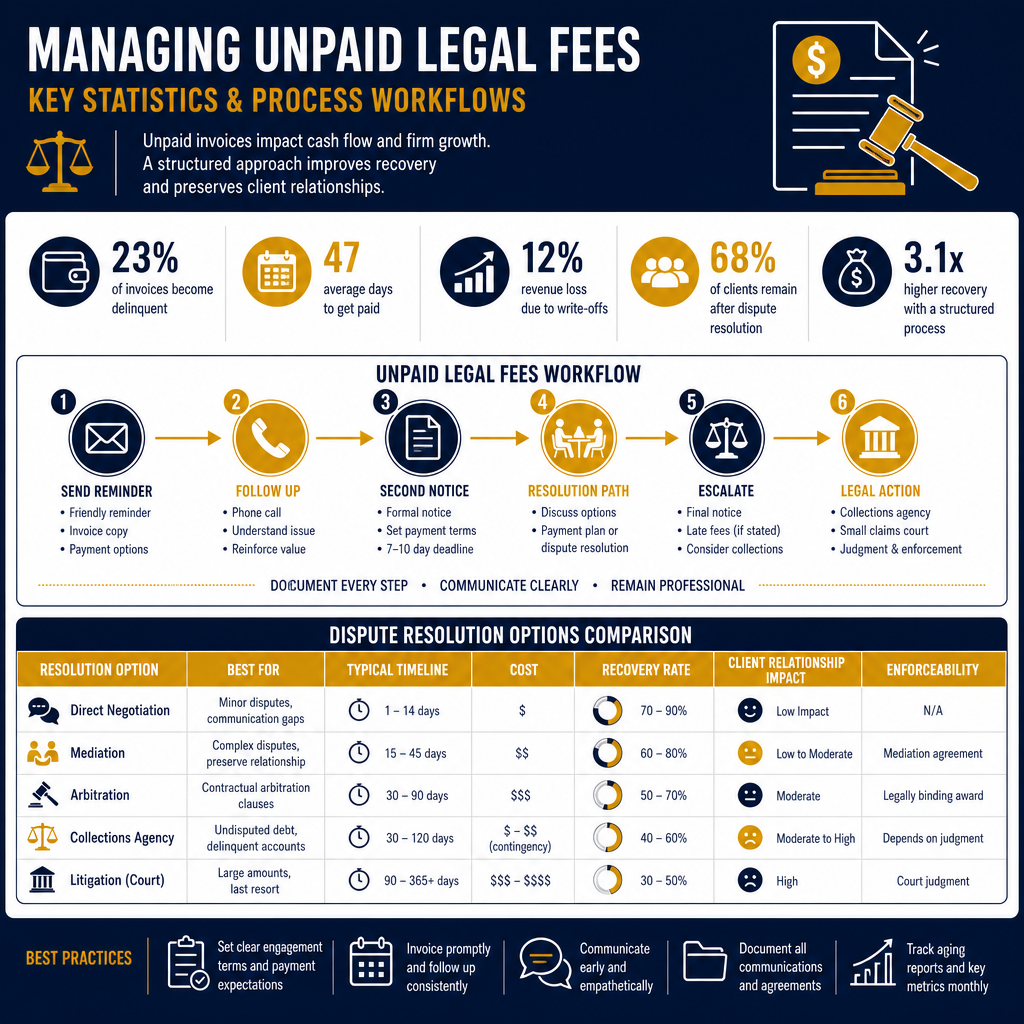
Prepared by AMA Legal Solutions Research & Analytics Team • Data & Compliance Overview
Court Proceedings: Last Resort for Unpaid Fees
Engaging in court proceedings is typically considered a last resort for recovering unpaid legal fees due to its lengthy and costly nature. Before proceeding, it's important for lawyers to exhaust all other avenues, such as Arbitration and Dispute Resolution or negotiating a payment plan directly with the client.
When all attempts at negotiation fail, filing a suit in civil court becomes necessary. Lawyers must meticulously prepare documentation, including the initial retainer agreement, detailed billing records, and any correspondence related to the unpaid fees. This evidence is crucial for substantiating the claim in court.
Understanding the Process
The court process begins with filing a suit in the appropriate jurisdiction, usually the client's location or where the services were rendered. It's essential to understand that the timeline for resolution can vary, potentially taking months or even years.
- Initial Pleadings: Filing of the complaint and serving the client with notice.
- Discovery: Gathering and exchanging evidence to support the claim.
- Trial: Presentation of the case before a judge, who will then render a decision.
While court proceedings can ensure a legal judgment for unpaid fees, the lawyer must weigh the costs and time involved against the potential recovery. It's advisable to consult with a colleague or consider Civil Litigation and Disputes experts to determine the best course of action.
Maintaining Client Relationships Amidst Financial Disputes
In the legal profession, nurturing a positive client relationship is paramount, even during financial disputes over unpaid fees. Clear communication is essential. Initiate a conversation to understand the client's perspective and financial constraints. Empathy goes a long way in diffusing tension and fostering understanding.
Employing a structured approach is beneficial. Draft a payment plan that acknowledges the client's situation while ensuring your interests are protected. This demonstrates your willingness to accommodate their needs, enhancing the likelihood of resolution without damaging the professional relationship.
Transparent Communication
- Set clear expectations from the outset regarding payment terms.
- Regularly update clients about their dues, avoiding surprises later.
- Utilize formal agreements to outline payment schedules and consequences for non-compliance.
Engaging Professional Mediation
If disputes escalate, consider involving Arbitration and Dispute Resolution professionals. Mediation helps maintain objectivity and provides a platform for amicable negotiations.
It's also prudent to familiarize yourself with Loan Settlement Services if the dispute involves financial distress from loans, offering clients a holistic approach to resolving their financial hurdles.
Ultimately, maintaining professionalism and patience throughout the process not only preserves the relationship but also upholds your reputation as a compassionate and pragmatic legal practitioner.
Preventive Measures: Avoiding Future Unpaid Fees
To safeguard against unpaid legal fees, it's vital for lawyers to adopt stringent preventive measures. One effective approach is implementing a robust retainer agreement that clearly outlines billing practices, payment schedules, and consequences for non-payment. A well-drafted agreement sets expectations from the outset and can be a crucial tool in eventual civil litigation and disputes if necessary.
Effective Communication
Consistent and clear communication with clients regarding fee structures and any changes is essential. Regular updates help clients understand their financial obligations and minimize misunderstandings. Consider monthly billing cycles that provide clients with a manageable payment structure, reducing the risk of accumulating large, unpaid balances.
Client Assessment
Conducting a thorough assessment of potential clients' financial stability and payment history before engagement is a prudent practice. This proactive step can prevent future issues related to unpaid fees. Additionally, consider offering flexible payment options to accommodate clients' financial constraints, thus fostering goodwill and ensuring consistent cash flow.
Utilizing Technology
- Adopt digital invoicing systems for prompt and trackable billing.
- Implement automated reminders to alert clients about upcoming or overdue payments.
- Utilize secure online payment portals to facilitate quick transactions.
These preventive measures, when implemented effectively, can significantly reduce the risk of unpaid legal fees and enhance client relationships. For further assistance, explore loan settlement services that might offer additional financial insights.
A Comparative Table: Legal Remedies vs. Procedural Steps
When dealing with unpaid legal fees, lawyers face the dual challenge of implementing legal remedies and following procedural steps to recover their dues. Understanding the comparative aspects of these approaches is crucial for effective action. Below is a detailed table that outlines the key parameters, legal provisions, and practical timelines involved in navigating unpaid legal fees.
| Parameter / Criterion | Key Details / Legal Provision | Timeline / Practical Impact |
|---|---|---|
| Initiating Legal Action | File a civil suit for recovery of unpaid fees under the Indian Contract Act. | Typically takes 6-12 months for preliminary hearings. |
| Mediation and Arbitration | Utilize alternative dispute resolution methods to settle fee disputes amicably. | Resolution possible within 3-6 months. |
| Enforcing Court Orders | Post-judgment, seek enforcement through execution petitions. | Enforcement can extend another 6-12 months. |
| Negotiated Settlement | Direct negotiation with clients for a mutually agreeable payment plan. | Immediate to 1 month, depending on client cooperation. |
| Utilizing Legal Notices | Issue a legal notice to the client demanding payment within a specified period. | Typically, clients have 15-30 days to respond. |
It's imperative for lawyers to assess both Civil Litigation and Disputes and Arbitration and Dispute Resolution options based on the specific circumstances of each case. Each approach has distinct timelines and practical impacts, affecting the strategy employed for recovering unpaid legal fees.
Sample Letters and Communication Strategies
Dealing with unpaid legal fees can be a sensitive issue. Effective communication is essential to address the matter professionally. Below are some strategies and sample letters that can help facilitate productive dialogue with clients.
Initial Reminder Letter
Begin with a polite reminder. A friendly tone reassures the client while reiterating the payment terms. Here's a sample:
- Subject: Friendly Reminder: Invoice #12345 Due
- Dear [Client's Name],
- I hope this message finds you well. This is a gentle reminder that the payment for Invoice #12345, dated [date], is due. Please let us know if there are any issues or if you require any assistance. We appreciate your prompt attention to this matter.
- Warm regards,
- [Your Name]
Follow-Up Communication
If the initial reminder does not prompt action, follow up with a more formal letter. It can express urgency while maintaining professionalism. At this stage, consider offering flexible payment options or discussing a loan settlement.
Final Notice
A final notice should be clear and assertive. It’s crucial to outline the consequences of non-payment while offering a final opportunity to resolve the issue amicably. In some cases, legal action may need to be mentioned as a last resort. For more guidance on similar matters, you might explore Civil Litigation and Disputes.
By using these strategies, lawyers can effectively manage unpaid fees while preserving professional relationships. Remember, each communication should aim to resolve the issue amicably and maintain client goodwill.
Real-Life Case Studies: Lessons Learned from Fee Disputes
In the realm of legal practice, fee disputes can pose significant challenges. One noteworthy case involved a client who refused to pay after a successful litigation outcome, citing dissatisfaction with the timeline. The lawyer, despite having a clear contract, faced an uphill battle in recovering fees. This highlights the importance of clearly defining expectations and timelines in client agreements.
Another case involved a lawyer who took on a high-profile corporate client. The client delayed payment due to alleged billing discrepancies. The lawyer's meticulous record-keeping and invoicing, however, helped resolve the matter through Arbitration and Dispute Resolution, underscoring the value of comprehensive documentation.
Lastly, consider a scenario where a lawyer engaged in a lengthy civil case. The client, experiencing financial difficulties, defaulted on agreed payments. In this instance, the lawyer successfully negotiated a settlement by offering a payment plan, showcasing the need for flexibility and mutual understanding in fee arrangements.
These examples illustrate common pitfalls and solutions in dealing with unpaid legal fees. For more insights on handling such disputes, explore our Civil Litigation and Disputes solutions.
Popular Searches

AMA Legal Solutions
Trusted with a 4.7 Google Rating, over 10,000+ Clients Served, 25,000+ Cases Handled, and more than 40+ Years of Experience in providing strategic legal defense and debt resolution across India.
Our media coverages





Client Reviews
"AMA Legal Solutions helped me draft clear contracts that prevent fee disputes. Their legal insights are unmatched."
Rohit Sharma
"Their strategies for handling unpaid legal fees have been a game-changer. AMA Legal Solutions’ support is exceptional."
Sneha Patel
"Navigating unpaid fees was daunting until I consulted AMA Legal Solutions. Their expertise in arbitration and dispute resolution was invaluable."
Priya Kapoor
"Thanks to AMA Legal Solutions, I now have robust payment agreements in place. Their legal advice is practical and actionable."
Vikram Singh
"AMA Legal Solutions provided an excellent framework for managing client payments. Their guidance on retainer agreements transformed my practice."
Arjun Mehta
Frequently Asked Questions
Related Articles

Achieving Loan Settlement in Minimum Time
Expert Strategies to Quickly Resolve Loan Defaults
Read Article
Why is My Bank Account Frozen or Liened?
Uncover the Reasons and Legal Remedies for Account Freezes
Read Article
Mastering 4 Budgeting Methods for a Debt-Free Life
Practical strategies to manage finances and achieve financial freedom.
Read ArticleAbout Author
Anuj Anand Malik
View ProfileAnuj Anand Malik, Founder of AMA Legal Solutions, is a trusted advocate, loan settlement expert, legal advisor, and banking lawyer. With over a decade of experience in loan settlement, corporate law, financial disputes, and compliance, he leads a result-driven law firm based in India that helps individuals, startups, and businesses achieve legal and financial stability.
Connect on LinkedInNeed Legal Help?
Get expert advice on loan settlement and debt relief.
Call +91-8700343611Request Callback