Section 194R TDS & Income Tax on Loan Settlement Waiver in India (2026)
Understand Section 194R TDS exemptions and income tax rules on OTS loan waivers.

Anuj Anand Malik
Reviewed by AMA Legal Solutions
Key Takeaways: Navigating section 194r tds and income tax on loan settlement waiver in india requires understanding the critical legal line between personal debt relief and commercial trading liabilities. Under Central Board of Direct Taxes (CBDT) Circular No. 18/2022 and Circular No. 12/2022, scheduled commercial banks, public financial institutions, State Financial Corporations, and systemically important NBFCs are explicitly exempt from deducting 10% TDS under Section 194R on One-Time Settlement (OTS) waivers. For salaried employees and retail consumers, loan waivers on personal loans and credit cards represent non-taxable capital receipts that cannot be taxed as income under Section 2(24) or Section 28(iv). However, for commercial enterprises and MSMEs, working capital waivers previously deducted as business expenses can trigger liability under Section 41(1), while capital asset loans remain fully protected under the Supreme Court's landmark Mahindra & Mahindra precedent. If your bank reports an OTS write-off under your Annual Information Statement (AIS) or Form 26AS, timely legal representation ensures erroneous automated tax demands are quashed. At AMA Legal Solutions, our dual-qualified banking and tax advocates structure legally shielded settlement deeds, protect high-net-worth clients, and provide end-to-end loan settlement services across India.
Introduction: Understanding Section 194R TDS and Income Tax on Loan Settlement Waiver in India
When an individual borrower, professional, or entrepreneur successfully negotiates a One-Time Settlement (OTS) with a bank or Non-Banking Financial Company (NBFC), the immediate emotion is immense relief. After months of financial distress, severe cash-flow crunches, and aggressive recovery collection calls, reaching a binding compromise that waives 40% to 70% of outstanding loan dues feels like a second chance at financial life. However, in modern Indian tax compliance, an unresolved question frequently turns relief into acute anxiety: Does the Income Tax Department treat the forgiven loan amount as taxable income?
Every year, thousands of borrowers confront the complexities of section 194r tds and income tax on loan settlement waiver in india after discovering unexpected entries in their Annual Information Statement (AIS) or receiving automated verification notices from the Centralized Processing Centre (CPC). The enactment of Section 194R under the Finance Act, 2022—mandating a 10% Tax Deducted at Source (TDS) on the value of any benefit or perquisite arising from business or exercise of a profession—created widespread panic across the credit and banking industry. Borrowers feared that if a bank agreed to waive Rs. 20,00,000 during an OTS, the lender would either deduct Rs. 2,00,000 in upfront cash tax or report the borrower for unpaid tax liabilities.
The reality of Indian tax jurisprudence is far more nuanced, rigorous, and protective of bona fide distressed borrowers than common collection folklore suggests. The legal character of a loan waiver depends strictly on three pillars: the underlying nature of the debt (capital borrowing versus operational trading liability), the borrower's legal classification (individual salaried consumer versus commercial business entity), and specific statutory circulars issued by the Central Board of Direct Taxes (CBDT). Understanding your precise rights under section 194r tds and income tax on loan settlement waiver in india is essential before signing any settlement sanction letter or responding to tax department communications regarding loan settlement in India.
Are Personal Loan and Credit Card OTS Waivers Taxable for Salaried & Individual Borrowers?
For salaried individuals, home-makers, retirees, and non-business retail borrowers, the core question is straightforward: Is a loan settlement waiver taxable in India when settling consumer credit cards, personal loans, or consumer durable debt? The unequivocal legal answer established by constitutional jurisprudence and tax tribunal rulings is NO—personal loan and credit card waivers are not taxable income.
1. The Capital Receipt Doctrine Under Indian Tax Law
Under Section 4 of the Income Tax Act, 1961, income tax is chargeable only on 'income' as defined under Section 2(24). A fundamental tenet of Indian direct taxation is the distinction between revenue receipts (which are inherently taxable unless specifically exempted) and capital receipts (which are completely non-taxable unless expressly brought into the tax net by a specific charging section, such as capital gains under Section 45).
When a salaried individual borrows Rs. 10,00,000 as a personal loan or swipes a credit card for personal consumption, household medical emergencies, or family obligations:
- Zero Tax Deductions Claimed: The borrower never claimed the principal loan amount or personal interest payments as a tax-deductible business expense or trading deduction in their past Income Tax Returns (ITRs).
- Capital Liability Extinguishment: When the lender enters into a compromise settlement and waives Rs. 5,00,000 of the outstanding debt, the transaction represents the mere reduction or remission of a personal capital liability.
- Absence of Income Generation: The remission of a personal debt does not generate any income, profit, or operational gain. You cannot be taxed on borrowed funds that you simply failed to repay due to insolvency or economic hardship.
2. Inapplicability of Section 56(2)(x) (Income from Other Sources)
Defaulters frequently worry that tax assessing officers will categorize the waived loan balance as an 'unearned gift' or deemed income under Section 56(2)(x) ('taxation of gifts and property received without consideration'). However, judicial authorities have consistently ruled that an institutional loan settlement is an adversarial commercial compromise executed between a lender and a defaulting debtor to minimize loan loss. It is not a voluntary, gratuitous 'gift' or transfer without consideration. Consequently, individual borrowers managing section 194r tds and income tax on loan settlement waiver in india can be completely assured that genuine personal loan and credit card OTS waivers carry zero personal income tax liability.
| Loan Category & Facility Type | Borrower Classification | Primary Use of Disbursed Funds | Past Tax Deductions Claimed in ITR | Section 194R TDS Applicability | Taxability of Waived Principal / Interest | Governing Judicial Precedent / Rule |
|---|---|---|---|---|---|---|
| Unsecured Personal Loan | Salaried Individual / Consumer | Personal consumption, medical, family needs | None (Zero business expense claimed) | EXEMPT (0% TDS) | NON-TAXABLE (Capital Receipt) | Section 4 & Section 2(24); CBDT Circular 18/2022; Capital Receipt Doctrine. |
| Credit Card Outstanding Dues | Retail Cardholder / Individual | Personal lifestyle, retail shopping, travel | None | EXEMPT (0% TDS) | NON-TAXABLE (Personal Liability Remission) | CIT v. Mahindra & Mahindra Ltd.; Not a business perquisite under Sec 28(iv). |
| Housing / Home Loan (Mortgage) | Individual Residential Buyer | Acquisition of residential immovable property | Sec 24(b) interest & Sec 80C principal (if any) | EXEMPT (0% TDS) | NON-TAXABLE (Principal waiver is capital; past interest may require adjustments) | Capital account asset financing; Cost of acquisition indexed under Section 43(1). |
| MSME Cash Credit / Overdraft (CC/OD) | Proprietorship / Partnership / Company | Working capital, inventory, vendor payments, trade debts | YES (Interest & raw materials debited to P&L) | EXEMPT from TDS by Bank (Circular 18/2022) | TAXABLE to the extent trading deductions were claimed | Section 41(1) (Cessation of trading liability); Taxable in year of waiver. |
| Commercial Term Loan for Plant & Machinery | Manufacturing / Infrastructure Enterprise | Purchase of capital machinery, industrial tools, commercial factory | Depreciation on asset cost; No deduction of principal | EXEMPT from TDS by Bank (Circular 18/2022) | NON-TAXABLE (Principal waiver); Adjusts asset block WDV under Section 43(6) | Supreme Court Landmark: CIT v. Mahindra & Mahindra Ltd. (2018). |
What Is Section 194R of the Income Tax Act (10% TDS on Business Perquisites) and Why Did It Panic Borrowers?
To grasp the origin of borrower anxiety surrounding section 194r tds and income tax on loan settlement waiver in india, one must examine the legislative history of Section 194R, introduced via the Finance Act, 2022 (effective from 1st July 2022). For detailed background on debt settlement taxation, see our legal guide on what are the income tax implications of a settled debt amount.
1. Legislative Intent of Section 194R
Section 194R(1) was designed by the Ministry of Finance to curb widespread tax evasion in the corporate and medical marketing sectors. Companies frequently showered distributors, doctors, channel partners, and agents with lavish non-cash perks—such as international holiday packages, luxury vehicles, high-end consumer electronics, and free gold coins—as business incentives. While the distributing corporations deducted these gifts as marketing expenses, the recipients rarely reported their fair market value as taxable business perquisites under Section 28(iv).
To plug this massive revenue leakage, Parliament enacted Section 194R, mandating:
"Any person responsible for providing to a resident, any benefit or perquisite, whether convertible into money or not, arising from business or the exercise of a profession by such resident, shall, before providing such benefit or perquisite, ensure that tax has been deducted in respect of such benefit or perquisite at the rate of ten per cent of the value or aggregate of value of such benefit or perquisite..."
2. The Dangerous Initial Interpretation for Loan Settlements
The statutory language of Section 194R was drafted in expansive terms. In June 2022, the CBDT released Circular No. 12/2022 containing initial guidelines for removing implementation difficulties. Under Question 3 of Circular 12/2022, the CBDT stated that Section 194R applies regardless of whether the benefit is in cash, in kind, or partly in cash and partly in kind. Crucially, the Board noted that a waiver of loan or settlement of loan could theoretically be viewed as a financial 'benefit' received by a borrower in the course of business.
This statement triggered an immediate crisis across Indian banking corridors. If a commercial bank or NBFC approved an OTS for an MSME borrower or entrepreneur, waiving Rs. 50,00,000 of unpaid dues, was the bank required to withhold 10% TDS (Rs. 5,00,000) before issuing the settlement sanction? Because a distressed debtor by definition lacks cash, forcing the bank to deposit TDS out of its own pocket—on top of absorbing a massive credit haircut—threatened to grind the entire Indian banking recovery machinery to a complete standstill!
The Statutory Shield: CBDT Circular No. 12/2022 & Circular No. 18/2022 Exempting Bank & NBFC One-Time Settlements
Recognizing that treating bank recovery haircuts as taxable corporate perks was economically absurd and legally unworkable, the Indian Banks' Association (IBA) and leading financial institutions made urgent representations to the Ministry of Finance. In response, the CBDT issued historic administrative clarifications that form the cornerstone of section 194r tds and income tax on loan settlement waiver in india.
1. CBDT Circular No. 18 of 2022 (Question 2 Clarification)
On 13th September 2022, the Central Board of Direct Taxes issued Circular No. 18/2022. Question 2 directly addressed whether Section 194R applies to one-time loan settlements or loan waivers granted by lending institutions. The CBDT issued an unequivocal, binding negative ruling:
"In order to remove difficulty, it is clarified that one-time loan settlement with borrowers or waiver of loan granted by following entities would not be subjected to tax deduction at source under section 194R of the Act..."
The CBDT recognized that lenders enter into compromise settlements not to confer business incentives or gratuities upon borrowers, but as an involuntary commercial distress resolution to salvage whatever capital is recoverable. Forcing institutional lenders to pay 10% withholding tax on money they lost would punish prudent banking recovery. This circular permanently shields qualifying institutional loan settlements from the operational threat of Section 194R TDS deductions.
2. Critical Legal Distinction: TDS Exemption vs. Recipient Taxability
While CBDT Circular No. 18/2022 resolved the withholding tax procedural hurdle, it included a vital statutory caveat that every borrower must understand when navigating section 194r tds and income tax on loan settlement waiver in india:
- Lender's Obligation (TDS): The bank or NBFC is 100% exempt from deducting 10% TDS under Section 194R at the time of approving the OTS or issuing the No Dues Certificate (NDC).
- Borrower's Obligation (Income Tax Return Assessment): The circular expressly cautions that the TDS exemption granted to lenders does not automatically mean the waived amount is tax-free in the hands of the borrower. The actual taxability of the waiver in the borrower's annual ITR must be evaluated independently under the substantive provisions of the Income Tax Act (specifically Section 41(1), Section 28(iv), and the capital-versus-revenue doctrine).
| Entity Classification Under Circular 18/2022 | Institutional Category & Regulatory Status | Exemption from Sec 194R TDS Deduction? | Scope of Protection for OTS Waivers | Legal Basis / Statutory Reference |
|---|---|---|---|---|
| Public Sector Banks (PSBs) | State Bank of India, Punjab National Bank, Bank of Baroda, Canara Bank, Union Bank, etc. | YES - 100% EXEMPT | All compromise settlements, OTS, and technical write-offs across retail, MSME, and corporate accounts. | CBDT Circular No. 18/2022 (Clause a); Banking Companies Act. |
| Private Scheduled Commercial Banks | HDFC Bank, ICICI Bank, Axis Bank, Kotak Mahindra Bank, IndusInd Bank, IDFC First Bank, etc. | YES - 100% EXEMPT | Full exemption on all retail consumer loans, credit card waivers, and commercial debt restructurings. | CBDT Circular No. 18/2022 (Clause a); Reserve Bank of India Act, 1934 (Second Schedule). |
| Public Financial Institutions (PFIs) | LIC of India, NABARD, SIDBI, NHB, EXIM Bank, REC Limited, PFC Limited | YES - 100% EXEMPT | Infrastructure, industrial development, and housing refinance loan compromise settlements. | CBDT Circular No. 18/2022 (Clause b); Section 4A of Companies Act, 1956 / Section 2(72) of Companies Act, 2013. |
| State Financial Corporations (SFCs) | Delhi Financial Corporation, RFC, TIIC, MSFC, State Industrial Development Corporations | YES - 100% EXEMPT | State-level industrial, small-scale, and enterprise development loan waivers. | CBDT Circular No. 18/2022 (Clause c); State Financial Corporations Act, 1951. |
| Systemically Important NBFCs (NBFC-ND-SI) | Deposit-taking NBFCs and Non-Deposit NBFCs with asset size >= Rs. 500 Crore (Bajaj Finance, Tata Capital, Aditya Birla, Piramal, Poonawalla, L&T Finance) | YES - 100% EXEMPT | Consumer durable loans, personal loans, business working capital loans, and merchant loans. | CBDT Circular No. 18/2022 (Clause e); RBI Master Directions for NBFCs. |
| Unregulated / Private Unregistered Lenders | Private money lenders, unregulated peer-to-peer informal lenders, non-SI micro-NBFCs | NO EXEMPTION | Waivers granted by private commercial entities outside the RBI regulated umbrella may face Section 194R scrutiny. | Strict construction of Circular 18/2022; General provisions of Section 194R apply. |
Key Insights & Data Infographic
Visual summary, statistical trends & procedural breakdown
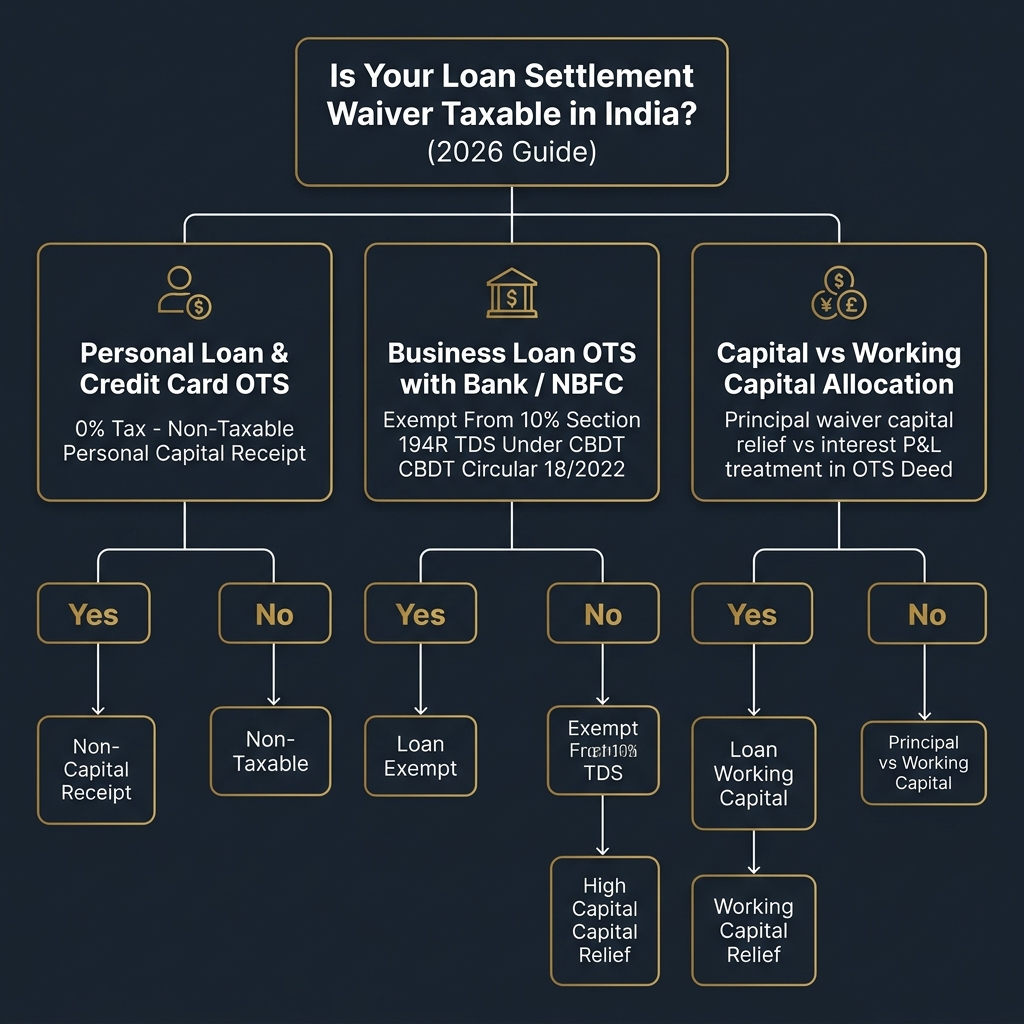
Prepared by AMA Legal Solutions Research & Analytics Team • Data & Compliance Overview

Halt Recovery Agent Harassment Legally
Which Lenders Are Exempt Under CBDT Circular 18/2022 vs. When Fintech/Private Waivers Trigger Tax Scrutiny
Understanding which creditors fall within the protective umbrella of Circular 18/2022 is critical for commercial borrowers and high-net-worth individuals managing section 194r tds and income tax on loan settlement waiver in india. The CBDT’s exemption list is strictly defined by regulatory statute.
1. The Five Protected Institutional Classes
Under Question 2 of Circular 18/2022, the CBDT extended immunity from Section 194R withholding tax strictly to five categories of financial institutions:
- Public Financial Institutions: Defined under Section 4A of the Companies Act, 1956 (now Section 2(72) of the Companies Act, 2013).
- Scheduled Commercial Banks: All commercial banks included in the Second Schedule to the Reserve Bank of India Act, 1934.
- Cooperative Banks: Rural and urban cooperative banks registered under state legislation or the Multi-State Cooperative Societies Act, 2002.
- State Financial Corporations & State Industrial Investment Corporations: Established under the State Financial Corporations Act, 1951.
- Systemically Important NBFCs: All deposit-taking NBFCs and non-deposit-taking NBFCs having an asset size of Rs. 500 Crore or more as per their last audited balance sheet.
2. The Fintech and Small NBFC Exposure Zone
Where does this leave digital lending apps, fintech platforms, and smaller NBFCs? Many small digital lending apps operate through minor Base-Layer NBFCs with balance sheet assets well below the Rs. 500 Crore threshold. If a small NBFC (with an asset size of Rs. 50 Crore) waives Rs. 15,00,000 for a business borrower, it does not technically qualify under Clause (e) of Circular 18/2022. While retail personal loans remain safe because Section 194R applies only to benefits arising from *business or profession*, business borrowers settling with small, non-systemic lenders must ensure their settlement deed is structured with precision. For complex enterprise cases, our specialized team manages business loan settlement and represents clients requiring how to settle loans above 1 crore to ensure complete tax immunity across consortium lenders.
Business & MSME Loan Settlements: Working Capital Waivers (Section 41(1)) vs. Capital Asset Loan Waivers (Supreme Court Mahindra Ruling)
When commercial entities, partnership firms, and MSME promoters seek debt relief, the interaction between section 194r tds and income tax on loan settlement waiver in india and substantive corporate taxation becomes paramount. The tax outcome hinges entirely on how the borrowed capital was originally utilized on the balance sheet.
1. Working Capital Loans & The Section 41(1) Tax Trap
Section 41(1) of the Income Tax Act contains a specific anti-abuse provision governing the 'remission or cessation of trading liability':
- If an enterprise claims an allowance or deduction in its profit and loss account in any past financial year in respect of a loss, expenditure, or trading liability; and
- In a subsequent year, the enterprise obtains any amount in respect of such expenditure or obtains some benefit by way of remission or cessation of that liability;
- Then the value of that remission is deemed to be profits and gains of business and is fully taxable as business income in the year of waiver!
Consider an MSME manufacturer that availed a Rs. 1 Crore Cash Credit (CC) limit. Over three years, the business paid Rs. 25 Lakhs in interest and utilized the credit line to purchase raw materials and pay factory wages, claiming 100% of these expenses as business deductions against operating revenue. If the bank settles the account for Rs. 40 Lakhs and waives Rs. 60 Lakhs, the portion of the waiver representing previously claimed operational expenses and interest is deemed taxable income under Section 41(1). Because the borrower already reduced its past tax liabilities by claiming those deductions, Indian tax law prevents a 'double benefit' by taxing the forgiven trading obligation.
2. Capital Asset Loans & The Supreme Court Mahindra & Mahindra Precedent
The legal landscape is entirely different when a loan was obtained to finance capital assets. In the landmark Constitution-affirming judgment of Commissioner of Income Tax v. Mahindra and Mahindra Ltd. (2018) 404 ITR 1 (SC), the Supreme Court of India laid down irreversible tax principles:
- Loan for Capital Equipment: Mahindra & Mahindra availed a foreign currency loan from Kaiser Jeep Corporation to purchase tooling dies, specialized welding machinery, and capital equipment. The lender subsequently waived the principal loan balance.
- Inapplicability of Section 28(iv): The Revenue argued that the loan waiver was a taxable business benefit under Section 28(iv). The Supreme Court decisively rejected this contention, ruling that Section 28(iv) applies *strictly and solely to benefits in kind* (non-monetary perquisites). A loan waiver involves direct monetary relief or cessation of cash liabilities and cannot be shoehorned into Section 28(iv)!
- Inapplicability of Section 41(1): The Supreme Court held that Section 41(1) applies only to *trading liabilities*. A loan procured to acquire capital assets is a capital liability, not a trading debt. Furthermore, the company never claimed the principal loan amount as a business deduction in past years.
- Definitive Ratio: The Supreme Court ruled that the waiver of a loan taken to acquire capital assets is a pure capital receipt and is NOT taxable as business income under either Section 28(iv) or Section 41(1)!
Borrowers structuring commercial settlements under section 194r tds and income tax on loan settlement waiver in india rely heavily on the Mahindra ruling. While the Finance Act, 2023 introduced minor amendments to Section 28(iv) to encompass benefits convertible into money, the foundational principle remains rock-solid: the remission of a pure capital liability does not constitute business revenue. At AMA Legal Solutions, our corporate law and tax compliance services ensure that commercial settlement deeds precisely allocate haircuts to capital asset liabilities, safeguarding high-net-worth entrepreneurs via our dedicated practice for loan settlement for high net worth individuals.
How to Draft Your OTS Settlement Agreement to Prevent Wrongful AIS / Form 26AS Tax Reporting
Even when a loan waiver is legally non-taxable, administrative errors by institutional accounting departments frequently trigger automated tax scrutiny. When evaluating section 194r tds and income tax on loan settlement waiver in india, proactive drafting of the settlement deed is your strongest procedural shield.
1. Why Loan Settlements Appear in AIS and Form 26AS
Under Section 285BA of the Income Tax Act, banking companies and financial institutions are legally required to submit an annual Statement of Financial Transactions (SFT) to the Income Tax Department's reporting portal. Automated banking software frequently flags large write-offs or compromise settlements under generic reporting codes. If an automated script mischaracterizes an OTS haircut as a 'miscellaneous contractual payment' or 'business perquisite', the waived figure is pulled directly into your Annual Information Statement (AIS) and Form 26AS under high-value financial transactions.
When the Income Tax Department's Centralized Processing Centre (CPC) runs automated algorithms cross-referencing your filed ITR against your AIS, the mismatch triggers an automated verification intimation under Section 143(1)(a) or a summons under Section 133(6). Review our defense strategies on income tax demand notice defense to understand how we resolve these intimations without penalty.
2. The Four Mandatory Drafting Clauses for Every OTS Agreement
To prevent institutional misreporting and defeat automated tax inquiries before they arise, AMA Legal Solutions insists on embedding four protective clauses into every OTS Sanction Letter and Compromise Deed:
- Explicit Capital Characterization Clause: The settlement deed must unequivocally state that the facility was a personal consumer loan (or capital asset financing loan) and that the waiver represents a remission of a capital liability, carrying zero revenue or trading character.
- CBDT Circular 18/2022 Compliance Confirmation: The agreement must incorporate a formal declaration that the lending institution has evaluated the transaction under CBDT Circular No. 18 of 2022 and confirms that no Tax Deducted at Source is applicable or deducted under Section 194R.
- Forensic Haircut Allocation Clause: In business loan settlements, the deed must explicitly allocate the settlement haircut first toward uncapitalized penal charges and accumulated compound interest, second toward capital asset principal, and last toward operational balances, minimizing potential Section 41(1) exposure.
- Non-Taxable SFT Reporting Covenant: The lender must covenant that any regulatory SFT filing or credit bureau reporting will accurately reflect a distressed recovery write-off rather than an incentive, perquisite, or commercial fee.
3. Step-by-Step Protocol to Clear Erroneous AIS Entries
If your lender has already reported an OTS haircut in your AIS, execute this proven three-step remediation workflow:
- Step 1 - Submit Online AIS Feedback: Log into the Income Tax e-filing portal (eportal.incometax.gov.in) -> Go to Services -> Annual Information Statement (AIS). Locate the specific SFT entry. Click Feedback, select "Information is incorrect" or "The transaction is not taxable", and enter an explanatory note stating that the entry represents an institutional loan recovery OTS waiver protected by CBDT Circular 18/2022.
- Step 2 - Procure Written Lender Clarification: Demand a formal letter from the bank's Nodal Officer or Finance Controller certifying that the write-off was an internal credit loss and not a Section 194R perquisite.
- Step 3 - File Formal Representation via Tax Counsel: If an automated intimation under Section 143(1) is issued, our senior tax advocates submit a comprehensive legal response annexing the OTS sanction letter, bank account trail, and the Supreme Court Mahindra judgment, compelling the CPC to drop the demand with zero penalty.
Strategic Conclusion: Structure Tax-Safe Loan Settlements with AMA Legal Solutions
Mastering section 194r tds and income tax on loan settlement waiver in india transforms debt resolution from an intimidating ordeal into a secure financial fresh start. Financial distress should never be compounded by erroneous tax demands. When you settle an unpayable personal loan, credit card balance, or commercial credit facility, the law does not intend to penalize your recovery with double taxation.
The statutory landscape is crystal clear: Section 194R TDS does not apply to One-Time Settlements executed with scheduled commercial banks, public financial institutions, or systemically important NBFCs under CBDT Circular No. 18/2022. Personal loan and credit card waivers for salaried individuals are non-taxable capital receipts that cannot be taxed as income. And for commercial enterprises, the landmark jurisprudence of the Supreme Court in the Mahindra & Mahindra case provides robust constitutional defense against arbitrary revenue assessments.
However, the difference between a smooth, tax-free debt resolution and a multi-year income tax litigation nightmare lies entirely in how your settlement is negotiated and documented. At AMA Legal Solutions, our multidisciplinary team of High Court Senior Advocates and Chartered Tax Counsels bridges the gap between banking litigation and direct tax defense. We negotiate deep 40% to 70% principal waivers with institutional creditors, eliminate 100% of predatory bounce and penal fees, draft ironclad tax-shielded settlement agreements, and defend your Annual Information Statement against unwarranted scrutiny.
If you are contemplating a One-Time Settlement, currently negotiating with bank recovery officers, or facing unexpected tax intimations following a debt write-off, do not leave your financial future to chance. Explore our full suite of loan settlement services, understand your broader rights under loan settlement in India, and contact AMA Legal Solutions today to schedule a confidential, comprehensive consultation. Let our senior legal team protect your hard-earned assets and guide you safely toward absolute, tax-compliant financial freedom.
Popular Searches & Topics
Commonly searched legal queries and keywords related to this article
Need Strategic Legal Defense for Your Situation?
Our banking & litigation advocates review your notices, debt liability, and recovery issues under complete advocate-client secrecy.
References & Authority
- Income Tax Act, 1961 - Section 194R (Deduction of tax on benefit or perquisite in respect of business or profession) - Income Tax Department
- Central Board of Direct Taxes (CBDT) - Circular No. 18 of 2022 (Guidelines under Section 194R regarding Loan Waivers / One-Time Settlements)
- Central Board of Direct Taxes (CBDT) - Circular No. 12 of 2022 (Initial Guidelines for removal of difficulties under subsection (2) of Section 194R)
- Supreme Court of India - Commissioner of Income Tax v. Mahindra and Mahindra Ltd. (2018) 404 ITR 1 (SC) - Landmark Ruling on Loan Waivers
- Income Tax Act, 1961 - Section 28(iv) & Section 41(1) (Profits and gains of business or profession & remission of liability) - India Code
- Reserve Bank of India (RBI) - Framework for Compromise Settlements and Technical Write-offs (DOR.STR.REC.20/21.04.048/2023-24)
- Finance Act, 2022 & Finance Act, 2023 - Statutory Amendments to Business Perquisites and Withholding Tax - Ministry of Finance
- Income Tax Department Directorate of Systems - Reporting of Statement of Financial Transactions (SFT) & Annual Information Statement (AIS)

AMA Legal Solutions
Trusted with a 4.7 Google Rating, over 10,000+ Clients Served, 25,000+ Cases Handled, and more than 40+ Years of Experience in providing strategic legal defense and debt resolution across India.
Our media coverages





Frequently Asked Questions
Related Articles
Multiple e-NACH & UPI Autopay Bounce Charges Harassment: RBI Rules & Settlement (2026)
Stop repeated e-NACH bounce charges under NPCI rules and get a 100% OTS waiver.
Read Article
SAMA, Presolv360 & Cordis ODR Notice for Loan Default: Legal Defense & Settlement (2026)
Prevent ex-parte online arbitration awards and negotiate a 50%+ OTS on ODR portals.
Read Article
CIBIL Locate Plus Skip Tracing & Account Aggregator Consent Revocation (2026)
Learn how to revoke Account Aggregator consents and stop CIBIL skip tracing.
Read ArticleAbout Author
Anuj Anand Malik
View ProfileAnuj Anand Malik, Founder of AMA Legal Solutions, is a trusted advocate, loan settlement expert, legal advisor, and banking lawyer. With over a decade of experience in loan settlement, corporate law, financial disputes, and compliance, he leads a result-driven law firm based in India that helps individuals, startups, and businesses achieve legal and financial stability.
Connect on LinkedInNeed Legal Representation?
Evaluate your defense against recovery agents, notices, or structure your loan settlement directly with Senior Advocates.
Call +91-8700343611