Understanding Remedies for Breach of Contract in 2026
Explore legal remedies and strategies for breach of contract.

Anuj Anand Malik
Reviewed by AMA Legal Solutions
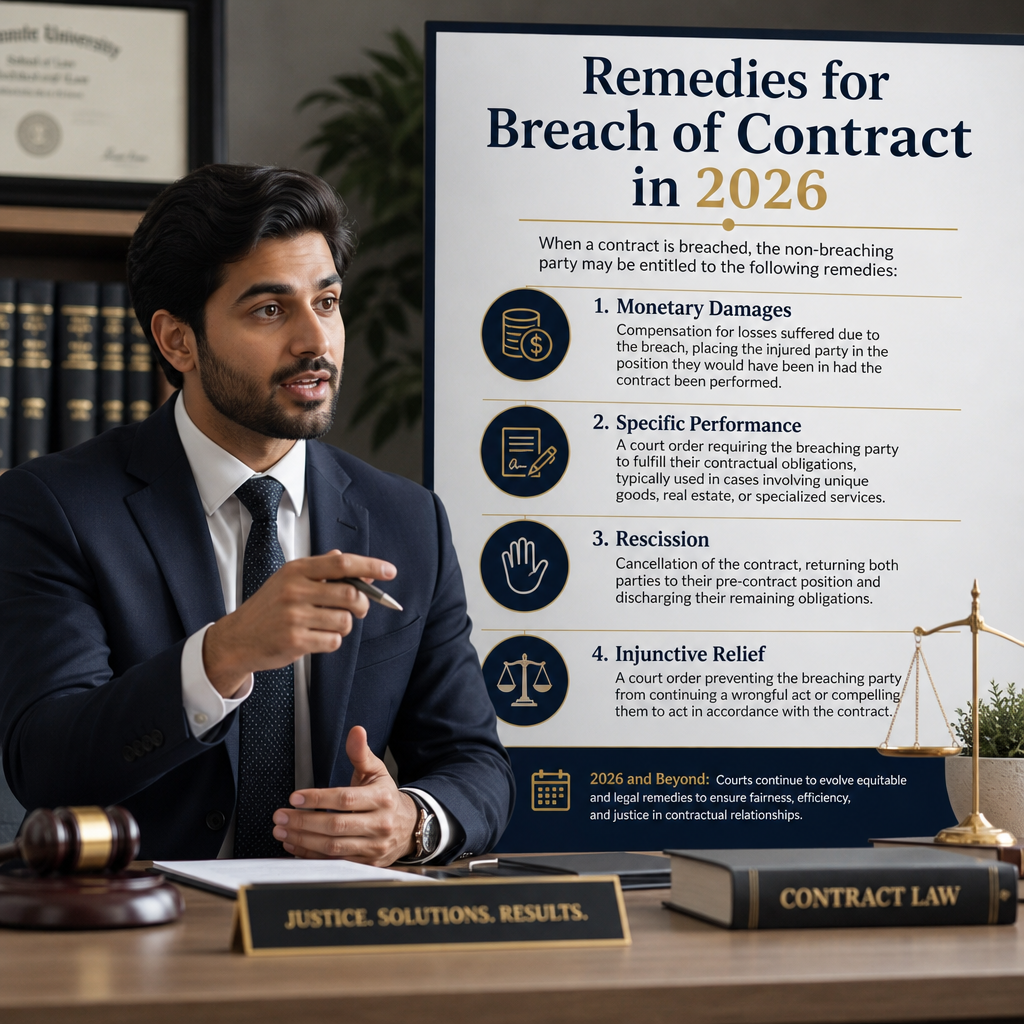
Introduction to Understanding Remedies for Breach of Contract in 2026
As we step into 2026, the complexities surrounding breach of contract disputes are more nuanced than ever, warranting a precise understanding of available remedies. Whether a contract pertains to business dealings, real estate, or service agreements, a breach can have significant legal and financial repercussions. In India, addressing breach of contract involves a multifaceted approach that considers statutory provisions, case law, and evolving commercial practices.
The primary remedies available include damages, specific performance, and injunctions, each serving distinct purposes in restoring parties to their rightful position. For instance, compensatory damages aim to indemnify the non-breaching party for losses incurred, while specific performance mandates the fulfillment of contractual obligations when monetary compensation is inadequate. Meanwhile, injunctions may prevent a party from continuing a breach.
The Indian Contract Act, 1872, alongside judicial interpretations, continues to play a pivotal role in shaping these remedies. Recent amendments and landmark judgments have further refined the application of these remedies, ensuring they are aligned with contemporary business standards and practices. It is essential for parties involved in contractual agreements to stay informed about these developments to effectively navigate breach scenarios in 2026.
Staying proactive and informed empowers individuals and businesses to handle breaches efficiently, mitigating potential losses and upholding contractual integrity.
Understanding the Legal Framework for Breach of Contract
In 2026, the legal framework governing breach of contract in India remains rooted in the Indian Contract Act, 1872. This statute outlines the rights and obligations of parties involved in a contractual agreement. A breach occurs when one party fails to fulfill their contractual duties, thereby inviting legal scrutiny.
Section 73 and Section 74 of the Act are pivotal in addressing breaches. These sections deal with compensation for loss or damage caused by breach and the applicability of penalty clauses respectively. Section 73 allows for compensation that naturally arises in the usual course of things from the breach, unless the parties have agreed otherwise. Section 74, on the other hand, provides for compensation not exceeding the penalty stipulated in the contract regardless of the actual loss.
Furthermore, the Specific Relief Act, 1963 complements the Contract Act by providing remedies such as specific performance or injunctions, particularly when damages are inadequate. This is increasingly pertinent in complex commercial agreements where monetary compensation may not suffice.
Understanding these laws is crucial for both individuals and businesses to effectively navigate contractual disputes, ensuring that they are adequately prepared for potential litigation or negotiation processes.
Types of Breaches and Their Legal Implications
Understanding the types of breaches is crucial for navigating contract disputes effectively. Breaches can generally be categorized into four main types: minor, material, fundamental, and anticipatory. Each has distinct legal implications, and knowing these can guide parties in seeking appropriate remedies.
Minor Breach
A minor breach, also termed a partial breach, occurs when the infringement is slight and does not impact the overall contract performance. While the injured party may not terminate the contract, they can seek compensation for any losses incurred. For example, a delay in delivery that doesn't affect the ultimate use of goods may qualify as a minor breach.
Material Breach
A material breach is significant and impacts the core of the contract. In such cases, the non-breaching party is justified in terminating the contract and seeking damages. For instance, delivering a product that is completely different from what was agreed upon constitutes a material breach.
Fundamental Breach
A fundamental breach violates the contract's core terms, rendering it impossible to continue. It allows the aggrieved party to terminate the contract and seek damages. An example includes failure to deliver a critical piece of machinery as per contract terms.
Anticipatory Breach
Anticipatory breach occurs when one party indicates they will not fulfill their contractual duties before the due date. This allows the non-breaching party to seek remedies immediately rather than waiting for the breach to occur. Written communication indicating inability to meet deadlines can be an anticipatory breach.
Exploring Common Remedies for Breach of Contract
When a breach of contract occurs, several remedies are available to the aggrieved party, ensuring that justice is served while maintaining contractual sanctity. Understanding these remedies is crucial for both parties involved in a contract. The most common remedies include:
1. Damages
Damages are monetary compensations awarded to the non-breaching party. In 2026, damages continue to be classified into compensatory, punitive, nominal, and liquidated damages. The aim is to put the injured party in the position they would have been in if the contract was performed as agreed.
2. Specific Performance
This equitable remedy compels the breaching party to fulfill their contractual obligations. It is typically granted when monetary damages are inadequate, especially in contracts involving unique goods or property.
3. Rescission
Rescission cancels the contract, releasing both parties from their obligations. It is an appropriate remedy when there is a mutual mistake, misrepresentation, or fraud involved in the contract formation.
4. Injunctions
An injunction is a court order preventing the breaching party from engaging in specific actions that would further harm the non-breaching party. It is often used when breaches threaten to cause irreparable damage.
In 2026, these remedies remain integral to contract law, offering nuanced solutions to address breaches effectively.
Financial Compensation: Damages and Indemnities
When a breach of contract occurs, financial compensation is a primary remedy to address the losses incurred. In 2026, the concepts of damages and indemnities have evolved, requiring a nuanced understanding. Damages are monetary awards given to the non-breaching party to cover direct and consequential losses. These can be compensatory to cover actual losses or punitive to deter future breaches.
Compensatory damages remain the most common, focusing on restoring the injured party to the position they would have occupied had the breach not occurred. For instance, if a supplier fails to deliver goods, the buyer can claim the cost difference to procure the goods elsewhere.
Indemnities
Indemnities, on the other hand, are contractual promises where one party agrees to compensate the other for certain predefined losses, often more extensive than damages. These are typically negotiated during contract formation and serve as a risk management tool.
- When: Indemnities are invoked when specified contractual events occur.
- How: The indemnifying party reimburses the losses as per the contractual agreement.
- Risks: Without clear definitions, indemnities can lead to disputes.
Both damages and indemnities are crucial in ensuring that the non-breaching party is adequately compensated, maintaining contractual integrity and trust in business relationships.
Specific Performance and Injunctive Relief
Specific performance is a legal remedy in contract law wherein a court mandates the breaching party to fulfill their contractual obligations as agreed. This remedy is particularly relevant in cases where monetary compensation is inadequate to address the harm. For instance, in real estate transactions, where each property is unique, courts may order the transfer of the property instead of monetary damages.
Injunctive relief, on the other hand, is a court order requiring a party to do or cease doing specific acts. It's commonly used to prevent ongoing or imminent harm that cannot be rectified through financial compensation alone. For example, in cases of intellectual property violations, a court may issue an injunction prohibiting further infringement.
When Are These Remedies Applicable?
- Specific Performance: Typically applied in contracts involving unique goods, art, antiques, or real estate, where the subject matter is not easily replaceable.
- Injunctive Relief: Used when there's a need to stop harmful actions or enforce non-compete clauses in employment contracts.
Both remedies serve as powerful tools to uphold contractual obligations and safeguard parties' interests effectively. However, courts exercise discretion in granting these remedies, considering factors like feasibility, fairness, and public interest.

Halt Recovery Agent Harassment Legally
Rescission and Restitution in Contract Breaches
Rescission and restitution are crucial remedies for addressing contract breaches, offering a way to unwind agreements and restore parties to their original states. In 2026, the application of these remedies continues to evolve, emphasizing equitable relief and fairness. Rescission involves the cancellation of a contract, effectively nullifying the obligations and rights that arose from it. This remedy is typically pursued when one party fundamentally fails to perform, rendering the contract's purpose unfulfilled.
The process of rescission demands mutual consent or a court order, highlighting its complexity. It is essential for parties seeking rescission to act promptly upon discovering a breach, as delays can imply acceptance of the breach, weakening their position.
Restitution, on the other hand, aims to prevent unjust enrichment by returning the parties to their pre-contractual state. This involves the return of any benefits or payments exchanged under the contract. Restitution is especially relevant when a party has partially performed, allowing them to reclaim the value of services or goods provided.
These remedies, while powerful, carry risks. Late action can forfeit rights, and courts may impose conditions, such as compensating for benefits received. Thus, navigating rescission and restitution requires a strategic approach, often with legal guidance, to ensure equitable outcomes.
Legal Considerations for Negotiating Settlements
When negotiating settlements for breach of contract in 2026, a thorough understanding of legal considerations is crucial. The process requires a careful assessment of contractual obligations, potential damages, and the feasibility of enforcement. It’s imperative to evaluate the strength of your legal position based on the contract's terms and relevant case law.
Key Factors to Assess
- Contractual Obligations: Analyze the specific obligations under the contract to determine what was breached and the impact of the breach.
- Potential Damages: Consider the types of damages eligible for recovery, which might include actual, consequential, or liquidated damages.
- Mitigation of Loss: Evaluate efforts made to mitigate losses as courts expect parties to take reasonable steps to minimize damages.
- Legal Precedents: Review recent judgments to understand how similar breaches have been adjudicated.
It's advisable to document all negotiations and communications meticulously. This documentation can prove invaluable in case negotiations fail and litigation ensues. Furthermore, maintaining a professional and amicable tone during negotiations can facilitate a smoother settlement process. Engaging a seasoned contract lawyer can provide strategic advantages, ensuring that your rights are protected and the settlement reached is equitable.
Court Procedures for Breach of Contract Cases
Breach of contract cases involve specific court procedures that are crucial for enforcing contractual obligations. Initially, the aggrieved party must file a plaint in the appropriate civil court, outlining the breach details and stating the relief sought. The defendant is then served with a summons to appear in court and respond to the claims.
The court may initially encourage alternative dispute resolution methods, such as mediation or arbitration, as per the arbitration guidelines. If these methods fail, the case proceeds to trial. During trial, both parties present evidence, including witness testimonies, contract documents, and other relevant materials.
The judge evaluates the evidence and may request further information or clarification from either party. Post evaluation, the court delivers a judgment, which may include specific performance, damages, or rescission of the contract, depending on the case specifics.
It's important to note that the duration of court proceedings can vary significantly, often influenced by factors such as court backlog and complexity of the case. Legal representation is advisable to navigate the intricacies of these proceedings efficiently.
To understand more about the legal proceedings involved, you can refer to our litigation services page.
The Role of Alternative Dispute Resolution
In 2026, the importance of Alternative Dispute Resolution (ADR) in addressing breaches of contract is increasingly recognized. ADR provides efficient, cost-effective ways for parties to resolve disputes without resorting to traditional litigation. The role of ADR is particularly crucial when parties seek to maintain business relationships and confidentiality.
Mediation and Arbitration
Mediation allows disputing parties to negotiate a mutually agreeable solution with the help of a neutral third-party mediator. It emphasizes collaboration and offers flexible outcomes. On the other hand, arbitration involves a binding decision from an arbitrator, chosen by the parties, which can often be faster and less formal than court proceedings.
Advantages of ADR
- Time-efficient: ADR can significantly reduce the time taken to resolve disputes compared to conventional litigation.
- Cost-effective: It generally incurs lower costs, as it minimizes legal fees and court expenses.
- Confidentiality: ADR processes are private, preserving the parties’ reputations and sensitive information.
- Relationship Preservation: By promoting dialogue and understanding, ADR helps maintain business relationships.
ADR is particularly effective in scenarios where both parties are willing to compromise and avoid the adversarial nature of court battles. As contractual disputes become more complex, ADR's role in providing amicable resolutions will only grow in significance.
Importance of Contract Clauses and Provisions
In 2026, the significance of contract clauses and provisions cannot be overstated. These elements form the backbone of any contractual agreement, defining the rights, obligations, and remedies available to the parties involved. Each clause serves a specific purpose and sets the boundaries within which the parties must operate.
Vital clauses such as force majeure, indemnity, and dispute resolution are particularly crucial in managing unforeseen circumstances and potential disputes. For instance, a well-drafted force majeure clause can protect a party from liabilities if an unforeseen event, like a pandemic, disrupts contractual obligations.
Moreover, provisions related to penalties or damages for breach of contract ensure that parties fulfill their commitments. By explicitly stating the consequences of non-performance, these provisions deter breaches and provide a clear path for remedies, should a breach occur. This clarity is indispensable in 2026's complex legal landscape.
Examples of Essential Clauses
- Termination Clause: Outlines the conditions under which parties may terminate the agreement.
- Confidentiality Clause: Protects sensitive information exchanged between parties.
- Arbitration Clause: Specifies how disputes will be resolved outside of court.
Overall, understanding and meticulously crafting contract clauses and provisions is paramount to safeguarding interests and ensuring enforceability in the contemporary legal framework.
Future Trends in Contract Law and Remedies in 2026
As contract law evolves towards 2026, several trends are emerging that promise to reshape how breaches are addressed. One significant shift is towards digital contract management systems. These advanced platforms utilize artificial intelligence to monitor performance, flag potential breaches, and automate enforcement actions. Consequently, parties can anticipate issues and remedy breaches proactively, reducing disputes.
Decentralized Contracts and Blockchain
Blockchain technology is increasingly impacting contract law through the use of smart contracts. These decentralized agreements automatically execute upon meeting predefined conditions, minimizing human intervention. For breaches, smart contracts offer real-time, automated remedies, providing efficiency and transparency.
Emphasis on Restorative Remedies
- With growing focus on maintaining business relationships, restorative remedies are gaining traction. These remedies prioritize repairing and continuing business partnerships over punitive damages.
- This trend is particularly relevant in industries where long-term collaborations are crucial.
Global Harmonization of Contract Laws
Efforts towards unifying contract laws on a global scale are intensifying. This trend is driven by the need to facilitate international trade and reduce cross-border legal complexities. Unified laws will likely lead to standardized remedies, making enforcement more predictable and equitable across jurisdictions.
These future trends underscore the importance of staying abreast of technological and legislative changes to effectively navigate contract law and remedies in 2026.
Need Strategic Legal Defense for Your Situation?
Our banking & litigation advocates review your notices, debt liability, and recovery issues under complete advocate-client secrecy.
AMA Legal Solutions
Trusted with a 4.7 Google Rating, over 10,000+ Clients Served, 25,000+ Cases Handled, and more than 40+ Years of Experience in providing strategic legal defense and debt resolution across India.
Our media coverages





Client Reviews
"The team at AMA Legal Solutions was incredibly professional in handling my breach of contract case. Their expertise ensured a favorable outcome for my business."
Anjali Kumar
"Outstanding service by AMA Legal Solutions! Their expertise in contract law and dedication to client success made a significant difference in my case."
Rajesh Patel
"I highly recommend AMA Legal Solutions for contract issues. Their thorough analysis and practical advice were instrumental in navigating complex legal challenges."
Vikram Singh
"AMA Legal Solutions provided exceptional guidance during my contract dispute. Their deep understanding of the legal framework and strategic advice helped resolve the issue swiftly."
Rahul Mehta
"AMA Legal Solutions' approach was comprehensive and client-focused. They provided clear insights and effective strategies for my breach of contract scenario."
Priya Desai
Frequently Asked Questions
Related Articles
RuPay Credit Card on UPI Default & Credit Line on UPI Settlement (2026)
Micro-transactions on RuPay UPI Credit Cards and pre-approved 'Credit Lines on UPI' have triggered a massive wave of 42%+ APR revolving debt traps. Find out if defaulting blocks your personal savings UPI and how to settle RuPay UPI credit dues for 30%–50%.
Read Article
Paytm, PhonePe & BharatPe Daily EDI Merchant Loan Settlement (2026)
Drowning in Equated Daily Installment (EDI) merchant loans where 100% of your daily QR Soundbox collections are auto-swept before you can pay suppliers or rent? Learn how retail shopkeepers and MSMEs legally halt QR sweeps and negotiate a 50%+ OTS.
Read Article
Can Bank or Loan App Remotely Lock Phone for EMI Default? RBI Rules (2026)
An investigative breakdown of RBI's Remote Device Locking Directions—explaining why lenders cannot lock your phone for personal loans, the mandatory 30/60 DPD safeguards on financed devices, the Rs. 250/hour delay penalty, and how to settle device & app loans.
Read ArticleAbout Author
Anuj Anand Malik
View ProfileAnuj Anand Malik, Founder of AMA Legal Solutions, is a trusted advocate, loan settlement expert, legal advisor, and banking lawyer. With over a decade of experience in loan settlement, corporate law, financial disputes, and compliance, he leads a result-driven law firm based in India that helps individuals, startups, and businesses achieve legal and financial stability.
Connect on LinkedInNeed Legal Representation?
Evaluate your defense against recovery agents, notices, or structure your loan settlement directly with Senior Advocates.
Call +91-8700343611