PNB e-OTS, SBI Rinn Samadhan & PSU Bank OTS Schemes in India (2026)
Compare PSU bank e-OTS portals with deeper Zonal Committee discretionary waivers.

Anuj Anand Malik
Reviewed by AMA Legal Solutions
Key Takeaways: Navigating Non-Performing Asset (NPA) resolution across Indian public sector banks has entered a new era of digital automation and regulatory oversight. Under the framework of the pnb e ots sbi rinn samadhan psu bank one time settlement scheme 2026, major state-run lenders including Punjab National Bank (PNB), State Bank of India (SBI), Bank of Baroda (BoB), Canara Bank, and Union Bank of India have deployed digital compromise portals to accelerate stressed debt recovery. While self-service online portals offer a fast, algorithm-driven resolution, they enforce rigid mathematical formulas that typically cap ledger balance haircuts at a modest 20% to 35%. In contrast, retaining experienced banking advocates to represent your case before the bank's Zonal Stressed Assets Recovery Committee (SARB / SASTRA / ZLCC) unlocks statutory discretionary powers under the Reserve Bank of India (RBI) Board-Approved Compromise Framework. This formal legal representation consistently achieves a 100% waiver of unapplied notional interest, penal charges, and legal expenses, coupled with a deep 50% to 75% principal haircut benchmarked to the realistic forced sale value of collateral and genuine borrower insolvency.
Introduction: PNB e-OTS, SBI Rinn Samadhan & PSU Bank One-Time Settlement Schemes in 2026
For decades, resolving a defaulted retail, MSME, or agricultural loan with an Indian Public Sector Undertaking (PSU) bank was an agonizing, bureaucratic ordeal. Borrowers trapped in involuntary financial distress—caused by business failure, severe illness, or unforeseen macroeconomic shocks—were forced to navigate endless branch visits, hostile recovery notices, and arbitrary demands from field recovery managers. However, the modernization of India's banking sector, guided by strict non-performing asset (NPA) provisioning mandates from the Reserve Bank of India, has radically transformed this landscape. In 2026, the implementation of the pnb e ots sbi rinn samadhan psu bank one time settlement scheme 2026 offers distressed borrowers transparent, legally sanctioned pathways to permanently extinguish their liabilities.
State-owned lenders hold tens of thousands of crores in legacy stressed assets. Under the regulatory supervisory framework of the Reserve Bank of India (RBI), banks are financially incentivized to clean their balance sheets of non-yielding debt rather than tie up capital in decade-long court battles. This institutional priority has birthed automated compromise settlement platforms. Chief among these digital initiatives are Punjab National Bank's Electronic One-Time Settlement (e-OTS) portal, SBI's high-visibility Rinn Samadhan campaign, and parallel schemes operated by Bank of Baroda, Canara Bank, and Union Bank of India. Millions of borrowers now receive automated SMS alerts and app notifications informing them of pre-approved settlement offers available at the click of a button.
However, beneath the polished interface of these automated recovery portals lies a critical financial reality that every borrower must understand before clicking "Accept." An automated portal calculates settlement terms using a standardized mathematical algorithm designed to optimize the bank's net cash recovery while minimizing official write-off accountability. While convenient, these automated portals rarely provide the deep debt relief necessary for a genuinely distressed individual or business to recover financially. For borrowers seeking comprehensive debt freedom, engaging professional loan settlement services and asserting your legal rights regarding loan settlement in India ensures that you do not settle for an inferior, superficial compromise. Selecting the optimal path under the pnb e ots sbi rinn samadhan psu bank one time settlement scheme 2026 requires understanding both digital portal mechanisms and the higher-level discretionary authority vested in executive bank committees.
Why Public Sector Banks Offer Non-Discretionary Special OTS Campaigns (Rinn Samadhan, e-OTS, BoB Samadhan & Maha Samadhan)
To understand the mechanics of state bank debt compromises, one must examine why public sector banks run special settlement drives. Unlike private fintech lenders or NBFCs that operate on flexible commercial discretion, PSU banks are subject to stringent oversight by statutory authorities, including the Central Vigilance Commission (CVC), the Comptroller and Auditor General (CAG), and the Central Bureau of Investigation (CBI). Historically, public sector bank branch managers and regional heads lived in perpetual dread of vigilance inquiries if they granted substantial loan write-offs or negotiated compromise settlements with defaulting borrowers. To eliminate this bureaucratic paralysis, the Reserve Bank of India mandated that all Regulated Entities institute comprehensive, transparent, board-approved compromise settlement policies.
Under the umbrella of the pnb e ots sbi rinn samadhan psu bank one time settlement scheme 2026, major state-run lenders launch quarterly recovery drives, especially in the quarters leading up to annual and semi-annual balance-sheet disclosures. These campaigns operate under distinct institutional brands:
- SBI Rinn Samadhan: State Bank of India's flagship compromise settlement scheme, rolled out across retail, agricultural, and MSME portfolios to resolve legacy NPAs;
- PNB e-OTS: Punjab National Bank's digital one-time settlement channel, executed through its specialized SASTRA (Stressed Assets & Stress Target Resolution Actions) recovery vertical;
- Bank of Baroda Special OTS / BoB Samadhan: Managed via the bank's specialized NPA Management Cell (NMC) and Stressed Assets Management Branches (SAMB);
- Canara Special OTS & Union Samadhan: Structured campaigns deployed by Canara Bank and Union Bank of India to resolve stressed credit accounts below ₹5 Crore;
- Bank of Maharashtra Maha Samadhan: A fast-track compromise settlement window for small business, agricultural, and personal loan defaults.
These schemes are legally classified as "non-discretionary, non-discriminatory" frameworks. Under RBI guidelines, a non-discretionary policy establishes standardized, transparent criteria for eligibility and financial sacrifice. By adopting board-approved algorithmic matrices, PSU bank executives are legally insulated from future vigilance allegations, provided they adhere strictly to the established scheme parameters. These campaigns enable banks to rapidly recover locked capital, eliminate expensive legal fees incurred before Debt Recovery Tribunals (DRT) and civil courts, and reduce their gross NPA ratios. For borrowers, these time-bound schemes represent a golden window of opportunity to achieve debt freedom, provided they understand how the underlying financial formulas operate.
How PNB e-OTS (Electronic One-Time Settlement) Works: Eligibility, Ledger Balance Cutoff & Online Application
Within the framework of the pnb e ots sbi rinn samadhan psu bank one time settlement scheme 2026, Punjab National Bank's digital portal enables borrowers to settle their defaulted debts through a streamlined online interface. Punjab National Bank has been at the forefront of digitizing stressed asset resolution through its dedicated vertical known as SASTRA (Stressed Assets & Stress Target Resolution Actions). The bank developed the eots pnb portal to offer an accessible, end-to-end digital compromise process for retail and commercial borrowers.
Eligibility Criteria Under PNB OTS Scheme 2026
To qualify for resolution under the pnb ots scheme 2026, a loan account must satisfy specific operational benchmarks established by the bank's Board of Directors:
- NPA Asset Classification: The credit facility must be formally classified as a Non-Performing Asset (NPA) under RBI prudential norms (overdue for 90 days or more), specifically categorized under Doubtful-1 (D1), Doubtful-2 (D2), Doubtful-3 (D3), or Loss/Technically Written-Off assets. Standard performing accounts or early-delinquency accounts (SMA-0, SMA-1, SMA-2) are strictly ineligible.
- Ledger Balance Cutoff: The portal primarily processes loan accounts with an outstanding ledger balance (exclusive of unapplied notional interest) up to ₹5 Crore. Higher-value exposures above ₹5 Crore are routed directly to specialized Zonal Stressed Assets Resolution Centres for physical committee evaluation.
- Exclusion of Fraud and Criminal Wilful Defaults: Accounts where forensic audits have identified fraudulent diversion of funds, round-tripping, or where criminal investigations have been initiated by the CBI, Police, or Enforcement Directorate (ED) are excluded from standard automated processing.
- Liquid Security Limitations: If the loan is fully secured by highly liquid assets—such as bank fixed deposits, National Savings Certificates (NSC), or surrender-value life insurance policies—the automated portal will reject an OTS application, as the bank can easily liquidate those instruments to recover 100% of its dues.
Step-by-Step: How to Apply for PSU Bank Online OTS Portal
For eligible borrowers exploring how to apply for psu bank online ots portal access on PNB's infrastructure, the process involves the following technical steps:
- Portal Authentication: Navigate to the official PNB digital recovery portal (accessible via
pnb.bank.inor the PNB One mobile app) and enter your registered 16-digit Loan Account Number (LAN) along with your verified PAN or Aadhaar-linked mobile number. - System Calculation Display: Upon entering the one-time password (OTP), the portal fetches your account records from the core banking system (CBS). The system displays three figures: the recorded Ledger Balance, the accumulated unapplied interest, and the automated "System-Generated Settlement Offer."
- Offer Acceptance or Counter-Proposal: The borrower can either accept the automated formula or submit a counter-proposal detailing genuine financial distress (such as catastrophic medical expenses, business bankruptcy, or permanent loss of income).
- Token Money Submission: Accepting the preliminary terms requires the digital transfer of an upfront Earnest Money Deposit (EMD)—typically 5% to 10% of the proposed settlement sum—into a designated no-lien settlement account.
- Sanction Verification: Once authenticated, the Circle SASTRA Centre issues an electronic in-principle approval letter detailing the installment schedule and final payment deadline.
Evaluating an application under the pnb e ots sbi rinn samadhan psu bank one time settlement scheme 2026 requires reviewing the ledger balance cutoff and scrutinizing the automated calculations. If your loan involves complex personal or commercial guarantees, securing tailored PNB Bank loan settlement legal advocacy ensures your proposal is structured to achieve the highest legally permissible waiver.
Inside SBI Rinn Samadhan & Bank of Baroda NMC (NPA Management Cell) Settlement Formulas
Another major pillar of the pnb e ots sbi rinn samadhan psu bank one time settlement scheme 2026 is SBI's flagship Rinn Samadhan initiative, alongside the robust NPA Management Cell (NMC) settlement architecture deployed by Bank of Baroda. As the largest commercial lender in the country, State Bank of India handles massive recovery volumes through its specialized SARB (Stressed Assets Recovery Branch) and SAMB (Stressed Assets Management Branch) networks. Understanding the mathematical architecture of these institutional formulas is crucial for any borrower seeking debt resolution.
The Architecture of the SBI Rinn Samadhan 2026 Scheme
Under the sbi rinn samadhan 2026 scheme, the settlement benchmark is governed by a transparent, two-part formula that splits the claimed debt into "Contractual Dues" and "Realizable Value of Security":
- Complete Waiver of Notional Unapplied Interest: The moment a loan is classified as an NPA, RBI accounting regulations require the bank to stop recognizing interest in its profit-and-loss accounts. Instead, interest is tracked in a separate memorandum ledger (commonly referred to as "Unapplied Interest" or "Interest Suspense"). Under SBI Rinn Samadhan, 100% of this accrued notional interest, along with all compounding penalties and penal charges, is waived automatically. The settlement base begins strictly from the "Ledger Outstanding" on the date of NPA classification, minus any subsequent recoveries.
- Net Present Value (NPV) & Security Coverage Discount: The required settlement amount is determined by the age of the NPA and the realizable value of the mortgaged collateral:
- Doubtful-1 Assets (NPA for up to 1 year): Settlement typically benchmarked at 70% to 85% of Ledger Outstanding, or the Forced Sale Value (FSV) of security, whichever is higher;
- Doubtful-2 Assets (NPA for 1 to 3 years): Settlement typically benchmarked at 50% to 65% of Ledger Outstanding;
- Doubtful-3 & Loss Assets (NPA for more than 3 years or unsecured): Settlement benchmarked at 30% to 50% of Ledger Outstanding. For completely unsecured personal loans or defunct MSME accounts, settlements frequently close at 25% to 40% of the principal ledger dues.
To examine detailed empirical settlement statistics and historical concessions for State Bank borrowers, review our authoritative analysis on the settlement waiver percentage of SBI bank loans and consult our specialized SBI Bank loan settlement practice group.
The Bank of Baroda NMC Settlement Samadhan Mechanism
Parallel to SBI, Bank of Baroda operates its recovery through its specialized NPA Management Cell under the bank of baroda nmc settlement samadhan guidelines. Bank of Baroda's compromise framework establishes strict delegated financial powers across branch managers, Regional Stressed Assets Recovery Branches (ROSARB), Zonal Stressed Assets Recovery Branches (ZOSARB), and the Head Office Compromise Committee (HOCC).
BoB's compromise formula places heavy weight on the "Forced Sale Value" (FSV) versus the "Realizable Market Value" (RMV) of pledged assets under the SARFAESI Act. In many cases, properties mortgaged to the bank suffer from legal encumbrances, structural deterioration, or severe local market illiquidity. When an advocate proves that the real-world liquidation of the mortgaged property will not yield the bank's unrealistic book value, BoB's NMC committee readily approves deep compromise haircuts. If you are dealing with recovery notices from Bank of Baroda, engaging experienced counsel for a structured Bank of Baroda loan settlement prevents distress public auctions and secures optimal debt relief.
Borrowers navigating the pnb e ots sbi rinn samadhan psu bank one time settlement scheme 2026 across Bank of Baroda or SBI must dissect how notional interest is calculated. The comparative matrix below details how the major public sector banks structure their flagship 2026 OTS schemes:
| PSU Bank & Flagship Scheme Name | Dedicated Recovery Vertical / Portal | Eligible Exposure & Asset Vintage | Standard Portal Haircut vs. Committee Waiver | Special Features & Early Payment Rebates |
|---|---|---|---|---|
| State Bank of India (SBI) SBI Rinn Samadhan 2026 |
SARB / SAMB Branches & SBI YONO / Online Settlement Desk | NPA accounts (D1, D2, D3 & Loss); retail, agri, and SME loans up to ₹20 Crore. | Portal: 20%–35% on Ledger Balance. Committee: 100% interest waiver + 45%–70% principal haircut. |
Additional 5% prompt-payment incentive if full compromise sum is paid within 30 days of sanction. |
| Punjab National Bank (PNB) PNB e-OTS Scheme 2026 |
SASTRA (Stressed Assets & Stress Target Resolution Actions) & e-OTS Portal | NPAs classified as Doubtful or Loss; exposures up to ₹5 Crore on digital portal; up to ₹50 Crore before ZLCC. | Portal: 25%–30% on Ledger Balance. Committee: 100% interest waiver + 50%–75% principal haircut. |
Digital token deposit (5% EMD) placed in no-lien suspense account; online tracking of sanction letter. |
| Bank of Baroda (BoB) BoB Special OTS / NMC Samadhan |
NPA Management Cell (NMC), ROSARB & ZOSARB Divisions | Substandard, Doubtful, and Loss accounts; special focus on MSME, retail, and commercial credit lines. | Portal: 20%–30% on Ledger Balance. Committee: 100% interest waiver + 40%–65% principal haircut. |
Formal linkage to National Lok Adalat for immediate consent awards; flexible 90-day interest-free repayment. |
| Canara Bank Canara Special OTS 2026 |
Stressed Assets Management Branch (SAMB) & Canara Digital OTS Desk | Doubtful & Loss NPAs up to ₹10 Crore; retail home loans, vehicle loans, and MSME working capital. | Portal: 20%–25% on Ledger Balance. Committee: 100% interest waiver + 45%–65% principal haircut. |
Dedicated concession grids for senior citizens, deceased borrower estates, and permanently closed micro-enterprises. |
| Union Bank of India Union Samadhan Scheme 2026 |
Stressed Asset Management (SAM) Vertical & Union e-Recovery Portal | All NPA categories with special emphasis on legacy accounts older than 2 years; credit lines up to ₹15 Crore. | Portal: 20%–30% on Ledger Balance. Committee: 100% interest waiver + 50%–70% principal haircut. |
Fast-track approval by Regional Level Compromise Committee (RLCC) within 14 working days of advocate representation. |
| Indian Bank & Bank of Maharashtra Ind Samadhan & Maha Samadhan |
Stressed Assets Recovery Branches & Branch Compromise Desks | Agricultural debt, retail credit, and MSME advances up to ₹5 Crore. | Portal: 15%–25% on Ledger Balance. Committee: 100% interest waiver + 50%–65% principal haircut. |
Re-schedulement of residual dues into structured quarterly installments; complete waiver of legal and valuation fees. |
Across these public institutions, including the popular canara bank union bank one time settlement scheme 2026 options, the headline digital offers represent only the initial floor of debt compromise. To unlock deep financial relief, one must understand why automated portals are fundamentally limited and how legal advocacy bridges the gap.
Key Insights & Data Infographic
Visual summary, statistical trends & procedural breakdown
Prepared by AMA Legal Solutions Research & Analytics Team • Data & Compliance Overview

Halt Recovery Agent Harassment Legally
The Limitation of Automated e-OTS Portals: Why the Portal Formula Only Offers Fixed 20%–35% Ledger Haircuts
Digital convenience often comes at a steep financial price. The biggest trap within the self-service track of the pnb e ots sbi rinn samadhan psu bank one time settlement scheme 2026 is the rigid algorithmic ceiling imposed by automated portals. While banks aggressively advertise their e-OTS portals as borrower-friendly tools, the software is deliberately programmed to safeguard the bank's maximum recovery, not to provide genuine financial rehabilitation to a distressed citizen.
The Algorithmic Blindness of Public Sector Bank Portals
An automated banking algorithm operates strictly on binary data points pulled from the bank's Core Banking System (CBS). It recognizes only:
- The numerical Ledger Outstanding;
- The date of NPA classification and days past due (DPD);
- The original sanctioned security valuation recorded years ago; and
- A hardcoded mathematical discount percentage determined by the bank's IT department.
What the automated portal completely ignores are the real-world human, economic, and legal realities that define your loan default. The software cannot evaluate that:
- The borrower suffered a life-altering medical tragedy or permanent loss of employment;
- A manufacturing plant or commercial business was destroyed by fire, municipal demolition, or structural market obsolescence;
- The mortgaged real estate property has suffered a catastrophic loss in market value due to title disputes, unauthorized construction, environmental encroachment, or severe lack of buyer demand;
- The bank's legal documentation suffers from severe technical defects, such as unregistered mortgage deeds, expired limitation periods under the Limitation Act, 1963, or flawed SARFAESI Section 13(2) notices that will collapse in court.
Borrowers utilizing the automated portal under the pnb e ots sbi rinn samadhan psu bank one time settlement scheme 2026 frequently discover that the system offers only a 20% to 35% discount on the ledger balance, demanding that the borrower pay 65% to 80% of the loan within an impossible 30-day window. For a borrower whose business has collapsed or whose family has exhausted its life savings on medical care, an offer requiring 75% cash payment is practically useless. Many desperate borrowers accept these automated terms, scrape together the 10% token deposit, and subsequently default on the remaining balance—resulting in the forfeiture of their hard-earned token money and the immediate resumption of aggressive recovery action by the bank!
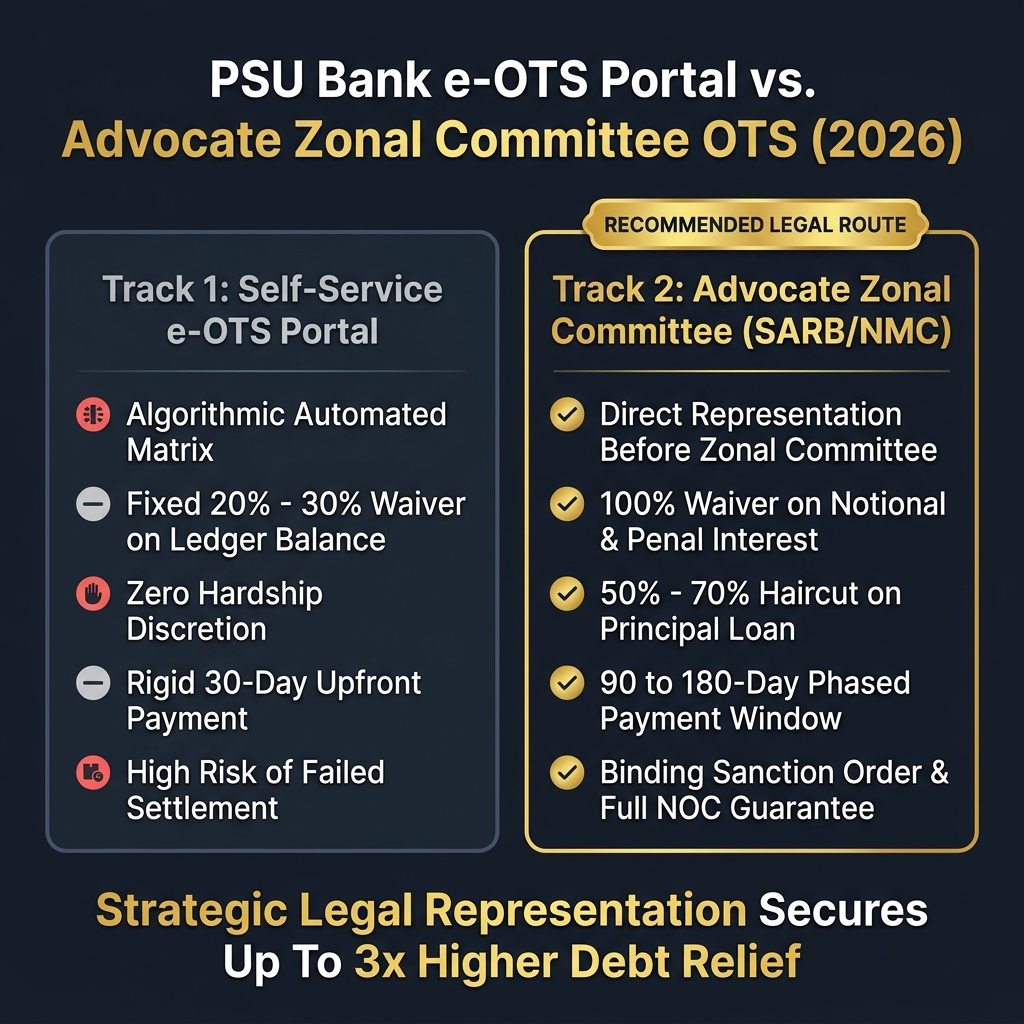
Understanding the fundamental difference between automated e ots and zonal committee ots pathways is the single most important strategic insight for any defaulting borrower. Automated portals are designed for high-volume, low-sacrifice recoveries. To obtain substantial debt relief that reflects your true financial reality, you must bypass the digital software and present your case before human decision-makers vested with statutory discretion.
How an Advocate Bypassing the Automated Portal to Petition the Regional/Zonal Settlement Committee Unlocks 50%–75% Waivers
When you step beyond the automated digital portal, you enter the domain of administrative banking law. Under the RBI Framework for Compromise Settlements and Technical Write-offs, every public sector bank maintains a structured hierarchy of compromise approval committees. These executive bodies hold delegated discretionary authority to sanction deep financial sacrifices far beyond what an automated portal is programmed to offer.
The Discretionary Committee Hierarchy in PSU Banks
In institutions like PNB, SBI, and Bank of Baroda, loan settlement authority is structured into escalating tiers based on exposure size and financial sacrifice:
- Branch / Circle Level Compromise Committee (CLCC): Evaluates small-ticket retail and agricultural loans typically up to ₹25 Lakh;
- Regional Level Compromise Committee (RLCC): Holds authority over medium-ticket exposures from ₹25 Lakh up to ₹1 Crore;
- Zonal Level Compromise Committee (ZLCC) / SARB Committee: Chaired by the Chief General Manager (CGM) or General Manager (GM), this powerful body reviews stressed exposures from ₹1 Crore up to ₹10 Crore;
- Head Office Compromise Committee (HOCC) & Board Management Committee: Reviews high-value corporate, consortium, and complex MSME exposures exceeding ₹10 Crore.
The Legal Advocacy Strategy: Constructing the Hardship Dossier
By stepping outside the automated portal of the pnb e ots sbi rinn samadhan psu bank one time settlement scheme 2026, senior banking advocates present comprehensive hardship petitions directly to these empowered committees. At AMA Legal Solutions, our legal strategy rests on building an airtight, legally compelling compromise dossier that provides bank executives with the exact statutory justifications required under RBI norms to grant deep waivers:
- Forensic Vulnerability Audit: We audit the bank's loan sanctions, account statements, and collateral documentation. If the bank has capitalized illegal penal interest in violation of RBI's Fair Lending Practice directives, failed to obtain valid mortgage registrations, or committed procedural errors under SARFAESI Rules, we highlight these vulnerabilities. Bank committees recognize that fighting an advocate in the Debt Recovery Tribunal (DRT) or High Court will delay recovery by 5 to 10 years, dramatically shifting the commercial calculus in favor of an immediate compromise.
- Distress & Forced Sale Valuation Analysis: Banks often rely on outdated, highly inflated "Book Value" or "Fair Market Value" reports prepared by empanelled valuers. Our team submits independent valuation assessments demonstrating the true "Realizable Forced Sale Value" (FSV) of the asset under distressed auction conditions. When the committee realizes that a public e-auction will fail repeatedly and yield less than our cash settlement offer, approving a substantial principal haircut becomes the bank's most prudent financial choice.
- Documented Hardship Substantiation: We compile exhaustive empirical evidence of genuine borrower distress—certified audited balance sheets proving business insolvency, medical records, tax assessment returns, and bank statements showing zero income. This evidence provides the committee with statutory protection under vigilance audits, documenting that the borrower has zero hidden wealth and that the compromise represents the maximum recoverable amount.
This strategic representation transforms the standard outcome of the pnb e ots sbi rinn samadhan psu bank one time settlement scheme 2026 into a substantial 50% to 75% principal reduction. The comparison table below highlights the operational and financial divergence between self-service portals and advocate-led committee representation:
| Resolution Parameter | Automated Self-Service e-OTS Portal Formula | Advocate-Represented Zonal Committee (SARB/SASTRA/ZLCC) OTS | Strategic Legal Advantage |
|---|---|---|---|
| Valuation & Baseline Dues | Calculated automatically on total recorded Ledger Balance on screen. | Audited forensic review; strikes out capitalized penal and illegal fees. | Reduces baseline claim by 15% to 30% before settlement negotiations begin. |
| Interest Sacrifice | Partial waiver of unapplied interest; retains contractual interest slabs. | 100% complete waiver of all notional, unapplied, and penal interest. | Completely eliminates phantom interest accumulated since NPA classification. |
| Principal Haircut Range | Rigidly capped at 20% to 35% of the ledger balance. | Substantive haircut ranging from 50% to 75% on pure principal. | Saves millions of rupees; delivers 2x to 3x higher financial debt relief. |
| Hardship & Insolvency Discretion | Zero discretion; algorithm rejects all subjective or medical justifications. | Full discretionary review under RBI Board-Approved Policy guidelines. | Medical crises, commercial failure, and job loss formally justify concessions. |
| Collateral Valuation Standard | Relies on original outdated book value or high guideline circle rates. | Forces acceptance of true Forced Sale Value (FSV) & distressed market reality. | Prevents bank from overestimating recovery potential through SARFAESI auctions. |
| Repayment Window & Tranches | Rigid 30-day full payment; immediate cancellation upon default. | Flexible 90 to 180-day phased payment window (with interest-free tranches). | Allows borrower realistic time to arrange funds through asset sales or family loans. |
| Litigation Immunity & Lok Adalat | Standard internal letter; ongoing DRT/SARFAESI cases remain active until end. | Formal consent award recorded before the National Lok Adalat. | Grants unappealable civil court decree; secures 100% refund of court fees. |
| Credit Bureau & NDC Delivery | Delayed automated bureau push; frequent delays in releasing property deeds. | Advocate-supervised physical deed return within 30 days & CIBIL closure. | Prevents post-settlement harassment and ensures unencumbered property title. |
When facing severe bank enforcement, relying on professional one time settlement OTS legal assistance provides the legal insulation, procedural authority, and negotiation leverage necessary to secure an optimal settlement sanction.
Upfront Deposit Rules (5% to 10% Application Money), Installment Timelines (30 to 180 Days) & Early-Payment Incentives
Once a borrower decides to pursue a One-Time Settlement, mastering the procedural rules governing financial deposits and payment schedules is vital. Compliance protocols governing the pnb e ots sbi rinn samadhan psu bank one time settlement scheme 2026 mandate an initial earnest money deposit and enforce strict installment timelines that must be navigated with precision.
The Rule of Upfront Earnest Money Deposit (EMD)
Public sector banks do not entertain frivolous or delay-tactic settlement requests. Under RBI-compliant compromise policies, a borrower submitting a formal OTS proposal must demonstrate bona fide intent by depositing an upfront sum—commonly termed Earnest Money Deposit (EMD), token money, or application money. Across PSU banks, this deposit is governed by strict rules:
- Quantum of EMD: Typically set at 5% to 10% of the proposed compromise settlement amount (or 5% of the total ledger balance);
- The "No-Lien Suspense Account" Mandate: This is a critical legal protection that every borrower must demand. The EMD must be deposited into a dedicated, non-interest-bearing No-Lien Suspense Account in the borrower's name, NOT credited directly into the delinquent loan account. Why? Because if the deposit is credited directly to the loan, the bank immediately appropriates the funds against overdue interest without accepting the settlement! If negotiations subsequently collapse, your money is gone. When placed in a No-Lien account, the funds remain your property until the bank issues a formal, written OTS Sanction Letter. If the bank rejects your proposal, the EMD must be refunded to you in full.
Structured Installment Timelines: The 25% and 75% Formula
Once the competent authority approves your compromise proposal, the bank issues a formal OTS Sanction Letter on its official corporate letterhead. Under standard public sector bank guidelines, repayment timelines operate under a disciplined two-stage milestone structure:
- Initial Upfront Tranche (25% Threshold): The borrower is required to deposit a cumulative 25% of the total sanctioned settlement amount (inclusive of the 5%–10% EMD already deposited) within 15 to 30 days from the date of receiving the sanction letter. Depositing this 25% constitutes formal legal acceptance of the compromise terms and temporarily suspends all pending SARFAESI auction actions.
- Residual Balance (75% Threshold): The remaining 75% balance must be liquidated within a specified repayment window:
- Standard Interest-Free Window: PSU banks typically grant 90 days from the date of sanction to pay the remaining 75% with zero interest charges;
- Extended Window with Simple Interest: Under RBI compromise directions, banks can grant payment extensions up to 180 days (and up to 12 months in exceptional MSME or agricultural cases). For payments made beyond the 90-day window, the bank charges simple interest (typically pegged to the bank's 1-year Marginal Cost of Funds-based Lending Rate - MCLR, or repo rate) on the reducing unpaid balance.
Early-Payment Incentives: Unlocking Additional Rebates
To accelerate immediate cash flow, almost all public sector bank OTS schemes include attractive "Early-Payment Rebates." For instance, under the SBI Rinn Samadhan and PNB schemes, if a borrower pays 100% of the sanctioned compromise amount within 30 to 45 days of sanction, the bank grants an additional 5% to 10% rebate on the approved settlement sum. For a ₹50 Lakh settlement, a 10% early-payment rebate puts an immediate ₹5 Lakh back into your pocket. Specialized banking advocates ensure that this prompt-payment clause is explicitly incorporated into your formal sanction order.
Legal Protection: Recording the Settlement in National Lok Adalat
A compromise settlement is not fully secure until it is legally bulletproofed against future revocation or institutional changes. Under Section 21 of the Legal Services Authorities Act, 1987, public sector banks regularly place their approved OTS compromises before the National Lok Adalat. When an OTS agreement is signed by both the bank's authorized officer and the borrower before a Lok Adalat panel (presided over by a sitting or retired judicial officer), it is transformed into a final, binding civil court decree. A Lok Adalat decree carries three profound legal protections:
- It is completely final and cannot be appealed or challenged by any successor bank manager or vigilance auditor;
- It permanently dismisses all pending civil suits, DRT recovery proceedings, and SARFAESI actions against the borrower; and
- Under Section 16 of the Court Fees Act, 1870, it entitles the parties to a 100% refund of all court fees paid in pending litigation, providing additional financial relief.
Strategic Conclusion: Maximize Your PSU Bank OTS Waiver with AMA Legal Solutions
Defaulting on a public sector bank loan does not make you a criminal, nor does it strip you of your constitutional and statutory rights as an Indian citizen. Genuine commercial reversals, business bankruptcies, and severe personal tragedies are recognized economic realities. The rollout of the pnb e ots sbi rinn samadhan psu bank one time settlement scheme 2026 reflects a national regulatory consensus: banks must purge non-performing assets, and honest, distressed citizens must be given a dignified, lawful exit from insurmountable debt.
However, securing debt relief through the pnb e ots sbi rinn samadhan psu bank one time settlement scheme 2026 should not be left to automated portal algorithms designed to minimize your waiver. When you accept an automated portal offer without legal representation, you needlessly leave tens of lakhs—often crores—of rupees on the negotiating table. The difference between a rigid 25% digital portal discount and a 65% advocate-negotiated Zonal Committee sanction can determine whether your family retains its residential shelter or whether your business survives to rebuild.
At AMA Legal Solutions, our team of seasoned banking, insolvency, and commercial litigation advocates specializes in representing borrowers against state-owned lenders across India. We bring deep institutional mastery of RBI master directions, forensic accounting precision, and formidable courtroom presence to the negotiating table. We intervene immediately to halt aggressive recovery harassment, stay unlawful SARFAESI auctions, petition the highest-level Stressed Assets Recovery Committees, and secure binding, Lok Adalat-decreed settlements that permanently extinguish your debt.
Do not let debt uncertainty dictate your future. If you are struggling with a defaulted loan at Punjab National Bank, State Bank of India, Bank of Baroda, or any other public sector bank, take control of your financial destiny today. Contact our senior banking advocates for a comprehensive, confidential case evaluation and secure the debt freedom you deserve. Reach out to our specialized loan settlement services team or contact AMA Legal Solutions today.
Popular Searches & Topics
Commonly searched legal queries and keywords related to this article
Need Strategic Legal Defense for Your Situation?
Our banking & litigation advocates review your notices, debt liability, and recovery issues under complete advocate-client secrecy.
References & Authority
- Reserve Bank of India - Framework for Compromise Settlements and Technical Write-offs (DOR.STR.REC.20/21.04.048/2023-24)
- Reserve Bank of India - Master Direction on Transfer of Loan Exposures & Stressed Asset Resolution Guidelines
- National Legal Services Authority (NALSA) - Pre-Litigation & Pending Matters Settlement Guidelines under Legal Services Authorities Act, 1987
- Punjab National Bank - Policy on Stressed Assets Resolution and e-OTS Guidelines (SASTRA Division)
- State Bank of India - Stressed Assets Recovery Branch (SARB) Compromise Settlement Framework (Rinn Samadhan)
- Bank of Baroda - Stressed Assets Management Cell (SAMC) Recovery and Compromise Settlement Policy
- Supreme Court of India - Bijnor Urban Cooperative Bank Ltd. vs. Meenal Agarwal & Ors. (2021) Civil Appeal No. 7411/2021 on Scope of OTS Policies
- Credit Information Companies (Regulation) Act, 2005 (CICRA) - Rules on Settlement Status Reporting

AMA Legal Solutions
Trusted with a 4.7 Google Rating, over 10,000+ Clients Served, 25,000+ Cases Handled, and more than 40+ Years of Experience in providing strategic legal defense and debt resolution across India.
Our media coverages





Frequently Asked Questions
Related Articles

Loan Against Mutual Funds, Shares & Gold Default: Section 176 & Settlement (2026)
Enforce Section 176 notice rights to stop illegal auctions and settle shortfalls.
Read Article
How Long Does a Settled Account Stay on CIBIL? (2026)
Understand the impact of settled accounts on your credit history and options available.
Read Article
Can a Personal Loan Defaulter Go to Jail in India? (2026)
Understanding legal ramifications & safeguards for personal loan defaulters in India
Read ArticleAbout Author
Anuj Anand Malik
View ProfileAnuj Anand Malik, Founder of AMA Legal Solutions, is a trusted advocate, loan settlement expert, legal advisor, and banking lawyer. With over a decade of experience in loan settlement, corporate law, financial disputes, and compliance, he leads a result-driven law firm based in India that helps individuals, startups, and businesses achieve legal and financial stability.
Connect on LinkedInNeed Legal Representation?
Evaluate your defense against recovery agents, notices, or structure your loan settlement directly with Senior Advocates.
Call +91-8700343611