Loan Against Mutual Funds, Shares & Gold Default: Section 176 & Settlement (2026)
Enforce Section 176 notice rights to stop illegal auctions and settle shortfalls.

Anuj Anand Malik
Reviewed by AMA Legal Solutions

Key Takeaways: Defaulting on a credit facility secured by movable assets does not give financial institutions the unbridled right to confiscate or dump your wealth into the market without due process. In the landscape of loan against mutual funds shares and gold default settlement india, borrowers are shielded by non-derogable federal statutory safeguards under the Indian Contract Act, 1872 and binding Reserve Bank of India (RBI) master directions. Under Section 176 of the Indian Contract Act, a lender (pawnee) cannot sell pledged collateral without serving specific, reasonable advance notice to the borrower (pawnor)—a statutory condition precedent that cannot be overridden by adhesion clauses or automated digital consent terms. As reinforced by the Supreme Court of India in PTC India Financial Services Ltd. vs. Venkateswarlu Kari (2022), invoking a pledge or transferring demat units does not extinguish the borrower's ownership or their unconditional right of redemption under Section 177 until an actual open-market sale to an independent third party takes place. Furthermore, RBI directives mandate a minimum 14-day advance notice, public auctions benchmarked to transparent floor prices, and an immediate 7-day refund of any auction surplus for gold jewellery loans. When predatory lenders execute illegal unnotified liquidations or fabricate inflated post-sale shortfalls, experienced banking advocates can challenge unlawful asset conversions, enforce statutory set-offs, and secure comprehensive One-Time Settlement (OTS) waivers.
Introduction: Loan Against Mutual Funds, Shares and Gold Default Settlement in India
The digitization of the Indian retail credit market over the past five years has fundamentally transformed collateralized borrowing. Once requiring weeks of physical branch visits, manual document verification, and physical share certificate endorsements, obtaining credit against investments is now instantaneous. Millions of retail investors, market traders, high-net-worth professionals, and micro-entrepreneurs routinely unlock liquidity through digital platforms. By leveraging facilities such as Loan Against Mutual Funds (LAMF) integrated through Registrar and Transfer Agents (RTAs) like CAMS and KFintech, Loan Against Shares (LAS) executed via National Securities Depository Limited (NSDL) and Central Depository Services (India) Limited (CDSL), or instant gold credit apps, borrowers access substantial capital while keeping their underlying wealth invested.
However, when stock market volatility triggers rapid index corrections, or when borrowers face sudden personal cash-flow interruptions, this seamless digital convenience abruptly turns adversarial. Digital non-banking financial companies (NBFCs) and aggressive commercial banks rapidly issue automated margin call alerts, demanding substantial cash injections within hours. When market prices slip past mandatory loan-to-value (LTV) boundaries, lenders routinely execute unilateral square-offs, selling off long-term equity portfolios at deep cycle bottoms or conducting opaque gold jewellery auctions behind closed doors. This aggressive, algorithmic recovery environment has created an urgent need for authoritative legal intervention in loan against mutual funds shares and gold default settlement india.
A widespread and catastrophic misconception among Indian borrowers is the belief that because they signed digital "click-wrap" terms or accepted standard loan agreements, they have forfeited all control over their pledged assets. Borrowers often assume that financial institutions possess absolute legal immunity to liquidate collateral at their whim. This assumption is completely false under Indian jurisprudence. The relationship between a borrower pledging movable assets and a lending institution is governed by the statutory law of pledge under the Indian Contract Act, 1872. Statutory rights established by Parliament cannot be contracted away through standard-form banking contracts. Whether you are dealing with aggressive margin calls from fintech apps or facing unnotified gold auctions, engaging specialized loan settlement services and asserting your legal rights regarding loan settlement in India ensures your assets are protected and unauthorized recovery actions are decisively stopped.
How Digital Pledge Loans Work (Loan Against Mutual Funds on CAMS/KFintech, Demat Shares & Gold Jewellery)
To establish a formidable legal defense during loan against mutual funds shares and gold default settlement india, one must first master the operational and legal mechanics governing digital asset pledging across different classes of movable property. Under Section 172 of the Indian Contract Act, 1872, a "pledge" is defined as the bailment of goods as security for the payment of a debt or the performance of a promise. The borrower is legally termed the "pawnor," and the creditor bank or NBFC is the "pawnee." In contemporary finance, this ancient doctrine manifests through three primary asset architectures:
1. Loan Against Mutual Funds (LAMF) via CAMS & KFintech Electronic Liens
In modern digital mutual fund financing—offered by players like Volt Money, Dhan, 5paisa, Mirae Asset, Bajaj Finserv, Tata Capital, and leading private banks—mutual fund units are not physically transferred. Instead, an electronic lien is marked against the borrower's mutual fund folios through RTAs (CAMS or KFintech). The units remain registered in the investor's name, and dividends continue to accrue to the borrower's bank account. However, the lien prevents the investor from redeeming, switching, or transferring those units until the lending institution issues an electronic lien revocation upon full repayment. When an account defaults, the lender requests the RTA to invoke the lien and redeem the units directly with the Asset Management Company (AMC) to satisfy the loan.
2. Loan Against Shares (LAS) via NSDL and CDSL Demat Pledges
For equity shares held in electronic form, pledging operates under the Depositories Act, 1996 and SEBI (Depositories and Participants) Regulations. The pledgor instructs their Depository Participant (DP) to create a pledge in favor of the lender. Upon confirmation by the lender's DP, the status of the shares changes to "pledged." Crucially, under SEBI guidelines, the shares remain in the borrower's demat account with a pledge flag; they are not transferred to the lender's account during the initial contract. Only when a default occurs can the pledgee trigger an invocation through depository mechanisms.
3. Gold Jewellery Loans (Physical Bailment)
Gold financing represents a traditional physical bailment. The borrower physically deposits hallmarked gold ornaments or jewellery into the bank or NBFC branch vault. The lender conducts an appraisal of purity and gross/net weight and disburses credit capped strictly under RBI regulatory Loan-to-Value (LTV) limits (typically capped at 75% for standard credit lines). The physical custody remains with the branch as a bailee under Section 151 of the Indian Contract Act, imposing an absolute statutory duty of care upon the lender.
While lenders frequently treat these assets as instant liquidity pools for debt recovery, each asset class is constrained by distinct statutory and regulatory frameworks. The comparative matrix below outlines the legal benchmarks governing each asset category:
| Operational & Legal Dimension | Loan Against Mutual Funds (LAMF) | Loan Against Shares (LAS) | Gold Jewellery Loans |
|---|---|---|---|
| Collateral Type & Custody | Electronic units in AMC folio; lien marked via CAMS/KFintech RTAs. | Dematerialized shares in NSDL/CDSL demat account with pledge flag. | Physical gold ornaments held in secure bank/NBFC branch vault. |
| Regulatory Framework | RBI Digital Lending Guidelines & SEBI Mutual Fund Regulations. | SEBI Depositories Regulations & RBI NBFC Master Directions. | RBI Lending Against Gold & Silver Collateral Directions (2025/2026). |
| Permissible LTV Thresholds | 50% for Equity MFs; 70% to 80% for Debt/Liquid Funds. | Strictly capped at 50% for approved list of equity securities. | Capped at 75% for standard loans; up to 85% for micro/agriculture. |
| Statutory Sale Pre-Condition | Mandatory Section 176 Reasonable Notice prior to AMC redemption. | Mandatory Section 176 Notice + Depositories Act invocation compliance. | Mandatory 14-day advance notice + local newspaper auction publication. |
| Common Illegal Lender Enforcements | Instant algorithmic liquidation upon intraday NAV decline without notice. | Unannounced bulk open-market dumping during high-volatility trading hours. | Secretive backroom auctions below market floor price; withholding surplus. |
| Borrower Redemption Rights | Section 177 right to pay dues and release folio lien before redemption. | Section 177 right to redeem shares anytime prior to actual third-party sale. | Unconditional right to redeem physical ornaments prior to auction hammer. |
| Advocate Settlement Remedies | Restructure margin, halt unauthorized selling, negotiate OTS waiver. | Challenge unnotified sale for conversion damages; settle shortfall dues. | File consumer complaint, claim 7-day surplus refund, achieve full NOC. |
Whether you hold physical gold, demat equities, or mutual fund units, defaulting on a collateralized facility does not give the lender free rein to disregard the law. If you are dealing with complex investment defaults, understanding structured trading loan settlement or restructuring options for a loan against LIC policy provides vital insights into how Indian law protects pledged financial assets.
The Ironclad Statutory Rule: Section 176 of the Indian Contract Act, 1872 Mandates 'Reasonable Notice' Before Any Sale
The substantive cornerstone of borrower protection in loan against mutual funds shares and gold default settlement india is codified in Section 176 of the Indian Contract Act, 1872. This statutory provision defines the exact boundaries of a pawnee's enforcement powers upon a borrower default. Section 176 provides:
"Pawnee's right where pawnor makes default.—If the pawnor makes default in payment of the debt, or performance; at the stipulated time of the promise, in respect of which the goods were pledged, the pawnee may bring a suit against the pawnor upon the debt or promise, and retain the goods pledged as a collateral security; or he may sell the thing pledged, on giving the pawnor reasonable notice of the sale."
The Two Mutually Exclusive Options of the Pawnee
Parliament provided the creditor with precisely two legal avenues—and nothing more:
- Retain and Sue: The lender may retain the pledged collateral in safe custody and institute a formal civil suit against the borrower for the recovery of the unpaid debt; OR
- Sell with Reasonable Notice: The lender may liquidate the pledged assets, subject to the strict condition precedent of giving the pawnor reasonable notice of the sale.
Why 'Reasonable Notice' Cannot Be Waived by Contract
Lenders routinely draft oppressive clauses into loan agreements stating: "The borrower irrevocably waives the requirement of any notice under Section 176 of the Indian Contract Act, and the bank shall be entitled to sell the securities at its absolute discretion without intimation." Indian courts have repeatedly and emphatically declared such waiver clauses illegal, void, and unenforceable under Section 23 of the Indian Contract Act on grounds of public policy.
The requirement of serving a section 176 indian contract act reasonable notice before pledge sale is mandatory. It cannot be dispensed with by mutual consent, standard-form contracts, or adhesion clauses. When asserting defenses in loan against mutual funds shares and gold default settlement india, understanding the non-derogable nature of Section 176 is paramount. The statutory rationale is fundamental: the notice is not a mere procedural formality; it is a substantive legal right designed to protect the pawnor's right of redemption under Section 177 of the Act.
Section 177: The Defaulting Pawnor's Absolute Right of Redemption
Section 177 of the Indian Contract Act establishes that a defaulting borrower retains the unconditional right to redeem the pledged goods at any time before the actual sale of them takes place. To redeem the collateral, the borrower must pay or tender the legitimate debt amount along with any reasonable expenses directly occasioned by the default. If a bank or NBFC fails to provide reasonable notice, it strips the borrower of their statutory opportunity to arrange alternative funds, cure the margin deficit, and save their wealth from liquidation. Therefore, any sale conducted without a reasonable, specific notice constitutes an unlawful conversion of property, rendering the lender civilly liable for damages.
Why Instant Automated Liquidation Without a Specific Sale Notice Is Illegal Under Supreme Court & High Court Precedents
In modern digital lending platforms like Volt Money, Bajaj Finserv, HDFC Bank, ICICI Bank, and brokerage-linked NBFCs, software algorithms continuously monitor live asset valuations. When market indexes drop and margin thresholds are breached, automated systems frequently trigger immediate square-offs within minutes. Borrowers receive an automated SMS or push notification stating: "Margin breached. Your portfolio has been liquidated." In loan against mutual funds shares and gold default settlement india, these automated liquidations are blatantly illegal under established Supreme Court and High Court precedents.
The Landmark Supreme Court Ruling: PTC India Financial Services Ltd. vs. Venkateswarlu Kari (2022)
In the historic judgment of PTC India Financial Services Ltd. vs. Venkateswarlu Kari (2022) 9 SCC 704, a three-judge bench of the Supreme Court of India exhaustively analyzed the intersection between modern dematerialized securities and the Indian Contract Act, 1872. The Apex Court laid down foundational principles that govern every loan against shares and mutual funds in India:
- Contract Act Governs All Pledges: The Supreme Court firmly rejected the argument that the Depositories Act, 1996 overrides the Indian Contract Act. Pledges of dematerialized shares and mutual fund units remain strictly subject to Sections 176 and 177 of the Contract Act.
- No 'Sale to Self' Permitted: When a lender invokes a pledge under depository rules and registers itself as the "beneficial owner" of the shares, this transfer does not constitute an actual sale. Under Indian law, a pawnee cannot sell the pledged asset to itself. The lender holds the securities merely as a pledgee with special property rights, not absolute ownership.
- Redemption Rights Survive Invocation: The borrower's right of redemption under Section 177 remains alive and enforceable even after the pledge has been invoked, right up until the precise second an actual sale to an independent third-party buyer is completed in the open market.
- Mandatory Requirement of Specific Notice: The Supreme Court held that Section 176 mandates reasonable notice before the actual sale. The notice must convey a clear, unambiguous intention to sell and provide the borrower sufficient time to exercise redemption.
Why Generic Margin Calls Do Not Satisfy Section 176
Fintech lenders frequently argue that sending a generic margin alert email—such as "Please maintain margin or shares may be sold at company discretion"—fulfills their legal obligation. High Courts across India, including landmark rulings by the Delhi High Court and Bombay High Court, have repeatedly held that a generic, conditional warning does not constitute a valid Section 176 notice. To satisfy statutory requirements, a loan against shares margin call legal notice section 176 must specify:
- The precise outstanding default amount required to cure the breach;
- The specific date, time, and trading window during which the securities will be offered for sale;
- The exact identification and quantity of the mutual fund units or share scrips earmarked for liquidation; and
- A reasonable time window (judicially recognized as at least 24 to 48 hours for market securities, depending on contract terms) allowing the borrower to tender payment.
When lenders execute unannounced square-offs, they commit the tort of wrongful conversion. In the realm of loan against mutual funds shares and gold default settlement india, algorithmic square-offs carried out without a specific Section 176 notice violate constitutional property protections. In cases involving volt money bajaj finserv hdfc loan against mutual funds default, borrowers who suffer devastating capital losses due to premature liquidations have the legal standing to challenge those transactions in competent judicial forums and demand full restitution.
Key Insights & Data Infographic
Visual summary, statistical trends & procedural breakdown
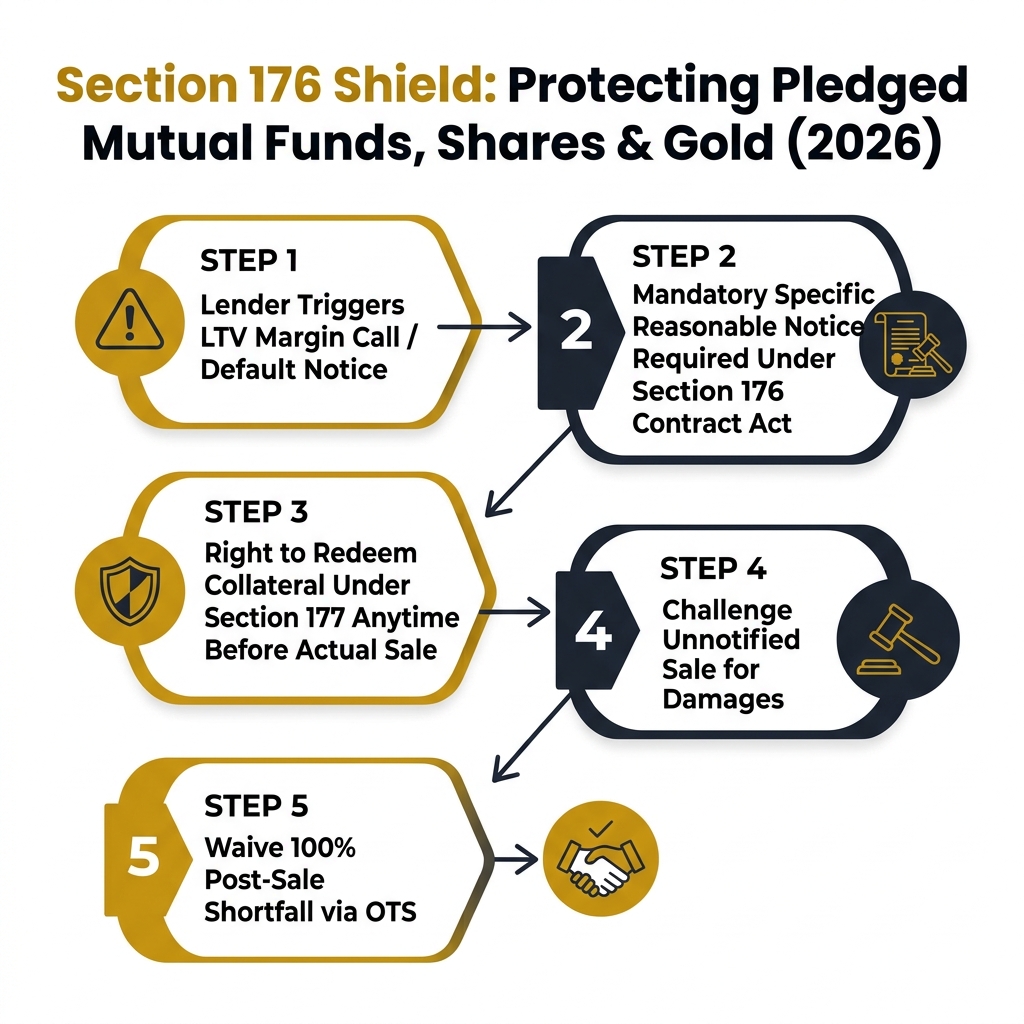
Prepared by AMA Legal Solutions Research & Analytics Team • Data & Compliance Overview

Halt Recovery Agent Harassment Legally
RBI's Strict Gold Loan Auction Rules (75% LTV, Transparent Local Auction, Mandatory Notice & Surplus Refund)
While digital shares and mutual funds are governed by depository and contract jurisprudence, gold loan enforcement in India is anchored by comprehensive regulatory directions issued by the Reserve Bank of India. Millions of Indian families pledge sovereign gold jewellery to finance businesses, medical emergencies, or agricultural operations. Recognizing widespread malpractices—such as clandestine auctions, predatory undervaluation, and the unauthorized pocketing of auction surpluses—the RBI established strict procedural guardrails under its Lending Against Gold and Silver Collateral Directions and Fair Practices Code. These rules are central to loan against mutual funds shares and gold default settlement india.
1. The Mandatory 14-Day Advance Written Notice
Under RBI master directions, a lending institution (such as Muthoot Finance, Manappuram Finance, Shriram Finance, or commercial banks) is strictly barred from conducting surprise auctions. The lender must serve a formal, advance written notice to the borrower giving a minimum of 14 days before any auction can take place. The notice must clearly state the outstanding principal, accumulated interest, and the exact date, time, and physical venue of the scheduled public auction. A gold loan auction without prior notice rbi rules breach is a severe regulatory violation that renders the entire auction voidable.
2. Transparency and Local Town Auction Mandate
To eliminate collusive bidding and ensure that borrowers can physically attend and participate, the RBI mandates that auctions must be conducted in the same town or district where the branch that granted the loan is located. Lenders are expressly prohibited from pooling gold ornaments from rural or semi-urban branches and shipping them to metropolitan centers for secretive bulk auctions. Furthermore, the auction must be advertised in at least two prominent local newspapers—one in a vernacular language and one in national English circulation.
3. Independent Valuation and Minimum Floor Reserve Price
Lenders cannot sell family gold at arbitrary distress prices. The reserve price for the auction must be benchmarked transparently against established market rates, specifically referencing the trailing 30-day average price published by the India Bullion and Jewellers Association (IBJA). In accordance with RBI guidelines, the auction floor price cannot be set below 90% of the prevailing market value of the gold content. Closed-door valuations conducted without the borrower's knowledge invite heavy supervisory penalties.
4. The 7-Day Statutory Surplus Refund Mandate
Because gold prices historically appreciate over long periods, the auction of pledged ornaments frequently generates proceeds that exceed the borrower's total outstanding liability (including legitimate interest and verified recovery costs). Under RBI directives, the lender is legally obligated to refund any auction surplus directly into the borrower's bank account within 7 working days of receiving auction proceeds. Lenders are strictly forbidden from absorbing this surplus into internal profit ledgers or inventing bogus administrative charges to dilute the borrower's refund.
5. Severe Penalties for Withholding or Mishandling Collateral
The RBI enforces severe financial disincentives against institutions that mishandle pledged gold. Borrowers seeking loan against mutual funds shares and gold default settlement india must recognize that the regulator has established strict accountability for financial institutions. If a borrower settles their account and the lender delays the return of the physical gold ornaments beyond the stipulated timeframe, the lender must pay statutory compensation of ₹5,000 per day of delay directly to the borrower. If you have been subjected to an opaque, unnotified gold sale, filing a formal consumer complaint against finance company or seeking auction settlement process loan recovery explained guidance allows you to hold rogue lenders fully accountable.
The 'Post-Auction Shortfall' Trap: When Lenders Sell Your Collateral and Still Demand Extra Money From You
Among the most distressing challenges encountered in loan against mutual funds shares and gold default settlement india is the notorious "post-auction shortfall" claim. In this scenario, the bank or NBFC sells off the borrower's pledged mutual funds, equity shares, or gold jewellery at a steep discount, credits only a fraction of the market value to the loan account, and subsequently issues an aggressive legal notice claiming that a substantial "residual deficit" remains outstanding.
The Architecture of an Inflated Shortfall Claim
A borrower who originally took a ₹20 lakh facility secured against ₹40 lakh worth of equity mutual funds may experience a market correction reducing their portfolio value to ₹24 lakh. The lender panics and liquidates the entire portfolio at a distressed bottom for ₹22 lakh. Instead of closing the account, the lender generates a fabricated statement of account showing:
- Principal balance: ₹20,00,000
- Compounded default penal interest (at 24% to 36% APR): ₹4,50,000
- Lien invocation and RTA processing levies: ₹75,000
- Brokerage and distress auction expenses: ₹1,25,000
- Total Claimed Liability: ₹26,50,000
- Net Liquidation Realization: ₹22,00,000
- Alleged Residual Shortfall Claimed from Borrower: ₹4,50,000
The lender's recovery desk then initiates aggressive collection calls, serves arbitration notices under Section 21 of the Arbitration and Conciliation Act, or presents dishonored e-NACH mandates under Section 25 of the Payment and Settlement Systems Act (PASSA) to coerce payment of this residual shortfall.
The Legal Defense: Unlawful Conversion and Equitable Set-Off
Under Indian contract and tort law, a lender that sells pledged property in violation of statutory rules (without mandatory Section 176 notice or in breach of RBI auction protocols) is guilty of wrongful conversion. A critical turning point in loan against mutual funds shares and gold default settlement india arises when the borrower confronts an illegal post-sale deficiency claim with established legal doctrines. Under Section 73 of the Indian Contract Act, the borrower is entitled to full compensation for any loss naturally arising from the lender's breach.
When challenging a claim regarding settling residual balance after gold loan or share auction, specialized banking advocates invoke the doctrine of equitable set-off. The borrower does not merely defend against the shortfall; they assert a counter-claim for the fair market value of the collateral had it been sold lawfully or preserved for redemption. Judicial precedents from High Courts establish that where a creditor sells pledged shares or gold negligently below prevailing market prices without reasonable notice, the court will credit the borrower with the full market value on the date of conversion. In many instances, an empirical forensic audit reveals that the lender's claim is completely wiped out, converting the alleged deficit into a net refund due to the borrower!
Before facing unnotified asset liquidation, exploring a proactive loan settlement before auction or executing an advocate-led secured loan settlement prevents lenders from executing distress sales and manufacturing artificial shortfall claims.
How AMA Legal Solutions Challenges Illegal Pledge Invocations and Settles Residual Deficits via OTS
Resolving complex collateral disputes and securing a favorable outcome in loan against mutual funds shares and gold default settlement india demands strategic legal acumen, regulatory mastery, and courtroom leverage. At AMA Legal Solutions, our senior banking and commercial litigation advocates execute an aggressive, multi-tiered legal protocol to safeguard your investments and extinguish uncollateralized deficits permanently.
Stage 1: Immediate Statutory Injunction and Redemption Notice
The moment an aggressive lender issues an unannounced margin call or threatens liquidation, our advocates serve an urgent, formal Legal Representation and Section 176/177 Notice upon the bank or NBFC's Managing Director, Principal Nodal Officer, and Central Risk Management Desk. This notice accomplishes three immediate objectives:
- It formally asserts your statutory right of redemption under Section 177 of the Indian Contract Act, placing the lender on formal notice that any automated or unnotified sale will be treated as civil conversion and criminal breach of trust.
- It cites the Supreme Court's ruling in PTC India Financial Services, warning the lender that transferring pledged demat units or invoking RTA liens does not grant beneficial ownership and that open-market sales without specific notice will invite immediate injunction proceedings.
- It demands the freezing of all distress liquidation workflows to enable formal compromise discussions.
Stage 2: Comprehensive Forensic Ledger and Valuation Audit
Our financial law analysts conduct a line-by-line forensic examination of the lender's account statement. We identify and legally strike out:
- Capitalized penal interest and usurious default charges banned under the RBI Fair Lending Practices Circular;
- Inflated liquidation expenses, auction marketing fees, and uncontracted legal levies;
- Valuation discrepancies between the realization price reported by the lender and the actual National Stock Exchange (NSE) / Bombay Stock Exchange (BSE) / IBJA benchmark market rates on the transaction date.
Stage 3: Multi-Jurisdictional Regulatory and Judicial Enforcement
If a lender has already conducted an unlawful sale or refuses to negotiate reasonably, we initiate simultaneous high-pressure legal proceedings across competent regulatory and judicial forums:
- RBI Ombudsman & CMS Portal: Escalating severe Fair Practices Code and gold auction violations directly to the Reserve Bank of India for regulatory inquiry and daily delay compensation.
- SEBI SCORES & Depository Grievance: Filing formal complaints against depository participants and broker NBFCs for unauthorized share pledge invocations.
- Consumer Disputes Redressal Commission: Filing statutory complaints under Section 35 of the Consumer Protection Act, 2019 for deficiency of service and unfair trade practices, claiming substantial monetary damages and compensation for illegal gold loan auction india.
Stage 4: Structuring a Binding One-Time Settlement (OTS) and No Dues Certificate
Faced with credible litigation risks and regulatory scrutiny, lenders readily abandon aggressive recovery postures and transition to commercial compromise. Our senior advocates negotiate a formal One-Time Settlement (OTS) that delivers:
- A 100% complete waiver of all accumulated penal interest, bounce fees, auction administrative charges, and legal expenses;
- A substantial haircut (often 50% to 80%) on any alleged residual shortfall balance;
- An official, stamped, and signed OTS Sanction Letter issued on the bank's corporate letterhead guaranteeing that upon payment of the agreed compromise sum, all claims are extinguished;
- The unconditional release of all lien markings on remaining mutual fund folios with CAMS/KFintech, unfreezing of demat share pledges, and issuance of a formal No Dues Certificate (NDC); and
- Mandatory reporting to all four credit bureaus (CIBIL, Experian, Equifax, CRIF High Mark) to update the credit tradeline to "Closed" or "Settled with Zero Balance."
The operational framework below illustrates the legal remedies available when navigating collateral disputes and shortfall settlements:
| Stage of Dispute | Lender Violation / Aggressive Action | Governing Statute & Judicial Authority | Immediate Legal Countermeasure | Expected Outcome & Settlement Leverage |
|---|---|---|---|---|
| Pre-Liquidation Margin Call | Algorithmic threat to dump shares or redeem mutual funds within hours. | Section 176 Contract Act; PTC India (SC 2022); SEBI Regulations. | Issue formal Section 176 Notice demanding specific notice & halting sale. | Blocks automated square-off; buys time to restructure margin or settle. |
| Pre-Auction Gold Notice | Abrupt auction notice without 14-day window or transparent valuation. | RBI Gold Lending Directions; Fair Practices Code; NCDRC Rulings. | Serve Objection Notice to Nodal Officer; cite local town auction mandate. | Suspends public auction; compels lender to disclose valuation & enter OTS. |
| Post-Sale Shortfall Demand | Demanding extra cash after selling collateral at distress cycle bottoms. | Section 73 & 180 Contract Act (Conversion); Equitable Set-off doctrine. | Audit realization vs. market high; counter-claim conversion damages. | Neutralizes shortfall completely; forces bank to waive 100% of residual dues. |
| Auction Surplus Withholding | Bank pockets excess gold auction proceeds beyond outstanding debt. | RBI 7-Day Surplus Refund Mandate; Section 403/405 BNS (Trust Breach). | File RBI CMS Ombudsman complaint + Consumer Commission petition. | Secures full surplus refund + ₹5,000/day statutory delay penalty. |
| Post-Settlement Tradeline Closure | Lender delays lien revocation on CAMS folios or leaves CIBIL overdue. | RBI Credit Information Directions; Section 177 Contract Act (Redemption). | Serve Notice of Charge Satisfaction; petition Banking Ombudsman. | Complete RTA lien removal; obtains NDC and clean zero-balance bureau update. |
Navigating these complex legal and financial mechanisms requires dedicated representation. If you are facing asset liquidation, consult our specialized loan settlement services and loan settlement in India professionals, or contact AMA Legal Solutions today to protect your wealth.
Strategic Conclusion: Protect Your Investments and Gold from Predatory Liquidation
Pledging mutual funds, demat shares, or family gold ornaments is an established financial strategy designed to bridge short-term liquidity needs without permanently divesting from long-term capital assets. However, when market downturns or personal financial distress strike, lenders cannot be allowed to exploit digital systems to strip you of your wealth. Navigating loan against mutual funds shares and gold default settlement india with strategic clarity restores the balance of power between individual borrowers and large financial institutions.
Indian contract law, the Supreme Court of India, and the Reserve Bank of India have erected an impregnable statutory framework safeguarding the borrower's ownership rights. From the mandatory requirement of reasonable notice under Section 176 to the unconditional right of redemption under Section 177, the law recognizes that collateral is pledged solely as a security—never as an absolute transfer of ownership. When lenders breach these fundamental protections, they open themselves to severe regulatory sanctions, conversion damages, and legal liability.
Do not allow an aggressive collection manager or an automated margin call bot to intimidate you into accepting catastrophic portfolio liquidations or unpayable shortfall demands. At AMA Legal Solutions, our senior advocates bring deep expertise in banking regulations, commercial litigation, and structured loan settlement. We intervene immediately to halt unlawful auctions, challenge inflated claims, and negotiate legally binding One-Time Settlements that preserve your financial standing and protect your family's future.
Popular Searches & Topics
Commonly searched legal queries and keywords related to this article
Need Strategic Legal Defense for Your Situation?
Our banking & litigation advocates review your notices, debt liability, and recovery issues under complete advocate-client secrecy.
References & Authority
- Indian Contract Act, 1872 - Section 176 (Pawnee's Right Where Pawnor Makes Default) & Section 177 (Defaulting Pawnor's Right to Redeem)
- Supreme Court of India - PTC India Financial Services Ltd. vs. Venkateswarlu Kari (2022) 9 SCC 704
- Reserve Bank of India - Master Direction on Lending Against Gold and Silver Collateral / Regulatory Framework for Gold Loans
- Securities and Exchange Board of India (SEBI) - Master Circular for Depositories and System of Pledge/Hypothecation
- Reserve Bank of India - Master Direction on Fair Practices Code for Non-Banking Financial Companies (NBFCs) and Banks
- National Consumer Disputes Redressal Commission (NCDRC) - Landmark Precedents on Unnotified Gold Auctions and Deficiency in Banking Service
- Reserve Bank of India - Master Direction on Fair Lending Practice - Penal Charges in Loan Accounts
- Ministry of Consumer Affairs, Food & Public Distribution - Consumer Protection Act, 2019 (Section 2(47) Unfair Trade Practices)

AMA Legal Solutions
Trusted with a 4.7 Google Rating, over 10,000+ Clients Served, 25,000+ Cases Handled, and more than 40+ Years of Experience in providing strategic legal defense and debt resolution across India.
Our media coverages





Frequently Asked Questions
Related Articles
PNB e-OTS, SBI Rinn Samadhan & PSU Bank OTS Schemes in India (2026)
Compare PSU bank e-OTS portals with deeper Zonal Committee discretionary waivers.
Read Article
How Long Does a Settled Account Stay on CIBIL? (2026)
Understand the impact of settled accounts on your credit history and options available.
Read Article
Can a Personal Loan Defaulter Go to Jail in India? (2026)
Understanding legal ramifications & safeguards for personal loan defaulters in India
Read ArticleAbout Author
Anuj Anand Malik
View ProfileAnuj Anand Malik, Founder of AMA Legal Solutions, is a trusted advocate, loan settlement expert, legal advisor, and banking lawyer. With over a decade of experience in loan settlement, corporate law, financial disputes, and compliance, he leads a result-driven law firm based in India that helps individuals, startups, and businesses achieve legal and financial stability.
Connect on LinkedInNeed Legal Representation?
Evaluate your defense against recovery agents, notices, or structure your loan settlement directly with Senior Advocates.
Call +91-8700343611