Joint Loan Default During Divorce in India: Co-Borrower Settlement & Release (2026)
Navigate joint loan defaults during divorce and secure a co-borrower OTS release.

Anuj Anand Malik
Reviewed by AMA Legal Solutions

Key Takeaways: Matrimonial breakdown is emotionally exhausting, but when compounded by joint financial debt, it frequently triggers severe economic catastrophe. The legal crisis of joint loan default during divorce in india co borrower settlement arises because personal relationship dissolutions do not dissolve tripartite commercial contracts. Under Section 43 of the Indian Contract Act, 1872, Indian banks and Non-Banking Financial Companies (NBFCs) enforce joint and several liability, meaning lenders hold the absolute statutory power to demand 100% of an unpaid loan from either spouse, completely disregarding Family Court divorce decrees or private settlement memorandums. When an estranged partner abruptly stops paying EMIs on a joint home loan, personal loan, or credit card, the non-defaulting spouse faces ruined credit scores, predatory recovery agent harassment, and legal litigation. Resolving this trap requires specialized legal intervention: auditing loan contracts to separate primary co-borrowers from non-signatory references, issuing statutory anti-harassment notices under Reserve Bank of India (RBI) 2026 directions, synchronizing Section 13B mutual consent divorce decrees with bank novation under Section 62, and negotiating individualized One-Time Settlement (OTS) releases under Section 44 to permanently protect your financial independence.
Introduction: The Joint Loan Default During Divorce Crisis in India
In contemporary Indian society, dual-income households and joint financial planning have become standard practice. When purchasing residential property, buying vehicles, or funding lifestyle expenditures, couples routinely execute joint borrowing agreements to enhance loan eligibility and secure higher sanction limits. However, when marriages fracture, these entangled financial arrangements often transform into bitter legal battlegrounds. Across the country, family court litigation is increasingly paralyzed by the complex reality of joint loan default during divorce in india co borrower settlement, leaving spouses stranded in financial jeopardy.
When a marriage dissolves, emotional cooperation evaporates. In thousands of matrimonial disputes across Delhi NCR, Mumbai, Bengaluru, Chennai, and other metropolitan centers, an estranged husband or wife abruptly stops servicing their share of monthly loan installments. The consequences are immediate and devastating: missed Equated Monthly Installments (EMIs) trigger punitive default charges, aggressive recovery agencies flood phones with abusive collection calls, and both individuals' TransUnion CIBIL scores plunge into delinquency. The fundamental legal dilemma is that emotional divorce and financial divorce operate on completely separate legal planes. While the Family Court adjudicates maintenance, custody, and dissolution under personal law, commercial banking contracts remain firmly anchored in the statutory framework of the Indian Contract Act, 1872.
Borrowers caught in this crossfire often assume that informing the bank of pending divorce litigation or presenting an interim court order will halt debt enforcement. This assumption is a dangerous myth. Banks are not parties to matrimonial disputes, and loan officers have zero statutory obligation to accommodate domestic friction. Without aggressive, strategic legal representation combining family law with commercial banking defense, an innocent spouse can remain financially crippled for decades. Navigating the treacherous waters of joint loan default during divorce in india co borrower settlement requires understanding your strict statutory liabilities, exercising your procedural rights under Reserve Bank of India (RBI) directives, and leveraging specialized loan settlement services to secure complete, permanent legal release.
Why a Family Court Divorce MOU Does Not Automatically Bind the Bank: Section 43 of the Indian Contract Act (Joint and Several Liability)
The most pervasive and catastrophic misunderstanding among divorcing couples in India involves the legal enforceability of a divorce Memorandum of Understanding (MOU) against lending institutions. When negotiating a mutual consent divorce under Section 13B of the Hindu Marriage Act, 1955, or Section 28 of the Special Marriage Act, 1954, spouses routinely draft settlement clauses allocating debt liabilities. A typical MOU clause might state: "The husband undertakes sole responsibility to pay all remaining EMIs on the joint ICICI Bank home loan, and the wife shall have no further liability whatsoever." While such an agreement is legally binding between the husband and wife, it has precisely zero legal effect on the lending bank.
The Iron Rule of Section 43: Joint and Several Liability
Under Indian commercial jurisprudence, multi-party debt obligations are governed strictly by Section 43 of the Indian Contract Act, 1872. Section 43 establishes the statutory doctrine of "joint and several liability" in the following terms:
"When two or more persons make a joint promise, the promisee may, in the absence of express agreement to the contrary, compel any one or more of such joint promisors to perform the whole of the promise."
When you and your spouse co-signed the loan sanction letter and mortgage deed, you entered into a legally binding tripartite commercial agreement with the bank as joint promisors. The bank lent public funds on the collective creditworthiness and repayment covenant of both individuals. Consequently, in the legal matrix of joint loan default during divorce in india co borrower settlement, Section 43 grants the bank the unrestricted statutory discretion to enforce the entire loan liability against either borrower singly, or against both jointly:
- Privity of Contract: The bank is not a party to your Family Court divorce petition, matrimonial settlement agreement, or domestic violence mediation. Under the foundational common law doctrine of privity of contract, a private bilateral contract between husband and wife cannot unilaterally alter, diminish, or extinguish the pre-existing rights of a third-party commercial creditor.
- Bank's Absolute Right of Recovery: If the husband defaults on the joint loan despite an explicit court-sanctioned divorce decree mandating him to pay, the bank is legally entitled to ignore the divorce decree completely. The lender can initiate SARFAESI property attachment, issue demand notices under Section 138 of the Negotiable Instruments Act, 1881, or file summary civil suits directly against the wife.
- Judicial Confirmation: The Supreme Court of India in landmark rulings, including State Bank of India vs. Indexport Registered & Ors. (1992), has consistently affirmed that a creditor cannot be restrained from executing its decree against any one of the joint promisors, and cannot be forced to exhaust remedies against one debtor before proceeding against another.
The Internal Remedy: Right to Contribution Under Section 43
While Section 43 exposes both co-borrowers to total bank recovery, it also creates an internal equitable remedy known as the Right to Contribution. Section 43 explicitly provides that "each of two or more joint promisors may compel every other joint promisor to contribute equally with himself to the performance of the promise, unless a contrary intention appears from the contract."
If you are forced by the bank to pay off a delinquent joint loan to save your credit score or protect mortgaged assets, Section 43 read with your Family Court divorce MOU empowers you to file an independent civil suit or execution petition against your defaulting ex-spouse to recover the entire disbursed sum. However, civil recovery in Indian courts can take years. Therefore, the prudent legal strategy during joint loan default during divorce in india co borrower settlement is not waiting to sue your ex-spouse for contribution, but compelling the bank to structure an immediate tripartite compromise release.
Critical Difference: Were You a True Co-Borrower, a Financial Guarantor (Section 128), or Merely a Listed Reference?
Before executing any defense strategy in joint loan default during divorce in india co borrower settlement, your legal counsel must conduct a rigorous forensic audit of the original loan documentation. In hundreds of cases handled by our senior advocates, spouses live under the agonizing belief that they are financially liable for their partner's debts, only to discover upon legal examination that they never signed as a primary obligor. In Indian banking practice, there are three fundamentally distinct categories of spousal association with a loan:
1. The Primary Co-Borrower (Joint Promisor)
A true co-borrower is an individual who actively signed the loan application form, executed the joint promissory note, submitted personal KYC and income verification documents, and executed the master loan agreement. Co-borrowers are common in home loans where spousal incomes are combined to meet debt-to-income (DTI) criteria, or where property is purchased in joint names. Co-borrowers bear primary, direct, and unconditional joint and several liability under Section 43 from the moment funds are disbursed.
2. The Financial Guarantor / Surety (Section 128)
A guarantor does not borrow the funds, but executes an independent Deed of Guarantee undertaking secondary collateral liability. Under Section 126 and Section 128 of the Indian Contract Act, 1872, the liability of the surety is co-extensive with that of the principal debtor, unless otherwise provided by the contract. While banks can pursue guarantors upon borrower default, guarantors possess formidable statutory shields under the Contract Act:
- Discharge by Contract Variance (Section 133): Any variance made without the surety's consent in the terms of the contract between the principal debtor and creditor discharges the surety as to transactions subsequent to the variance;
- Discharge by Release of Principal (Section 134): The surety is discharged by any contract between the creditor and principal debtor by which the principal debtor is released;
- Right of Subrogation (Section 140): Upon paying the guaranteed debt, the surety steps into the shoes of the bank and inherits all securities, liens, and recovery rights against the defaulting spouse. For comprehensive analysis on guarantor risks, explore can guarantor be liable after settlement.
3. The Non-Signatory Reference (Zero Legal Liability)
This is the most common arena of illegal banking aggression. When an individual applies for an unsecured personal loan, credit card, or digital fintech loan, lending apps routinely request the name, phone number, and address of the applicant's spouse under the classification of "Personal Reference" or "Emergency Contact." A listed reference is neither a borrower, nor a co-promisor, nor a guarantor. A reference signs no promissory covenant, undertakes no financial liability, and enters into zero contractual relations with the lender. If you are merely a listed reference on your spouse's loan, your legal liability under Indian law is precisely ₹0.00.
The comparative matrix below delineates the strict statutory boundaries, credit bureau impacts, and legal exposure across all spousal debt configurations during matrimonial dissolution:
| Loan Structure & Spousal Capacity | Contractual Governing Law | Primary Legal Liability on Default | Impact on Estranged Spouse's CIBIL Score | Bank's Legal Enforcement Powers | Recovery Agent Contact Legality |
|---|---|---|---|---|---|
| Listed Personal Reference / Emergency Contact (Unsecured Personal / App Loan) |
None (Zero Privity of Contract) | Zero Liability (₹0.00). Non-signatory spouse owes nothing. | Zero CIBIL Impact. Account cannot be reported on spouse's bureau. | Cannot file civil suits, Section 138, Section 25 PASSA, or SARFAESI actions. | 100% Illegal. Direct violation of RBI Fair Practices Code & Privacy norms. |
| Add-On Credit Card Holder (Primary Card Held by Spouse) |
Credit Card Agreement & RBI Card Issuance Directions | Zero Direct Liability. Primary cardholder is 100% liable for add-on dues. | Tradeline may appear on bureau, but direct default enforcement lies on primary holder. | Bank can block card, but cannot legally prosecute add-on user for primary debt. | Agents cannot harass add-on holder if primary holder defaults after separation. |
| Financial Guarantor / Surety (Secured or Business Loan) |
Sections 126–147 of the Indian Contract Act, 1872 | Co-Extensive Secondary Liability under Section 128 upon debtor default. | Delinquency reported as "Guarantor Default" on CIBIL upon account NPA. | Can invoke guarantee, issue recovery notices, and initiate DRT/civil proceedings. | Permitted to issue formal legal demand, but prohibited from workplace/family abuse. |
| Joint Co-Borrower (Unsecured Joint Personal / Consumer Loan) |
Section 43 of the Indian Contract Act, 1872 | 100% Joint and Several Liability. Bank can demand full sum from either. | Severe CIBIL Damage. 30–90+ DPD reported identically on both scores. | Can initiate Section 25 PASSA, arbitration, and civil summary execution suits. | Permitted to contact directly, but subject to 8 AM–7 PM and harassment bans. |
| Joint Co-Borrower & Co-Owner (Secured Residential Mortgage / Home Loan) |
Section 43 Contract Act & SARFAESI Act, 2002 | 100% Joint & Several Liability + Mortgage Charge on property. | Catastrophic CIBIL Damage. SMA/NPA classification blocks all future loans. | Can issue Section 13(2) & 13(4) SARFAESI notices, seize and auction property. | Permitted to issue statutory notices, strictly prohibited from violent physical visits. |
Understanding exactly which category you fall into is essential before formulating your response to joint loan default during divorce in india co borrower settlement. For deeper insights into co-borrower implications, review our detailed guide on does settlement impact a co-borrower.
When an Estranged Spouse Weaponizes EMI Default to Destroy Your CIBIL Score and Invite Recovery Harassment
In contentious matrimonial litigation, financial debt is frequently converted into an instrument of emotional and psychological warfare. In modern matrimonial disputes across India, seasoned divorce advocates regularly witness a vindictive tactic: an economically capable spouse deliberately stops paying joint loan EMIs to exert extreme pressure on the other partner. In the context of joint loan default during divorce in india co borrower settlement, this calculated tactic is known as "coercive debt default."
The Mechanics of Coercive Debt Default
When husband and wife separate, one spouse may possess higher independent liquidity or control the primary bank accounts. If the couple shares a joint home loan, car loan, or personal loan, the vindictive spouse abruptly halts EMI transfers. The strategic calculation behind this maneuver is ruthless:
- Instant Credit Score Destruction: Because credit bureaus like TransUnion CIBIL, Experian, Equifax, and CRIF High Mark report joint tradelines identically on both borrowers' PAN-linked profiles, a single missed installment registers simultaneously against both individuals. Within 90 days of non-payment, both credit scores plummet from pristine 780+ ratings down to distressed sub-600 territory.
- Blocking Independent Financial Survival: Matrimonial separation forces an exiting spouse—frequently the wife—to secure independent rental housing, establish a separate household, or seek professional loans. A trashed CIBIL score ensures that all independent credit card applications, personal loan requests, and consumer durable financing are instantly rejected by automated underwriting algorithms.
- Unleashing Outsourced Recovery Predators: Banks automatically outsource delinquent accounts past 30 Days Past Due (DPD) to aggressive third-party collection agencies. The vindictive spouse deliberately turns off their phone or relocates, directing recovery agents toward the other spouse's residential address, parents' home, or workplace to inflict maximum public humiliation.
- Extorting Unfavorable Matrimonial Settlements: By creating an unendurable cycle of financial terror and credit destruction, the defaulting spouse attempts to coerce the other partner into surrendering valid claims for child custody, permanent alimony, or ancestral stridhan.
This manipulative dynamic underlines why resolving joint loan default during divorce in india co borrower settlement cannot be treated as a routine banking administrative issue. It represents an urgent legal emergency requiring simultaneous countermeasures in the Family Court and the commercial banking sphere. Retaining specialized family and matrimonial lawyer services alongside experienced debt settlement counsel is the only way to neutralize this economic coercion.
Key Insights & Data Infographic
Visual summary, statistical trends & procedural breakdown
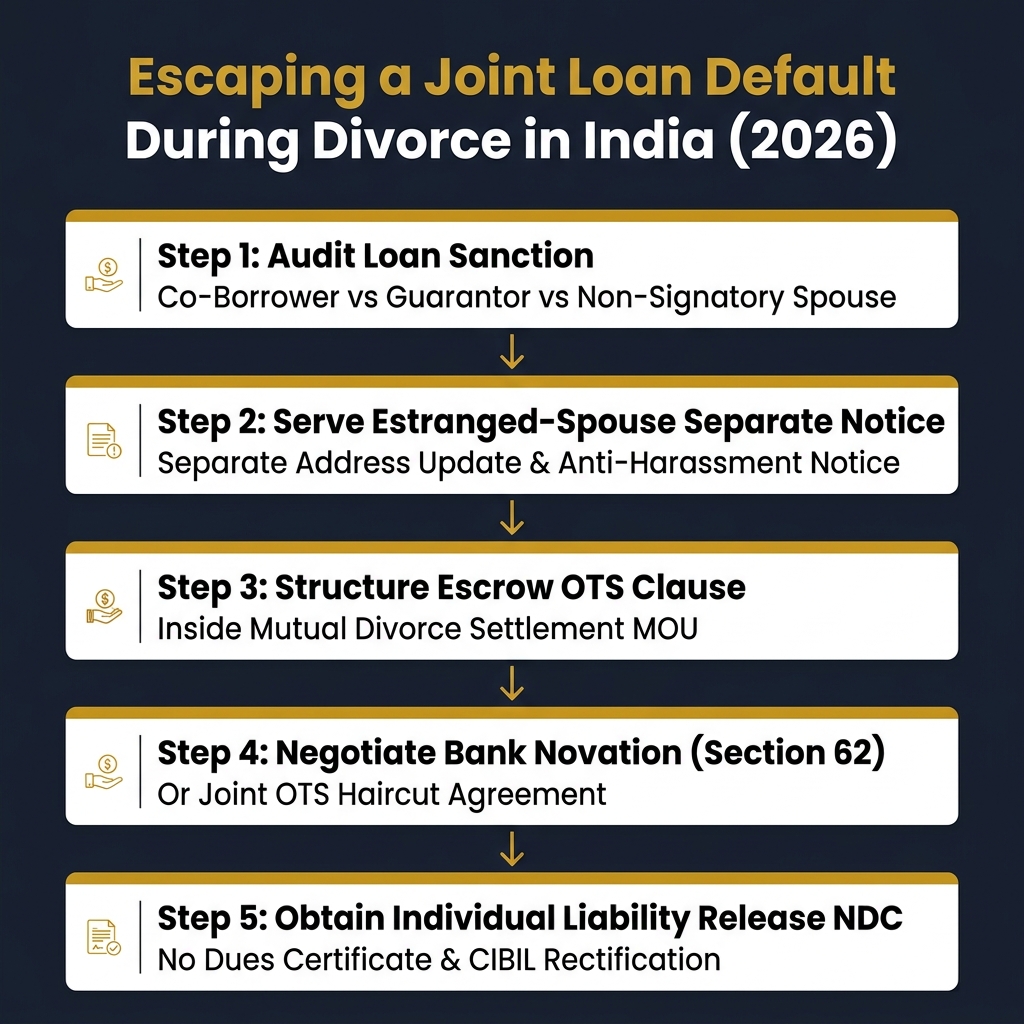
Prepared by AMA Legal Solutions Research & Analytics Team • Data & Compliance Overview

Halt Recovery Agent Harassment Legally
How to Stop Recovery Agents From Harassing You for a Loan Taken solely by Your Spouse (Where You Signed Nothing)
One of the most traumatic experiences during matrimonial separation occurs when third-party recovery agents arrive at your doorstep, call your elderly parents, or send threatening WhatsApp messages demanding payment for a personal loan or credit card incurred solely by your estranged spouse. In the chaotic landscape of joint loan default during divorce in india co borrower settlement, collection agencies exploit the borrower's family shame to extort money from innocent spouses who never signed a single loan document.
The Strict Statutory Prohibition on Third-Party Collection Harassment
Under the statutory framework of the Reserve Bank of India (RBI), such collection tactics are completely illegal. The RBI Master Direction on Fair Practices Code for Regulated Entities, read alongside the Master Direction on Managing Risks and Code of Conduct in Outsourcing of Financial Services, establishes ironclad rules governing debt collection:
- Prohibition on Contacting Third Parties: Lenders and their outsourced recovery agents are strictly prohibited from contacting anyone other than the formal borrower and co-borrower/guarantor. Reaching out to an estranged spouse, parents, siblings, or colleagues regarding an individual's private debt is an explicit regulatory breach.
- Ban on Abusive Language, Intimidation & Shaming: Recovery agents are legally forbidden from using obscene language, threatening physical violence, making repetitive persistent calls, calling before 8:00 AM or after 7:00 PM, or visiting an estranged spouse's workplace or residence to cause embarrassment.
- Strict Lender Vicarious Liability: Under RBI regulations, the commercial bank or NBFC is held directly and vicariously liable for the unlawful acts of its outsourced collection agencies. Lenders face severe regulatory penalties, supervisory audits, and monetary compensation orders for agent misconduct.
The 4-Step Legal Protocol to Halt Spousal Recovery Harassment
If you are being subjected to unlawful collection harassment for your spouse's individual loan, or being harassed beyond legal boundaries for a joint loan, AMA Legal Solutions executes an immediate, four-stage legal enforcement protocol:
- Comprehensive Evidence Preservation: Document every illegal interaction. Preserve incoming call logs, date and time stamps, audio recordings of agent threats, WhatsApp chat screenshots, and CCTV footage of unannounced home visits. Under Indian evidence law, these digital records form conclusive proof of regulatory violations.
- Advocate Cease-and-Desist Notice: We issue a formal legal notice to the bank's Managing Director, Principal Nodal Officer (PNO), and Head of Collections. The notice formally communicates the matrimonial estrangement, provides your separate residential address, establishes your non-signatory status (or invokes co-borrower protections), and demands immediate delisting of your contact details from active collection rosters.
- Escalation to the RBI Ombudsman (CMS Portal): If harassment continues for 24 hours post-notice, we immediately lodge an urgent complaint on the RBI Complaint Management System (CMS) portal (
cms.rbi.org.in) under the Reserve Bank - Integrated Ombudsman Scheme. The RBI Ombudsman possesses statutory power to penalize the bank and award compensation up to ₹20 Lakh for mental agony, harassment, and violation of privacy. - Police Action for Criminal Intimidation: If rogue recovery agents issue physical threats or refuse to vacate residential premises, we initiate criminal complaints under Sections 351, 352, and 79 of the Bharatiya Nyaya Sanhita (BNS), 2023 (criminal intimidation, intentional insult to provoke breach of peace, and word/act intended to insult modesty of a woman). To master your full protections, read our authoritative guide on legal rights when dealing with recovery agents.
Can You Settle Only Your Share of a Joint Unsecured Loan? The 'Individual Co-Borrower Release & Covenant Not to Sue' Strategy
When both spouses are genuine co-borrowers on an unsecured debt—such as a joint personal loan, debt-consolidation facility, or business overdraft—and the marriage ends, a critical question emerges: "Can I approach the bank, pay my 50% share of the debt, and be permanently released while the bank continues to pursue my ex-spouse for the rest?"
In standard retail banking operations, branch managers will routinely answer "No." Relying on Section 43 of the Contract Act, branch staff insist that they cannot split a joint loan and demand 100% full payment from whichever spouse has accessible assets. However, in the sophisticated domain of commercial debt settlement, seasoned banking advocates routinely execute a specialized legal structure: the Individual Co-Borrower Compromise Release & Covenant Not to Sue under Section 44 and Section 62 of the Indian Contract Act, 1872.
Statutory Foundation: Section 44 of the Indian Contract Act, 1872
While Section 43 binds joint promisors to the creditor, Section 44 specifically addresses the legal effect when a creditor chooses to release one joint debtor:
"Where two or more persons have made a joint promise, a release of one of such joint promisors by the promisee does not discharge the other joint promisor or joint promisors; neither does it free the joint promisor so released from responsibility to the other joint promisor or joint promisors."
Section 44 provides the exact statutory authority required for a partial commercial compromise. It confirms that a bank possesses the full legal power to release one co-borrower from liability without discharging the remaining co-borrower. In the framework of joint loan default during divorce in india co borrower settlement, our senior advocates leverage Section 44 to negotiate an individual compromise release on the following terms:
- Negotiated Haircut on Pro-Rata Share: Instead of paying 50% of the inflated ledger balance, we negotiate a substantial One-Time Settlement (OTS) haircut on your pro-rata portion. For instance, on a ₹20 Lakh joint default, rather than paying ₹10 Lakh, we petition the bank's Stressed Assets Resolution Committee to accept ₹4 Lakh to ₹6 Lakh as a full, final, individual discharge of your liability.
- Covenant Not to Sue & Indemnity: In exchange for the agreed settlement sum, the bank executes a formal bilateral agreement incorporating an explicit "Covenant Not to Sue." The bank legally covenants that it will never initiate civil, criminal, arbitration, or execution proceedings against you, and assigns all remaining debt recovery rights solely against your ex-spouse.
- Individualized No Dues Certificate (NDC): The bank issues an individual No Dues Certificate certifying that your personal liability under the designated Loan Account Number (LAN) is fully extinguished.
- CIBIL Tradeline Update: The bank submits an individualized bureau update to CIBIL, Equifax, and Experian, reflecting your specific tradeline status as "Settled / Closed" with a ₹0.00 current balance, decoupling your credit profile from the lingering default of your ex-partner.
Executing an individual release requires deep familiarity with institutional banking discretion. Engaging our specialized loan settlement in India practice ensures your settlement documentation contains ironclad legal covenants that shield you from future recovery attempts.
Synchronizing Your Divorce Settlement Decree (Section 13B Mutual Consent / Alimony Offset) With a Tripartite Bank OTS
The ultimate resolution of joint loan default during divorce in india co borrower settlement requires unifying matrimonial family law with commercial banking execution. Attempting to resolve your divorce first and dealing with joint bank debt later is a recipe for disaster. Once a divorce decree is finalized and alimony is disbursed, your leverage over your ex-spouse drops to zero. Conversely, settling with the bank without incorporating protective covenants into your divorce decree leaves you vulnerable to cross-litigation.
At AMA Legal Solutions, our dual-specialization in high-stakes banking litigation and matrimonial disputes allows us to execute a seamless, synchronized resolution protocol. Managing both bank and family court negotiations simultaneously protects your long-term wealth. The complete step-by-step roadmap for synchronizing a Family Court divorce settlement with a bank debt novation or compromise release is detailed below:
| Stage & Legal Forum | Mandatory Procedural Action | Key Statutory Provisions | Risk Mitigated / Strategic Outcome |
|---|---|---|---|
| Stage 1: Preliminary Financial Audit (Advocate Office) |
Forensic audit of all loan sanctions, KFS, and CIBIL reports to identify true co-borrowers vs. guarantors vs. non-signatory references. | RBI Digital Lending Guidelines & Fair Practices Code | Prevents paying debts where spouse has zero legal contractual obligation. |
| Stage 2: Matrimonial Notice & Address Delinking (Lender Branch & Nodal Desk) |
Serve formal notice of separation, update separate communication addresses, and revoke joint net-banking/NACH mandates. | Section 25 PASSA & Section 6 DPDP Act, 2023 | Stops auto-debit sweeps from innocent spouse's independent savings account. |
| Stage 3: Drafting Divorce Settlement Terms (Family Court First Motion) |
Incorporate explicit Debt Allocation, Alimony Offset, and Escrow Deposit clauses into the Section 13B Mutual Consent Petition. | Section 13B Hindu Marriage Act, 1955 | Ties alimony disbursements directly to successful loan settlement milestones. |
| Stage 4: Formal Bank Compromise Petition (Bank Stressed Assets Cell) |
Submit a unified tripartite OTS proposal to the bank's Zonal Committee, offering immediate cash settlement in exchange for release. | RBI Compromise Settlement Framework (2023-26) | Secures 40% to 70% principal waiver on unapplied interest and charges. |
| Stage 5: Escrow Funding & Sanction Validation (Joint Escrow Account) |
Spouses deposit agreed settlement funds into an escrow/advocate account; verify written Bank OTS Sanction Letter terms. | Indian Trust Act & Section 62 Contract Act | Guarantees money is only released to the bank upon issuance of valid NDC. |
| Stage 6: Final Divorce Decree & Deed Release (Family Court Second Motion) |
Record bank NDC before Family Court, execute property Release Deed (if home loan), and secure final Section 13B Divorce Decree. | Section 17 Registration Act & Section 13B(2) HMA | Both spouses exit marriage completely debt-free with clean legal titles. |
| Stage 7: Credit Bureau Tradeline Rectification (TransUnion CIBIL / Experian) |
Serve bank NDC to all 4 credit bureaus; verify tradeline updates to Rs. 0 balance and remove delinquent litigation tags. | Section 21 CICRA, 2005 & RBI Fortnightly Norms | Restores credit score to enable future independent borrowing and housing loans. |
Novation Under Section 62: Transferring the Loan to a Single Spouse
In cases where one spouse wishes to retain the matrimonial home or financed vehicle, the appropriate legal mechanism is Novation under Section 62 of the Indian Contract Act, 1872. Section 62 provides that "if the parties to a contract agree to substitute a new contract for it, or to rescind or alter it, the original contract need not be performed."
Under a Section 62 Novation protocol, the bank formally discharges the exiting spouse and substitutes a fresh, single-borrower loan agreement in the sole name of the retaining spouse. For the bank to approve novation during a joint loan default during divorce in india co borrower settlement scenario, the remaining spouse must demonstrate adequate independent income, or provide a substitute creditworthy co-borrower or additional tangible collateral. Concurrently, the exiting spouse executes a registered Relinquishment Deed or Release Deed conveying their share in the mortgaged property, while the bank issues a formal letter releasing all claims and personal guarantees against the exiting partner.
Following a successful settlement or novation, restoring your financial health is essential. To understand your credit recovery timeline, examine our analysis on home loan eligibility after settlement.
Strategic Conclusion: Protect Your Financial Independence with AMA Legal Solutions' Banking & Family Advocates
A marriage may end, but your right to economic dignity, financial security, and personal peace of mind must remain inviolable. Defaulting on a joint loan during matrimonial estrangement does not make you a fraudster, nor does it give banks or their recovery agents the right to harass, humiliate, or financially ruin you. The widespread crisis of joint loan default during divorce in india co borrower settlement is a complex commercial and personal dilemma, but it is one that Indian law and regulatory frameworks fully equip you to resolve.
Attempting to handle bank recovery agents and family court litigation alone will only prolong your anguish. The intersection of Section 43 joint liability, Section 13B mutual consent divorce, Section 62 novation, and RBI recovery directives requires the strategic guidance of advocates who command equal mastery of commercial banking tribunals and matrimonial courts. Relying on superficial promises from branch managers or informal spousal assurances will leave your credit score ruined and your financial future compromised.
At AMA Legal Solutions, our team of seasoned senior advocates provides comprehensive, multidisciplinary legal representation for individuals navigating joint loan default during divorce in india co borrower settlement challenges across India. We intervene swiftly to halt predatory collection harassment, defend you against unlawful coercive litigation, petition the highest-level bank Stressed Assets Committees to negotiate deep compromise waivers, and draft bulletproof Family Court settlement agreements that ensure your complete, unencumbered freedom.
Do not let an estranged partner's financial default hold your life hostage. Reclaim your credit score, protect your assets, and secure your financial independence today. Our senior advocates ensure your personal liability is extinguished and your credit score is restored. For a confidential, comprehensive case evaluation with our senior banking and family litigation counsel, reach out to our team or contact AMA Legal Solutions today.
Popular Searches & Topics
Commonly searched legal queries and keywords related to this article
Need Strategic Legal Defense for Your Situation?
Our banking & litigation advocates review your notices, debt liability, and recovery issues under complete advocate-client secrecy.
References & Authority
- The Indian Contract Act, 1872 - Section 43 (Joint and Several Liability of Joint Promisors)
- The Indian Contract Act, 1872 - Section 44 (Effect of Release of One Joint Promisor)
- The Indian Contract Act, 1872 - Section 62 (Effect of Novation, Rescission, and Alteration of Contract)
- The Hindu Marriage Act, 1955 - Section 13B (Divorce by Mutual Consent & Debt Indemnification Terms)
- Reserve Bank of India - Master Direction on Fair Practices Code for Regulated Entities & Ban on Harassing Third Parties
- Reserve Bank of India - Framework for Compromise Settlements and Technical Write-offs (DOR.STR.REC.20/21.04.048/2023-24)
- Credit Information Companies (Regulation) Act, 2005 (CICRA) - Co-Borrower Tradeline Reporting Rules
- Supreme Court of India - State Bank of India vs. Indexport Registered & Ors. (1992) 3 SCC 159 on Joint and Several Recovery

AMA Legal Solutions
Trusted with a 4.7 Google Rating, over 10,000+ Clients Served, 25,000+ Cases Handled, and more than 40+ Years of Experience in providing strategic legal defense and debt resolution across India.
Our media coverages





Frequently Asked Questions
Related Articles
PNB e-OTS, SBI Rinn Samadhan & PSU Bank OTS Schemes in India (2026)
Compare PSU bank e-OTS portals with deeper Zonal Committee discretionary waivers.
Read Article
Loan Against Mutual Funds, Shares & Gold Default: Section 176 & Settlement (2026)
Enforce Section 176 notice rights to stop illegal auctions and settle shortfalls.
Read Article
How Long Does a Settled Account Stay on CIBIL? (2026)
Understand the impact of settled accounts on your credit history and options available.
Read ArticleAbout Author
Anuj Anand Malik
View ProfileAnuj Anand Malik, Founder of AMA Legal Solutions, is a trusted advocate, loan settlement expert, legal advisor, and banking lawyer. With over a decade of experience in loan settlement, corporate law, financial disputes, and compliance, he leads a result-driven law firm based in India that helps individuals, startups, and businesses achieve legal and financial stability.
Connect on LinkedInNeed Legal Representation?
Evaluate your defense against recovery agents, notices, or structure your loan settlement directly with Senior Advocates.
Call +91-8700343611