Mastering Loan Settlement with HDFC Bank: A Borrower's Guide
Navigate personal loan settlements with insider tips and strategies.

Anuj Anand Malik
Reviewed by AMA Legal Solutions

Key Takeaways: Understanding HDFC loan settlements is crucial for managing financial recovery. Loan settlements can prevent legal actions, though they may impact credit scores. Knowledge of RBI guidelines and rights under Indian law, such as protections from the SARFAESI Act, are essential for informed decisions. Legal advice can optimize settlement outcomes and protect borrower interests.
Understanding the Importance of Settling Your HDFC Personal Loan
Settling your HDFC personal loan is crucial for restoring financial stability and averting potential legal consequences. Loan settlement involves negotiating with the bank to pay a reduced amount as full payment, typically when you’re unable to meet the original loan terms. This process can significantly affect your credit score, but it also provides relief from mounting debt.
Why Settle Your Loan?
Loan settlement is a viable solution when repaying the full loan amount is unfeasible. It helps in avoiding the accrual of additional penalties and interest, which can rapidly escalate the outstanding balance. Moreover, by settling your loan, you can prevent further legal actions such as arbitration or litigation, potentially saving you from lengthy and costly legal processes.
When and How to Approach Settlement?
It is ideal to initiate loan settlement discussions as soon as you foresee difficulties in maintaining your payment schedule. Engaging proactively with HDFC Bank can often result in more favorable terms. Typically, banks are more open to settlement discussions when the loan is classified as a non-performing asset (NPA).
- Evaluate your financial situation thoroughly.
- Consider consulting with a legal expert specializing in Banking and Finance Law.
- Communicate openly with the bank about your inability to pay in full.
Understanding the importance of settling your HDFC personal loan can be the first step towards financial recovery and peace of mind.
Legal Framework Governing Loan Settlements in India
In India, loan settlements are governed by a combination of statutory and regulatory frameworks that aim to protect both borrowers and lenders. The Banking and Finance Law primarily rests on the principles laid out by the Reserve Bank of India (RBI), which issues guidelines for loan restructuring and settlement processes. These guidelines ensure fairness and transparency in how banks handle non-performing assets (NPAs) and engage in loan recovery processes.
Reserve Bank of India Guidelines
The RBI's guidelines are crucial as they set out the conditions under which banks like HDFC can offer one-time settlements. These conditions include the status of the loan, the borrower's repayment ability, and any external economic factors. Compliance with these guidelines is mandatory for all scheduled banks in India, ensuring a structured approach to handling defaults.
Legal Protections for Borrowers
- The SARFAESI Act allows banks to recover non-performing assets without the intervention of the court system, but it also includes protections for borrowers.
- The Consumer Protection Act safeguards against unfair recovery practices, ensuring borrowers are treated fairly.
- Borrowers have the right to file objections and appeal decisions under the Debt Recovery Tribunal (DRT).
Understanding the legal framework is essential for navigating the complexities of loan settlements, particularly when dealing with a structured financial institution like HDFC Bank. Borrowers should seek detailed legal advice, possibly from experts in Loan Settlement Services, to ensure that their rights are upheld throughout the process.
Initial Steps to Initiate Loan Settlement with HDFC
Initiating a loan settlement with HDFC Bank involves a clear understanding of the process and preparation. Start by reviewing all your loan documents to understand the terms and outstanding balance. You should then calculate how much you can realistically offer as a settlement amount, considering your financial situation and any legal implications.
Contacting HDFC Bank
Reach out to HDFC Bank's loan department through their customer service line or visit the nearest branch. It's crucial to communicate clearly and express your willingness to settle the outstanding loan. Request to be connected with a loan settlement officer who can guide you further.
Preparing Your Case
Before meeting with the bank, prepare a detailed proposal that outlines your current financial situation and reasons for requesting a settlement. Include any supporting documents like income proof or medical bills that justify your inability to continue regular payments. Be honest about your situation to increase your chances of a favorable settlement.
- Research Loan Settlement Services that can assist you in negotiations.
- Review Banking and Finance Law to understand your rights and obligations.
Remember, HDFC Bank officials are more inclined to consider settlement offers if you can demonstrate genuine financial hardship. Your approach should be respectful and persistent, maintaining open communication with the bank.
Negotiating with HDFC: Strategies for Success
Successfully negotiating a loan settlement with HDFC Bank requires preparation, understanding of bank policies, and clear communication. To start, review your financial status comprehensively. This allows you to propose a realistic repayment plan that reflects your current capability. HDFC is often open to negotiations, especially if you demonstrate genuine financial hardship.
Prepare all necessary documents before initiating the conversation. This includes income proof, bank statements, and any correspondence related to financial distress. When approaching HDFC, communicate your intent clearly, emphasizing your commitment to settle the outstanding balance amicably.
Understanding HDFC's Perspective
Realize that banks aim to recover as much of the outstanding amount as possible. However, they also consider the cost of prolonged recovery processes. Here's where you can present a settlement offer that’s feasible for you and beneficial for the bank. Propose a lump-sum payment if possible, as this often results in a more favorable settlement.
- Be transparent about your financial constraints and negotiate terms that could include a reduced interest rate or an extended repayment period.
- Always communicate in writing to ensure there's a record of your discussions and agreements. This minimizes misunderstandings.
- If you need professional assistance, consider consulting Loan Settlement Services to strengthen your negotiation tactics.
Remember, patience is key. Negotiations might require several rounds of discussions. During these interactions, remain calm and respectful, and reiterate your willingness to resolve the debt. This approach not only fosters goodwill but also aids in achieving a successful outcome.
For more guidance, you can explore Banking and Finance Law to better understand your rights and options during the negotiation process.
What Banks Typically Don't Disclose to Borrowers
When dealing with the loan settlement process for a personal loan with HDFC Bank, borrowers often find themselves navigating a maze of information that banks don't readily disclose. Understanding these hidden facets can empower you during negotiations and help you achieve a favorable settlement.
Understanding Settlement Offers
Banks seldom reveal that settlement offers are not uniform; they are influenced by factors such as your repayment history, outstanding amount, and current financial situation. An experienced borrower knows that negotiating a settlement is possible, often reducing the payable amount significantly.
Impact on Credit Score
While banks may downplay the impact of a loan settlement on your credit score, it is crucial to know that settled accounts are marked as "settled" rather than "closed," affecting your creditworthiness. Learning how to repair your credit score post-settlement can be invaluable.
Internal NPA Classification
Banks internally classify non-performing assets (NPAs) using criteria that can affect the urgency and terms of your settlement. Being aware of your loan's NPA status can provide leverage in negotiations.
For more insights and personalized legal assistance, consider contacting our expert legal services to guide you through the complexities of loan settlements.
Legal Rights and Obligations During Loan Settlement
During the loan settlement process with HDFC Bank, borrowers have specific legal rights and obligations that they must be aware of. Understanding these can significantly impact the outcome of negotiations and protect your interests.
Legal Rights
- Right to Fair Treatment: Borrowers are entitled to fair and respectful treatment by bank officials and recovery agents. Any form of harassment or coercion is prohibited under Indian law.
- Right to Information: You have the right to receive detailed information about your outstanding loan amount, interest rates, and any penalties applied. This transparency is crucial for informed decision-making.
- Right to Negotiation: Borrowers can negotiate the terms of settlement. Banks often consider factors like financial hardship and past payment history during these negotiations.
Obligations
- Timely Communication: It's imperative to maintain open lines of communication with the bank. Ignoring notices or calls can lead to escalated legal actions.
- Accurate Documentation: Provide accurate financial documentation to substantiate your claims during negotiations. This includes income proofs, bank statements, and any other relevant documents.
- Compliance with Agreements: Once a settlement is reached, adhere strictly to the agreed terms to avoid future disputes or recovery actions.
For more detailed advice tailored to your situation, consider consulting our legal notice response guide or speak with a qualified legal expert.
Key Insights & Data Infographic
Visual summary, statistical trends & procedural breakdown
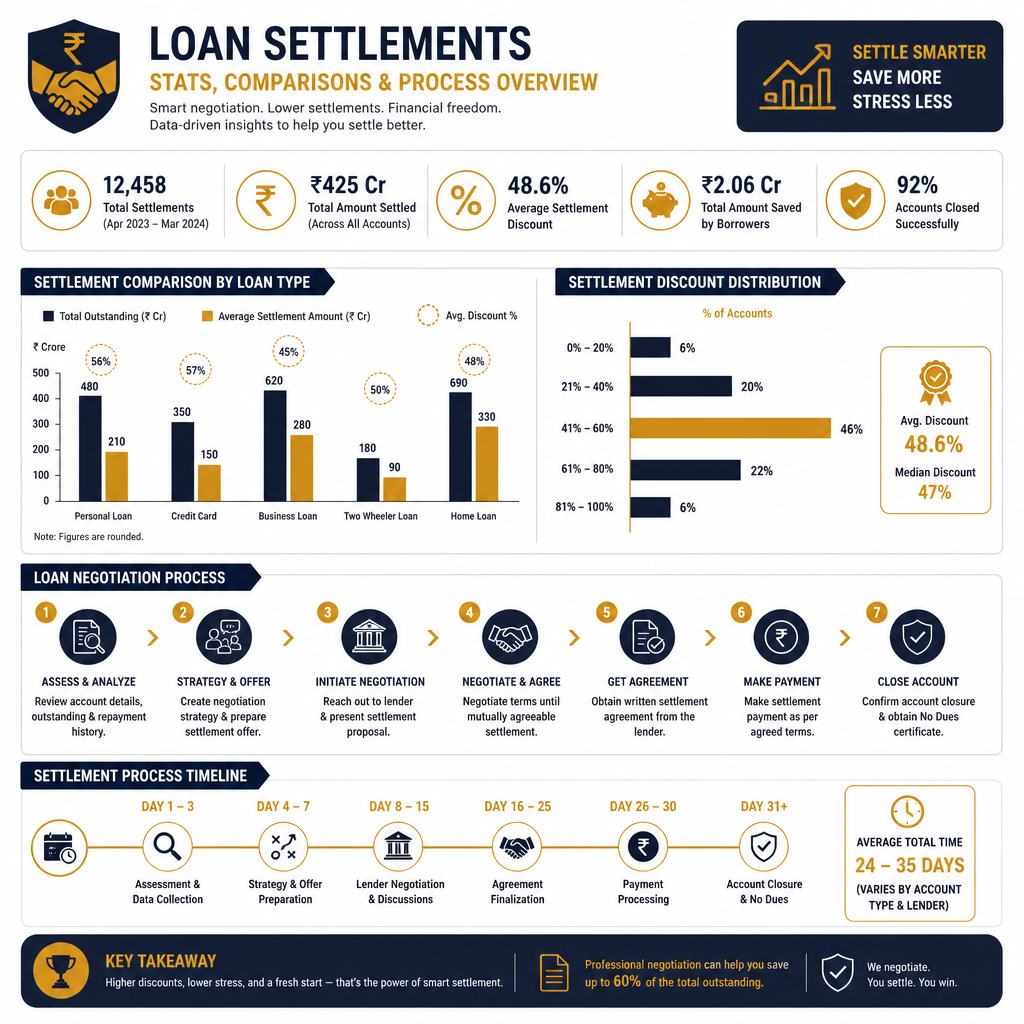
Prepared by AMA Legal Solutions Research & Analytics Team • Data & Compliance Overview
Analyzing RBI Guidelines and Their Impact on Settlements
The Reserve Bank of India (RBI) has laid down structured guidelines that significantly impact the loan settlement process with banks like HDFC. These guidelines aim to protect borrower interests while ensuring banks recover dues efficiently. Understanding these can help you navigate the settlement process more effectively.
RBI Guidelines You Should Know
- One-Time Settlement (OTS) Schemes: RBI mandates that banks offer OTS schemes as a recovery mechanism. These allow borrowers to clear debts by paying a reduced lump sum, easing financial stress.
- Non-Performing Assets (NPAs): Loans overdue beyond 90 days are classified as NPAs. RBI guidelines urge banks to address these through restructuring instead of aggressive recovery tactics.
- Fair Practices Code: RBI insists on ethical treatment of borrowers, particularly in settlements. Harassment or misleading tactics by recovery agents are strictly prohibited.
For HDFC borrowers, understanding and leveraging these guidelines can be crucial during negotiations for a loan settlement. For more comprehensive guidance on how to handle settlements effectively, consider consulting our Loan Settlement Services page. Additionally, understanding the nuances of Banking and Finance Law can further empower you in discussions with your bank.
Common Mistakes in Loan Settlement Negotiations
When negotiating the loan settlement of a personal loan with HDFC Bank, borrowers often make critical mistakes that can compromise their position. Understanding these pitfalls can significantly improve your chances of a favorable settlement.
Lack of Preparation
Many borrowers enter negotiations without a comprehensive understanding of their financial situation or the terms of their loan. Preparing thoroughly by collecting all relevant documents and understanding your financial limits is crucial. Consider consulting our Loan Settlement Services for professional guidance.
Emotional Responses
Emotions can cloud judgment during negotiations. Remaining composed and factual when communicating with the bank is essential. Emotional outbursts can derail negotiations and may lead the bank to adopt a more rigid stance.
Ignoring Legal Rights
Borrowers often overlook their legal rights during settlement talks, potentially leading to unfavorable outcomes. Familiarize yourself with your rights under Indian banking laws and consider seeking advice from experts in Banking and Finance Law.
| Parameter / Criterion | Key Details / Legal Provision | Timeline / Practical Impact |
|---|---|---|
| Preparation | Understanding loan terms and financial limits | Before negotiation begins |
| Emotional Responses | Maintain composure and focus on facts | Throughout negotiation |
| Legal Rights | Awareness of rights under RBI guidelines | Before and during negotiation |
| Professional Advice | Consult legal experts for strategic guidance | Before and during negotiation |
Underestimating the Impact of CIBIL Score
Loan settlements impact your CIBIL score. Misjudging this can have long-term repercussions on your creditworthiness. Understand the difference between loan settlement and loan closure on CIBIL to make informed decisions.
Not Documenting Agreements
Verbal agreements are insufficient. Always ensure any negotiation outcome is documented in writing, detailing all terms and conditions. This protects both parties and prevents future disputes.
When and How to Escalate Matters Legally
In the context of loan settlement with HDFC Bank, knowing when and how to escalate matters legally can be crucial for borrowers facing unresolved disputes or unfair treatment. Initiate this process when all attempts at negotiation have failed, or if you encounter harassment or rights violations by recovery agents.
Recognizing the Need to Escalate
- If HDFC Bank is unresponsive to your settlement requests or renegotiation attempts.
- When recovery agents engage in unlawful tactics, such as threats or harassment.
- If there are discrepancies in loan amounts or interest computations.
Steps to Legally Escalate
First, ensure all communication with HDFC Bank is documented. If issues persist, consult with a legal expert specializing in loan settlement services. They can guide you on potential legal remedies and drafting a formal complaint.
Filing a complaint with the Banking Ombudsman is an option if issues remain unresolved. This is a free service provided by the Reserve Bank of India to address grievances against banks.
For complex cases, you may need to engage in arbitration and dispute resolution or initiate civil litigation. Legal professionals can assist you in identifying the best course of action, ensuring your rights are protected at every stage.
Practical Case Studies of Successful Loan Settlements
Understanding how loan settlements unfold in real-world scenarios can provide invaluable insights. Below are examples of successful loan settlements with HDFC Bank, highlighting different strategies and outcomes.
Case Study 1: Negotiated Reduction
A salaried individual facing financial distress approached HDFC Bank for a settlement on a personal loan. Initially, the outstanding amount was Rs. 5 lakhs. The borrower was transparent about the financial hardships, providing documented proof of reduced income. After negotiations, HDFC agreed to a one-time settlement, reducing the payable amount by 30%. The borrower paid Rs. 3.5 lakhs, and the loan was closed.
Case Study 2: Restructuring Agreement
A small business owner experienced cash flow issues due to delayed payments from clients. With an outstanding personal loan of Rs. 10 lakhs, the borrower contacted HDFC Bank with a proposal for restructuring rather than a settlement. The bank agreed to extend the loan tenure by two years, relieving immediate financial pressure and allowing for easier repayments. This restructuring ensured the borrower maintained a good credit score.
Case Study 3: Mediation with Legal Assistance
An MSME owner defaulted on a personal loan due to business losses. The initial demand from HDFC was full repayment, but after involving a mediator, a middle ground was found. The loan was settled for Rs. 7 lakhs instead of the Rs. 9 lakhs owed, with a structured repayment timeline. The involvement of a legal expert facilitated smoother negotiations and ensured the borrower's rights were respected.
For more tailored advice on loan settlements, consider visiting our Loan Settlement Services page.
Understanding the Implications of a Settlement Agreement
When entering into a settlement agreement for a personal loan with HDFC Bank, it is essential to comprehend the full scope of its implications. A settlement implies that the borrower and the bank have agreed to settle the outstanding loan for a mutually agreed-upon amount, often due to financial distress or inability to pay the full amount. This arrangement can provide immediate relief but comes with certain consequences.
A critical implication is the impact on the borrower's credit score. Settling a loan, rather than paying it in full, is typically reported as "settled" in credit reports, which can negatively affect credit scores. This could restrict future access to credit or loans. Banks, including HDFC, may choose to reconsider extending further credit to borrowers with a history of settlements. Therefore, understanding the potential long-term effects on your creditworthiness is crucial.
Another consideration is the tax implications. The forgiven amount, i.e., the difference between the original loan amount and the settlement figure, might be treated as taxable income according to Indian tax laws. Borrowers should consult a tax advisor to understand these potential liabilities.
Additionally, the terms and conditions set in the agreement are binding. Borrowers should ensure they are clear about the terms, including payment timelines, to avoid future disputes. Consulting a legal professional or utilizing services like banking and finance law advisory can provide further insights and safeguards against unfavorable outcomes.
Checklist: Preparing for a Settlement Discussion with HDFC
Engaging in a settlement discussion with HDFC requires strategic preparation. Before initiating talks, ensure you have a comprehensive understanding of your loan status, repayment capabilities, and possible settlement options. Below is a checklist to guide you through the process.
Documents and Information Required
- Latest Loan Statement: Obtain your most recent loan statement to understand the outstanding principal and interest.
- Income Proof: Gather current salary slips or income tax returns to demonstrate your repayment capacity.
- Communication Records: Keep all correspondences with HDFC regarding your loan, including emails and letters.
- Bank Statements: Have copies of your last six months' bank statements to present your financial status.
Understanding Settlement Terms
- Settlement Offer: Understand what constitutes a reasonable settlement offer by reviewing similar cases.
- Impact on Credit Score: Familiarize yourself with how settlement affects your CIBIL score. Consider reading our guide on Loan Settlement vs Loan Closure Impact on CIBIL.
Legal and Financial Advice
- Consult with a Lawyer: It is advisable to seek legal counsel from a professional well-versed in Loan Settlement Services.
- Financial Advisor: Obtain advice from a financial consultant to evaluate the feasibility of proposed settlement terms.
| Parameter / Criterion | Key Details / Legal Provision | Timeline / Practical Impact |
|---|---|---|
| Loan Statement Review | Identify the outstanding principal, accrued interest, and penalties. | Before initial settlement discussion |
| Income Documentation | Prepare salary slips and tax returns to demonstrate financial capacity. | Prior to negotiation |
| Legal Consultation | Seek advice to understand legal implications of settlement offers. | During the planning phase |
| Settlement Offer Analysis | Evaluate the fairness and feasibility of the offer. | Post-receipt of offer |
By following this checklist, you can enhance your preparedness and ensure a more effective negotiation process with HDFC. Always remember to maintain open communication and document every step to protect your interests.
Popular Searches

AMA Legal Solutions
Trusted with a 4.7 Google Rating, over 10,000+ Clients Served, 25,000+ Cases Handled, and more than 40+ Years of Experience in providing strategic legal defense and debt resolution across India.
Our media coverages





Client Reviews
"Professional and empathetic service from AMA Legal Solutions made my loan settlement less stressful."
Smita Patel
"Thanks to AMA Legal Solutions, I managed a favorable loan settlement and avoided lengthy legal issues."
Vikram Joshi
"AMA Legal Solutions guided me expertly through my loan settlement with HDFC, ensuring a fair agreement."
Rajesh Kumar
"Highly satisfied with the expert legal counsel and successful outcome of my loan settlement with AMA Legal Solutions."
Prashant Mehta
"AMA Legal Solutions provided invaluable advice and support during my HDFC loan settlement."
Anita Rao
Frequently Asked Questions
Related Articles

How to Trust Law Associates for Loan Settlement
Ensure Successful Loan Settlement with Trusted Legal Experts
Read Article
Expert Loan Settlement Lawyer: Minimize Amount, Maximize Waiver
Unlocking the Secrets to Successful Loan Settlements in India
Read Article
Mastering Loan Settlement of Personal Loan by Bajaj Finance
Navigate Bajaj Finance Loan Settlements with Expert Legal Insights
Read ArticleAbout Author
Anuj Anand Malik
View ProfileAnuj Anand Malik, Founder of AMA Legal Solutions, is a trusted advocate, loan settlement expert, legal advisor, and banking lawyer. With over a decade of experience in loan settlement, corporate law, financial disputes, and compliance, he leads a result-driven law firm based in India that helps individuals, startups, and businesses achieve legal and financial stability.
Connect on LinkedInNeed Legal Help?
Get expert advice on loan settlement and debt relief.
Call +91-8700343611Request Callback