Deceased Borrower Loan Insurance Rejection & Legal Heir Settlement (2026)
Know legal heir liability limits, challenge insurance rejections, and settle debt.

Anuj Anand Malik
Reviewed by AMA Legal Solutions

Key Takeaways: Navigating deceased borrower loan insurance claim rejection and legal heir loan settlement requires an immediate grasp of your statutory shields under Indian law. Under Sections 50 and 52 of the Code of Civil Procedure (CPC), 1908, legal heirs—including surviving widows, elderly parents, and children—have absolute zero personal liability for the debts of a deceased borrower; liability is strictly capped to the value of the inherited estate. If a primary borrower passes away without leaving any attachable assets, banks and NBFCs cannot force family members to repay unsecured credit cards or personal loans out of their personal salaries or savings. Furthermore, under Section 45 of the Insurance Act, 1938, life and credit-shield insurance policies active for over three years cannot be repudiated on grounds of alleged non-disclosure or pre-existing diseases. For secured home loans, any SARFAESI notice issued in the name of a deceased person without formally serving all legal representatives is legally void under Indian High Court jurisprudence. Under Reserve Bank of India (RBI) 2026 Master Directions, recovery agents are strictly prohibited from contacting grieving families during bereavement. At AMA Legal Solutions, our senior banking and civil advocates intervene to quash illegal recovery harassment, challenge fraudulent insurance rejections before the Insurance Ombudsman and Consumer Commissions, and negotiate compassionate death-case One-Time Settlements with deep waivers through our dedicated loan settlement services.
Introduction: Navigating Deceased Borrower Loan Insurance Claim Rejection and Legal Heir Loan Settlement
The sudden death of a family breadwinner, spouse, or parent is a devastating personal tragedy. In the midst of acute grief, funeral arrangements, and emotional shock, surviving family members often face an unexpected and merciless second storm: aggressive recovery collection calls, hostile home visits, and intimidating legal notices from commercial banks and Non-Banking Financial Companies (NBFCs). When a family is grappling with loss, finding out that the deceased left behind unpaid credit cards, personal loans, or home loan liabilities creates overwhelming panic.
To make matters far worse, thousands of bereaved families in India discover that the bundled 'Credit Life Insurance' or 'Loan Protection Plan' purchased by the deceased—specifically to shield the family from debt in the event of untimely demise—has been arbitrarily rejected by the insurance underwriter. Insurance companies routinely cite boilerplate excuses, such as undisclosed pre-existing diabetes, hypertension, or technical reporting delays, to repudiate valid death claims. The lending institution then turns aggressively upon the surviving widow, elderly parents, or grieving children, falsely demanding that they pay the outstanding debt from their own pockets under threat of property attachment or police action.
Every grieving family in India must understand their undeniable constitutional and statutory rights: you are not personally liable for a deceased relative's unsecured debts, and banks cannot weaponize grief to extort money. Successfully managing deceased borrower loan insurance claim rejection and legal heir loan settlement requires asserting the statutory protections of the Code of Civil Procedure, enforcing the incontestability provisions of the Insurance Act, invoking RBI consumer protection directives, and securing an institutional compromise through structured loan settlement in India.
The Golden Rule of Indian Succession Law: Why Legal Heirs Have Zero Personal Liability Beyond the Inherited Estate
The foundational principle governing debt recovery from deceased persons in India is clear and unyielding: debts do not pass by blood; debts pass only by property. Under Indian succession laws and civil jurisprudence, a legal heir does not step into the shoes of the debtor as a personal obligor. Instead, the legal heir merely represents the estate of the deceased.
1. Statutory Protection Under Sections 50 and 52 of the Code of Civil Procedure (CPC), 1908
When evaluating options for deceased borrower loan insurance claim rejection and legal heir loan settlement, the first critical step is establishing the strict statutory boundary between the deceased debtor's estate and the personal property of surviving family members.
The limits of a legal representative's liability are codified under Sections 50 and 52 of the Code of Civil Procedure, 1908:
- Section 50(2) CPC - Execution Against Legal Representative: When a creditor seeks to execute a decree against the legal representative of a deceased person, "such liability is limited to the extent of the property of the deceased which has come to his hands and has not been duly disposed of."
- Section 52(1) CPC - Enforcement Against the Estate: A money decree passed against an estate can only be executed through the attachment and sale of the deceased borrower's inherited property.
- Zero Personal Liability: If the deceased left no property, or if the inherited property is insufficient to satisfy the debt, the legal representatives have mathematically zero liability to pay the deficit from their personal funds, salaries, or self-acquired assets.
2. Absolute Immunity of Self-Acquired Assets & Statutory Inalienable Funds
Bank recovery officers frequently intimidate family members by threatening to freeze the bank accounts of surviving spouses or garnish the salaries of adult children. Under Indian law, these threats are blatant legal falsehoods. The following assets are strictly immune from creditor claims:
- Self-Acquired Properties: Any movable or immovable property purchased by a wife, son, or daughter using their own independent earnings, business income, or dowry (Streedhan) cannot be touched by the deceased's creditors.
- Statutory Inalienable Monies: Under Section 60(1) of the CPC and specialized statutory enactments, family pensions, gratuity payments, life insurance policy proceeds payable to named nominees under Section 39 of the Insurance Act, and Provident Fund (PF) balances protected under Section 10 of the Employees' Provident Funds and Miscellaneous Provisions Act, 1952, do not form part of the deceased's general estate and are 100% exempt from bank attachment!
In every matter involving deceased borrower loan insurance claim rejection and legal heir loan settlement, our specialized advocates in civil litigation and estate services audit the deceased's estate inventory, establish the statutory boundary between inherited assets and protected personal wealth, and legally compel creditors to cease unlawful execution threats.
| Loan Category & Facility Type | Deceased Borrower Role | Legal Heir / Family Status | Legal Extent of Liability | Attachable Assets | Legal Remedy & Defense Strategy |
|---|---|---|---|---|---|
| Unsecured Personal Loan | Sole Primary Borrower | Surviving Spouse / Children (Non-Signatories) | Rs. 0 Personal Liability (Capped strictly to net inherited estate) | Only property titled in deceased's sole name (No personal funds) | Serve Section 50 CPC Notice; Demand debt write-off if zero estate exists. |
| Credit Card Outstanding Dues | Sole Cardholder | Family Members / Nominees | Zero Personal Liability (Unsecured consumer liability dies with debtor) | Deceased's estate assets only; Nominee funds are protected | Submit Death Certificate; Block bureau reporting; Close tradeline. |
| Secured Housing Loan (Mortgage) | Primary Mortgagor | Heirs Living in Collateral Property | Liability attaches to the Mortgaged Property, not heirs personally | The specific residential / commercial property mortgaged | Challenge defective SARFAESI notices; Execute compassionate OTS or loan transfer. |
| Joint Co-Signed Loan / Guarantee | Co-Borrower (Passed Away) | Surviving Spouse (Co-Applicant / Guarantor) | Joint & Several Liability under Section 43/128 Contract Act | Deceased estate + Co-applicant's personal assets | Enforce Credit Shield Insurance; Negotiate 50%-75% OTS waiver for surviving co-applicant. |
| Insured Loan (Credit Protect Policy) | Insured Primary Debtor | Legal Heirs / Policy Beneficiaries | Zero Liability (Insurer is contractually liable to pay outstanding balance) | None (Debt extinguished by policy payout) | Challenge wrongful claim repudiation under Section 45 Insurance Act via IRDAI / Consumer Commission. |
Unsecured Loans (Credit Cards & Personal Loans) Without a Co-Applicant: Can Banks Demand Payment From a Widow or Children?
One of the most frequent inquiries brought to AMA Legal Solutions by distraught families is: "My husband passed away leaving Rs. 15,00,000 in credit card dues and personal loans. Recovery agents are calling me daily, saying that as his wife, I am legally obligated to clear his debts. Are they right?"
1. The Purely Unsecured Nature of Credit Cards and Personal Loans
The definitive legal answer under Indian law is an emphatic NO. When an individual applies for an unsecured personal loan or credit card without a co-applicant or guarantor, the lending institution evaluates that individual's standalone financial profile—their credit score, personal income, and debt-to-income ratio. The bank prices this risk by charging high interest rates (often 14% to 42% APR). In return for these elevated yields, the bank knowingly assumes the unsecured commercial risk that if the borrower dies or goes bankrupt without leaving assets, the loan is completely unrecoverable.
When the sole borrower dies:
- The contractual relationship between the borrower and the bank terminates by operation of law.
- The surviving spouse, parents, and children were never parties to the loan contract. Under the doctrine of privity of contract codified in the Indian Contract Act, 1872, a stranger to a contract cannot be sued or forced to perform contractual obligations.
- Unless the bank can prove in a court of law that the deceased left behind specific tangible estate properties that the heirs have taken possession of, the bank cannot demand a single rupee from the surviving family.
2. Co-Borrower and Guarantor Realities: Protecting Surviving Signatories
The legal situation shifts significantly if a family member signed the loan agreement as a co-borrower or financial guarantor. Surviving spouses frequently ask: does settlement impact a co-borrower and can guarantor be liable after settlement? Under Section 43 of the Indian Contract Act, co-borrowers share joint and several liability. If the primary earner passes away, the lender possesses the legal right to demand payment from the surviving co-signatory.
However, even in co-signed accounts, legal heirs are not defenseless. If the primary borrower was covered under a mandatory group credit life insurance policy, that insurance must be claimed first to extinguish the entire outstanding liability, liberating the co-borrower. If the insurance has been wrongfully repudiated or was never bundled, our advocates initiate targeted legal representation to negotiate an expedited One-Time Settlement, wiping out accumulated penal interest and securing deep principal haircuts so the surviving co-signatory can exit the debt safely.
Asserting these defenses under deceased borrower loan insurance claim rejection and legal heir loan settlement permanently halts unauthorized debt collection against innocent family members.
The Bundled 'Credit Shield / Loan Protection Insurance' Scam: Challenging Wrongful Claim Rejections Before IRDAI & Consumer Courts
When disbursing substantial personal loans, business loans, or mortgages, banks routinely bundle single-premium 'Credit Life Insurance' or 'Loan Protection Policies' (such as HDFC Life Group Credit Protect, SBI Life Rinn Raksha, ICICI Lombard Loan Shield, or Kotak Complete Cover). The bank deducts thousands of rupees directly from the loan disbursement to fund the upfront insurance premium, assuring the borrower that in the event of death, the insurer will pay the full residual loan balance directly to the bank, leaving the family debt-free.
Tragically, when the borrower passes away and the grieving family submits the death claim, the insurance underwriter frequently repudiates the claim on spurious grounds. Understanding how to fight these rejections is central to deceased borrower loan insurance claim rejection and legal heir loan settlement.
1. Common Groundless Rejection Pretexts Used by Insurers
- Alleged Non-Disclosure of Pre-Existing Diseases (PED): Insurers comb through past hospital records to find minor mentions of hypertension, diabetes, or thyroid conditions, claiming the borrower "fraudulently suppressed material medical facts" during loan onboarding.
- The 'No Medical Examination' Trap: Banks and insurers willingly issue policies without conducting medical check-ups at the time of disbursal to maximize fee commissions, only to weaponize medical underwriting post-death to deny claims.
- Administrative Failure to Remit Premium: In shocking instances, the lending bank deducts the insurance premium from the borrower's loan account but fails to transmit the funds to the insurance company or fails to forward the completed proposal form, leading the insurer to claim that no risk cover ever commenced!
2. The Ironclad Statutory Shield: Section 45 of the Insurance Act, 1938 (3-Year Rule)
To eliminate arbitrary claim repudiations, Parliament amended Section 45 of the Insurance Act, 1938. Section 45(1) establishes an absolute statutory moratorium:
"No policy of life insurance shall be called in question on any ground whatsoever after the expiry of three years from the date of the policy, i.e., from the date of issuance of the policy or the date of commencement of risk or the date of revival of the policy or the date of the rider to the policy, whichever is later."
Under this landmark statutory mandate:
- Beyond 3 Years: Once a credit shield life policy has been in force for three continuous years, the insurance company is statutorily prohibited from rejecting a death claim on grounds of non-disclosure, misstatement, or pre-existing illness. Any rejection issued after 3 years is illegal on its face.
- Within 3 Years: Even if death occurs within the first three years, the insurer cannot simply allege non-disclosure. The insurer bears the heavy burden of establishing deliberate fraud with intent to deceive and proving a direct, unmistakable causal nexus between the alleged undisclosed condition and the proximate cause of death.
3. Holding Banks Liable for Gross Deficiency in Service
If the bank collected the insurance premium but failed to issue the policy or botched the paperwork, Indian courts provide decisive relief. The Supreme Court of India and the National Consumer Disputes Redressal Commission (NCDRC) have consistently held that where a bank collects an insurance premium from a borrower, an agency relationship is established. If the bank fails to remit the premium or secure the policy, the bank is guilty of gross 'deficiency in service' and unfair trade practice. The consumer forum will direct the bank to completely write off the outstanding loan balance and pay substantial compensation to the bereaved family!
Our senior advocates serve a formal consumer complaint notice on both the bank and the insurer, file petitions before the Insurance Ombudsman under the Insurance Ombudsman Rules, 2017, and litigate before Consumer Commissions to enforce complete debt clearance.
| Strategic Resolution Track | Primary Objective & Scope | Governing Forum / Authority | Key Statutory Weapons & Precedents | Typical Timeline | Ideal Scenario & Strategic Fit |
|---|---|---|---|---|---|
| Track 1: Insurance Repudiation Challenge | Compel insurer to pay 100% of residual loan balance directly to lender, extinguishing debt | Insurance Ombudsman / District or State Consumer Disputes Redressal Commission | Section 45 Insurance Act (3-year incontestability rule); Consumer Protection Act, 2019 (Deficiency in service). | Ombudsman: 30–90 Days; Consumer Court: 6–18 Months | Policy was active for >3 years, or rejection was based on arbitrary pre-existing illness without causal nexus to death. |
| Track 2: Compassionate Bank OTS Settlement | Secure immediate 50% to 80% principal haircut, 100% penal waiver, release property deeds & co-signer | Bank Competent Authority / Stressed Asset Resolution Committee / National Lok Adalat | Sections 50/52 CPC (Estate liability limits); RBI Compromise Settlement Framework; Board-approved Death Hardship Policy. | 15 to 45 Days | Urgent need to unencumber family residential property, prevent auction, or release surviving co-signatory quickly. |
| Dual-Track Unified Strategy (Recommended) | File formal Ombudsman / Consumer proceedings to freeze SARFAESI actions while negotiating a rock-bottom OTS | Simultaneous Banking Ombudsman / Consumer Forum + Zonal OTS Committee | Combined consumer litigation leverage + Section 13(3A) SARFAESI statutory objections. | 30 to 60 Days | High-value secured loans where insurance is disputed and the bank threatens recovery against mortgaged home. |
Key Insights & Data Infographic
Visual summary, statistical trends & procedural breakdown
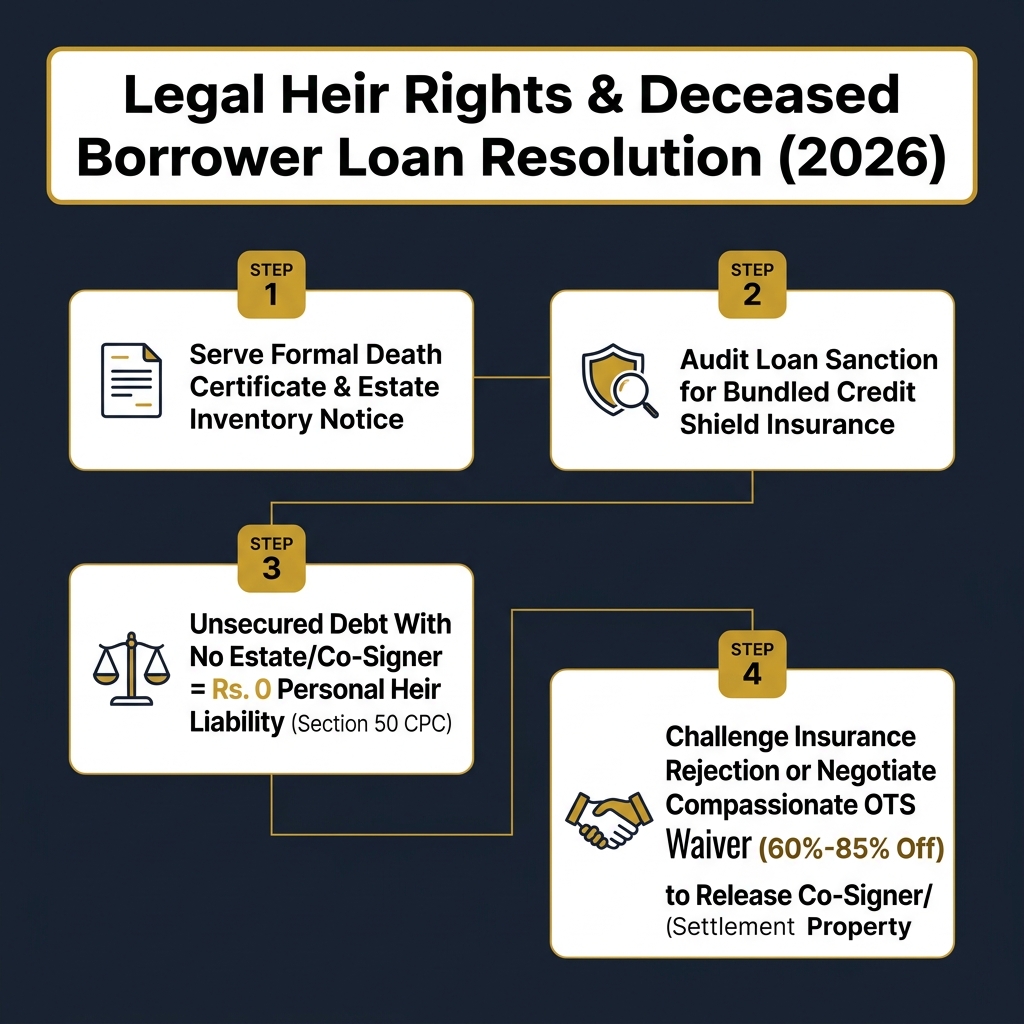
Prepared by AMA Legal Solutions Research & Analytics Team • Data & Compliance Overview

Halt Recovery Agent Harassment Legally
Secured Loans (Home & Car Loans): Why SARFAESI Action Against a Dead Person Without Serving All Legal Heirs Is Void
Unlike unsecured credit cards and personal loans, secured debts—such as home loans, loans against property (LAP), and vehicle loans—are backed by tangible collateral. If the borrower dies and EMIs cease, lenders frequently initiate swift enforcement proceedings under the Securitisation and Reconstruction of Financial Assets and Enforcement of Security Interest (SARFAESI) Act, 2002, to seize and auction the family home.
However, banks repeatedly commit fatal procedural errors that render their enforcement actions completely unlawful. Understanding these procedural defects is vital to deceased borrower loan insurance claim rejection and legal heir loan settlement.
1. SARFAESI Notices Issued Against a Dead Person Are Legally Non Est
Under Section 13(2) of the SARFAESI Act, a secured creditor must serve a 60-day demand notice requiring the borrower to discharge liabilities in full. Lenders often automatically generate and dispatch Section 13(2) demand notices, Section 13(4) possession notices, or Section 14 Chief Metropolitan Magistrate (CMM) applications addressed to the deceased individual!
High Courts across India—including landmark rulings from the Madras High Court, Kerala High Court, and Bombay High Court—have established that:
- A statutory notice issued in the name of a deceased individual is non est (a complete nullity in law) because a dead person cannot read, comply with, or raise objections to a demand notice.
- Under the Security Interest (Enforcement) Rules, 2002, the bank is strictly required to verify the borrower's death, identify all legal heirs, formally substitute them as legal representatives, and serve fresh, individualized 60-day notices upon each legal heir.
- Failure to formally notify all legal heirs deprives the family of their statutory right under Section 13(3A) of the SARFAESI Act to submit written representations and objections, violating fundamental principles of natural justice.
2. The Legal Heir's Right to Redeem the Mortgage
Under the legal frameworks governing deceased borrower loan insurance claim rejection and legal heir loan settlement, surviving family members must be afforded the full statutory opportunity to redeem mortgaged property before any bank enforcement measures proceed.
Legal heirs inherit the equity of redemption under Section 60 of the Transfer of Property Act, 1882. As legal representatives, surviving family members possess the absolute right to redeem the mortgaged property by clearing the genuine debt or negotiating a settlement before any auction occurs. To learn more about how security enforcement functions, explore our detailed analysis on what is SARFAESI Act India.
If a bank attempts to take physical possession of your family home without serving all legal heirs, our senior banking counsel immediately approaches the Debts Recovery Tribunal (DRT) under Section 17 of the SARFAESI Act within the mandatory 45-day limitation window. The DRT routinely quashes defective possession notices, restrains bank auctions, and orders lenders to maintain status quo, providing the family the essential leverage needed to negotiate a favorable resolution.
How to Stop Recovery Agents From Harassing a Bereaved Family Under RBI 2026 Directions
One of the most reprehensible practices in the Indian credit sector is the deployment of third-party recovery agencies against grieving households. Recovery agents frequently call dozens of times a day, visit homes during periods of traditional mourning, harass neighbors and relatives, and use abusive language, falsely claiming that failing to pay will result in the immediate arrest of the surviving widow or children.
The Reserve Bank of India (RBI) has enacted stringent, legally binding directives to eliminate these predatory practices.
1. RBI's Express Prohibition on Debt Recovery During Bereavement
Under the RBI Master Directions on Fair Practices Code and Guidelines on Recovery Agents, the central bank has established uncompromising standards of conduct:
- Ban on Contact During Bereavement: RBI directives explicitly state that lending institutions and their outsourced recovery agents must strictly avoid inappropriate occasions, such as bereavement in the family, medical emergencies, or serious illness, for making recovery calls or home visits. Contacting a family during active mourning is a direct regulatory violation.
- Restricted Calling Hours: Recovery calls or visits are strictly prohibited outside the window of 8:00 AM to 7:00 PM.
- Prohibition of Intimidation & Humiliation: Agents are banned from using uncivilized or threatening language, making repeated persistent calls, threatening physical harm, or publicly shaming family members before neighbors or employers.
- Mandatory Identification: Every agent must carry a certified bank identity card and a formal authorization letter from the lending institution. Outsourcing recovery to unvetted or uncertified recovery personnel is strictly illegal.
2. Four-Step Legal Protocol to Neutralize Harassment
If your grieving family is being harassed by recovery agents regarding deceased borrower loan insurance claim rejection and legal heir loan settlement, execute this proven four-step legal counter-strategy:
- Issue an Advocate Formal Representation & Death Intimation Notice: Our senior advocates dispatch a formal legal notice to the bank's Managing Director and Principal Nodal Officer (PNO), attaching the Death Certificate, detailing the death, and formally warning them that any further calls to family members violate RBI directives and Section 50 of the CPC.
- Document Every Violation: Record all incoming phone calls, take screenshots of threatening WhatsApp messages, and preserve security camera footage of any agents visiting your residence. Familiarize yourself with your fundamental legal rights when dealing with recovery agents.
- Lodge a High-Priority Complaint on the RBI CMS Portal: Escalate the matter to the RBI Ombudsman via the official Complaint Management System (cms.rbi.org.in). Banks face severe regulatory scrutiny and financial penalties for harassing bereaved families.
- File Police Complaints Under the Bharatiya Nyaya Sanhita (BNS): If recovery agents utter threats of violence, trespass upon your property, or insult the modesty of women, our criminal defense team files immediate police complaints under Sections 351 (Criminal Intimidation), 329 (Criminal Trespass), and 79 (Word, gesture or act intended to insult modesty of a woman) of the BNS, compelling local law enforcement to summon the recovery agency.
Negotiating a Compassionate Death-Case One-Time Settlement (OTS) to Release Mortgaged Property & Co-Applicant Liability
While fighting wrongful insurance rejections and quashing illegal recovery actions protects the family from immediate threats, families ultimately desire permanent closure: lifting mortgage liens from the family residence, retrieving original title deeds, releasing surviving co-applicants from legal exposure, and obtaining clean No Dues Certificates (NDCs).
The most effective, dignified mechanism to achieve this is an advocate-negotiated Compassionate One-Time Settlement (OTS).
1. Why Banks Offer Deep Haircuts in Deceased Borrower Cases
Securing an optimal outcome in deceased borrower loan insurance claim rejection and legal heir loan settlement requires balancing statutory defense before consumer forums with strategic commercial negotiation before the bank's settlement committee.
Commercial banks and NBFCs operate under cold actuarial calculations. When a primary borrower dies:
- The primary income stream that serviced the debt has permanently ceased.
- Foreclosing on mortgaged properties inhabited by surviving widows, minors, or elderly dependents involves severe reputational risk and prolonged judicial delays before DRTs and Civil Courts.
- Under RBI guidelines on compromise settlements, banks are mandated to maintain board-approved settlement frameworks that empower Stressed Asset Resolution Committees (SARCs) to exercise substantial discretion in cases of death, terminal illness, and catastrophic family hardship.
- Banks categorize these debts as Non-Performing Assets (NPAs) and prefer recovering a guaranteed lump-sum settlement today rather than spending years litigating an uncertain estate.
2. The Key Components of an Advocate-Negotiated Compassionate OTS
When AMA Legal Solutions manages deceased borrower loan insurance claim rejection and legal heir loan settlement, our senior banking counsel structures the settlement negotiations around four critical pillars:
- 100% Waiver of Uncapitalized Penalties & Compound Interest: We demand the complete elimination of all late payment charges, penal interest, e-NACH bounce fees, and legal charges that accumulated post-death.
- Deep Principal Haircuts (50% to 80% Reduction): Based on an independent valuation of the deceased's net estate and the family's genuine financial capacity, we negotiate substantial waivers on the core principal balance.
- Full Release of Mortgaged Immovable Property: The settlement deed explicitly covenants that upon receipt of the agreed OTS amount, the bank must surrender all original title deeds, cancel registered mortgage charges with the Sub-Registrar of Assurances, and file satisfaction of charges on the CERSAI portal.
- Complete Discharge of Co-Borrowers & Guarantors: The OTS agreement legally releases surviving co-signatories from joint and several liability, ensuring an unconditional No Dues Certificate is issued and the loan account is marked as settled/closed across all credit bureaus (CIBIL, Experian, Equifax, CRIF) without derogatory cross-contamination.
Strategic Conclusion: Protect Your Bereaved Family with AMA Legal Solutions' Senior Advocates
Grief is difficult enough without having to battle predatory loan recovery agents, corporate insurance claim rejections, and aggressive banking litigation. The death of a loved one should never be compounded by the unlawful loss of your family home, personal savings, or peace of mind. Indian law provides profound, robust shields to protect grieving families: from Section 50/52 CPC's absolute ban on personal liability for non-inherited debt, to Section 45 Insurance Act's 3-year incontestability rule, to RBI's strict zero-tolerance directives against bereavement harassment.
However, banks and collection agencies rely on fear, intimidation, and informational asymmetry to extract money from vulnerable families. Navigating deceased borrower loan insurance claim rejection and legal heir loan settlement requires aggressive, compassionate, and experienced legal counsel.
At AMA Legal Solutions, our senior High Court advocates, banking litigators, and consumer dispute specialists provide end-to-end legal protection for bereaved families across India. We immediately step between your family and harassing lenders, file decisive actions against insurance companies before the Insurance Ombudsman and Consumer Commissions, defend your home against illegal SARFAESI actions before the DRT, and negotiate compassionate One-Time Settlements with industry-leading principal waivers through our comprehensive loan settlement services.
Do not allow aggressive lenders or unscrupulous recovery agents to exploit your family's grief. Understand your rights under loan settlement in India, protect your loved ones' future, and contact AMA Legal Solutions today for a confidential, compassionate legal consultation. Let our senior legal team defend your family estate and guide you safely to financial freedom.
Popular Searches & Topics
Commonly searched legal queries and keywords related to this article
Need Strategic Legal Defense for Your Situation?
Our banking & litigation advocates review your notices, debt liability, and recovery issues under complete advocate-client secrecy.
References & Authority
- Code of Civil Procedure, 1908 - Section 50 & Section 52 (Liability of Legal Representative Limited to Estate) - India Code
- Insurance Act, 1938 - Section 45 (Policy not to be called in question after three years on ground of misstatement) - IRDAI
- Insurance Regulatory and Development Authority of India (IRDAI) - Protection of Policyholders' Interests Regulations
- SARFAESI Act, 2002 & Security Interest (Enforcement) Rules, 2002 - Section 13 (Enforcement of Security Interest) - Ministry of Finance
- Reserve Bank of India (RBI) - Master Direction on Fair Practices Code and Conduct of Recovery Agents - RBI Regulatory Framework
- Consumer Protection Act, 2019 - Redressal of Deficiency in Banking and Insurance Services - Department of Consumer Affairs
- Legal Services Authorities Act, 1987 - Resolution of Compoundable Debt Disputes in National Lok Adalat - NALSA
- Indian Succession Act, 1925 - Devolution of Estate, Rights of Legal Heirs & Administration - India Code

AMA Legal Solutions
Trusted with a 4.7 Google Rating, over 10,000+ Clients Served, 25,000+ Cases Handled, and more than 40+ Years of Experience in providing strategic legal defense and debt resolution across India.
Our media coverages





Frequently Asked Questions
Related Articles
Section 194R TDS & Income Tax on Loan Settlement Waiver in India (2026)
Understand Section 194R TDS exemptions and income tax rules on OTS loan waivers.
Read Article
Multiple e-NACH & UPI Autopay Bounce Charges Harassment: RBI Rules & Settlement (2026)
Stop repeated e-NACH bounce charges under NPCI rules and get a 100% OTS waiver.
Read Article
SAMA, Presolv360 & Cordis ODR Notice for Loan Default: Legal Defense & Settlement (2026)
Prevent ex-parte online arbitration awards and negotiate a 50%+ OTS on ODR portals.
Read ArticleAbout Author
Anuj Anand Malik
View ProfileAnuj Anand Malik, Founder of AMA Legal Solutions, is a trusted advocate, loan settlement expert, legal advisor, and banking lawyer. With over a decade of experience in loan settlement, corporate law, financial disputes, and compliance, he leads a result-driven law firm based in India that helps individuals, startups, and businesses achieve legal and financial stability.
Connect on LinkedInNeed Legal Representation?
Evaluate your defense against recovery agents, notices, or structure your loan settlement directly with Senior Advocates.
Call +91-8700343611