Comparing Loan Settlement Options in India: A Legal Perspective
Navigate India's Loan Settlement Options with Expert Legal Insights

Anuj Anand Malik
Reviewed by AMA Legal Solutions

Key Takeaways: Loan settlement in India offers a pathway for borrowers to negotiate debt relief under financial distress, subject to RBI guidelines and legal frameworks like the SARFAESI Act and the Indian Contract Act. While affecting credit scores, settlement may be preferable to prolonged defaults. Professional legal assistance is crucial for effectively navigating and negotiating favorable terms, understanding rights and implications.
Understanding Loan Settlement in India
Loan settlement in India is a vital process for borrowers facing financial distress, as it offers a structured mechanism to negotiate and resolve outstanding debts with lending institutions. It is a strategic alternative to alleviate debt burdens when borrowers find themselves unable to fulfill the original repayment terms. The intricacies of loan settlement hinge on various legal and financial considerations, making it essential for borrowers to comprehend the nuanced landscape before embarking on this path.
Typically, loan settlement involves negotiating a one-time settlement with the bank, wherein the borrower agrees to pay a lump sum less than the total outstanding amount. This approach is often pursued when regular repayment becomes untenable due to unforeseen circumstances such as job loss or medical emergencies. An understanding of the RBI guidelines is crucial, as they provide the framework within which banks operate to formulate settlement offers.
Borrowers must also be aware of the potential impact on their credit scores, as settlements can adversely affect CIBIL scores. However, in certain scenarios, opting for settlements may be preferable to prolonged defaults. For comprehensive guidance, engaging with professionals who specialize in Loan Settlement Services and Banking and Finance Law can offer tailored strategies to navigate these complex negotiations effectively. Understanding these elements equips borrowers with the knowledge to make informed decisions and negotiate favorable terms.
Legal Framework Governing Loan Settlements
The legal framework governing loan settlements in India is intricate, designed to protect both borrowers and lenders. The foundation lies in the Banking and Finance Law, which outlines the obligations and rights of financial institutions and their clients. A prominent component is the SARFAESI Act, 2002, which empowers banks to recover outstanding dues swiftly without court intervention, provided certain conditions are met.
Additionally, the Indian Contract Act, 1872, plays a vital role by governing the agreements between borrowers and lenders. It ensures that any settlement or restructuring of loans adheres to legal standards, safeguarding both parties' interests. The Reserve Bank of India (RBI) also issues circulars detailing guidelines on loan settlements, restructuring, and debt consolidation, ensuring that the processes remain fair and transparent.
Understanding these legal frameworks is crucial for borrowers to navigate loan settlements effectively. Legal recourse such as arbitration and dispute resolution can be sought if there are disagreements regarding the settlement terms. It is advisable for borrowers to be fully aware of their rights and options under these laws to negotiate effectively and achieve favorable outcomes.
Key Differences Between Loan Settlement and Loan Restructuring
When comparing loan settlement options presently available in India, understanding the key differences between loan settlement and loan restructuring is crucial. Loan settlement involves negotiating with lenders to accept a reduced amount as full payment, which can adversely affect credit scores. In contrast, loan restructuring modifies the terms of the loan, such as extending the tenure or reducing the interest rate, without necessarily affecting credit scores negatively.
While loan settlement is often pursued when repayment is beyond the borrower's capacity, loan restructuring is suitable when borrowers anticipate future affordability but need temporary relief. Both processes involve negotiations, but they have distinct legal and financial implications.
Loan restructuring is often encouraged by regulatory bodies and can include options like moratoriums, whereas settlements are typically one-time solutions. Borrowers should carefully consider the implications of each and may consult Loan Settlement Services for expert guidance.
| Parameter / Criterion | Key Details / Legal Provision | Timeline / Practical Impact |
|---|---|---|
| Impact on Credit Score | Settlement often negatively impacts credit scores. | Immediate effect post-settlement. |
| Regulatory Support | Restructuring is often supported by RBI guidelines. | Structured timelines based on RBI regulations. |
| Financial Burden | Settlement reduces total payable amount. | One-time financial relief. |
| Process Complexity | Restructuring involves modifying existing loan terms. | May take longer due to regulatory checks. |
For more insights on how loan restructuring and settlement options impact financial planning, you can explore Banking and Finance Law services provided by AMA Legal Solutions.
Exploring the SARFAESI Act: Implications for Borrowers
The Securitisation and Reconstruction of Financial Assets and Enforcement of Security Interest (SARFAESI) Act empowers banks and financial institutions to recover non-performing assets (NPAs) without the intervention of courts. This legislation is significant for borrowers as it allows lenders to seize and auction the collateralized assets when a borrower defaults.
Why the SARFAESI Act Matters
For borrowers in India, understanding the implications of the SARFAESI Act is crucial. It means that once a loan account is classified as an NPA, the lender can initiate recovery proceedings after a 60-day notice. Borrowers must respond promptly to the notice, either by clearing the dues or negotiating a loan settlement.
Impact and Exceptions
- Exclusion of Small Loans: The SARFAESI Act does not cover loans below ₹1 lakh or unsecured loans, offering relief to small borrowers.
- Defending Against Unfair Practices: Borrowers can approach the Debt Recovery Tribunal (DRT) if they believe the lender's actions are unjustified or if there are discrepancies in the recovery process.
Borrowers should consider engaging legal expertise to navigate the complexities of this Act. For those facing recovery threats, exploring options like arbitration and dispute resolution can be beneficial. Understanding one's rights and responsibilities under the SARFAESI Act can prevent undue stress and financial loss.
RBI Guidelines on Loan Settlement: What Borrowers Should Know
The Reserve Bank of India (RBI) has established guidelines to ensure that loan settlements are conducted fairly and transparently. These guidelines provide a framework for both borrowers and lenders, facilitating the settlement process while protecting the rights of consumers. It's crucial for borrowers to be informed about these guidelines to make educated decisions when comparing loan settlement options presently available in India.
Understanding the RBI Framework
The RBI mandates banks to classify non-performing assets (NPAs) and initiate appropriate recovery measures. Loan settlements come into play when a borrower is unable to repay the loan amount despite these measures. The RBI's guidelines emphasize a borrower-centric approach, encouraging banks to explore restructuring options such as rescheduling payment terms or reducing interest rates before proceeding to settlement.
- Borrowers should be aware that banks are required to follow a transparent process and provide clear communication throughout the settlement process.
- It is advisable to seek a loan settlement when repayment becomes unmanageable, as per RBI's directives.
- If faced with aggressive recovery tactics, borrowers have the right to report such actions under RBI's consumer protection norms.
For further assistance, borrowers can consult services specializing in Banking and Finance Law to better understand their rights and options. Knowing these guidelines can significantly aid borrowers in negotiating terms and achieving a favorable settlement.
Step-by-Step Process of Loan Settlement Negotiation
Negotiating a loan settlement requires strategic planning and understanding of legal provisions. Here's a detailed step-by-step guide for borrowers in India seeking to resolve their loan issues effectively.
1. Analyze Your Financial Situation
First, evaluate your current financial standing to determine how much you can realistically offer as a settlement. Prepare documentation of income, expenses, and any assets. This not only helps in negotiations but also shows the lender your genuine intent to settle.
2. Initiate Communication with the Lender
Contact your lender to express your willingness to settle the debt. It is advisable to do this through written communication, such as email, to maintain a record. Be clear about your financial constraints and propose a realistic settlement amount.
3. Negotiate the Terms
Engage in negotiations with the lender's representative. Highlight your financial limitations and the settlement amount you can afford. It's crucial to be polite yet firm. Highlight the benefits of settlement for both parties, including avoiding lengthy litigation processes.
4. Draft a Formal Settlement Agreement
Once terms are agreed upon, request a formal settlement agreement. This document should detail the settlement amount, payment timeline, and any other conditions. Review this with a legal expert to ensure it aligns with RBI guidelines and protects your interests.
5. Fulfill the Settlement Conditions
Adhere to the payment schedule and any other conditions outlined in the settlement agreement. Once the final payment is made, ensure you receive a 'No Due Certificate' from the lender.
| Parameter / Criterion | Key Details / Legal Provision | Timeline / Practical Impact |
|---|---|---|
| Initial Contact | Express intent to settle; maintain written records | Immediate; sets the stage for negotiations |
| Financial Assessment | Evaluate your financial capacity; prepare documents | 1 week; foundation for negotiation |
| Negotiation Phase | Discuss terms with lender; propose offers | 1-2 weeks; impacted by lender’s response |
| Settlement Agreement | Draft and review terms; ensure compliance with legal standards | 1 week; critical to formalize the deal |
| Payment Fulfillment | Complete agreed payment; obtain no due certificate | Varies; concludes settlement |
For more detailed guidance, consider consulting our Loan Settlement Services to ensure a smooth and legally compliant resolution process. You might also explore our Banking and Finance Law services for comprehensive legal advice.
Key Insights & Data Infographic
Visual summary, statistical trends & procedural breakdown
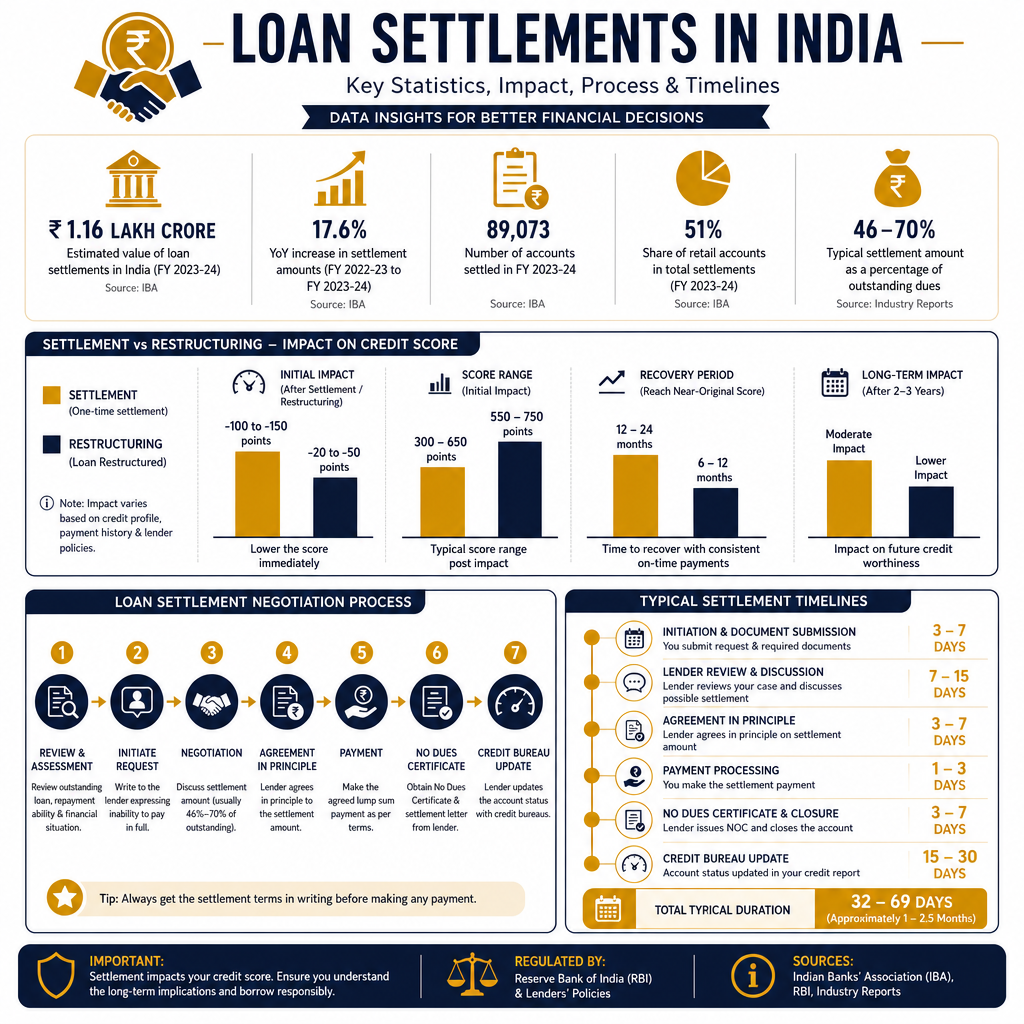
Prepared by AMA Legal Solutions Research & Analytics Team • Data & Compliance Overview
Rights and Obligations of Borrowers in Loan Settlement
Borrowers in India navigating loan settlements have specific rights and obligations. Understanding these can empower borrowers and ensure fair treatment during the settlement process. Firstly, borrowers have the right to receive clear communication from banks about their outstanding dues and possible settlement terms. This transparency is crucial for making informed decisions.
It is also important for borrowers to acknowledge their obligation to respond promptly to communication from banks and financial institutions. This includes maintaining a record of all correspondences, which can be invaluable during negotiations. Borrowers should be aware that they can negotiate terms and seek professional advice if needed.
Key Borrower Rights
- The right to be treated fairly and without harassment during negotiations.
- The right to request a written statement of dues before agreeing to any settlement.
- The right to involve a legal advisor, such as those experienced in Loan Settlement Services, to ensure fair dealings.
Borrower Obligations
- To communicate proactively with the bank regarding their financial situation.
- To honor the terms of any settlement agreement reached.
- To explore available options and consult Banking and Finance Law experts if necessary.
By understanding these rights and obligations, borrowers can better navigate loan settlements and seek favorable outcomes while maintaining their financial integrity.
Understanding the Role of Arbitration in Loan Disputes
Arbitration has emerged as a pivotal mechanism in resolving loan disputes in India, offering an alternative to protracted court battles. Loan agreements often include an arbitration clause, providing a streamlined path to dispute resolution. This clause empowers both lenders and borrowers to appoint an arbitrator who will impartially adjudicate the matter.
One of the key advantages of arbitration is its efficiency. Unlike traditional litigation, arbitration is generally quicker, with a typical proceeding lasting between six months to a year. This speed can be crucial when settling loans swiftly becomes imperative.
Why Choose Arbitration?
- Cost-Effective: Arbitration is usually less costly than court procedures, saving both parties time and money.
- Confidentiality: Proceedings are private, maintaining the confidentiality of sensitive financial information.
- Enforceability: Arbitration awards are recognized globally, simplifying cross-border enforcement.
When engaging in arbitration, borrowers should prepare meticulously. This involves compiling evidence, understanding the loan's nuances, and potentially seeking expert guidance from professionals in arbitration and dispute resolution. Being proactive can significantly impact the outcome, ensuring a fair and equitable settlement.
Impact of Loan Settlement on Credit Score: Myths vs Reality
In the context of comparing loan settlement options presently available in India, one of the most prevalent concerns borrowers face is its impact on their credit score. While it's true that loan settlements can affect your credit score, the extent and nature of this impact are often misunderstood.
Myths Surrounding Loan Settlement and Credit Score
- Myth 1: Loan settlement will completely ruin my credit score. This is not entirely correct. While settlement is reported to credit bureaus, its impact can vary based on other financial behaviors.
- Myth 2: Once settled, my credit score will never improve. A settled account is a signal of past financial distress, but with disciplined repayment habits, your score can recover over time.
The Reality of Loan Settlement's Impact
When you settle a loan, the lender reports it as "settled" rather than "paid in full," which can lower your credit score. However, the impact is not permanent. Over time, by engaging in good credit practices and monitoring your financial activities, you can rebuild your score. For borrowers exploring debt consolidation & restructuring, understanding these nuances is essential. Proactive management and advice from experts can mitigate adverse effects.
Practical Tips for Negotiating Favorable Loan Settlements
Negotiating a favorable loan settlement requires strategic communication and a clear understanding of your financial position. Begin by thoroughly assessing your financial situation to identify an affordable repayment amount. This clarity is crucial when presenting your case to the bank. Understand that banks prefer settlements over prolonged defaults, which gives you an opportunity to negotiate.
Understand Your Rights and Obligations
Always be aware of your rights as a borrower during negotiations. Banks are obligated to follow Banking and Finance Law and should respect your privacy and dignity. It's advisable to communicate via email to create a record of all interactions.
Prepare a Negotiation Strategy
- Gather all relevant documentation, including loan agreements and correspondence with the bank.
- Consider offering a lump sum payment, as banks are often more receptive to immediate settlements.
- Be transparent about your financial hardships, as honesty can foster empathy from the bank's side.
- If you're struggling, consult a professional from our Loan Settlement Services for personalized advice.
Lastly, remain calm and patient throughout the process. Banks may initially refuse a settlement offer, but persistence and a well-prepared strategy can lead to a mutually beneficial resolution.
Mistakes to Avoid During Loan Settlement Negotiations
Successfully navigating loan settlement negotiations requires awareness of potential pitfalls that could undermine your efforts. One critical mistake is entering negotiations without a clear understanding of your financial situation. Always assess your liabilities and prepare a feasible repayment plan before discussions begin.
Another common error is failing to document agreements. Verbal commitments can easily be disputed, so ensure all terms are captured in writing, confirming mutual understanding. Additionally, avoid aggressive negotiation tactics. A cooperative approach often yields better results and maintains goodwill with the lender.
Ignoring Professional Advice
Many borrowers neglect the value of professional guidance during negotiations. Consulting with experts in banking and finance law can provide insights into feasible strategies and legal protections. Their expertise ensures you're not overlooking crucial details that could affect the outcome.
Overlooking RBI Guidelines
Ignoring Reserve Bank of India guidelines can be detrimental. Familiarize yourself with these regulations to ensure that your negotiation rights are maintained and the lender's actions are compliant.
Lastly, avoid rushing into settlements. Hastily agreeing to terms without fully understanding their long-term implications can lead to further financial strain. Take the time to evaluate offers thoroughly.
Comparative Analysis of Settlement Options: Banks vs NBFCs
When comparing loan settlement options presently available in India, it is crucial to understand the differences between traditional banks and Non-Banking Financial Companies (NBFCs). Both entities offer distinct advantages and challenges in the settlement process, influencing borrower decisions significantly.
Settlement Process with Banks
Banks are typically more regulated, adhering strictly to Banking and Finance Law. Settlements often require more documentation and formalities. Banks may have more leverage due to their size and reputation, often offering structured settlement plans with fixed terms. However, the negotiation process might be less flexible, leaving less room for borrower-specific adjustments.
Settlement Process with NBFCs
NBFCs, on the other hand, offer more flexibility in settlements. They can tailor settlement offers to suit borrower needs more effectively, owing to lesser regulatory constraints. This flexibility, however, comes with a potential downside of higher interest rates and fees. NBFCs may also expedite the settlement process quicker than traditional banks, which can be advantageous for borrowers seeking immediate resolution.
- Documentation: Banks require extensive documentation, while NBFCs may have simplified requirements.
- Flexibility: NBFCs offer higher flexibility in repayment terms compared to banks.
- Interest Rates: Interest rates at NBFCs can be higher, impacting the overall cost of the settlement.
Choosing between banks and NBFCs for loan settlement depends on individual circumstances, including the urgency of resolution and existing financial obligations. For detailed advice on loan settlements and strategies for negotiation, consider consulting with a legal expert in Loan Settlement Services.
Popular Searches

AMA Legal Solutions
Trusted with a 4.7 Google Rating, over 10,000+ Clients Served, 25,000+ Cases Handled, and more than 40+ Years of Experience in providing strategic legal defense and debt resolution across India.
Our media coverages





Client Reviews
"AMA Legal Solutions provided exceptional guidance during my loan settlement. Their expertise made a complex process straightforward and stress-free. Highly recommended!"
Amit Patel
"AMA Legal Solutions helped me navigate the loan settlement process with ease. Their clear explanations and strategic advice were exactly what I needed."
Priya Gupta
"I was facing severe financial stress, but AMA Legal Solutions handled everything with professionalism and care. Their legal insights were invaluable. Thank you!"
Rajiv Menon
"From start to finish, AMA Legal Solutions provided top-notch service. Their deep understanding of banking law ensured a successful settlement outcome."
Vivek Singh
"The team at AMA Legal Solutions was instrumental in securing a favorable settlement. Their attention to detail and client-focused approach were truly impressive."
Neha Sharma
Frequently Asked Questions
Related Articles

How to Trust Law Associates for Loan Settlement
Ensure Successful Loan Settlement with Trusted Legal Experts
Read Article
Expert Loan Settlement Lawyer: Minimize Amount, Maximize Waiver
Unlocking the Secrets to Successful Loan Settlements in India
Read Article
Mastering Loan Settlement of Personal Loan by Bajaj Finance
Navigate Bajaj Finance Loan Settlements with Expert Legal Insights
Read ArticleAbout Author
Anuj Anand Malik
View ProfileAnuj Anand Malik, Founder of AMA Legal Solutions, is a trusted advocate, loan settlement expert, legal advisor, and banking lawyer. With over a decade of experience in loan settlement, corporate law, financial disputes, and compliance, he leads a result-driven law firm based in India that helps individuals, startups, and businesses achieve legal and financial stability.
Connect on LinkedInNeed Legal Help?
Get expert advice on loan settlement and debt relief.
Call +91-8700343611Request Callback