CIBIL 'Suit Filed' Status Removal After Loan Settlement & RBI Rs. 100/Day Rule (2026)
Remove Suit Filed status from CIBIL post-OTS and claim Rs. 100/day RBI penalty.

Anuj Anand Malik
Reviewed by AMA Legal Solutions
Key Takeaways: Securing a One-Time Settlement (OTS) and obtaining a No Dues Certificate (NDC) should mark the end of your debt nightmare, yet thousands of Indian borrowers discover their credit history remains paralyzed by a devastating litigation flag. The legal challenge of cibil suit filed status removal after loan settlement and rbi 100 rs day penalty represents one of the most critical post-settlement battles in modern Indian banking. Under the Credit Information Companies (Regulation) Act, 2005 (CICRA), credit institutions are legally required to report accurate, updated loan statuses. When a bank files a civil suit, DRT application, or Section 138 complaint and later settles the debt, it bears a mandatory statutory obligation to record the formal withdrawal in court and notify all credit bureaus within fortnightly reporting cycles. Under the Reserve Bank of India (RBI) landmark Circular on Framework for Compensation to Customers for Delayed Updation/Rectification of Credit Information (RBI/2023-24/72), lenders and credit bureaus face a strict 30-calendar-day deadline to resolve customer disputes, failing which the borrower is legally entitled to an automatic statutory compensation of ₹100 per calendar day of delay credited directly to their bank account. Learn the exact legal protocol to purge Suit Filed tags, satisfy CERSAI security charges, and enforce your statutory delay compensation.
Introduction: CIBIL 'Suit Filed' Status Removal After Loan Settlement and RBI's Rs. 100/Day Penalty Rule
For any individual or business owner in India, reaching a One-Time Settlement (OTS) with a lending bank or Non-Banking Financial Company (NBFC) brings immense psychological relief. You negotiated a reasonable compromise, paid the agreed settlement amount, received an official No Dues Certificate (NDC), and reasonably assumed your financial life was restored. However, months later, when applying for a critical home loan, business line of credit, or premium credit card, your application is rejected within seconds. Upon pulling your TransUnion CIBIL, Experian, Equifax, or CRIF High Mark report, you are shocked to find that the account is still branded with a toxic, career-destroying remark: "Suit Filed" or "Suit Filed (Wilful Default)". This frustrating scenario is precisely why mastering cibil suit filed status removal after loan settlement and rbi 100 rs day penalty has become essential for settled borrowers nationwide.
In the digital lending and modern automated underwriting ecosystem of Indian banking, credit assessment algorithms operate on zero-tolerance rules. When an underwriting engine detects a "Suit Filed" remark on any tradeline, it treats the applicant as an active, high-risk litigation adversary. Credit managers do not pause to verify whether your outstanding balance is zero or whether you hold an authentic NDC. The algorithmic system simply flags an unresolved court or tribunal case and instantly triggers an automated rejection. Your credit score may be hovering around 750, yet you remain completely blacklisted from mainstream institutional credit, unable to secure commercial financing, residential mortgages, or educational loans for your family.
Fortunately, Indian law and regulatory directives no longer tolerate bank apathy. The Reserve Bank of India has established stringent accountability mechanisms to protect consumers against bureaucratic credit reporting negligence. Navigating cibil suit filed status removal after loan settlement and rbi 100 rs day penalty is not a matter of pleading with indifferent bank branch managers; it is an enforceable statutory right grounded in the Credit Information Companies (Regulation) Act, 2005 (CICRA) and RBI's landmark 2023–2026 consumer compensation directives. By enforcing mandatory court withdrawal orders, serving statutory legal notices, and lodging time-bound regulatory disputes, borrowers can permanently purge litigation flags from their credit files while compelling non-compliant lenders to pay daily monetary penalties for every day of administrative delay.
What Does 'Suit Filed' vs. 'Suit Filed (Wilful Default)' Actually Mean on Your TransUnion CIBIL Report?
To successfully execute cibil suit filed status removal after loan settlement and rbi 100 rs day penalty, you must understand the exact legal classification and technical architecture of litigation flags on Indian credit bureau files. When an account defaults and crosses 90 Days Past Due (DPD), it is classified as a Non-Performing Asset (NPA). If informal recovery efforts fail, the lender initiates formal legal recovery proceedings. Depending on the loan quantum and collateral, the lender may file a summary civil suit under Order XXXVII of the Code of Civil Procedure (CPC), an application before the Debt Recovery Tribunal (DRT) under the Recovery of Debts and Bankruptcy Act, 1993, a petition under the SARFAESI Act, 2002, or a criminal complaint under Section 138 of the Negotiable Instruments Act, 1881 / Section 25 of the Payment and Settlement Systems Act, 2007 (PASSA).
The Two Distinct Categories of Litigation Reporting
Indian credit bureaus report litigation under two separate, highly consequential classifications:
- Suit Filed: This status indicates that the lending institution has instituted formal judicial or quasi-judicial recovery proceedings against the borrower in a court of law, DRT, or arbitral tribunal for the recovery of unpaid dues. While devastating to credit approvals, it reflects a standard commercial recovery action arising from financial distress or operational default.
- Suit Filed (Wilful Default): This is the most catastrophic mark an individual or corporate borrower can carry on their credit profile. It means that not only has a recovery suit been filed, but the lender's internal Wilful Defaulter Identification Committee has formally declared the borrower a "Wilful Defaulter" under RBI Master Directions. This classification implies intentional non-payment, diversion of loan funds, siphoning of capital, or disposal of mortgaged assets without bank permission. To understand how banks arrive at this severe classification and how to challenge it legally, examine our comprehensive guide on who is considered as wilful defaulter.
The comparative matrix below delineates the statutory foundations, credit reporting impacts, and underwriting consequences across all default and litigation stages in India:
| Bureau Status Tag | Underlying Banking Condition | Commercial & Underwriting Impact | Legal Basis & Reporting Trigger | Post-OTS Rectification Requirement |
|---|---|---|---|---|
| Active Overdue / SMA (0–90 DPD) | Missed monthly installments; loan remains performing or stressed. | Credit score drops 50–120 points; automated rate hikes triggered. | RBI Master Direction on Prudential Norms on Asset Classification. | Clear delinquent installments or restructure repayment schedule. |
| Written-Off (Post-90 DPD NPA) | Bank moved bad debt to off-balance-sheet ledger for tax/provisioning purposes. | Severe credit embargo; all unsecured credit cards and personal loans blocked. | RBI Master Direction on Compromise Settlements and Technical Write-offs. | Negotiate formal One-Time Settlement (OTS) and obtain No Dues Certificate. |
| Suit Filed | Bank filed recovery suit before Civil Court, DRT, Lok Adalat, or Section 138 court. | Instant automated loan rejection across all Indian banks and NBFCs. | Section 21(3) CICRA, 2005 read with Credit Information Companies Rules, 2006. | Mandatory court withdrawal memo + bureau dispute + charge satisfaction. |
| Suit Filed (Wilful Default) | Suit filed PLUS borrower blacklisted for fraudulent diversion/refusal to pay. | Total financial ostracization: barred from directorships, bank credit, and SEBI markets. | RBI Master Directions on Wilful Defaulters & Show-Cause Committee Orders. | Advocate representation to quash wilful default order before High Court / Board. |
| Settled / Post-Write-Off Settled | Borrower paid negotiated compromise sum; balance haircut waived by bank. | Eligible for secured credit after rehabilitation; tradeline balance reflects ₹0. | RBI Framework for Compromise Settlements; bank updates status to "Settled". | Can optionally upgrade to "Closed" by paying residual waived balance later. |
Understanding these distinct markers demonstrates why simply receiving a settlement sanction letter does not instantly clean your CIBIL file. Without explicit procedural action, the "Suit Filed" flag remains frozen on your profile indefinitely.
Why Do Banks Fail to Remove the 'Suit Filed' Flag Even After Issuing a No Dues Certificate (NDC)?
The core dilemma behind cibil suit filed status removal after loan settlement and rbi 100 rs day penalty lies in the structural, administrative, and legal silos within Indian banking institutions. Borrowers frequently assume that once their settlement funds are debited and an NDC is generated, the bank's central computer automatically informs CIBIL to clear all litigation marks. In practice, this almost never happens automatically. There are three primary operational breakdowns responsible for this chronic failure:
1. The Disconnect Between Recovery Cells and Bureau Data Operations
In large public and private sector banks (such as SBI, PNB, Bank of Baroda, HDFC, ICICI, and Axis Bank), compromise settlements are negotiated and executed by the Stressed Assets Resolution Centre (SARC / SARB / ARMB) or the branch legal recovery cell. However, monthly and fortnightly credit data uploads to CIBIL, Experian, Equifax, and CRIF High Mark are executed by a completely separate Centralized IT Operations Department. The recovery officer closes the loan file in their recovery tracking ledger, but fails to submit an internal "Bureau Modification Memo" to the central IT unit. As a result, the bank's automated bureau batch files continue uploading the historical "Suit Filed" parameter month after month.
2. The Abandoned Court Case: Failure to File Formal Withdrawal Memos
When a bank files a recovery suit in a Civil Court or an Original Application (OA) in the DRT, the judicial proceeding is assigned a formal case registration number. Under the law of civil procedure, a lawsuit does not vanish simply because the parties agreed to a private compromise outside the courtroom. The plaintiff bank's panel advocate must physically file an Application for Withdrawal under Order XXIII Rule 1 of the Code of Civil Procedure, 1908, or record a joint compromise award before the National Lok Adalat under the Legal Services Authorities Act, 1987.
Because bank panel lawyers are paid per court appearance or upon settlement milestones, they frequently neglect to attend subsequent formal court hearings once the money is in the bank's account. The suit remains pending on the judicial docket, appearing active on the e-Courts or DRT portal. When the bank's compliance auditors review open legal files, they see an active case number and instruct the bureau team to retain the "Suit Filed" flag. Borrowers must ensure all required closing documents are in order; review our detailed checklist on documents needed for loan settlement NOC.
3. Data Truncation and the Default "Settled" Ambiguity
When banks submit their fortnightly credit bureau data dump, the file structure contains multiple data fields: Account Status, Current Balance, Amount Overdue, and Legal Status. When a loan is settled, inexperienced branch staff update the Current Balance to ₹0 and the Account Status to "Settled", but leave the Legal Status field marked as "Suit Filed". Unless a borrower actively intervenes through statutory legal channels, this administrative negligence can paralyze their financial mobility for up to seven years.
RBI's Game-Changing Credit Bureau Rules: Mandatory 15-Day Fortnightly Reporting & the 30-Day Dispute Clock
Recognizing the widespread consumer exploitation and economic paralysis caused by sloppy bank reporting, the Reserve Bank of India enacted historic regulatory reforms governing credit information management. Understanding these statutory timelines is the bedrock of executing cibil suit filed status removal after loan settlement and rbi 100 rs day penalty with maximum leverage.
The 15-Day Fortnightly Reporting Directive
Historically, Credit Institutions (CIs) in India reported borrower credit data to Credit Information Companies (CICs) on a monthly basis. This sluggish 30-day reporting cycle allowed banks to excuse delays, claiming updates took 60 to 90 days to cycle through the system. Under RBI Directive DoR.FIN.REC.39/20.16.056/2024-25 on Credit Information Reporting, the RBI permanently abolished monthly lags. All banks and NBFCs are now legally mandated to maintain and update credit information on a fortnightly basis—specifically as of the 15th and the last calendar day of each month.
Furthermore, CICs are legally mandated to ingest and reflect this fortnightly data within five to seven calendar days of receipt. Under these accelerated operational rules, any bank that claims it takes "two to three months" for a settlement or suit withdrawal to reflect on CIBIL is making a false statement that directly violates RBI regulatory directives.
The 30-Day Statutory Dispute Clock
The decisive regulatory weapon for borrowers is RBI Circular RBI/2023-24/72 (DoR.FIN.REC.48/20.16.003/2023-24 & CO.CEPD.PRS.No.S652/13-01-018/2023-24), titled "Framework for Compensation to Customers for Delayed Updation/Rectification of Credit Information". This framework establishes an uncompromising 30-calendar-day statutory clock that starts ticking the moment a borrower lodges a formal data dispute with either the credit bureau or the lending bank.
The operational division of the 30-day statutory window is detailed in the regulatory matrix below:
| Timeline Stage | Responsible Entity | Statutory Obligation & Procedural Action | Regulatory Cutoff | Penalty Trigger if Non-Compliant |
|---|---|---|---|---|
| Stage 1: Day 1 to Day 21 (Lender Verification) |
Credit Institution (Bank / NBFC) | Verify borrower settlement proof, verify court withdrawal memo, update CBS records to ₹0 balance, and transmit corrected data feed to all 4 CICs. | Day 21 Calendar Cutoff from initial dispute filing date. | Bank becomes solely liable for subsequent compensation if it exceeds 21 days. |
| Stage 2: Day 22 to Day 30 (Bureau Ingestion) |
Credit Information Company (CIBIL / Experian) | Ingest updated lender data feed, purge "Suit Filed" remark, recalculate credit score, and notify consumer via SMS/email confirmation. | Day 30 Calendar Cutoff from initial dispute filing date. | Bureau becomes liable for delay if bank submitted data on time but bureau lagged. |
| Stage 3: Day 31 Onward (Statutory Compensation) |
Defaulting Entity (Bank, Bureau, or Both) | Mandatory daily financial penalty accrual until complete rectification is reflected on the consumer's live credit report. | Immediate & Automatic on calendar Day 31. | ₹100 Per Calendar Day payable directly to consumer's bank account. |
| Stage 4: Day 60+ Non-Compliance (Regulatory Escalation) |
RBI Integrated Ombudsman | Adjudication of deficiency in service; enforcement of statutory ₹100/day dues plus compensation for harassment and damages up to ₹20 Lakhs. | Post 30-day lender response failure. | Formal supervisory penalty and audit sanction against the non-compliant bank. |
This statutory countdown creates an ironclad mechanism for cibil suit filed status removal after loan settlement and rbi 100 rs day penalty. If the bank or credit bureau fails to purge the inaccurate suit filed remark within 30 days, every single additional day of delay puts money directly into your pocket.
Key Insights & Data Infographic
Visual summary, statistical trends & procedural breakdown
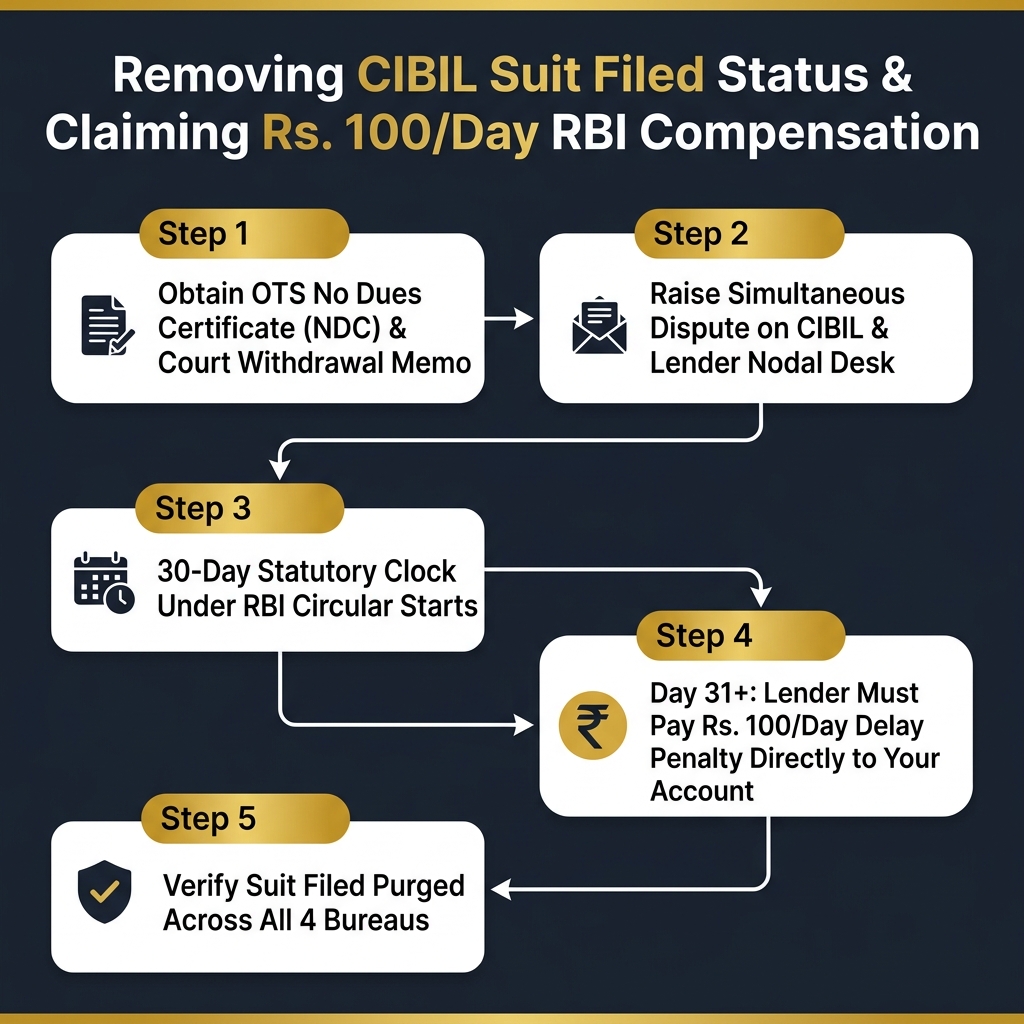
Prepared by AMA Legal Solutions Research & Analytics Team • Data & Compliance Overview

Credit Card & Personal Loan Settlement With Your Bank
How to Claim Rs. 100 Per Calendar Day Statutory Compensation From Your Bank/NBFC for Delayed CIBIL Rectification
The ₹100 per calendar day compensation is not an optional goodwill gesture; it is a legally binding statutory obligation enforceable under the Reserve Bank of India Act, 1934 and the Banking Regulation Act, 1949. However, lenders and credit bureaus rarely volunteer to disburse compensation unless compelled by experienced banking advocates. To ensure you successfully enforce cibil suit filed status removal after loan settlement and rbi 100 rs day penalty, you must execute a meticulous, evidence-backed enforcement strategy:
1. Establish an Indisputable Dispute Timestamp
The 30-day statutory clock does not begin when you have an informal conversation with your branch manager. It begins only when a formal, verifiable dispute is recorded. You must lodge a dual dispute:
- On the Credit Bureau Portal: Log in to TransUnion CIBIL (or Experian/Equifax/CRIF), navigate to the Dispute Resolution Center, enter your credit report Control Number (ECN), select the delinquent account, and submit a formal dispute specifying: "Account settled under OTS on [Date]. Full payment completed, No Dues Certificate issued, and suit withdrawn. 'Suit Filed' remark is factually inaccurate under Section 21 CICRA, 2005. Request immediate deletion." Secure the official Dispute ID and timestamped confirmation.
- To the Lender's Principal Nodal Officer: Concurrently dispatch a formal grievance via registered email to the bank's Principal Nodal Officer (PNO) and Chief Grievance Redressal Officer, attaching the settlement letter, payment receipt, NDC, and CIBIL Dispute ID.
2. The Day 31 Legal Demand Notice
If calendar Day 30 arrives and your CIBIL report still displays "Suit Filed" or the dispute remains unresolved, the bank and bureau have officially entered statutory default. On Day 31, our senior advocates issue a formal statutory legal demand notice to the bank's Managing Director and the CIC's Compliance Officer. The legal notice establishes:
- The precise filing date and Dispute Reference Number;
- The expiration of the mandatory 21-day lender and 30-day cumulative regulatory windows under Circular RBI/2023-24/72;
- A demand for immediate rectification within seven days;
- The daily calculation of the ₹100 per day statutory compensation accrued from Day 31 onward, providing your registered bank account IFSC and account details for direct electronic transfer. For structured legal framing, review our blueprint on notice for CIBIL correction after settlement.
3. Escalating to the RBI Integrated Ombudsman for Penalty Disbursement
If the lender fails to credit the statutory compensation within 30 days of your notice, we immediately file an electronic complaint on the RBI Complaint Management System (CMS) portal (cms.rbi.org.in) under Clause 10 of the Reserve Bank - Integrated Ombudsman Scheme, 2021. In the complaint petition, we submit:
- Proof of settlement and NDC issuance;
- Certified copy of the court withdrawal application or Lok Adalat award;
- CIBIL Dispute Registration receipt demonstrating the passage of over 30 days;
- Calculated statutory compensation: e.g., 90 days of delay = ₹9,000 statutory compensation;
- Prayer for additional damages for economic injury, mental harassment, and deprivation of credit access under Section 11 of the Ombudsman Scheme.
In our firm's experience, once an RBI Ombudsman complaint is registered with indisputable timestamped documentation, bank headquarters intervene within days, instructing their operations team to purge the "Suit Filed" mark and crediting the accrued ₹100/day penalty directly to the client's bank account.
Step-by-Step Legal Process to Purge 'Suit Filed' From CIBIL, Experian, Equifax, CRIF & CERSAI After OTS
Successfully completing cibil suit filed status removal after loan settlement and rbi 100 rs day penalty requires an exhaustive, multi-institutional legal approach. Clearing your name at TransUnion CIBIL is insufficient if the litigation flag remains visible on Experian or if a secured charge remains registered on CERSAI. The complete, battle-tested legal roadmap developed by AMA Legal Solutions encompasses six sequential phases:
Step 1: Obtain Certified Court Withdrawal Orders or Lok Adalat Awards
Never rely on a verbal promise from a recovery officer stating, "We will drop the court case." Require the bank's legal counsel to furnish a certified copy of the Order of Dismissal as Withdrawn passed by the Civil Court or DRT under Order XXIII Rule 1 CPC, or a certified copy of the National Lok Adalat Award recording the compromise under Section 21 of the Legal Services Authorities Act, 1987. A Lok Adalat decree is final, non-appealable, and carries the statutory weight of a civil court decree, serving as unassailable proof of litigation termination.
Step 2: Procure an Unconditional No Dues Certificate (NDC) with Litigation Covenants
Ensure that your settlement NDC is not a generic computer receipt. A legally sound NDC must explicitly specify:
- The exact Loan Account Number (LAN);
- The full receipt of the agreed One-Time Settlement amount in full and final satisfaction of all claims;
- An explicit covenant that the bank has withdrawn all pending civil, criminal, and tribunal proceedings, including specific suit numbers;
- An express undertaking that the bank will transmit an updated status to all four RBI-licensed credit bureaus within the mandatory fortnightly cycle.
Step 3: Enforce CERSAI Charge Satisfaction (Mandatory for Property & Asset Loans)
If your settled loan was a mortgage, LAP, or business loan secured by immovable property, the lender registered an equitable mortgage charge on the central CERSAI registry under Chapter IV of the SARFAESI Act, 2002. Even after clearing CIBIL, a lingering charge on CERSAI blocks any future sale or refinancing of your property.
Under Section 23 of the SARFAESI Act, 2002, the lending bank is statutorily obligated to register the satisfaction of security interest on the CERSAI portal within 30 days of loan repayment. We mandate that the bank upload Form CERSAI-I (Satisfaction of Charge) and deliver the certified CERSAI Discharge Certificate along with your original title deeds.
Step 4: File Simultaneous Formal Disputes Across All Four Credit Bureaus
Lenders do not report solely to CIBIL. Indian banking is monitored by four distinct RBI-regulated Credit Information Companies: TransUnion CIBIL, Experian India, Equifax India, and CRIF High Mark. We lodge simultaneous, synchronized online dispute tickets across all four platforms, attaching the court withdrawal order, NDC, and CERSAI satisfaction certificate to ensure complete industry-wide data synchronization.
Step 5: Serve Advocate Statutory Representation on the Lender's Compliance Desk
Simultaneously with bureau disputes, our senior advocates serve a formal statutory representation on the lender's Chief Compliance Officer (CCO) and Head of Bureau Operations. This notice cites Section 21(3) of CICRA, 2005 (duty to provide accurate credit data), warns of the ₹100 per day statutory delay penalty, and provides a strict 14-day compliance window before escalating to the RBI Ombudsman.
Step 6: Credit Score Rehabilitation and Post-Purge Monitoring
Once the "Suit Filed" tag is completely purged, your tradeline status updates to "Settled" with a ₹0 balance. While your credit score immediately rebounds from sub-600 distress levels, deliberate steps must be taken to rebuild a 780+ credit profile. Follow our practical strategies on how to improve CIBIL score after loan settlement.
How to Upgrade 'Post-Write-Off Settled' to 'Closed' via a Supplemental Balance-Clearance NOC
While mastering cibil suit filed status removal after loan settlement and rbi 100 rs day penalty successfully eliminates active litigation barriers, settled borrowers must confront another credit reporting hurdle: the permanent "Settled" remark. When an OTS is executed, the bank agrees to accept a lesser amount (e.g., ₹6 Lakhs against a total outstanding claim of ₹15 Lakhs) and write off the remaining ₹9 Lakhs as a commercial loss.
The Real-World Impact of a "Settled" Status
Under credit reporting regulations, the bank reports the account status as "Settled" or "Post-Write-Off Settled". While the "Suit Filed" mark is gone and your current balance is ₹0, the "Settled" remark signals to future loan underwriters that you failed to repay your debt in full according to original contractual terms. For credit cards or small personal loans, this may not be fatal after two or three years of credit repair. However, if you plan to apply for a large government tender, corporate directorship, or high-value residential home loan with a conservative public sector bank (like SBI or PNB), underwriters often refuse approval until the account status is updated to "Closed".
The Solution: The Supplemental Balance-Clearance Protocol
Many borrowers believe that once an account is marked "Settled", it can never be altered. This is a common legal misconception. Indian law fully permits borrowers to upgrade their credit records through a structured supplemental balance clearance:
- Re-Opening the Settlement Ledger: When your financial liquidity recovers (often two to four years after the original settlement), your legal counsel approaches the bank's Zonal Stressed Assets Committee to re-open the file under an amended resolution petition.
- Negotiating the Differential Principal Balance: We request an exact statement of the previously waived principal haircut (excluding all compounded penal charges, unapplied interest, and legal costs).
- Executing a Supplemental Settlement Deed: Upon payment of the net differential principal balance, the bank executes an amended, supplemental settlement deed confirming that 100% of the loan principal has been paid in full.
- Mandatory Bureau Status Conversion to "Closed": The bank generates a fresh, unconditional "Closed / Paid in Full" No Dues Certificate and transmits a priority bureau data correction file to CIBIL, permanently converting the tradeline status from "Settled" to "Closed". For an in-depth breakdown of this strategic mechanism, read our authoritative analysis on can I convert settled to closed later.
Strategic Conclusion: Enforce Your CIBIL Rectification & Claim RBI Compensation with AMA Legal Solutions
Reaching an amicable debt compromise is a major milestone, but a settlement is legally incomplete until your credit file is fully purged of predatory litigation tags. Leaving an erroneous "Suit Filed" or "Suit Filed (Wilful Default)" status on your CIBIL report inflicts catastrophic commercial harm, paralyzing your borrowing capability, restricting your business growth, and tarnishing your personal financial reputation. Navigating cibil suit filed status removal after loan settlement and rbi 100 rs day penalty is not an administrative courtesy you must beg from a bank; it is an ironclad statutory right established by Indian law, enforced by the Reserve Bank of India, and vigorously protected by the courts.
The days when banks could issue an NDC, pocket your settlement money, and leave your credit report ruined for seven years are over. With mandatory 15-day fortnightly reporting, strict 30-day dispute resolution deadlines, and automatic ₹100 per day statutory delay compensation, Indian law now places immense leverage in the hands of informed borrowers. However, unlocking this leverage requires assertive, disciplined legal representation that bridges court litigation, banking regulation, and credit bureau data protocols.
At AMA Legal Solutions, our team of senior banking and litigation advocates has successfully guided thousands of individuals, professionals, and MSME business owners across India through complex debt resolutions. From negotiating deep-haircut One-Time Settlements and drafting bulletproof settlement covenants to securing certified court withdrawal orders, satisfying CERSAI charges, purging CIBIL litigation flags, and claiming statutory RBI delay penalties, we protect your financial future at every stage. Explore our end-to-end loan settlement services and discover how our specialized expertise in loan settlement in India delivers total financial rehabilitation.
Do not allow bank negligence or bureaucratic indifference to keep you blacklisted from the credit economy. Enforce your statutory rights, eliminate unlawful "Suit Filed" flags, and claim the daily compensation you are legally owed. For a confidential, high-level review of your credit reports, settlement documentation, and legal remedies, reach out to our senior legal counsel or contact AMA Legal Solutions today.
Popular Searches & Topics
Commonly searched legal queries and keywords related to this article
Need Strategic Legal Defense for Your Situation?
Our banking & litigation advocates review your notices, debt liability, and recovery issues under complete advocate-client secrecy.
References & Authority
- Reserve Bank of India - Framework for Compensation to Customers for Delayed Updation/Rectification of Credit Information (RBI/2023-24/72 & DoR.FIN.REC.48/20.16.003/2023-24)
- Reserve Bank of India - Directive on Fortnightly Reporting of Credit Information by Credit Institutions to CICs (DoR.FIN.REC.39/20.16.056/2024-25)
- Credit Information Companies (Regulation) Act, 2005 (CICRA) - Section 21 & Section 18 (Grievance Redressal and Data Accuracy Mandate)
- Credit Information Companies Rules, 2006 & Credit Information Companies Regulations, 2006
- Reserve Bank of India - Master Direction on Compromise Settlements and Technical Write-offs (DOR.STR.REC.20/21.04.048/2023-24)
- Securitisation and Reconstruction of Financial Assets and Enforcement of Security Interest (SARFAESI) Act, 2002 - Section 20-26 (CERSAI Charge Satisfaction)
- Reserve Bank - Integrated Ombudsman Scheme, 2021 (Clause 10 - Deficiency in Service & Credit Bureau Rectification Compensation)
- Supreme Court of India - Standard Chartered Bank vs. Dharminder Bhohi (2013) 15 SCC 341 on Redressal of Credit Information Deficiencies

AMA Legal Solutions
Trusted with a 4.7 Google Rating, over 10,000+ Clients Served, 25,000+ Cases Handled, and more than 40+ Years of Experience in providing strategic legal defense and debt resolution across India.
Our media coverages





Frequently Asked Questions
Related Articles

Joint Loan Default During Divorce in India: Co-Borrower Settlement & Release (2026)
Navigate joint loan defaults during divorce and secure a co-borrower OTS release.
Read Article
PNB e-OTS, SBI Rinn Samadhan & PSU Bank OTS Schemes in India (2026)
Compare PSU bank e-OTS portals with deeper Zonal Committee discretionary waivers.
Read Article
Loan Against Mutual Funds, Shares & Gold Default: Section 176 & Settlement (2026)
Enforce Section 176 notice rights to stop illegal auctions and settle shortfalls.
Read ArticleAbout Author
Anuj Anand Malik
View ProfileAnuj Anand Malik, Founder of AMA Legal Solutions, is a trusted advocate, loan settlement expert, legal advisor, and banking lawyer. With over a decade of experience in loan settlement, corporate law, financial disputes, and compliance, he leads a result-driven law firm based in India that helps individuals, startups, and businesses achieve legal and financial stability.
Connect on LinkedInNeed Legal Representation?
Evaluate your defense against recovery agents, notices, or structure your loan settlement directly with Senior Advocates.
Call +91-8700343611