Before You Send a Cheque Bounce Notice – Check If Your Case Qualifies Under Section 138
Ensure your cheque bounce notice meets Section 138 requirements to avoid dismissal.

Anuj Anand Malik
Reviewed by AMA Legal Solutions
Introduction to Section 138 Cheque Bounce Notices
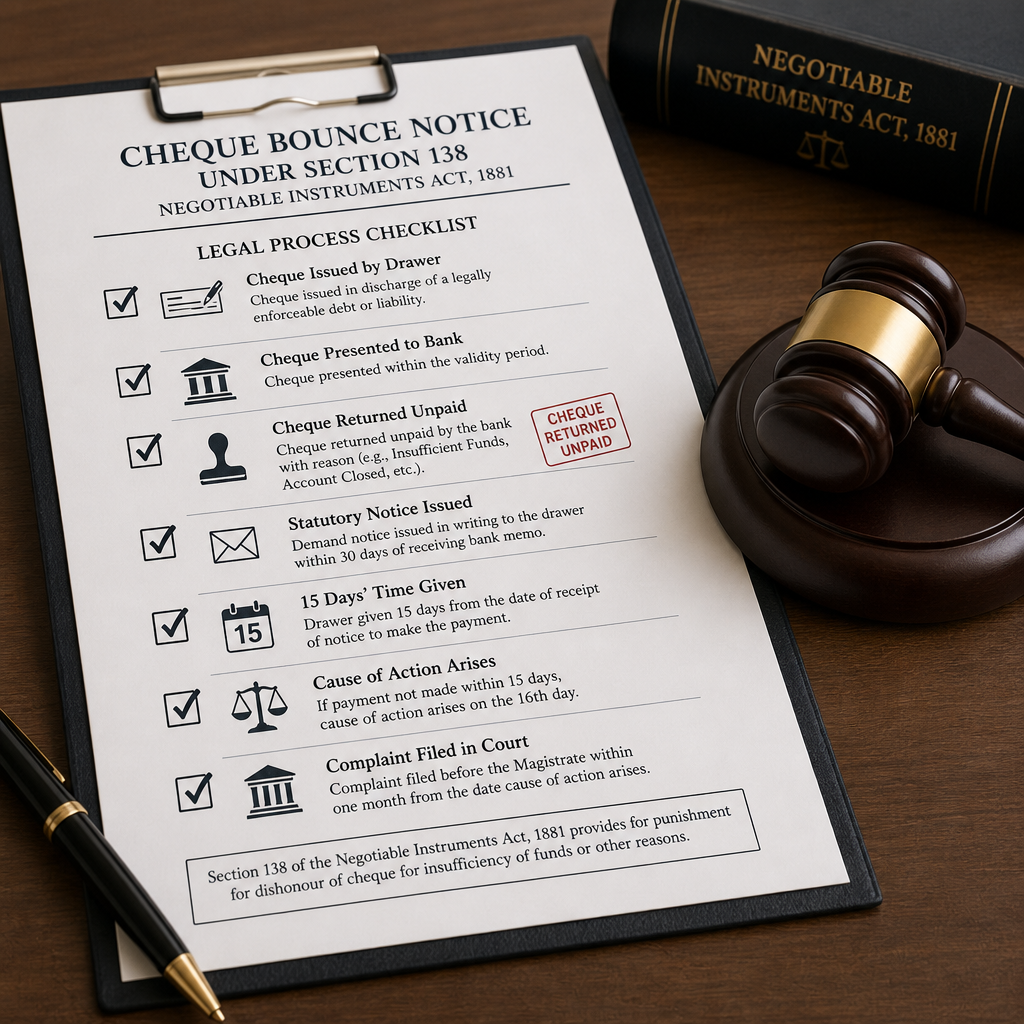
Before sending a cheque bounce notice, ensure your case qualifies under Section 138 of the Negotiable Instruments Act, 1881. This section requires three conditions to be met: the cheque must clear a legally enforceable debt, be presented within its 3-month validity, and be dishonoured due to insufficient funds or exceeding the bank arrangement.
A cheque bounce notice is a statutory requirement, not an option. It must be issued within 30 days of receiving the cheque return memo, demanding payment within 15 days. Without this notice, filing a criminal complaint under Section 138 is impossible. Courts dismiss complaints lacking a valid notice, as one missing element can invalidate the entire case.
Reasons like insufficient funds or exceeding arrangement trigger Section 138 liability. Other technical returns, such as signature mismatches or stale cheques, do not. For these, rectification and re-presentation are advised. Section 138 cases must adhere to strict timelines: 30 days post-return memo for notice issuance, 15 days for drawer payment, and 30 days post-15-day period for filing a complaint.
Legal compliance requires notices to detail the cheque, the dishonour date, reasons, and demands for payment. Missing any element can lead to case dismissal. Always verify your case meets these criteria before proceeding.
Understanding the Legal Framework of Section 138
Section 138 of the Negotiable Instruments Act, 1881, plays a crucial role in ensuring the credibility of cheque transactions in India. It criminalizes the act of cheque dishonour for insufficient funds or surpassing the bank arrangement. To establish an offence under this section, three key conditions must be satisfied:
- The cheque must be issued to settle a legally enforceable debt or liability.
- It should be presented to the bank within three months from the date on the cheque.
- The cheque must be returned unpaid due to insufficient funds or because the amount exceeds the arrangement made with the bank.
Upon return of the cheque, the payee must send a written demand notice to the drawer within 30 days. The drawer then has a 15-day window to clear the payment. Failure to pay within this timeframe allows the payee to file a criminal complaint within 30 days after the notice period ends.
This framework aims to deter misuse of cheques and enhances the reliability of cheque transactions by imposing penalties such as imprisonment up to two years or a fine up to twice the cheque value. It's crucial to ensure all statutory requirements are met to maintain the validity of the notice and subsequent legal proceedings.
Essential Criteria for a Valid Cheque Bounce Notice
A cheque bounce notice, under Section 138 of the Negotiable Instruments Act, 1881, is a critical legal instrument. For it to be valid and enforceable in court, it must meet several essential criteria. Failure to comply with any of these requirements can render the notice invalid, undermining the legal action against the drawer. Here's what must be included:
1. Legally Enforceable Debt
The cheque must be issued to settle a legally enforceable debt or liability. If the cheque was provided as a gift, or for any purpose other than the discharge of a debt, Section 138 does not apply.
2. Presentation Within Validity
The cheque should be presented for payment within three months from the date on the cheque. Presenting it beyond this period results in a stale cheque, nullifying the ability to pursue a Section 138 complaint.
3. Reasons for Dishonour
- Insufficient Funds: The account lacks adequate balance to honor the cheque.
- Exceeds Arrangement: The cheque amount surpasses the overdraft or credit arrangement.
4. Timely Demand Notice
A written demand notice must be served on the drawer within 30 days of the cheque return memo. This notice demands the payment of the cheque amount.
5. Payment Window
The drawer is given a 15-day window post-receipt of the notice to settle the debt. Failure to pay within this period allows the payee to initiate legal proceedings.
Ensuring all these criteria are met is pivotal in making a cheque bounce notice valid and actionable in a court of law. Compliance with these statutory requirements is non-negotiable for the successful prosecution under Section 138.
Common Reasons for Cheque Dishonour and Their Implications
Cheques are dishonoured for various reasons, but only certain conditions trigger the liability under Section 138 of the Negotiable Instruments Act, 1881. Understanding these reasons is crucial for both the payee and the drawer to assess the potential legal implications.
Reasons Triggering Section 138
- Insufficient Funds: This is the most common reason for cheque bounce. If the drawer's account lacks sufficient balance to cover the cheque amount, Section 138 is invoked, leading to criminal liability.
- Exceeds Arrangement: If the cheque amount exceeds the overdraft or credit limit sanctioned to the drawer, it constitutes an offence under Section 138.
Reasons Not Triggering Section 138
- Signature Mismatch: A mismatch between the cheque’s signature and bank records is a technical defect. The cheque can be re-presented after correction.
- Post-Dated Cheque Presented Early: Presenting a cheque before its intended date doesn’t attract Section 138. Instead, present it on or after the specified date.
- Stale Cheque: If a cheque is presented after its 3-month validity, it becomes stale and cannot enforce Section 138. Simply request a new cheque.
For technical returns, addressing the defect and re-presenting the cheque might resolve the issue. However, for substantive grounds like insufficient funds or exceeding arrangements, the next step is issuing a Section 138 notice to pursue legal remedy.
Legal Provisions and Offences Under Section 138, 141 & 142
The laws governing cheque bounce cases in India primarily revolve around Sections 138, 141, and 142 of the Negotiable Instruments Act, 1881. Each section serves a distinct function in addressing cheque dishonour offences.
Section 138: The Core Offence
This section criminalizes the act of cheque dishonour when a cheque is returned unpaid due to insufficient funds or exceeding the arrangement with the drawee bank. The penalties include imprisonment of up to 2 years, a fine up to twice the cheque amount, or both. For the offence to be actionable, the cheque must be presented within its 3-month validity, a written demand notice must be served within 30 days of the return memo, and the drawer must fail to pay within 15 days.
Section 141: Liability of Directors for Company's Cheque Bounce
Section 141 extends liability to individuals responsible for a company's operations, such as directors and authorized signatories, when a company's cheque bounces. They can avoid liability if they prove the offence occurred without their knowledge or they exercised due diligence to prevent it.
Section 142: Jurisdiction and Procedure
Section 142 stipulates that a Section 138 complaint must be filed in writing by the payee within 30 days after the 15-day notice period expires, before a Judicial Magistrate of the First Class. Jurisdiction is determined by the location where the cheque was presented, as clarified by the Supreme Court in Dasrath Rupsingh Rathod v. State of Maharashtra (2014) and codified by the 2015 amendment.
Time Limits and Deadlines for Cheque Bounce Notices
Time management is crucial when dealing with cheque bounce issues under Section 138 of the Negotiable Instruments Act, 1881. This section operates on a specific timeline, and any deviation could nullify your case. Here's how the timing works:
Key Deadlines to Observe
- Within 30 Days: A legal notice must be sent to the cheque issuer (drawer) within 30 days from receiving the cheque return memo from your bank. This memo indicates that the cheque was dishonoured due to insufficient funds or exceeding the bank arrangement.
- 15-Day Payment Period: Once the notice is served, the drawer has 15 days to respond by paying the cheque amount. If payment is not made within this period, further legal action can be taken.
- Filing a Complaint: If the drawer fails to pay within the 15-day window, the payee has an additional 30 days to file a criminal complaint under Section 138 against the drawer. This complaint must be filed with the Judicial Magistrate of the First Class in the jurisdiction where the cheque was presented for payment.
Missing any of these deadlines can render the cheque unenforceable under Section 138. It's critical to adhere to these timelines to ensure the viability of your legal recourse.

Halt Recovery Agent Harassment Legally
Key Components of a Legally Compliant Notice
To ensure your cheque bounce notice is legally compliant under Section 138, it must meticulously include several critical elements. Missing even one of these can jeopardize your case. Here’s a breakdown of what a valid notice should contain:
- Cheque Details: Clearly specify the dishonoured cheque number, date, and amount in both figures and words. Include details of the drawer's bank and branch where the cheque was deposited.
- Presentation and Return Dates: Mention the exact date the cheque was presented for payment and the date it was returned unpaid by the bank.
- Reason for Dishonour: State the precise reason for dishonour as indicated in the bank’s return memo, such as “funds insufficient” or “exceeds arrangement.”
- Demand for Payment: Include a clear demand for the drawer to pay the cheque amount within 15 days from receipt of the notice.
- Legal Consequences: Explicitly state that failure to comply will result in filing a criminal complaint under Section 138 of the Negotiable Instruments Act, 1881.
- Annexures: Attach copies of the dishonoured cheque and the bank return memo for reference.
- Advocate Details: Provide the advocate's name, enrolment number, signature, and address for service of documents.
- Mode of Service: Use Registered Post with AD or Speed Post with tracking to ensure proof of delivery, which is critical for legal proceedings.
Effective Responses to Receiving a Cheque Bounce Notice
Receiving a cheque bounce notice can be unsettling, but responding effectively can mitigate potential legal consequences. Here are strategic responses:
Immediate Actions
- Review Notice Details: Verify the cheque details, notice date, and reason for dishonour. Ensure the notice adheres to Section 138 requirements.
- Consult a Lawyer: Engage a legal expert to assess the notice’s validity and strategize an appropriate response.
Response Options
- Fulfill Payment Obligations: If funds were genuinely insufficient, arrange full payment within 15 days. Secure a written acknowledgment from the payee.
- Negotiate Settlement: If immediate full payment is infeasible, initiate settlement discussions. Document any agreement in writing to avoid future disputes.
- Raise Valid Defences: If the cheque was for security, lacked consideration, or was lost/stolen, issue a detailed reply notice. Provide supporting evidence to counter claims.
Risks of Non-Response
- Ignoring the notice can lead to criminal proceedings. Courts assume notice receipt under Section 27 of the General Clauses Act, commencing the 15-day resolution period.
- A proactive response not only protects legal standing but may prevent escalation to court proceedings.
Exploring Defences Available to the Drawer
When faced with a Section 138 notice, the drawer has several potential defences to mount a successful challenge. These defences can mitigate or entirely negate the liability under the Negotiable Instruments Act, 1881.
Cheque Issued as Security
If the cheque was issued as a security rather than for discharging a debt, this serves as a valid defence. The drawer must provide evidence that the cheque was not meant for immediate payment but was conditional upon certain events.
Lack of Legally Enforceable Debt
The absence of a legally enforceable debt at the time the cheque was issued nullifies the prosecution. For instance, debts arising from gambling or time-barred debts do not constitute valid liabilities under Section 138.
Cheque Filled by a Third Party
A cheque completed by someone other than the drawer without authorization may be contested, as the drawer can argue that it was not properly executed or intended for clearance.
Expired Cheque Validity
Cheques presented beyond their three-month validity period automatically disqualify under Section 138. The drawer can claim this as a defence if the payee fails to adhere to this timeline.
Improper Notice Serving
Failure to serve the notice within 30 days of the cheque's dishonour renders the notice invalid. Courts require strict adherence to timelines, providing the drawer a viable defence against prosecution.
Legal, Criminal, and Financial Consequences of a Bounced Cheque
When a cheque bounces, the repercussions can be severe and multifaceted, impacting the drawer legally, criminally, and financially. Understanding these consequences is vital to navigate the situation effectively.
Legal Consequences
- Section 138 of the NI Act: A bounced cheque may lead to legal proceedings under Section 138 of the Negotiable Instruments Act, 1881, if it was issued for a legally enforceable debt. This section mandates that a notice must be served within 30 days of the cheque's dishonour.
- Mandatory Notice: Failure to issue a notice within the stipulated time results in the loss of the right to file a complaint, making timely action crucial.
Criminal Consequences
- Imprisonment: A conviction under Section 138 can result in imprisonment for up to two years.
- Fines: The court may impose a fine up to twice the cheque amount, often awarded to the payee as compensation.
- Criminal Record: Being convicted affects the drawer's ability to secure future loans, licenses, and may lead to disqualification under various statutes like the Companies Act.
Financial Consequences
- Bank Charges: Banks typically charge ₹150 to ₹750 per bounced cheque, in addition to any fees charged by the payee's bank.
- Credit Impact: A bounced cheque negatively affects the drawer's credit score, potentially impacting future financial dealings.
- Collateral Damage: Repeat offenders risk losing cheque-writing privileges and face further restrictions from financial institutions.
These consequences highlight the importance of addressing a bounced cheque promptly and exploring options such as settlement or legal defense to mitigate potential damages.
Steps to Take If You Miss the Notice Deadline
Missing the 30-day deadline to send a cheque bounce notice under Section 138 of the Negotiable Instruments Act can seem daunting, but there are still actionable steps you can take to seek redress. Here's a comprehensive guide on how to proceed:
Present the Cheque Again
If the cheque is still within its 3-month validity, re-present it to the bank. On receiving a new return memo, the 30-day notice period resets, allowing you to issue a fresh demand notice.
File a Civil Summary Suit
- Consider filing a civil summary suit under Order 37 of the Code of Civil Procedure (CPC).
- This route allows for recovery of the cheque amount, along with interest and costs.
- Note that this process might take longer, typically 1-3 years, compared to a Section 138 proceeding.
Explore a Section 420 IPC Complaint
If there is evidence of fraudulent intent-such as the drawer knowingly issuing a cheque from an empty account-you may file a complaint for cheating under Section 420 of the Indian Penal Code (IPC). This runs parallel to any civil action and focuses on the fraudulent aspect.
Legal Consultation
Consult a legal expert to evaluate these options and understand the best course of action based on your case specifics. This ensures that you pursue the most viable legal remedy.
Choosing Between Criminal Complaint and Summary Suit for Recovery
When a cheque bounces, and the drawer fails to settle within the statutory 15-day period, the payee can pursue two legal routes: filing a criminal complaint under Section 138 of the Negotiable Instruments Act, or initiating a summary suit under Order 37 of the Code of Civil Procedure. Each option has distinct advantages and procedural nuances.
Criminal Complaint under Section 138
- Objective: Imposes criminal liability, typically resulting in imprisonment up to 2 years and fines up to twice the cheque's value, often granted as compensation to the payee.
- Presumption: Section 139 holds the cheque as evidence of a legally enforceable debt, easing the burden on the payee.
- Duration: Quicker resolution, generally ranging between 6 months to 2 years.
- Jurisdiction: Requires filing in the Judicial Magistrate’s court where the cheque was presented.
Summary Suit under Order 37 CPC
- Objective: Seeks a civil recovery of the cheque amount, along with interest and legal costs.
- Presumption: Payee benefits from a presumption favoring them, but the drawer can seek leave to defend based on valid grounds.
- Duration: Typically longer, spanning 1 to 3 years.
- Jurisdiction: Filed in a civil court with the appropriate pecuniary jurisdiction.
Both remedies can be pursued simultaneously, allowing the payee to leverage legal pressure for recovery. The choice depends on the amount involved, the urgency for recovery, and the payee's strategic objectives.
Need Strategic Legal Defense for Your Situation?
Our banking & litigation advocates review your notices, debt liability, and recovery issues under complete advocate-client secrecy.
AMA Legal Solutions
Trusted with a 4.7 Google Rating, over 10,000+ Clients Served, 25,000+ Cases Handled, and more than 40+ Years of Experience in providing strategic legal defense and debt resolution across India.
Our media coverages





Client Reviews
"I was impressed by the professionalism and dedication shown by AMA Legal Solutions. They helped secure a favorable outcome in my cheque bounce matter."
Vikram Mehta
"AMA Legal Solutions' in-depth knowledge of banking law was a key factor in winning my case. Their strategic advice was invaluable."
Anjali Rao
"AMA Legal Solutions provided exceptional service in handling my cheque bounce case. Their expertise in Section 138 proceedings was evident from day one."
Rajesh Kumar
"From the initial consultation to the final settlement, AMA Legal Solutions provided top-notch service, ensuring every step was handled expertly."
Nikhil Singh
"The team at AMA Legal Solutions guided me through the complex legal process smoothly. Their attention to detail ensured my case was resolved successfully."
Priya Sharma
Frequently Asked Questions
Related Articles
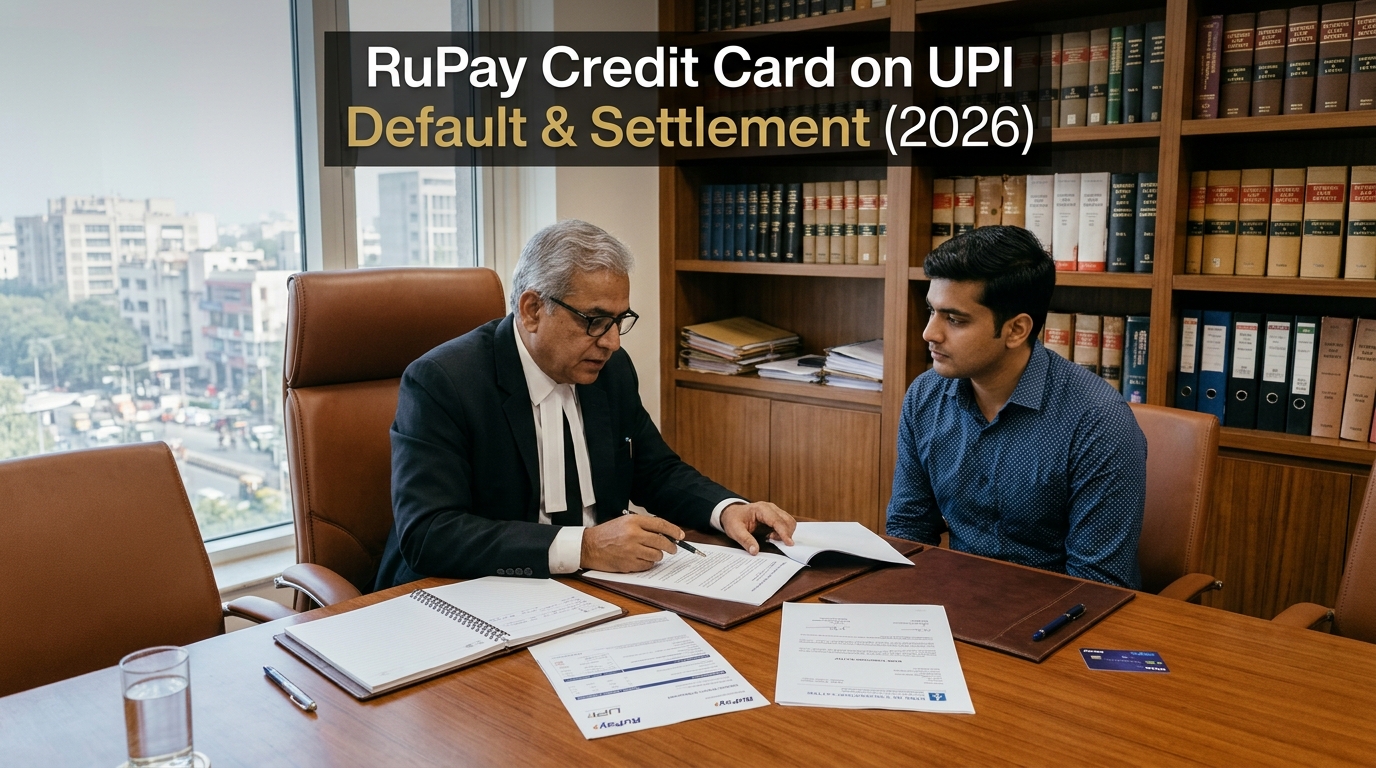
RuPay Credit Card on UPI Default & Credit Line on UPI Settlement (2026)
Micro-transactions on RuPay UPI Credit Cards and pre-approved 'Credit Lines on UPI' have triggered a massive wave of 42%+ APR revolving debt traps. Find out if defaulting blocks your personal savings UPI and how to settle RuPay UPI credit dues for 30%–50%.
Read Article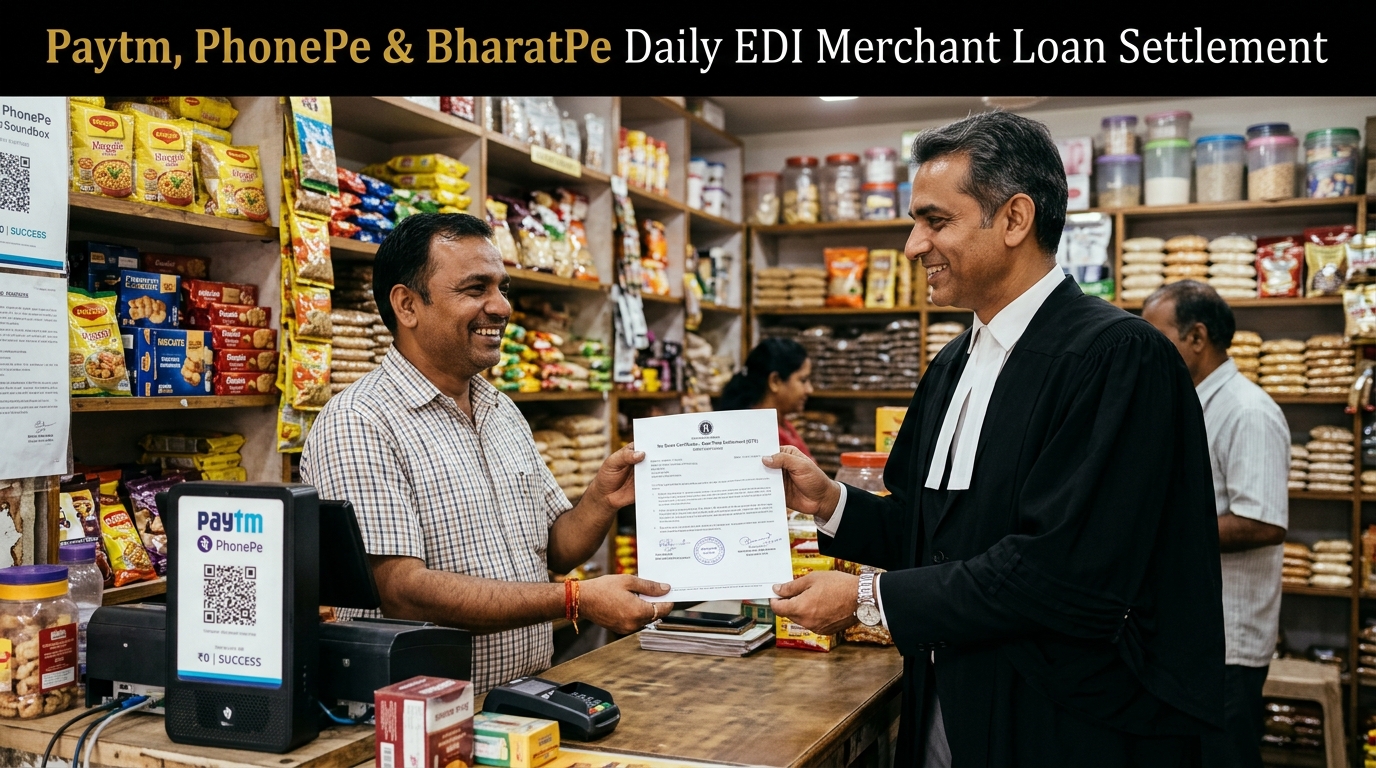
Paytm, PhonePe & BharatPe Daily EDI Merchant Loan Settlement (2026)
Drowning in Equated Daily Installment (EDI) merchant loans where 100% of your daily QR Soundbox collections are auto-swept before you can pay suppliers or rent? Learn how retail shopkeepers and MSMEs legally halt QR sweeps and negotiate a 50%+ OTS.
Read Article
Can Bank or Loan App Remotely Lock Phone for EMI Default? RBI Rules (2026)
An investigative breakdown of RBI's Remote Device Locking Directions—explaining why lenders cannot lock your phone for personal loans, the mandatory 30/60 DPD safeguards on financed devices, the Rs. 250/hour delay penalty, and how to settle device & app loans.
Read ArticleAbout Author
Anuj Anand Malik
View ProfileAnuj Anand Malik, Founder of AMA Legal Solutions, is a trusted advocate, loan settlement expert, legal advisor, and banking lawyer. With over a decade of experience in loan settlement, corporate law, financial disputes, and compliance, he leads a result-driven law firm based in India that helps individuals, startups, and businesses achieve legal and financial stability.
Connect on LinkedInNeed Legal Representation?
Evaluate your defense against recovery agents, notices, or structure your loan settlement directly with Senior Advocates.
Call +91-8700343611