Personal Loan Harassment in India: Your Legal Guide
Navigate RBI rules, borrower rights, and settlement options effectively.

Anuj Anand Malik
Reviewed by AMA Legal Solutions
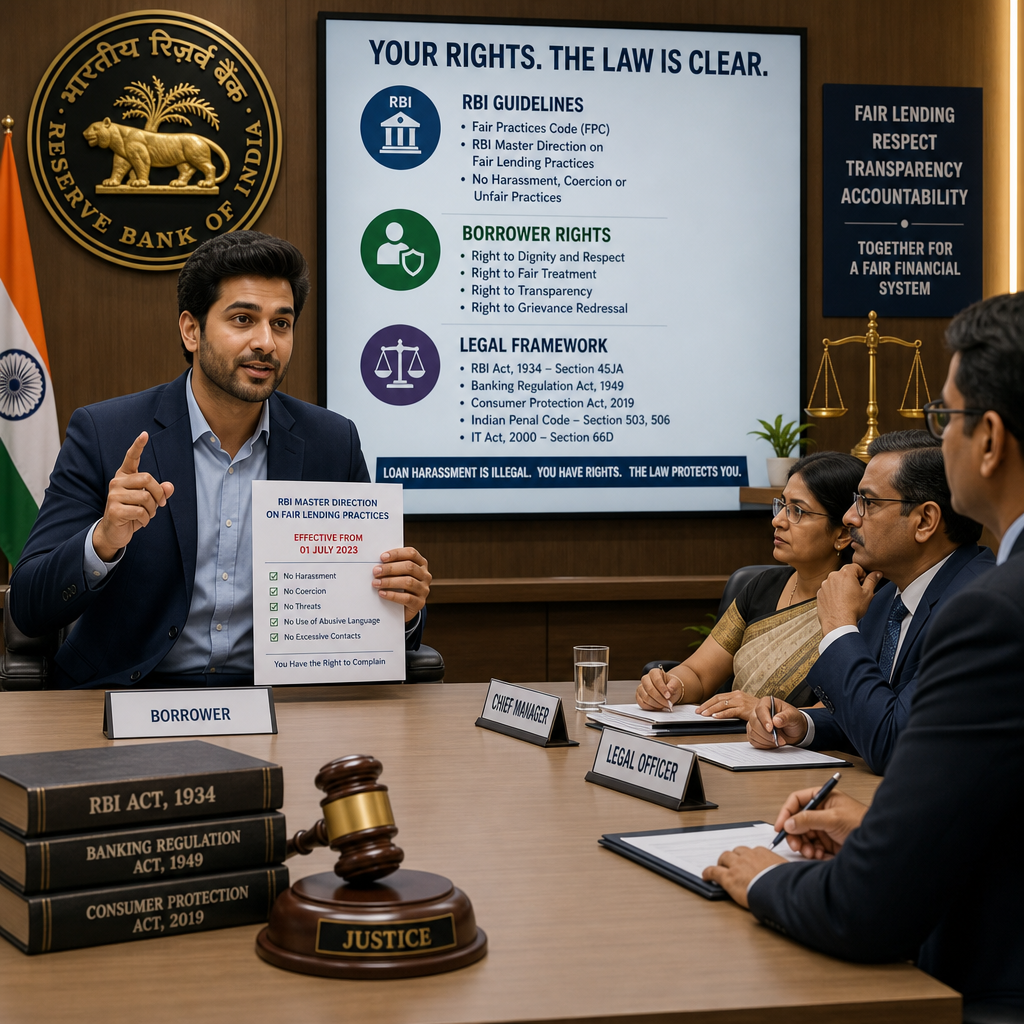
Personal Loan Harassment in India: Everything You Need to Know
Receiving dozens of phone calls every day from recovery agents can be mentally exhausting. Many borrowers begin to believe that defaulting on a personal loan is a criminal offence or that they may be arrested at any moment. Others fear that banks can seize their property, publicly shame them, or contact their employers to force repayment.
The reality is very different.
In India, defaulting on a personal loan is generally a civil matter, not a criminal offence. While banks and financial institutions have the legal right to recover outstanding dues, they must follow the law. They cannot threaten, abuse, intimidate, or harass borrowers simply because payments are overdue.
The Reserve Bank of India (RBI) has issued detailed guidelines governing how banks and recovery agents must interact with borrowers. Courts across India have repeatedly emphasised that financial institutions cannot violate an individual's dignity while attempting to recover money.
Unfortunately, many borrowers remain unaware of these legal protections. As a result, they often tolerate unlawful behaviour that they are not legally required to endure.
This guide has been prepared to help borrowers understand:
What legally amounts to personal loan harassment.
The rights available to borrowers under Indian law.
What recovery agents can and cannot do.
RBI guidelines governing debt recovery.
The legal process after a personal loan default.
How loan settlements work.
When legal assistance becomes necessary.
Practical steps to stop harassment lawfully.
Whether you have missed one EMI or your loan has already entered the recovery stage, understanding the legal framework can help you make informed decisions and protect your rights.
Quick Answer
What is Personal Loan Harassment?
Personal loan harassment refers to unlawful or unethical behaviour by banks, NBFCs, recovery agents, or collection agencies while attempting to recover unpaid loan amounts. Harassment may include threatening phone calls, abusive language, repeated calls at inappropriate hours, intimidation, contacting family members or employers without justification, public humiliation, or misleading borrowers regarding legal consequences.
The Reserve Bank of India requires all banks and recovery agencies to follow fair recovery practices. Borrowers have the right to be treated with dignity and may file complaints if these guidelines are violated.
Why This Guide Is Different
Most articles available online merely repeat RBI circulars or provide generic legal information.
This guide goes several steps further by explaining:
How banks actually recover personal loans.
The timeline followed after an EMI default.
The legal rights of both borrowers and lenders.
Court decisions affecting loan recovery.
Practical negotiation strategies.
When loan settlement is appropriate.
Common mistakes borrowers make.
How experienced banking lawyers approach recovery disputes.
Rather than focusing only on legal theory, this guide aims to provide practical knowledge that borrowers can apply immediately.
Understanding Personal Loans in India
Before discussing harassment and recovery practices, it is important to understand how personal loans function.
A personal loan is an unsecured loan provided by banks or Non-Banking Financial Companies (NBFCs). Unlike home loans or vehicle loans, personal loans are granted without requiring the borrower to pledge any collateral or security.
Approval is generally based on factors such as:
Monthly income
Employment stability
Existing liabilities
Credit score
Repayment capacity
Previous banking history
Since personal loans are unsecured, lenders assume a greater level of financial risk. Consequently, interest rates are usually higher than secured loans.
Although banks have legal remedies if a borrower defaults, those remedies must always be exercised through lawful procedures.
What Happens When You Miss an EMI?
One of the biggest misconceptions among borrowers is that missing a single EMI immediately triggers legal action.
That is not how the process works.
A typical recovery timeline looks like this:
Time After Missed EMI | What Usually Happens |
|---|---|
1–7 Days | SMS reminders, emails, courtesy calls |
7–30 Days | Follow-up calls from collection team |
30–60 Days | Increased recovery communication |
Around 90 Days | Loan may be classified as NPA (subject to applicable norms) |
After NPA | Recovery department takes over, settlement discussions may begin, and legal proceedings may be considered depending on the lender and circumstances |
Every bank follows its own internal policies, but most recovery actions follow a similar progression.
Understanding this timeline helps borrowers distinguish between legitimate recovery efforts and unlawful harassment.
What Is Personal Loan Harassment?
Not every recovery call amounts to harassment.
Banks are legally entitled to remind borrowers about overdue payments and discuss repayment options.
Harassment begins when recovery methods cross the boundaries established by law.
Examples include:
Continuous Phone Calls
Calling a borrower repeatedly throughout the day with the intention of causing pressure or distress.
Abusive Language
Using insulting, threatening, or offensive language.
False Criminal Threats
Informing borrowers that they will be arrested immediately for failing to repay a personal loan.
Public Humiliation
Contacting neighbours, relatives, or colleagues solely to embarrass the borrower.
Threatening Family Members
Recovery agents cannot threaten family members to compel repayment.
Workplace Harassment
Repeatedly contacting employers with the intention of damaging the borrower's professional reputation.
Fake Legal Notices
Sending misleading notices that falsely claim to be court orders.
Unauthorised Home Visits
Visiting residences repeatedly without justification or behaving aggressively during visits.
Common Myths About Personal Loan Defaults
Borrowers frequently make decisions based on misinformation.
Let's address some of the most common myths.
Myth 1: I Can Be Arrested for Not Paying a Personal Loan
Generally, no.
Personal loan defaults usually involve civil recovery proceedings, not criminal prosecution. However, criminal liability may arise in exceptional circumstances involving fraud, forged documents, or deliberate deception.
Myth 2: Recovery Agents Can Seize My House
Not for an unsecured personal loan.
Since no collateral has been pledged, recovery agents cannot simply take possession of your home or other assets without following the appropriate legal process.
Myth 3: Banks Can Publish My Photograph
Courts have consistently emphasised that borrowers retain their right to dignity. Public shaming solely to recover unsecured debts may expose lenders to legal challenges.
Myth 4: Ignoring Calls Solves the Problem
Ignoring communication generally makes matters worse.
Borrowers should respond professionally, keep written records, and engage constructively where possible.
Myth 5: Loan Settlement Is Illegal
Loan settlements are a recognised mechanism used by many financial institutions. However, settlements should always be properly documented, and borrowers should understand their implications, including any effect on their credit history.
Why Borrowers Face Harassment
Recovery pressure often increases because:
Banks aim to reduce non-performing assets (NPAs).
Collection agencies may have performance targets.
Communication between borrowers and lenders breaks down.
Borrowers avoid responding, leading to repeated follow-ups.
Some third-party agencies use aggressive methods despite regulatory expectations.
While recovery is a legitimate objective, it must never come at the cost of violating a borrower's legal rights.
What You Should Do Immediately If You're Being Harassed
If you are currently receiving repeated recovery calls or visits:
Stay calm and avoid confrontations.
Keep records of every call, message, email, and visit.
Ask the recovery agent to identify themselves and the institution they represent.
Request written communication wherever possible.
Do not sign any document without understanding its contents.
Avoid making promises you cannot fulfil.
Consider seeking legal advice if the conduct becomes threatening or abusive.
These simple steps often place borrowers in a stronger position if the dispute later requires formal intervention.
RBI Guidelines on Recovery Agents: What Every Borrower Should Know
One of the biggest misconceptions among borrowers is that banks can recover their money "by any means necessary." This is incorrect.
The Reserve Bank of India (RBI) has repeatedly directed banks and Non-Banking Financial Companies (NBFCs) to ensure that loan recovery is carried out ethically, professionally, and lawfully. Banks remain responsible for the conduct of their recovery agents, even when they outsource recovery activities to third-party agencies.
This means that while lenders have the legal right to recover outstanding dues, they do not have the right to intimidate, threaten, abuse, or humiliate borrowers.
Why Did RBI Issue Recovery Guidelines?
During the early 2000s, there were numerous reports of borrowers being subjected to:
Physical intimidation
Verbal abuse
Midnight recovery calls
Threats of arrest
Public humiliation
Harassment of family members
Illegal seizure attempts
Several High Courts and the Supreme Court expressed concern over such practices. Consequently, the RBI strengthened its regulatory framework to ensure that recovery efforts respect the dignity and legal rights of borrowers.
Today, every regulated lender is expected to adopt a Fair Practices Code, train recovery personnel appropriately, and establish grievance redressal mechanisms for borrowers.
RBI's Core Principle
The RBI's approach can be summarised in one sentence:
Recovery of loans must never compromise the dignity, privacy, or legal rights of the borrower.
This principle underpins the RBI's guidance to banks and recovery agencies.
What Recovery Agents Are Legally Allowed to Do
Borrowers often assume that every recovery call is illegal. That is not true.
Recovery agents may legitimately:
Contact You Regarding Outstanding Dues
Banks are entitled to remind borrowers about overdue EMIs and discuss repayment options.
Request Payment
Recovery agents may request payment or propose restructuring or settlement options.
Visit Your Residence
A recovery agent may visit your residence or workplace for recovery-related discussions, provided the visit is conducted professionally, respectfully, and in accordance with the lender's policies and applicable RBI guidance.
Verify Contact Details
Banks may verify your address, phone number, and employment details for legitimate recovery purposes.
Discuss Repayment Options
Recovery personnel may discuss:
Revised repayment schedules
Loan restructuring
One Time Settlement (OTS)
Temporary relief measures (where applicable)
Other lawful repayment arrangements
The objective should be to resolve the default—not to intimidate the borrower.
What Recovery Agents Cannot Do
The RBI does not permit coercive recovery methods.
Below are common practices that may amount to misconduct or violate applicable guidance and other laws.
Recovery Practice | Permitted? |
|---|---|
Using abusive language | ❌ No |
Threatening arrest for ordinary loan default | ❌ No |
Physically intimidating borrowers | ❌ No |
Repeated late-night calls | ❌ No |
Calling neighbours to shame the borrower | ❌ No |
Public humiliation | ❌ No |
Damaging property | ❌ No |
Fake court notices | ❌ No |
False claims of police action | ❌ No |
Entering your home without permission | ❌ No |
If any of these occur, the borrower should preserve evidence and consider using the lender's grievance mechanism or seeking legal advice.
Can Recovery Agents Call Every Day?
Banks may follow up regarding overdue payments, but communication should remain reasonable and professional.
If a borrower begins receiving:
20–30 calls daily,
continuous calls despite requesting written communication,
or repeated calls intended only to create fear,
the conduct may become excessive and potentially improper.
Practical Tip
Instead of arguing on every call, calmly state:
"Please communicate with me through email or official written correspondence. I will respond appropriately."
Written communication creates a reliable record and often reduces unnecessary verbal disputes.
Can Recovery Agents Call My Family?
This is one of the most searched questions on Google.
Short Answer
Generally, recovery agents should not contact family members merely to pressure or embarrass the borrower.
There may be limited situations where family members are contacted to locate a borrower or where they are co-borrowers or guarantors. However, disclosing debt details simply to shame the borrower or exert pressure is inappropriate and may raise legal concerns.
Can Recovery Agents Call My Employer?
Employers are frequently contacted during recovery proceedings, creating understandable anxiety.
Is it legal?
It depends on the purpose.
A lender may verify employment information where legitimately required.
However, repeatedly contacting an employer to embarrass a borrower, disclose confidential debt information without justification, or interfere with employment may be considered improper.
Can Recovery Agents Visit My House?
Yes but only within legal limits.
A recovery visit should be:
Civil and respectful.
Conducted for a legitimate recovery purpose.
Free from threats or intimidation.
Respectful of the borrower's privacy.
A recovery agent cannot lawfully:
Force entry into your home.
Confiscate property in an unsecured personal loan matter without due legal process.
Threaten family members.
Damage belongings.
Remain after being asked to leave if there is no lawful authority.
Can Recovery Agents Record Me?
Many borrowers ask this question.
Recovery agents may record conversations in accordance with applicable laws and institutional policies.
Similarly, borrowers often choose to maintain their own records of communications. Where lawful, keeping accurate records of interactions can be valuable if a dispute later arises. If you intend to record calls, ensure you comply with applicable laws and seek legal advice where necessary.
Borrowers' Rights Under RBI's Fair Recovery Principles
Every borrower deserves respectful treatment, regardless of whether payments are overdue.
You have the right to:
Be treated with dignity.
Receive clear information about your outstanding dues.
Know the identity of the recovery agent.
Ask which bank or NBFC the agent represents.
Request written communication.
Raise grievances with the lender.
Seek legal advice where necessary.
Negotiate repayment or settlement options.
Defaulting on a loan does not mean you lose your legal rights.
Rights of Banks and NBFCs
The discussion must also remain balanced.
Banks have lawful rights, including the ability to:
Recover legitimate outstanding dues.
Issue reminders and legal notices.
Engage authorised recovery agencies.
Initiate arbitration or civil proceedings where permitted by the loan agreement and law.
Report repayment history to credit information companies in accordance with applicable regulations.
Negotiate settlements with eligible borrowers.
The legal framework seeks to balance the rights of lenders to recover money with the rights of borrowers to be treated fairly.
The Difference Between Recovery and Harassment
Many borrowers confuse these two concepts.
Legitimate Recovery | Unlawful or Improper Harassment |
|---|---|
Payment reminder | Threatening calls |
Settlement discussion | Abusive language |
Legal notice | Fake court notice |
Recovery visit | Intimidation |
EMI reminder | Public humiliation |
Written communication | Repeated calls solely to create fear |
Understanding this distinction helps borrowers recognise when recovery practices cross the line.
What If You Receive Threats of Arrest?
This is perhaps the most common fear among borrowers.
For an ordinary personal loan default, recovery agents cannot simply have you arrested because you missed EMIs.
In certain exceptional situations such as allegations involving fraud, forged documents, or deliberate deception—criminal proceedings may arise based on the specific facts. However, non-payment alone does not automatically result in arrest.
If someone falsely claims:
"Pay today or the police will arrest you tonight,"
remain calm, ask for the communication in writing, and consider seeking legal advice.
Practical Checklist: If a Recovery Agent Contacts You
✔ Ask for the agent's full name.
✔ Ask which bank or NBFC they represent.
✔ Request an employee or agency identification number.
✔ Note the date and time of the interaction.
✔ Avoid arguments or abusive language.
✔ Request written communication.
✔ Do not make promises you cannot fulfil.
✔ Keep copies of emails, messages, and notices.
✔ Consider consulting a banking lawyer if recovery conduct becomes threatening or unlawful.
What Happens After You Miss a Personal Loan EMI? The Complete Recovery Process Explained
One of the biggest fears borrowers have is uncertainty.
Questions like:
Will I be arrested?
Will the bank seize my property?
Will recovery agents come to my house tomorrow?
Can my salary be deducted?
These concerns often arise because borrowers don't understand how the recovery process actually works.
The truth is that banks cannot skip legal procedures simply because a borrower has defaulted. Recovery follows a structured process, and understanding each stage allows borrowers to make informed decisions instead of reacting out of fear.
Recovery Timeline After Missing a Personal Loan EMI
The exact process varies slightly between banks and NBFCs, but a typical timeline looks like this:
Stage | Typical Timeline | What Usually Happens |
|---|---|---|
EMI Missed | Day 1 | Payment becomes overdue. |
Reminder Stage | Days 1–30 | SMS, emails and courteous reminder calls. |
Collection Stage | Days 30–90 | Collection team contacts the borrower and discusses repayment. |
NPA Stage* | Around 90 days | The account may be classified as a Non-Performing Asset (subject to RBI norms and the lender's policies). |
Recovery Stage | After NPA | Recovery department or authorised recovery agency may become involved. |
Legal Action | If unresolved | Arbitration, civil proceedings, or other contractual/legal remedies may be initiated, depending on the loan agreement and applicable law. |
The timing and classification depend on RBI regulations and the specific loan product.
The earlier a borrower engages with the lender, the more options are usually available.
Stage 1 – Missing Your First EMI
Missing a single EMI does not usually result in legal proceedings.
Instead, the bank typically:
Sends an SMS reminder.
Sends an email.
Makes a courtesy phone call.
Requests payment.
Reminds you of late payment charges, if applicable.
Many borrowers miss an EMI because of:
Job loss
Medical emergencies
Business slowdown
Temporary cash flow issues
Family emergencies
Banks generally recognise that short-term financial difficulties can occur and may initially attempt to resolve the matter amicably.
Stage 2 – Collection Department Contacts You
If the overdue amount remains unpaid, the account is usually handled by the bank's internal collections team.
At this stage, the bank may:
Ask why payments have stopped.
Request a payment date.
Offer revised repayment arrangements.
Discuss restructuring, where available.
Explain the consequences of continued default.
This stage is often the best opportunity to communicate openly.
Practical Tip
If you're facing genuine financial hardship, don't disappear.
A simple email explaining your situation can demonstrate your willingness to resolve the issue and create a documented record of communication.
Stage 3 – What Is an NPA?
One of the most misunderstood banking terms is Non-Performing Asset (NPA).
What Does NPA Mean?
An account may be classified as a Non-Performing Asset when it meets the applicable RBI criteria for overdue payments. For many standard loan products, this is generally when the overdue period exceeds 90 days, although classification depends on RBI norms and the nature of the facility.
An NPA classification does not mean:
you have committed a crime,
the bank owns your assets,
or recovery agents can ignore the law.
It is primarily an accounting and regulatory classification used by financial institutions.
What Happens After an Account Becomes an NPA?
Once the account is classified as an NPA, the lender may:
Transfer the account to a specialised recovery team.
Appoint an authorised recovery agency.
Consider restructuring or settlement proposals.
Initiate contractual or legal recovery proceedings if necessary.
Report repayment history in accordance with applicable regulations.
This is usually when borrowers notice an increase in communication from the lender.
Stage 4 – Recovery Calls Increase
At this stage, borrowers often receive more frequent calls.
These calls may include discussions regarding:
Outstanding balance
Interest accrued
Late payment charges
Settlement possibilities
One Time Settlement (OTS), if offered
Instalment plans
Remember:
More calls do not automatically mean harassment.
The key issue is how the communication is conducted.
Professional communication aimed at resolving the matter is different from abusive or intimidating behaviour.
Stage 5 – Recovery Agent Visits
Some lenders appoint trained recovery personnel to meet borrowers.
A recovery visit should focus on:
Understanding the borrower's financial situation.
Discussing repayment options.
Exploring settlement possibilities.
Collecting documentation where necessary.
Recovery visits should not involve:
Threats
Physical intimidation
Public humiliation
Forced entry
Confiscation of property in an unsecured personal loan matter without due legal process
Stage 6 – Legal Notice
If recovery efforts fail, the lender may issue a legal notice.
A legal notice generally includes:
Loan details.
Amount outstanding.
Nature of the default.
Demand for payment.
Time within which the borrower should respond.
Possible legal remedies if the matter remains unresolved.
Receiving a legal notice does not mean you have already lost the case.
It is an opportunity to:
respond,
explain your circumstances,
negotiate,
seek legal advice,
or propose a settlement.
Ignoring a legal notice is rarely advisable.
Should You Ignore a Legal Notice?
No.
Many borrowers assume:
"If I ignore it, the problem will go away."
In reality, ignoring correspondence often limits your ability to negotiate and may lead the lender to proceed with formal recovery measures.
Even if you cannot immediately repay the amount, it is usually better to:
acknowledge receipt,
seek legal advice,
respond professionally,
and explore practical solutions.
Stage 7 – Arbitration
Many personal loan agreements include an arbitration clause.
This means that certain disputes may be referred to arbitration rather than being decided through a traditional civil trial, depending on the terms of the agreement and applicable law.
What Is Arbitration?
Arbitration is a legally recognised dispute resolution process where an independent arbitrator considers the evidence and issues a decision.
Compared with court litigation, arbitration is often:
quicker,
less formal,
and governed by the terms of the agreement and the law.
Borrowers should never ignore an arbitration notice. If you receive one, consider obtaining legal advice promptly.
Stage 8 – Civil Recovery Proceedings
If the dispute is not resolved through negotiation or arbitration (where applicable), the lender may pursue civil recovery proceedings.
The court will examine:
the loan agreement,
repayment history,
evidence from both sides,
contractual obligations,
and applicable law.
A decree, if granted, follows a legal process. Recovery does not occur merely because a recovery agent demands payment.
Can the Bank Attach My Salary?
This depends on the circumstances and the applicable legal process.
For an unsecured personal loan:
A bank cannot simply instruct your employer to deduct your salary because you missed EMIs.
Any attachment of salary would generally require legal authority through the appropriate process.
Every case depends on its facts, the loan documents, and any court orders that may exist.
Can the Bank Freeze My Bank Account?
Many borrowers believe banks can instantly freeze all of their accounts after a default.
That is generally not how unsecured personal loan recovery works.
Whether a bank can exercise rights against a particular account depends on:
the contractual terms,
whether the account is with the same bank,
any applicable right of set-off,
and any legal proceedings or orders.
The answer varies by case, so borrowers should seek advice based on their specific circumstances.
Can the Bank Take My House?
This is one of the most common misconceptions.
A personal loan is usually unsecured.
Since no property has been pledged as security, a recovery agent cannot simply arrive and seize your house because you defaulted on a personal loan.
Recovery against assets, if available at all, requires legal procedures and depends on the facts of the case.
Secured vs Unsecured Loans
Understanding this distinction is essential.
Feature | Personal Loan | Home Loan |
|---|---|---|
Security | Usually none | Property mortgaged |
Collateral | Not required | Required |
Property recovery | No automatic right over your home | Mortgage enforcement may be available, subject to law |
Recovery process | Contractual and legal recovery | Contractual, statutory and legal remedies relating to the secured asset |
This is why the recovery process for personal loans differs significantly from home loans.
When Should You Consider Loan Settlement?
Many borrowers wait until matters become highly stressful before exploring settlement.
In practice, settlement discussions are often more productive when:
you have suffered a genuine financial setback,
you cannot realistically resume regular EMI payments,
you have access to a lump sum for negotiation,
and you wish to resolve the matter permanently.
We'll cover One Time Settlement (OTS), negotiation strategy, documentation, and its impact on your credit history in detail later in this guide.
Key Takeaways
Missing one EMI does not trigger immediate legal action.
Banks generally follow a structured recovery process.
An NPA is a regulatory classification not a criminal label.
Legal notices should be taken seriously but not feared.
Arbitration may apply if your loan agreement contains an arbitration clause.
Personal loan recovery is fundamentally different from recovery under secured loans.
Understanding the process helps borrowers negotiate from an informed position rather than out of panic.
Can Recovery Agents Legally Do This? – 40+ Frequently Asked Questions Answered
When borrowers start receiving calls from banks or recovery agents, they often have the same questions:
Can they threaten me?
Can they call my employer?
Can they visit my home?
Can they contact my family?
Can they seize my belongings?
Let's answer these questions based on Indian banking practices and the applicable legal framework.
Can Recovery Agents Call Me Every Day?
Yes but only within reasonable limits.
Banks have the right to follow up regarding overdue payments. However, repeated calls intended solely to intimidate or mentally pressure a borrower may become improper.
If you are receiving dozens of calls every day, maintain a record of the dates, times, and phone numbers.
Practical Tip
Send an email to the lender stating:
"Kindly communicate with me through email or written correspondence. I am willing to discuss repayment, but repeated phone calls are causing inconvenience."
Can Recovery Agents Call at Night?
Recovery communications should be made at reasonable times.
Calls made very early in the morning, late at night, or at odd hours without justification are generally inconsistent with fair recovery practices.
Can Recovery Agents Abuse Me?
Absolutely not.
Recovery personnel cannot:
Use abusive language.
Shout at you.
Use caste-based, religious, or personal insults.
Threaten violence.
Humiliate you.
Professional conduct is expected at all times.
Can Recovery Agents Threaten Arrest?
This is perhaps the most common scare tactic.
Simply defaulting on a personal loan does not mean you will be arrested.
Unless there are separate allegations involving fraud or other criminal conduct, recovery agents cannot lawfully threaten immediate arrest merely because EMIs are overdue.
If someone says:
"Pay today or we'll send the police tonight."
Ask them to send the communication in writing and consider seeking legal advice.
Can Recovery Agents Visit My Home?
Yes.
However, the visit must remain lawful.
A recovery visit should involve:
Identifying themselves.
Explaining why they are visiting.
Discussing repayment professionally.
They cannot:
Force entry.
Create a public scene.
Threaten your family.
Refuse to leave without lawful authority.
Damage your property.
Can Recovery Agents Enter My House Without Permission?
No.
Your home remains your private property.
Without legal authority, a recovery agent cannot simply walk into your residence.
Can Recovery Agents Sit Inside My House Until I Pay?
No.
You are under no obligation to allow recovery personnel to remain inside your home indefinitely.
If a discussion becomes uncomfortable, politely end the meeting.
Can They Bring the Police?
This is another widespread misconception.
Recovery agents cannot arrive with police officers simply to force payment of a personal loan.
Police may become involved only in situations where there is a separate legal basis, not merely because an EMI has been missed.
Can Recovery Agents Call My Family Members?
This depends on the circumstances.
They may contact family members in limited situations—for example, to locate a borrower or where a family member is a co-borrower or guarantor.
However, repeatedly calling relatives solely to shame or pressure the borrower is not an appropriate recovery practice.
Can Recovery Agents Speak to My Parents About My Loan?
Generally, lenders should respect borrower confidentiality.
Unless your parents are co-borrowers, guarantors, or there is another legitimate reason, repeatedly discussing your debt with them merely to create pressure may raise legal concerns.
Can Recovery Agents Call My Spouse?
The answer depends on whether your spouse is connected to the loan.
If your spouse has no contractual relationship with the loan, disclosure of financial information should be handled carefully and only where justified.
Can Recovery Agents Contact My Employer?
Employers are often contacted to verify employment details.
However, repeatedly informing your employer about your loan with the intention of embarrassing you or affecting your employment may be considered improper.
Can Recovery Agents Visit My Office?
Yes.
However:
They should conduct themselves professionally.
They should not:
Create a disturbance.
Publicly discuss your debt.
Humiliate you before colleagues.
Damage your professional reputation.
Can Recovery Agents Call My Neighbours?
Generally, borrowers' financial information should remain confidential.
Contacting neighbours merely to shame a borrower serves no legitimate recovery purpose and may be challenged.
Can Recovery Agents Contact My Friends?
No.
Friends generally have no legal involvement in your loan.
Using friends to pressure a borrower may amount to improper conduct.
Can They Call From Different Phone Numbers?
Banks often use multiple authorised contact numbers.
However, repeatedly calling from numerous numbers after being asked to communicate in writing may become excessive.
Can They Send WhatsApp Messages?
Many banks now use WhatsApp for customer communication.
Professional reminders are common.
However, threatening messages, abusive language, or misleading legal claims through WhatsApp are inappropriate.
Always preserve screenshots of such communications.
Can They Send Voice Notes?
Yes.
Professional reminders are permissible.
Threatening voice recordings should be preserved as evidence.
Can Recovery Agents Record My Conversation?
Many financial institutions record calls for quality and compliance purposes.
Borrowers should assume that conversations may be recorded.
Remain calm and avoid emotional arguments.
Can I Record Recovery Calls?
Where legally permissible, maintaining accurate records of conversations may help if disputes later arise.
If you are unsure about the legal position in your jurisdiction, seek legal advice before recording calls.
Can Recovery Agents Ask for Cash?
Exercise caution.
If making any payment:
Pay directly to the lender through authorised channels.
Obtain an official receipt.
Never hand over cash without proper documentation.
Can Recovery Agents Ask Me to Sign Blank Papers?
Never.
Do not sign:
Blank sheets.
Blank settlement letters.
Blank cheques.
Undated documents.
Read every document carefully before signing.
Can Recovery Agents Take My Car?
If the vehicle was not pledged as security for your personal loan, a recovery agent cannot simply take it away.
Recovery of assets depends on the type of loan and applicable legal procedures.
Can Recovery Agents Take Jewellery?
No.
For an unsecured personal loan, recovery agents cannot seize your jewellery simply because you defaulted.
Can Recovery Agents Freeze My Bank Account?
Recovery agents themselves cannot freeze bank accounts.
Whether a lender can exercise any rights against an account depends on contractual terms and applicable legal processes—not on the recovery agent's decision.
Can Recovery Agents Take My Salary?
No.
A recovery agent cannot independently direct your employer to deduct your salary.
Any recovery affecting salary would generally require appropriate legal authority.
Can Recovery Agents Post My Photo on Social Media?
No.
Publicly displaying a borrower's photograph or debt details to shame them may expose the responsible parties to legal consequences.
Can Recovery Agents Share My Loan Details Online?
Borrowers' financial information is confidential.
Sharing personal debt information without proper authority or lawful justification may violate legal obligations.
Can Recovery Agents Threaten My Family?
Absolutely not.
Threatening:
Parents
Children
Spouse
Siblings
is unacceptable and should be documented immediately.
Can Recovery Agents Force Me to Pay Immediately?
No.
They may request payment.
They cannot compel payment through intimidation or unlawful pressure.
Can Recovery Agents Break Into My House?
No.
Only authorities acting under lawful legal processes may exercise such powers in appropriate circumstances.
Recovery agents do not possess those powers.
Can They Disconnect My Electricity?
No.
Electricity, water, internet, or other essential services cannot be disconnected by recovery agents because of a personal loan default.
Can They Force Me to Sell My Property?
No.
For unsecured personal loans, recovery agents cannot compel you to sell your assets.
Can They Make Me Sign a Settlement Immediately?
No.
You have every right to:
Read the document.
Seek legal advice.
Negotiate terms.
Request time before signing.
Never sign under pressure.
Can Recovery Agents Refuse to Leave?
No.
If a recovery visit becomes uncomfortable or aggressive, you may ask the visitors to leave.
If the situation escalates, consider contacting the local authorities.
Can They Use Fake Legal Notices?
No.
Only genuine legal communications should be relied upon.
If you receive a notice that appears suspicious:
Verify the sender.
Confirm whether it is from the bank or a law firm.
Seek legal advice before responding.
Can Recovery Agents Demand OTPs or Banking Passwords?
Never.
No legitimate recovery process requires:
Internet banking passwords.
UPI PINs.
Debit card PINs.
OTPs.
Treat such requests as potential fraud.
Can Banks Recover Loans Through Social Media?
Professional institutions may communicate through official customer support channels.
They should not publicly disclose your debt or use social media to shame borrowers.
Can Recovery Agents Threaten Criminal Cases?
Ordinary loan default does not automatically become a criminal matter.
Threats of criminal prosecution without legal basis are misleading and should not be used as recovery tactics.
What Should You Do If a Recovery Agent Crosses the Line?
If a recovery agent behaves unlawfully:
Step 1
Remain calm.
Do not respond with abuse or threats.
Step 2
Collect evidence.
Save:
Call recordings (where legally permissible)
WhatsApp chats
SMS messages
Emails
Photos
CCTV footage
Visitor details
Step 3
Send a written complaint to the bank.
Address it to the bank's grievance or customer service department.
Step 4
Escalate the complaint if necessary.
If the issue remains unresolved, you may consider the lender's higher grievance mechanisms, applicable regulatory complaint channels, or legal remedies based on the circumstances.
Step 5
Consult a banking lawyer.
Timely legal advice can often help resolve disputes more effectively and protect your rights.
Quick Summary
Question
Answer
Can they abuse me?
❌ No
Can they threaten arrest?
❌ Generally No
Can they seize my house?
❌ Not for a typical unsecured personal loan without due legal process
Can they call my employer repeatedly to shame me?
❌ No
Can they call family just to pressure me?
❌ Generally No
Can they visit my house respectfully?
✅ Yes
Can they ask for repayment?
✅ Yes
Can they discuss settlement?
✅ Yes
Can they force me to sign documents?
❌ No
Can they damage my reputation?
❌ No
How to Stop Personal Loan Harassment Legally: A Step-by-Step Action Plan
Receiving constant calls from banks or recovery agents can be emotionally draining. Many borrowers panic, stop answering calls, or even change their phone numbers. Unfortunately, these reactions often make the situation worse.
The better approach is to remain calm, understand your rights, and follow a structured legal strategy.
This section explains exactly what you should do if you're facing harassment due to a personal loan.
Step 1: Stay Calm and Don't Panic
The first reaction of many borrowers is fear.
They worry about:
Being arrested
Losing their job
Losing their home
Recovery agents visiting their family
Public embarrassment
Remember:
A personal loan default is generally a civil matter, not a criminal offence.
Panic often leads borrowers to make poor decisions, such as borrowing more money, signing documents without reading them, or making promises they cannot fulfil.
Instead, take a structured approach.
Step 2: Understand Your Financial Position
Before speaking to the bank, calculate your actual financial situation.
Create a simple table like this:
Particulars | Amount |
|---|---|
Total Outstanding Loan | ₹________ |
Monthly Income | ₹________ |
Essential Monthly Expenses | ₹________ |
Existing EMIs | ₹________ |
Savings Available | ₹________ |
Amount You Can Realistically Pay | ₹________ |
Many borrowers promise to pay unrealistic amounts just to stop the calls.
This usually leads to another default.
Always negotiate based on what you can genuinely afford.
Step 3: Start Documenting Everything
Documentation is one of the strongest tools available to a borrower.
Maintain a record of:
Phone calls
WhatsApp messages
SMS messages
Emails
Home visits
Office visits
Voice notes
Letters
Courier receipts
Create a spreadsheet containing:
Date | Time | Person | Organisation | Discussion |
|---|
This information becomes invaluable if you later need to file a complaint or seek legal assistance.
Step 4: Verify the Recovery Agent's Identity
Before discussing your loan, politely ask:
Full name
Employee ID
Agency name
Bank represented
Official contact number
If someone refuses to identify themselves, avoid sharing personal information.
Professional recovery personnel should be able to identify themselves.
Step 5: Request Written Communication
One of the simplest ways to reduce unnecessary verbal disputes is to communicate in writing.
You can politely say:
"I am willing to discuss the matter. Kindly communicate through email so that we have a proper record."
Written communication:
reduces misunderstandings,
creates evidence,
and often results in more professional interactions.
Sample Email to the Bank
Subject: Request for Written Communication Regarding Loan Account
Dear Sir/Madam,
I acknowledge that my loan account is currently overdue. Due to financial difficulties, I am unable to make immediate payment.
I request that all future communications regarding this account be made through email or written correspondence.
I remain willing to discuss a mutually acceptable repayment solution and appreciate your cooperation.
Thank you.
Regards,
[Your Name]
Step 6: Don't Ignore the Bank
Many borrowers stop answering calls completely.
This often results in:
more recovery calls,
escalation to recovery teams,
delayed settlement discussions,
avoidable legal proceedings.
Instead:
Respond professionally.
Even a short email every few weeks is better than complete silence.
Step 7: Never Sign Documents Under Pressure
If a recovery agent asks you to sign documents immediately:
Don't.
Read everything carefully.
Understand:
settlement amount,
payment schedule,
waiver terms,
consequences of default,
No Objection Certificate (NOC) process.
If necessary, ask for time to consult a lawyer.
Step 8: Don't Pay Cash Without Proof
Always make payments through authorised banking channels.
Obtain:
official receipt,
transaction reference,
acknowledgement from the lender.
Avoid:
cash payments without receipts,
payments into personal accounts,
unofficial QR codes,
verbal promises.
Step 9: Save Every Receipt
Maintain a folder containing:
EMI receipts
Settlement receipts
Bank emails
Legal notices
Payment screenshots
Account statements
These records may become important later.
Step 10: If Harassment Continues, Send a Formal Complaint
If recovery practices become abusive, send a written complaint to the bank's grievance department.
Include:
Loan account number
Dates of incidents
Names (if known)
Call details
WhatsApp screenshots
Emails
Description of the conduct
Relief sought
Always remain factual and professional.
Sample Complaint to the Bank
Subject: Complaint Regarding Improper Recovery Conduct
Dear Sir/Madam,
I wish to formally report repeated recovery communications that I believe are inappropriate and causing significant distress.
I remain willing to discuss repayment and resolve the outstanding dues. However, I request that future communications be conducted professionally and through appropriate channels.
Kindly investigate the matter and ensure that all future interactions comply with applicable RBI guidelines and your internal recovery policies.
I look forward to your response.
Regards,
[Your Name]
Step 11: Escalate Within the Bank
If the issue is not resolved, escalate it internally.
Most banks have:
Customer Care
Grievance Redressal Officer
Nodal Officer
Principal Nodal Officer
Follow the escalation process provided by your lender before considering external remedies.
Step 12: Consider Legal Advice
You should consider consulting a banking lawyer if:
Recovery agents use threats.
You receive a legal notice.
Arbitration proceedings are initiated.
Settlement negotiations become complex.
The outstanding amount is substantial.
Your employer or family is repeatedly contacted.
A lawyer can help you:
understand your legal position,
negotiate with the lender,
draft replies,
review settlement terms,
and protect your rights.
Step 13: Negotiate Instead of Arguing
Recovery agents are generally interested in recovering money—not arguments.
Productive negotiations often focus on:
affordable repayment plans,
temporary relief,
restructuring,
or settlement where appropriate.
Aggressive arguments rarely produce positive outcomes.
Common Negotiation Mistakes
Avoid saying:
❌
"I'll pay tomorrow."
when you know you cannot.
Avoid:
❌
"I've arranged the money."
if you haven't.
Avoid:
❌
"I don't care."
Professional communication generally leads to better outcomes.
What Information Should You Keep Ready?
Before speaking to the bank, have:
Loan account number
Outstanding balance
EMI amount
Employment details
Income proof (if relevant)
Medical documents (if financial hardship is health-related)
Job loss documents (if applicable)
This helps lenders assess repayment options more accurately.
When Should You Consider Loan Settlement?
Settlement may be appropriate where:
financial hardship is genuine,
repayment under the original terms is no longer realistic,
a lump sum is available,
both parties are willing to negotiate.
However, settlement decisions should be taken carefully after understanding the legal and financial consequences, including any impact on your credit history.
We'll cover this in detail in Part 7.
What Not to Do
Never:
❌ Abuse recovery agents.
❌ Threaten them.
❌ Share false information.
❌ Hide assets fraudulently.
❌ Submit forged documents.
❌ Borrow from loan sharks to repay another loan.
❌ Ignore genuine legal notices.
❌ Sign documents without reading them.
These actions can make an already difficult situation much worse.
Practical Checklist
If you're being harassed today:
✅ Stay calm.
✅ Record every interaction.
✅ Verify the caller's identity.
✅ Request written communication.
✅ Respond professionally.
✅ Keep copies of all documents.
✅ Use authorised payment methods.
✅ Raise a formal complaint if conduct becomes improper.
✅ Seek legal advice where necessary.
Frequently Asked Question
Should I Block the Recovery Agent's Number?
Blocking a number may provide temporary relief but usually doesn't resolve the underlying issue. If the loan remains unpaid, the lender may contact you through other authorised channels.
A better approach is to request written communication and continue engaging professionally while preserving evidence.
Expert Insight from AMA Legal Solutions
In our experience, borrowers who maintain organised records, communicate respectfully, and respond promptly are generally in a stronger position during negotiations than those who ignore communications or react emotionally.
Every case is different, but preparation and documentation often make a meaningful difference in resolving disputes efficiently.
Personal Loan Settlement in India: The Complete Guide (2026)
Many borrowers believe that once they default on a personal loan, they only have two options:
Continue paying EMIs they can no longer afford, or
Face endless recovery calls and legal proceedings.
In reality, there is another option that may be available in appropriate cases—loan settlement.
A properly negotiated settlement can help borrowers resolve outstanding debt by agreeing to pay an amount that the lender accepts as full and final settlement of the account.
However, settlement is not suitable for everyone. It has legal and financial implications that borrowers should understand before making a decision.
This guide explains how personal loan settlements work in India, when they may be appropriate, and how to negotiate them responsibly.
What Is a Personal Loan Settlement?
A personal loan settlement is an agreement between the borrower and the lender under which the lender agrees to accept a negotiated amount instead of pursuing the entire outstanding balance.
Once the agreed amount is paid in accordance with the settlement terms, the account is treated as settled under the terms of that agreement.
Settlement usually becomes relevant when the borrower is facing genuine financial hardship and is unable to continue repayment under the original loan schedule.
Is Loan Settlement Legal in India?
Yes.
Loan settlements are a recognised commercial practice used by banks and NBFCs.
Financial institutions may choose to negotiate settlements when they conclude that:
the borrower is facing genuine financial hardship,
continued litigation may be commercially inefficient,
or a negotiated recovery is preferable to prolonged enforcement efforts.
Settlement is a commercial decision by the lender. It is not a legal right that every borrower can demand.
Difference Between Loan Closure and Loan Settlement
Many borrowers confuse these two concepts.
Loan Closure | Loan Settlement |
|---|---|
Entire loan is repaid as agreed | Loan is resolved under negotiated terms |
EMIs completed normally | Outstanding amount negotiated |
Usually reflects full contractual repayment | Reflects settlement as agreed with the lender |
Typically has a different impact on credit history than a settlement | May affect your credit profile depending on reporting practices |
Understanding this distinction is essential before choosing a settlement route.
Who Can Apply for Loan Settlement?
Settlement is generally considered for borrowers who have experienced genuine financial hardship.
Examples include:
Job loss
Medical emergencies
Business losses
Reduction in income
Disability
Family crisis
Unexpected financial obligations
Every lender has its own internal assessment criteria.
Who May Not Be a Suitable Candidate?
Settlement may not be appropriate where:
the borrower has sufficient income to continue repayments,
temporary financial difficulty can be resolved through restructuring,
or the borrower wishes to preserve a strong credit profile and can reasonably service the loan.
In some situations, restructuring or revised repayment schedules may be a better option than settlement.
How Do Banks Decide Settlement Amounts?
There is no fixed formula.
Banks evaluate multiple factors, including:
Outstanding loan amount
Duration of default
Borrower's repayment history
Financial circumstances
Age of the account
Probability of recovery through litigation
Cost of recovery proceedings
Internal settlement policies
This is why two borrowers with similar loan amounts may receive very different settlement offers.
Factors That Strengthen a Settlement Request
Borrowers who can clearly demonstrate financial hardship often present a stronger case.
Supporting documents may include:
Salary reduction letters
Termination letters
Medical records
Business loss documents
Bank statements
Income tax returns
Financial statements
Family medical expenses
The objective is to present an honest and well-supported explanation of the borrower's financial position.
What Is a One Time Settlement (OTS)?
One Time Settlement (OTS) is a negotiated arrangement where the borrower agrees to pay a lump-sum amount and the lender agrees to treat the account as settled in accordance with the agreed terms.
Although commonly associated with NPAs and business lending, similar negotiated settlements may also occur for eligible personal loan accounts, depending on the lender's policies.
An OTS generally involves:
Negotiation
Written settlement terms
Agreed payment timeline
Final settlement confirmation
Closure documentation upon compliance
Never rely solely on verbal assurances.
Can I Negotiate the Settlement Amount?
Yes.
Settlement discussions are negotiations.
Borrowers may present:
Their financial circumstances
Supporting documents
Repayment capacity
Lump-sum availability
Hardship evidence
Professional, evidence-based negotiation is generally more effective than emotional arguments.
Mistakes Borrowers Make During Settlement
1. Accepting the First Offer
The initial proposal may not always represent the final position.
Where appropriate, borrowers may continue discussions respectfully.
2. Negotiating Only Over Phone Calls
Important settlement terms should always be confirmed in writing.
3. Paying Before Receiving Written Confirmation
Never make a substantial settlement payment based solely on a verbal promise.
Always obtain written settlement terms.
4. Ignoring Tax or Credit Implications
Borrowers should understand the broader consequences of settlement before proceeding.
Where necessary, seek professional financial or legal advice.
5. Failing to Obtain Closure Documents
Many borrowers pay the agreed amount but fail to collect:
Settlement Letter
No Objection Certificate (NOC)
No Dues Certificate (where issued)
Payment acknowledgement
These documents should be preserved carefully.
Documents Required for Loan Settlement
Although requirements vary by lender, borrowers are commonly asked to provide:
Identity proof
Address proof
Loan account details
Income documents
Bank statements
Financial hardship evidence
Settlement request letter
Supporting financial records
Providing complete documentation often helps lenders assess requests more efficiently.
How Long Does Settlement Take?
There is no standard timeline.
The duration depends on:
the lender,
the complexity of the case,
responsiveness of the parties,
availability of supporting documents,
and the progress of negotiations.
Simple matters may conclude relatively quickly, while complex cases can take significantly longer.
Will Loan Settlement Affect My CIBIL Score?
This is one of the most important questions borrowers ask.
Yes, it may.
If an account is reported as "Settled" rather than fully repaid according to the original loan terms, it may affect how future lenders assess your credit profile.
However, the long-term impact depends on several factors, including:
future repayment behaviour,
overall credit history,
subsequent responsible borrowing,
and the policies of future lenders.
Borrowers should weigh the immediate financial relief of settlement against potential future credit implications.
Can I Get Another Loan After Settlement?
Possibly.
Future loan approval depends on:
Credit profile
Income
Existing liabilities
Repayment behaviour after settlement
Internal policies of the new lender
A previous settlement does not automatically prevent future borrowing, but it may influence a lender's credit assessment.
Can I Improve My Credit Score After Settlement?
Yes.
Good financial discipline after settlement can gradually strengthen your credit profile.
Helpful practices include:
Paying all future EMIs on time
Keeping credit utilisation low
Avoiding repeated defaults
Monitoring your credit report
Correcting any reporting errors through the appropriate process
Credit improvement usually takes time and consistent financial behaviour.
Should You Settle or Continue Paying?
The answer depends on your circumstances.
Situation | Settlement May Be Appropriate? |
|---|---|
Temporary cash-flow issue with ability to recover soon | Usually consider continuing repayments or restructuring first |
Permanent loss of income | Settlement may be explored |
Serious medical hardship | Settlement may be appropriate in some cases |
Business closure | Settlement discussions may be worthwhile |
Able to comfortably continue EMIs | Settlement may not be the preferred option |
Every case should be evaluated individually.
How Lawyers Help During Settlement
Professional legal assistance can add value by:
Reviewing loan documents
Assessing the lender's claims
Drafting settlement proposals
Conducting negotiations
Reviewing settlement terms
Ensuring proper documentation
Helping obtain closure documents
Advising on legal risks
This is particularly valuable in high-value or legally complex matters.
Case Study 1 – Medical Emergency
A borrower experienced a prolonged medical emergency that significantly reduced household income.
After submitting medical records and financial documents, the lender agreed to discuss a negotiated resolution rather than continuing prolonged recovery efforts.
This demonstrates how properly documented hardship can facilitate constructive discussions.
Case Study 2 – Business Loss
A small business owner experienced a severe decline in revenue following market disruptions.
Instead of avoiding the lender, the borrower:
explained the financial position,
shared business records,
proposed a realistic repayment plan,
and participated in structured negotiations.
The matter was ultimately resolved through a mutually agreed settlement arrangement.
Case Study 3 – Job Loss
A salaried employee lost employment during an economic slowdown.
The borrower maintained communication with the lender, documented the change in financial circumstances, and sought professional assistance during negotiations.
The parties eventually reached a structured resolution without prolonged litigation.
Checklist Before Signing a Settlement Agreement
Before making any payment, ensure that you have:
✔ Read every clause carefully.
✔ Confirmed the agreed settlement amount in writing.
✔ Understood the payment schedule.
✔ Clarified whether interest or other charges are included.
✔ Verified the consequences of any missed settlement payment.
✔ Confirmed the lender's process for issuing closure documents.
✔ Retained copies of all correspondence and receipts.
Expert Insight from AMA Legal Solutions
In our experience, successful settlement negotiations are rarely driven by pressure or emotion. They are built on preparation, transparent communication, supporting documentation, and a clear understanding of the borrower's financial position.
Borrowers who approach negotiations professionally are often better positioned to achieve practical and sustainable outcomes than those who rely on verbal assurances or avoid communication altogether.
Important Court Decisions, Real-Life Case Studies & Practical Legal Strategies
Understanding the law is important—but understanding how courts apply the law is even more valuable.
Indian courts have repeatedly recognised two important principles:
Banks have a legal right to recover money that is lawfully due.
Borrowers have a legal right to dignity, privacy and fair treatment during the recovery process.
Neither right overrides the other.
The law aims to strike a balance between legitimate debt recovery and the protection of individual rights.
What Have Indian Courts Said About Loan Recovery?
Indian courts have consistently observed that recovery must be carried out through lawful means.
Courts have criticised practices such as:
intimidation,
coercion,
public humiliation,
use of force,
threats,
and recovery methods that violate a borrower's dignity.
The message from the judiciary has remained consistent:
Recovery must be lawful, not coercive.
Borrowers Still Have Constitutional Rights
Many people wrongly believe that once they default on a loan, they lose all legal protections.
That is incorrect.
Borrowers continue to enjoy rights available under Indian law, including:
the right to dignity,
the right to privacy,
the right to due process,
and the right to seek legal remedies where appropriate.
Financial difficulty does not remove these protections.
Banks Also Have Legal Rights
The discussion should remain balanced.
Banks and NBFCs also have legitimate rights.
They may:
recover outstanding dues,
issue legal notices,
appoint authorised recovery agencies,
negotiate settlements,
commence arbitration where applicable,
initiate civil proceedings,
and report repayment information in accordance with applicable regulations.
The legal system protects lenders as well.
The issue is how recovery is carried out.
Case Study 1 – Continuous Harassment Calls
Situation
A salaried employee lost his job following company downsizing.
Within weeks of missing EMIs, he began receiving dozens of calls every day from different numbers.
The borrower became anxious and stopped answering calls altogether.
What Went Wrong?
Ignoring communication increased the frequency of recovery attempts.
The bank assumed the borrower was avoiding repayment.
Practical Strategy
Instead of remaining silent, the borrower:
explained the job loss,
shared supporting documents,
requested written communication,
and proposed a realistic repayment plan.
Communication became significantly more structured.
Lesson
Ignoring recovery rarely helps.
Professional communication often improves the situation.
Case Study 2 – Employer Contacted Repeatedly
Situation
A marketing executive discovered that recovery personnel were repeatedly contacting her office reception.
She became concerned that her employer would question her integrity.
Action Taken
The borrower:
documented every incident,
sent a written complaint,
requested that future communication be made directly with her,
and preserved all evidence.
The repeated workplace contact stopped.
Lesson
Documentation is often more effective than emotional confrontation.
Case Study 3 – Fake Legal Threats
Situation
A borrower received WhatsApp messages stating:
"Police will arrest you today."
The messages carried no official letterhead and appeared to come from an unknown mobile number.
Reality
Ordinary personal loan default does not automatically result in arrest.
The borrower verified the information directly with the lender instead of reacting to the message.
Lesson
Never rely on threats received through unofficial communication channels.
Always verify legal notices.
Case Study 4 – Successful Settlement After Business Loss
Situation
A small business owner experienced significant financial losses.
Regular EMI payments became impossible.
Instead of:
changing phone numbers,
avoiding calls,
ignoring notices,
the borrower:
collected financial statements,
explained the business losses,
submitted supporting records,
negotiated professionally.
The matter concluded through a mutually agreed settlement.
Lesson
Preparation is often more valuable than confrontation.
Case Study 5 – Medical Emergency
Situation
A borrower underwent major surgery.
Medical expenses consumed family savings.
Loan repayments stopped.
Approach
Medical documentation was shared with the lender.
Settlement discussions became more constructive because the financial hardship was properly supported.
Lesson
Evidence matters.
Banks are more likely to evaluate hardship where it is properly documented.
Common Legal Mistakes Borrowers Make
After assisting borrowers in banking and debt-related matters, several recurring mistakes become apparent.
Mistake 1 – Ignoring Every Call
Some borrowers believe:
"If I never answer, they'll stop."
Usually, they don't.
Communication generally becomes more frequent.
Mistake 2 – Borrowing From Another Lender
Many borrowers take:
another personal loan,
expensive informal credit,
or high-interest borrowing
simply to pay existing EMIs.
This often worsens the financial situation.
Mistake 3 – Believing Every Threat
Statements such as:
"We'll arrest you."
"We'll seize everything."
"Police are coming."
should never be accepted without verification.
Understand your legal rights before reacting.
Mistake 4 – Signing Whatever Is Given
Never sign:
blank papers,
incomplete settlement forms,
undated cheques,
or documents you do not understand.
Mistake 5 – Paying Without Written Confirmation
A borrower should always receive written confirmation of settlement terms before making significant settlement payments.
Mistake 6 – Trusting Only Verbal Assurances
If someone says:
"Pay today—we'll close the loan."
Ask them to confirm the settlement in writing.
Documentation protects both parties.
When Should You Consult a Lawyer?
Professional legal assistance becomes particularly valuable when:
you receive a legal notice,
arbitration proceedings commence,
recovery conduct becomes threatening,
substantial amounts are involved,
settlement negotiations become complicated,
or there are disputes regarding settlement terms.
Early legal advice can often prevent larger disputes later.
What Should You Bring to Your Lawyer?
Organise:
Loan agreement
Account statements
EMI history
Legal notices
Emails
WhatsApp messages
Payment receipts
Settlement offers
Financial documents
Income records
Well-organised documentation saves time and enables more effective advice.
Practical Negotiation Strategy
Professional negotiators generally focus on facts rather than emotion.
A structured approach includes:
Step 1
Understand the exact outstanding amount.
Step 2
Review your financial position honestly.
Step 3
Collect supporting evidence.
Step 4
Prepare a realistic repayment or settlement proposal.
Step 5
Communicate professionally.
Step 6
Obtain all agreed terms in writing.
Red Flags During Settlement
Be cautious if anyone:
🚩 Demands immediate payment without documentation.
🚩 Refuses to provide written confirmation.
🚩 Requests payment into a personal account.
🚩 Asks for passwords or OTPs.
🚩 Uses threats instead of discussing solutions.
🚩 Refuses to issue receipts.
🚩 Discourages you from reading the settlement agreement.
Can You File a Complaint Against a Recovery Agent?
If you believe recovery practices are improper, options may include:
raising the issue with the lender's grievance mechanism,
escalating within the institution,
exploring applicable regulatory complaint processes,
seeking legal advice regarding civil or other remedies,
or, where appropriate, approaching law enforcement if there are allegations of criminal conduct.
The appropriate course depends on the facts of each case.
Expert Tips From AMA Legal Solutions
Based on our experience in banking and financial disputes:
✔ Keep Every Document
Never throw away:
notices,
receipts,
emails,
settlement letters,
account statements.
✔ Don't Negotiate Emotionally
Banks evaluate:
financial capacity,
documentation,
repayment proposals,
commercial feasibility.
Facts carry more weight than frustration.
✔ Understand Before Signing
Never assume.
Read every clause carefully.
If necessary, seek independent legal advice.
✔ Respectful Communication Works Better
Professional communication often results in more constructive discussions than hostile exchanges.
✔ Seek Help Early
Many disputes become more difficult simply because borrowers wait too long before seeking advice.
Early intervention can preserve more options.
Key Takeaways
Courts recognise both the lender's right to recover and the borrower's right to dignity.
Harassment is not an accepted method of debt recovery.
Good documentation strengthens your position.
Never rely on verbal promises during settlement discussions.
Seek legal guidance when recovery escalates or formal proceedings begin.
Practical preparation is often more effective than panic.
Frequently Asked Questions (FAQ) About Personal Loan Harassment, Recovery Agents & Loan Settlement
1. Can I be arrested for not paying a personal loan?
In most cases, no. A personal loan default is generally a civil matter, not a criminal offence. However, if there are allegations of fraud, forged documents, or other criminal conduct, separate legal proceedings may arise based on the facts.
2. Can a bank send recovery agents to my house?
Yes. Banks and NBFCs may appoint authorised recovery agents to discuss repayment. However, they must behave professionally and cannot intimidate, threaten, or harass you.
3. Can recovery agents force me to pay immediately?
No. They may request payment and discuss repayment options, but they cannot compel payment through unlawful pressure or intimidation.
4. Can recovery agents seize my house?
For a typical unsecured personal loan, recovery agents cannot simply seize your home. Recovery against assets, if available, requires lawful procedures and depends on the specific facts and applicable law.
5. Can recovery agents take my car?
Only if the vehicle is legally connected to the loan or subject to another lawful recovery process. A standard unsecured personal loan does not automatically give a recovery agent the right to take your vehicle.
6. Can banks contact my employer?
Banks may verify employment information where necessary. However, repeatedly contacting your employer merely to embarrass you is not consistent with fair recovery practices.
7. Can banks contact my relatives?
Only in limited situations, such as where a relative is a guarantor or co-borrower, or where there is another legitimate reason. Repeatedly contacting family members to pressure a borrower may be improper.
8. Can recovery agents visit my office?
Yes, but they should behave professionally and avoid causing embarrassment or disruption in your workplace.
9. Can banks publish my photograph?
Using a borrower's photograph or personal details to publicly shame them may expose the responsible parties to legal consequences.
10. Can recovery agents threaten me?
No. Threats of violence, humiliation, or unlawful action are unacceptable.
11. Can recovery agents use abusive language?
No. Professional conduct is expected throughout the recovery process.
12. Can recovery agents enter my home without permission?
No. They cannot force entry into your residence without lawful authority.
13. Can recovery agents record conversations?
Many banks record calls for compliance and quality purposes. Borrowers should assume official calls may be recorded.
14. Can I record recovery calls?
Where legally permissible, keeping accurate records may help if disputes arise. If unsure about the legal position, seek legal advice.
15. Can I stop answering recovery calls?
Ignoring all communication usually does not resolve the issue. A better approach is to request written communication and respond professionally.
16. What happens if I ignore a legal notice?
Ignoring a legal notice can reduce opportunities to negotiate and may lead to further legal action. It is generally advisable to respond after taking appropriate legal advice.
17. What happens after 90 days of default?
Depending on RBI norms and the lender's policies, the account may be classified as a Non-Performing Asset (NPA), and recovery efforts may become more structured.
18. What is a Non-Performing Asset (NPA)?
An NPA is a regulatory classification used by banks when a loan remains overdue beyond the applicable period. It does not mean the borrower has committed a criminal offence.
19. What is a One Time Settlement (OTS)?
An OTS is a negotiated agreement in which the borrower pays an agreed amount in full and final settlement of the loan, subject to the lender's approval and written terms.
20. Is loan settlement legal?
Yes. Loan settlement is a recognised commercial practice used by banks and NBFCs in appropriate cases.
21. Does loan settlement affect my credit score?
It may. Accounts reported as "Settled" may be viewed differently from accounts repaid in full according to the original loan terms.
22. Can I get another loan after settlement?
Possibly. Approval depends on your overall credit profile, income, repayment history, and the new lender's internal policies.

Halt Recovery Agent Harassment Legally
23. Can I improve my credit score after settlement?
Yes. Responsible financial behaviour over time—such as timely repayments and low credit utilisation—can help strengthen your credit profile.
24. Should I hire a lawyer?
Legal assistance may be valuable if you receive legal notices, arbitration notices, or face improper recovery practices, or if settlement negotiations become complex.
25. Can I negotiate with the bank myself?
Yes. Many borrowers negotiate directly. However, professional advice may be useful for high-value or legally complicated matters.
26. Should I pay cash to a recovery agent?
It is generally safer to make payments through authorised banking channels and always obtain an official receipt.
27. Can I ask for all communication in writing?
Yes. Requesting email or written communication helps create a documented record.
28. What documents should I keep?
Maintain copies of:
Loan agreement
Account statements
Payment receipts
Emails
SMS messages
WhatsApp chats
Legal notices
Settlement letters
No Objection Certificate (NOC), if issued
29. What if I lose my job?
Inform the lender promptly, explain your financial circumstances honestly, and explore restructuring or settlement options where appropriate.
30. What if I have a medical emergency?
Share supporting medical documents with the lender. Genuine hardship is often easier to assess when properly documented.
31. Can the bank deduct money from my savings account?
In some situations, lenders may have contractual rights such as a right of set-off, particularly where accounts are held with the same bank. Whether this applies depends on the account terms and the facts of your case.
32. Can my salary account be frozen?
A recovery agent cannot independently freeze your salary account. Any action affecting accounts depends on contractual rights and applicable legal procedures.
33. Can the bank stop me from travelling abroad?
Ordinarily, loan default alone does not prevent overseas travel. However, each situation depends on any legal proceedings or orders that may exist.
34. Can I get a passport if I have a loan default?
A personal loan default does not automatically prevent the issuance or renewal of a passport. Separate legal issues, if any, may affect individual cases.
35. Can banks blacklist me permanently?
There is no concept of a permanent "blacklist" simply because of a loan default. However, repayment history may influence future lending decisions.
36. How long does a settlement remain relevant?
Credit reporting periods and lender assessments vary. Borrowers should check their credit reports periodically and maintain good repayment behaviour going forward.
37. Can recovery agents demand OTPs or passwords?
No. Legitimate recovery personnel should never ask for your banking password, PIN, or OTP.
38. Can banks recover loans through social media?
Banks may communicate through official digital channels, but publicly disclosing your debt or shaming you on social media is not appropriate.
39. Can I file a complaint against a recovery agent?
Yes. You may raise concerns with the lender through its grievance mechanism and, where appropriate, explore regulatory or legal remedies.
40. How do I know if a legal notice is genuine?
Check:
Who issued it
Whether it contains complete details
Whether it identifies the lender
Whether it has proper contact information
If in doubt, consult a lawyer before responding.
41. What is the difference between restructuring and settlement?
Restructuring modifies the repayment terms while keeping the loan alive.
Settlement resolves the loan by paying an agreed amount accepted by the lender in accordance with the settlement terms.
42. Can guarantors be contacted?
Yes. Guarantors have legal obligations under the guarantee agreement, and lenders may contact them regarding repayment.
43. What happens if I ignore arbitration proceedings?
Ignoring arbitration notices may result in proceedings continuing without your participation, subject to the applicable legal process. Seek legal advice promptly if you receive such a notice.
44. Can recovery agents take photographs during a home visit?
Recovery personnel should respect your privacy. If photographs or videos are taken without justification or in an intrusive manner, preserve evidence and seek legal advice if necessary.
45. What should I do before agreeing to a settlement?
Before accepting any settlement:
Read the settlement letter carefully.
Confirm the amount in writing.
Understand the payment timeline.
Clarify when the NOC or closure documents will be issued.
Keep copies of all communications and receipts.
Common Myths vs Reality
Myth | Reality |
|---|---|
Missing one EMI means jail | ❌ Generally false |
Recovery agents can seize any property | ❌ Not for a typical unsecured personal loan without due process |
Ignoring calls solves the problem | ❌ Usually makes matters worse |
Settlement is illegal | ❌ It is a recognised commercial practice |
Recovery agents can abuse borrowers | ❌ They must act professionally |
Every loan default ends in court | ❌ Many matters are resolved through communication, restructuring, or settlement |
Quick Checklist for Borrowers
If you are facing loan recovery today:
✅ Stay calm.
✅ Verify the caller's identity.
✅ Request written communication.
✅ Keep records of every interaction.
✅ Do not sign documents without reading them.
✅ Make payments only through authorised channels.
✅ Preserve all receipts and correspondence.
✅ Seek legal advice if recovery practices become improper or formal legal proceedings begin.
Expert Insight from AMA Legal Solutions
Many borrowers delay seeking help because they believe they have no legal rights after defaulting on a loan. In reality, both borrowers and lenders have rights and obligations. Understanding the legal process, maintaining proper documentation, and engaging constructively with the lender often leads to better outcomes than avoiding communication or reacting emotionally.
When Should You Hire a Banking Lawyer? How AMA Legal Solutions Can Help
Many borrowers try to handle recovery matters on their own. In many situations, this is entirely appropriate—especially during the early stages when the issue can be resolved through open communication with the lender.
However, there are circumstances where professional legal guidance can help protect your rights, review complex documentation, and assist with negotiations.
This section explains when legal assistance may be beneficial, what to expect during the process, and how to prepare before consulting a lawyer.
Do You Need a Lawyer for Every Loan Default?
No.
Missing an EMI does not automatically mean you need legal representation.
In many cases, borrowers can resolve the issue by:
communicating with the lender,
explaining their financial circumstances,
negotiating revised repayment terms,
or exploring settlement options.
However, legal advice may become valuable when the matter becomes more complex.
Situations Where Legal Assistance May Be Helpful
Consider consulting a lawyer if:
You Receive a Legal Notice
A legal notice should not be ignored.
A lawyer can explain:
what the notice means,
whether a response is necessary,
and what options are available.
Arbitration Proceedings Begin
Many personal loan agreements contain arbitration clauses.
Receiving an arbitration notice is an important legal development and should be reviewed carefully.
Recovery Conduct Becomes Improper
Examples include:
repeated intimidation,
threats,
abusive language,
repeated workplace contact,
repeated family harassment,
misleading legal claims.
A lawyer can advise on appropriate legal remedies based on the facts.
Settlement Negotiations Become Complicated
High-value settlements often involve:
detailed negotiations,
documentation,
payment schedules,
waiver clauses,
settlement letters,
closure documents.
Independent legal review can help reduce misunderstandings.
You Have Multiple Loans
Many borrowers today have:
Personal Loans
Credit Cards
Business Loans
Consumer Loans
Overdraft Facilities
Negotiating each account individually without a structured strategy can be challenging.
How AMA Legal Solutions Assists Borrowers
At AMA Legal Solutions, every matter begins with understanding the client's financial position rather than offering a one-size-fits-all solution.
Depending on the circumstances, legal support may include:
Reviewing loan documentation
Assessing recovery communications
Explaining borrower rights
Drafting responses to legal notices
Assisting with settlement negotiations
Reviewing settlement terms
Advising on arbitration proceedings
Supporting clients in banking disputes
Coordinating documentation and correspondence
The approach always depends on the specific facts of each case.
Our Step-by-Step Approach
Step 1 – Initial Consultation
The first discussion focuses on understanding:
Loan amount
Outstanding balance
Financial hardship
Current recovery stage
Legal notices received
Client objectives
No strategy should be prepared without first understanding the complete picture.
Step 2 – Document Review
Documents commonly reviewed include:
Loan Agreement
Sanction Letter
EMI Schedule
Account Statement
Legal Notices
Emails
WhatsApp Communications
Payment Receipts
Settlement Offers
Arbitration Notices (if applicable)
Proper documentation often determines the strength of the borrower's position.
Step 3 – Legal Assessment
The legal team evaluates:
Recovery stage
Contractual obligations
Available options
Settlement feasibility
Risks associated with litigation
Documentation gaps
Possible negotiation strategy
Every recommendation should be tailored to the client's circumstances.
Step 4 – Strategy Discussion
Possible approaches may include:
Continuing regular repayment
Seeking restructuring
Negotiating a settlement
Responding to legal notices
Participating in arbitration
Defending recovery proceedings
The objective is to identify the most practical and legally appropriate course of action.
Step 5 – Negotiation
Where settlement is appropriate, negotiations generally focus on:
repayment capacity,
supporting financial documents,
commercially realistic proposals,
and proper documentation.
Professional negotiations often produce clearer outcomes than informal verbal discussions.
Step 6 – Settlement Documentation
If a settlement is agreed, borrowers should ensure they receive:
Written Settlement Letter
Payment Instructions
Official Receipts
No Objection Certificate (NOC), where applicable
No Dues Certificate, if issued by the lender
Closure confirmation
These documents should be preserved permanently.
Documents to Keep Ready Before Consulting a Lawyer
Preparing documents in advance helps make the consultation more productive.
Recommended documents include:
Identity Documents
PAN Card
Aadhaar Card
Passport (if relevant)
Loan Documents
Loan Agreement
Sanction Letter
EMI Schedule
Account Statement
Recovery Documents
Legal Notices
Emails
SMS Messages
WhatsApp Chats
Call Records (where lawfully maintained)
Recovery Visit Details
Financial Documents
Salary Slips
Income Tax Returns
Bank Statements
Business Financials
Medical Records (if hardship is health-related)
Termination Letter (if employment ended)
Questions to Ask Before Hiring a Lawyer
Choosing legal representation is an important decision.
Consider asking:
What experience do you have with banking and debt recovery matters?
Have you handled settlement negotiations?
How will you communicate updates?
What documents do you need?
What are the likely legal options?
What risks should I be aware of?
What outcomes are realistically possible?
A good lawyer should explain both opportunities and limitations clearly.
Common Mistakes Borrowers Make Before Consulting a Lawyer
Waiting Too Long
Many borrowers seek legal advice only after proceedings have advanced significantly.
Earlier advice often provides more options.
Hiding Information
Clients sometimes omit:
additional loans,
previous settlements,
legal notices,
or financial documents.
Incomplete information makes accurate legal advice more difficult.
Expecting Guaranteed Results
No ethical lawyer can guarantee:
a specific settlement amount,
a particular court outcome,
or a fixed timeline.
Each matter depends on its facts, documentation, the lender's position, and applicable law.
Why Documentation Matters
The strongest cases are usually those supported by clear evidence.
Maintain copies of:
Loan Agreements
Account Statements
Payment Receipts
Settlement Offers
Emails
Notices
WhatsApp Messages
Courier Receipts
Well-organised records save time and strengthen negotiations.
Why Borrowers Choose Professional Assistance
Borrowers often seek legal guidance because they want:
clarity about their legal rights,
help understanding complex notices,
assistance during negotiations,
confidence that documentation is in order,
and an informed assessment of available options.
Professional advice can help borrowers make decisions based on facts rather than fear.
Why Choose AMA Legal Solutions?
AMA Legal Solutions focuses on practical, legally informed solutions for borrowers facing banking and financial disputes.
Our work includes:
✔ Banking & Finance Law
✔ Personal Loan Matters
✔ Credit Card Recovery Disputes
✔ Loan Settlement Assistance
✔ Arbitration Proceedings
✔ Legal Notice Responses
✔ Banking Litigation Support
✔ Debt Negotiation
✔ Consumer Disputes
✔ Financial Documentation Review
Our objective is to help clients understand their legal position and pursue practical, well-documented solutions.
Need Professional Guidance?
If you're facing repeated recovery calls, have received a legal notice, or are exploring settlement options, obtaining timely legal advice can help you understand your rights and responsibilities before taking the next step.
During a consultation, we typically help clients:
Review their loan documents.
Understand the recovery process.
Assess available legal and commercial options.
Explain settlement implications.
Review notices and correspondence.
Discuss practical next steps based on their circumstances.
Related Articles You Should Read
To improve user experience and strengthen your website's topical authority, internally link this guide to related articles such as:
Credit Card Settlement in India: Complete Guide
Personal Loan Settlement Process Explained
RBI Guidelines for Recovery Agents
Can Recovery Agents Call Your Employer?
What Happens After Loan Default?
Understanding One Time Settlement (OTS)
How to Improve Your Credit Score After Settlement
Difference Between Loan Restructuring and Loan Settlement
Banking Ombudsman Complaint Guide
Consumer Rights Against Loan Recovery Harassment
These internal links help readers find relevant information and signal topical depth to search engines.
Final Thoughts Before You Continue
A loan default can feel overwhelming, but it does not mean you have lost your legal rights or your ability to resolve the situation.
Understanding the recovery process, maintaining proper records, communicating professionally, and seeking legal advice when appropriate can make a significant difference.
The law aims to balance the rights of borrowers and lenders. Approaching the situation with knowledge rather than fear is often the first step towards a constructive resolution.
Conclusion, Action Checklist, SEO Package & Publication Guide
Congratulations—you've reached the end of this comprehensive guide on Personal Loan Harassment, Recovery Agents, Borrower Rights, and Loan Settlement in India.
If you've read this far, you now understand something many borrowers do not:
Defaulting on a loan does not mean you lose your legal rights.
While banks and NBFCs are entitled to recover legitimate dues through lawful means, borrowers are equally entitled to fair treatment, dignity, and due process. Understanding both sides of this legal relationship is the foundation of resolving financial disputes effectively.
What Have We Learned?
Throughout this guide, we've covered:
How personal loans work
What happens after an EMI is missed
RBI guidelines on recovery practices
Borrowers' legal rights
The difference between lawful recovery and harassment
How to handle recovery calls professionally
Steps to negotiate with lenders
Loan settlement and One Time Settlement (OTS)
Credit score implications
Court principles governing debt recovery
Real-life scenarios and practical legal strategies
Frequently asked questions
When to seek legal assistance
The common thread across all these topics is simple:
Knowledge empowers better decisions.
What Should You Do If You're Facing Loan Harassment Today?
If you're currently receiving repeated recovery calls or facing financial stress, here's a practical action plan:
1. Don't Panic
A missed EMI is a financial issue that requires a structured response—not panic.
2. Understand Your Position
Know:
Outstanding balance
EMI amount
Monthly income
Essential expenses
Available savings
3. Communicate Professionally
Avoid arguments.
Respond politely and, where possible, request written communication.
4. Keep Records
Maintain copies of:
Emails
SMS
WhatsApp chats
Call logs
Legal notices
Payment receipts
5. Explore Your Options
Depending on your circumstances, possible options may include:
Continuing repayments
Loan restructuring
Temporary relief measures
Negotiated settlement
Legal advice
Every case is different, so avoid assuming that someone else's solution will automatically work for you.
Emergency Borrower Checklist
If recovery calls begin today:
✅ Verify the caller's identity.
✅ Do not disclose passwords or OTPs.
✅ Request communication in writing.
✅ Avoid making promises you cannot keep.
✅ Preserve all documentation.
✅ Make payments only through authorised channels.
✅ Read every document before signing.
✅ Seek legal advice if formal proceedings or improper recovery practices arise.
Documents Every Borrower Should Preserve
Keep a dedicated folder (physical or digital) containing:
Loan Agreement
Sanction Letter
Account Statements
EMI Receipts
Settlement Letters
No Objection Certificate (NOC)
No Dues Certificate (if issued)
Legal Notices
Arbitration Notices
Email Correspondence
WhatsApp Conversations
SMS Records
Courier Receipts
Bank Statements
Proof of Financial Hardship (if applicable)
These documents can be invaluable if a dispute later arises.
Sample Settlement Request Letter
Subject: Request for Settlement Discussion – Loan Account No. [XXXXXX]
Dear Sir/Madam,
I am writing regarding the above-mentioned loan account. Due to unforeseen financial hardship, I am presently unable to continue repayment under the original terms of the loan.
I remain committed to resolving the matter responsibly and request an opportunity to discuss a mutually acceptable settlement or other suitable repayment arrangement.
I would appreciate receiving details of any available options in writing.
Thank you for your consideration.
Yours faithfully,
[Your Name]
Sample Complaint Regarding Recovery Conduct
Subject: Complaint Regarding Recovery Communications
Dear Sir/Madam,
I wish to bring to your attention concerns regarding the manner in which recovery communications have recently been conducted in relation to my loan account.
While I acknowledge my repayment obligations and remain willing to engage constructively, I request that all future communications be carried out professionally and, where possible, through written correspondence.
Kindly review the matter and ensure that future interactions comply with your internal policies and applicable regulatory requirements.
Yours faithfully,
[Your Name]
Frequently Overlooked Tips
Never rely solely on verbal settlement promises.
Always insist on written confirmation before making a significant settlement payment.
Read settlement agreements carefully.
Keep receipts permanently.
Monitor your credit report periodically after resolution.
Seek clarification if you do not understand any legal notice or contractual clause.
Why This Guide Matters
Financial distress is challenging, but it should never prevent borrowers from understanding their rights and responsibilities.
This guide has been designed to provide balanced, practical, and legally informed information—not to encourage default or discourage legitimate recovery, but to help borrowers navigate difficult circumstances responsibly.
About AMA Legal Solutions
AMA Legal Solutions is a law firm focused on providing legal guidance in banking and finance matters, including:
Banking & Finance Law
Debt Recovery Matters
Loan Settlement Assistance
Arbitration
Consumer Disputes
Legal Notice Drafting & Responses
Credit Card and Personal Loan Matters
Banking Litigation Support
Our approach is centred on helping clients understand their legal position, organise documentation, and explore practical solutions that are appropriate for their individual circumstances.
Final Key Takeaways
✔ Missing an EMI does not mean you lose your legal rights.
✔ Lenders have the right to recover dues, but recovery must be lawful.
✔ Documentation is one of the borrower's strongest protections.
✔ Communication is generally more effective than avoidance.
✔ Settlement may be appropriate in some cases, but it is not suitable for everyone.
✔ Read all legal and settlement documents carefully before signing.
✔ Professional legal advice can help when disputes become complex.
Need Strategic Legal Defense for Your Situation?
Our banking & litigation advocates review your notices, debt liability, and recovery issues under complete advocate-client secrecy.
AMA Legal Solutions
Trusted with a 4.7 Google Rating, over 10,000+ Clients Served, 25,000+ Cases Handled, and more than 40+ Years of Experience in providing strategic legal defense and debt resolution across India.
Our media coverages





Client Reviews
"AMA Legal Solutions' expertise in debt settlement law was instrumental in resolving my issues with the bank. Their client-centered approach made a daunting situation manageable and stress-free."
Vikram Singh
"AMA Legal Solutions provided exceptional guidance through my loan harassment case. Their expertise in banking law ensured I knew my rights and helped me successfully negotiate a fair settlement with the bank."
Anjali Sharma
"I highly recommend AMA Legal Solutions for anyone facing loan harassment. Their clear, strategic advice helped me maneuver through a complex legal landscape, securing a favorable outcome with my lender."
Neha Kapoor
"The professional team at AMA Legal Solutions was invaluable in addressing my grievance with a recovery agent. Their knowledge of RBI guidelines protected my interests, and I felt supported throughout the process."
Rajesh Kumar
"The team at AMA Legal Solutions is outstanding. They provided thorough insights into my borrower rights, guiding me effectively through the legal processes and ensuring my concerns were addressed promptly."
Priya Menon
Frequently Asked Questions
Related Articles
RuPay Credit Card on UPI Default & Credit Line on UPI Settlement (2026)
Micro-transactions on RuPay UPI Credit Cards and pre-approved 'Credit Lines on UPI' have triggered a massive wave of 42%+ APR revolving debt traps. Find out if defaulting blocks your personal savings UPI and how to settle RuPay UPI credit dues for 30%–50%.
Read Article
Paytm, PhonePe & BharatPe Daily EDI Merchant Loan Settlement (2026)
Drowning in Equated Daily Installment (EDI) merchant loans where 100% of your daily QR Soundbox collections are auto-swept before you can pay suppliers or rent? Learn how retail shopkeepers and MSMEs legally halt QR sweeps and negotiate a 50%+ OTS.
Read Article
Can Bank or Loan App Remotely Lock Phone for EMI Default? RBI Rules (2026)
An investigative breakdown of RBI's Remote Device Locking Directions—explaining why lenders cannot lock your phone for personal loans, the mandatory 30/60 DPD safeguards on financed devices, the Rs. 250/hour delay penalty, and how to settle device & app loans.
Read ArticleAbout Author
Anuj Anand Malik
View ProfileAnuj Anand Malik, Founder of AMA Legal Solutions, is a trusted advocate, loan settlement expert, legal advisor, and banking lawyer. With over a decade of experience in loan settlement, corporate law, financial disputes, and compliance, he leads a result-driven law firm based in India that helps individuals, startups, and businesses achieve legal and financial stability.
Connect on LinkedInNeed Legal Representation?
Evaluate your defense against recovery agents, notices, or structure your loan settlement directly with Senior Advocates.
Call +91-8700343611