Expert Debt Recovery Services for Banks: A Comprehensive Guide
Optimize Your Financial Recovery with Proven Strategies

Anuj Anand Malik
Reviewed by AMA Legal Solutions
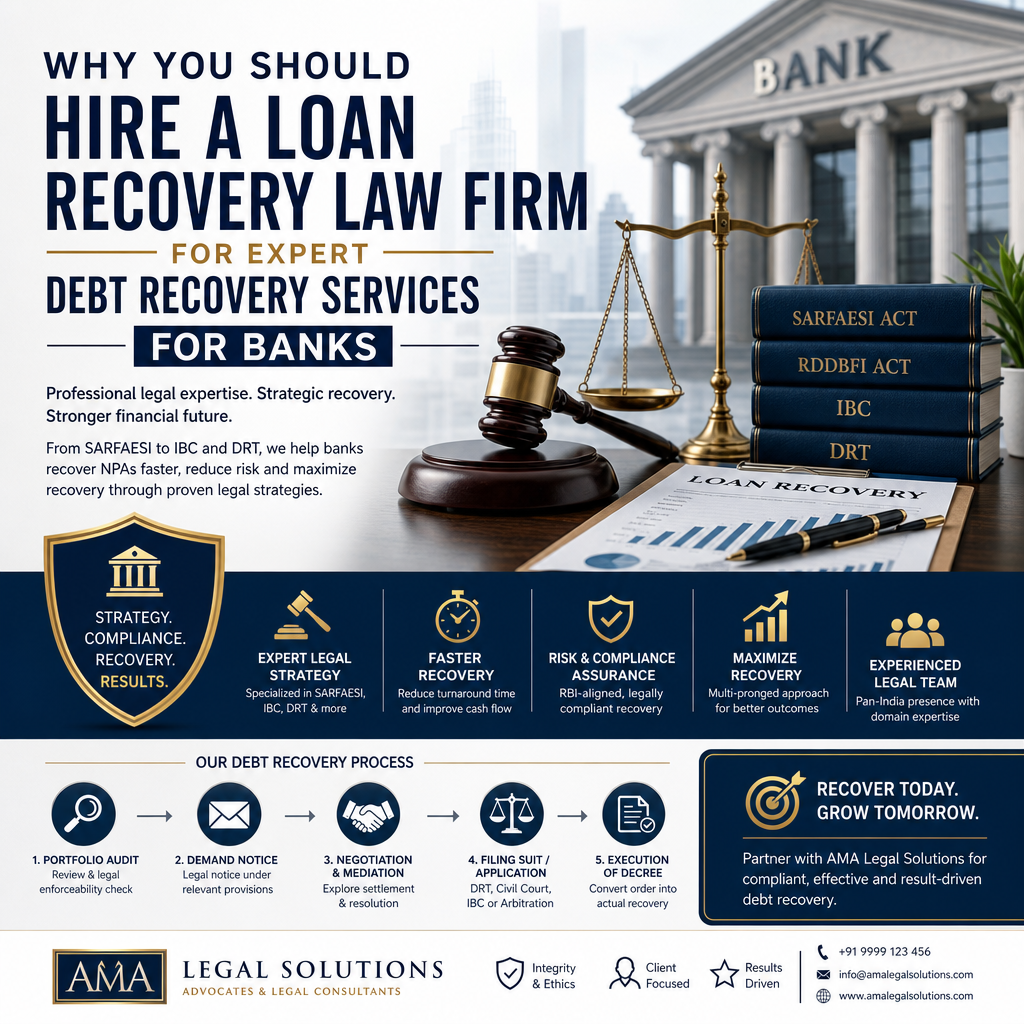
Why You Should Hire a Loan Recovery Law Firm for Expert Debt Recovery Services for Banks
The landscape of non-performing assets (NPAs) in the banking sector has undergone a massive transformation. As financial regulations tighten and borrower sophisticated increases, the traditional "one-size-fits-all" approach to collections is no longer sufficient. To maintain liquidity and protect shareholder value, financial institutions must prioritize professional debt recovery services for banks. Utilizing a specialized legal framework is not just an option; it is a strategic necessity for modern lending institutions.
When you hire a loan recovery law firm, you bridge the gap between simple collection efforts and enforceable legal outcomes. Professional legal intervention ensures that every step—from the initial demand notice to the final auction of assets—is compliant with the latest regulatory mandates. This article provides a deep dive into how specialized legal services can streamline recovery, mitigate risks, and maximize the bottom line for banking and NBFC partners.
The Strategic Importance of Professional Debt Recovery Services for Banks
Effective debt recovery is the backbone of a healthy financial ecosystem. For banks, every delayed payment impacts the Capital Adequacy Ratio (CAR) and increases the burden of provisioning. Professional debt recovery services for banks focus on high-stakes recovery that requires more than just tele-calling; they require a robust grasp of the Banking and Finance legal framework.
The Role of Legal Expertise in NPA Management
Managing NPAs involves navigating a labyrinth of statutes, including the SARFAESI Act, the RDDBFI Act, and the Insolvency and Bankruptcy Code (IBC). A dedicated law firm provides:
Asset Tracing: Identifying hidden assets through legal discovery.
Regulatory Alignment: Ensuring all recovery actions align with the latest RBI master circulars.
Speed of Execution: Reducing the "turnaround time" for litigation in Debt Recovery Tribunals (DRT).
Why Financial Institutions Hire a Loan Recovery Law Firm
Many banks maintain in-house legal teams, but the sheer volume and complexity of modern defaults often necessitate external counsel. To hire a loan recovery law firm means gaining access to a specialized workforce that lives and breathes litigation and Drafting of iron-clad recovery notices.
Specialized Expertise in SARFAESI and DRT
Specialized firms understand the nuances of Section 13(2) and 13(4) of the SARFAESI Act. They ensure that possession notices are served correctly, avoiding technical loopholes that borrowers often use to obtain "stay orders" from the DRT.
Mitigation of Reputational Risk
The RBI has become increasingly strict regarding "harassment" in recovery. A law firm acts as a professional intermediary, ensuring that the recovery process remains dignified, legal, and firm, thereby protecting the bank's brand equity.
Benefit | In-House Team | Professional Law Firm |
Scalability | Limited by headcount | High (Pan-India presence) |
Specialization | Generalist | Expert (SARFAESI/IBC/DRT) |
Tech Integration | Manual tracking | Automated case management |
Compliance | High risk of error | Low risk (Dedicated audit) |
Key Legal Avenues for Debt Recovery
When providing debt recovery services for banks, a multi-pronged legal strategy is essential. The choice of forum depends on the nature of the debt, the value of the claim, and the presence of security interest.
The SARFAESI Act, 2002
This is the most powerful tool for secured creditors. It allows banks to take possession of secured assets without the intervention of the court. However, any procedural lapse can lead to a "Securitization Application" by the borrower, stalling the process for years.
Debt Recovery Tribunals (DRT)
For debts exceeding ₹20 lakhs (as per current thresholds), the DRT provides a dedicated forum. A professional firm handles the Litigation process, ensuring that Original Applications (OA) are filed with precision and interim reliefs, such as attachment of properties, are secured early.
Insolvency and Bankruptcy Code (IBC)
For corporate debtors, the IBC has emerged as a game-changer. Filing a petition under Section 7 of the IBC can often bring a defaulting company to the Loan Settlement table due to the fear of losing management control.
Step-by-Step Guidance: The Recovery Process
If you are looking to hire a loan recovery law firm, it is important to understand the typical lifecycle of a recovery mandate.
Portfolio Audit: The firm reviews the loan documents to ensure they are legally enforceable and properly stamped.
Demand Notice: Issuance of a formal legal notice under Section 138 of the NI Act (for cheque bounce) or Section 13(2) of SARFAESI.
Negotiation & Mediation: In many cases, Arbitration or mediation is used to reach a settlement before full-blown litigation begins.
Filing Suit/Application: Depending on the debt type, filing an OA in DRT or a summary suit in Civil court.
Execution of Decree: The final and most crucial step—converting a court order into actual cash recovery through the sale of assets.

Halt Recovery Agent Harassment Legally
Navigating Complex Recovery Scenarios
Not all debts are straightforward. Some involve criminal intent or complex corporate structures.
Criminal Complaints and Fraud
In cases of willful default or diversion of funds, Criminal Law provisions can be invoked. Filing an FIR for cheating or criminal breach of trust acts as a strong deterrent.
Cyber-Related Financial Frauds
With the rise of digital banking, many defaults are linked to Cyber crimes or unauthorized transactions. Specialized legal experts can help banks navigate the recovery of funds lost to digital fraud.
Real Estate and Project Finance
Recovery in the Real Estate sector often involves RERA implications. A law firm with cross-domain expertise can manage the interests of both the bank and the project’s home buyers.
Case Study: Turning a "Loss Asset" into Recovery
Note: This is a representative example based on industry standards.
A leading private bank was struggling with a ₹50 Crore NPA in the manufacturing sector. The borrower had secured multiple stay orders from local courts. After deciding to hire a loan recovery law firm, the bank initiated a combined strategy of IBC Section 7 filing and a high-court challenge against the frivolous stay orders. Within 6 months, the borrower opted for a Corporate restructuring deal, resulting in 85% recovery of the principal.
Frequently Asked Questions (FAQs)
Q1: Why should a bank hire a loan recovery law firm instead of using an agency?
Agencies focus on persuasion; law firms focus on enforcement. A law firm can initiate Litigation and execute court decrees, which agencies cannot.
Q2: What are the primary debt recovery services for banks?
The services include SARFAESI proceedings, DRT litigation, IBC filings, Section 138 (cheque bounce) cases, and Arbitration.
Q3: How long does it take to recover a debt through DRT?
While the law stipulates a quick timeline, it usually takes 12-24 months. However, hiring an expert firm can expedite this through proactive case management.
Q4: Can banks recover money from unsecured loans?
Yes, primarily through summary suits in Civil court or through Arbitration if the loan agreement allows it.
Q5: What is the minimum amount for filing a case in DRT?
Currently, the threshold for filing a case in the Debt Recovery Tribunal is ₹20 lakhs.
Q6: Can a law firm help with Intellectual Property as collateral?
Absolutely. If the debt is secured by Intellectual Property Rights, a firm can help in valuing and transitioning those rights.
Q7: Is mediation possible in banking defaults?
Yes, many banks prefer Loan Settlement through Lok Adalats or private mediation to save time and costs.
Q8: How does the IBC benefit banks?
The IBC allows banks to initiate a time-bound resolution process, often leading to a change in management or liquidation, ensuring some level of recovery.
Q9: Do law firms handle recovery for the entertainment industry?
Yes, specialized recovery for production houses and media firms falls under Entertainment law disputes.
Q10: What is the role of a legal notice in recovery?
A legal notice is a formal warning that establishes the "cause of action." It is a mandatory precursor to most legal proceedings.
Conclusion
The complexity of modern financial defaults requires a sophisticated response. To protect the integrity of the lending process, financial institutions must leverage specialized debt recovery services for banks. By moving beyond traditional collection methods and utilizing the full force of the legal system, banks can significantly improve their recovery rates and reduce their NPA ratios.
When you hire a loan recovery law firm, you are investing in a partner that understands the high stakes of Banking and Finance law. At AMA Legal Solutions, we provide end-to-end support, from meticulous Drafting of notices to aggressive representation in the DRT and High Courts. Our goal is to ensure your institution remains financially resilient through compliant and effective recovery strategies.
Contact AMA Legal Solutions today to streamline your NPA recovery and secure your institution's financial future.
Need Strategic Legal Defense for Your Situation?
Our banking & litigation advocates review your notices, debt liability, and recovery issues under complete advocate-client secrecy.
AMA Legal Solutions
Trusted with a 4.7 Google Rating, over 10,000+ Clients Served, 25,000+ Cases Handled, and more than 40+ Years of Experience in providing strategic legal defense and debt resolution across India.
Our media coverages





Client Reviews
"Their in-depth understanding of banking law and comprehensive services have tremendously aided our recovery strategies."
Priya Desai
"Thanks to AMA Legal Solutions, our loan settlements have become much more efficient and less stressful."
Vikram Singh
"The team's strategic approach to litigation helped us recover significant amounts through legal channels. Highly recommend their services!"
Deepa Kapoor
"AMA Legal Solutions provided us with exceptional debt recovery services. Their professionalism and expertise were evident at every stage."
Raj Malhotra
"We appreciated the proactive communication and tailored solutions that AMA Legal Solutions offered us during our debt recovery process."
Arjun Kumar
Frequently Asked Questions
Related Articles
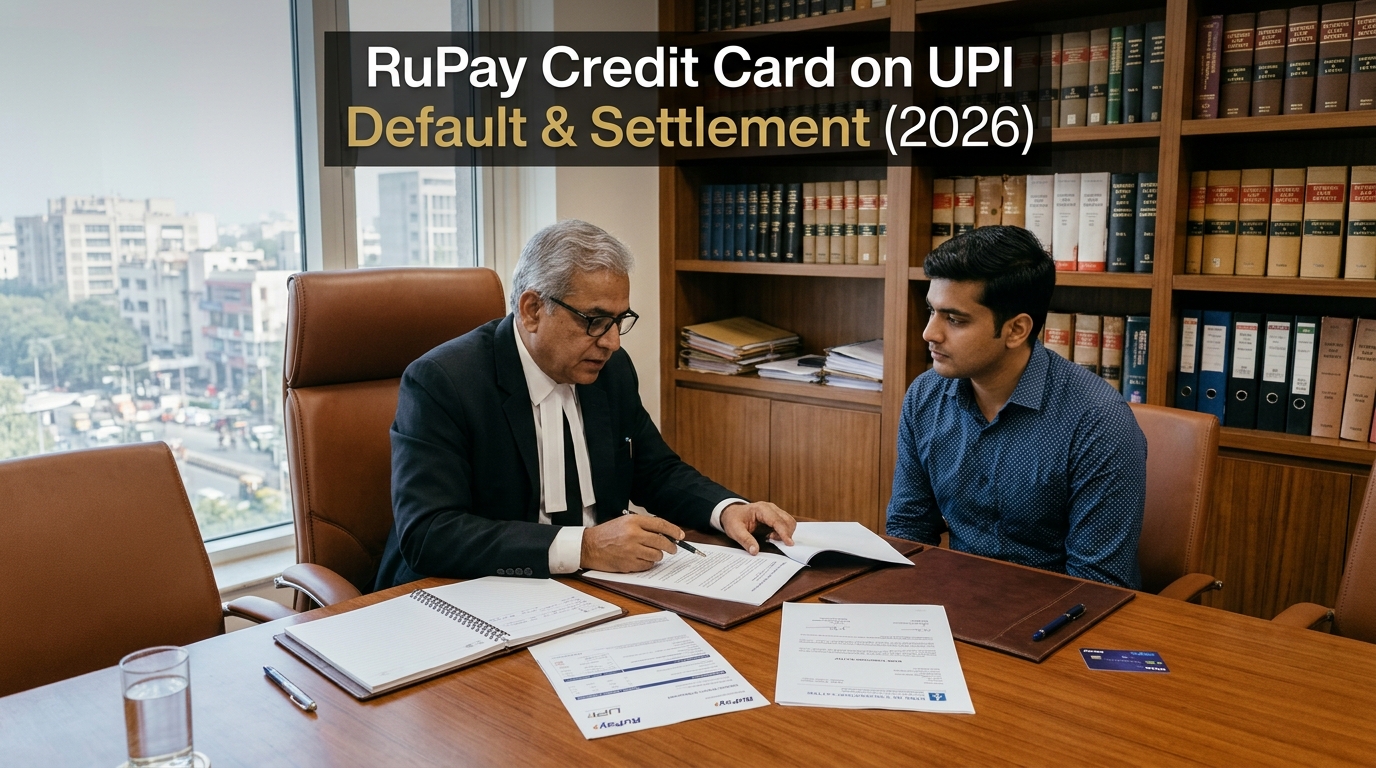
RuPay Credit Card on UPI Default & Credit Line on UPI Settlement (2026)
Micro-transactions on RuPay UPI Credit Cards and pre-approved 'Credit Lines on UPI' have triggered a massive wave of 42%+ APR revolving debt traps. Find out if defaulting blocks your personal savings UPI and how to settle RuPay UPI credit dues for 30%–50%.
Read Article
Paytm, PhonePe & BharatPe Daily EDI Merchant Loan Settlement (2026)
Drowning in Equated Daily Installment (EDI) merchant loans where 100% of your daily QR Soundbox collections are auto-swept before you can pay suppliers or rent? Learn how retail shopkeepers and MSMEs legally halt QR sweeps and negotiate a 50%+ OTS.
Read Article
Can Bank or Loan App Remotely Lock Phone for EMI Default? RBI Rules (2026)
An investigative breakdown of RBI's Remote Device Locking Directions—explaining why lenders cannot lock your phone for personal loans, the mandatory 30/60 DPD safeguards on financed devices, the Rs. 250/hour delay penalty, and how to settle device & app loans.
Read ArticleAbout Author
Anuj Anand Malik
View ProfileAnuj Anand Malik, Founder of AMA Legal Solutions, is a trusted advocate, loan settlement expert, legal advisor, and banking lawyer. With over a decade of experience in loan settlement, corporate law, financial disputes, and compliance, he leads a result-driven law firm based in India that helps individuals, startups, and businesses achieve legal and financial stability.
Connect on LinkedInNeed Legal Representation?
Evaluate your defense against recovery agents, notices, or structure your loan settlement directly with Senior Advocates.
Call +91-8700343611