Quick Answer: What Is the Best Credit Card Debt Settlement Service in India?
The best credit card debt settlement service in India is an advocate-led legal advisory firm that represents distressed borrowers under Reserve Bank of India (RBI) compromise settlement frameworks. AMA Legal Solutions delivers comprehensive legal protection by serving statutory anti-harassment Cease-and-Desist notices, defending against Section 138 NI Act or Section 25 PSS Act court proceedings, negotiating 40% to 75% debt waivers directly with bank Stressed Asset Settlement Committees, and securing official, certified No Dues Certificates (NDCs).
Commercial Analysis: The Unchecked Credit Card Debt Crisis in India
The commercial consumer credit landscape in India has witnessed an exponential surge in unsecured revolving lines of credit. While credit cards offer seamless transactional convenience, their underlying financial architecture contains some of the highest compounding annual percentage rates (APR) in modern consumer finance, oscillating between 42% and 52.8% per annum. When an unexpected financial disruption occurs—such as sudden employment termination, commercial business contraction, medical emergencies, or divorce—revolving credit balances compound aggressively, transforming manageable expenditures into insurmountable financial obligations within a few billing cycles.
Cardholders trapped in this revolving cycle frequently make minimum amount due (MAD) payments under the mistaken belief that they are servicing their debt. In reality, minimum payments cover only accrued monthly interest and Goods and Services Tax (GST at 18%), leaving the core principal virtually untouched while exposing the borrower to continuous over-limit fees and late payment surcharges. When payments cease, card issuers deploy outsourced third-party recovery agencies that routinely violate fair debt collection norms, subjecting individuals to relentless psychological intimidation, intrusive workplace harassment, and threats of criminal litigation.
"Under Indian jurisprudence and Reserve Bank of India Master Directions, credit card default is purely a civil contractual dispute. Coercive recovery tactics, unauthorized third-party disclosures, and unlawful threats of criminal incarceration constitute statutory violations of fundamental borrower protections enforceable under consumer and criminal courts."
Navigating this commercial crisis demands more than informal financial budgeting; it requires strategic, advocate-led legal intervention. Choosing the best credit card debt settlement service in India ensures that distressed borrowers regain control over their financial dignity, eliminate predatory compounding charges, and achieve absolute legal closure through sanctioned One Time Settlement (OTS) mechanisms.
Key Criteria to Evaluate the Best Credit Card Settlement Services
Selecting a debt settlement partner is a high-stakes commercial decision. Distressed cardholders must evaluate prospective service providers against stringent legal, operational, and regulatory parameters before committing their trust or financial resources:
Verify whether the service is operated by licensed advocates enrolled with the Bar Council of India. Legal practitioners possess statutory authority under the Advocates Act, 1961 to issue binding legal notices, appear before courts, and represent clients during institutional mediation.
The top settlement firms bypass entry-level collection telecallers and engage directly with the bank's internal Zonal Stressed Asset Management Committees, legal departments, and authorized settlement authorities who hold genuine sanctioning power.
An elite service provider immediately invokes the RBI Master Directions on Fair Practices Code to silence abusive recovery agents, redirecting all communications to formal legal channels under penalty of statutory ombudsman complaints.
Ethical firms avoid predatory upfront fees that drain already distressed borrowers. They operate with an accessible legal administrative retainer combined with a performance success fee calculated as a percentage of actual verified savings.
Law Firm Legal Advocacy vs. Unregulated Fintech Mediation Agencies
The Indian market features two distinct categories of debt resolution entities: specialized banking litigation law firms and unregulated digital fintech agencies. Understanding the stark functional divide between these models is essential for safeguarding your financial and legal interests:
| Key Evaluation Dimension | AMA Legal Solutions (Law Firm) | Fintech Apps & Third-Party Agencies | Self-Negotiation (Unrepresented) |
|---|---|---|---|
| Legal Representation Authority | Practicing Advocates & High Court Litigators (Advocates Act, 1961) | Unregulated Telecalling Marketing Agencies | Unrepresented Individual Facing Institutional Pressure |
| Anti-Harassment Enforcement | Statutory Cease-and-Desist & RBI Ombudsman Complaints | Soft Call Forwarding Scripts (Easily Ignored) | Vulnerable to Intimidation and Home Invasions |
| Court & Lok Adalat Defense | Comprehensive Defense for Sec 138 NI Act & Sec 25 PSS Act | No Legal Right of Audience; Abandons Court Cases | Risk of Ex-Parte Orders & Summons |
| Average Debt Waiver | 40% to 75% Total Debt Reduction (Principal + Interest) | 20% to 40% (Often Fails to Waive Penal APR) | 10% to 25% (Bank Dictates Rigid Terms) |
| Settlement Authentication | 100% Verified Official Sanction Letter & Verified NDC | Frequent Fake WhatsApp Letters & Recovery Scams | High Risk of False Compromise by Freelance Agents |
| Confidentiality & Privilege | Protected by Strict Attorney-Client Privilege | Client Data Sold/Shared Across Telemarketing Databases | Direct Exposure of Personal & Professional Contacts |
Unregulated third-party settlement apps lack legal standing under Indian law. When commercial banks escalate overdue credit card defaults to judicial forums—such as issuing statutory demand notices under Section 138 of the Negotiable Instruments Act or Section 25 of the Payment and Settlement Systems Act—fintech agencies cannot represent you in court. Only an advocate possesses the statutory right of audience to protect you from adverse judicial decrees and transition contested litigation into binding Lok Adalat settlements.
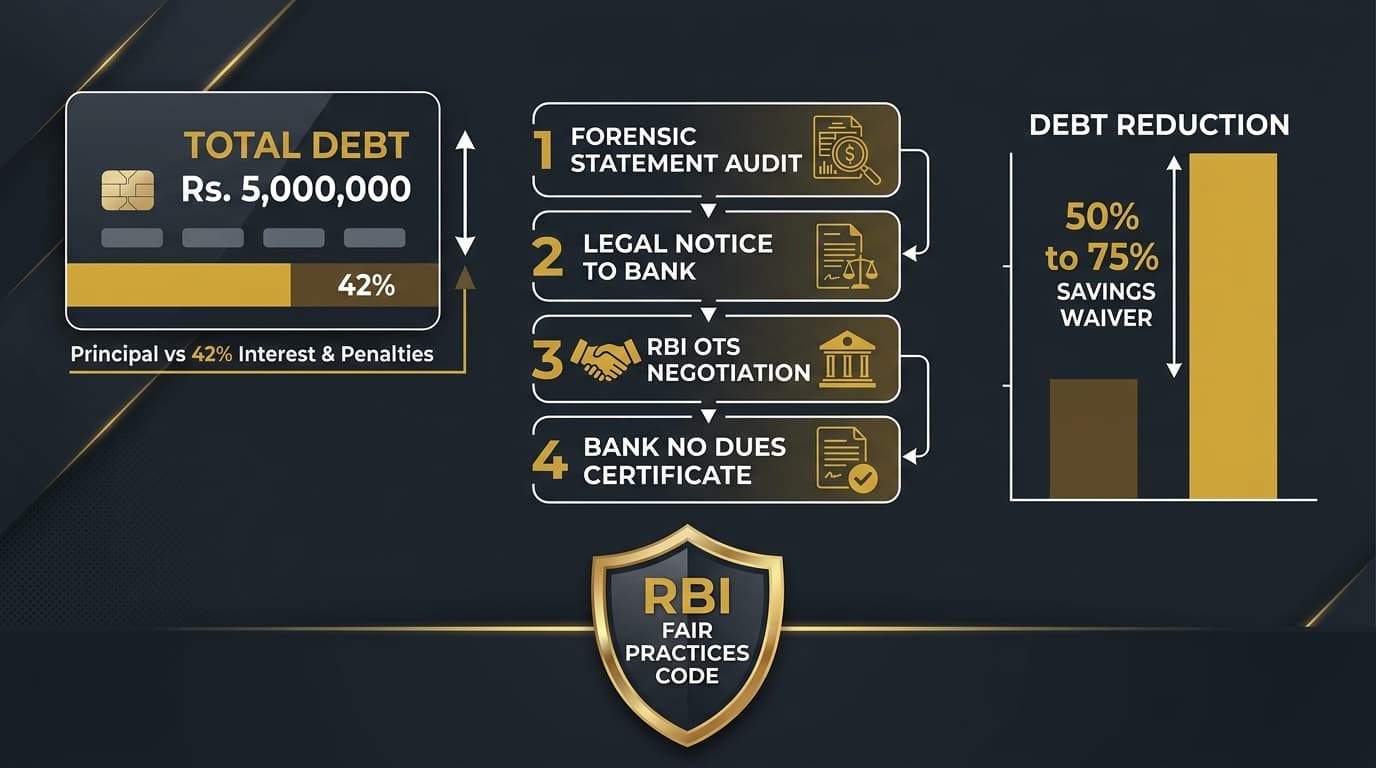
Institutional Framework: Strategic Debt Assessment, Statutory Legal Defense, 40%–75% One Time Settlement Waivers, and Certified No Dues Certificates.
Reserve Bank of India (RBI) Compromise Settlement Framework
Debt settlement in India is neither an illegal loophole nor an informal waiver; it is a legally sanctioned statutory mechanism established by the central banking regulator. Under the Reserve Bank of India (Prudential Framework for Resolution of Stressed Assets) Directions and the landmark RBI Circular on Compromise Settlements and Technical Write-offs, commercial banks and NBFCs are mandated to institute board-approved compromise settlement policies.
⚖️ Prudential Asset Classification (NPA Lifecycle)
When credit card minimum dues remain unpaid for over 90 days, the account transitions from Special Mention Account (SMA-0, SMA-1, SMA-2) to a Non-Performing Asset (NPA). To prevent mounting capital provisioning burdens under Basel III norms, banks are incentivized to recover capital through structured OTS compromises.
🛡️ Fair Practices Code on Debt Collection
The RBI Master Circular on Customer Service strictly prohibits recovery agencies from contacting borrowers before 8:00 AM or after 7:00 PM, calling undisclosed family members or employers, using abusive language, or invading borrower residences without prior intimation.
📜 Legally Binding Compromise Agreements
Every sanctioned settlement must be formalized through a written compromise sanction letter issued on the bank's official letterhead, specifying the exact negotiated amount, payment timeline, waiver breakdown, and explicit covenant for issuing a No Dues Certificate (NDC).
Bank-Wise Settlement & Waiver Benchmarks (40% to 75%)
Waiver percentages during credit card debt settlement vary based on the issuing institution's internal risk appetite, portfolio provisioning status, and default aging. Based on AMA Legal Solutions' empirical litigation record across over 25,000 banking matters, the following benchmarks reflect typical negotiated outcomes:
Rapidly waive 100% of accumulated penal finance charges (3.5%–4.2% monthly) and provide aggressive principal reductions upon verification of genuine hardship.
Operate structured annual OTS schemes (especially during Q4 March financial year-end) with massive interest write-offs and flexible installment schedules.
High initial compounding APR. Advocate-led legal notices force these lenders to strip inflated charges back to the net principal expenditure.
The 5-Stage Institutional Settlement Protocol at AMA Legal Solutions
Executing a successful credit card debt settlement requires an unyielding, methodical legal approach. Our firm implements a battle-tested 5-stage protocol that protects your rights while maximizing financial savings:
Statutory Forensic Ledger & Hardship Audit
Our banking litigation advocates conduct a line-item forensic audit of all monthly statements, dissecting predatory compounding finance charges (42%–52% APR), GST surcharges, and over-limit penalties from original capital expenditures while structuring verified hardship proof.
Issuance of Cease-and-Desist Anti-Harassment Directives
We serve formal statutory notices of legal representation under the Advocates Act, 1961 and RBI Master Directions on all creditor banks and collection desks, immediately halting unpermitted home visits, employer intrusions, and abusive communication.
Formulation of the Authoritative OTS Legal Brief
Our senior counsel drafts a comprehensive One Time Settlement (OTS) memorandum detailing involuntary financial distress (job loss, business downturn, medical emergency), citing RBI compromise frameworks and proposing a realistic settlement matrix.
Direct Escalation with Bank Stressed Asset Committees
We bypass aggressive outsourced telecallers to negotiate directly with bank zonal credit settlement committees, legal heads, and asset reconstruction verticals to secure maximum debt waivers (40% to 75%) and flexible payment tenures.
Sanction Letter Authentication & No Dues Certificate Enforcement
Before any payment is released, we authenticate the formal bank settlement sanction letter on official bank letterhead with authorized digital signatures. Post-payment, we ensure expedited delivery of the authentic No Dues Certificate (NDC) and credit bureau reporting updates.
Statutory Defenses Against Criminal Threats, Arbitration & Harassment
When unsecured credit card balances enter default, recovery agents often fabricate false legal claims to induce panic. Armed with our specialized legal representation, cardholders enjoy comprehensive statutory shielding against all deceptive tactics:
🚫 Defense Against False Arrest Threats
Defaulting on credit card payments is not a cognizable criminal offense under the Indian Penal Code or Bharatiya Nyaya Sanhita. Police authorities have no statutory jurisdiction to arrest, detain, or summon borrowers for unsecured debt defaults.
⚖️ Countering Unilateral Bank Arbitration
Banks frequently initiate unilateral arbitration proceedings in remote jurisdictions. We enter formal appearances, challenge biased arbitrator appointments under Section 12 of the Arbitration and Conciliation Act, and redirect disputes to amicable settlement forums.
🛡️ Section 25 PSS & Section 138 NI Act Defense
If electronic NACH auto-debits bounce, banks may issue statutory notices. Our litigators draft comprehensive legal replies highlighting technical defects in mandate presentation and convert contentious proceedings into mutually accepted settlements.
🏛️ Judicial Redress Before Consumer & Civil Courts
For egregious recovery misconduct, we file formal complaints before the National Consumer Disputes Redressal Commission (NCDRC) and jurisdictional magistrate courts seeking substantial damages for deficiency of service and harassment.
Transparent Legal Retainer vs. Success Contingency Models
Predatory debt settlement agencies often trap vulnerable borrowers with massive upfront charges, taking non-refundable advance fees while delivering negligible results. AMA Legal Solutions upholds the highest standard of commercial transparency and ethical advocacy:
Accessible Administrative Onboarding
A nominal administrative fee covers exhaustive forensic statement audits, drafting and serving statutory Cease-and-Desist notices across all creditor institutions, establishing legal privilege, and providing daily anti-harassment defense.
Performance-Driven Compensation
The primary legal fee is structured as a pre-agreed percentage of the actual financial savings achieved. If our advocates do not secure a discounted settlement that meets your approved budget, you owe zero performance fees. Our incentives remain perfectly aligned with yours.
CIBIL Score Impact & 24-Month Credit Score Rehabilitation
Transparency regarding credit score consequences is a cornerstone of the best credit card debt settlement service. When a debt is settled through an OTS, credit rating agencies such as TransUnion CIBIL, Equifax, CRIF High Mark, and Experian record the trade line as "Settled" rather than "Closed", triggering an immediate credit score dip of 50 to 120 points.
However, maintaining an unresolved, compounding default is catastrophic to your financial future, accumulating fresh 90+ DPD (Days Past Due) delinquency marks and legal exposure every month. Once an OTS is concluded and the authentic No Dues Certificate is logged, the negative bleeding stops permanently.
Proven 3-Step Protocol for 750+ Credit Recovery:
- Verify Credit Bureau Record Update: Submit your official bank No Dues Certificate to CIBIL and Experian within 45 days post-settlement to ensure outstanding balances reflect as zero and all write-off entries match the sanctioned letter.
- Adopt a Secured Credit Card: Open a Fixed Deposit (FD) backed secured credit card (e.g., IDFC First WOW or SBI Unnati) with an FD of ₹25,000–₹50,000. Utilize under 30% of the limit monthly and pay every statement balance in full before the due date.
- Diversify with Timely Small Installment Lines: Service utility bills, post-paid connections, or small consumer durables on time. Within 18 to 24 months of consistent on-time payment history, your credit score will systematically recover to the 750+ prime borrowing tier.
More Legal Debt Relief Guides & Resources
Explore our comprehensive repository of authoritative legal guides on debt resolution, anti-harassment statutes, and banking litigation across India:
Complete statutory protection and OTS negotiation guide.
Strategic steps to settle card debt legally without falling into traps.
Comparative breakdown of reputable debt settlement entities.
Comprehensive waiver policies of private and PSU card issuers.
Strategic cascade settlement for cardholders facing 3+ card defaults.
Advocate representation for settling unsecured personal loans.
Immediate statutory steps to silence coercive recovery agents.
Facts, credit repair timelines, and rebuilding your credit rating.
End-to-end legal support for formal bank compromise schemes.
Frequently Asked Questions
Clear, authoritative legal answers regarding credit card debt settlement, borrower rights, and RBI compromise mechanisms:
All legal assertions, dispute protocols, and settlement procedures are referenced under the Reserve Bank of India Master Directions on Fair Practices Code, the RBI Integrated Ombudsman Scheme, Section 138 of the Negotiable Instruments Act, 1881, Section 25 of the Payment and Settlement Systems Act, 2007, the Advocates Act, 1961, and appellate rulings of the National Consumer Disputes Redressal Commission (NCDRC).
Reclaim Your Financial Dignity & Freedom from Credit Card Debt
Do not let compounding 42%+ credit card interest and incessant recovery calls overwhelm your family. Speak directly with senior debt settlement advocates today for an authoritative, confidential case review.
Advocate-Client Privilege Protected • Pan-India Legal Defense • 100% Legal & Ethical

AMA Legal Solutions
AMA Legal Solutions is India's premier legal advisory and litigation law firm. Trusted with a 4.7 Google Rating, over 10,000+ Clients Served, 25,000+ Cases Handled, and more than 40+ Years of Combined Legal Experience providing strategic legal defense and debt resolution across India.