Loan Recovery Agent Harassment in India: RBI Guidelines, Borrower Rights and Legal Options
Finding Your Rights and Remedies Against Loan Recovery Agent Harassment

Anuj Anand Malik
Reviewed by AMA Legal Solutions
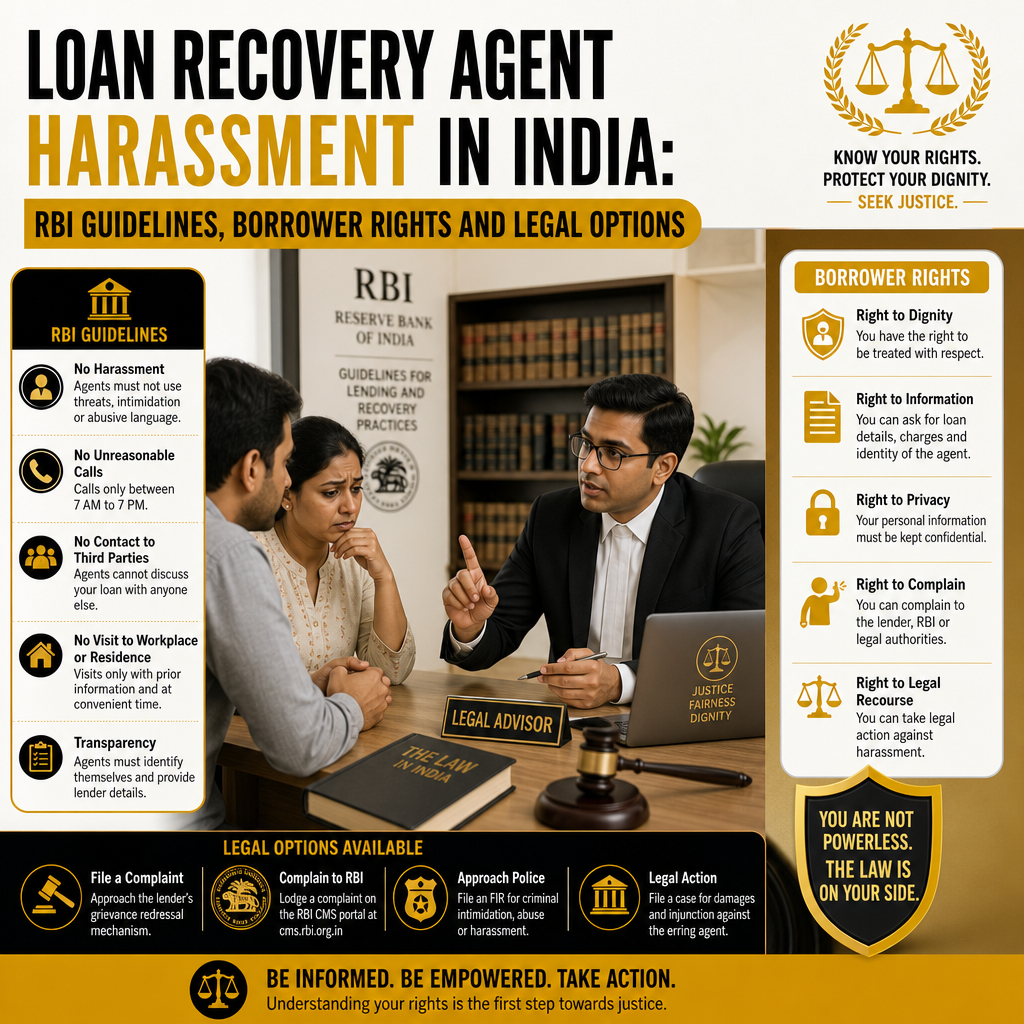
Key Takeaways: In instances of loan recovery agent harassment in India, borrowers possess rights that are protected by the RBI’s guidelines. Lenders and their agents must not engage in intimidation or harassment, particularly outside stipulated communication hours. For victims of harassment, documenting interactions, utilizing grievance mechanisms, and seeking legal counsel are essential steps to safeguard their rights.
Loan Recovery Agent Harassment in India: RBI Guidelines, Borrower Rights and Legal Options
Missing a loan EMI can be stressful.
But for many borrowers, the financial difficulty is only one part of the problem.
Repeated phone calls, messages, visits, communication with family members, or aggressive recovery tactics can make an already difficult financial situation even more stressful.
If you are dealing with loan recovery agent harassment in India, it is important to understand that borrowers have rights and that lenders and their authorized recovery agents are required to follow applicable regulatory requirements.
The Reserve Bank of India has issued instructions concerning the conduct of regulated entities and recovery agents during debt collection. Among other things, regulated entities and their agents must not resort to intimidation or harassment.
AMA Legal Solutions assists borrowers with legal consultation and debt-related matters, including recovery disputes, legal notices, lender communication, and eligible loan settlement matters.
What Is Loan Recovery Agent Harassment?
Recovery activity itself is not necessarily unlawful.
Lenders have the right to seek repayment of legitimate outstanding dues.
However, the manner in which recovery is conducted matters.
Harassment can involve conduct such as:
Threatening communication
Abusive language
Repeated inappropriate calls
Threatening or anonymous calls
Inappropriate messages
Public humiliation
Intrusion into the privacy of family members
False or misleading statements
Persistent calls at prohibited times
The RBI has specifically instructed regulated entities and their recovery agents not to engage in intimidation or harassment and has addressed inappropriate recovery calls and communications.
What Does RBI Say About Recovery Agents?
RBI's instructions place responsibility on regulated entities for the conduct of their recovery agents.
The RBI has stated that regulated entities should ensure that recovery agents do not resort to intimidation or harassment, including verbal or physical conduct, public humiliation, intrusion into the privacy of family members, inappropriate messages, threatening or anonymous calls, and persistent calls.
The RBI has also specified that recovery calls should not be made before 8:00 a.m. or after 7:00 p.m. under the 2022 instructions applicable to the relevant regulated entities.
This does not mean that a borrower does not have to repay a legitimate debt.
It means that debt recovery must be conducted in accordance with applicable rules.
What Should You Do If a Recovery Agent Is Harassing You?
The first step is to remain calm and document everything.
1. Keep Records of Calls
Maintain records of:
Date
Time
Phone number
Name of caller
Organization represented
Nature of conversation
Where legally appropriate, preserve relevant evidence.
2. Save Messages
Do not delete threatening or inappropriate WhatsApp messages, SMS messages, emails, or other communications.
These may become important if a complaint or legal proceeding becomes necessary.
3. Ask for Identification
You can ask the caller to identify:
Their name
The lender they represent
Their agency, where applicable
Reference/account details
Do not provide sensitive information to an unknown caller without verifying who they represent.
4. Communicate in Writing
Where possible, written communication can make it easier to maintain a clear record of the issue.
You can communicate your financial situation and request appropriate communication from the lender.
5. Use the Lender's Grievance Mechanism
Raise the issue with the lender through its official grievance mechanism.
Keep copies of your complaint and any response received.
6. Seek Legal Assistance Where Necessary
If the conduct involves threats, intimidation, unlawful disclosure of information, or other serious issues, legal advice may be appropriate.
AMA Legal Solutions can assess the circumstances and advise on available legal options.
Can Recovery Agents Contact Your Family?
RBI instructions specifically address conduct involving the privacy of debtors' family members, referees, and friends.
Regulated entities and their recovery agents should not engage in conduct that humiliates the borrower publicly or intrudes upon the privacy of family members, referees, and friends.
The specific circumstances matter.
If someone is contacting people connected to you in a manner that appears threatening, humiliating, or invasive, document the communication and seek appropriate guidance.
Can Recovery Agents Threaten Borrowers?
Threatening or intimidating borrowers is not an acceptable debt-recovery practice.
The RBI's instructions expressly address intimidation and harassment in recovery efforts.
However, this does not mean that a lender cannot communicate the legitimate consequences of non-payment.
There is an important distinction between informing a borrower about legitimate legal or financial consequences and using threats, intimidation, or false statements.
What If You Cannot Pay the Loan?
If you genuinely cannot afford your outstanding loan, ignoring calls may not resolve the underlying debt.
Instead, consider understanding your available options.
Depending on your circumstances, these may include:
Continuing repayment
Discussing repayment arrangements with the lender
Exploring restructuring where available
Negotiating outstanding dues
Exploring loan settlement where appropriate
Seeking legal assistance
The appropriate option depends on your financial position and the nature of the loan.
Key Insights & Data Infographic
Visual summary, statistical trends & procedural breakdown
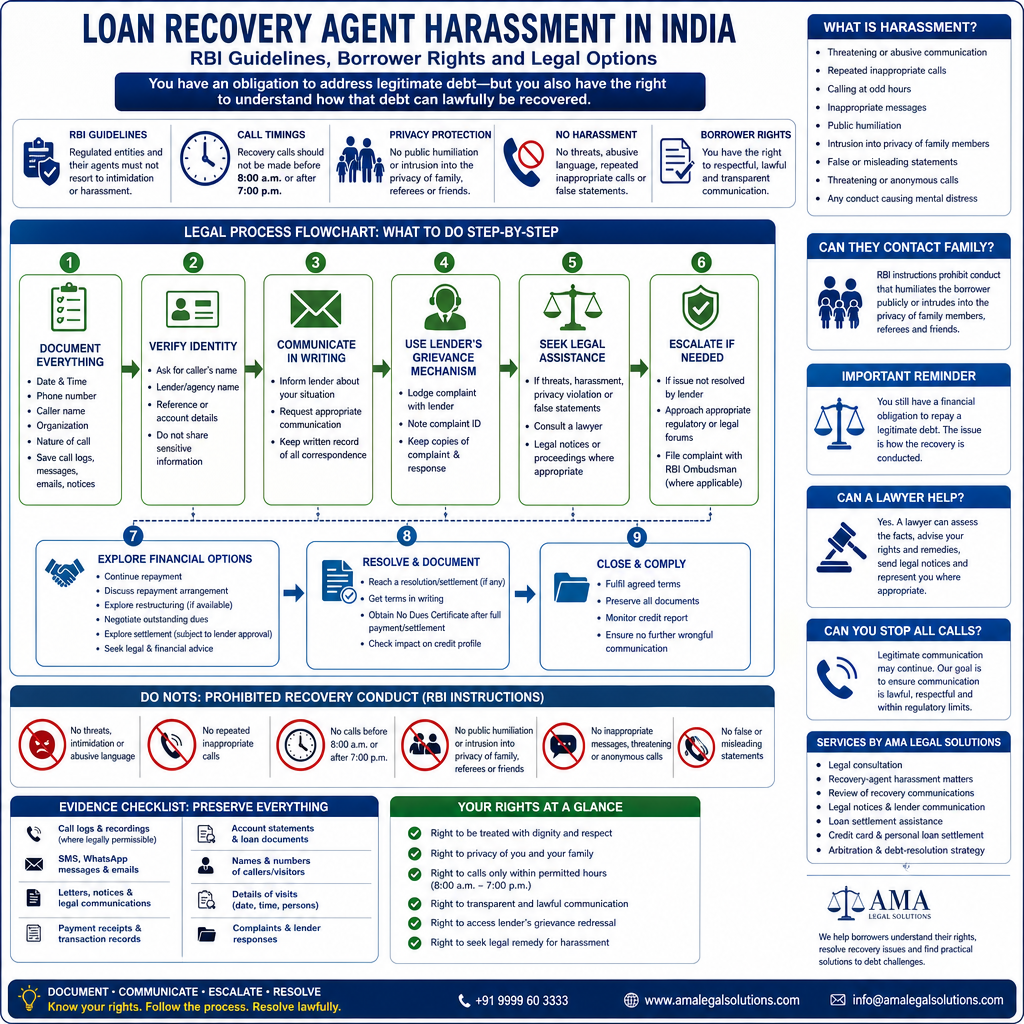
Prepared by AMA Legal Solutions Research & Analytics Team • Data & Compliance Overview

Halt Recovery Agent Harassment Legally
Loan Settlement and Recovery Harassment
For borrowers who cannot repay the entire outstanding amount, settlement may be one option worth exploring.
Loan settlement involves reaching an agreement with the lender regarding an amount that will resolve the outstanding dues.
Settlement requires lender approval.
It is also important to understand that settlement can have implications for the borrower's credit profile.
Therefore, borrowers should not choose settlement simply because they are receiving recovery calls.
The decision should be based on the overall financial situation.
How AMA Legal Solutions Can Help With Recovery Matters
Debt-related matters can involve both legal and financial considerations.
AMA Legal Solutions can assist borrowers with:
Legal consultation
Recovery-agent harassment matters
Review of recovery communications
Legal notices
Lender communication
Loan settlement assistance
Credit-card settlement
Personal loan settlement
Arbitration-related matters
Debt-resolution strategy
Our approach is to understand the facts before determining what legal or practical steps may be appropriate.
What Evidence Should You Preserve?
If you believe recovery practices are inappropriate, preserve as much relevant information as possible.
This may include:
Call logs
Messages
Emails
Letters
Notices
Payment records
Account statements
Names and numbers of callers
Details of visits
Written complaints
Responses from the lender
Good documentation can make it easier to explain the issue accurately.
Can You Stop Recovery Calls Completely?
A borrower should not assume that engaging a lawyer or debt-resolution professional automatically means every communication will stop.
The lender may continue legitimate communication concerning outstanding dues.
However, if the manner or timing of recovery communication violates applicable requirements, borrowers can raise the issue through appropriate grievance and legal channels.
The objective should be to move the communication toward a lawful and structured process while addressing the underlying debt.
Important: You Still Have a Financial Obligation
Understanding your rights does not eliminate a legitimate loan obligation.
If you have borrowed money and outstanding dues remain payable, the lender may have lawful remedies for recovery.
The issue is how those remedies are exercised.
Borrowers should therefore avoid two extremes:
Ignoring legitimate debt completely.
Accepting unlawful or inappropriate recovery conduct simply because money is owed.
A structured approach is usually more useful.
Final Thoughts
Dealing with overdue loans is difficult enough without unnecessary intimidation or harassment.
If you are facing loan recovery agent harassment in India, start by documenting the conduct, communicating with the lender through appropriate channels, and understanding your rights.
If you are also struggling to repay the underlying debt, explore the financial options available to you.
Depending on your circumstances, repayment, restructuring, negotiation, or settlement may need to be considered.
AMA Legal Solutions assists borrowers with legal consultation, recovery-related matters, lender communication, and eligible loan settlement and debt-resolution matters.
You have an obligation to address legitimate debt—but you also have the right to understand how that debt can lawfully be recovered.
Frequently Asked Questions
1. Can loan recovery agents harass borrowers?
Recovery agents must follow applicable regulatory requirements. RBI instructions prohibit regulated entities and their agents from intimidation and harassment during debt collection.
2. Can recovery agents call before 8 a.m. or after 7 p.m.?
The RBI's 2022 instructions state that regulated entities and their recovery agents should not call borrowers before 8:00 a.m. or after 7:00 p.m. for recovery of overdue loans, subject to the scope of the applicable instructions.
3. Can recovery agents contact my family?
RBI instructions prohibit conduct involving public humiliation or intrusion into the privacy of debtors' family members, referees, and friends.
4. What should I do if a recovery agent threatens me?
Preserve the evidence, verify the identity of the caller, raise the matter with the lender through its grievance mechanism, and seek legal advice where appropriate.
5. Can I complain about a recovery agent?
Yes. Depending on the circumstances and the regulated entity involved, you can use the lender's grievance mechanism and, where applicable, appropriate regulatory or legal channels.
6. Can a lawyer help with recovery-agent harassment?
A lawyer can assess the facts, advise you regarding applicable rights and remedies, and assist with appropriate legal communication or proceedings where warranted.
7. Can I settle my loan if recovery agents are calling me?
Potentially. Recovery communication and loan settlement are separate issues. If you are unable to repay your outstanding debt, settlement may be one option to explore subject to lender approval and your circumstances.
8. Does hiring a lawyer cancel my loan?
No. Legal assistance does not cancel a legitimate financial obligation. It can help you understand your rights, obligations, and available legal or financial options.
Need Strategic Legal Defense for Your Situation?
Our banking & litigation advocates review your notices, debt liability, and recovery issues under complete advocate-client secrecy.

AMA Legal Solutions
Trusted with a 4.7 Google Rating, over 10,000+ Clients Served, 25,000+ Cases Handled, and more than 40+ Years of Experience in providing strategic legal defense and debt resolution across India.
Our media coverages





Frequently Asked Questions
Related Articles
Will Drafting Services for NRI: How Global Indians Can Protect Indian Assets from Abroad (2026)
A comprehensive legal guide on modern Will drafting services for Non-Resident Indians (NRIs) and OCIs managing real estate, bank accounts, and investments across India.
Read Article
Will Drafting Services for Indians Living Abroad (NRIs & OCIs): The Complete Cross-Border Legal Guide (2026)
How Non-Resident Indians can protect their Indian real estate, NRE/NRO accounts, and Demat investments without flying to India or risking multi-year probate disputes.
Read Article
Online Will Drafting in India: The Complete Legal Guide to Estate Planning (2026)
Protect your family's legacy, prevent bitter inheritance disputes, and discover how to create a legally binding, court-ready Will online under the Indian Succession Act, 1925.
Read ArticleAbout Author
Anuj Anand Malik
View ProfileAnuj Anand Malik, Founder of AMA Legal Solutions, is a trusted advocate, loan settlement expert, legal advisor, and banking lawyer. With over a decade of experience in loan settlement, corporate law, financial disputes, and compliance, he leads a result-driven law firm based in India that helps individuals, startups, and businesses achieve legal and financial stability.
Connect on LinkedInNeed Legal Representation?
Evaluate your defense against recovery agents, notices, or structure your loan settlement directly with Senior Advocates.
Call +91-8700343611